 by Tom Gurney
Tom Gurney BSc (Hons) is an art history expert with over 20 years experience
Published on June 19, 2020 / Updated on October 2, 2026
Email: tomgurney1@gmail.com / Phone: +44 7429 011000
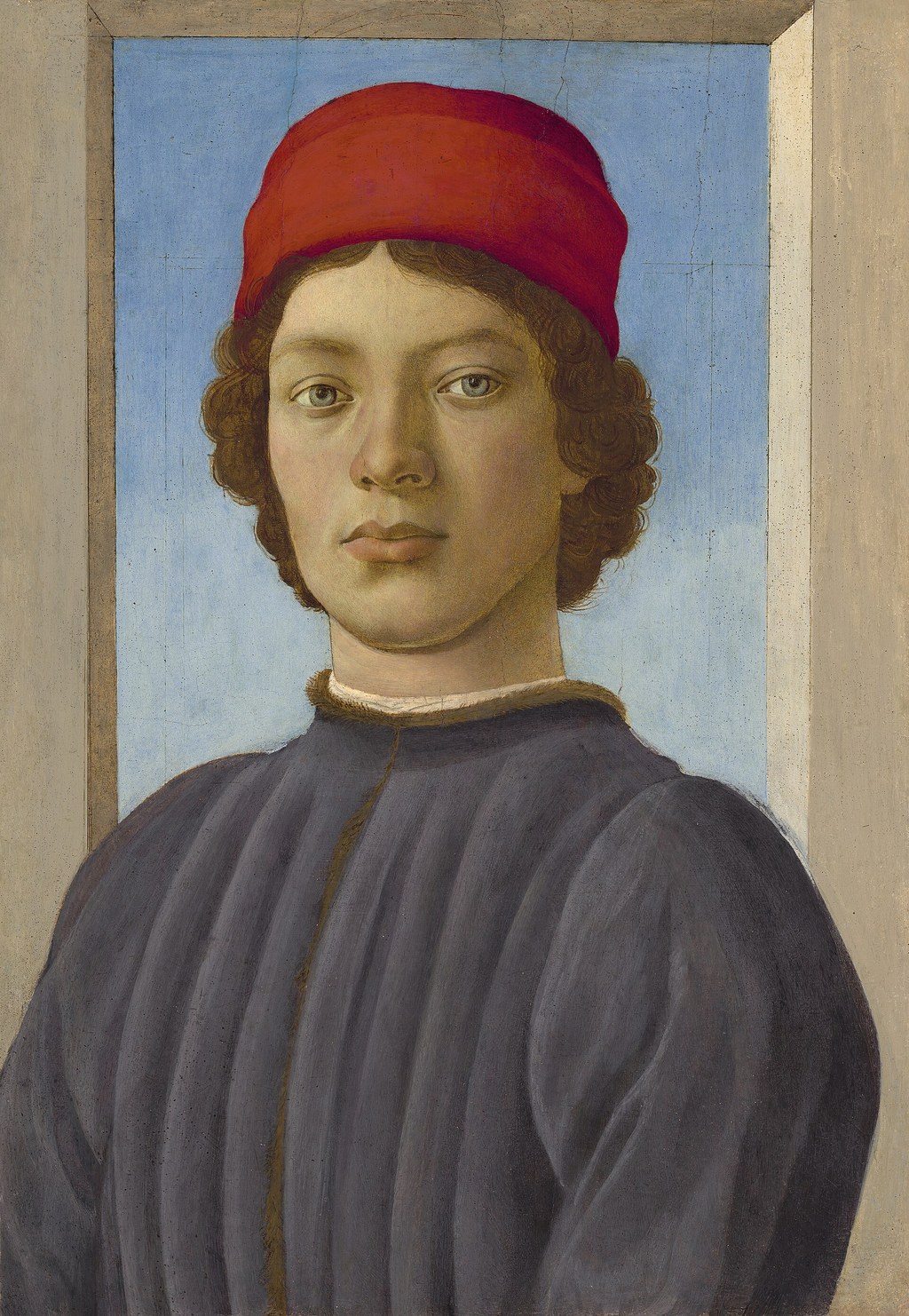
Portrait of a Youth by Filippino Lippi
Filippino Lippi’s Portrait of a Youth, painted around 1485 and now in the National Gallery of Art in Washington, is one of the most direct and restrained images in his surviving catalogue. A young man appears against a pale stone window opening onto blue sky. He wears a crimson cap and a blue-grey, fur-lined garment and looks almost directly towards the viewer.[1]
There is no narrative action. No saintly attribute identifies him. No elaborate landscape distracts attention.
The painting depends upon face, clothing, pose and the psychological effect of being looked at by an unknown person from fifteenth-century Florence. The NGA dates the work to around 1485 and identifies the medium as oil and tempera on panel. It measures 52.1 by 36.5 centimetres.[1] Its attribution history is particularly instructive. For decades, scholars repeatedly connected the portrait with Botticelli. Publications of the 1930s and later catalogues variously called it Botticelli, a work from his school or a picture by the “Amico di Sandro”.
That uncertainty makes the panel exceptionally useful for understanding Filippino’s relationship with his former master. Around 1485 Filippino was already an independent painter responsible for major work in the Brancacci Chapel and important commissions. Yet the shared workshop vocabulary remained strong enough to confuse later connoisseurs. The portrait therefore demonstrates both continuity and independence.
At a Glance
- ArtistFilippino Lippi
- TitlePortrait of a Youth
- Datec. 1485
- MediumOil and tempera on panel
- Dimensions52.1 × 36.5 cm
- Current locationNational Gallery of Art, Washington
- Accession number1937.1.20
- Credit lineAndrew W. Mellon Collection
- Sitterunidentified young man
- Distinctive featurescrimson cap, blue-grey fur-lined garment, stone opening, vivid blue sky
- Attribution historyrepeatedly associated with Botticelli and his school
- Career significancemature pre-Roman portrait demonstrating Filippino’s independence within Botticellian visual culture
Contents
- The Unknown Sitter
- The Crimson Cap
- Oil and Tempera
- Filippino versus Botticelli
- Provenance: Stefano Bardini
- Portraiture and Social Presence
- The Window as Portrait Device
- The Psychology Problem
- Liechtenstein Taste
- Why the Portrait Matters
- Frequently Asked Questions
- References
The Unknown Sitter
The young man’s identity is not securely known. This absence changes the way modern viewers experience the painting. A named sitter comes with biography, family and social history.
An anonymous sitter must be understood through appearance. Clothing suggests status. Youth shapes expression.
The architectural opening suggests elite portrait convention. But interpretation stops where evidence stops. The anonymity also creates a peculiar intimacy. The man looks present while remaining historically inaccessible.
Portraiture in Fifteenth-Century Florence. Florentine portraiture changed substantially during Filippino’s lifetime. Earlier profile portraits often presented sitters with almost heraldic clarity. By the later fifteenth century, three-quarter and more frontal poses created greater psychological engagement.[1]
Filippino’s youth turns slightly while looking towards us. This produces a sense of encounter. The sitter is no longer merely an emblematic silhouette. He occupies shared space with the viewer.
The Face. The NGA describes wide-set pale blue eyes, smooth skin, rounded nose, broad jaw and full light-pink lips.[1] These details matter because the portrait is built through specificity. The sitter is not idealised into generic beauty.
His features are carefully differentiated. The face remains calm. There is no broad smile or dramatic expression. Psychology emerges through restraint.
The Gaze. The gaze is the painting’s strongest source of immediacy. The sitter looks outward rather than remaining absorbed within his own world. This establishes a relationship across the picture plane.
Modern viewers often read such gazes psychologically, but certainty is impossible. We cannot know whether Filippino intended confidence, reserve, curiosity or simply attentive presence. The power lies precisely in that ambiguity.
The Crimson Cap
The brimless red cap creates the strongest colour accent. It frames the sitter’s brown curls and helps separate the head from the blue sky. Clothing in Renaissance portraiture could communicate age, status and fashion. Even where the sitter is unknown, dress gives historical identity. The cap places him within a specific social world rather than timeless portrait convention.
The Fur-Lined Garment. The blue-grey jacket appears to be lined with brown fur. Its high neck and pleated chest suggest costly clothing. The garment contributes to the sitter’s social presentation.
Portraits did not merely record faces. They represented how people wished to appear publicly. Fabric, colour and tailoring could communicate wealth and refinement without explicit heraldry.
The Stone Window. The pale architectural opening creates a frame within the painted frame. This device isolates the sitter from the blue sky while giving the portrait spatial depth. The edges of the opening run parallel to the panel itself.
Architecture therefore stabilises the image. The young man appears at a threshold between interior and exterior. That threshold enhances the sense that he might step into the viewer’s world.
Blue Sky. The vivid sky gives the portrait unusual freshness. Rather than a dark neutral background, Filippino creates open atmosphere. This makes the face and crimson cap especially luminous.
The simplicity is striking compared with his more narrative works. Here Filippino does not need distant towns, saints or antique fragments. Sky alone is enough.
Oil and Tempera
The NGA identifies oil and tempera on panel.[1] This mixed technique was increasingly common in late-fifteenth-century Florence. Oil allowed softer modelling and richer transitions.
Tempera retained precision. Portraiture benefited from such flexibility because skin, hair, fabric and fur required different effects. The result is materially more subtle than a purely linear drawing translated into paint.
Around 1485. The date places the portrait at a particularly interesting point. Filippino had moved beyond his earliest Botticellian workshop period. He had been involved with the Brancacci Chapel.
He was producing major independent panels. Rome still lay several years ahead. The portrait therefore belongs to the same broad phase as the Vision of Saint Bernard, the Met Madonna and Child and the Rucellai altarpiece.[3] Yet its visual restraint demonstrates that Filippino’s pre-Roman style was not uniformly complex.
Attribution to Botticelli. The NGA bibliography records repeated historical attributions to Botticelli.[1] This is not surprising. Filippino had trained with Botticelli after Fra Filippo’s death.
Figure types, contour and workshop habits overlapped. Later scholars trying to separate individual hands often worked without the documentary or technical resources available today. Attribution uncertainty therefore reflects genuine historical closeness.
“Amico di Sandro”. At one stage the painting was assigned to the so-called “Amico di Sandro”, literally “friend of Sandro”. Such provisional names were used when scholars recognised a coherent artistic personality close to Botticelli but could not identify it securely. The history of this label reveals how connoisseurship develops. A group of works can first be separated stylistically and only later connected with a known artist. Filippino’s early and middle career repeatedly created exactly this problem.
Filippino versus Botticelli
The point of comparison should not be to prove that every feature is unlike Botticelli. Shared language is expected. More useful is the portrait’s place within Filippino’s own development.
The quiet directness of the sitter resembles the observational sensitivity visible in his fresco portraits. His figures often possess individualised faces even within crowds. The portrait isolates that capacity and makes it the entire subject.
Portraits inside Frescoes. Filippino inserted contemporary likenesses into major narrative cycles, including the Brancacci Chapel. Those figures demonstrate his interest in individual physiognomy. The Washington portrait can therefore be understood as part of a broader practice rather than an isolated experiment. Sacred history and autonomous portraiture draw upon the same skill: making one face distinct from another.
A Young Man’s Identity. The sitter’s youth is important. Renaissance portraits could commemorate marriage, family status, office or transition into adulthood. Without documentation, one should not assign a specific occasion. The safest reading is that the portrait records a young man of sufficient status to commission or receive a painted likeness. His clothes and presentation suggest social aspiration even if his name is lost.
Individuality and Dynasty. Many Florentine portraits served family memory. A likeness could preserve one person within a lineage. Even without visible heraldry, the object may once have been understood through household knowledge.
Modern anonymity therefore results partly from loss of context. The first owners likely knew exactly who he was. What feels mysterious today may originally have been obvious.
Provenance: Stefano Bardini
By the later nineteenth century the portrait was associated with Stefano Bardini, the influential Florentine dealer and collector. Bardini played a major role in the international trade in Italian Renaissance objects. His involvement places the panel within the period when Florentine works moved increasingly into northern European and American collections. The portrait’s modern life therefore mirrors the dispersal of many Renaissance domestic objects.
Liechtenstein Collection. Prince Johann II von Liechtenstein acquired the painting in 1890. It remained within the princely collection before moving again through the art market. This stage reflects the strong late-nineteenth-century appetite for Italian Renaissance painting among European aristocratic collectors. Works once tied to Florentine households acquired new identities as Old Master treasures.
Andrew Mellon. The portrait eventually entered the collection of Andrew W. Mellon. Mellon became one of the foundational donors of the National Gallery of Art.[1] His collection helped shape the museum’s early European holdings. The painting therefore passed from Florentine private portrait to European aristocratic collection to American national museum.
Museum Context. Today the sitter is encountered as “Filippino Lippi” before he is encountered as himself. The museum label foregrounds the artist because the subject’s identity is lost. This reverses the probable original hierarchy. For the first owner, the person may have mattered more than the painter’s name. Modern art history changes what an object is for.
Portraiture and Social Presence
A Renaissance portrait did more than preserve physical appearance. It established social presence. Clothes, pose and setting communicated how the sitter belonged within the world.
The youth’s direct gaze makes this especially clear. He is not represented working, praying or performing an office. His presence itself is the subject. The painting therefore asks the viewer to attend to identity before narrative.
Why Youth Matters. Youth portraits could mark important transitions. Marriage, inheritance, entry into public life or simple dynastic commemoration might justify a likeness. The sitter’s exact occasion is unknown, so none of these possibilities should be asserted.
What is secure is that his age mattered enough to be recorded. The smooth face, fashionable cap and carefully groomed curls construct a particular stage of life. The portrait preserves not merely a person but youth itself.
Fashion as Historical Evidence. The crimson cap and fur-lined jacket locate the sitter socially and chronologically. Fashion changes quickly. Portrait clothing therefore helps historians understand status and date.
The garments also affect personality. The vivid cap gives confidence and visual energy. The muted jacket produces restraint. Filippino balances display and sobriety. The sitter looks fashionable without appearing theatrical.
Fur and Wealth. Fur was costly and status-bearing. Its inclusion does not prove extraordinary aristocratic rank, but it suggests a household with resources. Portraiture often allowed such material cues to operate quietly.
A sitter did not need to hold coins or display a palace. Fabric could communicate social position more elegantly. The brown lining therefore belongs to the portrait’s language of respectability.
The Window as Portrait Device
The stone opening creates an architectural frame around the sitter. This device was useful because it separated the body from background while maintaining spatial realism. The window also creates ambiguity.
Is the sitter inside looking out? Is he standing at an opening? Is the architecture simply a pictorial structure? Filippino does not need to resolve the question. The threshold makes the portrait feel more immediate.
Sky and Psychological Effect. The blue sky has no iconographic programme. Its value is emotional and visual. It gives air around the head.
It brightens the face. It prevents the portrait from feeling enclosed. The result is remarkably modern in its simplicity. Filippino’s later works can overwhelm through detail. Here absence of detail becomes a strength.
Comparison with Botticelli Portraits. Botticelli painted several famous portraits of young men. Those works provide the obvious workshop comparison. Both artists could use simple backgrounds, elegant dress and sharply defined faces.
The problem for connoisseurs is therefore genuine. Filippino learned the portrait language from an environment in which Botticelli already excelled. Independence emerged gradually.
Comparison with Filippino’s Fresco Faces. In the Brancacci and later chapel cycles, Filippino populated crowds with distinctive faces. Some may be portraits. Others are highly individualised types.
The Washington panel shows the same observational skill isolated from narrative. This helps explain why his crowds rarely feel anonymous. Portrait practice trained the eye to notice difference.
The Psychology Problem
Art historians often describe Renaissance portraits using psychological language. A sitter looks proud, anxious, melancholy or intelligent. Such descriptions can become overconfident.
The portrait records appearance, but not thoughts. Filippino’s youth looks directly at us, yet his inner state remains inaccessible. The most responsible interpretation acknowledges the effect of presence without pretending to know personality.
Likeness and Idealisation. Portraits balance recognition with social presentation. A patron wanted to be identifiable but not necessarily depicted with brutal neutrality. Filippino likely adjusted appearance through artistic convention.
Skin is smooth. Clothing is ordered. The pose is controlled. The result probably lies between observed likeness and ideal social image. That balance is fundamental to Renaissance portraiture.
Lost Context. The painting’s original location is unknown. This loss limits interpretation. If it hung among family portraits, it functioned dynastically.
If it marked marriage negotiations or adulthood, its meaning would be more specific. Without documentation, those possibilities remain open. The lack of context should be treated as evidence of historical loss rather than an invitation to invent narrative.
Bardini and the International Art Market. Stefano Bardini’s involvement gives the portrait an important modern chapter. Florence in the late nineteenth century became a major centre for the sale of Renaissance art to foreign collectors. Dealers removed objects from old family contexts and repositioned them within the international market. Bardini was one of the most important figures in that transformation. The portrait’s move through his hands reflects the broader dispersal of Italian heritage.
Liechtenstein Taste
Prince Johann II’s purchase shows how Renaissance portraiture appealed to aristocratic collectors beyond Italy. An anonymous Florentine youth could acquire prestige because of artistic authorship and period rather than known identity. This is a major shift in value.
The original sitter mattered as person. The later collector valued “Botticelli” or “Filippino” as master. Art-market history reverses the logic of portraiture.
Attribution and Market Value. The Botticelli attribution would also have affected market prestige. Botticelli’s modern reputation grew dramatically during the nineteenth and twentieth centuries. A portrait assigned to him could carry different cultural and financial weight from one assigned to a lesser-known follower. Attribution debates therefore have economic consequences as well as scholarly ones. The Washington panel’s history sits at the intersection of connoisseurship and collecting.
Mellon and the National Gallery. Andrew Mellon’s acquisition placed the painting within the formation of a major American public collection. Mellon’s gifts created the foundation of the National Gallery of Art.[1] This changed the portrait’s audience again.
Private possession became public education. The unknown youth now belongs to a national museum thousands of kilometres from Florence. His personal identity is lost, but his visual presence has become globally accessible.
Why Attribution History Matters. The long Botticelli debate should be retained prominently because it teaches visitors something important about Renaissance authorship. Workshops blur modern categories. Master and pupil share drawings, types and techniques.
Later scholarship has to reconstruct distinctions from objects, documents and stylistic evidence. The uncertainty is not failure. It is a clue to how art was actually made.
Why the Portrait Matters
The portrait matters because it strips Filippino’s art down to one face. There is no complex iconography to decode. The viewer confronts an individual.
That makes the painting an important counterweight to the crowded Carafa and Strozzi chapels. It also provides unusually clear evidence for Filippino’s Botticellian inheritance. The repeated historical misattributions show how deeply workshop training shaped his early visual language.
At the same time, the work belongs securely within the mature pre-Roman career. Its quietness demonstrates range. Filippino could build elaborate sacred worlds, but he could also sustain attention through a crimson cap, pale architecture, blue sky and one anonymous gaze.
Frequently Asked Questions
Discussion
What stands out to you most about Portrait of a Youth in relation to Filippino Lippi's wider career?
Reader Insights
Notice how the page connects close visual detail with patronage, workshop practice and the wider Renaissance setting.
Which comparison elsewhere in the cluster helps clarify this work or theme most strongly?
Join the Conversation
Have a thought or observation about Portrait of a Youth? Share it below. Thoughtful responses may be added to this section.
References
- National Gallery of Art, Washington, Filippino Lippi, Portrait of a Youth, 1937.1.20. View Source
- National Gallery of Art, provenance and bibliography for Portrait of a Youth.
- Metropolitan Museum of Art, The Drawings of Filippino Lippi and His Circle, 1997. View Source
- National Gallery, London, Filippino Lippi artist biography and early Botticelli workshop context. View Source