 by Tom Gurney
Tom Gurney BSc (Hons) is an art history expert with over 20 years experience
Published on November 18, 2026 / Updated on November 18, 2026
Email: tomgurney1@gmail.com / Phone: +44 7429 011000
Bust of Scipione Borghese
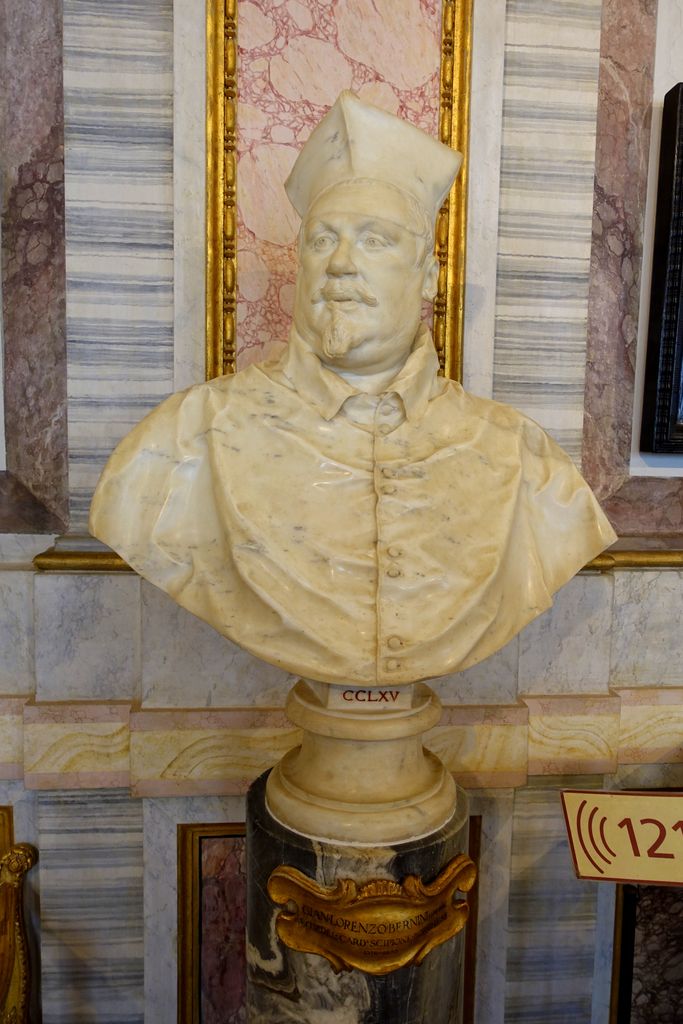
In 1632 Gian Lorenzo Bernini carved two marble portraits of Cardinal Scipione Borghese. Both give the cardinal parted lips and a slight turn of the head, as though his attention has shifted in the middle of a conversation. The first bust has a fine crack across the forehead. The second repeats the pose with small changes to the face, clothing and finish. The Galleria Borghese in Rome preserves both. Together they give us a chance to see the decisions that made a formal portrait appear momentary, and to ask why a marble with an obvious flaw was still given a prominent place in the Borghese villa. [1][2][4]
At a Glance
- Date1632
- Location or statusGalleria Borghese, Rome
- WorkTwo marble busts
The work in Bernini’s career
Apollo and Daphne
1622–25David
1623–24St Peter’s Baldachin
1624–33Bust of Scipione Borghese
1632The patron becomes the sitter
Scipione Caffarelli Borghese was the nephew of Pope Paul V, who adopted him into the Borghese family after his election. During his uncle’s pontificate Scipione occupied several senior church offices and built up the collection associated with the family villa outside Porta Pinciana. He had commissioned major sculpture from Bernini, including the groups now known as The Rape of Proserpina and Apollo and Daphne. In those works, an action taken from a story determined what a viewer saw in the figures. In the busts of Scipione the action is smaller, but no less essential to the resemblance. A turn of the head and an expectation of speech bring the individual forward within the robes of his office. [1][2][5]
The portrait came over a decade after Paul V’s death. By 1632 Bernini was already engaged at St Peter’s under Urban VIII. The Galleria Borghese catalogue records that Urban commissioned the likeness and that the Borghese accounts document a payment of 500 scudi from Scipione in December 1632. The papal request and the cardinal’s payment help situate the portrait among Bernini’s official commitments. The tone of the finished work is more familiar than the circumstances might suggest. The sitter wears the short cape, called a mozzetta, and the headgear proper to a cardinal, yet the space beside the face feels like a place where another person could stand. [1][2]
The impression of interrupted speech
The bust extends far enough below the shoulders for the cape to support the head visually. Its broad lower outline seems settled. Against that outline, the head’s slight turn becomes easier to see. The opening between the lips then focuses attention on an action whose beginning and end remain outside the sculpture. You can look from the centre of the chest up the buttons to find the axis of the garment, and then follow the face as it departs from it. The effect makes a quiet pose appear to have a before and an after. This is the quality behind the gallery’s description of the work as a talking portrait. [1][2]
The clothing also varies the way light moves on the marble. Turn towards one side of the first bust and the ridges on the short cape catch light at different angles. A sheen runs across them in broken patches, suggesting the changing appearance of silk. By contrast, the edges at the mouth and eyes are small and concentrated. They can register changes in the flesh without competing with the sweep of the garment. Bernini could bring those effects together in a single material through differences in inclination, depth and polish. The dress establishes the cardinal’s place in the church and gives the face a quieter surface against which its expression can be read. [1][2]
The crack and the second marble
The first version, inventory CCLXV, is 77.2 centimetres high. Its crack runs along the forehead. The second, CCLXVI, measures 78 centimetres. The replacement retains the basic arrangement, but the gallery notes that its cape is less wrinkled, covers more of the neck and has a low horizontal fold between the final buttons. It also records a more even polish. Where the first version gives the eye a varied succession of folds, those on the second follow a slightly simpler course. Comparing equal areas of the two marbles makes the repeat visible as another act of carving. The lower buttons provide a fixed point for following the course of the fold in each version. [1][2]
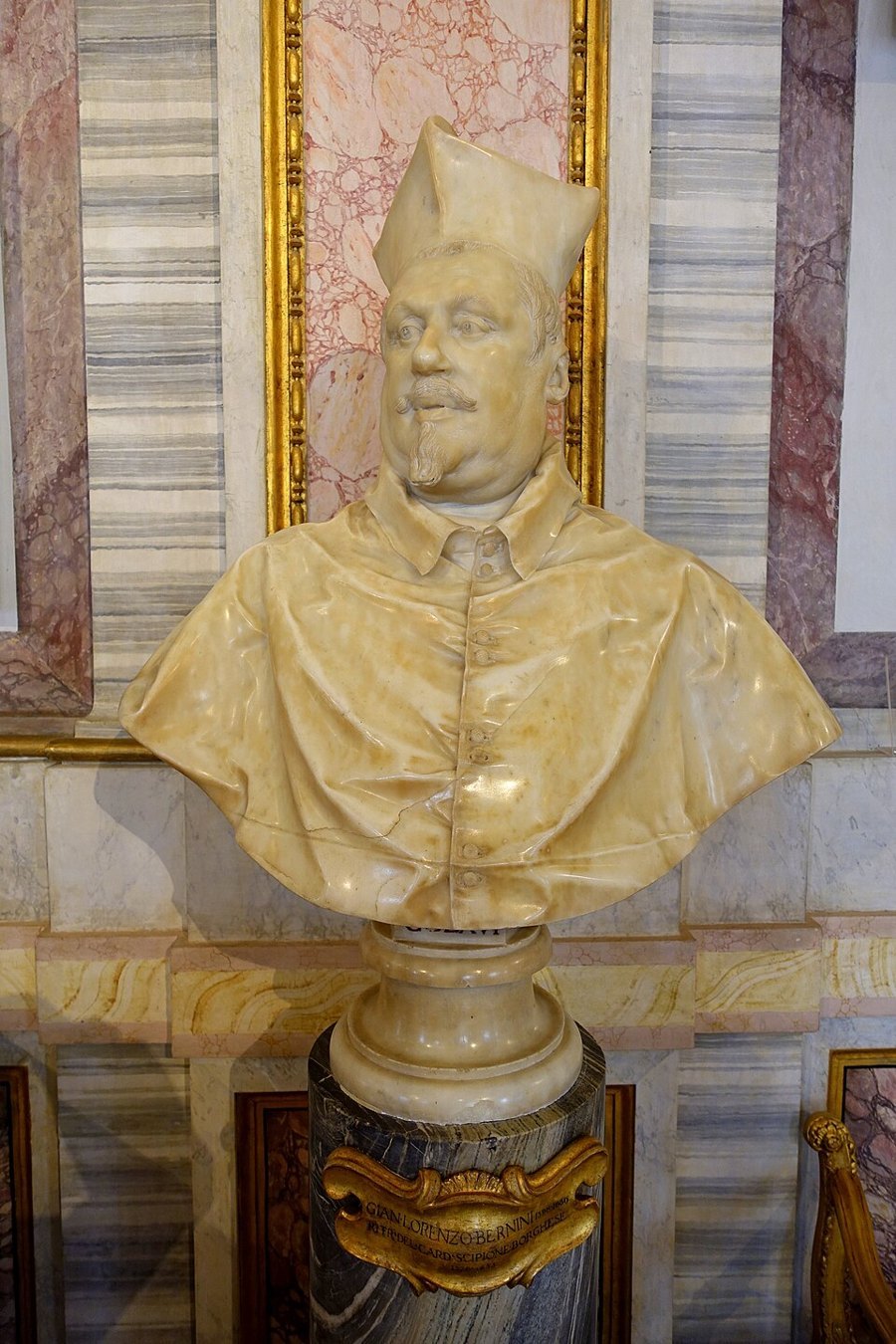
The early accounts disagree about the speed of the work and the way the cardinal discovered it. Filippo Baldinucci says Bernini made the replacement in fifteen nights, showed the damaged bust to Scipione first and then surprised him with the new one. Domenico Bernini gives his father only three days and puts the second bust first at the presentation. In his account, the cardinal remembered an expressive difference from the version he had already seen and asked for both. The surviving busts confirm the sequence of carving and the reason for comparing them closely. The two stories show how that episode acquired different emphases in print, from the sculptor’s ingenuity to the sitter’s ability to recognise his own likeness. [1][2][4]
How Bouchardon’s drawings identify the first bust
A century after Bernini carved the two versions, the French sculptor Edme Bouchardon drew the first one from two directions. The Louvre dates both red chalk drawings to about 1723–32. In the profile sheet the face is seen from the side, while the body still presents some of the front of the cape. The combination makes the cardinal’s turn measurable on the page. A line that looks simply like the rear of the head in profile has to be read against a torso already on a different axis. The drawing preserves a useful distinction between the position of the person depicted and the position of the person drawing him. [6]
The Louvre connects the sheets to the first marble through features visible even if the fracture is hard to make out. Near the third button from the bottom, on its right, the cape makes a fold that bends like an S. The Louvre also singles out the interruption under the left shoulder in the large arc of the garment’s bottom edge. Together the outline and the smaller details identify a specific version. If you are comparing reproductions taken under different light, those clues offer another way to tell the two marbles apart. A shadow can vanish as the lighting changes, but the difference in the course of the lower edge remains. [6]
Bouchardon recorded measurements in Roman palms, including the overall height and dimensions of the pedestal. The Louvre notes that these agree with the object. Drawing from two viewpoints and writing down measurements let him record features a single sheet could otherwise obscure. The profile subsequently became the basis for a reversed etching by the Comte de Caylus. Its reversal matters if it is used to reconstruct the bust’s pose: the print can convey the relationship between the face and cape while reversing the direction in which the sitter appears to turn. [6]
What the restoration archive can establish
The Galleria Borghese lists work on the first bust in 1911 under Eugenio Mattia, with Giulio Cantalamessa directing. The entry describes two Bernini busts being secured and filled, but it does not specify which part of the forehead was treated. The recorded intervention should therefore be kept separate from the biographies’ explanation of how the second portrait came to be made. The archive documents later attention to the object, rather than repeating the account of its first discovery. [7]
For 1997 the same archive lists colour measurements, ultraviolet fluorescence and close photography before a full restoration of the first version. Such methods can record differences that are difficult to describe from general photographs. The brief catalogue entry establishes that the investigations took place. It does not give their results in enough detail to date each filled area or identify the material of every dark mark. That limit matters particularly where the eye reads a small black or grey passage as part of the expression. A visible detail and an explanation of how it arrived there are two separate pieces of evidence. [7]
The cardinal in fewer lines
Genevieve Warwick distinguishes the red chalk study at the Morgan from a pen caricature of Scipione preserved at the Vatican Library. In the chalk, small shifts of tone can describe the skin around the eye and chin. The caricature has fewer marks, and the relative weight of the cheeks, neck and shoulders has to carry much of the likeness. The drawing can help a reader isolate features that the marble distributes across a much more complicated surface. It also reveals something about the breadth of the relationship between sculptor and patron. The face could be described at length in chalk, given formal presence in marble, or made recognisable with a few lines in pen. The joke, study and bust each rely on a different selection of details. [8]
Drawing, modelling and display
The Morgan Library & Museum holds a likeness of Scipione in red chalk over graphite, dated about 1632. It catalogues the sheet as a possible study for the marble. The Galleria Borghese connects it directly to preparations and draws attention to the economy with which Bernini indicates the face. The gallery also cites Lelio Guidiccioni’s letter describing work in clay alongside work on the stone. Dark traces around the eyes of the first marble have been interpreted in connection with that account, which describes drawing on the block. The evidence lets us follow the likeness across several ways of working while the two carved versions show how differently its surfaces could be finished. [1][3]
The two busts once occupied different positions in the villa. The first was documented in the Room of the Emperors, where it appeared among busts of Caesars. The second went in the upstairs picture gallery. Stefano Pierguidi reads the early written evidence as pointing to greater esteem for the first version, despite the imperfection in its stone. Their settings also gave the busts different company. Beside the emperors the cardinal’s portrait participated in a display of sculpted authority. In the picture gallery the other version belonged to a setting organised around paintings. The Italian state acquired both in 1892. The gallery’s two catalogue records now place them in the Lanfranco Loggia, where the similarities and changes can be studied at close range. [1][2][4]
Discussion
Two marble busts of the same sitter preserve small differences in execution.
Reader Insights
Which change to the mouth or brow most affects the expression?
How does the crack alter your attention to the first bust?
What is the strongest visual evidence that the two works share an underlying pose?
Join the Conversation
Share a detail, comparison or question about Bust of Scipione Borghese by Gian Lorenzo Bernini below.
References
- Felici, Sonja. Bust of Scipione Borghese. Galleria Borghese, inv. CCLXV. View source
- Galleria Borghese. Bust of Scipione Borghese. Inv. CCLXVI. View source
- Morgan Library & Museum. Portrait of Cardinal Borghese. IV, 176. View source
- Pierguidi, Stefano. A Certain Livelier Quality of Expression: Bernini’s Two Versions of the Bust of Scipione Borghese. Sapienza University of Rome repository abstract, 2014. View source
- Galleria Borghese. Bernini. Exhibition materials, 2017–18. View source
- Musée du Louvre. Edme Bouchardon, Buste de Scipion Borghèse, vu de profil, INV 23988. French catalogue discussion of the two drawings, identification of CCLXV, Roman measurements and the Caylus etching.
- Galleria Borghese, Archivi Digitali. Conservation register for the first portrait of Scipione Borghese, CCLXV_1911 and CCLXV_1997. Italian record of the campaign dates, examination methods and documentation.
- Warwick, Genevieve. Bernini: Art as Theatre, Yale University Press, 2012. English discussion of the chalk study and Vatican caricature, figs. 94 and 99.