 by Tom Gurney
Tom Gurney BSc (Hons) is an art history expert with over 20 years experience
Published on November 18, 2026 / Updated on November 18, 2026
Email: tomgurney1@gmail.com / Phone: +44 7429 011000
Equestrian Statue of Constantine
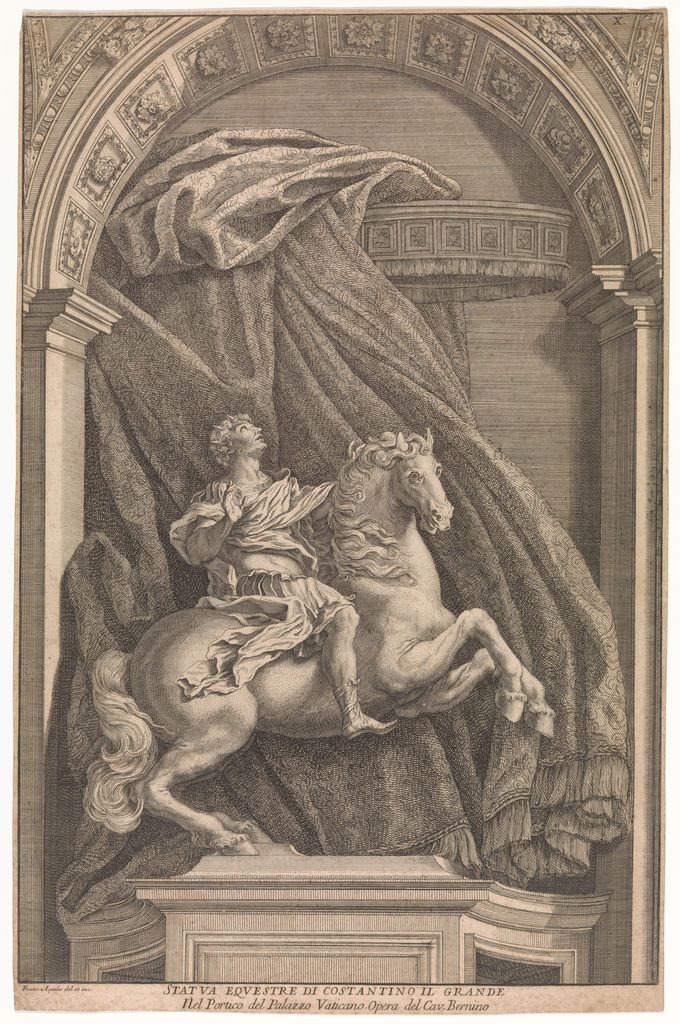
At the Vatican end of the portico of St Peter’s Basilica, Gian Lorenzo Bernini’s marble Constantine looks up as his horse rears. The rider and horse occupy a deep architectural setting at the foot of the Scala Regia, the stairway to the Vatican palace. The subject is the emperor’s vision of a sign of victory before his battle against Maxentius. Bernini chose the instant of seeing. The horse’s raised forequarters make the pause visible across the space, while Constantine’s face carries the eye up towards the place where he sees the sign. The commission began under Innocent X and took its final form under Alexander VII. [1][2][3]
At a Glance
- Date1662–70, final project
- Location or statusFoot of the Scala Regia, Vatican City
- WorkMarble equestrian monument
The work in Bernini’s career
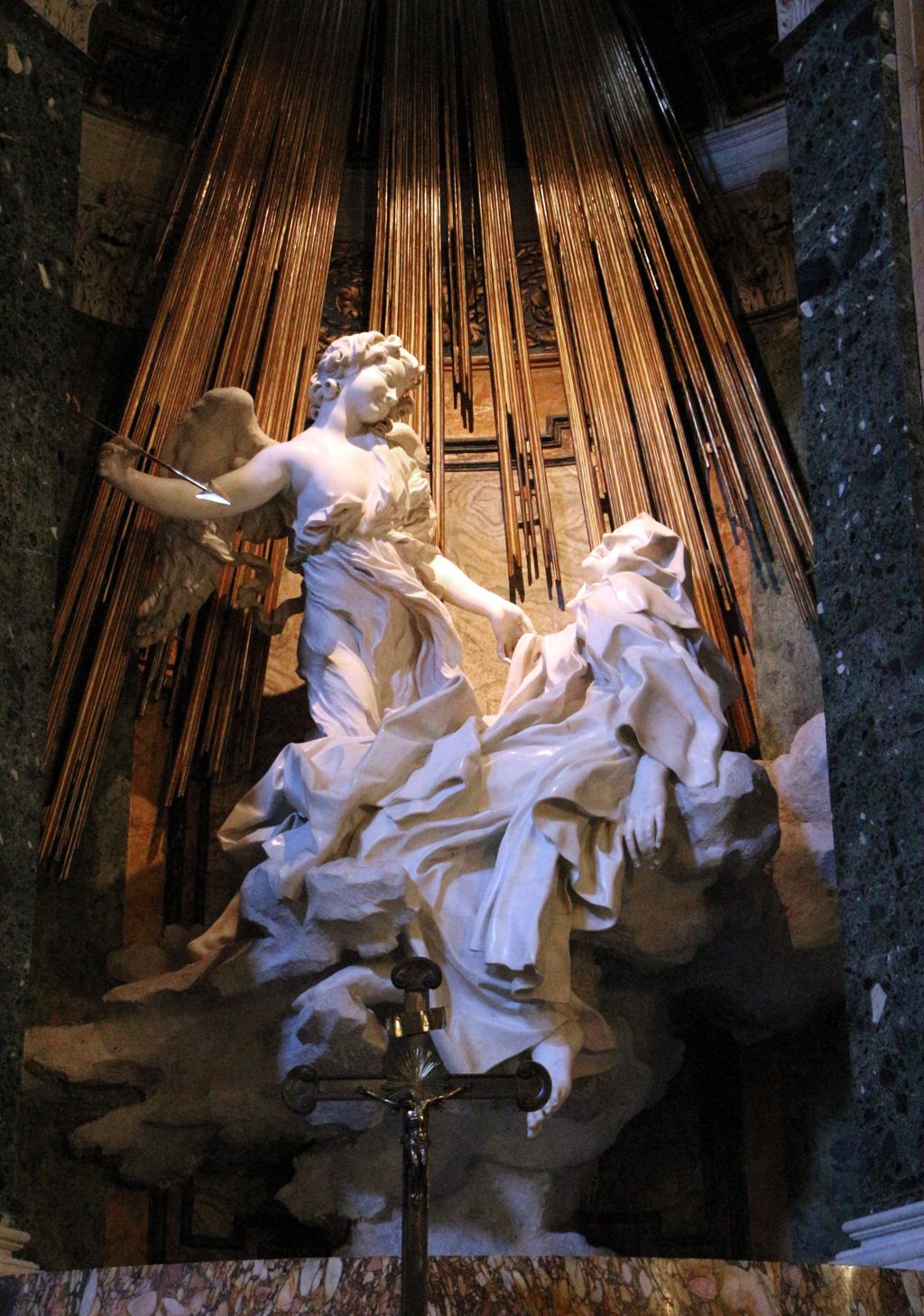
Ecstasy of Saint Teresa
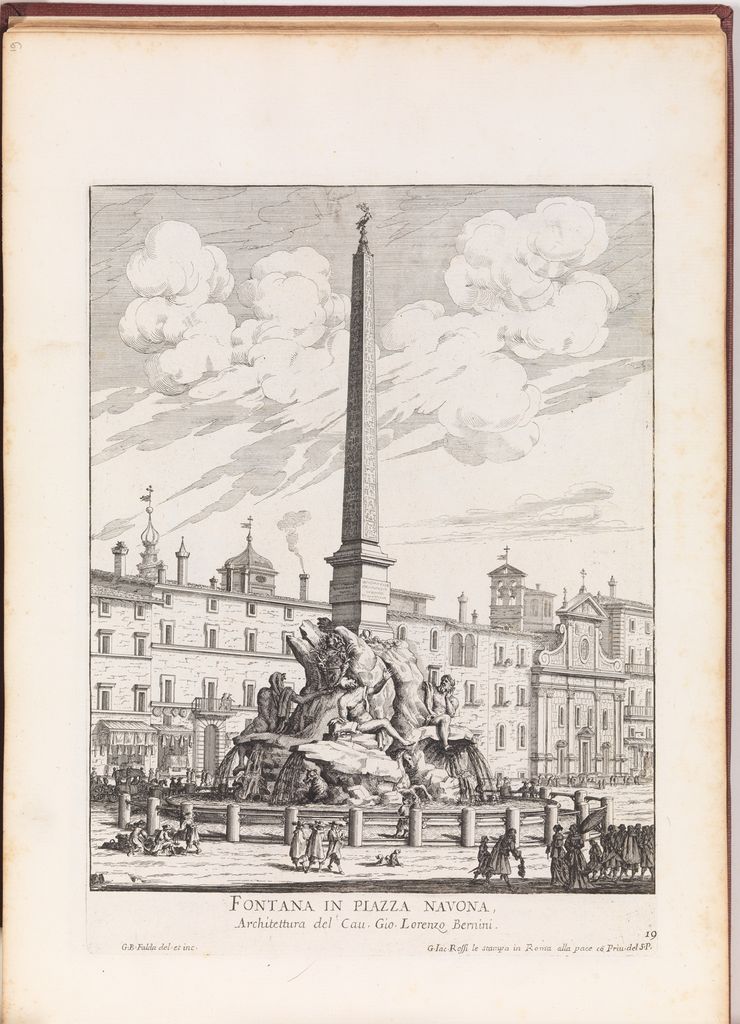
1647–52Fountain of the Four Rivers
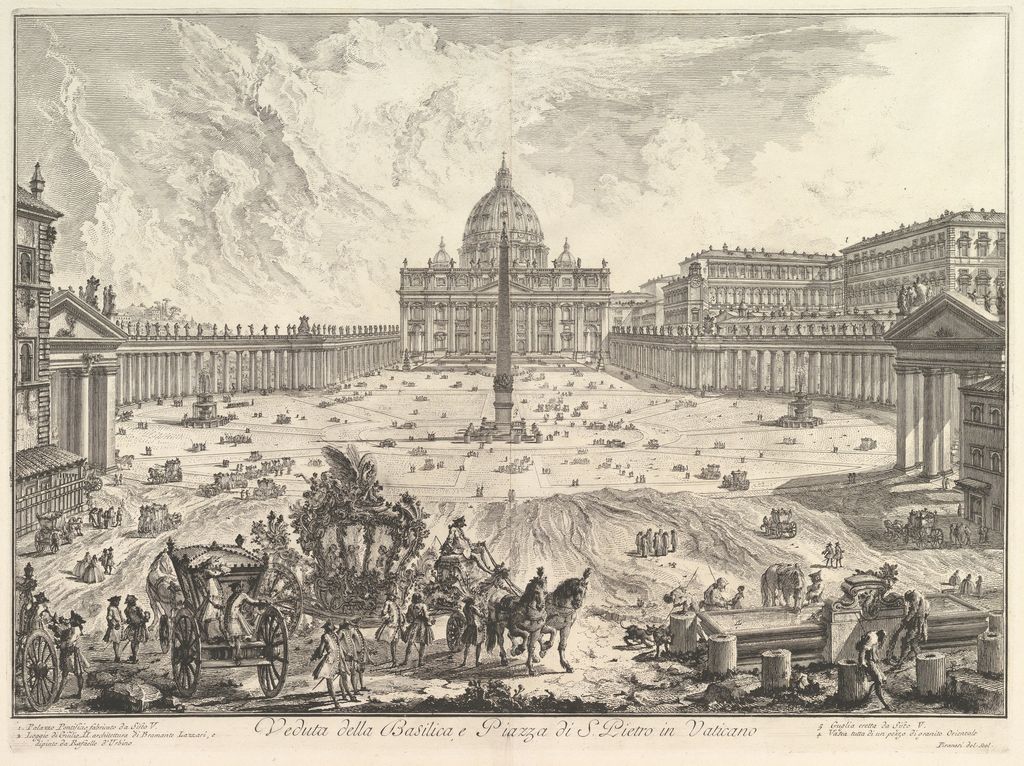
1648–51St Peter’s Square
1656–67Equestrian Statue of Constantine
1662–70, final projectFrom a side aisle to the palace stair
Innocent X planned a monument to Constantine in 1654. Irving Lavin relates the initial location, in an aisle of the basilica, to the monument to Matilda of Tuscany that Bernini had already made for St Peter’s. Both commemorated figures understood as benefactors of the church. Constantine was associated with the founding of the earlier basilica on the site. Inside the church, his statue would have belonged to a series of monuments encountered from the aisles. The project acquired a different role when Alexander VII took it up as part of work on the basilica and its approaches. [1][2]
The eventual location connects three directions of movement. The portico extends across the basilica. The north side of St Peter’s Square leads towards the Bronze Door and the Constantine Wing. The Scala Regia rises towards the Apostolic Palace. Lavin describes the statue as occupying their junction. Hence its view could become part of a route from the square to the palace, as well as part of the encounter with the basilica. The Vatican’s account of the wing records the ceremonial use of the corridor by papal processions. The sculpture stands where the architectural path and Constantine’s association with the founding of St Peter’s can be read together. [1][2]
The date of the marble belongs to a longer history than the building date given for the wing itself. The Hermitage catalogue traces the original order to 1654 and the renewal of work in 1662, when the Scala Regia site was chosen. Lavin discusses the realised monument and stair together under 1662–70. This sequence helps explain why a study for the emperor’s pose can belong to work first conceived for a different architectural position. It also explains why the final composition depends so heavily on what a person can see along the approach to the stair. [1][2][4]
The vision and the rider’s response
In Eusebius’s Life of Constantine, the emperor describes seeing a luminous cross in the sky during the day, accompanied by words promising victory through that sign. A dream then follows in which Christ instructs him to use the sign. Bernini chose the visible reaction to the apparition as the subject of the monument. Its setting links the emperor with Christian Rome, but the marble concentrates on the turn of the head and the response of the body. The statue leaves the viewer to follow the direction of the rider’s gaze. [2][3]
The horse gives this act of looking a much larger scale. Its front rises while its hindquarters bear down towards the support. The emperor’s upper body and tilted head carry the movement farther upward. From a distance the shape of the horse is apparent before the expression on Constantine’s face can be seen. Once the face comes into view, the idea of a rearing mount becomes part of the account of what the rider has just seen. The combined outlines allow Bernini to hold an event between beginnings and consequences that the spectator must supply. [2][5]
Bernini also described his intention in connection with another commission. In a letter to Colbert of 30 December 1669, discussed by Lavin, he explained that Constantine looks in wonder at the cross, while the equestrian Louis XIV he was designing would convey majesty and command. Both subjects gave him a horse and a ruler. His distinction places the emphasis of the Vatican figure on an act of attention directed beyond the rider. It also explains why the position of the face matters as much as the physical energy of the horse. [6]
A niche that turns towards the stair
From the basilica portico the arch gives the monument a clear terminus. Leonardo Paris’s survey of the Scala Regia shows that this view is only one of the directions built into the stonework. The arch containing the figure uses solid perspective. Its receding lines converge towards a point well to the left in the view from the portico, where the route turns towards the palace stair. In plan, the flights of the Scala Regia take the form of two trapezoids with different angles of convergence. The stairs rise as the columns become narrower and more closely spaced. A person arriving in front of Constantine therefore sees a tall architectural enclosure at the end of the portico and a design that redirects the eye and the body towards an ascending route. [7]
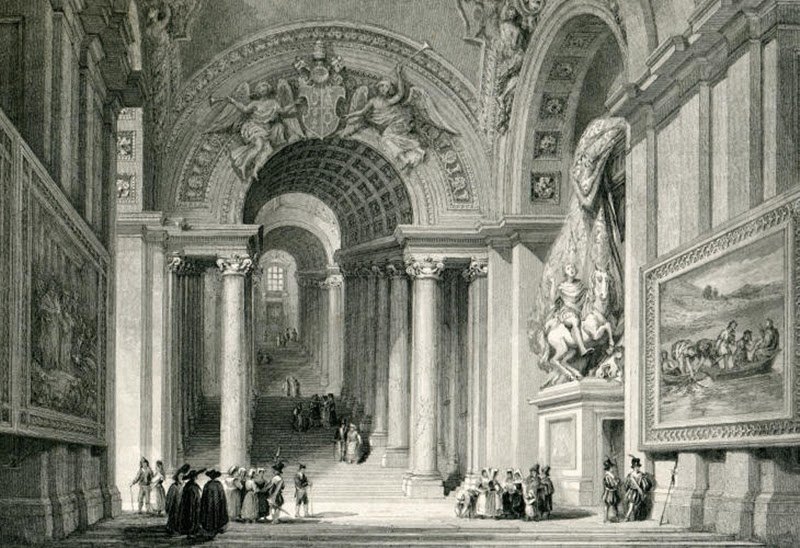
Paris compared sections made from the survey with older views of the junction. Carlo Fontana’s engraving of 1694 omits the equestrian group and the pointed window. Paul Letarouilly’s representation of 1882 includes the statue but shows a much smaller window. Both drawings represent the adjoining vault with a horizontal line where the survey records a pronounced slope. Those differences affect how we read the relation of the group to the architecture. For example, the opening that a drawing diminishes is the very opening towards which the emperor looks. The survey makes its size and position available for comparison with the older illustrations, which record the spaces with different degrees of detail. [7]
What the two approaches reveal
Frank Fehrenbach distinguishes the view from the portico and landing from the one a person gets while ascending the ceremonial stair. On the stair, Constantine’s open right hand stands forward in the light. The horse’s head follows, and then the emperor’s upward face. The cross and the light from the eastern window are behind the observer at that point. From the more frontal position the large folds become legible across the whole backdrop. Fehrenbach describes how morning light can pick out a long fold leading towards the head of the emperor. That effect gives the folds a part in the story as well as in the silhouette of the horse. [8]
The distinction matters when looking at a photograph. A broad view from the portico can register the passage from the edge of the arch to the horse and the open hand. The sequence Fehrenbach describes is an effect of occupying and moving through the stair. The survey gives this distinction a physical basis, since the arch, window and sloping passage meet at different angles. The visibility of the details also varies with the direction of daylight. [7][8]
Drawing and printing the monument
Edme Bouchardon drew the group in red chalk around 1724–25. The Louvre’s catalogue notes an unusual use of a ruler to set out the architecture. You can follow one line through the middle of the sheet and others around the pedestal. The horse and rider were worked more freely. Bouchardon marked the horse’s eyes and curls but left out the embroidered ornaments of the great hanging. He used long strokes and areas of bare paper to indicate the relief of its folds, with gentler contrasts than those Anne-Lise Desmas observes in the monument. A counterproof in Stockholm records another impression of this study. [9]
Francesco Faraone Aquila’s etching in the Metropolitan Museum of Art presents the group within its niche at roughly the same sheet height as Bouchardon’s drawing. Its lines are carried through a printable plate, and the architectural setting forms part of what the etching could circulate. Read together, the two records show what a view of the monument could make portable. The relations of pedestal, curtain and horse survive on paper, while the actual path through the portico and up the stair still has to be reconstructed from the architecture. [7][9][10]
From the clay model to the architectural frame
A damaged terracotta in the Hermitage preserves an earlier version of the composition. Its history can be followed back through the Farsetti collection, where it was already identified as Constantine on horseback. The clay study makes it possible to see how strongly the idea depended on the relationship between horse and rider even before their surroundings were settled. The surviving form also has to be read with care because losses affect the limbs and details. The model is most informative at the scale of the whole action, where the relation of the bodies remains legible. [4][5]
A study in The Art and Influence of Gianlorenzo Bernini discusses drawings in Madrid and Leipzig, as well as a chalk study of the emperor’s head. It connects the Leipzig view of the ensemble to decisions about how the finished marble would be seen in its position. The decisions visible in the head study concern the profile and upward attention. The setting gives those decisions a larger role. A figure placed at the end of a long approach must carry its expression through light and silhouette before a visitor can study the face in detail. [5]
Behind Constantine, the large folds of the stucco hanging provide a shaded field against which the pale horse and rider stand forward. The setting also makes use of daylight entering near the approach to the Scala Regia. The stronger illumination of the marble can make the face and raised body seem to emerge as one comes towards the monument. The architectural frame thereby participates in the story. The horse establishes the scale of the reaction, the rider directs it upwards and the lighting gives the act of looking an equivalent in the space of the spectator. [1][2][5]
A freestanding equestrian bronze such as the antique Marcus Aurelius can be approached from several sides. Lavin notes that the bronze was long identified as Constantine and also traces a tradition of equestrian reliefs attached to buildings. Bernini’s monument combines the scale of a mounted ruler with a view controlled by its architectural enclosure. The hanging frames the animal’s profile, and the depth of the opening gives the raised legs space to register against it. [2]
Discussion
The rider and horse react together in a deep recess at the foot of the stairs.
Reader Insights
Where does the emperor’s gaze direct your own?
How does the drapery help you read the horse’s movement from the portico?
What would change if the monument stood in the centre of a room?
Join the Conversation
Share a detail, comparison or question about Equestrian Statue of Constantine by Gian Lorenzo Bernini below.
References
- Holy See. Constantine Wing. View source
- Lavin, Irving. Bernini at St. Peter’s. Section on Constantine and the Scala Regia, figs. 176–79. View source
- Eusebius of Caesarea. Life of Constantine, book I, chapters 28–29. Translated by Ernest Cushing Richardson. View source
- State Hermitage Museum. Catalogue of Italian sculpture, section on seventeenth- and eighteenth-century Rome. Entry for the Constantine terracotta. View source
- Institute for Advanced Study. The Art and Influence of Gianlorenzo Bernini, section on Constantine’s studies and illumination, pp. 124–26. Institute for Advanced Study digital copy. View source
- Lavin, Irving. Bernini’s Image of the Sun King. Discussion of the letter to Colbert. View source
- Paris, Leonardo. Prospettive solide. La Scala Regia in Vaticano, pp. 66–73, especially figs. 2 and 6–10.
- Fehrenbach, Frank. Colpi vitali. Berninis Beseelungen, pp. 120–21, fig. 11.
- Musée du Louvre. Statue équestre de Constantin, à Rome. Drawings catalogue, including the analysis of Anne-Lise Desmas.
- Metropolitan Museum of Art. Equestrian Statue of Constantine the Great. Etching by Francesco Faraone Aquila after Bernini, no. 1991.1063.