 by Tom Gurney
Tom Gurney BSc (Hons) is an art history expert with over 20 years experience
Published on June 19, 2020 / Updated on November 3, 2026
Email: tomgurney1@gmail.com / Phone: +44 7429 011000
Andalucía, El Encierro: Introduction
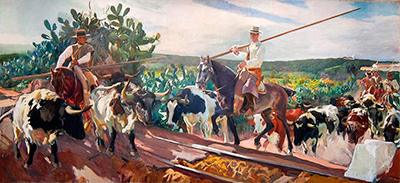
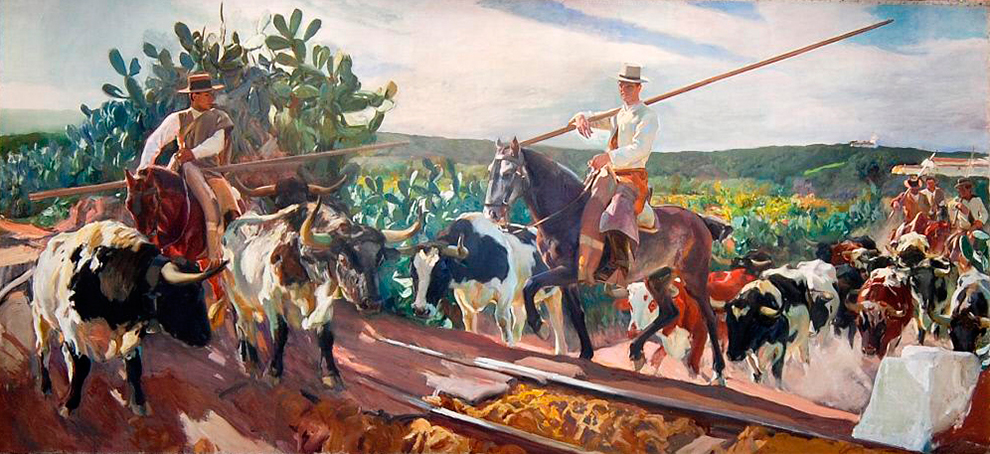
Railway tracks cross the foreground of Joaquín Sorolla’s Andalucía, El Encierro. Beyond them, cattle advance through reddish earth and rising dust, accompanied by mounted men carrying long poles. The nearest animals almost fill the space between the spectator and the riders. Farther back, the herd narrows into a crowded stream at the right. Across this movement, a pale-shirted horseman holds a strikingly steady position near the centre, his pole extending high into the sky.
Painted in 1914, this immense oil on canvas belongs to the Hispanic Society Museum & Library in New York. It measures 351 × 752 centimetres, giving its country scene a width of more than seven metres.[1] Its place within Vision of Spain matters to the way it addresses the viewer. The panel presents a broad stretch of terrain, yet its nearest cattle are brought close enough to interrupt any detached survey of the landscape. Looking across the countryside means encountering bodies that occupy the route directly ahead.
At a Glance
- ArtistJoaquín Sorolla
- SubjectAndalucía, El Encierro
- Date1914
- CollectionHispanic Society Museum & Library
- InventoryA1808
This work across Joaquín Sorolla’s career
Contents
- A round-up across open country
- Two riders and a web of lines
- The railway in the foreground
- Searching for a setting
- Breadth within the painted room
A round-up across open country
The subject is the movement of cattle under the guidance of mounted herdsmen. Blanca Pons-Sorolla’s account of the series translates the title as Andalucia: The Round-up and places its execution after the northern regional panels of 1914.[2] Here, the activity takes place along an open country route. Prickly pears rise at the left, low vegetation spreads across the middle distance, and a dark green ridge extends beneath a wide sky.
The composition makes the herd’s arrival feel uneven and immediate. At the left, a large black-and-white animal turns its head towards the right while its body remains directed into the foreground. Beside it, paler cattle face more nearly towards the spectator. Their horns establish different angles, and their heads occur at different heights. The animals overlap closely enough to suggest a moving group, while the variations prevent the front rank from becoming a regular procession.
The right side supplies another view of the same movement. Smaller heads and shoulders press together behind the central horse, with mounted figures rising above them farther away. Dust blurs some of the lower outlines. The eye follows the compact group forward until individual animals become legible, then encounters the larger bodies at the front. Distance is made through changing scale and visibility rather than through an empty road that can be traced from beginning to end.
This arrangement gives the cattle considerable pictorial independence. The men stand higher, have clearer silhouettes and carry the long lines that organise the upper part of the picture. The animals, however, occupy much of the lower field. Their varied coats break the herd into patches of black, cream, brown and white. They make their own strong pattern, repeatedly drawing attention away from the riders and back towards the ground.
Andalucía, El Encierro — larger view
Two riders and a web of lines
The two largest horsemen establish a broad interval across the scene. At the left, a rider in a dark vest and pale sleeves sits against the prickly pears. His pole runs low across the vegetation and animals. Nearer the centre, the second rider’s white shirt stands out against the darker countryside; his pole climbs towards the upper right. The poles connect widely separated portions of the canvas without making a rigid frame around the herd.
The central figure is particularly clear because his body joins several contrasting directions. His torso rises upright; one arm extends across the pole; his legs descend beside the horse. Beneath him, the horse turns towards the left, with a bent foreleg lifting away from the ground. The rider’s contained posture and the animal’s articulated limbs produce different impressions of movement within one mounted figure.
The hats perform a small but effective task. Their flat brims form short horizontal accents near the top of each rider’s head. They help faces remain readable amid the much longer diagonals of the poles. The white shirt at the centre also makes the hand and arm positions easier to follow. Clothing gives shape to the gesture before the eye begins to examine its smaller details.
Sorolla places the horses within the herd rather than isolating them on a separate strip of ground. Cattle interrupt the lower silhouettes; one pale animal appears behind the central horse’s legs. These overlaps make the group seem physically involved in a common passage. They also complicate a first reading of the scene. The eye has to separate horse from cattle, near body from distant body, and a visible leg from the animal partly concealing it.
The prickly pears answer the people and animals with another kind of bodily shape. Their thick, rounded pads gather into a tall mass behind the left rider. Individual pads point upwards or outwards, repeating the variety of angles among horns and poles on a smaller scale. Their concentrated vertical growth anchors the left side, while the low ridge and open sky allow the right to spread out.
The railway in the foreground
The rails give the foreground a firm structure. Dark, hard-edged lengths run obliquely across the bottom of the scene, with exposed earth and rough stones around them. At the right, a pale block marks another solid presence beside the crossing. The cattle route meets this engineered line close to the viewer, where the change of surface can be seen most clearly.
The tracks introduce a second system of movement. The herd follows the road through the countryside; the railway cuts across it. Their meeting makes the crossing a specific place of passage. This is occupied land with routes running through it, and the herding takes place among those routes. The straight rails make the changing outlines of cattle, dust and soil especially conspicuous.
They also alter the spectator’s position. The nearest rail lies below the animals, creating a shallow interval before the herd. Looking into the painting involves passing visually across that boundary. The railway therefore acts both as a recognisable feature of the place and as a device that sets the approaching bodies at a particular distance from us.
Above it, the earth is painted in broad pinkish and reddish areas, cut by shadows and interrupted by hoofs. Against this warm ground, the pale hides become luminous while the darker animals retain weight. Farther away, cooler greens and blues give the countryside greater continuity. The picture moves from broken, crowded forms nearby towards broader bands at the horizon.
Searching for a setting
Pons-Sorolla’s essay for the Museo Carmen Thyssen Málaga describes preparation beginning in October 1914. At El Cuco, Sorolla painted vineyard studies, then searched farther afield for the background he wanted. He eventually set up the large canvas at Tabladilla outside Seville and made cattle studies at Las Delicias. The account dates completion of the panel to 14 December.[3]
The same essay identifies seven preparatory studies of riders and pole-bearing herdsmen. The museum’s Garrochista, Sevilla is a separate 1914 oil on cardboard measuring 75 × 105 centimetres. Pons-Sorolla tentatively dates it to 2–5 November from family correspondence and discusses how its rider and brown horse relate to elements developed differently in the final panel.[3]
Seen beside the finished scene, that study makes the problem of enlargement tangible. A single mounted man fills much of its surface. His shirt catches the light, his pole passes behind his shoulder, and his brown horse occupies the foreground. The background remains loosely stated, with broad areas of brown and green. The rider is already a strong visual unit, capable of holding attention without a surrounding herd.
In the large canvas, comparable gestures have to work among numerous competing forms. The pale shirt becomes an accent across a much longer distance; the pole reaches into open sky; the horse takes its place among other animals. A figure that commands a study can become one component in a panorama. The comparison reveals how much the final effect depends on intervals and surroundings as well as on the mounted pose itself.
Photography offers another possible connection. The Museo Sorolla holds Emilio Beauchy’s Conducción de ganado o encierro en Sevilla, inventory 82769. Its record describes mounted herdsmen conducting cattle and states that the photograph was possibly used in making Sorolla’s panel.[4] That qualified link places the photograph among the potential resources behind the composition. It records a related cattle-handling subject, providing a historical comparison with the mounted group in the painting.
Breadth within the painted room
The Hispanic Society commissioned Vision of Spain in 1911. Its fourteen canvases were painted at locations in Spain between 1912 and 1919, and the installation opened in New York in 1926.[5] Within this surrounding ensemble, the Andalusian cattle scene offers an unusually expansive stretch of open country. Its broad sky and low horizon give the nearest figures room to rise above the herd.
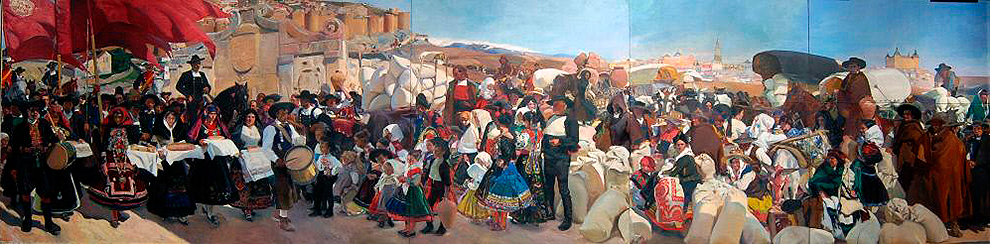
A comparison with Castilla, the Feast of Bread helps clarify the use of width. Both paintings encourage the eye to travel sideways through a substantial gathering. Here, however, the changing size of the cattle and the line of distant riders also pull attention forwards, from the right background towards the foreground crossing. Lateral breadth is combined with approach.
The landscape participates in that approach without becoming a neutral backdrop. Dense vegetation shelters the left rider; open sky clarifies the central pole; the ridge gives the animals a distant limit. Near the spectator, the tracks and uneven ground make every hoof and leg seem more exposed. Each zone supplies a different condition for reading the bodies moving through it.
The panel’s lasting force comes from this balance between an intelligible activity and a complicated visual encounter. One can recognise a herd being conducted across country immediately. Sustained looking reveals how many separate directions and interruptions make that recognition possible: a turning head, a lifted hoof, an angled pole, a line of dust and a rail passing under the whole group. Across seven metres of canvas, Sorolla makes collective movement readable while preserving the restless differences within it.
Comparison: Castilla, the Feast of Bread
Watch: Sorolla, light and painting
Three National Gallery films offer an introduction, a closer look at technique and a longer curator’s talk.
An introduction to 'Sorolla: Spanish Master of Light'
Start with a short exhibition introduction to Sorolla’s subjects and career.
Watch on YouTubeArtworks and exhibition records
Browse 103 artwork articles, 350 numbered entries from the Hispanic Society’s 1909 New York catalogue, and two selected Meadows Museum drawings. These are records, not a count of unique artworks: repeated historical titles remain separate entries and may overlap with the articles. A catalogue’s exhibition year does not establish an execution date. This researched selection is not a complete catalogue raisonné.
| Name | Date | Medium |
|---|---|---|
| Women Walking on the Beach | 1909 | Painting |
| Sewing the Sail | 1896 | Painting |
| Running Along the Beach | 1908 | Painting |
| Sad Inheritance | 1899 | Painting |
| Mother | 1895–1900 | Painting |
| The Horse's Bath | 1909 | Painting |
| The Pink Robe | 1916 | Painting |
| And They Still Say Fish are Expensive! | 1894 | Painting |
| The Return from Fishing | 1894 | Painting |
| Children on the Beach | 1909 | Painting |
| Castilla, the Feast of Bread | 1913 | Painting |
| Sevilla, Holy Week Penitents | 1914 | Painting |
| Aragon, Jota | 1914 | Painting |
| Navarre, the Town Council of Roncal | 1914 | Painting |
| Guipúzcoa, Bowling | 1914 | Painting |
| Andalucía, El Encierro | 1914 | Painting |
| Seville, the Dance | 1915 | Painting |
| Sevilla, The Bullfighters | 1915 | Painting |
| Galicia, The Pilgrimage | 1915 | Painting |
| The Fish | 1915 | Painting |
| Valencia, Couples on Horseback | 1916 | Painting |
| Extremadura, The Market | 1917 | Painting |
| Elche, The Palm Grove | 1918–1919 | Painting |
| The Tunny Catch | 1919 | Painting |
| Louis Comfort Tiffany | 1911 | Painting |
| Adobe Houses | 1890–1895 | Painting |
| After Bathing | 1915 | Painting |
| After Bathing, Valencia | 1909 | Painting |
| After Bathing, Valencian Beach | 1908 | Painting |
| Afternoon Sun, Playa de Valencia | 1910 (Album catalogue) | Painting |
| Aim of Ibiza | 1919 | Painting |
| Almond Trees in Asis | Spring,1887–1889 | Painting |
| Another Margarita | 1892 | Painting |
| Antonio García at the Beach | 1909 | Painting |
| Around Segovia | 9–15 October 1906 | Painting |
| Artist's Patio, Cafe Novedades, Seville | 1915 | Painting |
| Asturian Landscape | circa 1904 | Painting |
| Aureliano de Beruete | 1902 | Painting |
| Aureliano de Beruete y Moret, Son | 1902 | Painting |
| The Bath, Jávea | 1905 | Painting |
| The Bathing Hour | 1915 execution, signed and dated1917 (Sothebys catalogue account) | Painting |
| Bathing Time | 1904 | Painting |
| Beach at Valencia | 1908 in ARC catalogue | Painting |
| Beach at Zarauz | 1910 | Painting |
| Beach of Biarritz | 1906 | Painting |
| Beach of Biarritz, France | Summer1906 | Painting |
| Beached Boats | 1915 | Painting |
| Beaching the Boat | 1908 in ARC catalogue | Painting |
| Blessing the Boat | 1895 | Painting |
| Blind Man of Toledo | 1906 | Painting |
| Boat Builders | 1894 | Painting |
| Boat in Albufera | 1895 | Painting |
| Boy on the Sand | Undated | Painting |
| Boys in the Sea | 1908 | Painting |
| Boys on the Beach | BeforeNewYork1909exhibition; exactyearunresolved | Painting |
| Breakwater, San Sebastian | 1917–1918 | Painting |
| Bulls in the Sea | 1903 | Painting |
| Capturing the Moment | 1906 | Painting |
| Castle of La Mota, Medina del Campo | 29 May 1912 | Painting |
| Children in the Sea | Painting | |
| Children on the Beach, Valencia | 1916 | Painting |
| Children on the Seashore | 1903 | Painting |
| Child's Siesta | circa 1918 (ARC catalogue) | Painting |
| Church Roncal Stairs | 22–28August1912 | Painting |
| Clothilde at the Beach | Summer1904 | Painting |
| Clotilde and Elena on the Rocks at Javea | 1905 | Painting |
| Clotilde García del Castillo | April1890 | Painting |
| Clotilde in a Grey Dress | 1900 | Painting |
| Clotilde with Hat | 1910 | Painting |
| Coast at Santa Cristina | 29 September 1915 (current CERES1122) | Painting |
| Court of the Dances, Alcázar, Sevilla | 1910 | Painting |
| Covachuelas, Toledo | 21–30 October 1906 | Painting |
| Dragging the Trawler | circa 1903–1904 in educational catalogue | Painting |
| El Retiro, Madrid | 1898 | Painting |
| Female Nude | 1902 | Painting |
| Fisherman in Valencia | 1904 | Painting |
| Fisherwomen from Valencia | June–July 1915 | Painting |
| Fishing Boats | by February 1909 | Painting |
| Fishing Nets | 1893 | Painting |
| The Gardens at the Sorolla Family House | spring 1920 | Painting |
| Hall of the Ambassadors, Alhambra, Granada | 1909 | Painting |
| Harbour | 1880 | Painting |
| Joaquín Sorolla García in a White Dress | 1896 | Painting |
| Lighthouse Walk at Biarritz | 1906 | Painting |
| The Little Yacht | 1909 | Painting |
| Maria at La Granja | 1907 | Painting |
| My Children | 1904 | Painting |
| My Wife and Daughters in the Garden | 1910 | Painting |
| Portrait of Benito Pérez Galdós | 1894 | Painting |
| A Rooftop with Flowers | 1902 | Painting |
| Self Portrait | 1904 | Painting |
| Self Portrait | 1909 | Painting |
| Señora de Sorolla in Black | 1906 | Painting |
| La Siesta | 1911 | Painting |
| The Skipping Rope | 1907 | Painting |
| Swimmers, Jávea | 1905 | Painting |
| Time for a Bathe | 1909 | Painting |
| Under the Awning, Zarauz | 1910 | Painting |
| Valencia Beach in the Morning Light | summer 1908 | Painting |
| Valencian Fishermen | 1895 | Painting |
| The White Boat, Jávea | 1905 | Painting |
| White Slave Trade | 1894 | Painting |
| The Wounded Foot | 1909 | Painting |
| Seven Peaks, Guadarrama — 1909 catalogue, no. 1 | Painting | |
| Covachuelas, Toledo — 1909 catalogue, no. 2 | Painting | |
| Las Pedrizas, El Pardo — 1909 catalogue, no. 3 | Painting | |
| Señor Gomar — 1909 catalogue, no. 4 | Painting | |
| El Torneo, El Pardo — 1909 catalogue, no. 5 | Painting | |
| A Toledo Street — 1909 catalogue, no. 6 | Painting | |
| View from El Torneo — 1909 catalogue, no. 7 | Painting | |
| Walls of Segovia — 1909 catalogue, no. 8 | Painting | |
| Convent of El Parral, Segovia — 1909 catalogue, no. 9 | Painting | |
| Environs of Segovia — 1909 catalogue, no. 10 | Painting | |
| Reflections from the Cape, Jávea — 1909 catalogue, no. 11 | Painting | |
| The Clamores, Segovia — 1909 catalogue, no. 12 | Painting | |
| Rocks of the Cape, Jávea — 1909 catalogue, no. 13 | Painting | |
| Farmhouse, Alcira — 1909 catalogue, no. 14 | Painting | |
| María at Biarritz — 1909 catalogue, no. 15 | Painting | |
| Shadow of the Alcántara Bridge, Toledo — 1909 catalogue, no. 16 | Painting | |
| Castle of San Servando, Toledo — 1909 catalogue, no. 17 | Painting | |
| Dr Decret — 1909 catalogue, no. 18 | Painting | |
| Alcántara Bridge, Toledo — 1909 catalogue, no. 19 | Painting | |
| The Forest, La Granja — 1909 catalogue, no. 20 | Painting | |
| Trout Stream, La Granja — 1909 catalogue, no. 21 | Painting | |
| Court of the Dances, Alcázar, Seville — 1909 catalogue, no. 22 | Painting | |
| Oleanders — 1909 catalogue, no. 23 | Painting | |
| Glen, Asturias — 1909 catalogue, no. 24 | Painting | |
| Pavilion of Charles V, Seville — 1909 catalogue, no. 25 | Painting | |
| St Martin's Bridge, Toledo — 1909 catalogue, no. 26 | Painting | |
| Orange Trees — 1909 catalogue, no. 27 | Painting | |
| Rope Makers — 1909 catalogue, no. 28 | Painting | |
| Señor Franzen — 1909 catalogue, no. 29 | Painting | |
| Rocks at the Lighthouse, Biarritz — 1909 catalogue, no. 30 | Painting | |
| St Martin's Bridge, Toledo — 1909 catalogue, no. 31 | Painting | |
| Valencian Fisherwoman — 1909 catalogue, no. 32 | Painting | |
| Road of San Esteban, Asturias — 1909 catalogue, no. 33 | Painting | |
| Basin in the Alcázar, Seville — 1909 catalogue, no. 34 | Painting | |
| Harbour of Valencia — 1909 catalogue, no. 35 | Painting | |
| Haymaking, Asturias — 1909 catalogue, no. 36 | Painting | |
| House of El Greco, Toledo — 1909 catalogue, no. 37 | Painting | |
| María with a Black Hat — 1909 catalogue, no. 38 | Painting | |
| Entrance Tower, Toledo — 1909 catalogue, no. 39 | Painting | |
| Las Covachuelas, Toledo — 1909 catalogue, no. 40 | Painting | |
| Rocks, Jávea — 1909 catalogue, no. 41 | Painting | |
| Road of the Alijares, Toledo — 1909 catalogue, no. 42 | Painting | |
| Segovian Family — 1909 catalogue, no. 43 | Painting | |
| Scalding Grapes, Jávea — 1909 catalogue, no. 44 | Painting | |
| Joaquín — 1909 catalogue, no. 45 | Painting | |
| Elena — 1909 catalogue, no. 46 | Painting | |
| El Grutesco, Alcázar, Seville — 1909 catalogue, no. 47 | Painting | |
| Beach of Valencia — 1909 catalogue, no. 48 | Painting | |
| Sails Drying, Valencia — 1909 catalogue, no. 49 | Painting | |
| Orange Tree — 1909 catalogue, no. 50 | Painting | |
| Little Boy with a Toy Boat — 1909 catalogue, no. 51 | Painting | |
| Old Valencian Fisherman — 1909 catalogue, no. 52 | Painting | |
| Fishing Boats — 1909 catalogue, no. 53 | Painting | |
| Harbour of Valencia — 1909 catalogue, no. 54 | Painting | |
| The Kiss — 1909 catalogue, no. 55 | Painting | |
| Little Boy on a Rock, Jávea — 1909 catalogue, no. 56 | Painting | |
| The Queen's Beam, Valsaín — 1909 catalogue, no. 57 | Painting | |
| Staircase of the Palace, La Granja — 1909 catalogue, no. 58 | Painting | |
| Elena at El Pardo — 1909 catalogue, no. 59 | Painting | |
| Fountain of the Horses, La Granja — 1909 catalogue, no. 60 | Painting | |
| Autumn, La Granja — 1909 catalogue, no. 61 | Painting | |
| María Painting, El Pardo — 1909 catalogue, no. 62 | Painting | |
| Fountain of the Forest, La Granja — 1909 catalogue, no. 63 | Painting | |
| Fountain of Neptune, La Granja — 1909 catalogue, no. 64 | Painting | |
| Orange Grove, Valencia — 1909 catalogue, no. 65 | Painting | |
| Francisqueta, Valencia — 1909 catalogue, no. 66 | Painting | |
| Waiting for the Fish, Valencia — 1909 catalogue, no. 67 | Painting | |
| Taking in the Sail, Valencia — 1909 catalogue, no. 68 | Painting | |
| Return from Fishing, Valencia — 1909 catalogue, no. 69 | Painting | |
| Crayfishers, Valencia — 1909 catalogue, no. 70 | Painting | |
| Swimmer, Jávea — 1909 catalogue, no. 71 | Painting | |
| Elena among Roses — 1909 catalogue, no. 72 | Painting | |
| Idyll — 1909 catalogue, no. 73 | Painting | |
| Vicente Blasco Ibáñez — 1909 catalogue, no. 74 | Painting | |
| Yellow Tree, La Granja — 1909 catalogue, no. 75 | Painting | |
| Blind Man of Toledo — 1909 catalogue, no. 76 | Painting | |
| Fisherwoman with Her Son, Valencia — 1909 catalogue, no. 77 | Painting | |
| The Bath, La Granja — 1909 catalogue, no. 78 | Painting | |
| Sewing the Sail, Valencia — 1909 catalogue, no. 79 | Painting | |
| Looking for Crabs, Jávea — 1909 catalogue, no. 80 | Painting | |
| María, La Granja — 1909 catalogue, no. 81 | Painting | |
| Joaquín and His Dog — 1909 catalogue, no. 82 | Painting | |
| Upon the Sand — 1909 catalogue, no. 83 | Painting | |
| Valencian Fisherwomen — 1909 catalogue, no. 84 | Painting | |
| Señora de Sorolla in White — 1909 catalogue, no. 85 | Painting | |
| At the Seashore, Valencia — 1909 catalogue, no. 86 | Painting | |
| Valencian Woman — 1909 catalogue, no. 87 | Painting | |
| In the Gardens of La Granja — 1909 catalogue, no. 88 | Painting | |
| Old Castilian — 1909 catalogue, no. 89 | Painting | |
| Marqués de Urquijo — 1909 catalogue, no. 90 | Painting | |
| Fisherman's Daughter, Valencia — 1909 catalogue, no. 91 | Painting | |
| Elena and Her Dolls — 1909 catalogue, no. 92 | Painting | |
| My Children — 1909 catalogue, no. 93 | Painting | |
| Swimmers — 1909 catalogue, no. 94 | Painting | |
| Low Tide: Elena at Biarritz — 1909 catalogue, no. 95 | Painting | |
| Mending Nets — 1909 catalogue, no. 96 | Painting | |
| The Bath, Jávea — 1909 catalogue, no. 97 | Painting | |
| The Bath, Jávea — 1909 catalogue, no. 98 | Painting | |
| Boxing Raisins — 1909 catalogue, no. 99 | Painting | |
| Forest Bridge, La Granja — 1909 catalogue, no. 100 | Painting | |
| View of the Palace, La Granja — 1909 catalogue, no. 101 | Painting | |
| Return from Fishing, Valencia — 1909 catalogue, no. 102 | Painting | |
| At the Bath, Valencia — 1909 catalogue, no. 103 | Painting | |
| Little Girl with a Blue Ribbon, Valencia — 1909 catalogue, no. 104 | Painting | |
| María at the Harbour of Jávea — 1909 catalogue, no. 105 | Painting | |
| Instantaneous, Biarritz — 1909 catalogue, no. 106 | Painting | |
| Boy among Breakers, Jávea — 1909 catalogue, no. 107 | Painting | |
| Garden of the Alcázar, Seville — 1909 catalogue, no. 108 | Painting | |
| Oleander Road, Valencia — 1909 catalogue, no. 109 | Painting | |
| María and Her Grandmother — 1909 catalogue, no. 110 | Painting | |
| Malvarrosa Beach, Valencia — 1909 catalogue, no. 111 | Painting | |
| The Huerta of Valencia — 1909 catalogue, no. 112 | Painting | |
| Garden of the Alcázar, Seville — 1909 catalogue, no. 113 | Painting | |
| Garden of the Alcázar, Seville — 1909 catalogue, no. 114 | Painting | |
| The Giralda, Seville — 1909 catalogue, no. 115 | Painting | |
| Palace of Charles V, Seville — 1909 catalogue, no. 116 | Painting | |
| Harbour of Valencia — 1909 catalogue, no. 117 | Painting | |
| Marqués de la Vega-Inclán — 1909 catalogue, no. 118 | Painting | |
| Harbour of Valencia — 1909 catalogue, no. 119 | Painting | |
| At the Water, Valencia — 1909 catalogue, no. 120 | Painting | |
| House in the Huerta, Valencia — 1909 catalogue, no. 121 | Painting | |
| Beach Garden, Valencia — 1909 catalogue, no. 122 | Painting | |
| Huerta of Valencia — 1909 catalogue, no. 123 | Painting | |
| Garden of the Alcázar, Seville — 1909 catalogue, no. 124 | Painting | |
| Asturias — 1909 catalogue, no. 125 | Painting | |
| San Sebastián — 1909 catalogue, no. 126 | Painting | |
| Old Harbour, Biarritz — 1909 catalogue, no. 127 | Painting | |
| Beach of Biarritz — 1909 catalogue, no. 128 | Painting | |
| Beach of Biarritz — 1909 catalogue, no. 129 | Painting | |
| Beach of Biarritz — 1909 catalogue, no. 130 | Painting | |
| Beach of Biarritz — 1909 catalogue, no. 131 | Painting | |
| Beach of Biarritz — 1909 catalogue, no. 132 | Painting | |
| Beach of Biarritz — 1909 catalogue, no. 133 | Painting | |
| Beach of Biarritz — 1909 catalogue, no. 134 | Painting | |
| Beach of Biarritz — 1909 catalogue, no. 135 | Painting | |
| Beach of Biarritz — 1909 catalogue, no. 136 | Painting | |
| Beach of Biarritz — 1909 catalogue, no. 137 | Painting | |
| Beach of Biarritz — 1909 catalogue, no. 138 | Painting | |
| Beach of Biarritz — 1909 catalogue, no. 139 | Painting | |
| Beach of Biarritz — 1909 catalogue, no. 140 | Painting | |
| Beach of Biarritz — 1909 catalogue, no. 141 | Painting | |
| Beach of Biarritz — 1909 catalogue, no. 142 | Painting | |
| Beach of Biarritz — 1909 catalogue, no. 143 | Painting | |
| La Concha, San Sebastián — 1909 catalogue, no. 144 | Painting | |
| Beach of Biarritz — 1909 catalogue, no. 145 | Painting | |
| Beach of Biarritz — 1909 catalogue, no. 146 | Painting | |
| Beach of Biarritz — 1909 catalogue, no. 147 | Painting | |
| Beach of Biarritz — 1909 catalogue, no. 148 | Painting | |
| Beach of Biarritz — 1909 catalogue, no. 149 | Painting | |
| Beach of Biarritz — 1909 catalogue, no. 150 | Painting | |
| Beach of Biarritz — 1909 catalogue, no. 151 | Painting | |
| Beach of Biarritz — 1909 catalogue, no. 152 | Painting | |
| Beach of Biarritz — 1909 catalogue, no. 153 | Painting | |
| Beach of Biarritz — 1909 catalogue, no. 154 | Painting | |
| Beach of Valencia — 1909 catalogue, no. 155 | Painting | |
| Beach of Valencia — 1909 catalogue, no. 156 | Painting | |
| Beach of Valencia — 1909 catalogue, no. 157 | Painting | |
| Harbour of San Sebastián — 1909 catalogue, no. 158 | Painting | |
| Harbour of San Sebastián — 1909 catalogue, no. 159 | Painting | |
| Beach of Valencia — 1909 catalogue, no. 160 | Painting | |
| Pasajes — 1909 catalogue, no. 161 | Painting | |
| Harbour of San Sebastián — 1909 catalogue, no. 162 | Painting | |
| La Concha, San Sebastián — 1909 catalogue, no. 163 | Painting | |
| La Concha, San Sebastián — 1909 catalogue, no. 164 | Painting | |
| Harbour of Pasajes — 1909 catalogue, no. 165 | Painting | |
| Beach of Valencia — 1909 catalogue, no. 166 | Painting | |
| Beach of Valencia — 1909 catalogue, no. 167 | Painting | |
| Beach of Valencia — 1909 catalogue, no. 168 | Painting | |
| Beach of Valencia — 1909 catalogue, no. 169 | Painting | |
| Beach of Valencia — 1909 catalogue, no. 170 | Painting | |
| Beach of Valencia — 1909 catalogue, no. 171 | Painting | |
| Beach of Valencia — 1909 catalogue, no. 172 | Painting | |
| Beach of Valencia — 1909 catalogue, no. 173 | Painting | |
| Beach of Valencia — 1909 catalogue, no. 174 | Painting | |
| Beach of Valencia — 1909 catalogue, no. 175 | Painting | |
| Beach of Valencia — 1909 catalogue, no. 176 | Painting | |
| Beach of Valencia — 1909 catalogue, no. 177 | Painting | |
| Cape San Antonio, Jávea — 1909 catalogue, no. 178 | Painting | |
| Galicia — 1909 catalogue, no. 179 | Painting | |
| Sewing the Sail — 1909 catalogue, no. 180 | Painting | |
| Poppies — 1909 catalogue, no. 181 | Painting | |
| Beach of Valencia — 1909 catalogue, no. 182 | Painting | |
| Malvarrosa — 1909 catalogue, no. 183 | Painting | |
| Harbour of San Sebastián — 1909 catalogue, no. 184 | Painting | |
| Beach of Valencia — 1909 catalogue, no. 185 | Painting | |
| Locutory — 1909 catalogue, no. 186 | Painting | |
| Beach of Valencia — 1909 catalogue, no. 187 | Painting | |
| Beach of Valencia — 1909 catalogue, no. 188 | Painting | |
| Cape San Antonio, Jávea — 1909 catalogue, no. 189 | Painting | |
| Beach of Valencia — 1909 catalogue, no. 190 | Painting | |
| Oleanders — 1909 catalogue, no. 191 | Painting | |
| Beach of Valencia — 1909 catalogue, no. 192 | Painting | |
| La Concha, San Sebastián — 1909 catalogue, no. 193 | Painting | |
| Beach of Valencia — 1909 catalogue, no. 194 | Painting | |
| Beach of Valencia — 1909 catalogue, no. 195 | Painting | |
| Beach of Valencia — 1909 catalogue, no. 196 | Painting | |
| Biarritz — 1909 catalogue, no. 197 | Painting | |
| Biarritz — 1909 catalogue, no. 198 | Painting | |
| Segovia — 1909 catalogue, no. 199 | Painting | |
| Asturias — 1909 catalogue, no. 200 | Painting | |
| Versailles — 1909 catalogue, no. 201 | Painting | |
| Beach of Valencia — 1909 catalogue, no. 202 | Painting | |
| Beach of Valencia — 1909 catalogue, no. 203 | Painting | |
| Beach of Valencia — 1909 catalogue, no. 204 | Painting | |
| Beach of Valencia — 1909 catalogue, no. 205 | Painting | |
| Court of El Cabañal — 1909 catalogue, no. 206 | Painting | |
| In the River — 1909 catalogue, no. 207 | Painting | |
| Harbour of Valencia — 1909 catalogue, no. 208 | Painting | |
| Beach of Valencia — 1909 catalogue, no. 209 | Painting | |
| Harbour of Valencia — 1909 catalogue, no. 210 | Painting | |
| Beach of Valencia — 1909 catalogue, no. 211 | Painting | |
| Beach of Valencia — 1909 catalogue, no. 212 | Painting | |
| Beach of Valencia — 1909 catalogue, no. 213 | Painting | |
| Royal Mallows — 1909 catalogue, no. 214 | Painting | |
| Geraniums — 1909 catalogue, no. 215 | Painting | |
| Altar of St Vincent, Valencia — 1909 catalogue, no. 216 | Painting | |
| Beach of Valencia — 1909 catalogue, no. 217 | Painting | |
| Harbour of Avilés — 1909 catalogue, no. 218 | Painting | |
| Beach of Valencia — 1909 catalogue, no. 219 | Painting | |
| Beach of Valencia — 1909 catalogue, no. 220 | Painting | |
| Beach of Valencia — 1909 catalogue, no. 221 | Painting | |
| Market of León — 1909 catalogue, no. 222 | Painting | |
| Beach of Valencia — 1909 catalogue, no. 223 | Painting | |
| Beach of Valencia — 1909 catalogue, no. 224 | Painting | |
| Beach of Valencia — 1909 catalogue, no. 225 | Painting | |
| Beach of Valencia — 1909 catalogue, no. 226 | Painting | |
| Beach of Valencia — 1909 catalogue, no. 227 | Painting | |
| Huerta of Valencia — 1909 catalogue, no. 228 | Painting | |
| Beach of Valencia — 1909 catalogue, no. 229 | Painting | |
| Beach of Valencia — 1909 catalogue, no. 230 | Painting | |
| Beach of Valencia — 1909 catalogue, no. 231 | Painting | |
| Beach of Valencia — 1909 catalogue, no. 232 | Painting | |
| Beach of Valencia — 1909 catalogue, no. 233 | Painting | |
| Beach of Valencia — 1909 catalogue, no. 234 | Painting | |
| Asturias — 1909 catalogue, no. 235 | Painting | |
| Beach of Valencia — 1909 catalogue, no. 236 | Painting | |
| Women Playing — 1909 catalogue, no. 237 | Painting | |
| Beach of Valencia — 1909 catalogue, no. 238 | Painting | |
| Beach of Valencia — 1909 catalogue, no. 239 | Painting | |
| Beach of Valencia — 1909 catalogue, no. 240 | Painting | |
| Beach of Valencia — 1909 catalogue, no. 241 | Painting | |
| Market of León — 1909 catalogue, no. 242 | Painting | |
| Beach of Valencia — 1909 catalogue, no. 243 | Painting | |
| Beach of Valencia — 1909 catalogue, no. 244 | Painting | |
| Beach of Valencia — 1909 catalogue, no. 245 | Painting | |
| Beach of Valencia — 1909 catalogue, no. 246 | Painting | |
| Asturias — 1909 catalogue, no. 247 | Painting | |
| León — 1909 catalogue, no. 248 | Painting | |
| Asturias — 1909 catalogue, no. 249 | Painting | |
| Jávea — 1909 catalogue, no. 250 | Painting | |
| Asturias — 1909 catalogue, no. 251 | Painting | |
| León — 1909 catalogue, no. 252 | Painting | |
| Asturias — 1909 catalogue, no. 253 | Painting | |
| Asturias — 1909 catalogue, no. 254 | Painting | |
| Beach of Valencia — 1909 catalogue, no. 255 | Painting | |
| Beach of Valencia — 1909 catalogue, no. 256 | Painting | |
| Asturias — 1909 catalogue, no. 257 | Painting | |
| León — 1909 catalogue, no. 258 | Painting | |
| Beach of Valencia — 1909 catalogue, no. 259 | Painting | |
| Beach of Valencia — 1909 catalogue, no. 260 | Painting | |
| Beach of Valencia — 1909 catalogue, no. 261 | Painting | |
| León — 1909 catalogue, no. 262 | Painting | |
| Beach of Valencia — 1909 catalogue, no. 263 | Painting | |
| Asturias — 1909 catalogue, no. 264 | Painting | |
| Galicia — 1909 catalogue, no. 265 | Painting | |
| Malvarrosa — 1909 catalogue, no. 266 | Painting | |
| Jávea — 1909 catalogue, no. 267 | Painting | |
| Biarritz — 1909 catalogue, no. 268 | Painting | |
| Harbour of Jávea — 1909 catalogue, no. 269 | Painting | |
| La Concha, San Sebastián — 1909 catalogue, no. 270 | Painting | |
| San Sebastián — 1909 catalogue, no. 271 | Painting | |
| San Sebastián — 1909 catalogue, no. 272 | Painting | |
| Beach of Valencia — 1909 catalogue, no. 273 | Painting | |
| Beach of Valencia — 1909 catalogue, no. 274 | Painting | |
| Beach of Valencia — 1909 catalogue, no. 275 | Painting | |
| Beach of Valencia — 1909 catalogue, no. 276 | Painting | |
| Beach of Valencia — 1909 catalogue, no. 277 | Painting | |
| Washerwomen — 1909 catalogue, no. 278 | Painting | |
| San Sebastián — 1909 catalogue, no. 279 | Painting | |
| Beach of Valencia — 1909 catalogue, no. 280 | Painting | |
| San Sebastián — 1909 catalogue, no. 281 | Painting | |
| San Sebastián — 1909 catalogue, no. 282 | Painting | |
| Beach of Valencia — 1909 catalogue, no. 283 | Painting | |
| Beach of Valencia — 1909 catalogue, no. 284 | Painting | |
| Uncle Pancha — 1909 catalogue, no. 285 | Painting | |
| Señor García — 1909 catalogue, no. 286 | Painting | |
| Boy Nude, La Granja — 1909 catalogue, no. 287 | Painting | |
| Señora de Sorolla in Black — 1909 catalogue, no. 288 | Painting | |
| Duke of Alba — 1909 catalogue, no. 289 | Painting | |
| Mother: Señora de Sorolla — 1909 catalogue, no. 290 | Painting | |
| Running along the Beach — 1909 catalogue, no. 291 | Painting | |
| After the Bath — 1909 catalogue, no. 292 | Painting | |
| Lighthouse Walk, Biarritz — 1909 catalogue, no. 293 | Painting | |
| Little Boy on the Beach — 1909 catalogue, no. 294 | Painting | |
| Cape San Antonio, Jávea — 1909 catalogue, no. 295 | Painting | |
| Count of Villagonzalo — 1909 catalogue, no. 296 | Painting | |
| Boy in the Sea — 1909 catalogue, no. 297 | Painting | |
| Children on the Beach — 1909 catalogue, no. 298 | Painting | |
| Valencian Boats — 1909 catalogue, no. 299 | Painting | |
| The Little Brother — 1909 catalogue, no. 300 | Painting | |
| Children in the Sea — 1909 catalogue, no. 301 | Painting | |
| Orange Grove, Alcira — 1909 catalogue, no. 302 | Painting | |
| At the Water — 1909 catalogue, no. 303 | Painting | |
| Little Boy on the Beach — 1909 catalogue, no. 304 | Painting | |
| Street of Orange Trees — 1909 catalogue, no. 305 | Painting | |
| Playing in the Water — 1909 catalogue, no. 306 | Painting | |
| Beach of Valencia by Morning Light — 1909 catalogue, no. 307 | Painting | |
| Coming out of the Bath — 1909 catalogue, no. 308 | Painting | |
| The Grandson — 1909 catalogue, no. 309 | Painting | |
| Water Joy — 1909 catalogue, no. 310 | Painting | |
| On the Sand — 1909 catalogue, no. 311 | Painting | |
| Francisco Acebal — 1909 catalogue, no. 312 | Painting | |
| Marcelino Menéndez y Pelayo — 1909 catalogue, no. 313 | Painting | |
| Aureliano de Beruete — 1909 catalogue, no. 314 | Painting | |
| Marqués de Viana — 1909 catalogue, no. 315 | Painting | |
| Beach of Valencia — 1909 catalogue, no. 316 | Painting | |
| Señor Granzón — 1909 catalogue, no. 317 | Painting | |
| Oxen Ready to Beach Fishing Boats, Valencia — 1909 catalogue, no. 318 | Painting | |
| Children in the Sea — 1909 catalogue, no. 319 | Painting | |
| Sea: Morning Effect — 1909 catalogue, no. 320 | Painting | |
| Fishing Boat — 1909 catalogue, no. 321 | Painting | |
| Sails at Sea — 1909 catalogue, no. 322 | Painting | |
| Return from Fishing — 1909 catalogue, no. 323 | Painting | |
| Boats on the Sand — 1909 catalogue, no. 324 | Painting | |
| Study of Boats — 1909 catalogue, no. 325 | Painting | |
| Fishing Boats — 1909 catalogue, no. 326 | Painting | |
| Boats — 1909 catalogue, no. 327 | Painting | |
| Children on the Shore — 1909 catalogue, no. 328 | Painting | |
| Beach of Valencia — 1909 catalogue, no. 329 | Painting | |
| Beach of Valencia — 1909 catalogue, no. 330 | Painting | |
| Beach of Valencia — 1909 catalogue, no. 331 | Painting | |
| Beach of Valencia — 1909 catalogue, no. 332 | Painting | |
| Nets Drying — 1909 catalogue, no. 333 | Painting | |
| Shoving off the Boat — 1909 catalogue, no. 334 | Painting | |
| Beach of Valencia — 1909 catalogue, no. 335 | Painting | |
| Oleanders — 1909 catalogue, no. 336 | Painting | |
| Beach of Valencia — 1909 catalogue, no. 337 | Painting | |
| Beach of Valencia — 1909 catalogue, no. 338 | Painting | |
| Beach of Valencia — 1909 catalogue, no. 339 | Painting | |
| Leonese Peasants — 1909 catalogue, no. 340 | Painting | |
| At the Bath — 1909 catalogue, no. 341 | Painting | |
| Sea Idyll — 1909 catalogue, no. 342 | Painting | |
| The Little Granddaughter — 1909 catalogue, no. 343 | Painting | |
| Manuel B. Cossío — 1909 catalogue, no. 344 | Painting | |
| The Peppers — 1909 catalogue, no. 345 | Painting | |
| Raimundo de Madrazo — 1909 catalogue, no. 346 | Painting | |
| Alejandro Pidal y Mon — 1909 catalogue, no. 347 | Painting | |
| Señora de Sorolla in Spanish Mantilla — 1909 catalogue, no. 348 | Painting | |
| My Daughters, Elena and María, on Horseback in Valencian Costumes of 1808 — 1909 catalogue, no. 349 | Painting | |
| Sad Inheritance — 1909 catalogue, no. 350 | Painting | |
| Study of Hands | c. 1889 | Drawing |
| Clotilde Reading (recto) | c. 1902 | Drawing |
Discussion
Look again at the images and ideas explored in Andalucía, El Encierro. These editorial prompts invite your observations.
Reader Insights
Which detail in Andalucía, El Encierro first caught your attention, and where did your eye travel next?
The section “A round-up across open country” offers one way into the subject. Which detail or comparison most helps you assess that reading?
After reading “Breadth within the painted room”, what would you return to for a closer look?
Join the Conversation
Share a detail, comparison or question about Andalucía, El Encierro below.
References
- Hispanic Society Museum & Library. “Vision of Spain (formerly, The Provinces of Spain): Andalucía, El Encierro.” Collection record 1620, accession A1808: 1914, oil on canvas, 351 × 752 cm. Owner’s object record. View source.
- Blanca Pons-Sorolla. “Sorolla in the Huntingtons’ Collections,” in José Luis Colomer, Blanca Pons-Sorolla and Mark A. Roglán, eds., Sorolla in America: Friends and Patrons. Madrid: Centro de Estudios Europa Hispánica, 2015, p. 66; publisher’s excerpt, PDF p. 14, sequence of regional panels and English title. Publisher’s excerpt. View source.
- Blanca Pons-Sorolla. “Garrochista, Sevilla.” Museo Carmen Thyssen Málaga, collection catalogue essay and object record CTB.1999.22; sections on the October–December 1914 campaign, seven rider studies and comparison with the final panel. Museum essay and study. View source.
- Museo Sorolla. “Conducción de ganado o encierro en Sevilla.” Emilio Beauchy Cano, photograph, inventory 82769. Institutional collection sheet, description and reasoned classification; possible use for the 1914 panel. Museum collection sheet. View source.
- Hispanic Society Museum & Library. “Joaquín Sorolla’s Vision of Spain.” Installation account, commission, execution dates and 1926 inauguration. Owner’s ensemble account. View source.
- Hispanic Society of America, Catalogue of Paintings by Joaquín Sorolla y Bastida, 1909, entries 1–350. View source.
- Amanda W. Dotseth, Study of Hands, Sketch for The Regency, and Six Other Drawings by Joaquín Sorolla y Bastida, At the Meadows, Fall 2018, pp. 24–29. View source.