 by Tom Gurney
Tom Gurney BSc (Hons) is an art history expert with over 20 years experience
Published on June 19, 2020 / Updated on November 3, 2026
Email: tomgurney1@gmail.com / Phone: +44 7429 011000
Castilla, the Feast of Bread: Introduction
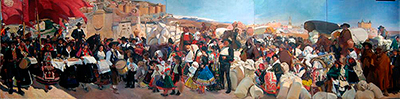
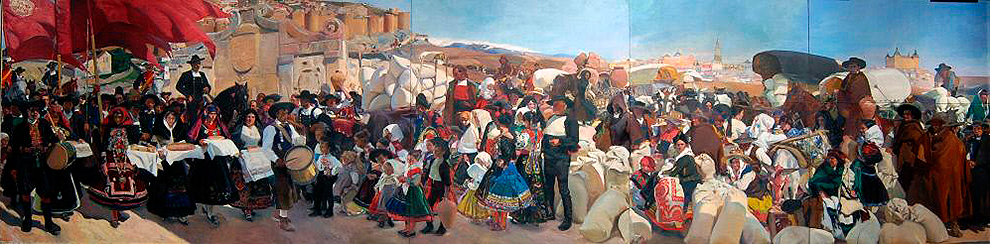
A procession advances beneath enormous red banners, women carry bread on white cloths, and carts, animals and sacks crowd the other end of the scene. Across this extraordinary gathering, Joaquín Sorolla keeps opening new routes for the eye. A bright skirt catches attention; a pale load interrupts the crowd; a mounted figure rises above the heads around him. Castilla, the Feast of Bread asks to be explored sideways, in stages, as well as seen whole.
Completed in 1913, the oil painting belongs to the Hispanic Society Museum & Library in New York. Its Spanish title is Castilla. La fiesta del pan. Almost fourteen metres wide, it is the widest of the fourteen panels in Sorolla’s Vision of Spain. The Hispanic Society and the Prado’s 2009 exhibition checklist agree on its width of 1,392 centimetres, although their recorded heights differ.[1][2] That exceptional breadth shapes everything about the picture: the number of people, the changes of emphasis, and the way a scene of public celebration becomes a larger image of a region.
At a Glance
- ArtistJoaquín Sorolla
- SubjectCastilla, the Feast of Bread
- Date1913
- CollectionHispanic Society Museum & Library
- InventoryA1815
This work across Joaquín Sorolla’s career
Contents
- A crowd with several centres
- A festival assembled from places
- Clothing as colour and evidence
- From studies to a monumental canvas
- A panorama within a room
A crowd with several centres
The composition begins with a great canopy of red. The banners at the upper left extend beyond the painted edge, so that the procession appears to continue outside the picture. Their folds form large, irregular planes above the much smaller incidents below. Against them, the dark clothing of the people gathers into a dense mass, broken by faces, white fabric and decorative colour.
Below this covering, the women carrying bread form an unusually clear line. The light cloths spread across their arms make a pale horizontal passage through the surrounding darkness. Their clothing differs in pattern and colour, but the repeated action joins them. Bread is given a ceremonial presence through the way it is carried and presented. It occupies the space between the women and the viewer, almost at the front of the painting.
Sorolla does not arrange the entire gathering into an even row. Behind the carriers, figures overlap and recede; riders and upright poles lift the eye; the large stone structure brings another scale into the crowded left half. Nearer the middle, smaller figures advance into more open ground. Their separation makes a change of pace. We can distinguish individual bodies and the shapes of their skirts more readily than in the densely packed group beneath the banners.
A woman’s blue skirt becomes one of the central colour anchors. Its broad shape is edged with bright decorative bands, and the surrounding reds, yellows, greens and white sleeves give the foreground a concentrated richness. These garments also make the bodies legible: spreading skirts widen the lower part of the group, while narrow dark bodices and upright heads establish a firmer vertical rhythm. The picture holds a crowd together through repeated shapes without making everyone look interchangeable.
At the right, the organisation becomes looser. Pale sacks accumulate close to the bottom edge; cart wheels and harnessed animals introduce curves and diagonals among the upright people. A rider stands high against the sky. The loaded vehicles help turn the ceremonial scene towards the material business of carrying goods. The eye travels between people and loads, rather than following one uninterrupted procession from end to end.
These shifts are essential to the panorama. The left has the weight and order of a public presentation; the middle offers distinct foreground figures; the right gives greater prominence to transport and accumulation. Together they make an expansive gathering whose different activities remain connected by the continuous ground and the crowd behind them.
Castilla, the Feast of Bread — larger view
A festival assembled from places
The title suggests an identifiable occasion, yet the picture is a carefully constructed regional scene. Discussing its large preparatory study, Museo Sorolla specialist David Ruiz López describes an imaginary votive procession. He connects the left section with León, Salamanca and Zamora, provinces then grouped as the Region of León, and identifies Ávila’s Fuente del Pradillo and suggested city walls among its architectural ingredients.[3] Such a combination explains why the panorama feels more expansive than a view of one square at one moment.
The distinction matters when looking at the background. Architecture appears above and between the people, but it never establishes the kind of continuous street plan that would organise an ordinary town view. Pale masonry, distant towers, low roofs and the long horizon provide recognisable kinds of place. The human gathering moves across them with a continuity of its own. Monument and crowd share the picture without either becoming a complete survey.
Sorolla’s preparatory landscapes show how much observation could lie behind this assembled setting. The Museo Sorolla identifies Castle of La Mota, Medina del Campo, painted on 29 May 1912, as a preliminary study for the background of this panel.[4] A small landscape could therefore serve a project of enormous dimensions. Its role was to supply observed material that the painter could reconsider within a much broader design.
Another museum landscape, View of Ávila, was painted in May 1912 and is likewise catalogued as preparation for The Feast of Bread.[5] These studies give a geographical substance to the finished scene. They also reveal the distance between gathering information and organising a painting: a place seen during travel becomes one part of a panorama built to accommodate many figures and several kinds of regional association.
The Castile of the panel consequently has a deliberately wide reach. Its ceremonial dress, provisions, transport and monumental background bring together different aspects of the chosen territory. The people retain their individual presence within the crowd while representing places and traditions for viewers elsewhere.
Clothing as colour and evidence
Traditional dress is one of the painting’s principal means of distinction. Dark garments beneath the banners allow white cloths and ornament to register strongly. Further along, brilliant skirts spread colour over a larger area. At the right, long brown garments and pale loads alter the balance again. These differences register before the individual details.
This variety grew from sustained preparation. The Museo Sorolla’s exhibition dossier Fiesta y color describes the Castilian campaign of 1912 and part of 1913 through figure studies, landscapes, photographs and the acquisition of traditional clothing. It places the studies Types of Lagartera, Types of Salamanca and Salamancan Bride and Groom alongside the garments that help explain this part of Sorolla’s work.[6] Dress was material to study, collect and compose with, as well as something to render attractively.
The museum’s textile overview confirms that many pieces in its collection were gathered or bought during journeys undertaken for the Hispanic Society commission. Much of the collection dates from the late nineteenth and early twentieth centuries, with substantial holdings from La Alberca, León, Roncal, Lagartera and Ansó.[7] These surviving objects bring the represented clothing closer to a history of actual making and use. The painted patterns belong to garments with local histories, even when Sorolla turns them into broad accents within a huge design.
Collection history can also complicate an apparently straightforward connection. The museum’s account of the richly ornamented traje de vistas from La Alberca explains that Sorolla wanted to buy it when preparing his 1912 painting of the Salamanca couple, but acquired it only two years after completing the Castile panel.[8] The costume’s survival helps illuminate his interest; its later purchase cannot by itself establish that this very museum object was available in his studio throughout the panel’s execution.
For a viewer, the larger effect remains immediately visible. Cloth varies between flowing expanse and dense decoration. White sleeves and coverings catch the light differently from dark bodices; the coloured bands at the bottom of a skirt follow its curve. Sorolla uses these changes to give weight and direction to the figures. A garment can be evidence of a chosen tradition and, at the same time, one of the chief shapes holding the composition together.
From studies to a monumental canvas
Archer Milton Huntington formally commissioned the decoration on 26 November 1911. In her account of Sorolla’s work for the Huntington collection, Blanca Pons-Sorolla places the completed Castile panel first in the sequence of execution, in 1913; the panels of Seville’s Holy Week, Aragon, Navarre and other regions followed in 1914.[9] Castile was therefore an early and exceptionally ambitious solution to the practical problem of turning regional material into a room-sized painting.
The preparatory works reveal more than one kind of decision. Landscape studies secured features of place; figure studies examined clothing and pose; a compositional study tested how incidents could fit together. Ruiz López notes the use of collage in the large study and its close relationship to the left part of the final panel. He also points to connections with oil and gouache studies and photographs acquired by the artist.[3] The finished painting’s apparent abundance depended on decisions about placement, scale and connection.
A separate gouache in the Museo Sorolla, inventory 1020, concerns the right section. The museum dates it to January–February 1913 and describes a procession, a loaded cart, sacks, figures and an animal seen from behind. Its catalogue explicitly distinguishes the arrangement in the study from that in the final painting. The same record places Sorolla’s temporary studio at the Cuesta de las Perdices in Madrid, where models posed in regional clothing during the first months of 1913.[10]
That evidence makes the picture’s different kinds of space particularly interesting. Some people seem to present themselves clearly to the viewer; others are half lost among companions and equipment. The sacks at the front occupy a broad, shallow zone, while the crowd beyond compresses into a strip of heads and hats. The large canvas accommodates both the studied individual figure and the anonymous multitude, changing the density around each group to make it readable.
Its daylight also works at several scales. Large pale shapes establish the overall balance, while smaller flashes pick out faces and sleeves. Sunlit architecture supplies a warm, relatively continuous background to the busy foreground. The sky gives the upper right an openness that answers the mass of banners at the opposite end. A scene packed with people thus retains a broad division between the weight of the gathering and the air above it.
A panorama within a room
The full ensemble was painted between 1912 and 1919 and inaugurated at the Hispanic Society in 1926. Its gallery surrounds the viewer with regional scenes.[11] Within that setting, Castile’s width has a particular force. A reproduction reduces the whole gathering to a narrow band; at the painting’s actual scale, attention has to move between local encounters and the wider design.
The contrasting formats of the other panels make this breadth more noticeable. Navarre, the Town Council of Roncal brings a standing group into a comparatively narrow field, while Aragon, Jota concentrates on dancers and their company.[2] In The Feast of Bread, the question is how several groups can coexist across an exceptionally long surface. Its intervals matter as much as its crowding: every clearer patch of ground or pale interruption gives the eye room to begin again.
The bread carriers remain a memorable entrance into the picture, but the panorama gradually enlarges their action. Bread, cloth, decorated dress, transport and architecture become parts of a collective presentation. Sorolla gives the region an image through the meeting of these things, keeping individual figures visible within the scale of the undertaking. The richness comes from that exchange between the close encounter and the almost unmanageable whole: a cloth supported by two arms, a single bright skirt, then the gathering stretching far beyond either.
Watch: Sorolla, light and painting
Three National Gallery films offer an introduction, a closer look at technique and a longer curator’s talk.
An introduction to 'Sorolla: Spanish Master of Light'
Start with a short exhibition introduction to Sorolla’s subjects and career.
Watch on YouTubeArtworks and exhibition records
Browse 103 artwork articles, 350 numbered entries from the Hispanic Society’s 1909 New York catalogue, and two selected Meadows Museum drawings. These are records, not a count of unique artworks: repeated historical titles remain separate entries and may overlap with the articles. A catalogue’s exhibition year does not establish an execution date. This researched selection is not a complete catalogue raisonné.
| Name | Date | Medium |
|---|---|---|
| Women Walking on the Beach | 1909 | Painting |
| Sewing the Sail | 1896 | Painting |
| Running Along the Beach | 1908 | Painting |
| Sad Inheritance | 1899 | Painting |
| Mother | 1895–1900 | Painting |
| The Horse's Bath | 1909 | Painting |
| The Pink Robe | 1916 | Painting |
| And They Still Say Fish are Expensive! | 1894 | Painting |
| The Return from Fishing | 1894 | Painting |
| Children on the Beach | 1909 | Painting |
| Castilla, the Feast of Bread | 1913 | Painting |
| Sevilla, Holy Week Penitents | 1914 | Painting |
| Aragon, Jota | 1914 | Painting |
| Navarre, the Town Council of Roncal | 1914 | Painting |
| Guipúzcoa, Bowling | 1914 | Painting |
| Andalucía, El Encierro | 1914 | Painting |
| Seville, the Dance | 1915 | Painting |
| Sevilla, The Bullfighters | 1915 | Painting |
| Galicia, The Pilgrimage | 1915 | Painting |
| The Fish | 1915 | Painting |
| Valencia, Couples on Horseback | 1916 | Painting |
| Extremadura, The Market | 1917 | Painting |
| Elche, The Palm Grove | 1918–1919 | Painting |
| The Tunny Catch | 1919 | Painting |
| Louis Comfort Tiffany | 1911 | Painting |
| Adobe Houses | 1890–1895 | Painting |
| After Bathing | 1915 | Painting |
| After Bathing, Valencia | 1909 | Painting |
| After Bathing, Valencian Beach | 1908 | Painting |
| Afternoon Sun, Playa de Valencia | 1910 (Album catalogue) | Painting |
| Aim of Ibiza | 1919 | Painting |
| Almond Trees in Asis | Spring,1887–1889 | Painting |
| Another Margarita | 1892 | Painting |
| Antonio García at the Beach | 1909 | Painting |
| Around Segovia | 9–15 October 1906 | Painting |
| Artist's Patio, Cafe Novedades, Seville | 1915 | Painting |
| Asturian Landscape | circa 1904 | Painting |
| Aureliano de Beruete | 1902 | Painting |
| Aureliano de Beruete y Moret, Son | 1902 | Painting |
| The Bath, Jávea | 1905 | Painting |
| The Bathing Hour | 1915 execution, signed and dated1917 (Sothebys catalogue account) | Painting |
| Bathing Time | 1904 | Painting |
| Beach at Valencia | 1908 in ARC catalogue | Painting |
| Beach at Zarauz | 1910 | Painting |
| Beach of Biarritz | 1906 | Painting |
| Beach of Biarritz, France | Summer1906 | Painting |
| Beached Boats | 1915 | Painting |
| Beaching the Boat | 1908 in ARC catalogue | Painting |
| Blessing the Boat | 1895 | Painting |
| Blind Man of Toledo | 1906 | Painting |
| Boat Builders | 1894 | Painting |
| Boat in Albufera | 1895 | Painting |
| Boy on the Sand | Undated | Painting |
| Boys in the Sea | 1908 | Painting |
| Boys on the Beach | BeforeNewYork1909exhibition; exactyearunresolved | Painting |
| Breakwater, San Sebastian | 1917–1918 | Painting |
| Bulls in the Sea | 1903 | Painting |
| Capturing the Moment | 1906 | Painting |
| Castle of La Mota, Medina del Campo | 29 May 1912 | Painting |
| Children in the Sea | Painting | |
| Children on the Beach, Valencia | 1916 | Painting |
| Children on the Seashore | 1903 | Painting |
| Child's Siesta | circa 1918 (ARC catalogue) | Painting |
| Church Roncal Stairs | 22–28August1912 | Painting |
| Clothilde at the Beach | Summer1904 | Painting |
| Clotilde and Elena on the Rocks at Javea | 1905 | Painting |
| Clotilde García del Castillo | April1890 | Painting |
| Clotilde in a Grey Dress | 1900 | Painting |
| Clotilde with Hat | 1910 | Painting |
| Coast at Santa Cristina | 29 September 1915 (current CERES1122) | Painting |
| Court of the Dances, Alcázar, Sevilla | 1910 | Painting |
| Covachuelas, Toledo | 21–30 October 1906 | Painting |
| Dragging the Trawler | circa 1903–1904 in educational catalogue | Painting |
| El Retiro, Madrid | 1898 | Painting |
| Female Nude | 1902 | Painting |
| Fisherman in Valencia | 1904 | Painting |
| Fisherwomen from Valencia | June–July 1915 | Painting |
| Fishing Boats | by February 1909 | Painting |
| Fishing Nets | 1893 | Painting |
| The Gardens at the Sorolla Family House | spring 1920 | Painting |
| Hall of the Ambassadors, Alhambra, Granada | 1909 | Painting |
| Harbour | 1880 | Painting |
| Joaquín Sorolla García in a White Dress | 1896 | Painting |
| Lighthouse Walk at Biarritz | 1906 | Painting |
| The Little Yacht | 1909 | Painting |
| Maria at La Granja | 1907 | Painting |
| My Children | 1904 | Painting |
| My Wife and Daughters in the Garden | 1910 | Painting |
| Portrait of Benito Pérez Galdós | 1894 | Painting |
| A Rooftop with Flowers | 1902 | Painting |
| Self Portrait | 1904 | Painting |
| Self Portrait | 1909 | Painting |
| Señora de Sorolla in Black | 1906 | Painting |
| La Siesta | 1911 | Painting |
| The Skipping Rope | 1907 | Painting |
| Swimmers, Jávea | 1905 | Painting |
| Time for a Bathe | 1909 | Painting |
| Under the Awning, Zarauz | 1910 | Painting |
| Valencia Beach in the Morning Light | summer 1908 | Painting |
| Valencian Fishermen | 1895 | Painting |
| The White Boat, Jávea | 1905 | Painting |
| White Slave Trade | 1894 | Painting |
| The Wounded Foot | 1909 | Painting |
| Seven Peaks, Guadarrama — 1909 catalogue, no. 1 | Painting | |
| Covachuelas, Toledo — 1909 catalogue, no. 2 | Painting | |
| Las Pedrizas, El Pardo — 1909 catalogue, no. 3 | Painting | |
| Señor Gomar — 1909 catalogue, no. 4 | Painting | |
| El Torneo, El Pardo — 1909 catalogue, no. 5 | Painting | |
| A Toledo Street — 1909 catalogue, no. 6 | Painting | |
| View from El Torneo — 1909 catalogue, no. 7 | Painting | |
| Walls of Segovia — 1909 catalogue, no. 8 | Painting | |
| Convent of El Parral, Segovia — 1909 catalogue, no. 9 | Painting | |
| Environs of Segovia — 1909 catalogue, no. 10 | Painting | |
| Reflections from the Cape, Jávea — 1909 catalogue, no. 11 | Painting | |
| The Clamores, Segovia — 1909 catalogue, no. 12 | Painting | |
| Rocks of the Cape, Jávea — 1909 catalogue, no. 13 | Painting | |
| Farmhouse, Alcira — 1909 catalogue, no. 14 | Painting | |
| María at Biarritz — 1909 catalogue, no. 15 | Painting | |
| Shadow of the Alcántara Bridge, Toledo — 1909 catalogue, no. 16 | Painting | |
| Castle of San Servando, Toledo — 1909 catalogue, no. 17 | Painting | |
| Dr Decret — 1909 catalogue, no. 18 | Painting | |
| Alcántara Bridge, Toledo — 1909 catalogue, no. 19 | Painting | |
| The Forest, La Granja — 1909 catalogue, no. 20 | Painting | |
| Trout Stream, La Granja — 1909 catalogue, no. 21 | Painting | |
| Court of the Dances, Alcázar, Seville — 1909 catalogue, no. 22 | Painting | |
| Oleanders — 1909 catalogue, no. 23 | Painting | |
| Glen, Asturias — 1909 catalogue, no. 24 | Painting | |
| Pavilion of Charles V, Seville — 1909 catalogue, no. 25 | Painting | |
| St Martin's Bridge, Toledo — 1909 catalogue, no. 26 | Painting | |
| Orange Trees — 1909 catalogue, no. 27 | Painting | |
| Rope Makers — 1909 catalogue, no. 28 | Painting | |
| Señor Franzen — 1909 catalogue, no. 29 | Painting | |
| Rocks at the Lighthouse, Biarritz — 1909 catalogue, no. 30 | Painting | |
| St Martin's Bridge, Toledo — 1909 catalogue, no. 31 | Painting | |
| Valencian Fisherwoman — 1909 catalogue, no. 32 | Painting | |
| Road of San Esteban, Asturias — 1909 catalogue, no. 33 | Painting | |
| Basin in the Alcázar, Seville — 1909 catalogue, no. 34 | Painting | |
| Harbour of Valencia — 1909 catalogue, no. 35 | Painting | |
| Haymaking, Asturias — 1909 catalogue, no. 36 | Painting | |
| House of El Greco, Toledo — 1909 catalogue, no. 37 | Painting | |
| María with a Black Hat — 1909 catalogue, no. 38 | Painting | |
| Entrance Tower, Toledo — 1909 catalogue, no. 39 | Painting | |
| Las Covachuelas, Toledo — 1909 catalogue, no. 40 | Painting | |
| Rocks, Jávea — 1909 catalogue, no. 41 | Painting | |
| Road of the Alijares, Toledo — 1909 catalogue, no. 42 | Painting | |
| Segovian Family — 1909 catalogue, no. 43 | Painting | |
| Scalding Grapes, Jávea — 1909 catalogue, no. 44 | Painting | |
| Joaquín — 1909 catalogue, no. 45 | Painting | |
| Elena — 1909 catalogue, no. 46 | Painting | |
| El Grutesco, Alcázar, Seville — 1909 catalogue, no. 47 | Painting | |
| Beach of Valencia — 1909 catalogue, no. 48 | Painting | |
| Sails Drying, Valencia — 1909 catalogue, no. 49 | Painting | |
| Orange Tree — 1909 catalogue, no. 50 | Painting | |
| Little Boy with a Toy Boat — 1909 catalogue, no. 51 | Painting | |
| Old Valencian Fisherman — 1909 catalogue, no. 52 | Painting | |
| Fishing Boats — 1909 catalogue, no. 53 | Painting | |
| Harbour of Valencia — 1909 catalogue, no. 54 | Painting | |
| The Kiss — 1909 catalogue, no. 55 | Painting | |
| Little Boy on a Rock, Jávea — 1909 catalogue, no. 56 | Painting | |
| The Queen's Beam, Valsaín — 1909 catalogue, no. 57 | Painting | |
| Staircase of the Palace, La Granja — 1909 catalogue, no. 58 | Painting | |
| Elena at El Pardo — 1909 catalogue, no. 59 | Painting | |
| Fountain of the Horses, La Granja — 1909 catalogue, no. 60 | Painting | |
| Autumn, La Granja — 1909 catalogue, no. 61 | Painting | |
| María Painting, El Pardo — 1909 catalogue, no. 62 | Painting | |
| Fountain of the Forest, La Granja — 1909 catalogue, no. 63 | Painting | |
| Fountain of Neptune, La Granja — 1909 catalogue, no. 64 | Painting | |
| Orange Grove, Valencia — 1909 catalogue, no. 65 | Painting | |
| Francisqueta, Valencia — 1909 catalogue, no. 66 | Painting | |
| Waiting for the Fish, Valencia — 1909 catalogue, no. 67 | Painting | |
| Taking in the Sail, Valencia — 1909 catalogue, no. 68 | Painting | |
| Return from Fishing, Valencia — 1909 catalogue, no. 69 | Painting | |
| Crayfishers, Valencia — 1909 catalogue, no. 70 | Painting | |
| Swimmer, Jávea — 1909 catalogue, no. 71 | Painting | |
| Elena among Roses — 1909 catalogue, no. 72 | Painting | |
| Idyll — 1909 catalogue, no. 73 | Painting | |
| Vicente Blasco Ibáñez — 1909 catalogue, no. 74 | Painting | |
| Yellow Tree, La Granja — 1909 catalogue, no. 75 | Painting | |
| Blind Man of Toledo — 1909 catalogue, no. 76 | Painting | |
| Fisherwoman with Her Son, Valencia — 1909 catalogue, no. 77 | Painting | |
| The Bath, La Granja — 1909 catalogue, no. 78 | Painting | |
| Sewing the Sail, Valencia — 1909 catalogue, no. 79 | Painting | |
| Looking for Crabs, Jávea — 1909 catalogue, no. 80 | Painting | |
| María, La Granja — 1909 catalogue, no. 81 | Painting | |
| Joaquín and His Dog — 1909 catalogue, no. 82 | Painting | |
| Upon the Sand — 1909 catalogue, no. 83 | Painting | |
| Valencian Fisherwomen — 1909 catalogue, no. 84 | Painting | |
| Señora de Sorolla in White — 1909 catalogue, no. 85 | Painting | |
| At the Seashore, Valencia — 1909 catalogue, no. 86 | Painting | |
| Valencian Woman — 1909 catalogue, no. 87 | Painting | |
| In the Gardens of La Granja — 1909 catalogue, no. 88 | Painting | |
| Old Castilian — 1909 catalogue, no. 89 | Painting | |
| Marqués de Urquijo — 1909 catalogue, no. 90 | Painting | |
| Fisherman's Daughter, Valencia — 1909 catalogue, no. 91 | Painting | |
| Elena and Her Dolls — 1909 catalogue, no. 92 | Painting | |
| My Children — 1909 catalogue, no. 93 | Painting | |
| Swimmers — 1909 catalogue, no. 94 | Painting | |
| Low Tide: Elena at Biarritz — 1909 catalogue, no. 95 | Painting | |
| Mending Nets — 1909 catalogue, no. 96 | Painting | |
| The Bath, Jávea — 1909 catalogue, no. 97 | Painting | |
| The Bath, Jávea — 1909 catalogue, no. 98 | Painting | |
| Boxing Raisins — 1909 catalogue, no. 99 | Painting | |
| Forest Bridge, La Granja — 1909 catalogue, no. 100 | Painting | |
| View of the Palace, La Granja — 1909 catalogue, no. 101 | Painting | |
| Return from Fishing, Valencia — 1909 catalogue, no. 102 | Painting | |
| At the Bath, Valencia — 1909 catalogue, no. 103 | Painting | |
| Little Girl with a Blue Ribbon, Valencia — 1909 catalogue, no. 104 | Painting | |
| María at the Harbour of Jávea — 1909 catalogue, no. 105 | Painting | |
| Instantaneous, Biarritz — 1909 catalogue, no. 106 | Painting | |
| Boy among Breakers, Jávea — 1909 catalogue, no. 107 | Painting | |
| Garden of the Alcázar, Seville — 1909 catalogue, no. 108 | Painting | |
| Oleander Road, Valencia — 1909 catalogue, no. 109 | Painting | |
| María and Her Grandmother — 1909 catalogue, no. 110 | Painting | |
| Malvarrosa Beach, Valencia — 1909 catalogue, no. 111 | Painting | |
| The Huerta of Valencia — 1909 catalogue, no. 112 | Painting | |
| Garden of the Alcázar, Seville — 1909 catalogue, no. 113 | Painting | |
| Garden of the Alcázar, Seville — 1909 catalogue, no. 114 | Painting | |
| The Giralda, Seville — 1909 catalogue, no. 115 | Painting | |
| Palace of Charles V, Seville — 1909 catalogue, no. 116 | Painting | |
| Harbour of Valencia — 1909 catalogue, no. 117 | Painting | |
| Marqués de la Vega-Inclán — 1909 catalogue, no. 118 | Painting | |
| Harbour of Valencia — 1909 catalogue, no. 119 | Painting | |
| At the Water, Valencia — 1909 catalogue, no. 120 | Painting | |
| House in the Huerta, Valencia — 1909 catalogue, no. 121 | Painting | |
| Beach Garden, Valencia — 1909 catalogue, no. 122 | Painting | |
| Huerta of Valencia — 1909 catalogue, no. 123 | Painting | |
| Garden of the Alcázar, Seville — 1909 catalogue, no. 124 | Painting | |
| Asturias — 1909 catalogue, no. 125 | Painting | |
| San Sebastián — 1909 catalogue, no. 126 | Painting | |
| Old Harbour, Biarritz — 1909 catalogue, no. 127 | Painting | |
| Beach of Biarritz — 1909 catalogue, no. 128 | Painting | |
| Beach of Biarritz — 1909 catalogue, no. 129 | Painting | |
| Beach of Biarritz — 1909 catalogue, no. 130 | Painting | |
| Beach of Biarritz — 1909 catalogue, no. 131 | Painting | |
| Beach of Biarritz — 1909 catalogue, no. 132 | Painting | |
| Beach of Biarritz — 1909 catalogue, no. 133 | Painting | |
| Beach of Biarritz — 1909 catalogue, no. 134 | Painting | |
| Beach of Biarritz — 1909 catalogue, no. 135 | Painting | |
| Beach of Biarritz — 1909 catalogue, no. 136 | Painting | |
| Beach of Biarritz — 1909 catalogue, no. 137 | Painting | |
| Beach of Biarritz — 1909 catalogue, no. 138 | Painting | |
| Beach of Biarritz — 1909 catalogue, no. 139 | Painting | |
| Beach of Biarritz — 1909 catalogue, no. 140 | Painting | |
| Beach of Biarritz — 1909 catalogue, no. 141 | Painting | |
| Beach of Biarritz — 1909 catalogue, no. 142 | Painting | |
| Beach of Biarritz — 1909 catalogue, no. 143 | Painting | |
| La Concha, San Sebastián — 1909 catalogue, no. 144 | Painting | |
| Beach of Biarritz — 1909 catalogue, no. 145 | Painting | |
| Beach of Biarritz — 1909 catalogue, no. 146 | Painting | |
| Beach of Biarritz — 1909 catalogue, no. 147 | Painting | |
| Beach of Biarritz — 1909 catalogue, no. 148 | Painting | |
| Beach of Biarritz — 1909 catalogue, no. 149 | Painting | |
| Beach of Biarritz — 1909 catalogue, no. 150 | Painting | |
| Beach of Biarritz — 1909 catalogue, no. 151 | Painting | |
| Beach of Biarritz — 1909 catalogue, no. 152 | Painting | |
| Beach of Biarritz — 1909 catalogue, no. 153 | Painting | |
| Beach of Biarritz — 1909 catalogue, no. 154 | Painting | |
| Beach of Valencia — 1909 catalogue, no. 155 | Painting | |
| Beach of Valencia — 1909 catalogue, no. 156 | Painting | |
| Beach of Valencia — 1909 catalogue, no. 157 | Painting | |
| Harbour of San Sebastián — 1909 catalogue, no. 158 | Painting | |
| Harbour of San Sebastián — 1909 catalogue, no. 159 | Painting | |
| Beach of Valencia — 1909 catalogue, no. 160 | Painting | |
| Pasajes — 1909 catalogue, no. 161 | Painting | |
| Harbour of San Sebastián — 1909 catalogue, no. 162 | Painting | |
| La Concha, San Sebastián — 1909 catalogue, no. 163 | Painting | |
| La Concha, San Sebastián — 1909 catalogue, no. 164 | Painting | |
| Harbour of Pasajes — 1909 catalogue, no. 165 | Painting | |
| Beach of Valencia — 1909 catalogue, no. 166 | Painting | |
| Beach of Valencia — 1909 catalogue, no. 167 | Painting | |
| Beach of Valencia — 1909 catalogue, no. 168 | Painting | |
| Beach of Valencia — 1909 catalogue, no. 169 | Painting | |
| Beach of Valencia — 1909 catalogue, no. 170 | Painting | |
| Beach of Valencia — 1909 catalogue, no. 171 | Painting | |
| Beach of Valencia — 1909 catalogue, no. 172 | Painting | |
| Beach of Valencia — 1909 catalogue, no. 173 | Painting | |
| Beach of Valencia — 1909 catalogue, no. 174 | Painting | |
| Beach of Valencia — 1909 catalogue, no. 175 | Painting | |
| Beach of Valencia — 1909 catalogue, no. 176 | Painting | |
| Beach of Valencia — 1909 catalogue, no. 177 | Painting | |
| Cape San Antonio, Jávea — 1909 catalogue, no. 178 | Painting | |
| Galicia — 1909 catalogue, no. 179 | Painting | |
| Sewing the Sail — 1909 catalogue, no. 180 | Painting | |
| Poppies — 1909 catalogue, no. 181 | Painting | |
| Beach of Valencia — 1909 catalogue, no. 182 | Painting | |
| Malvarrosa — 1909 catalogue, no. 183 | Painting | |
| Harbour of San Sebastián — 1909 catalogue, no. 184 | Painting | |
| Beach of Valencia — 1909 catalogue, no. 185 | Painting | |
| Locutory — 1909 catalogue, no. 186 | Painting | |
| Beach of Valencia — 1909 catalogue, no. 187 | Painting | |
| Beach of Valencia — 1909 catalogue, no. 188 | Painting | |
| Cape San Antonio, Jávea — 1909 catalogue, no. 189 | Painting | |
| Beach of Valencia — 1909 catalogue, no. 190 | Painting | |
| Oleanders — 1909 catalogue, no. 191 | Painting | |
| Beach of Valencia — 1909 catalogue, no. 192 | Painting | |
| La Concha, San Sebastián — 1909 catalogue, no. 193 | Painting | |
| Beach of Valencia — 1909 catalogue, no. 194 | Painting | |
| Beach of Valencia — 1909 catalogue, no. 195 | Painting | |
| Beach of Valencia — 1909 catalogue, no. 196 | Painting | |
| Biarritz — 1909 catalogue, no. 197 | Painting | |
| Biarritz — 1909 catalogue, no. 198 | Painting | |
| Segovia — 1909 catalogue, no. 199 | Painting | |
| Asturias — 1909 catalogue, no. 200 | Painting | |
| Versailles — 1909 catalogue, no. 201 | Painting | |
| Beach of Valencia — 1909 catalogue, no. 202 | Painting | |
| Beach of Valencia — 1909 catalogue, no. 203 | Painting | |
| Beach of Valencia — 1909 catalogue, no. 204 | Painting | |
| Beach of Valencia — 1909 catalogue, no. 205 | Painting | |
| Court of El Cabañal — 1909 catalogue, no. 206 | Painting | |
| In the River — 1909 catalogue, no. 207 | Painting | |
| Harbour of Valencia — 1909 catalogue, no. 208 | Painting | |
| Beach of Valencia — 1909 catalogue, no. 209 | Painting | |
| Harbour of Valencia — 1909 catalogue, no. 210 | Painting | |
| Beach of Valencia — 1909 catalogue, no. 211 | Painting | |
| Beach of Valencia — 1909 catalogue, no. 212 | Painting | |
| Beach of Valencia — 1909 catalogue, no. 213 | Painting | |
| Royal Mallows — 1909 catalogue, no. 214 | Painting | |
| Geraniums — 1909 catalogue, no. 215 | Painting | |
| Altar of St Vincent, Valencia — 1909 catalogue, no. 216 | Painting | |
| Beach of Valencia — 1909 catalogue, no. 217 | Painting | |
| Harbour of Avilés — 1909 catalogue, no. 218 | Painting | |
| Beach of Valencia — 1909 catalogue, no. 219 | Painting | |
| Beach of Valencia — 1909 catalogue, no. 220 | Painting | |
| Beach of Valencia — 1909 catalogue, no. 221 | Painting | |
| Market of León — 1909 catalogue, no. 222 | Painting | |
| Beach of Valencia — 1909 catalogue, no. 223 | Painting | |
| Beach of Valencia — 1909 catalogue, no. 224 | Painting | |
| Beach of Valencia — 1909 catalogue, no. 225 | Painting | |
| Beach of Valencia — 1909 catalogue, no. 226 | Painting | |
| Beach of Valencia — 1909 catalogue, no. 227 | Painting | |
| Huerta of Valencia — 1909 catalogue, no. 228 | Painting | |
| Beach of Valencia — 1909 catalogue, no. 229 | Painting | |
| Beach of Valencia — 1909 catalogue, no. 230 | Painting | |
| Beach of Valencia — 1909 catalogue, no. 231 | Painting | |
| Beach of Valencia — 1909 catalogue, no. 232 | Painting | |
| Beach of Valencia — 1909 catalogue, no. 233 | Painting | |
| Beach of Valencia — 1909 catalogue, no. 234 | Painting | |
| Asturias — 1909 catalogue, no. 235 | Painting | |
| Beach of Valencia — 1909 catalogue, no. 236 | Painting | |
| Women Playing — 1909 catalogue, no. 237 | Painting | |
| Beach of Valencia — 1909 catalogue, no. 238 | Painting | |
| Beach of Valencia — 1909 catalogue, no. 239 | Painting | |
| Beach of Valencia — 1909 catalogue, no. 240 | Painting | |
| Beach of Valencia — 1909 catalogue, no. 241 | Painting | |
| Market of León — 1909 catalogue, no. 242 | Painting | |
| Beach of Valencia — 1909 catalogue, no. 243 | Painting | |
| Beach of Valencia — 1909 catalogue, no. 244 | Painting | |
| Beach of Valencia — 1909 catalogue, no. 245 | Painting | |
| Beach of Valencia — 1909 catalogue, no. 246 | Painting | |
| Asturias — 1909 catalogue, no. 247 | Painting | |
| León — 1909 catalogue, no. 248 | Painting | |
| Asturias — 1909 catalogue, no. 249 | Painting | |
| Jávea — 1909 catalogue, no. 250 | Painting | |
| Asturias — 1909 catalogue, no. 251 | Painting | |
| León — 1909 catalogue, no. 252 | Painting | |
| Asturias — 1909 catalogue, no. 253 | Painting | |
| Asturias — 1909 catalogue, no. 254 | Painting | |
| Beach of Valencia — 1909 catalogue, no. 255 | Painting | |
| Beach of Valencia — 1909 catalogue, no. 256 | Painting | |
| Asturias — 1909 catalogue, no. 257 | Painting | |
| León — 1909 catalogue, no. 258 | Painting | |
| Beach of Valencia — 1909 catalogue, no. 259 | Painting | |
| Beach of Valencia — 1909 catalogue, no. 260 | Painting | |
| Beach of Valencia — 1909 catalogue, no. 261 | Painting | |
| León — 1909 catalogue, no. 262 | Painting | |
| Beach of Valencia — 1909 catalogue, no. 263 | Painting | |
| Asturias — 1909 catalogue, no. 264 | Painting | |
| Galicia — 1909 catalogue, no. 265 | Painting | |
| Malvarrosa — 1909 catalogue, no. 266 | Painting | |
| Jávea — 1909 catalogue, no. 267 | Painting | |
| Biarritz — 1909 catalogue, no. 268 | Painting | |
| Harbour of Jávea — 1909 catalogue, no. 269 | Painting | |
| La Concha, San Sebastián — 1909 catalogue, no. 270 | Painting | |
| San Sebastián — 1909 catalogue, no. 271 | Painting | |
| San Sebastián — 1909 catalogue, no. 272 | Painting | |
| Beach of Valencia — 1909 catalogue, no. 273 | Painting | |
| Beach of Valencia — 1909 catalogue, no. 274 | Painting | |
| Beach of Valencia — 1909 catalogue, no. 275 | Painting | |
| Beach of Valencia — 1909 catalogue, no. 276 | Painting | |
| Beach of Valencia — 1909 catalogue, no. 277 | Painting | |
| Washerwomen — 1909 catalogue, no. 278 | Painting | |
| San Sebastián — 1909 catalogue, no. 279 | Painting | |
| Beach of Valencia — 1909 catalogue, no. 280 | Painting | |
| San Sebastián — 1909 catalogue, no. 281 | Painting | |
| San Sebastián — 1909 catalogue, no. 282 | Painting | |
| Beach of Valencia — 1909 catalogue, no. 283 | Painting | |
| Beach of Valencia — 1909 catalogue, no. 284 | Painting | |
| Uncle Pancha — 1909 catalogue, no. 285 | Painting | |
| Señor García — 1909 catalogue, no. 286 | Painting | |
| Boy Nude, La Granja — 1909 catalogue, no. 287 | Painting | |
| Señora de Sorolla in Black — 1909 catalogue, no. 288 | Painting | |
| Duke of Alba — 1909 catalogue, no. 289 | Painting | |
| Mother: Señora de Sorolla — 1909 catalogue, no. 290 | Painting | |
| Running along the Beach — 1909 catalogue, no. 291 | Painting | |
| After the Bath — 1909 catalogue, no. 292 | Painting | |
| Lighthouse Walk, Biarritz — 1909 catalogue, no. 293 | Painting | |
| Little Boy on the Beach — 1909 catalogue, no. 294 | Painting | |
| Cape San Antonio, Jávea — 1909 catalogue, no. 295 | Painting | |
| Count of Villagonzalo — 1909 catalogue, no. 296 | Painting | |
| Boy in the Sea — 1909 catalogue, no. 297 | Painting | |
| Children on the Beach — 1909 catalogue, no. 298 | Painting | |
| Valencian Boats — 1909 catalogue, no. 299 | Painting | |
| The Little Brother — 1909 catalogue, no. 300 | Painting | |
| Children in the Sea — 1909 catalogue, no. 301 | Painting | |
| Orange Grove, Alcira — 1909 catalogue, no. 302 | Painting | |
| At the Water — 1909 catalogue, no. 303 | Painting | |
| Little Boy on the Beach — 1909 catalogue, no. 304 | Painting | |
| Street of Orange Trees — 1909 catalogue, no. 305 | Painting | |
| Playing in the Water — 1909 catalogue, no. 306 | Painting | |
| Beach of Valencia by Morning Light — 1909 catalogue, no. 307 | Painting | |
| Coming out of the Bath — 1909 catalogue, no. 308 | Painting | |
| The Grandson — 1909 catalogue, no. 309 | Painting | |
| Water Joy — 1909 catalogue, no. 310 | Painting | |
| On the Sand — 1909 catalogue, no. 311 | Painting | |
| Francisco Acebal — 1909 catalogue, no. 312 | Painting | |
| Marcelino Menéndez y Pelayo — 1909 catalogue, no. 313 | Painting | |
| Aureliano de Beruete — 1909 catalogue, no. 314 | Painting | |
| Marqués de Viana — 1909 catalogue, no. 315 | Painting | |
| Beach of Valencia — 1909 catalogue, no. 316 | Painting | |
| Señor Granzón — 1909 catalogue, no. 317 | Painting | |
| Oxen Ready to Beach Fishing Boats, Valencia — 1909 catalogue, no. 318 | Painting | |
| Children in the Sea — 1909 catalogue, no. 319 | Painting | |
| Sea: Morning Effect — 1909 catalogue, no. 320 | Painting | |
| Fishing Boat — 1909 catalogue, no. 321 | Painting | |
| Sails at Sea — 1909 catalogue, no. 322 | Painting | |
| Return from Fishing — 1909 catalogue, no. 323 | Painting | |
| Boats on the Sand — 1909 catalogue, no. 324 | Painting | |
| Study of Boats — 1909 catalogue, no. 325 | Painting | |
| Fishing Boats — 1909 catalogue, no. 326 | Painting | |
| Boats — 1909 catalogue, no. 327 | Painting | |
| Children on the Shore — 1909 catalogue, no. 328 | Painting | |
| Beach of Valencia — 1909 catalogue, no. 329 | Painting | |
| Beach of Valencia — 1909 catalogue, no. 330 | Painting | |
| Beach of Valencia — 1909 catalogue, no. 331 | Painting | |
| Beach of Valencia — 1909 catalogue, no. 332 | Painting | |
| Nets Drying — 1909 catalogue, no. 333 | Painting | |
| Shoving off the Boat — 1909 catalogue, no. 334 | Painting | |
| Beach of Valencia — 1909 catalogue, no. 335 | Painting | |
| Oleanders — 1909 catalogue, no. 336 | Painting | |
| Beach of Valencia — 1909 catalogue, no. 337 | Painting | |
| Beach of Valencia — 1909 catalogue, no. 338 | Painting | |
| Beach of Valencia — 1909 catalogue, no. 339 | Painting | |
| Leonese Peasants — 1909 catalogue, no. 340 | Painting | |
| At the Bath — 1909 catalogue, no. 341 | Painting | |
| Sea Idyll — 1909 catalogue, no. 342 | Painting | |
| The Little Granddaughter — 1909 catalogue, no. 343 | Painting | |
| Manuel B. Cossío — 1909 catalogue, no. 344 | Painting | |
| The Peppers — 1909 catalogue, no. 345 | Painting | |
| Raimundo de Madrazo — 1909 catalogue, no. 346 | Painting | |
| Alejandro Pidal y Mon — 1909 catalogue, no. 347 | Painting | |
| Señora de Sorolla in Spanish Mantilla — 1909 catalogue, no. 348 | Painting | |
| My Daughters, Elena and María, on Horseback in Valencian Costumes of 1808 — 1909 catalogue, no. 349 | Painting | |
| Sad Inheritance — 1909 catalogue, no. 350 | Painting | |
| Study of Hands | c. 1889 | Drawing |
| Clotilde Reading (recto) | c. 1902 | Drawing |
Discussion
Look again at the images and ideas explored in Castilla, the Feast of Bread. These editorial prompts invite your observations.
Reader Insights
Which detail in Castilla, the Feast of Bread first caught your attention, and where did your eye travel next?
The section “A crowd with several centres” offers one way into the subject. Which detail or comparison most helps you assess that reading?
After reading “A panorama within a room”, what would you return to for a closer look?
Join the Conversation
Share a detail, comparison or question about Castilla, the Feast of Bread below.
References
- Hispanic Society Museum & Library, “Vision of Spain (formerly, The Provinces of Spain): Castilla”, collection record A1815, date, medium and maximum dimensions; indexed record consulted. View source.
- Museo Nacional del Prado, “Joaquín Sorolla (1863–1923)”, 2009 exhibition, Hispanic Society section and checklist entries 82, 84–85; indexed institutional text consulted. View source.
- David Ruiz López, Museo Sorolla, “Estudio para «La fiesta del pan»”, museum study essay, paragraphs on the left section, Ávila motifs, collage and documentary sources; indexed text consulted. View source.
- Museo Sorolla, CER.es, “Castillo de la Mota, Medina del Campo”, inventory 00964, dating and reasoned classification, including reference to the 2019 catalogue raisonné and letter of 30 May 1912. View source.
- Museo Sorolla, CER.es, “Vista de Ávila”, inventory 00963, dating and reasoned classification; indexed institutional record consulted. View source.
- Museo Sorolla, Fiesta y color. La mirada etnográfica de Sorolla, exhibition dossier, section “1. Castilla”; indexed section consulted. View source.
- Museo Sorolla, “Textiles”, collection overview; indexed institutional text consulted. View source.
- Museo Sorolla, “Traje de vistas de La Alberca”, collection account, preparation and later acquisition; indexed institutional text consulted. View source.
- Blanca Pons-Sorolla, “Sorolla in the Huntingtons’ Collections,” in José Luis Colomer, Blanca Pons-Sorolla and Mark A. Roglán, eds., Sorolla in America: Friends and Patrons, publisher’s excerpt, printed p. 66 (PDF p. 14). View source.
- Museo Sorolla, CER.es, “Estudio para «Castilla. La fiesta del pan»”, inventory 01020, description, dating and reasoned classification; indexed institutional record consulted. View source.
- Hispanic Society Museum & Library, “Joaquín Sorolla’s Vision of Spain”, ensemble account, commission, execution dates and 1926 inauguration. View source.
- Hispanic Society of America, Catalogue of Paintings by Joaquín Sorolla y Bastida, 1909, entries 1–350. View source.
- Amanda W. Dotseth, Study of Hands, Sketch for The Regency, and Six Other Drawings by Joaquín Sorolla y Bastida, At the Meadows, Fall 2018, pp. 24–29. View source.