 by Tom Gurney
Tom Gurney BSc (Hons) is an art history expert with over 20 years experience
Published on June 19, 2020 / Updated on November 3, 2026
Email: tomgurney1@gmail.com / Phone: +44 7429 011000
Navarre, the Town Council of Roncal by Joaquín Sorolla: Introduction
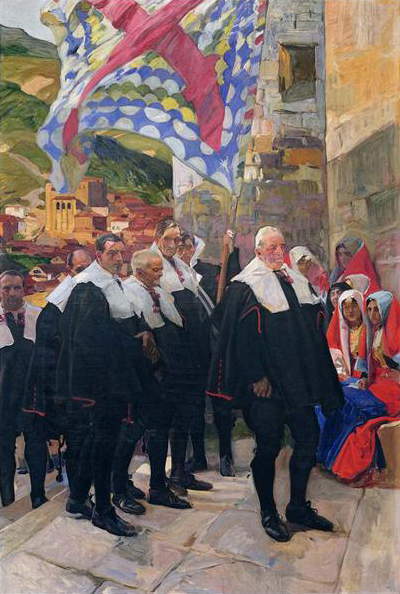
A great patterned flag opens above a group of men in black. Beneath it, white collars catch the light, heads turn in different directions, and polished shoes rest on pale stone. In Navarre, the Town Council of Roncal, Joaquín Sorolla gives civic ceremony a physical presence: heavy clothing, closely gathered bodies and the conspicuous fabric of a shared emblem. The scene feels concentrated, even crowded, yet a view of the town and its hills remains visible behind the gathering.
Painted in 1914, Navarra. El concejo del Roncal belongs to the Hispanic Society Museum & Library in New York. This oil on canvas measures 349 × 230 centimetres: a tall, relatively narrow contribution to Sorolla’s monumental Vision of Spain.[1] Its shape matters. The men appear gathered near us, with little empty ground between their feet and the lower edge. Above them, the flag occupies space that a more conventional group portrait might leave to sky or architecture. Public authority is expressed through people, dress and movement rather than a council chamber.
At a Glance
- ArtistJoaquín Sorolla
- SubjectNavarre, the Town Council of Roncal by Joaquín Sorolla
- Date1914
- CollectionHispanic Society Museum & Library
- InventoryA1802
This work across Joaquín Sorolla’s career
Contents
- What is the council doing?
- Black cloth and white collars
- A flag that changes the whole picture
- From Roncal studies to the finished panel
- A concentrated image within Vision of Spain
What is the council doing?
The word concejo means council, but the English title can suggest a seated meeting that the painting does not show. These men stand outdoors in ceremonial dress. The foreground figure is separated slightly from the others, while companions gather behind and beside him. Their assembly belongs to a wider public occasion.
Art historian Javier Azanza López identifies the setting with the arrival of Roncal’s authorities at the chapel of the Virgen del Castillo, accompanied by the valley’s flag. He describes the architecture as idealised and offers two possible occasions: a meeting of the valley council or a pilgrimage to the chapel. His account also relates the seven officials to the seven villages of the valley.[2] That uncertainty leaves the central subject clear. Sorolla has represented a body of civic authority participating in ceremonial life, without giving us the proceedings of a particular documented meeting.
The group’s arrangement encourages us to read both the collective and the individual. The foremost man stands almost fully exposed against the stone behind him. Other bodies overlap, their dark garments joining into a broad mass. Faces emerge at different heights, some in profile, others turned towards the viewer. The repeated collars unite them, but their postures interrupt any sense of a rigid uniform row.
A man near the centre inclines his head; another looks across the gathering. A raised hand holds the flagpole behind them. These small changes of direction give the scene its internal activity. Even where the figures remain still, the eye moves between their faces and hands. The civic group is legible as a shared presence without becoming a pattern of identical people.
Black cloth and white collars
The striking garments have a local history. The Museo Sorolla’s account of Roncal dress describes the ceremonial outfit of a regidor or mayor as including a black outer garment, or capote, edged in red, with a white valona. This broad collar was worn over the black cloth, spreading across the shoulders and chest. The museum preserves an example of the outfit.[3]
Those features explain much of the painting’s design. Fine red lines trace the edges of the dark garments, while the white collars produce a succession of bright angular shapes. Against the dark bodies, the collars make shoulders especially prominent. They widen the upper figures and lend weight to their appearance without requiring large gestures.
Sorolla allows substantial areas of black to remain visually continuous. He does not describe every fold with equal emphasis. A sleeve, the edge of a cloak and a bent arm may nearly merge before a small passage of light makes their relationship clear. The result gives the group density. Its dark centre holds together even while faces, cuffs and collars lead the eye from one person to the next.
The foreground man’s bare head also becomes a strong point of contrast. Pale skin stands out between white fabric and black clothing; his lowered hand is a smaller warm accent farther down. His legs and shoes remain clearly divided against the light paving. Behind him, overlapping garments make the other men’s positions more compressed. Sorolla uses the same dress to produce different degrees of visibility.
The women along the right edge introduce a different distribution of colour. Red and blue cloth gathers low beside the dark standing figures, while pale coverings frame faces above it. Their clothing extends the painting’s interest in ceremonial appearance beyond the council itself. Their placement is equally important: seated figures bring the eye down from the men’s shoulders towards the ground and keep the right side from becoming an uninterrupted wall of black.
The surviving clothes in Sorolla’s collection help explain his attention to such distinctions. The Museo Sorolla states that he gathered and purchased regional garments while preparing the Hispanic Society panels; Roncal is among the places represented in those holdings.[4] The relationship between clothing and painting was therefore practical as well as visual. He could study how a garment was made and how it fell, as well as its appearance on a model.
A flag that changes the whole picture
The flag is the composition’s most expansive form. Its strong red diagonal passes across blue, yellow and white patterning, while folds break the design into irregular patches. The cloth spreads above the heads and crosses much of the upper canvas. Its lower edge lifts away from the background, opening a view towards the town.
This breadth balances the narrowness of the panel. The standing men build a series of vertical shapes; the flag carries the eye sideways and diagonally. Its large curves loosen the more compact arrangement below. The contrast makes the gathering feel ordered without making the painting stiff.
Colour also connects upper and lower parts. The red in the flag finds smaller echoes in the men’s garment edging and larger ones in the women’s clothing. Blue appears both overhead and near the right edge. These repetitions help bind parts that are separated by substantial dark areas. The flag is therefore more than an emblem placed above the subject: its colour relationships organise the whole canvas.
Its pole provides another connection. Rising through the figures, it leads from a hand and shoulder into the cloth above. The physical act of carrying the flag remains visible beneath the decorative sweep. Sorolla keeps its weight and support in view, even as its patterned surface becomes one of the painting’s most exuberant passages.
Behind the men, red roofs and a warmly coloured church appear against green slopes. Their smaller scale opens a considerable distance within a tightly occupied picture. The town belongs to the same scene, but the figures command our immediate space. We look past shoulders and heads towards the buildings, then return to the faces nearest us.
On the right, masonry creates a firmer boundary. The dark rectangular opening high in the stone contrasts with the flag’s broken curves. Below, broad paving slabs spread towards the viewer. Their changing angles and bands of light give the group a substantial platform. The painting joins fabric, bodies and architecture through contrasts of weight: fluttering cloth above, dense garments in the middle, and stone beneath.
From Roncal studies to the finished panel
The finished work followed earlier investigation. Sorolla visited Roncal in August 1912, making figure paintings, landscapes and smaller studies. Azanza records that this material, together with acquired clothing, informed the panel painted in Jaca in 1914.[2] The interval is important: the final composition brings together observations gathered before its execution.
One 1912 painting, Tipos del Roncal, now in a private collection, shows two standing men in the black ceremonial dress, with a colourful flag behind them.[2] Comparing it with the completed panel reveals a substantial change in emphasis. The earlier pair occupies almost the entire foreground. Their full figures remain distinct, and the flag fills much of the space between and behind them. In the final work, a related vocabulary of black garments, white collars and patterned cloth becomes part of a larger gathering.
The expansion changes how we look. With two figures, attention moves readily between their faces and contrasting poses. In the final panel, the eye must work through overlapping heads and shoulders before reaching the more distant figures. The foreground man still offers a clear full-length presence, but the group around him establishes the public scale of the occasion. The preparatory painting demonstrates close attention to people and dress; the final canvas reorganises that attention around an assembly.
Another Roncal work, the staircase of the church of San Esteban, is a separate landscape. The Museo Sorolla identifies that picture as inventory 1049 and dates it to August 1912.[5] Its broad steps and vaulted passage have a different subject and spatial structure. The earlier landscape records an approach to San Esteban; the later panel gives ceremonial figures the dominant position.
The distinction also shows the range of his preparation. A landscape allows stone, steps and openings to occupy the centre of attention; a figure study concentrates on how people stand and wear their clothes. The council panel brings a gathering into an architectural and landscape setting, making those different kinds of observation work together.
A concentrated image within Vision of Spain
Archer Milton Huntington formally commissioned the regional ensemble on 26 November 1911. Blanca Pons-Sorolla places the Navarre panel among the works completed in 1914, alongside the panels for Aragon and other regions.[6] Roncal thus belongs to an extensive undertaking in which selected local scenes represented a much larger country.
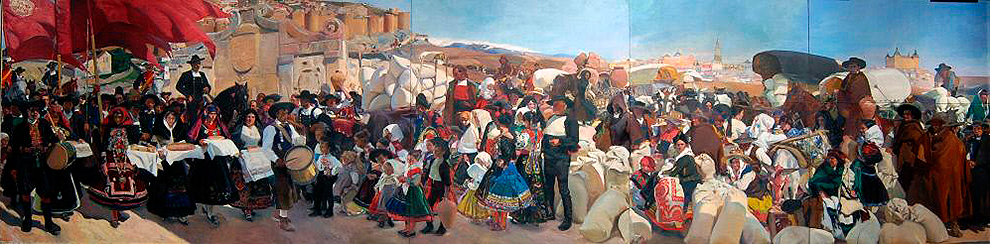
Within that undertaking, the contrast with Castilla, the Feast of Bread is especially useful. Castile’s broad panorama invites the viewer to follow groups across an extended field. Roncal directs attention into a narrow gathering, then upwards towards the flag. One composition unfolds horizontally; the other builds its presence through overlap, height and proximity.
The council panel’s relatively restricted width should not obscure its physical scale. At nearly three and a half metres high, its white collars, dark garments and patterned cloth have an architectural presence of their own. A small reproduction makes the composition easy to take in at once. In the gallery, the figures belong to an ensemble that surrounds the viewer. The Hispanic Society dates the painting of the series to 1912–1919 and its public inauguration to 1926.[7]
Seen as part of Vision of Spain, Roncal contributes a particular form of public life: authority made visible through collective dress, a carried flag and a ceremonial gathering. Seen on its own, it rewards attention to smaller relationships—the red line along a sleeve, a hand against black cloth, a glimpse of roofs between heads. Those details give the monumental scene its human scale.
Comparison: Castilla, the Feast of Bread
Watch: Sorolla, light and painting
Three National Gallery films offer an introduction, a closer look at technique and a longer curator’s talk.
An introduction to 'Sorolla: Spanish Master of Light'
Start with a short exhibition introduction to Sorolla’s subjects and career.
Watch on YouTubeArtworks and exhibition records
Browse 103 artwork articles, 350 numbered entries from the Hispanic Society’s 1909 New York catalogue, and two selected Meadows Museum drawings. These are records, not a count of unique artworks: repeated historical titles remain separate entries and may overlap with the articles. A catalogue’s exhibition year does not establish an execution date. This researched selection is not a complete catalogue raisonné.
| Name | Date | Medium |
|---|---|---|
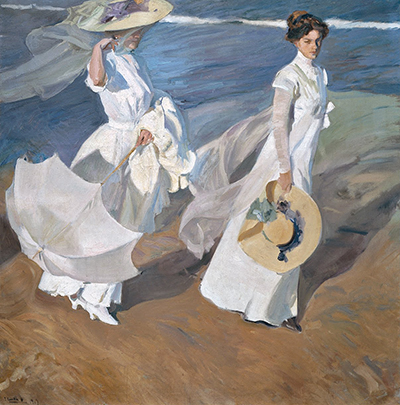
| Women Walking on the Beach | 1909 | Painting |
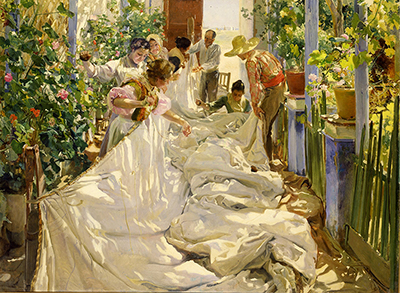
| Sewing the Sail | 1896 | Painting |
| Running Along the Beach | 1908 | Painting |
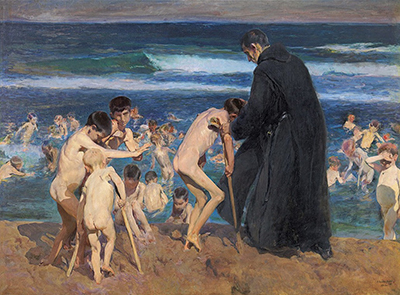
| Sad Inheritance | 1899 | Painting |
| Mother | 1895–1900 | Painting |
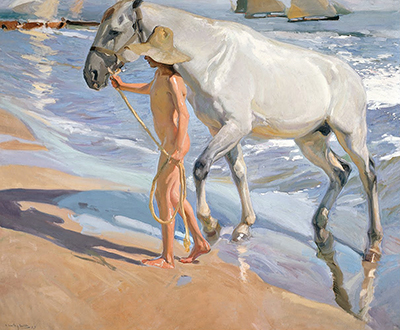
| The Horse's Bath | 1909 | Painting |
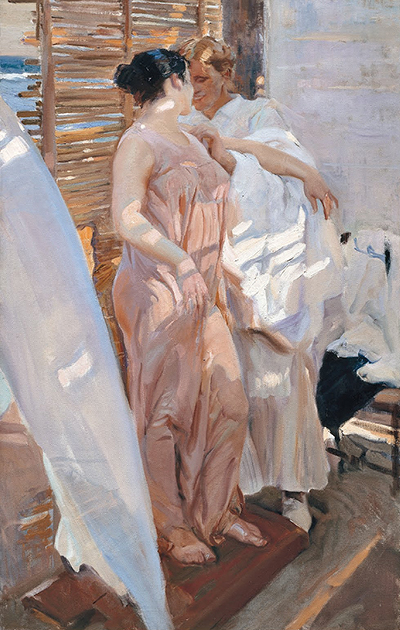
| The Pink Robe | 1916 | Painting |
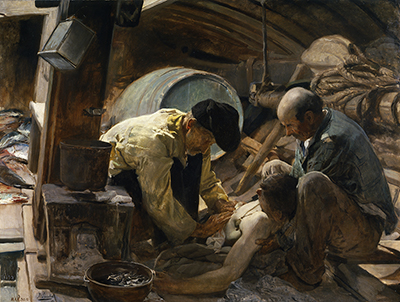
| And They Still Say Fish are Expensive! | 1894 | Painting |
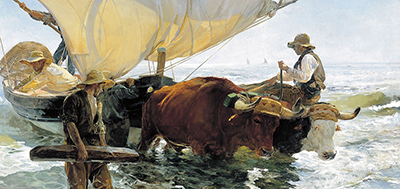
| The Return from Fishing | 1894 | Painting |
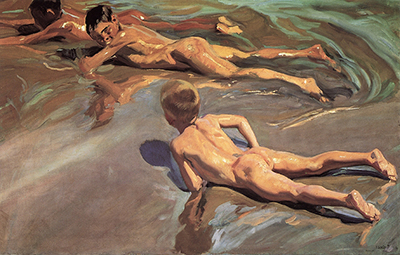
| Children on the Beach | 1909 | Painting |
| Castilla, the Feast of Bread | 1913 | Painting |
| Sevilla, Holy Week Penitents | 1914 | Painting |
| Aragon, Jota | 1914 | Painting |
| Navarre, the Town Council of Roncal | 1914 | Painting |
| Guipúzcoa, Bowling | 1914 | Painting |
| Andalucía, El Encierro | 1914 | Painting |
| Seville, the Dance | 1915 | Painting |
| Sevilla, The Bullfighters | 1915 | Painting |
| Galicia, The Pilgrimage | 1915 | Painting |
| The Fish | 1915 | Painting |
| Valencia, Couples on Horseback | 1916 | Painting |
| Extremadura, The Market | 1917 | Painting |
| Elche, The Palm Grove | 1918–1919 | Painting |
| The Tunny Catch | 1919 | Painting |
| Louis Comfort Tiffany | 1911 | Painting |
| Adobe Houses | 1890–1895 | Painting |
| After Bathing | 1915 | Painting |
| After Bathing, Valencia | 1909 | Painting |
| After Bathing, Valencian Beach | 1908 | Painting |
| Afternoon Sun, Playa de Valencia | 1910 (Album catalogue) | Painting |
| Aim of Ibiza | 1919 | Painting |
| Almond Trees in Asis | Spring,1887–1889 | Painting |
| Another Margarita | 1892 | Painting |
| Antonio García at the Beach | 1909 | Painting |
| Around Segovia | 9–15 October 1906 | Painting |
| Artist's Patio, Cafe Novedades, Seville | 1915 | Painting |
| Asturian Landscape | circa 1904 | Painting |
| Aureliano de Beruete | 1902 | Painting |
| Aureliano de Beruete y Moret, Son | 1902 | Painting |
| The Bath, Jávea | 1905 | Painting |
| The Bathing Hour | 1915 execution, signed and dated1917 (Sothebys catalogue account) | Painting |
| Bathing Time | 1904 | Painting |
| Beach at Valencia | 1908 in ARC catalogue | Painting |
| Beach at Zarauz | 1910 | Painting |
| Beach of Biarritz | 1906 | Painting |
| Beach of Biarritz, France | Summer1906 | Painting |
| Beached Boats | 1915 | Painting |
| Beaching the Boat | 1908 in ARC catalogue | Painting |
| Blessing the Boat | 1895 | Painting |
| Blind Man of Toledo | 1906 | Painting |
| Boat Builders | 1894 | Painting |
| Boat in Albufera | 1895 | Painting |
| Boy on the Sand | Undated | Painting |
| Boys in the Sea | 1908 | Painting |
| Boys on the Beach | BeforeNewYork1909exhibition; exactyearunresolved | Painting |
| Breakwater, San Sebastian | 1917–1918 | Painting |
| Bulls in the Sea | 1903 | Painting |
| Capturing the Moment | 1906 | Painting |
| Castle of La Mota, Medina del Campo | 29 May 1912 | Painting |
| Children in the Sea | Painting | |
| Children on the Beach, Valencia | 1916 | Painting |
| Children on the Seashore | 1903 | Painting |
| Child's Siesta | circa 1918 (ARC catalogue) | Painting |
| Church Roncal Stairs | 22–28August1912 | Painting |
| Clothilde at the Beach | Summer1904 | Painting |
| Clotilde and Elena on the Rocks at Javea | 1905 | Painting |
| Clotilde García del Castillo | April1890 | Painting |
| Clotilde in a Grey Dress | 1900 | Painting |
| Clotilde with Hat | 1910 | Painting |
| Coast at Santa Cristina | 29 September 1915 (current CERES1122) | Painting |
| Court of the Dances, Alcázar, Sevilla | 1910 | Painting |
| Covachuelas, Toledo | 21–30 October 1906 | Painting |
| Dragging the Trawler | circa 1903–1904 in educational catalogue | Painting |
| El Retiro, Madrid | 1898 | Painting |
| Female Nude | 1902 | Painting |
| Fisherman in Valencia | 1904 | Painting |
| Fisherwomen from Valencia | June–July 1915 | Painting |
| Fishing Boats | by February 1909 | Painting |
| Fishing Nets | 1893 | Painting |
| The Gardens at the Sorolla Family House | spring 1920 | Painting |
| Hall of the Ambassadors, Alhambra, Granada | 1909 | Painting |
| Harbour | 1880 | Painting |
| Joaquín Sorolla García in a White Dress | 1896 | Painting |
| Lighthouse Walk at Biarritz | 1906 | Painting |
| The Little Yacht | 1909 | Painting |
| Maria at La Granja | 1907 | Painting |
| My Children | 1904 | Painting |
| My Wife and Daughters in the Garden | 1910 | Painting |
| Portrait of Benito Pérez Galdós | 1894 | Painting |
| A Rooftop with Flowers | 1902 | Painting |
| Self Portrait | 1904 | Painting |
| Self Portrait | 1909 | Painting |
| Señora de Sorolla in Black | 1906 | Painting |
| La Siesta | 1911 | Painting |
| The Skipping Rope | 1907 | Painting |
| Swimmers, Jávea | 1905 | Painting |
| Time for a Bathe | 1909 | Painting |
| Under the Awning, Zarauz | 1910 | Painting |
| Valencia Beach in the Morning Light | summer 1908 | Painting |
| Valencian Fishermen | 1895 | Painting |
| The White Boat, Jávea | 1905 | Painting |
| White Slave Trade | 1894 | Painting |
| The Wounded Foot | 1909 | Painting |
| Seven Peaks, Guadarrama — 1909 catalogue, no. 1 | Painting | |
| Covachuelas, Toledo — 1909 catalogue, no. 2 | Painting | |
| Las Pedrizas, El Pardo — 1909 catalogue, no. 3 | Painting | |
| Señor Gomar — 1909 catalogue, no. 4 | Painting | |
| El Torneo, El Pardo — 1909 catalogue, no. 5 | Painting | |
| A Toledo Street — 1909 catalogue, no. 6 | Painting | |
| View from El Torneo — 1909 catalogue, no. 7 | Painting | |
| Walls of Segovia — 1909 catalogue, no. 8 | Painting | |
| Convent of El Parral, Segovia — 1909 catalogue, no. 9 | Painting | |
| Environs of Segovia — 1909 catalogue, no. 10 | Painting | |
| Reflections from the Cape, Jávea — 1909 catalogue, no. 11 | Painting | |
| The Clamores, Segovia — 1909 catalogue, no. 12 | Painting | |
| Rocks of the Cape, Jávea — 1909 catalogue, no. 13 | Painting | |
| Farmhouse, Alcira — 1909 catalogue, no. 14 | Painting | |
| María at Biarritz — 1909 catalogue, no. 15 | Painting | |
| Shadow of the Alcántara Bridge, Toledo — 1909 catalogue, no. 16 | Painting | |
| Castle of San Servando, Toledo — 1909 catalogue, no. 17 | Painting | |
| Dr Decret — 1909 catalogue, no. 18 | Painting | |
| Alcántara Bridge, Toledo — 1909 catalogue, no. 19 | Painting | |
| The Forest, La Granja — 1909 catalogue, no. 20 | Painting | |
| Trout Stream, La Granja — 1909 catalogue, no. 21 | Painting | |
| Court of the Dances, Alcázar, Seville — 1909 catalogue, no. 22 | Painting | |
| Oleanders — 1909 catalogue, no. 23 | Painting | |
| Glen, Asturias — 1909 catalogue, no. 24 | Painting | |
| Pavilion of Charles V, Seville — 1909 catalogue, no. 25 | Painting | |
| St Martin's Bridge, Toledo — 1909 catalogue, no. 26 | Painting | |
| Orange Trees — 1909 catalogue, no. 27 | Painting | |
| Rope Makers — 1909 catalogue, no. 28 | Painting | |
| Señor Franzen — 1909 catalogue, no. 29 | Painting | |
| Rocks at the Lighthouse, Biarritz — 1909 catalogue, no. 30 | Painting | |
| St Martin's Bridge, Toledo — 1909 catalogue, no. 31 | Painting | |
| Valencian Fisherwoman — 1909 catalogue, no. 32 | Painting | |
| Road of San Esteban, Asturias — 1909 catalogue, no. 33 | Painting | |
| Basin in the Alcázar, Seville — 1909 catalogue, no. 34 | Painting | |
| Harbour of Valencia — 1909 catalogue, no. 35 | Painting | |
| Haymaking, Asturias — 1909 catalogue, no. 36 | Painting | |
| House of El Greco, Toledo — 1909 catalogue, no. 37 | Painting | |
| María with a Black Hat — 1909 catalogue, no. 38 | Painting | |
| Entrance Tower, Toledo — 1909 catalogue, no. 39 | Painting | |
| Las Covachuelas, Toledo — 1909 catalogue, no. 40 | Painting | |
| Rocks, Jávea — 1909 catalogue, no. 41 | Painting | |
| Road of the Alijares, Toledo — 1909 catalogue, no. 42 | Painting | |
| Segovian Family — 1909 catalogue, no. 43 | Painting | |
| Scalding Grapes, Jávea — 1909 catalogue, no. 44 | Painting | |
| Joaquín — 1909 catalogue, no. 45 | Painting | |
| Elena — 1909 catalogue, no. 46 | Painting | |
| El Grutesco, Alcázar, Seville — 1909 catalogue, no. 47 | Painting | |
| Beach of Valencia — 1909 catalogue, no. 48 | Painting | |
| Sails Drying, Valencia — 1909 catalogue, no. 49 | Painting | |
| Orange Tree — 1909 catalogue, no. 50 | Painting | |
| Little Boy with a Toy Boat — 1909 catalogue, no. 51 | Painting | |
| Old Valencian Fisherman — 1909 catalogue, no. 52 | Painting | |
| Fishing Boats — 1909 catalogue, no. 53 | Painting | |
| Harbour of Valencia — 1909 catalogue, no. 54 | Painting | |
| The Kiss — 1909 catalogue, no. 55 | Painting | |
| Little Boy on a Rock, Jávea — 1909 catalogue, no. 56 | Painting | |
| The Queen's Beam, Valsaín — 1909 catalogue, no. 57 | Painting | |
| Staircase of the Palace, La Granja — 1909 catalogue, no. 58 | Painting | |
| Elena at El Pardo — 1909 catalogue, no. 59 | Painting | |
| Fountain of the Horses, La Granja — 1909 catalogue, no. 60 | Painting | |
| Autumn, La Granja — 1909 catalogue, no. 61 | Painting | |
| María Painting, El Pardo — 1909 catalogue, no. 62 | Painting | |
| Fountain of the Forest, La Granja — 1909 catalogue, no. 63 | Painting | |
| Fountain of Neptune, La Granja — 1909 catalogue, no. 64 | Painting | |
| Orange Grove, Valencia — 1909 catalogue, no. 65 | Painting | |
| Francisqueta, Valencia — 1909 catalogue, no. 66 | Painting | |
| Waiting for the Fish, Valencia — 1909 catalogue, no. 67 | Painting | |
| Taking in the Sail, Valencia — 1909 catalogue, no. 68 | Painting | |
| Return from Fishing, Valencia — 1909 catalogue, no. 69 | Painting | |
| Crayfishers, Valencia — 1909 catalogue, no. 70 | Painting | |
| Swimmer, Jávea — 1909 catalogue, no. 71 | Painting | |
| Elena among Roses — 1909 catalogue, no. 72 | Painting | |
| Idyll — 1909 catalogue, no. 73 | Painting | |
| Vicente Blasco Ibáñez — 1909 catalogue, no. 74 | Painting | |
| Yellow Tree, La Granja — 1909 catalogue, no. 75 | Painting | |
| Blind Man of Toledo — 1909 catalogue, no. 76 | Painting | |
| Fisherwoman with Her Son, Valencia — 1909 catalogue, no. 77 | Painting | |
| The Bath, La Granja — 1909 catalogue, no. 78 | Painting | |
| Sewing the Sail, Valencia — 1909 catalogue, no. 79 | Painting | |
| Looking for Crabs, Jávea — 1909 catalogue, no. 80 | Painting | |
| María, La Granja — 1909 catalogue, no. 81 | Painting | |
| Joaquín and His Dog — 1909 catalogue, no. 82 | Painting | |
| Upon the Sand — 1909 catalogue, no. 83 | Painting | |
| Valencian Fisherwomen — 1909 catalogue, no. 84 | Painting | |
| Señora de Sorolla in White — 1909 catalogue, no. 85 | Painting | |
| At the Seashore, Valencia — 1909 catalogue, no. 86 | Painting | |
| Valencian Woman — 1909 catalogue, no. 87 | Painting | |
| In the Gardens of La Granja — 1909 catalogue, no. 88 | Painting | |
| Old Castilian — 1909 catalogue, no. 89 | Painting | |
| Marqués de Urquijo — 1909 catalogue, no. 90 | Painting | |
| Fisherman's Daughter, Valencia — 1909 catalogue, no. 91 | Painting | |
| Elena and Her Dolls — 1909 catalogue, no. 92 | Painting | |
| My Children — 1909 catalogue, no. 93 | Painting | |
| Swimmers — 1909 catalogue, no. 94 | Painting | |
| Low Tide: Elena at Biarritz — 1909 catalogue, no. 95 | Painting | |
| Mending Nets — 1909 catalogue, no. 96 | Painting | |
| The Bath, Jávea — 1909 catalogue, no. 97 | Painting | |
| The Bath, Jávea — 1909 catalogue, no. 98 | Painting | |
| Boxing Raisins — 1909 catalogue, no. 99 | Painting | |
| Forest Bridge, La Granja — 1909 catalogue, no. 100 | Painting | |
| View of the Palace, La Granja — 1909 catalogue, no. 101 | Painting | |
| Return from Fishing, Valencia — 1909 catalogue, no. 102 | Painting | |
| At the Bath, Valencia — 1909 catalogue, no. 103 | Painting | |
| Little Girl with a Blue Ribbon, Valencia — 1909 catalogue, no. 104 | Painting | |
| María at the Harbour of Jávea — 1909 catalogue, no. 105 | Painting | |
| Instantaneous, Biarritz — 1909 catalogue, no. 106 | Painting | |
| Boy among Breakers, Jávea — 1909 catalogue, no. 107 | Painting | |
| Garden of the Alcázar, Seville — 1909 catalogue, no. 108 | Painting | |
| Oleander Road, Valencia — 1909 catalogue, no. 109 | Painting | |
| María and Her Grandmother — 1909 catalogue, no. 110 | Painting | |
| Malvarrosa Beach, Valencia — 1909 catalogue, no. 111 | Painting | |
| The Huerta of Valencia — 1909 catalogue, no. 112 | Painting | |
| Garden of the Alcázar, Seville — 1909 catalogue, no. 113 | Painting | |
| Garden of the Alcázar, Seville — 1909 catalogue, no. 114 | Painting | |
| The Giralda, Seville — 1909 catalogue, no. 115 | Painting | |
| Palace of Charles V, Seville — 1909 catalogue, no. 116 | Painting | |
| Harbour of Valencia — 1909 catalogue, no. 117 | Painting | |
| Marqués de la Vega-Inclán — 1909 catalogue, no. 118 | Painting | |
| Harbour of Valencia — 1909 catalogue, no. 119 | Painting | |
| At the Water, Valencia — 1909 catalogue, no. 120 | Painting | |
| House in the Huerta, Valencia — 1909 catalogue, no. 121 | Painting | |
| Beach Garden, Valencia — 1909 catalogue, no. 122 | Painting | |
| Huerta of Valencia — 1909 catalogue, no. 123 | Painting | |
| Garden of the Alcázar, Seville — 1909 catalogue, no. 124 | Painting | |
| Asturias — 1909 catalogue, no. 125 | Painting | |
| San Sebastián — 1909 catalogue, no. 126 | Painting | |
| Old Harbour, Biarritz — 1909 catalogue, no. 127 | Painting | |
| Beach of Biarritz — 1909 catalogue, no. 128 | Painting | |
| Beach of Biarritz — 1909 catalogue, no. 129 | Painting | |
| Beach of Biarritz — 1909 catalogue, no. 130 | Painting | |
| Beach of Biarritz — 1909 catalogue, no. 131 | Painting | |
| Beach of Biarritz — 1909 catalogue, no. 132 | Painting | |
| Beach of Biarritz — 1909 catalogue, no. 133 | Painting | |
| Beach of Biarritz — 1909 catalogue, no. 134 | Painting | |
| Beach of Biarritz — 1909 catalogue, no. 135 | Painting | |
| Beach of Biarritz — 1909 catalogue, no. 136 | Painting | |
| Beach of Biarritz — 1909 catalogue, no. 137 | Painting | |
| Beach of Biarritz — 1909 catalogue, no. 138 | Painting | |
| Beach of Biarritz — 1909 catalogue, no. 139 | Painting | |
| Beach of Biarritz — 1909 catalogue, no. 140 | Painting | |
| Beach of Biarritz — 1909 catalogue, no. 141 | Painting | |
| Beach of Biarritz — 1909 catalogue, no. 142 | Painting | |
| Beach of Biarritz — 1909 catalogue, no. 143 | Painting | |
| La Concha, San Sebastián — 1909 catalogue, no. 144 | Painting | |
| Beach of Biarritz — 1909 catalogue, no. 145 | Painting | |
| Beach of Biarritz — 1909 catalogue, no. 146 | Painting | |
| Beach of Biarritz — 1909 catalogue, no. 147 | Painting | |
| Beach of Biarritz — 1909 catalogue, no. 148 | Painting | |
| Beach of Biarritz — 1909 catalogue, no. 149 | Painting | |
| Beach of Biarritz — 1909 catalogue, no. 150 | Painting | |
| Beach of Biarritz — 1909 catalogue, no. 151 | Painting | |
| Beach of Biarritz — 1909 catalogue, no. 152 | Painting | |
| Beach of Biarritz — 1909 catalogue, no. 153 | Painting | |
| Beach of Biarritz — 1909 catalogue, no. 154 | Painting | |
| Beach of Valencia — 1909 catalogue, no. 155 | Painting | |
| Beach of Valencia — 1909 catalogue, no. 156 | Painting | |
| Beach of Valencia — 1909 catalogue, no. 157 | Painting | |
| Harbour of San Sebastián — 1909 catalogue, no. 158 | Painting | |
| Harbour of San Sebastián — 1909 catalogue, no. 159 | Painting | |
| Beach of Valencia — 1909 catalogue, no. 160 | Painting | |
| Pasajes — 1909 catalogue, no. 161 | Painting | |
| Harbour of San Sebastián — 1909 catalogue, no. 162 | Painting | |
| La Concha, San Sebastián — 1909 catalogue, no. 163 | Painting | |
| La Concha, San Sebastián — 1909 catalogue, no. 164 | Painting | |
| Harbour of Pasajes — 1909 catalogue, no. 165 | Painting | |
| Beach of Valencia — 1909 catalogue, no. 166 | Painting | |
| Beach of Valencia — 1909 catalogue, no. 167 | Painting | |
| Beach of Valencia — 1909 catalogue, no. 168 | Painting | |
| Beach of Valencia — 1909 catalogue, no. 169 | Painting | |
| Beach of Valencia — 1909 catalogue, no. 170 | Painting | |
| Beach of Valencia — 1909 catalogue, no. 171 | Painting | |
| Beach of Valencia — 1909 catalogue, no. 172 | Painting | |
| Beach of Valencia — 1909 catalogue, no. 173 | Painting | |
| Beach of Valencia — 1909 catalogue, no. 174 | Painting | |
| Beach of Valencia — 1909 catalogue, no. 175 | Painting | |
| Beach of Valencia — 1909 catalogue, no. 176 | Painting | |
| Beach of Valencia — 1909 catalogue, no. 177 | Painting | |
| Cape San Antonio, Jávea — 1909 catalogue, no. 178 | Painting | |
| Galicia — 1909 catalogue, no. 179 | Painting | |
| Sewing the Sail — 1909 catalogue, no. 180 | Painting | |
| Poppies — 1909 catalogue, no. 181 | Painting | |
| Beach of Valencia — 1909 catalogue, no. 182 | Painting | |
| Malvarrosa — 1909 catalogue, no. 183 | Painting | |
| Harbour of San Sebastián — 1909 catalogue, no. 184 | Painting | |
| Beach of Valencia — 1909 catalogue, no. 185 | Painting | |
| Locutory — 1909 catalogue, no. 186 | Painting | |
| Beach of Valencia — 1909 catalogue, no. 187 | Painting | |
| Beach of Valencia — 1909 catalogue, no. 188 | Painting | |
| Cape San Antonio, Jávea — 1909 catalogue, no. 189 | Painting | |
| Beach of Valencia — 1909 catalogue, no. 190 | Painting | |
| Oleanders — 1909 catalogue, no. 191 | Painting | |
| Beach of Valencia — 1909 catalogue, no. 192 | Painting | |
| La Concha, San Sebastián — 1909 catalogue, no. 193 | Painting | |
| Beach of Valencia — 1909 catalogue, no. 194 | Painting | |
| Beach of Valencia — 1909 catalogue, no. 195 | Painting | |
| Beach of Valencia — 1909 catalogue, no. 196 | Painting | |
| Biarritz — 1909 catalogue, no. 197 | Painting | |
| Biarritz — 1909 catalogue, no. 198 | Painting | |
| Segovia — 1909 catalogue, no. 199 | Painting | |
| Asturias — 1909 catalogue, no. 200 | Painting | |
| Versailles — 1909 catalogue, no. 201 | Painting | |
| Beach of Valencia — 1909 catalogue, no. 202 | Painting | |
| Beach of Valencia — 1909 catalogue, no. 203 | Painting | |
| Beach of Valencia — 1909 catalogue, no. 204 | Painting | |
| Beach of Valencia — 1909 catalogue, no. 205 | Painting | |
| Court of El Cabañal — 1909 catalogue, no. 206 | Painting | |
| In the River — 1909 catalogue, no. 207 | Painting | |
| Harbour of Valencia — 1909 catalogue, no. 208 | Painting | |
| Beach of Valencia — 1909 catalogue, no. 209 | Painting | |
| Harbour of Valencia — 1909 catalogue, no. 210 | Painting | |
| Beach of Valencia — 1909 catalogue, no. 211 | Painting | |
| Beach of Valencia — 1909 catalogue, no. 212 | Painting | |
| Beach of Valencia — 1909 catalogue, no. 213 | Painting | |
| Royal Mallows — 1909 catalogue, no. 214 | Painting | |
| Geraniums — 1909 catalogue, no. 215 | Painting | |
| Altar of St Vincent, Valencia — 1909 catalogue, no. 216 | Painting | |
| Beach of Valencia — 1909 catalogue, no. 217 | Painting | |
| Harbour of Avilés — 1909 catalogue, no. 218 | Painting | |
| Beach of Valencia — 1909 catalogue, no. 219 | Painting | |
| Beach of Valencia — 1909 catalogue, no. 220 | Painting | |
| Beach of Valencia — 1909 catalogue, no. 221 | Painting | |
| Market of León — 1909 catalogue, no. 222 | Painting | |
| Beach of Valencia — 1909 catalogue, no. 223 | Painting | |
| Beach of Valencia — 1909 catalogue, no. 224 | Painting | |
| Beach of Valencia — 1909 catalogue, no. 225 | Painting | |
| Beach of Valencia — 1909 catalogue, no. 226 | Painting | |
| Beach of Valencia — 1909 catalogue, no. 227 | Painting | |
| Huerta of Valencia — 1909 catalogue, no. 228 | Painting | |
| Beach of Valencia — 1909 catalogue, no. 229 | Painting | |
| Beach of Valencia — 1909 catalogue, no. 230 | Painting | |
| Beach of Valencia — 1909 catalogue, no. 231 | Painting | |
| Beach of Valencia — 1909 catalogue, no. 232 | Painting | |
| Beach of Valencia — 1909 catalogue, no. 233 | Painting | |
| Beach of Valencia — 1909 catalogue, no. 234 | Painting | |
| Asturias — 1909 catalogue, no. 235 | Painting | |
| Beach of Valencia — 1909 catalogue, no. 236 | Painting | |
| Women Playing — 1909 catalogue, no. 237 | Painting | |
| Beach of Valencia — 1909 catalogue, no. 238 | Painting | |
| Beach of Valencia — 1909 catalogue, no. 239 | Painting | |
| Beach of Valencia — 1909 catalogue, no. 240 | Painting | |
| Beach of Valencia — 1909 catalogue, no. 241 | Painting | |
| Market of León — 1909 catalogue, no. 242 | Painting | |
| Beach of Valencia — 1909 catalogue, no. 243 | Painting | |
| Beach of Valencia — 1909 catalogue, no. 244 | Painting | |
| Beach of Valencia — 1909 catalogue, no. 245 | Painting | |
| Beach of Valencia — 1909 catalogue, no. 246 | Painting | |
| Asturias — 1909 catalogue, no. 247 | Painting | |
| León — 1909 catalogue, no. 248 | Painting | |
| Asturias — 1909 catalogue, no. 249 | Painting | |
| Jávea — 1909 catalogue, no. 250 | Painting | |
| Asturias — 1909 catalogue, no. 251 | Painting | |
| León — 1909 catalogue, no. 252 | Painting | |
| Asturias — 1909 catalogue, no. 253 | Painting | |
| Asturias — 1909 catalogue, no. 254 | Painting | |
| Beach of Valencia — 1909 catalogue, no. 255 | Painting | |
| Beach of Valencia — 1909 catalogue, no. 256 | Painting | |
| Asturias — 1909 catalogue, no. 257 | Painting | |
| León — 1909 catalogue, no. 258 | Painting | |
| Beach of Valencia — 1909 catalogue, no. 259 | Painting | |
| Beach of Valencia — 1909 catalogue, no. 260 | Painting | |
| Beach of Valencia — 1909 catalogue, no. 261 | Painting | |
| León — 1909 catalogue, no. 262 | Painting | |
| Beach of Valencia — 1909 catalogue, no. 263 | Painting | |
| Asturias — 1909 catalogue, no. 264 | Painting | |
| Galicia — 1909 catalogue, no. 265 | Painting | |
| Malvarrosa — 1909 catalogue, no. 266 | Painting | |
| Jávea — 1909 catalogue, no. 267 | Painting | |
| Biarritz — 1909 catalogue, no. 268 | Painting | |
| Harbour of Jávea — 1909 catalogue, no. 269 | Painting | |
| La Concha, San Sebastián — 1909 catalogue, no. 270 | Painting | |
| San Sebastián — 1909 catalogue, no. 271 | Painting | |
| San Sebastián — 1909 catalogue, no. 272 | Painting | |
| Beach of Valencia — 1909 catalogue, no. 273 | Painting | |
| Beach of Valencia — 1909 catalogue, no. 274 | Painting | |
| Beach of Valencia — 1909 catalogue, no. 275 | Painting | |
| Beach of Valencia — 1909 catalogue, no. 276 | Painting | |
| Beach of Valencia — 1909 catalogue, no. 277 | Painting | |
| Washerwomen — 1909 catalogue, no. 278 | Painting | |
| San Sebastián — 1909 catalogue, no. 279 | Painting | |
| Beach of Valencia — 1909 catalogue, no. 280 | Painting | |
| San Sebastián — 1909 catalogue, no. 281 | Painting | |
| San Sebastián — 1909 catalogue, no. 282 | Painting | |
| Beach of Valencia — 1909 catalogue, no. 283 | Painting | |
| Beach of Valencia — 1909 catalogue, no. 284 | Painting | |
| Uncle Pancha — 1909 catalogue, no. 285 | Painting | |
| Señor García — 1909 catalogue, no. 286 | Painting | |
| Boy Nude, La Granja — 1909 catalogue, no. 287 | Painting | |
| Señora de Sorolla in Black — 1909 catalogue, no. 288 | Painting | |
| Duke of Alba — 1909 catalogue, no. 289 | Painting | |
| Mother: Señora de Sorolla — 1909 catalogue, no. 290 | Painting | |
| Running along the Beach — 1909 catalogue, no. 291 | Painting | |
| After the Bath — 1909 catalogue, no. 292 | Painting | |
| Lighthouse Walk, Biarritz — 1909 catalogue, no. 293 | Painting | |
| Little Boy on the Beach — 1909 catalogue, no. 294 | Painting | |
| Cape San Antonio, Jávea — 1909 catalogue, no. 295 | Painting | |
| Count of Villagonzalo — 1909 catalogue, no. 296 | Painting | |
| Boy in the Sea — 1909 catalogue, no. 297 | Painting | |
| Children on the Beach — 1909 catalogue, no. 298 | Painting | |
| Valencian Boats — 1909 catalogue, no. 299 | Painting | |
| The Little Brother — 1909 catalogue, no. 300 | Painting | |
| Children in the Sea — 1909 catalogue, no. 301 | Painting | |
| Orange Grove, Alcira — 1909 catalogue, no. 302 | Painting | |
| At the Water — 1909 catalogue, no. 303 | Painting | |
| Little Boy on the Beach — 1909 catalogue, no. 304 | Painting | |
| Street of Orange Trees — 1909 catalogue, no. 305 | Painting | |
| Playing in the Water — 1909 catalogue, no. 306 | Painting | |
| Beach of Valencia by Morning Light — 1909 catalogue, no. 307 | Painting | |
| Coming out of the Bath — 1909 catalogue, no. 308 | Painting | |
| The Grandson — 1909 catalogue, no. 309 | Painting | |
| Water Joy — 1909 catalogue, no. 310 | Painting | |
| On the Sand — 1909 catalogue, no. 311 | Painting | |
| Francisco Acebal — 1909 catalogue, no. 312 | Painting | |
| Marcelino Menéndez y Pelayo — 1909 catalogue, no. 313 | Painting | |
| Aureliano de Beruete — 1909 catalogue, no. 314 | Painting | |
| Marqués de Viana — 1909 catalogue, no. 315 | Painting | |
| Beach of Valencia — 1909 catalogue, no. 316 | Painting | |
| Señor Granzón — 1909 catalogue, no. 317 | Painting | |
| Oxen Ready to Beach Fishing Boats, Valencia — 1909 catalogue, no. 318 | Painting | |
| Children in the Sea — 1909 catalogue, no. 319 | Painting | |
| Sea: Morning Effect — 1909 catalogue, no. 320 | Painting | |
| Fishing Boat — 1909 catalogue, no. 321 | Painting | |
| Sails at Sea — 1909 catalogue, no. 322 | Painting | |
| Return from Fishing — 1909 catalogue, no. 323 | Painting | |
| Boats on the Sand — 1909 catalogue, no. 324 | Painting | |
| Study of Boats — 1909 catalogue, no. 325 | Painting | |
| Fishing Boats — 1909 catalogue, no. 326 | Painting | |
| Boats — 1909 catalogue, no. 327 | Painting | |
| Children on the Shore — 1909 catalogue, no. 328 | Painting | |
| Beach of Valencia — 1909 catalogue, no. 329 | Painting | |
| Beach of Valencia — 1909 catalogue, no. 330 | Painting | |
| Beach of Valencia — 1909 catalogue, no. 331 | Painting | |
| Beach of Valencia — 1909 catalogue, no. 332 | Painting | |
| Nets Drying — 1909 catalogue, no. 333 | Painting | |
| Shoving off the Boat — 1909 catalogue, no. 334 | Painting | |
| Beach of Valencia — 1909 catalogue, no. 335 | Painting | |
| Oleanders — 1909 catalogue, no. 336 | Painting | |
| Beach of Valencia — 1909 catalogue, no. 337 | Painting | |
| Beach of Valencia — 1909 catalogue, no. 338 | Painting | |
| Beach of Valencia — 1909 catalogue, no. 339 | Painting | |
| Leonese Peasants — 1909 catalogue, no. 340 | Painting | |
| At the Bath — 1909 catalogue, no. 341 | Painting | |
| Sea Idyll — 1909 catalogue, no. 342 | Painting | |
| The Little Granddaughter — 1909 catalogue, no. 343 | Painting | |
| Manuel B. Cossío — 1909 catalogue, no. 344 | Painting | |
| The Peppers — 1909 catalogue, no. 345 | Painting | |
| Raimundo de Madrazo — 1909 catalogue, no. 346 | Painting | |
| Alejandro Pidal y Mon — 1909 catalogue, no. 347 | Painting | |
| Señora de Sorolla in Spanish Mantilla — 1909 catalogue, no. 348 | Painting | |
| My Daughters, Elena and María, on Horseback in Valencian Costumes of 1808 — 1909 catalogue, no. 349 | Painting | |
| Sad Inheritance — 1909 catalogue, no. 350 | Painting | |
| Study of Hands | c. 1889 | Drawing |
| Clotilde Reading (recto) | c. 1902 | Drawing |
Discussion
Look again at the images and ideas explored in Navarre, the Town Council of Roncal by Joaquín Sorolla. These editorial prompts invite your observations.
Reader Insights
Which detail in Navarre, the Town Council of Roncal by Joaquín Sorolla first caught your attention, and where did your eye travel next?
The section “What is the council doing?” offers one way into the subject. Which detail or comparison most helps you assess that reading?
After reading “A concentrated image within Vision of Spain”, what would you return to for a closer look?
Join the Conversation
Share a detail, comparison or question about Navarre, the Town Council of Roncal by Joaquín Sorolla below.
References
- Josep Eixerés Ros, “Documenting light and structure: The role of the Hispanic Society Library in interpreting Joaquín Sorolla’s architectural vision,” Art Libraries Journal, vol. 50, nos. 2–3, pp. 54–60; published online 18 March 2026. Figure 4 identifies the final panel, date, medium, dimensions and collection. View source.
- Javier Azanza López, “Tipos y paisajes: tras las huellas de Sorolla en el valle de Roncal,” Cátedra de Patrimonio y Arte Navarro, Universidad de Navarra, 3 September 2016. Account of the 1912 visit, preparatory paintings, Jaca execution and possible ceremonial occasions; reproductions of studies and final panel. View source.
- Covadonga Pitarch, “Sorolla en el valle de Roncal,” Pieza del mes, Museo Sorolla, January 2014, pp. 13–14, section “La indumentaria roncalesa.” View source.
- Museo Sorolla, Ministerio de Cultura, “Textiles,” collection overview, particularly the collection’s origins in Sorolla’s travels for the regional panels. View source.
- Museo Sorolla, “Subida a la iglesia de San Esteban del Roncal, inventory 01049,” CER.es full object record, description and reasoned classification; dated 22–28 August 1912. View source.
- Blanca Pons-Sorolla, “Sorolla in the Huntingtons’ Collections,” in José Luis Colomer, Blanca Pons-Sorolla and Mark A. Roglán, eds., Sorolla in America: Friends and Patrons, Centro de Estudios Europa Hispánica, 2015, p. 66, publisher’s excerpt, PDF p. 14. View source.
- Hispanic Society Museum & Library, “Joaquín Sorolla’s Vision of Spain,” institutional account of the commission, execution, installation and later history. View source.
- Hispanic Society of America, Catalogue of Paintings by Joaquín Sorolla y Bastida, 1909, entries 1–350. View source.
- Amanda W. Dotseth, Study of Hands, Sketch for The Regency, and Six Other Drawings by Joaquín Sorolla y Bastida, At the Meadows, Fall 2018, pp. 24–29. View source.