 by Tom Gurney
Tom Gurney BSc (Hons) is an art history expert with over 20 years experience
Published on June 19, 2020 / Updated on November 3, 2026
Email: tomgurney1@gmail.com / Phone: +44 7429 011000
Vision of Spain: Introduction
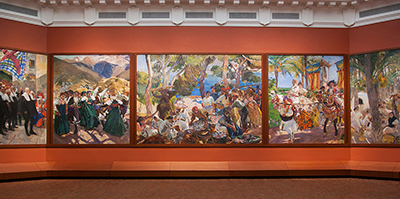
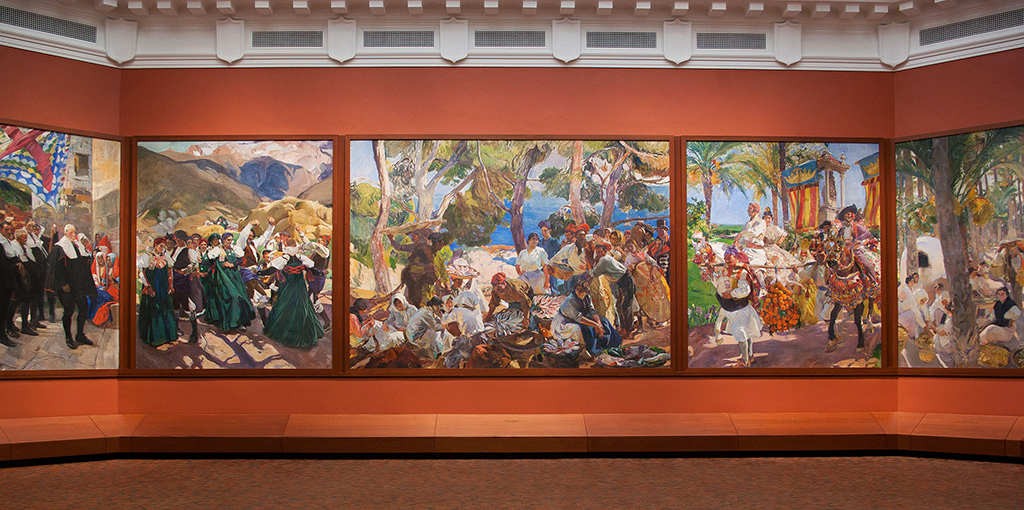
A crowd can fill a picture; Joaquín Sorolla’s Vision of Spain fills a room. People carry bread, dance, gather for a civic occasion, watch a game, handle fish and move through ceremonial streets. Their activities differ, and the settings change from mountain country to a fishing harbour. Across the ensemble, however, bodies, clothing, trees and architecture occupy a shared monumental scale. The spectator stands among images of people who seem to have their own places to go and things to do.
The fourteen paintings belong to the Hispanic Society Museum & Library in New York. Its founder, Archer Milton Huntington, commissioned the ensemble in 1911. Sorolla painted the canvases at locations in Spain between 1912 and 1919; they were publicly inaugurated in New York in 1926, three years after his death. Nearly twelve feet high and approximately two hundred feet long in total, the paintings surround the viewer.[1] Those dimensions change how the work is encountered. Looking becomes a matter of turning, approaching and stepping back, of remembering one group while another comes into view.
The title offers a good way into the project. This is a vision of Spain assembled from selected places, occasions and people. Its national subject is made through regional difference, while its unity comes from Sorolla’s decisions about scale, arrangement and colour. To understand the whole, it helps to move between the room and a few particular scenes: the breadth of Castile, the concentrated procession in Seville, the lifted arms of the Aragonese dancers and the working bodies at Ayamonte.
At a Glance
- ArtistJoaquín Sorolla
- SubjectVision of Spain
Contents
- Paintings that become an environment
- A commission across the Atlantic
- Travel, studies and the making of a whole
- Clothes as objects, shapes and signs
- Four contrasts within the ensemble
- Work, ceremony and recreation
- Light across the room
- Earlier groups, enlarged ambitions
- Installation, renewed looking and conservation
Paintings that become an environment
The installation gives the canvases an architectural continuity without turning them into a single uninterrupted landscape. In the gallery view, narrow vertical divisions separate one scene from the next. Above them runs a broad field of wall; below, a continuous base establishes another horizontal line. Within those boundaries the painted spaces open in markedly different ways. A mountain rises behind dancers, tree trunks frame a crowded shore, and richly dressed riders occupy another outdoor setting. The room holds these changes together.
This has a practical effect on attention. A small reproduction encourages the eye to take in each picture as a compact arrangement. At the scale of the room, a foreground figure, a stretch of fabric or an outstretched arm can command attention before the entire composition becomes clear. The larger pattern emerges by moving away, looking along the surface and comparing one passage with another. Sorolla gives the eye both close incidents and broad structures to follow.
The divisions are therefore active parts of the experience. A tree inside a painting may echo a vertical frame beside it; a horizon may carry the eye sideways until the next panel resets the depth. Dark clothing forms one kind of mass, sunlit white cloth another. The recurrence of these large shapes helps the ensemble remain legible even when a spectator cannot study every face. At the same time, the differing settings prevent the repeated scale from becoming monotonous.
The installation photograph also makes clear how much painted movement can exist inside an orderly room. Cornices, frames and the lower wall form a stable enclosure. Within it, skirts swing, branches angle overhead, baskets tip towards the viewer and bodies turn across the picture planes. The architecture supplies a measure against which those gestures become conspicuous. A raised hand in the dance can seem especially free because its surrounding canvas remains so firmly bounded.
There is no single viewpoint from which fourteen paintings can be absorbed with equal clarity. One canvas is seen frontally while another is seen obliquely; a turn changes both relationships. That makes memory part of the composition as experienced. A dark procession can remain in mind while a bright dance comes into view. The paintings gain associations through proximity, but they also ask the spectator to connect scenes separated by the room.
Vision of Spain — larger view
A commission across the Atlantic
Huntington’s relationship with Sorolla developed through exhibitions before it produced this permanent ensemble. Blanca Pons-Sorolla traces his encounter with the artist’s work at London’s Grafton Galleries in 1908 and the subsequent invitation to exhibit at the Hispanic Society. The formal commission followed on 26 November 1911. Her account describes a decoration intended for the institution’s library and reproduces the signed agreement.[2] That historical destination belongs to the project’s inception; the paintings’ later home is the dedicated gallery in which they form a surrounding ensemble.
The arrangement also connects a painter’s selection with an institution’s purpose. Spain is the subject brought to an audience in New York, yet the images do not offer a sequence of famous rulers or an illustrated chronology. They make collective life visible through people engaged in particular activities. Bread, fish, animals, garments and gestures carry much of the representative burden. The objects are substantial enough to occupy the foreground, while the people using them make the scenes readable as human encounters.
The Prado’s account of the series describes the subjects and working campaigns developing gradually through Sorolla’s interests, despite an initial ambition for an ordered representation of the Iberian regions.[3] The completed ensemble is consequently better approached through its choices than as a map with every area assigned an equivalent place. Different subjects receive different amounts of space, and some places recur through more than one occasion.
The undertaking was still new when Duncan C. Phillips Jr visited Sorolla’s Madrid home in the spring of 1912. His article, published that December, recalls the painter speaking enthusiastically about his American friends and the commission for New York.[4] The visit belongs to the beginning of the work. Its interest is the connection it records between an expansive public project and the everyday setting of the painter’s house, studio and garden.
Phillips’s account also reveals how strongly a foreign visitor could arrive with a preconceived image of Spain. He describes expectations of gloom and severity, and reports Sorolla disputing his impression. Read beside the later paintings, that exchange helps explain what is at stake in representation. A painter’s choice of subjects can answer an audience’s expectations, complicate them or redirect its attention. The ensemble offers opportunities to look at gathering, work and celebration in several different forms.
Travel, studies and the making of a whole
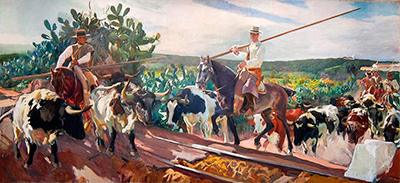
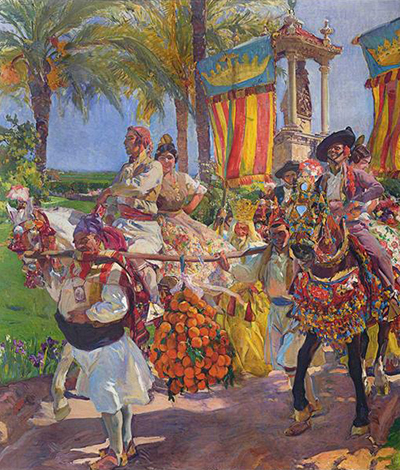
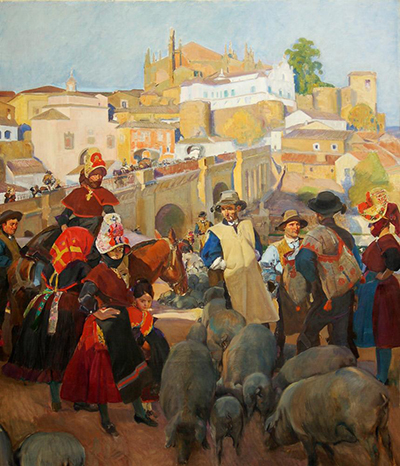
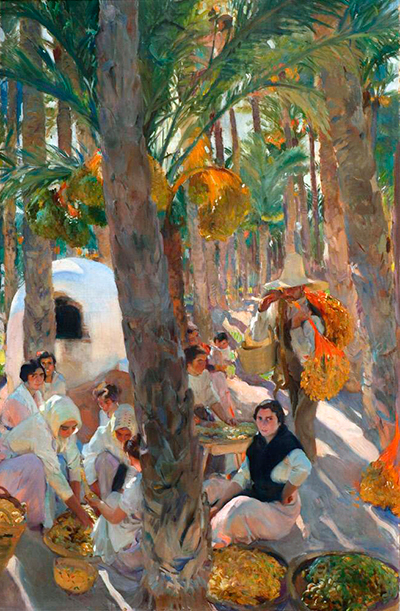
The paintings emerged over years rather than through one uninterrupted tour. Pons-Sorolla’s sequence begins with the Castilian panel in 1913, followed by a substantial group in 1914: Seville’s penitents, Aragon, Navarre, Guipúzcoa and the Andalusian Encierro. Further subjects followed in 1915, Valencia in 1916 and Extremadura in 1917; the final stages brought Elche and, in 1919, Ayamonte.[2] This sequence restores time to a room whose paintings can initially appear simultaneous.
Travel supplied more than scenery. The National Gallery’s account describes Sorolla painting local people in their settings, sometimes furnishing costumes and props, and making landscape paintings that fed into the commission. Its 2019 exhibition included four large preparatory figure studies from 1912.[5] People, dress and places could therefore be examined in different forms before being integrated into a monumental scene.
There is direct material evidence of recomposition. A University of Valencia account of research on the ensemble’s gouache sketches describes studies of figures, objects and landscapes that Sorolla cut, rearranged and assembled in collage-like compositions.[6] Small pieces of painted paper allowed relationships to be tested. Moving a figure changes an interval; shifting a group changes the apparent centre; opening a patch of background can give a crowded scene room to breathe.
Scale adds another problem. A gesture readily understood in a small study may become too weak when enlarged, while a fold of cloth can become a major shape. Sorolla’s groups repeatedly combine strongly readable silhouettes with complicated interiors. A broad skirt is recognisable at a distance; nearer, its coloured folds break into smaller movements. A dark cloak makes a clear upright form before its edges, collar and relationship to the figure beside it become distinct.
Clothes as objects, shapes and signs
The Museo Sorolla’s textile collection preserves a tangible part of this preparation. The museum states that most of the pieces were acquired during the travels associated with the Hispanic Society commission. Many date from the late nineteenth or early twentieth century and come from places including La Alberca, León, Roncal, Lagartera and Ansó.[7] These holdings make dress part of the material history of the project, alongside paintings and studies.
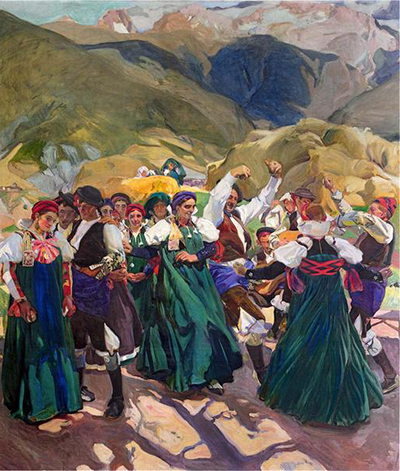
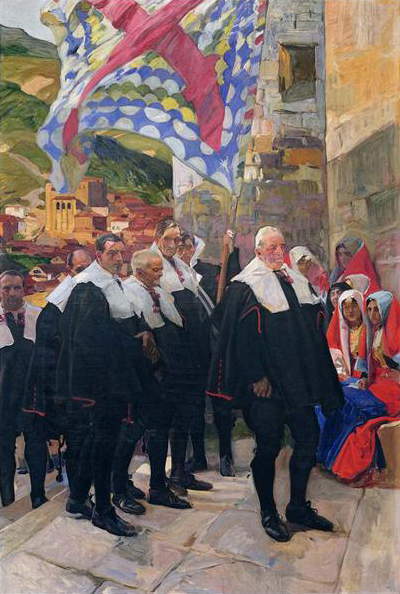
Consider the contrast between the men of Navarre, the Town Council of Roncal and the dancers of Aragon, Jota. In the Roncal scene, dark garments fall in broad, comparatively contained shapes. Pale collars draw attention back towards the heads and shoulders. In the dance, full skirts open and turn; white sleeves make the lifted arms particularly clear. Clothing changes the apparent motion of the entire group.
The contrast becomes more interesting when one looks beyond colour. A cloak brings the outline of an arm closer to the torso, making a figure read as a compact unit. A dancer’s sleeve separates the arm from the body and displays its angle. A skirt can conceal the exact placement of a leg while making the direction of a turn unmistakable. Dress both covers anatomy and gives movement another visible form.
Four contrasts within the ensemble
A useful way to approach the series is to compare four forms of collective action: a broad gathering, a ceremonial procession, a dance and a working group. They need not be treated as consecutive episodes. Each establishes a different relationship between an individual body and the people around it.
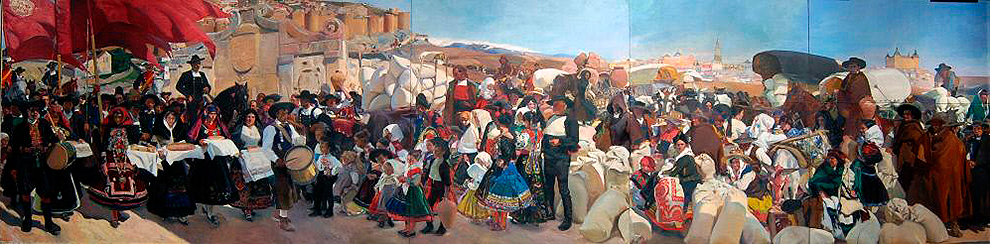
In Castilla, the Feast of Bread, the great width is itself a subject. The eye travels through a succession of groups instead of finding one compact centre. Red banners rise over the left, while pale garments and the bodies of animals create other emphases farther across. People are differently oriented: some face towards the viewer, others attend to neighbours or the direction of the gathering. There is enough variation to make the crowd feel occupied from within.
Its breadth changes the role of an individual. One person may command attention briefly, then yield to another group farther along. The canvas asks for sustained scanning, with small clusters acting almost as stopping places. Figures in the foreground make an immediate claim on the spectator, while the buildings and landscape establish a larger setting. The distant passages keep the gathering from becoming a decorative band pressed entirely against the surface.
Bread gives the subject a material focus. The title directs attention towards something made, carried and presented, connecting collective display with an ordinary necessity. Within this wide arrangement, ceremony and the presence of goods can coexist.
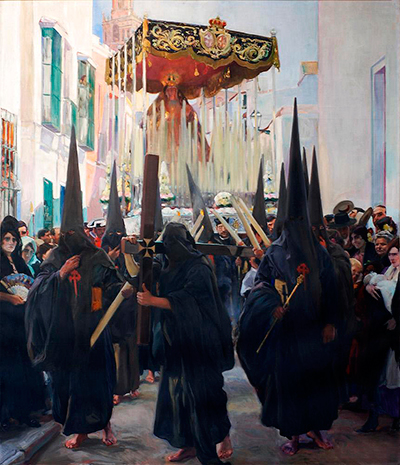
The experience contracts sharply in Sevilla, Holy Week Penitents. Tall dark hoods and robes dominate the foreground. Behind them, pale candles rise towards a richly decorated canopy, while the street’s bright walls contain the procession. The movement is directed through a comparatively narrow space. Where Castile spreads attention sideways, Seville concentrates it between bodies and architecture.
Here the repetition of upright forms creates order. The hoods, candles and poles differ in thickness and colour, but their rising lines reinforce one another. Dark masses occupy the lower portion of the picture, while reflected light and pale architecture open above. Faces visible at the sides make another kind of presence beside the concealed faces in the procession. The contrast gives the crowd different degrees of access to the spectator.
The canopy complicates the upright rhythm. Its decorated edges extend across the upper part of the moving group, gathering the verticals beneath a horizontal shelter. The street is both a route and a frame. A spectator looking into this image encounters layers: the nearest robes, the rising ceremonial structure and the buildings beyond. The panel creates depth through interruption, with one element partially hiding another.
Aragon’s dance opens the arrangement again. Lifted hands and bent arms establish angles against the mountains, while the skirts give the foreground weight. The people watching do not simply repeat the dancers’ movements. Their steadier presence makes the active gestures more pronounced.
Light strengthens that distinction. White sleeves carry the eye upwards, then darker bodices and saturated skirts bring it down towards the ground. Shadows beneath the figures make the scene feel physically occupied. The mountain background has its own broad pattern of light and dark, but its comparatively large shapes allow the smaller changes among hands, faces and folds to remain active. Human movement takes place within a setting whose scale exceeds it.
The dance also demonstrates what a still image can do with time. Several gestures are visible together, inviting the eye to connect them into a rhythm. One arm rises where another bends; a skirt turns towards an interval between bodies. The spectator supplies an imagined continuation from these relationships. The painting holds the gestures still long enough for their structure to be seen.
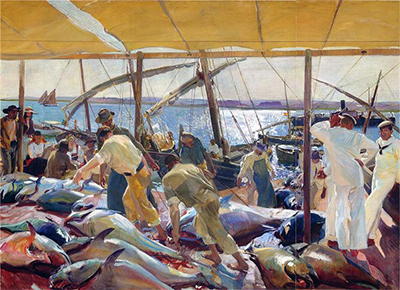
At Ayamonte, the Tuna Catch, the emphasis shifts to bodies engaged with heavy things. Fish fill the foreground; workers bend and turn among them. Above, a yellow canopy forms a broad overhead plane, while poles and rigging divide the view towards boats and water. The group is held together by a task, with the catch creating both the reason for the gathering and much of its visible weight.
The bodies of the fish introduce strong, sweeping shapes near the spectator. Their gleaming surfaces contrast with the folds of clothes and the comparatively flat shelter above. Human figures stand, stoop and reach at different angles, giving the work a distributed rhythm. The bright figure at the right and the central bending figures do different compositional jobs: one establishes a strong upright, while the others draw attention down into the catch.
Comparison: Castilla, the Feast of Bread
Work, ceremony and recreation
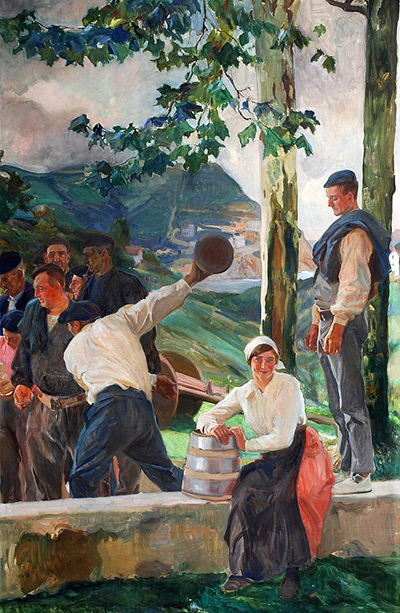
The bowling scene from Guipúzcoa is particularly useful beside the dancers. A player’s raised arm opens dramatically across the image, with the round bowl held clear of the body. Other people watch from nearby, while tree trunks provide strong uprights and foliage occupies the upper space. The subject turns an ordinary outdoor gathering into a composition about expectation. Attention gathers around a movement that seems ready to continue beyond the painted instant.
The figure seated beside a barrel provides a different tempo from the player. Her contained posture and the barrel’s rounded solidity help steady the foreground. The standing man at the right establishes another pause. Between them, the active body is easy to read. The picture makes recreation visible as a social arrangement: space is needed for the action, but the surrounding people are part of its meaning.
The Catalan fish scene offers another form of concentration. Baskets and pale catches occupy the foreground, and the people attending to them sit, bend or stand at different heights. Tree trunks frame a glimpse of water and sky beyond. The shaded, crowded area near the spectator opens intermittently into brightness, so that looking involves moving between close work and the larger outdoor setting.
Placed beside Ayamonte, it reveals how one broad subject can receive distinct pictorial treatments. Fish can be gathered in smaller containers or spread as large bodies across the front of a canvas. People can cluster within shade or work beneath an overhead canopy. The comparison draws attention to the arrangements through which a task becomes visible, rather than reducing both scenes to the same illustration of fishing life.
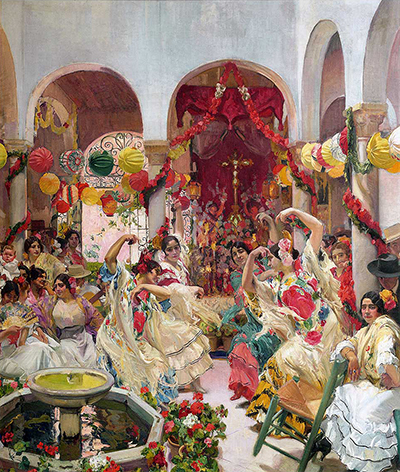
Seville itself receives more than one kind of image. The penitents and The Dance establish markedly different occasions. In the dance panel, lifted arms, pale dresses and bright decorations fill an architectural courtyard. The figures’ gestures curve across a densely ornamented setting. The procession’s tall, dark forms have given way to flaring fabric and small bursts of colour. A single city can sustain several visual rhythms within the national ensemble.
This plurality matters. Each selected scene is particular enough to reward attention, while the presence of other subjects keeps it from carrying the entire identity of its place. The room’s meaning grows through comparison. Recreation, religious ceremony, civic gathering and exchange take their places beside one another as ways in which collective life can become visible.
Light across the room
Phillips was especially attentive to the different effects of light on surfaces. In 1912 he praised Sorolla’s ability to vary the appearance of white across sails, clothing, walls and bodies, rather than treating it as an identical colour wherever it occurred.[4] His observation offers a useful exercise in the gallery: follow the lightest areas from one panel to another and consider what they make visible.
At Ayamonte, the canopy is a broad, warm field over a much more varied surface below. Bright passages are broken among workers, catches and glimpses of the harbour. The eye moves down from the shelter towards the complicated foreground, then out between the supports towards the water. Here the organisation of light helps separate overhead cover, near activity and distance.
Earlier groups, enlarged ambitions
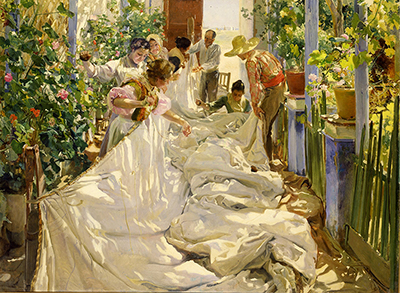
The ensemble extends problems already present in Sorolla’s earlier figure paintings. Sewing the Sail gathers people around a great expanse of fabric. Its folds carry the eye from the foreground towards the workers, while vegetation and supports enclose the task. The sail is both an object receiving attention and a device that connects otherwise separated figures. Looking at it beside the later fish scenes makes the importance of a shared material focus especially clear.
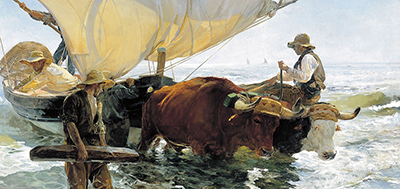
In The Return from Fishing, a sail, boat, animals and workers are organised through the effort of movement. A broad curved surface occupies the upper part of the image, and powerful animal bodies carry its weight below. In Ayamonte, another overhead expanse meets another foreground of substantial bodies, but the labour and setting have changed.
Installation, renewed looking and conservation
The long interval between commission and inauguration belongs to the work’s history. The room opened in 1926, after Sorolla’s death. Much later, all fourteen canvases underwent restoration in 2006–2007 before touring Spain. The Hispanic Society records exhibitions in six Spanish cities between November 2007 and February 2010 and the inauguration of the renovated New York gallery in 2010.[1] The paintings’ movement brought the ensemble to audiences outside the room for which it had been made.
The studies have also had their own public life. The Thyssen-Bornemisza’s 1998–1999 exhibition presented studies and sketches for the panels, allowing the preparatory work to be encountered as a substantial body of art.[8]
Conservation research adds material knowledge to that history. The University of Valencia’s 2016 report concerns the gouache sketches on paper. It describes scientific examination and explains that the results informed their restoration.[6] These are particular objects with their own supports and techniques. Their preservation keeps visible an important stage of the project, in which painted fragments and observations could be brought into new relationships.
The finished canvases bring those accumulated decisions into the spectator’s space. Their people remain occupied with their own ceremonies, performances and tasks, while the viewer moves among them. The room gives a national subject this physical immediacy: its image of Spain unfolds through encounters with distinct groups, each absorbed in a particular part of collective life.
Explore the paintings
 Joaquin Sorolla.jpg)
Watch: Sorolla, light and painting
Three National Gallery films offer an introduction, a closer look at technique and a longer curator’s talk.
An introduction to 'Sorolla: Spanish Master of Light'
Start with a short exhibition introduction to Sorolla’s subjects and career.
Watch on YouTubeArtworks and exhibition records
Browse 103 artwork articles, 350 numbered entries from the Hispanic Society’s 1909 New York catalogue, and two selected Meadows Museum drawings. These are records, not a count of unique artworks: repeated historical titles remain separate entries and may overlap with the articles. A catalogue’s exhibition year does not establish an execution date. This researched selection is not a complete catalogue raisonné.
| Name | Date | Medium |
|---|---|---|
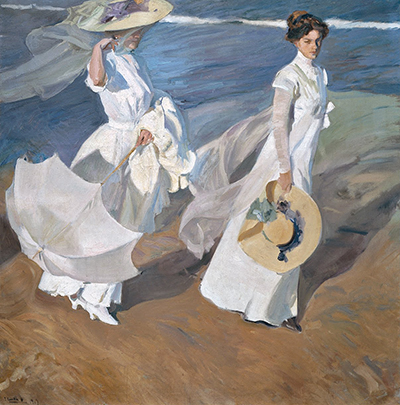
| Women Walking on the Beach | 1909 | Painting |
| Sewing the Sail | 1896 | Painting |
| Running Along the Beach | 1908 | Painting |
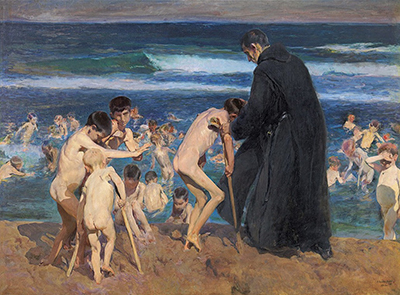
| Sad Inheritance | 1899 | Painting |
| Mother | 1895–1900 | Painting |
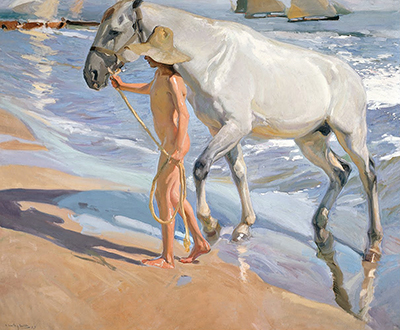
| The Horse's Bath | 1909 | Painting |
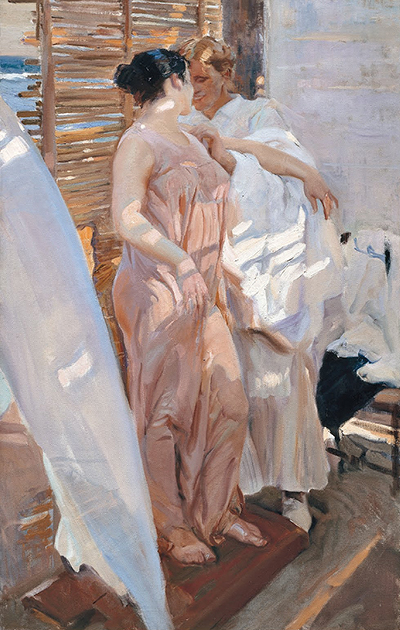
| The Pink Robe | 1916 | Painting |
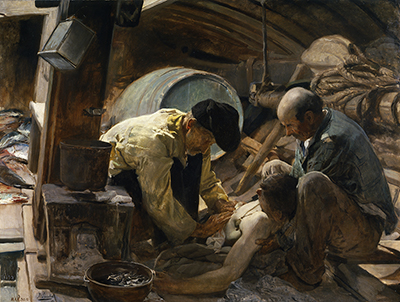
| And They Still Say Fish are Expensive! | 1894 | Painting |
| The Return from Fishing | 1894 | Painting |
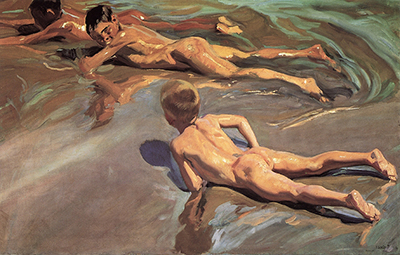
| Children on the Beach | 1909 | Painting |
| Castilla, the Feast of Bread | 1913 | Painting |
| Sevilla, Holy Week Penitents | 1914 | Painting |
| Aragon, Jota | 1914 | Painting |
| Navarre, the Town Council of Roncal | 1914 | Painting |
| Guipúzcoa, Bowling | 1914 | Painting |
| Andalucía, El Encierro | 1914 | Painting |
| Seville, the Dance | 1915 | Painting |
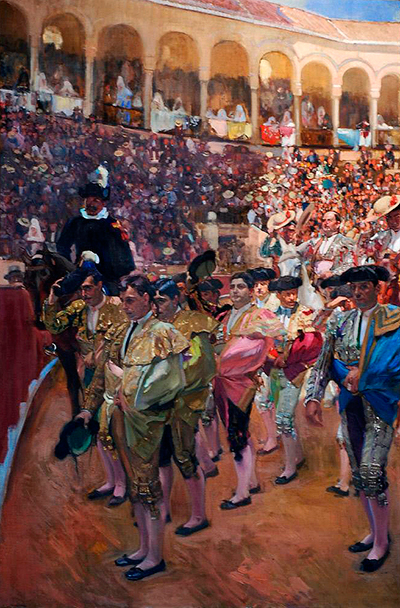
| Sevilla, The Bullfighters | 1915 | Painting |
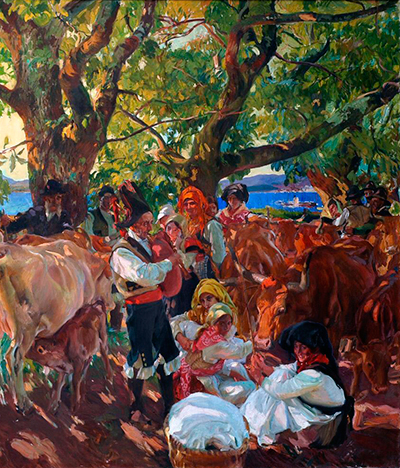
| Galicia, The Pilgrimage | 1915 | Painting |
| The Fish | 1915 | Painting |
| Valencia, Couples on Horseback | 1916 | Painting |
| Extremadura, The Market | 1917 | Painting |
| Elche, The Palm Grove | 1918–1919 | Painting |
| The Tunny Catch | 1919 | Painting |
| Louis Comfort Tiffany | 1911 | Painting |
| Adobe Houses | 1890–1895 | Painting |
| After Bathing | 1915 | Painting |
| After Bathing, Valencia | 1909 | Painting |
| After Bathing, Valencian Beach | 1908 | Painting |
| Afternoon Sun, Playa de Valencia | 1910 (Album catalogue) | Painting |
| Aim of Ibiza | 1919 | Painting |
| Almond Trees in Asis | Spring,1887–1889 | Painting |
| Another Margarita | 1892 | Painting |
| Antonio García at the Beach | 1909 | Painting |
| Around Segovia | 9–15 October 1906 | Painting |
| Artist's Patio, Cafe Novedades, Seville | 1915 | Painting |
| Asturian Landscape | circa 1904 | Painting |
| Aureliano de Beruete | 1902 | Painting |
| Aureliano de Beruete y Moret, Son | 1902 | Painting |
| The Bath, Jávea | 1905 | Painting |
| The Bathing Hour | 1915 execution, signed and dated1917 (Sothebys catalogue account) | Painting |
| Bathing Time | 1904 | Painting |
| Beach at Valencia | 1908 in ARC catalogue | Painting |
| Beach at Zarauz | 1910 | Painting |
| Beach of Biarritz | 1906 | Painting |
| Beach of Biarritz, France | Summer1906 | Painting |
| Beached Boats | 1915 | Painting |
| Beaching the Boat | 1908 in ARC catalogue | Painting |
| Blessing the Boat | 1895 | Painting |
| Blind Man of Toledo | 1906 | Painting |
| Boat Builders | 1894 | Painting |
| Boat in Albufera | 1895 | Painting |
| Boy on the Sand | Undated | Painting |
| Boys in the Sea | 1908 | Painting |
| Boys on the Beach | BeforeNewYork1909exhibition; exactyearunresolved | Painting |
| Breakwater, San Sebastian | 1917–1918 | Painting |
| Bulls in the Sea | 1903 | Painting |
| Capturing the Moment | 1906 | Painting |
| Castle of La Mota, Medina del Campo | 29 May 1912 | Painting |
| Children in the Sea | Painting | |
| Children on the Beach, Valencia | 1916 | Painting |
| Children on the Seashore | 1903 | Painting |
| Child's Siesta | circa 1918 (ARC catalogue) | Painting |
| Church Roncal Stairs | 22–28August1912 | Painting |
| Clothilde at the Beach | Summer1904 | Painting |
| Clotilde and Elena on the Rocks at Javea | 1905 | Painting |
| Clotilde García del Castillo | April1890 | Painting |
| Clotilde in a Grey Dress | 1900 | Painting |
| Clotilde with Hat | 1910 | Painting |
| Coast at Santa Cristina | 29 September 1915 (current CERES1122) | Painting |
| Court of the Dances, Alcázar, Sevilla | 1910 | Painting |
| Covachuelas, Toledo | 21–30 October 1906 | Painting |
| Dragging the Trawler | circa 1903–1904 in educational catalogue | Painting |
| El Retiro, Madrid | 1898 | Painting |
| Female Nude | 1902 | Painting |
| Fisherman in Valencia | 1904 | Painting |
| Fisherwomen from Valencia | June–July 1915 | Painting |
| Fishing Boats | by February 1909 | Painting |
| Fishing Nets | 1893 | Painting |
| The Gardens at the Sorolla Family House | spring 1920 | Painting |
| Hall of the Ambassadors, Alhambra, Granada | 1909 | Painting |
| Harbour | 1880 | Painting |
| Joaquín Sorolla García in a White Dress | 1896 | Painting |
| Lighthouse Walk at Biarritz | 1906 | Painting |
| The Little Yacht | 1909 | Painting |
| Maria at La Granja | 1907 | Painting |
| My Children | 1904 | Painting |
| My Wife and Daughters in the Garden | 1910 | Painting |
| Portrait of Benito Pérez Galdós | 1894 | Painting |
| A Rooftop with Flowers | 1902 | Painting |
| Self Portrait | 1904 | Painting |
| Self Portrait | 1909 | Painting |
| Señora de Sorolla in Black | 1906 | Painting |
| La Siesta | 1911 | Painting |
| The Skipping Rope | 1907 | Painting |
| Swimmers, Jávea | 1905 | Painting |
| Time for a Bathe | 1909 | Painting |
| Under the Awning, Zarauz | 1910 | Painting |
| Valencia Beach in the Morning Light | summer 1908 | Painting |
| Valencian Fishermen | 1895 | Painting |
| The White Boat, Jávea | 1905 | Painting |
| White Slave Trade | 1894 | Painting |
| The Wounded Foot | 1909 | Painting |
| Seven Peaks, Guadarrama — 1909 catalogue, no. 1 | Painting | |
| Covachuelas, Toledo — 1909 catalogue, no. 2 | Painting | |
| Las Pedrizas, El Pardo — 1909 catalogue, no. 3 | Painting | |
| Señor Gomar — 1909 catalogue, no. 4 | Painting | |
| El Torneo, El Pardo — 1909 catalogue, no. 5 | Painting | |
| A Toledo Street — 1909 catalogue, no. 6 | Painting | |
| View from El Torneo — 1909 catalogue, no. 7 | Painting | |
| Walls of Segovia — 1909 catalogue, no. 8 | Painting | |
| Convent of El Parral, Segovia — 1909 catalogue, no. 9 | Painting | |
| Environs of Segovia — 1909 catalogue, no. 10 | Painting | |
| Reflections from the Cape, Jávea — 1909 catalogue, no. 11 | Painting | |
| The Clamores, Segovia — 1909 catalogue, no. 12 | Painting | |
| Rocks of the Cape, Jávea — 1909 catalogue, no. 13 | Painting | |
| Farmhouse, Alcira — 1909 catalogue, no. 14 | Painting | |
| María at Biarritz — 1909 catalogue, no. 15 | Painting | |
| Shadow of the Alcántara Bridge, Toledo — 1909 catalogue, no. 16 | Painting | |
| Castle of San Servando, Toledo — 1909 catalogue, no. 17 | Painting | |
| Dr Decret — 1909 catalogue, no. 18 | Painting | |
| Alcántara Bridge, Toledo — 1909 catalogue, no. 19 | Painting | |
| The Forest, La Granja — 1909 catalogue, no. 20 | Painting | |
| Trout Stream, La Granja — 1909 catalogue, no. 21 | Painting | |
| Court of the Dances, Alcázar, Seville — 1909 catalogue, no. 22 | Painting | |
| Oleanders — 1909 catalogue, no. 23 | Painting | |
| Glen, Asturias — 1909 catalogue, no. 24 | Painting | |
| Pavilion of Charles V, Seville — 1909 catalogue, no. 25 | Painting | |
| St Martin's Bridge, Toledo — 1909 catalogue, no. 26 | Painting | |
| Orange Trees — 1909 catalogue, no. 27 | Painting | |
| Rope Makers — 1909 catalogue, no. 28 | Painting | |
| Señor Franzen — 1909 catalogue, no. 29 | Painting | |
| Rocks at the Lighthouse, Biarritz — 1909 catalogue, no. 30 | Painting | |
| St Martin's Bridge, Toledo — 1909 catalogue, no. 31 | Painting | |
| Valencian Fisherwoman — 1909 catalogue, no. 32 | Painting | |
| Road of San Esteban, Asturias — 1909 catalogue, no. 33 | Painting | |
| Basin in the Alcázar, Seville — 1909 catalogue, no. 34 | Painting | |
| Harbour of Valencia — 1909 catalogue, no. 35 | Painting | |
| Haymaking, Asturias — 1909 catalogue, no. 36 | Painting | |
| House of El Greco, Toledo — 1909 catalogue, no. 37 | Painting | |
| María with a Black Hat — 1909 catalogue, no. 38 | Painting | |
| Entrance Tower, Toledo — 1909 catalogue, no. 39 | Painting | |
| Las Covachuelas, Toledo — 1909 catalogue, no. 40 | Painting | |
| Rocks, Jávea — 1909 catalogue, no. 41 | Painting | |
| Road of the Alijares, Toledo — 1909 catalogue, no. 42 | Painting | |
| Segovian Family — 1909 catalogue, no. 43 | Painting | |
| Scalding Grapes, Jávea — 1909 catalogue, no. 44 | Painting | |
| Joaquín — 1909 catalogue, no. 45 | Painting | |
| Elena — 1909 catalogue, no. 46 | Painting | |
| El Grutesco, Alcázar, Seville — 1909 catalogue, no. 47 | Painting | |
| Beach of Valencia — 1909 catalogue, no. 48 | Painting | |
| Sails Drying, Valencia — 1909 catalogue, no. 49 | Painting | |
| Orange Tree — 1909 catalogue, no. 50 | Painting | |
| Little Boy with a Toy Boat — 1909 catalogue, no. 51 | Painting | |
| Old Valencian Fisherman — 1909 catalogue, no. 52 | Painting | |
| Fishing Boats — 1909 catalogue, no. 53 | Painting | |
| Harbour of Valencia — 1909 catalogue, no. 54 | Painting | |
| The Kiss — 1909 catalogue, no. 55 | Painting | |
| Little Boy on a Rock, Jávea — 1909 catalogue, no. 56 | Painting | |
| The Queen's Beam, Valsaín — 1909 catalogue, no. 57 | Painting | |
| Staircase of the Palace, La Granja — 1909 catalogue, no. 58 | Painting | |
| Elena at El Pardo — 1909 catalogue, no. 59 | Painting | |
| Fountain of the Horses, La Granja — 1909 catalogue, no. 60 | Painting | |
| Autumn, La Granja — 1909 catalogue, no. 61 | Painting | |
| María Painting, El Pardo — 1909 catalogue, no. 62 | Painting | |
| Fountain of the Forest, La Granja — 1909 catalogue, no. 63 | Painting | |
| Fountain of Neptune, La Granja — 1909 catalogue, no. 64 | Painting | |
| Orange Grove, Valencia — 1909 catalogue, no. 65 | Painting | |
| Francisqueta, Valencia — 1909 catalogue, no. 66 | Painting | |
| Waiting for the Fish, Valencia — 1909 catalogue, no. 67 | Painting | |
| Taking in the Sail, Valencia — 1909 catalogue, no. 68 | Painting | |
| Return from Fishing, Valencia — 1909 catalogue, no. 69 | Painting | |
| Crayfishers, Valencia — 1909 catalogue, no. 70 | Painting | |
| Swimmer, Jávea — 1909 catalogue, no. 71 | Painting | |
| Elena among Roses — 1909 catalogue, no. 72 | Painting | |
| Idyll — 1909 catalogue, no. 73 | Painting | |
| Vicente Blasco Ibáñez — 1909 catalogue, no. 74 | Painting | |
| Yellow Tree, La Granja — 1909 catalogue, no. 75 | Painting | |
| Blind Man of Toledo — 1909 catalogue, no. 76 | Painting | |
| Fisherwoman with Her Son, Valencia — 1909 catalogue, no. 77 | Painting | |
| The Bath, La Granja — 1909 catalogue, no. 78 | Painting | |
| Sewing the Sail, Valencia — 1909 catalogue, no. 79 | Painting | |
| Looking for Crabs, Jávea — 1909 catalogue, no. 80 | Painting | |
| María, La Granja — 1909 catalogue, no. 81 | Painting | |
| Joaquín and His Dog — 1909 catalogue, no. 82 | Painting | |
| Upon the Sand — 1909 catalogue, no. 83 | Painting | |
| Valencian Fisherwomen — 1909 catalogue, no. 84 | Painting | |
| Señora de Sorolla in White — 1909 catalogue, no. 85 | Painting | |
| At the Seashore, Valencia — 1909 catalogue, no. 86 | Painting | |
| Valencian Woman — 1909 catalogue, no. 87 | Painting | |
| In the Gardens of La Granja — 1909 catalogue, no. 88 | Painting | |
| Old Castilian — 1909 catalogue, no. 89 | Painting | |
| Marqués de Urquijo — 1909 catalogue, no. 90 | Painting | |
| Fisherman's Daughter, Valencia — 1909 catalogue, no. 91 | Painting | |
| Elena and Her Dolls — 1909 catalogue, no. 92 | Painting | |
| My Children — 1909 catalogue, no. 93 | Painting | |
| Swimmers — 1909 catalogue, no. 94 | Painting | |
| Low Tide: Elena at Biarritz — 1909 catalogue, no. 95 | Painting | |
| Mending Nets — 1909 catalogue, no. 96 | Painting | |
| The Bath, Jávea — 1909 catalogue, no. 97 | Painting | |
| The Bath, Jávea — 1909 catalogue, no. 98 | Painting | |
| Boxing Raisins — 1909 catalogue, no. 99 | Painting | |
| Forest Bridge, La Granja — 1909 catalogue, no. 100 | Painting | |
| View of the Palace, La Granja — 1909 catalogue, no. 101 | Painting | |
| Return from Fishing, Valencia — 1909 catalogue, no. 102 | Painting | |
| At the Bath, Valencia — 1909 catalogue, no. 103 | Painting | |
| Little Girl with a Blue Ribbon, Valencia — 1909 catalogue, no. 104 | Painting | |
| María at the Harbour of Jávea — 1909 catalogue, no. 105 | Painting | |
| Instantaneous, Biarritz — 1909 catalogue, no. 106 | Painting | |
| Boy among Breakers, Jávea — 1909 catalogue, no. 107 | Painting | |
| Garden of the Alcázar, Seville — 1909 catalogue, no. 108 | Painting | |
| Oleander Road, Valencia — 1909 catalogue, no. 109 | Painting | |
| María and Her Grandmother — 1909 catalogue, no. 110 | Painting | |
| Malvarrosa Beach, Valencia — 1909 catalogue, no. 111 | Painting | |
| The Huerta of Valencia — 1909 catalogue, no. 112 | Painting | |
| Garden of the Alcázar, Seville — 1909 catalogue, no. 113 | Painting | |
| Garden of the Alcázar, Seville — 1909 catalogue, no. 114 | Painting | |
| The Giralda, Seville — 1909 catalogue, no. 115 | Painting | |
| Palace of Charles V, Seville — 1909 catalogue, no. 116 | Painting | |
| Harbour of Valencia — 1909 catalogue, no. 117 | Painting | |
| Marqués de la Vega-Inclán — 1909 catalogue, no. 118 | Painting | |
| Harbour of Valencia — 1909 catalogue, no. 119 | Painting | |
| At the Water, Valencia — 1909 catalogue, no. 120 | Painting | |
| House in the Huerta, Valencia — 1909 catalogue, no. 121 | Painting | |
| Beach Garden, Valencia — 1909 catalogue, no. 122 | Painting | |
| Huerta of Valencia — 1909 catalogue, no. 123 | Painting | |
| Garden of the Alcázar, Seville — 1909 catalogue, no. 124 | Painting | |
| Asturias — 1909 catalogue, no. 125 | Painting | |
| San Sebastián — 1909 catalogue, no. 126 | Painting | |
| Old Harbour, Biarritz — 1909 catalogue, no. 127 | Painting | |
| Beach of Biarritz — 1909 catalogue, no. 128 | Painting | |
| Beach of Biarritz — 1909 catalogue, no. 129 | Painting | |
| Beach of Biarritz — 1909 catalogue, no. 130 | Painting | |
| Beach of Biarritz — 1909 catalogue, no. 131 | Painting | |
| Beach of Biarritz — 1909 catalogue, no. 132 | Painting | |
| Beach of Biarritz — 1909 catalogue, no. 133 | Painting | |
| Beach of Biarritz — 1909 catalogue, no. 134 | Painting | |
| Beach of Biarritz — 1909 catalogue, no. 135 | Painting | |
| Beach of Biarritz — 1909 catalogue, no. 136 | Painting | |
| Beach of Biarritz — 1909 catalogue, no. 137 | Painting | |
| Beach of Biarritz — 1909 catalogue, no. 138 | Painting | |
| Beach of Biarritz — 1909 catalogue, no. 139 | Painting | |
| Beach of Biarritz — 1909 catalogue, no. 140 | Painting | |
| Beach of Biarritz — 1909 catalogue, no. 141 | Painting | |
| Beach of Biarritz — 1909 catalogue, no. 142 | Painting | |
| Beach of Biarritz — 1909 catalogue, no. 143 | Painting | |
| La Concha, San Sebastián — 1909 catalogue, no. 144 | Painting | |
| Beach of Biarritz — 1909 catalogue, no. 145 | Painting | |
| Beach of Biarritz — 1909 catalogue, no. 146 | Painting | |
| Beach of Biarritz — 1909 catalogue, no. 147 | Painting | |
| Beach of Biarritz — 1909 catalogue, no. 148 | Painting | |
| Beach of Biarritz — 1909 catalogue, no. 149 | Painting | |
| Beach of Biarritz — 1909 catalogue, no. 150 | Painting | |
| Beach of Biarritz — 1909 catalogue, no. 151 | Painting | |
| Beach of Biarritz — 1909 catalogue, no. 152 | Painting | |
| Beach of Biarritz — 1909 catalogue, no. 153 | Painting | |
| Beach of Biarritz — 1909 catalogue, no. 154 | Painting | |
| Beach of Valencia — 1909 catalogue, no. 155 | Painting | |
| Beach of Valencia — 1909 catalogue, no. 156 | Painting | |
| Beach of Valencia — 1909 catalogue, no. 157 | Painting | |
| Harbour of San Sebastián — 1909 catalogue, no. 158 | Painting | |
| Harbour of San Sebastián — 1909 catalogue, no. 159 | Painting | |
| Beach of Valencia — 1909 catalogue, no. 160 | Painting | |
| Pasajes — 1909 catalogue, no. 161 | Painting | |
| Harbour of San Sebastián — 1909 catalogue, no. 162 | Painting | |
| La Concha, San Sebastián — 1909 catalogue, no. 163 | Painting | |
| La Concha, San Sebastián — 1909 catalogue, no. 164 | Painting | |
| Harbour of Pasajes — 1909 catalogue, no. 165 | Painting | |
| Beach of Valencia — 1909 catalogue, no. 166 | Painting | |
| Beach of Valencia — 1909 catalogue, no. 167 | Painting | |
| Beach of Valencia — 1909 catalogue, no. 168 | Painting | |
| Beach of Valencia — 1909 catalogue, no. 169 | Painting | |
| Beach of Valencia — 1909 catalogue, no. 170 | Painting | |
| Beach of Valencia — 1909 catalogue, no. 171 | Painting | |
| Beach of Valencia — 1909 catalogue, no. 172 | Painting | |
| Beach of Valencia — 1909 catalogue, no. 173 | Painting | |
| Beach of Valencia — 1909 catalogue, no. 174 | Painting | |
| Beach of Valencia — 1909 catalogue, no. 175 | Painting | |
| Beach of Valencia — 1909 catalogue, no. 176 | Painting | |
| Beach of Valencia — 1909 catalogue, no. 177 | Painting | |
| Cape San Antonio, Jávea — 1909 catalogue, no. 178 | Painting | |
| Galicia — 1909 catalogue, no. 179 | Painting | |
| Sewing the Sail — 1909 catalogue, no. 180 | Painting | |
| Poppies — 1909 catalogue, no. 181 | Painting | |
| Beach of Valencia — 1909 catalogue, no. 182 | Painting | |
| Malvarrosa — 1909 catalogue, no. 183 | Painting | |
| Harbour of San Sebastián — 1909 catalogue, no. 184 | Painting | |
| Beach of Valencia — 1909 catalogue, no. 185 | Painting | |
| Locutory — 1909 catalogue, no. 186 | Painting | |
| Beach of Valencia — 1909 catalogue, no. 187 | Painting | |
| Beach of Valencia — 1909 catalogue, no. 188 | Painting | |
| Cape San Antonio, Jávea — 1909 catalogue, no. 189 | Painting | |
| Beach of Valencia — 1909 catalogue, no. 190 | Painting | |
| Oleanders — 1909 catalogue, no. 191 | Painting | |
| Beach of Valencia — 1909 catalogue, no. 192 | Painting | |
| La Concha, San Sebastián — 1909 catalogue, no. 193 | Painting | |
| Beach of Valencia — 1909 catalogue, no. 194 | Painting | |
| Beach of Valencia — 1909 catalogue, no. 195 | Painting | |
| Beach of Valencia — 1909 catalogue, no. 196 | Painting | |
| Biarritz — 1909 catalogue, no. 197 | Painting | |
| Biarritz — 1909 catalogue, no. 198 | Painting | |
| Segovia — 1909 catalogue, no. 199 | Painting | |
| Asturias — 1909 catalogue, no. 200 | Painting | |
| Versailles — 1909 catalogue, no. 201 | Painting | |
| Beach of Valencia — 1909 catalogue, no. 202 | Painting | |
| Beach of Valencia — 1909 catalogue, no. 203 | Painting | |
| Beach of Valencia — 1909 catalogue, no. 204 | Painting | |
| Beach of Valencia — 1909 catalogue, no. 205 | Painting | |
| Court of El Cabañal — 1909 catalogue, no. 206 | Painting | |
| In the River — 1909 catalogue, no. 207 | Painting | |
| Harbour of Valencia — 1909 catalogue, no. 208 | Painting | |
| Beach of Valencia — 1909 catalogue, no. 209 | Painting | |
| Harbour of Valencia — 1909 catalogue, no. 210 | Painting | |
| Beach of Valencia — 1909 catalogue, no. 211 | Painting | |
| Beach of Valencia — 1909 catalogue, no. 212 | Painting | |
| Beach of Valencia — 1909 catalogue, no. 213 | Painting | |
| Royal Mallows — 1909 catalogue, no. 214 | Painting | |
| Geraniums — 1909 catalogue, no. 215 | Painting | |
| Altar of St Vincent, Valencia — 1909 catalogue, no. 216 | Painting | |
| Beach of Valencia — 1909 catalogue, no. 217 | Painting | |
| Harbour of Avilés — 1909 catalogue, no. 218 | Painting | |
| Beach of Valencia — 1909 catalogue, no. 219 | Painting | |
| Beach of Valencia — 1909 catalogue, no. 220 | Painting | |
| Beach of Valencia — 1909 catalogue, no. 221 | Painting | |
| Market of León — 1909 catalogue, no. 222 | Painting | |
| Beach of Valencia — 1909 catalogue, no. 223 | Painting | |
| Beach of Valencia — 1909 catalogue, no. 224 | Painting | |
| Beach of Valencia — 1909 catalogue, no. 225 | Painting | |
| Beach of Valencia — 1909 catalogue, no. 226 | Painting | |
| Beach of Valencia — 1909 catalogue, no. 227 | Painting | |
| Huerta of Valencia — 1909 catalogue, no. 228 | Painting | |
| Beach of Valencia — 1909 catalogue, no. 229 | Painting | |
| Beach of Valencia — 1909 catalogue, no. 230 | Painting | |
| Beach of Valencia — 1909 catalogue, no. 231 | Painting | |
| Beach of Valencia — 1909 catalogue, no. 232 | Painting | |
| Beach of Valencia — 1909 catalogue, no. 233 | Painting | |
| Beach of Valencia — 1909 catalogue, no. 234 | Painting | |
| Asturias — 1909 catalogue, no. 235 | Painting | |
| Beach of Valencia — 1909 catalogue, no. 236 | Painting | |
| Women Playing — 1909 catalogue, no. 237 | Painting | |
| Beach of Valencia — 1909 catalogue, no. 238 | Painting | |
| Beach of Valencia — 1909 catalogue, no. 239 | Painting | |
| Beach of Valencia — 1909 catalogue, no. 240 | Painting | |
| Beach of Valencia — 1909 catalogue, no. 241 | Painting | |
| Market of León — 1909 catalogue, no. 242 | Painting | |
| Beach of Valencia — 1909 catalogue, no. 243 | Painting | |
| Beach of Valencia — 1909 catalogue, no. 244 | Painting | |
| Beach of Valencia — 1909 catalogue, no. 245 | Painting | |
| Beach of Valencia — 1909 catalogue, no. 246 | Painting | |
| Asturias — 1909 catalogue, no. 247 | Painting | |
| León — 1909 catalogue, no. 248 | Painting | |
| Asturias — 1909 catalogue, no. 249 | Painting | |
| Jávea — 1909 catalogue, no. 250 | Painting | |
| Asturias — 1909 catalogue, no. 251 | Painting | |
| León — 1909 catalogue, no. 252 | Painting | |
| Asturias — 1909 catalogue, no. 253 | Painting | |
| Asturias — 1909 catalogue, no. 254 | Painting | |
| Beach of Valencia — 1909 catalogue, no. 255 | Painting | |
| Beach of Valencia — 1909 catalogue, no. 256 | Painting | |
| Asturias — 1909 catalogue, no. 257 | Painting | |
| León — 1909 catalogue, no. 258 | Painting | |
| Beach of Valencia — 1909 catalogue, no. 259 | Painting | |
| Beach of Valencia — 1909 catalogue, no. 260 | Painting | |
| Beach of Valencia — 1909 catalogue, no. 261 | Painting | |
| León — 1909 catalogue, no. 262 | Painting | |
| Beach of Valencia — 1909 catalogue, no. 263 | Painting | |
| Asturias — 1909 catalogue, no. 264 | Painting | |
| Galicia — 1909 catalogue, no. 265 | Painting | |
| Malvarrosa — 1909 catalogue, no. 266 | Painting | |
| Jávea — 1909 catalogue, no. 267 | Painting | |
| Biarritz — 1909 catalogue, no. 268 | Painting | |
| Harbour of Jávea — 1909 catalogue, no. 269 | Painting | |
| La Concha, San Sebastián — 1909 catalogue, no. 270 | Painting | |
| San Sebastián — 1909 catalogue, no. 271 | Painting | |
| San Sebastián — 1909 catalogue, no. 272 | Painting | |
| Beach of Valencia — 1909 catalogue, no. 273 | Painting | |
| Beach of Valencia — 1909 catalogue, no. 274 | Painting | |
| Beach of Valencia — 1909 catalogue, no. 275 | Painting | |
| Beach of Valencia — 1909 catalogue, no. 276 | Painting | |
| Beach of Valencia — 1909 catalogue, no. 277 | Painting | |
| Washerwomen — 1909 catalogue, no. 278 | Painting | |
| San Sebastián — 1909 catalogue, no. 279 | Painting | |
| Beach of Valencia — 1909 catalogue, no. 280 | Painting | |
| San Sebastián — 1909 catalogue, no. 281 | Painting | |
| San Sebastián — 1909 catalogue, no. 282 | Painting | |
| Beach of Valencia — 1909 catalogue, no. 283 | Painting | |
| Beach of Valencia — 1909 catalogue, no. 284 | Painting | |
| Uncle Pancha — 1909 catalogue, no. 285 | Painting | |
| Señor García — 1909 catalogue, no. 286 | Painting | |
| Boy Nude, La Granja — 1909 catalogue, no. 287 | Painting | |
| Señora de Sorolla in Black — 1909 catalogue, no. 288 | Painting | |
| Duke of Alba — 1909 catalogue, no. 289 | Painting | |
| Mother: Señora de Sorolla — 1909 catalogue, no. 290 | Painting | |
| Running along the Beach — 1909 catalogue, no. 291 | Painting | |
| After the Bath — 1909 catalogue, no. 292 | Painting | |
| Lighthouse Walk, Biarritz — 1909 catalogue, no. 293 | Painting | |
| Little Boy on the Beach — 1909 catalogue, no. 294 | Painting | |
| Cape San Antonio, Jávea — 1909 catalogue, no. 295 | Painting | |
| Count of Villagonzalo — 1909 catalogue, no. 296 | Painting | |
| Boy in the Sea — 1909 catalogue, no. 297 | Painting | |
| Children on the Beach — 1909 catalogue, no. 298 | Painting | |
| Valencian Boats — 1909 catalogue, no. 299 | Painting | |
| The Little Brother — 1909 catalogue, no. 300 | Painting | |
| Children in the Sea — 1909 catalogue, no. 301 | Painting | |
| Orange Grove, Alcira — 1909 catalogue, no. 302 | Painting | |
| At the Water — 1909 catalogue, no. 303 | Painting | |
| Little Boy on the Beach — 1909 catalogue, no. 304 | Painting | |
| Street of Orange Trees — 1909 catalogue, no. 305 | Painting | |
| Playing in the Water — 1909 catalogue, no. 306 | Painting | |
| Beach of Valencia by Morning Light — 1909 catalogue, no. 307 | Painting | |
| Coming out of the Bath — 1909 catalogue, no. 308 | Painting | |
| The Grandson — 1909 catalogue, no. 309 | Painting | |
| Water Joy — 1909 catalogue, no. 310 | Painting | |
| On the Sand — 1909 catalogue, no. 311 | Painting | |
| Francisco Acebal — 1909 catalogue, no. 312 | Painting | |
| Marcelino Menéndez y Pelayo — 1909 catalogue, no. 313 | Painting | |
| Aureliano de Beruete — 1909 catalogue, no. 314 | Painting | |
| Marqués de Viana — 1909 catalogue, no. 315 | Painting | |
| Beach of Valencia — 1909 catalogue, no. 316 | Painting | |
| Señor Granzón — 1909 catalogue, no. 317 | Painting | |
| Oxen Ready to Beach Fishing Boats, Valencia — 1909 catalogue, no. 318 | Painting | |
| Children in the Sea — 1909 catalogue, no. 319 | Painting | |
| Sea: Morning Effect — 1909 catalogue, no. 320 | Painting | |
| Fishing Boat — 1909 catalogue, no. 321 | Painting | |
| Sails at Sea — 1909 catalogue, no. 322 | Painting | |
| Return from Fishing — 1909 catalogue, no. 323 | Painting | |
| Boats on the Sand — 1909 catalogue, no. 324 | Painting | |
| Study of Boats — 1909 catalogue, no. 325 | Painting | |
| Fishing Boats — 1909 catalogue, no. 326 | Painting | |
| Boats — 1909 catalogue, no. 327 | Painting | |
| Children on the Shore — 1909 catalogue, no. 328 | Painting | |
| Beach of Valencia — 1909 catalogue, no. 329 | Painting | |
| Beach of Valencia — 1909 catalogue, no. 330 | Painting | |
| Beach of Valencia — 1909 catalogue, no. 331 | Painting | |
| Beach of Valencia — 1909 catalogue, no. 332 | Painting | |
| Nets Drying — 1909 catalogue, no. 333 | Painting | |
| Shoving off the Boat — 1909 catalogue, no. 334 | Painting | |
| Beach of Valencia — 1909 catalogue, no. 335 | Painting | |
| Oleanders — 1909 catalogue, no. 336 | Painting | |
| Beach of Valencia — 1909 catalogue, no. 337 | Painting | |
| Beach of Valencia — 1909 catalogue, no. 338 | Painting | |
| Beach of Valencia — 1909 catalogue, no. 339 | Painting | |
| Leonese Peasants — 1909 catalogue, no. 340 | Painting | |
| At the Bath — 1909 catalogue, no. 341 | Painting | |
| Sea Idyll — 1909 catalogue, no. 342 | Painting | |
| The Little Granddaughter — 1909 catalogue, no. 343 | Painting | |
| Manuel B. Cossío — 1909 catalogue, no. 344 | Painting | |
| The Peppers — 1909 catalogue, no. 345 | Painting | |
| Raimundo de Madrazo — 1909 catalogue, no. 346 | Painting | |
| Alejandro Pidal y Mon — 1909 catalogue, no. 347 | Painting | |
| Señora de Sorolla in Spanish Mantilla — 1909 catalogue, no. 348 | Painting | |
| My Daughters, Elena and María, on Horseback in Valencian Costumes of 1808 — 1909 catalogue, no. 349 | Painting | |
| Sad Inheritance — 1909 catalogue, no. 350 | Painting | |
| Study of Hands | c. 1889 | Drawing |
| Clotilde Reading (recto) | c. 1902 | Drawing |
Discussion
Look again at the images and ideas explored in Vision of Spain. These editorial prompts invite your observations.
Reader Insights
Which detail in Vision of Spain first caught your attention, and where did your eye travel next?
The section “Paintings that become an environment” offers one way into the subject. Which detail or comparison most helps you assess that reading?
After reading “Installation, renewed looking and conservation”, what would you return to for a closer look?
Join the Conversation
Share a detail, comparison or question about Vision of Spain below.
References
- Hispanic Society Museum & Library. “Joaquín Sorolla’s Vision of Spain.” Installation account, paragraphs on the commission, scale, execution, 1926 inauguration, 2006–2007 restoration, Spanish tour and 2010 gallery reopening. Owner’s account. View source.
- Blanca Pons-Sorolla. “Sorolla in the Huntingtons’ Collections,” in José Luis Colomer, Blanca Pons-Sorolla and Mark A. Roglán, eds., Sorolla in America: Friends and Patrons. Madrid: Centro de Estudios Europa Hispánica, 2015. Publisher’s selected pages: printed pp. 45–48, 51 and 66–67; PDF pp. 5–8 and 14–15. Commission and execution sequence p. 66; reproduced contract p. 67. Publisher’s excerpt. View source.
- Museo Nacional del Prado. “Joaquín Sorolla (1863–1923),” exhibition, 2009. Indexed institutional text, section “Paneles de la Visión de España” and checklist entries 82–95; curators José Luis Díez and Javier Barón. Exhibition account and checklist. View source.
- Duncan C. Phillips Jr. “Sorolla: The Painter of Sunlight.” Art and Progress 4, no. 2, December 1912, pp. 791–797, especially the spring 1912 visit and new commission p. 794, and the exchange about perceptions of Spain pp. 795–797. Digitised article. View source.
- National Gallery, London. “Sorolla: Spanish Master of Light.” Press release, January 2019, Room Five discussion of regional travel, local models, costumes, props, landscape paintings and four 1912 preparatory studies. Exhibition account. View source.
- Parc Científic de la Universitat de València. “El ICMUV autentifica el riguroso trabajo de Sorolla en los bocetos de ‘Visión de España’,” 29 February 2016. Opening account of cut and recomposed gouache studies and concluding discussion of conservation; report on research by Clodoaldo Roldán, David Juanes, Livio Ferrazza and Jorgelina Carballo, “Characterization of Sorolla’s gouache pigments by means of spectroscopic techniques,” Radiation Physics and Chemistry 119 (2016), pp. 253–263. University research account. View source.
- Museo Sorolla. “Textiles.” Collection overview, acquisition during preparatory travels, approximate dates and geographical origins of regional dress. Museum collection overview. View source.
- Museo Nacional Thyssen-Bornemisza. “Sorolla and the Hispanic Society,” exhibition, 4 November 1998–17 January 1999. Exhibition summary on the display of studies and sketches for the regional panels. Exhibition record. View source.
- Hispanic Society of America, Catalogue of Paintings by Joaquín Sorolla y Bastida, 1909, entries 1–350. View source.
- Amanda W. Dotseth, Study of Hands, Sketch for The Regency, and Six Other Drawings by Joaquín Sorolla y Bastida, At the Meadows, Fall 2018, pp. 24–29. View source.