



 by Tom Gurney
Tom Gurney BSc (Hons) is an art history expert with over 20 years experience
Published on / Updated on
Email: tomgurney1@gmail.com / Phone: +44 7429 011000
Sorolla Style and Technique: Introduction
A white sail in a crowded courtyard, a sheet spread across a bed, three boys lying in shallow water: Sorolla could make each subject a sustained experiment in seeing. His pictures invite attention to familiar things, then make those things unexpectedly difficult to separate. Where does a sunlit arm end and its reflection begin? How much colour can enter a white cloth before it ceases to look white? How few marks will describe a hand that carries weight?
His technique answers such questions through relationships. A bright passage gains force from the colour beside it; a figure becomes solid through the angle of a shoulder or the placement of its shadow; a broad stroke carries both the description of an object and the movement of the painter's hand. The impression of immediacy can be powerful. Looking across his paintings and drawings, however, reveals several kinds of work behind it: patient modelling, rapid notation, the selection of a viewpoint, experiments with scale and the rearrangement of a composition.
At a Glance
- ArtistJoaquín Sorolla
- SubjectSorolla Style and Technique
Contents
- Observation and the structure of a picture
- Drawing at different speeds
- White as a subject
- Shadows that describe space
- The stroke and the thing described
- Cropping and the position of the viewer
- Outdoor painting and changes of scale
- Revision and the material surface
Observation and the structure of a picture
Sorolla's attention to passing effects grew alongside a substantial training in representing bodies and space. Leonard Williams's account, published in the Hispanic Society's 1909 collection of essays, describes his academy study of drawing from the model and perspective, together with his copying of Velázquez and Ribera in the Prado. Those practices offered ways of judging proportion, placing a figure and making light establish its volume. They remained relevant when the subject moved outdoors.[1]
In Children on the Beach, the nearest boy's back is a compact lesson in this kind of construction. Its broad illuminated surface is interrupted by the ridge of the spine and the changing planes around the shoulder blades. The bent arm projects away from the torso. The legs spread across the wet sand, each with its own turn at knee and ankle. Small bright accents have an important role, but the body already makes sense through the arrangement of larger shapes.
The picture also allows a comparison within itself. The nearest child offers his back to us, while the central boy turns his face towards the viewer. Similar bodies produce different visible arrangements as their positions change. The water further complicates the task: a reflected arm stretches and breaks where the actual arm remains compact. Sorolla makes the viewer recognise both without giving them equal sharpness.
Camille Mauclair, writing about the 1906 Paris exhibition, described drawing achieved through planes, modelling and tonal values within the paint. This is a useful critical description of the finished effect. It directs attention to the shaping work done by colour, rather than requiring every object to have a continuous enclosing line.[2] In the beach painting, the contour can be sharp at an elbow and almost lost where a wet limb meets the water. The interruption makes the body belong to its surroundings while its posture remains legible.
Drawing at different speeds
Sorolla's surviving works on paper make the range of his preparation unusually clear. The Meadows Museum's Study of Hands, dated about 1889, is a charcoal drawing of clasped hands resting on a knee. Its acquisition history and place within a group of eight drawings are discussed by Amanda W. Dotseth in the museum's 2018 magazine.[3]
The drawing is concentrated and substantial. One hand crosses the other, fingers overlap, and the knuckles catch pale light against darker recesses. Broad shaded areas establish the supporting leg and clothing. Within the hands, smaller changes distinguish a flattened finger from the rounder joint beside it. The darkest accents are selective: they deepen a gap, separate adjacent forms or mark the turn beneath a finger. The subject feels weighted because these contacts have been worked out.
A very different energy appears in Fisherman with His Baskets, about 1903, on the reverse of a sheet whose front carries a pencil study for The Regency. Dotseth identifies the contrasting subjects and media.[3] In the ink sketch, curved basket marks, a bent body and quick dark washes gather into an account of carrying. Much of the paper stays open. The marks do not resolve every part of the scene to the same degree; they concentrate on the action that holds it together.
These drawings serve different purposes. The charcoal hands sustain examination of interlocking forms. The fisherman preserves a compact arrangement of movement, load and balance. The royal composition, on the other side of the sheet, considers how standing figures will occupy a formal setting. They offer three kinds of thinking through drawing, with no requirement that one should be the standard procedure for every painting.
That distinction helps explain the freedom of the oils. A loosely painted hand may contain few individual finger marks yet still have a convincing direction and grip. A figure can be abbreviated because its balance is clear. Sorolla's drawings make visible the close attention to posture and proportion that supports such abbreviation.
White as a subject
White gives Sorolla an especially demanding subject because it exposes small differences in illumination. Compare Mother with Sewing the Sail. Both devote a large part of the canvas to pale fabric, but their spaces and rhythms are strikingly different.
In Mother, the bed occupies nearly the whole lower field. A dark head and a much smaller face emerge from a succession of pillows, sheets and covers. The wall behind them offers a quiet expanse. The bedding contains warm cream, cool grey and faintly coloured intervals, but these changes remain close enough for the fabric to read as one enveloping mass. A fold can be established by a restrained change in tone. The long slope of the covers carries the eye towards the heads without breaking the stillness into a collection of separate objects.
The Museo Sorolla catalogue distinguishes the picture's inception in 1895 from its completion in 1900.[4] That extended history matters when considering the apparent simplicity of the result. The sparse setting and few exposed features concentrate the picture; they do not describe how quickly it was made. Here light makes small differences perceptible across a broad, quiet surface.
The sail, by contrast, is full of interruptions. Its folds climb towards the workers and descend into the foreground. Angular shadows articulate ridges and hollows. Sunlit patches arrive through the foliage, scattering brightness over fabric, figures and plants. The same large cloth joins the workers' separate activities into a single composition: hands lift it, bodies bend towards it, and its folds lead between them.
Aureliano de Beruete noticed this unusual distribution of interest in his 1901 essay. He discussed the sail itself as the principal subject and explained how folds, workers, plants and filtered sunlight could make an ordinary task compelling.[5] His response catches a central feature of the picture: an everyday material becomes complex enough to organise a large painting.
The comparison shows why white cannot be treated as a single bright ingredient. In Mother, its variations draw attention to an almost enclosed world. In the courtyard, they give a continuous cloth many turns through space. One surface absorbs the viewer into a slow succession of gentle changes; the other repeatedly catches and redirects the eye.
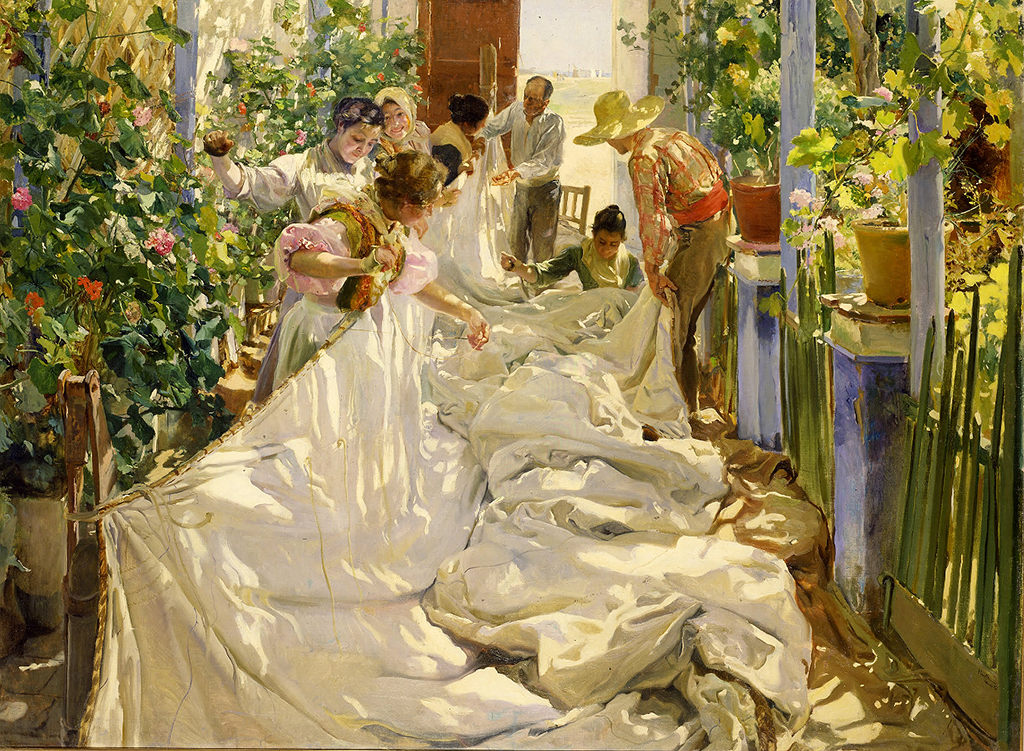
Comparison: Sewing the Sail

Comparison: Mother by Joaquín Sorolla
Shadows that describe space
In Children on the Beach, the nearest boy's shadow is a distinct blue-violet shape beside his head and upper body. Further across the picture, darker water curves around the more distant limbs. These passages establish where bodies touch the ground, where they rise above it and how water moves around them. Shadow contributes information as well as contrast.
The warm areas of skin become more vivid beside these cooler passages. At the same time, the picture distributes blue, grey, green and brown across the shallows, so that no single dark band isolates the boys from their setting. The water carries traces of their reflected colour; their bodies take part in the surrounding pattern of light and shade. Flesh remains solid even where that pattern becomes intricate.
Duncan C. Phillips, in his 1912 article on Sorolla, made the changing appearance of white one of his central observations. He emphasised different surfaces and edges under different kinds of sunlight. His account also praised Sorolla's study of tonal relationships in the tradition of Velázquez.[6] These are the judgments of an early critic, but they remain useful prompts for looking. A shadow may be light in tone and still perform its spatial task if the neighbouring surface is lighter. A pale object may contain a dark accent without losing its overall identity.
The Pink Robe provides another arrangement. Much of the standing pair occupies shelter, while bright patches break across faces, arms and clothing. The lattice behind them admits small intervals of the outside world. At the left edge, a hanging white cloth receives a different pattern of illumination from the garments nearer the centre. At the bottom, a dark recess behind the figures makes their feet and the wooden platform more emphatic.
Here shade has an architectural role. The screen, cloth and floor define a narrow occupied space. Light passing through it gives the bodies their changing surfaces while the darker intervals keep that space readable. The picture's brightness depends on the organisation of its shade.
The stroke and the thing described
Sorolla's paint can be conspicuous without making the subject difficult to recognise. The broad strokes in the pink robe are visibly marks, yet they also follow the garment down the body. Narrower lights and folds interrupt those broad passages at the waist and knees. The cloth's weight and the figure's stance emerge together.
The nearby white garment presents a different sequence. More angular light patches cross its folds, and some boundaries break into the neighbouring colour. The two fabrics remain distinct even where both receive bright light. Their visible differences depend on the direction, interval and shape of the marks, as well as on their colour.
In the beach painting, strokes describing water often sweep around the boys. Their curves supply a movement different from the firmer angles of an elbow or a foot. The reflected forms can be extended into that movement. A viewer reads the same patch twice: first as a piece of water and then as a distorted reflection. This interplay helps the surface feel active without requiring an inventory of individual ripples.
Such handling is selective. The cloth in Mother is broad and softly differentiated; the sail contains more abrupt turns; the beach has long currents of colour. Describing all three as loosely painted would conceal the choices that distinguish them. The stroke changes its task from one setting to another.
Mauclair's account of the Paris exhibition is revealing here. Alongside his admiration for dazzling colour and apparent fluency, he registered restrained passages of grey and beige. He also distinguished the portraits from the marine subjects and small studies, finding different degrees of individuality in them.[2] His criticism preserves the variety that a single label can flatten. Sorolla's freedom includes the ability to reduce the force of the mark when the picture needs a quieter surface.
Cropping and the position of the viewer
Sorolla's viewpoint often places the observer unusually close to the subject. Children on the Beach removes the horizon altogether. The upper edge cuts into the furthest figure, while the nearest boy stretches almost across the width of the foreground. Little room remains for a spectator to stand back and survey a complete beach. We look down into a particular area of wet sand and water.
This arrangement changes the painting's balance. Without a sky to separate from the land, the eye follows bodies and currents across an almost continuous surface. Distance is established through overlap, relative size and the recession of the figures. At the same time, the oblique bodies form an emphatic pattern across the rectangle. The scene has depth, but the design remains close to the surface.
The National Gallery relates Sorolla's cropping and exaggerated viewpoints to his awareness of photography.[7] That context helps explain his interest in a view that appears caught in passing. The resulting composition still involves selection: the position of an edge determines how much of a body is visible, where movement enters the picture and which neighbouring forms are excluded.
Instantánea, Biarritz, dated 1906 in the Museo Sorolla catalogue, brings a camera into the painted scene itself.[4] A seated figure in white holds the dark apparatus while other figures sit further away. The beach runs diagonally behind them and the surf occupies the upper part of the view. A long shadow extends from the central figure across the sand. The compact dark camera has visual weight within the pale clothing, drawing attention to the act of looking through a device.
The picture offers more than a convenient emblem of photography's influence. Cloth, hat, camera, sloping beach and distant figures have been brought into a particular balance. Its sense of an unposed instant rests on a design that directs attention with considerable precision.
Outdoor painting and changes of scale
Working from nature presents a painter with movement, changing illumination and more information than a canvas can hold. Sorolla's pictures repeatedly show the value of selecting a dominant relationship. In the sail painting, a great expanse of fabric unites a crowded courtyard. In Mother, the pale bed establishes the space before the faces become the focus. In the beach picture, the bodies and their reflections determine the rhythm of the shallows.
Scale adds another decision. Sewing the Sail measures more than two metres high and three metres across. The museum catalogue describes its development before the motif in a Valencian courtyard and suggests that it was finished in Madrid.[4] The connection with outdoor observation therefore does not require every stage of the painting to have taken place in the same setting. A large composition can preserve the force of an observed arrangement through further work.
The relationship between landscape study and monumental painting is especially clear in Coast of Santa Cristina, Lloret de Mar. The 1915 painting sets trunks and branches before white rocks and blue sea. The catalogue Sorolla, el color del mar identifies it as a study whose setting was enlarged for the Catalonia fishing panel in Vision of Spain.[8]
In the study, the trunks divide the prospect into irregular openings. Rocks occupy the centre, and the sea is visible between and beyond them. In the panel reproduction, the wooded setting accompanies a dense foreground gathering of people, baskets and fish. Openings through the trees continue to matter, but they now work around a much more crowded human subject. The landscape supplies a framework capable of carrying the activity.
This comparison shows observation entering a larger act of composition. An actual place offers forms, colours and intervals. The finished panel must also accommodate figures and make their groupings readable across an extensive surface. Enlarging the setting changes its relationship to everything placed within it.
Revision and the material surface
The preparatory works for Vision of Spain also preserve a more physical kind of rearrangement. A 2016 study by Clodoaldo Roldán and colleagues examined 32 works on paper, including gouache collages, occasional oil and a charcoal installation plan. Figures and other painted elements were cut out and assembled. Some gouaches have underlying charcoal drawing. Microscopic examination found both single and multiple paint layers; opacity allowed details to be reworked. No priming was detected on these paper works. The 640 X-ray fluorescence readings reported in the study are measurement points, rather than 640 physical samples.[9]
These findings belong to the preparatory paper group, distinct from the fourteen finished oil panels. White pigments varied between studies: the researchers identified lead white in one example, zinc white in another and both in a collage. They also identified bone black in examined passages. Their results describe adaptable materials and procedures within a defined group.[9]
Canvas presents a different material question. In Arte de la luz, an unfinished portrait study of about 1918, inventory 1252, illustrates a light-grey ground left exposed around the developing figure.[4] The broad pale surface contributes to the image before it is covered. This particular example shows how a prepared support could participate in the painting's emerging relationships.
Cutting, assembling and covering earlier passages offered different means of adjustment. Rapidly recording a motif and taking time to arrange it could answer different needs.
Mauclair's description of seemingly effortless execution helps explain why this distinction matters. A finished surface could persuade a contemporary viewer that every tone had arrived without hesitation.[2] The energy of the preparatory works allows room for reconsideration. Responsiveness and control meet in the choice of which marks to preserve.
Further reading
Museum publications, a historical exhibition catalogue and the early-work catalogue raisonné offer different ways to continue.
Sorolla: Catalogue Raisonné of Paintings, Volume I. Blanca Pons-Sorolla and collaborators. Ediciones El Viso, 2026. Covers 1876–1894.
Use this volume for the early paintings, from juvenilia to the major works of the 1890s. Publisher information.
Catalogue of Paintings by Joaquín Sorolla y Bastida. Hispanic Society of America, New York, 1909.
The historical exhibition catalogue supplies the numbered records in the directory. Its titles and ownership statements describe that exhibition period. Read the historical catalogue.
Eight Essays on Joaquín Sorolla y Bastida. Hispanic Society of America, 1909. Essays in several languages.
Compare contemporary judgments by Beruete, Mauclair, Williams and Huneker with the paintings discussed in the articles. Read the period essays.
Watch: Sorolla, light and painting
Three National Gallery films offer an introduction, a closer look at technique and a longer curator’s talk.
An introduction to 'Sorolla: Spanish Master of Light'
Start with a short exhibition introduction to Sorolla’s subjects and career.
Watch on YouTubeArtworks and exhibition records
Browse 103 artwork articles, 350 numbered entries from the Hispanic Society’s 1909 New York catalogue, and two selected Meadows Museum drawings. These are records, not a count of unique artworks: repeated historical titles remain separate entries and may overlap with the articles. A catalogue’s exhibition year does not establish an execution date. This researched selection is not a complete catalogue raisonné.
| Name | Date | Medium |
|---|---|---|
| Women Walking on the Beach | 1909 | Painting |
| Sewing the Sail | 1896 | Painting |
| Running Along the Beach | 1908 | Painting |
| Sad Inheritance | 1899 | Painting |
| Mother | 1895–1900 | Painting |
| The Horse's Bath | 1909 | Painting |
| The Pink Robe | 1916 | Painting |
| And They Still Say Fish are Expensive! | 1894 | Painting |
| The Return from Fishing | 1894 | Painting |
| Children on the Beach | 1909 | Painting |
| Castilla, the Feast of Bread | 1913 | Painting |
| Sevilla, Holy Week Penitents | 1914 | Painting |
| Aragon, Jota | 1914 | Painting |
| Navarre, the Town Council of Roncal | 1914 | Painting |
| Guipúzcoa, Bowling | 1914 | Painting |
| Andalucía, El Encierro | 1914 | Painting |
| Seville, the Dance | 1915 | Painting |
| Sevilla, The Bullfighters | 1915 | Painting |
| Galicia, The Pilgrimage | 1915 | Painting |
| The Fish | 1915 | Painting |
| Valencia, Couples on Horseback | 1916 | Painting |
| Extremadura, The Market | 1917 | Painting |
| Elche, The Palm Grove | 1918–1919 | Painting |
| The Tunny Catch | 1919 | Painting |
| Louis Comfort Tiffany | 1911 | Painting |
| Adobe Houses | 1890–1895 | Painting |
| After Bathing | 1915 | Painting |
| After Bathing, Valencia | 1909 | Painting |
| After Bathing, Valencian Beach | 1908 | Painting |
| Afternoon Sun, Playa de Valencia | 1910 (Album catalogue) | Painting |
| Aim of Ibiza | 1919 | Painting |
| Almond Trees in Asis | Spring,1887–1889 | Painting |
| Another Margarita | 1892 | Painting |
| Antonio García at the Beach | 1909 | Painting |
| Around Segovia | 9–15 October 1906 | Painting |
| Artist's Patio, Cafe Novedades, Seville | 1915 | Painting |
| Asturian Landscape | circa 1904 | Painting |
| Aureliano de Beruete | 1902 | Painting |
| Aureliano de Beruete y Moret, Son | 1902 | Painting |
| The Bath, Jávea | 1905 | Painting |
| The Bathing Hour | 1915 execution, signed and dated1917 (Sothebys catalogue account) | Painting |
| Bathing Time | 1904 | Painting |
| Beach at Valencia | 1908 in ARC catalogue | Painting |
| Beach at Zarauz | 1910 | Painting |
| Beach of Biarritz | 1906 | Painting |
| Beach of Biarritz, France | Summer1906 | Painting |
| Beached Boats | 1915 | Painting |
| Beaching the Boat | 1908 in ARC catalogue | Painting |
| Blessing the Boat | 1895 | Painting |
| Blind Man of Toledo | 1906 | Painting |
| Boat Builders | 1894 | Painting |
| Boat in Albufera | 1895 | Painting |
| Boy on the Sand | Undated | Painting |
| Boys in the Sea | 1908 | Painting |
| Boys on the Beach | BeforeNewYork1909exhibition; exactyearunresolved | Painting |
| Breakwater, San Sebastian | 1917–1918 | Painting |
| Bulls in the Sea | 1903 | Painting |
| Capturing the Moment | 1906 | Painting |
| Castle of La Mota, Medina del Campo | 29 May 1912 | Painting |
| Children in the Sea | Painting | |
| Children on the Beach, Valencia | 1916 | Painting |
| Children on the Seashore | 1903 | Painting |
| Child's Siesta | circa 1918 (ARC catalogue) | Painting |
| Church Roncal Stairs | 22–28August1912 | Painting |
| Clothilde at the Beach | Summer1904 | Painting |
| Clotilde and Elena on the Rocks at Javea | 1905 | Painting |
| Clotilde García del Castillo | April1890 | Painting |
| Clotilde in a Grey Dress | 1900 | Painting |
| Clotilde with Hat | 1910 | Painting |
| Coast at Santa Cristina | 29 September 1915 (current CERES1122) | Painting |
| Court of the Dances, Alcázar, Sevilla | 1910 | Painting |
| Covachuelas, Toledo | 21–30 October 1906 | Painting |
| Dragging the Trawler | circa 1903–1904 in educational catalogue | Painting |
| El Retiro, Madrid | 1898 | Painting |
| Female Nude | 1902 | Painting |
| Fisherman in Valencia | 1904 | Painting |
| Fisherwomen from Valencia | June–July 1915 | Painting |
| Fishing Boats | by February 1909 | Painting |
| Fishing Nets | 1893 | Painting |
| The Gardens at the Sorolla Family House | spring 1920 | Painting |
| Hall of the Ambassadors, Alhambra, Granada | 1909 | Painting |
| Harbour | 1880 | Painting |
| Joaquín Sorolla García in a White Dress | 1896 | Painting |
| Lighthouse Walk at Biarritz | 1906 | Painting |
| The Little Yacht | 1909 | Painting |
| Maria at La Granja | 1907 | Painting |
| My Children | 1904 | Painting |
| My Wife and Daughters in the Garden | 1910 | Painting |
| Portrait of Benito Pérez Galdós | 1894 | Painting |
| A Rooftop with Flowers | 1902 | Painting |
| Self Portrait | 1904 | Painting |
| Self Portrait | 1909 | Painting |
| Señora de Sorolla in Black | 1906 | Painting |
| La Siesta | 1911 | Painting |
| The Skipping Rope | 1907 | Painting |
| Swimmers, Jávea | 1905 | Painting |
| Time for a Bathe | 1909 | Painting |
| Under the Awning, Zarauz | 1910 | Painting |
| Valencia Beach in the Morning Light | summer 1908 | Painting |
| Valencian Fishermen | 1895 | Painting |
| The White Boat, Jávea | 1905 | Painting |
| White Slave Trade | 1894 | Painting |
| The Wounded Foot | 1909 | Painting |
| Seven Peaks, Guadarrama — 1909 catalogue, no. 1 | Painting | |
| Covachuelas, Toledo — 1909 catalogue, no. 2 | Painting | |
| Las Pedrizas, El Pardo — 1909 catalogue, no. 3 | Painting | |
| Señor Gomar — 1909 catalogue, no. 4 | Painting | |
| El Torneo, El Pardo — 1909 catalogue, no. 5 | Painting | |
| A Toledo Street — 1909 catalogue, no. 6 | Painting | |
| View from El Torneo — 1909 catalogue, no. 7 | Painting | |
| Walls of Segovia — 1909 catalogue, no. 8 | Painting | |
| Convent of El Parral, Segovia — 1909 catalogue, no. 9 | Painting | |
| Environs of Segovia — 1909 catalogue, no. 10 | Painting | |
| Reflections from the Cape, Jávea — 1909 catalogue, no. 11 | Painting | |
| The Clamores, Segovia — 1909 catalogue, no. 12 | Painting | |
| Rocks of the Cape, Jávea — 1909 catalogue, no. 13 | Painting | |
| Farmhouse, Alcira — 1909 catalogue, no. 14 | Painting | |
| María at Biarritz — 1909 catalogue, no. 15 | Painting | |
| Shadow of the Alcántara Bridge, Toledo — 1909 catalogue, no. 16 | Painting | |
| Castle of San Servando, Toledo — 1909 catalogue, no. 17 | Painting | |
| Dr Decret — 1909 catalogue, no. 18 | Painting | |
| Alcántara Bridge, Toledo — 1909 catalogue, no. 19 | Painting | |
| The Forest, La Granja — 1909 catalogue, no. 20 | Painting | |
| Trout Stream, La Granja — 1909 catalogue, no. 21 | Painting | |
| Court of the Dances, Alcázar, Seville — 1909 catalogue, no. 22 | Painting | |
| Oleanders — 1909 catalogue, no. 23 | Painting | |
| Glen, Asturias — 1909 catalogue, no. 24 | Painting | |
| Pavilion of Charles V, Seville — 1909 catalogue, no. 25 | Painting | |
| St Martin's Bridge, Toledo — 1909 catalogue, no. 26 | Painting | |
| Orange Trees — 1909 catalogue, no. 27 | Painting | |
| Rope Makers — 1909 catalogue, no. 28 | Painting | |
| Señor Franzen — 1909 catalogue, no. 29 | Painting | |
| Rocks at the Lighthouse, Biarritz — 1909 catalogue, no. 30 | Painting | |
| St Martin's Bridge, Toledo — 1909 catalogue, no. 31 | Painting | |
| Valencian Fisherwoman — 1909 catalogue, no. 32 | Painting | |
| Road of San Esteban, Asturias — 1909 catalogue, no. 33 | Painting | |
| Basin in the Alcázar, Seville — 1909 catalogue, no. 34 | Painting | |
| Harbour of Valencia — 1909 catalogue, no. 35 | Painting | |
| Haymaking, Asturias — 1909 catalogue, no. 36 | Painting | |
| House of El Greco, Toledo — 1909 catalogue, no. 37 | Painting | |
| María with a Black Hat — 1909 catalogue, no. 38 | Painting | |
| Entrance Tower, Toledo — 1909 catalogue, no. 39 | Painting | |
| Las Covachuelas, Toledo — 1909 catalogue, no. 40 | Painting | |
| Rocks, Jávea — 1909 catalogue, no. 41 | Painting | |
| Road of the Alijares, Toledo — 1909 catalogue, no. 42 | Painting | |
| Segovian Family — 1909 catalogue, no. 43 | Painting | |
| Scalding Grapes, Jávea — 1909 catalogue, no. 44 | Painting | |
| Joaquín — 1909 catalogue, no. 45 | Painting | |
| Elena — 1909 catalogue, no. 46 | Painting | |
| El Grutesco, Alcázar, Seville — 1909 catalogue, no. 47 | Painting | |
| Beach of Valencia — 1909 catalogue, no. 48 | Painting | |
| Sails Drying, Valencia — 1909 catalogue, no. 49 | Painting | |
| Orange Tree — 1909 catalogue, no. 50 | Painting | |
| Little Boy with a Toy Boat — 1909 catalogue, no. 51 | Painting | |
| Old Valencian Fisherman — 1909 catalogue, no. 52 | Painting | |
| Fishing Boats — 1909 catalogue, no. 53 | Painting | |
| Harbour of Valencia — 1909 catalogue, no. 54 | Painting | |
| The Kiss — 1909 catalogue, no. 55 | Painting | |
| Little Boy on a Rock, Jávea — 1909 catalogue, no. 56 | Painting | |
| The Queen's Beam, Valsaín — 1909 catalogue, no. 57 | Painting | |
| Staircase of the Palace, La Granja — 1909 catalogue, no. 58 | Painting | |
| Elena at El Pardo — 1909 catalogue, no. 59 | Painting | |
| Fountain of the Horses, La Granja — 1909 catalogue, no. 60 | Painting | |
| Autumn, La Granja — 1909 catalogue, no. 61 | Painting | |
| María Painting, El Pardo — 1909 catalogue, no. 62 | Painting | |
| Fountain of the Forest, La Granja — 1909 catalogue, no. 63 | Painting | |
| Fountain of Neptune, La Granja — 1909 catalogue, no. 64 | Painting | |
| Orange Grove, Valencia — 1909 catalogue, no. 65 | Painting | |
| Francisqueta, Valencia — 1909 catalogue, no. 66 | Painting | |
| Waiting for the Fish, Valencia — 1909 catalogue, no. 67 | Painting | |
| Taking in the Sail, Valencia — 1909 catalogue, no. 68 | Painting | |
| Return from Fishing, Valencia — 1909 catalogue, no. 69 | Painting | |
| Crayfishers, Valencia — 1909 catalogue, no. 70 | Painting | |
| Swimmer, Jávea — 1909 catalogue, no. 71 | Painting | |
| Elena among Roses — 1909 catalogue, no. 72 | Painting | |
| Idyll — 1909 catalogue, no. 73 | Painting | |
| Vicente Blasco Ibáñez — 1909 catalogue, no. 74 | Painting | |
| Yellow Tree, La Granja — 1909 catalogue, no. 75 | Painting | |
| Blind Man of Toledo — 1909 catalogue, no. 76 | Painting | |
| Fisherwoman with Her Son, Valencia — 1909 catalogue, no. 77 | Painting | |
| The Bath, La Granja — 1909 catalogue, no. 78 | Painting | |
| Sewing the Sail, Valencia — 1909 catalogue, no. 79 | Painting | |
| Looking for Crabs, Jávea — 1909 catalogue, no. 80 | Painting | |
| María, La Granja — 1909 catalogue, no. 81 | Painting | |
| Joaquín and His Dog — 1909 catalogue, no. 82 | Painting | |
| Upon the Sand — 1909 catalogue, no. 83 | Painting | |
| Valencian Fisherwomen — 1909 catalogue, no. 84 | Painting | |
| Señora de Sorolla in White — 1909 catalogue, no. 85 | Painting | |
| At the Seashore, Valencia — 1909 catalogue, no. 86 | Painting | |
| Valencian Woman — 1909 catalogue, no. 87 | Painting | |
| In the Gardens of La Granja — 1909 catalogue, no. 88 | Painting | |
| Old Castilian — 1909 catalogue, no. 89 | Painting | |
| Marqués de Urquijo — 1909 catalogue, no. 90 | Painting | |
| Fisherman's Daughter, Valencia — 1909 catalogue, no. 91 | Painting | |
| Elena and Her Dolls — 1909 catalogue, no. 92 | Painting | |
| My Children — 1909 catalogue, no. 93 | Painting | |
| Swimmers — 1909 catalogue, no. 94 | Painting | |
| Low Tide: Elena at Biarritz — 1909 catalogue, no. 95 | Painting | |
| Mending Nets — 1909 catalogue, no. 96 | Painting | |
| The Bath, Jávea — 1909 catalogue, no. 97 | Painting | |
| The Bath, Jávea — 1909 catalogue, no. 98 | Painting | |
| Boxing Raisins — 1909 catalogue, no. 99 | Painting | |
| Forest Bridge, La Granja — 1909 catalogue, no. 100 | Painting | |
| View of the Palace, La Granja — 1909 catalogue, no. 101 | Painting | |
| Return from Fishing, Valencia — 1909 catalogue, no. 102 | Painting | |
| At the Bath, Valencia — 1909 catalogue, no. 103 | Painting | |
| Little Girl with a Blue Ribbon, Valencia — 1909 catalogue, no. 104 | Painting | |
| María at the Harbour of Jávea — 1909 catalogue, no. 105 | Painting | |
| Instantaneous, Biarritz — 1909 catalogue, no. 106 | Painting | |
| Boy among Breakers, Jávea — 1909 catalogue, no. 107 | Painting | |
| Garden of the Alcázar, Seville — 1909 catalogue, no. 108 | Painting | |
| Oleander Road, Valencia — 1909 catalogue, no. 109 | Painting | |
| María and Her Grandmother — 1909 catalogue, no. 110 | Painting | |
| Malvarrosa Beach, Valencia — 1909 catalogue, no. 111 | Painting | |
| The Huerta of Valencia — 1909 catalogue, no. 112 | Painting | |
| Garden of the Alcázar, Seville — 1909 catalogue, no. 113 | Painting | |
| Garden of the Alcázar, Seville — 1909 catalogue, no. 114 | Painting | |
| The Giralda, Seville — 1909 catalogue, no. 115 | Painting | |
| Palace of Charles V, Seville — 1909 catalogue, no. 116 | Painting | |
| Harbour of Valencia — 1909 catalogue, no. 117 | Painting | |
| Marqués de la Vega-Inclán — 1909 catalogue, no. 118 | Painting | |
| Harbour of Valencia — 1909 catalogue, no. 119 | Painting | |
| At the Water, Valencia — 1909 catalogue, no. 120 | Painting | |
| House in the Huerta, Valencia — 1909 catalogue, no. 121 | Painting | |
| Beach Garden, Valencia — 1909 catalogue, no. 122 | Painting | |
| Huerta of Valencia — 1909 catalogue, no. 123 | Painting | |
| Garden of the Alcázar, Seville — 1909 catalogue, no. 124 | Painting | |
| Asturias — 1909 catalogue, no. 125 | Painting | |
| San Sebastián — 1909 catalogue, no. 126 | Painting | |
| Old Harbour, Biarritz — 1909 catalogue, no. 127 | Painting | |
| Beach of Biarritz — 1909 catalogue, no. 128 | Painting | |
| Beach of Biarritz — 1909 catalogue, no. 129 | Painting | |
| Beach of Biarritz — 1909 catalogue, no. 130 | Painting | |
| Beach of Biarritz — 1909 catalogue, no. 131 | Painting | |
| Beach of Biarritz — 1909 catalogue, no. 132 | Painting | |
| Beach of Biarritz — 1909 catalogue, no. 133 | Painting | |
| Beach of Biarritz — 1909 catalogue, no. 134 | Painting | |
| Beach of Biarritz — 1909 catalogue, no. 135 | Painting | |
| Beach of Biarritz — 1909 catalogue, no. 136 | Painting | |
| Beach of Biarritz — 1909 catalogue, no. 137 | Painting | |
| Beach of Biarritz — 1909 catalogue, no. 138 | Painting | |
| Beach of Biarritz — 1909 catalogue, no. 139 | Painting | |
| Beach of Biarritz — 1909 catalogue, no. 140 | Painting | |
| Beach of Biarritz — 1909 catalogue, no. 141 | Painting | |
| Beach of Biarritz — 1909 catalogue, no. 142 | Painting | |
| Beach of Biarritz — 1909 catalogue, no. 143 | Painting | |
| La Concha, San Sebastián — 1909 catalogue, no. 144 | Painting | |
| Beach of Biarritz — 1909 catalogue, no. 145 | Painting | |
| Beach of Biarritz — 1909 catalogue, no. 146 | Painting | |
| Beach of Biarritz — 1909 catalogue, no. 147 | Painting | |
| Beach of Biarritz — 1909 catalogue, no. 148 | Painting | |
| Beach of Biarritz — 1909 catalogue, no. 149 | Painting | |
| Beach of Biarritz — 1909 catalogue, no. 150 | Painting | |
| Beach of Biarritz — 1909 catalogue, no. 151 | Painting | |
| Beach of Biarritz — 1909 catalogue, no. 152 | Painting | |
| Beach of Biarritz — 1909 catalogue, no. 153 | Painting | |
| Beach of Biarritz — 1909 catalogue, no. 154 | Painting | |
| Beach of Valencia — 1909 catalogue, no. 155 | Painting | |
| Beach of Valencia — 1909 catalogue, no. 156 | Painting | |
| Beach of Valencia — 1909 catalogue, no. 157 | Painting | |
| Harbour of San Sebastián — 1909 catalogue, no. 158 | Painting | |
| Harbour of San Sebastián — 1909 catalogue, no. 159 | Painting | |
| Beach of Valencia — 1909 catalogue, no. 160 | Painting | |
| Pasajes — 1909 catalogue, no. 161 | Painting | |
| Harbour of San Sebastián — 1909 catalogue, no. 162 | Painting | |
| La Concha, San Sebastián — 1909 catalogue, no. 163 | Painting | |
| La Concha, San Sebastián — 1909 catalogue, no. 164 | Painting | |
| Harbour of Pasajes — 1909 catalogue, no. 165 | Painting | |
| Beach of Valencia — 1909 catalogue, no. 166 | Painting | |
| Beach of Valencia — 1909 catalogue, no. 167 | Painting | |
| Beach of Valencia — 1909 catalogue, no. 168 | Painting | |
| Beach of Valencia — 1909 catalogue, no. 169 | Painting | |
| Beach of Valencia — 1909 catalogue, no. 170 | Painting | |
| Beach of Valencia — 1909 catalogue, no. 171 | Painting | |
| Beach of Valencia — 1909 catalogue, no. 172 | Painting | |
| Beach of Valencia — 1909 catalogue, no. 173 | Painting | |
| Beach of Valencia — 1909 catalogue, no. 174 | Painting | |
| Beach of Valencia — 1909 catalogue, no. 175 | Painting | |
| Beach of Valencia — 1909 catalogue, no. 176 | Painting | |
| Beach of Valencia — 1909 catalogue, no. 177 | Painting | |
| Cape San Antonio, Jávea — 1909 catalogue, no. 178 | Painting | |
| Galicia — 1909 catalogue, no. 179 | Painting | |
| Sewing the Sail — 1909 catalogue, no. 180 | Painting | |
| Poppies — 1909 catalogue, no. 181 | Painting | |
| Beach of Valencia — 1909 catalogue, no. 182 | Painting | |
| Malvarrosa — 1909 catalogue, no. 183 | Painting | |
| Harbour of San Sebastián — 1909 catalogue, no. 184 | Painting | |
| Beach of Valencia — 1909 catalogue, no. 185 | Painting | |
| Locutory — 1909 catalogue, no. 186 | Painting | |
| Beach of Valencia — 1909 catalogue, no. 187 | Painting | |
| Beach of Valencia — 1909 catalogue, no. 188 | Painting | |
| Cape San Antonio, Jávea — 1909 catalogue, no. 189 | Painting | |
| Beach of Valencia — 1909 catalogue, no. 190 | Painting | |
| Oleanders — 1909 catalogue, no. 191 | Painting | |
| Beach of Valencia — 1909 catalogue, no. 192 | Painting | |
| La Concha, San Sebastián — 1909 catalogue, no. 193 | Painting | |
| Beach of Valencia — 1909 catalogue, no. 194 | Painting | |
| Beach of Valencia — 1909 catalogue, no. 195 | Painting | |
| Beach of Valencia — 1909 catalogue, no. 196 | Painting | |
| Biarritz — 1909 catalogue, no. 197 | Painting | |
| Biarritz — 1909 catalogue, no. 198 | Painting | |
| Segovia — 1909 catalogue, no. 199 | Painting | |
| Asturias — 1909 catalogue, no. 200 | Painting | |
| Versailles — 1909 catalogue, no. 201 | Painting | |
| Beach of Valencia — 1909 catalogue, no. 202 | Painting | |
| Beach of Valencia — 1909 catalogue, no. 203 | Painting | |
| Beach of Valencia — 1909 catalogue, no. 204 | Painting | |
| Beach of Valencia — 1909 catalogue, no. 205 | Painting | |
| Court of El Cabañal — 1909 catalogue, no. 206 | Painting | |
| In the River — 1909 catalogue, no. 207 | Painting | |
| Harbour of Valencia — 1909 catalogue, no. 208 | Painting | |
| Beach of Valencia — 1909 catalogue, no. 209 | Painting | |
| Harbour of Valencia — 1909 catalogue, no. 210 | Painting | |
| Beach of Valencia — 1909 catalogue, no. 211 | Painting | |
| Beach of Valencia — 1909 catalogue, no. 212 | Painting | |
| Beach of Valencia — 1909 catalogue, no. 213 | Painting | |
| Royal Mallows — 1909 catalogue, no. 214 | Painting | |
| Geraniums — 1909 catalogue, no. 215 | Painting | |
| Altar of St Vincent, Valencia — 1909 catalogue, no. 216 | Painting | |
| Beach of Valencia — 1909 catalogue, no. 217 | Painting | |
| Harbour of Avilés — 1909 catalogue, no. 218 | Painting | |
| Beach of Valencia — 1909 catalogue, no. 219 | Painting | |
| Beach of Valencia — 1909 catalogue, no. 220 | Painting | |
| Beach of Valencia — 1909 catalogue, no. 221 | Painting | |
| Market of León — 1909 catalogue, no. 222 | Painting | |
| Beach of Valencia — 1909 catalogue, no. 223 | Painting | |
| Beach of Valencia — 1909 catalogue, no. 224 | Painting | |
| Beach of Valencia — 1909 catalogue, no. 225 | Painting | |
| Beach of Valencia — 1909 catalogue, no. 226 | Painting | |
| Beach of Valencia — 1909 catalogue, no. 227 | Painting | |
| Huerta of Valencia — 1909 catalogue, no. 228 | Painting | |
| Beach of Valencia — 1909 catalogue, no. 229 | Painting | |
| Beach of Valencia — 1909 catalogue, no. 230 | Painting | |
| Beach of Valencia — 1909 catalogue, no. 231 | Painting | |
| Beach of Valencia — 1909 catalogue, no. 232 | Painting | |
| Beach of Valencia — 1909 catalogue, no. 233 | Painting | |
| Beach of Valencia — 1909 catalogue, no. 234 | Painting | |
| Asturias — 1909 catalogue, no. 235 | Painting | |
| Beach of Valencia — 1909 catalogue, no. 236 | Painting | |
| Women Playing — 1909 catalogue, no. 237 | Painting | |
| Beach of Valencia — 1909 catalogue, no. 238 | Painting | |
| Beach of Valencia — 1909 catalogue, no. 239 | Painting | |
| Beach of Valencia — 1909 catalogue, no. 240 | Painting | |
| Beach of Valencia — 1909 catalogue, no. 241 | Painting | |
| Market of León — 1909 catalogue, no. 242 | Painting | |
| Beach of Valencia — 1909 catalogue, no. 243 | Painting | |
| Beach of Valencia — 1909 catalogue, no. 244 | Painting | |
| Beach of Valencia — 1909 catalogue, no. 245 | Painting | |
| Beach of Valencia — 1909 catalogue, no. 246 | Painting | |
| Asturias — 1909 catalogue, no. 247 | Painting | |
| León — 1909 catalogue, no. 248 | Painting | |
| Asturias — 1909 catalogue, no. 249 | Painting | |
| Jávea — 1909 catalogue, no. 250 | Painting | |
| Asturias — 1909 catalogue, no. 251 | Painting | |
| León — 1909 catalogue, no. 252 | Painting | |
| Asturias — 1909 catalogue, no. 253 | Painting | |
| Asturias — 1909 catalogue, no. 254 | Painting | |
| Beach of Valencia — 1909 catalogue, no. 255 | Painting | |
| Beach of Valencia — 1909 catalogue, no. 256 | Painting | |
| Asturias — 1909 catalogue, no. 257 | Painting | |
| León — 1909 catalogue, no. 258 | Painting | |
| Beach of Valencia — 1909 catalogue, no. 259 | Painting | |
| Beach of Valencia — 1909 catalogue, no. 260 | Painting | |
| Beach of Valencia — 1909 catalogue, no. 261 | Painting | |
| León — 1909 catalogue, no. 262 | Painting | |
| Beach of Valencia — 1909 catalogue, no. 263 | Painting | |
| Asturias — 1909 catalogue, no. 264 | Painting | |
| Galicia — 1909 catalogue, no. 265 | Painting | |
| Malvarrosa — 1909 catalogue, no. 266 | Painting | |
| Jávea — 1909 catalogue, no. 267 | Painting | |
| Biarritz — 1909 catalogue, no. 268 | Painting | |
| Harbour of Jávea — 1909 catalogue, no. 269 | Painting | |
| La Concha, San Sebastián — 1909 catalogue, no. 270 | Painting | |
| San Sebastián — 1909 catalogue, no. 271 | Painting | |
| San Sebastián — 1909 catalogue, no. 272 | Painting | |
| Beach of Valencia — 1909 catalogue, no. 273 | Painting | |
| Beach of Valencia — 1909 catalogue, no. 274 | Painting | |
| Beach of Valencia — 1909 catalogue, no. 275 | Painting | |
| Beach of Valencia — 1909 catalogue, no. 276 | Painting | |
| Beach of Valencia — 1909 catalogue, no. 277 | Painting | |
| Washerwomen — 1909 catalogue, no. 278 | Painting | |
| San Sebastián — 1909 catalogue, no. 279 | Painting | |
| Beach of Valencia — 1909 catalogue, no. 280 | Painting | |
| San Sebastián — 1909 catalogue, no. 281 | Painting | |
| San Sebastián — 1909 catalogue, no. 282 | Painting | |
| Beach of Valencia — 1909 catalogue, no. 283 | Painting | |
| Beach of Valencia — 1909 catalogue, no. 284 | Painting | |
| Uncle Pancha — 1909 catalogue, no. 285 | Painting | |
| Señor García — 1909 catalogue, no. 286 | Painting | |
| Boy Nude, La Granja — 1909 catalogue, no. 287 | Painting | |
| Señora de Sorolla in Black — 1909 catalogue, no. 288 | Painting | |
| Duke of Alba — 1909 catalogue, no. 289 | Painting | |
| Mother: Señora de Sorolla — 1909 catalogue, no. 290 | Painting | |
| Running along the Beach — 1909 catalogue, no. 291 | Painting | |
| After the Bath — 1909 catalogue, no. 292 | Painting | |
| Lighthouse Walk, Biarritz — 1909 catalogue, no. 293 | Painting | |
| Little Boy on the Beach — 1909 catalogue, no. 294 | Painting | |
| Cape San Antonio, Jávea — 1909 catalogue, no. 295 | Painting | |
| Count of Villagonzalo — 1909 catalogue, no. 296 | Painting | |
| Boy in the Sea — 1909 catalogue, no. 297 | Painting | |
| Children on the Beach — 1909 catalogue, no. 298 | Painting | |
| Valencian Boats — 1909 catalogue, no. 299 | Painting | |
| The Little Brother — 1909 catalogue, no. 300 | Painting | |
| Children in the Sea — 1909 catalogue, no. 301 | Painting | |
| Orange Grove, Alcira — 1909 catalogue, no. 302 | Painting | |
| At the Water — 1909 catalogue, no. 303 | Painting | |
| Little Boy on the Beach — 1909 catalogue, no. 304 | Painting | |
| Street of Orange Trees — 1909 catalogue, no. 305 | Painting | |
| Playing in the Water — 1909 catalogue, no. 306 | Painting | |
| Beach of Valencia by Morning Light — 1909 catalogue, no. 307 | Painting | |
| Coming out of the Bath — 1909 catalogue, no. 308 | Painting | |
| The Grandson — 1909 catalogue, no. 309 | Painting | |
| Water Joy — 1909 catalogue, no. 310 | Painting | |
| On the Sand — 1909 catalogue, no. 311 | Painting | |
| Francisco Acebal — 1909 catalogue, no. 312 | Painting | |
| Marcelino Menéndez y Pelayo — 1909 catalogue, no. 313 | Painting | |
| Aureliano de Beruete — 1909 catalogue, no. 314 | Painting | |
| Marqués de Viana — 1909 catalogue, no. 315 | Painting | |
| Beach of Valencia — 1909 catalogue, no. 316 | Painting | |
| Señor Granzón — 1909 catalogue, no. 317 | Painting | |
| Oxen Ready to Beach Fishing Boats, Valencia — 1909 catalogue, no. 318 | Painting | |
| Children in the Sea — 1909 catalogue, no. 319 | Painting | |
| Sea: Morning Effect — 1909 catalogue, no. 320 | Painting | |
| Fishing Boat — 1909 catalogue, no. 321 | Painting | |
| Sails at Sea — 1909 catalogue, no. 322 | Painting | |
| Return from Fishing — 1909 catalogue, no. 323 | Painting | |
| Boats on the Sand — 1909 catalogue, no. 324 | Painting | |
| Study of Boats — 1909 catalogue, no. 325 | Painting | |
| Fishing Boats — 1909 catalogue, no. 326 | Painting | |
| Boats — 1909 catalogue, no. 327 | Painting | |
| Children on the Shore — 1909 catalogue, no. 328 | Painting | |
| Beach of Valencia — 1909 catalogue, no. 329 | Painting | |
| Beach of Valencia — 1909 catalogue, no. 330 | Painting | |
| Beach of Valencia — 1909 catalogue, no. 331 | Painting | |
| Beach of Valencia — 1909 catalogue, no. 332 | Painting | |
| Nets Drying — 1909 catalogue, no. 333 | Painting | |
| Shoving off the Boat — 1909 catalogue, no. 334 | Painting | |
| Beach of Valencia — 1909 catalogue, no. 335 | Painting | |
| Oleanders — 1909 catalogue, no. 336 | Painting | |
| Beach of Valencia — 1909 catalogue, no. 337 | Painting | |
| Beach of Valencia — 1909 catalogue, no. 338 | Painting | |
| Beach of Valencia — 1909 catalogue, no. 339 | Painting | |
| Leonese Peasants — 1909 catalogue, no. 340 | Painting | |
| At the Bath — 1909 catalogue, no. 341 | Painting | |
| Sea Idyll — 1909 catalogue, no. 342 | Painting | |
| The Little Granddaughter — 1909 catalogue, no. 343 | Painting | |
| Manuel B. Cossío — 1909 catalogue, no. 344 | Painting | |
| The Peppers — 1909 catalogue, no. 345 | Painting | |
| Raimundo de Madrazo — 1909 catalogue, no. 346 | Painting | |
| Alejandro Pidal y Mon — 1909 catalogue, no. 347 | Painting | |
| Señora de Sorolla in Spanish Mantilla — 1909 catalogue, no. 348 | Painting | |
| My Daughters, Elena and María, on Horseback in Valencian Costumes of 1808 — 1909 catalogue, no. 349 | Painting | |
| Sad Inheritance — 1909 catalogue, no. 350 | Painting | |
| Study of Hands | c. 1889 | Drawing |
| Clotilde Reading (recto) | c. 1902 | Drawing |
Discussion
Look again at the images and ideas explored in Sorolla Style and Technique. These editorial prompts invite your observations.
Reader Insights
Which detail in Sorolla Style and Technique first caught your attention, and where did your eye travel next?
The section “Observation and the structure of a picture” offers one way into the subject. Which detail or comparison most helps you assess that reading?
After reading “Revision and the material surface”, what would you return to for a closer look?
Join the Conversation
Share a detail, comparison or question about Sorolla Style and Technique below.
References
- Leonard Williams, “The Art of Joaquín Sorolla,” in Eight Essays on Joaquín Sorolla y Bastida, vol. I, Hispanic Society of America, New York, 1909, especially pp. 197–205. Digitised volume. View source.
- Camille Mauclair, “M. Sorolla y Bastida,” originally Art et Décoration, October 1906; reprinted in Eight Essays on Joaquín Sorolla y Bastida, vol. I, 1909, especially pp. 113–126 and 143–150. Digitised volume. View source.
- Amanda W. Dotseth, “Study of Hands, Sketch for The Regency, and Six Other Drawings by Joaquín Sorolla y Bastida,” At the Meadows, autumn 2018, pp. 24–29. Museum publication. View source.
- Museo Sorolla, Sorolla. Arte de la luz, exhibition catalogue, 2015, especially pp. 41, 46–47, 113, 127–129 and 132–136. Catalogue. View source.
- Aureliano de Beruete, “Joaquín Sorolla y Bastida,” originally La Lectura, January 1901; reprinted in Eight Essays on Joaquín Sorolla y Bastida, vol. I, 1909, especially pp. 89–95. Digitised volume. View source.
- Duncan C. Phillips, Jr., “Sorolla: The Painter of Sunlight,” Art and Progress 4, no. 2, December 1912, pp. 791–797, especially pp. 792–794. Digitised article. View source.
- National Gallery, London, “Bright colours, bold brushstrokes, and unexpected angles,” published for Sorolla: Spanish Master of Light, 2019. Technique account. View source.
- José Manuel Pascual and Consuelo Luca de Tena, catalogue texts in Sorolla, el color del mar, Museo Sorolla–Fundación Museo Sorolla, 2013, pp. 97–98. Catalogue. View source.
- Clodoaldo Roldán, David Juanes, Livio Ferrazza and Jorgelina Carballo, “Characterization of Sorolla's gouache pigments by means of spectroscopic techniques,” Radiation Physics and Chemistry 119, 2016, pp. 253–263, especially pp. 253–258 and 261–262, Tables 1–2. Research paper. View source.
- Hispanic Society of America, Catalogue of Paintings by Joaquín Sorolla y Bastida, 1909, entries 1–350. View source.
- Amanda W. Dotseth, Study of Hands, Sketch for The Regency, and Six Other Drawings by Joaquín Sorolla y Bastida, At the Meadows, Fall 2018, pp. 24–29. View source.


