 by Tom Gurney
Tom Gurney BSc (Hons) is an art history expert with over 20 years experience
Published on June 19, 2020 / Updated on November 6, 2025
Email: tomgurney1@gmail.com / Phone: +44 7429 011000
The Creation of the Sun, Moon and Plants by Michelangelo
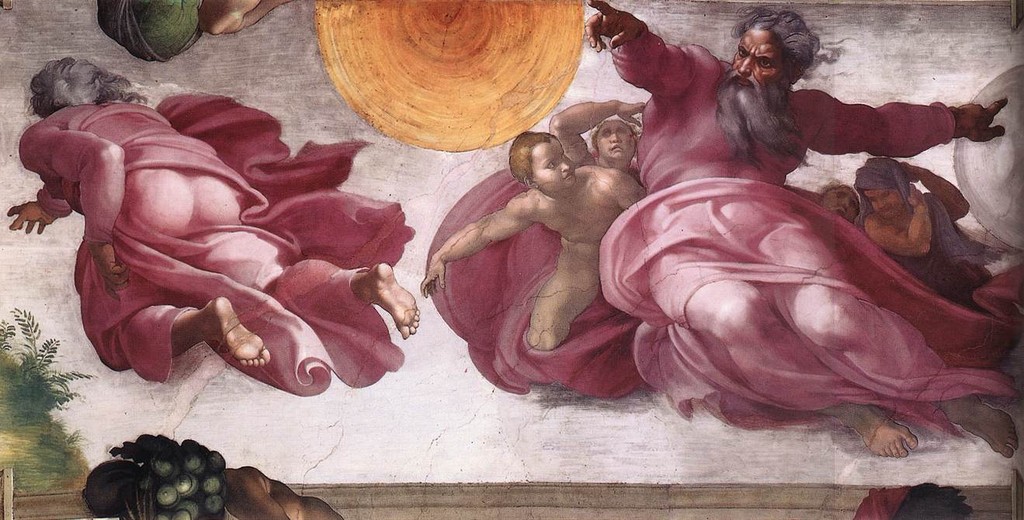
God crosses the painted sky twice in Michelangelo’s Creation of the Sun, Moon and Plants. On one side he opens his arms between the radiant discs of sun and moon; on the other he turns away and reaches toward newly created vegetation. Two days of Genesis, two directions of movement and two appearances of the same divine figure are compressed into a single charged field.
This is the second of the nine central Genesis stories when the Sistine Chapel ceiling is read from the altar toward the entrance.[1][2] The full title is important. The familiar shorthand Creation of the Sun and Moon identifies the most conspicuous action but omits the plants and therefore the earlier of the two biblical episodes Michelangelo joined. The Vatican Museums’ dedicated record makes the double subject explicit.[1]
At a Glance
- TitleThe Creation of the Sun, Moon and Plants
- PainterMichelangelo Buonarroti
- MediumFresco
- LocationA central narrative compartment on the Sistine Chapel vault in Vatican City
- Ceiling campaign1508–1512[4]
- PatronPope Julius II
- SubjectThe creation of vegetation and the heavenly lights, drawn from Genesis 1:11–19[3]
- Central sequence positionSecond when read from altar toward entrance[2]
- FiguresGod appears twice within the same composition
- Key visual elementsSun, moon, low vegetation, airborne divine bodies and sweeping drapery
- Title cautionCreation of the Sun and Moon is common but incomplete
- Chronology cautionThe overall campaign dates are documented; an exact isolated date for this fresco is not
- Viewing cautionReproductions frequently crop the plants or detach the scene from its ceiling bay
Contents
- One Fresco, Two Days of Creation
- Why the Title Includes Plants
- Genesis and the Problem of Visible Order
- God as a Turning, Repeated Body
- The Sun and Moon
- The Quiet Importance of Vegetation
- An Overhead Fresco, Not an Easel Painting
- Its Place in the Nine Genesis Stories
- Commission and Working Chronology
- Restoration and the Problem of Colour
- Copies, Crops and Later Reception
- Why the Fresco Matters
- Artist Up Close
One Fresco, Two Days of Creation
Genesis assigns vegetation to the third day and the lights in the firmament to the fourth.[3] Michelangelo did not divide those moments with a frame. He made them coexist. At the less visually dominant side, a rear-facing God extends an arm toward a small area of green growth. Across the field, a larger appearance of God commands the sun and moon.
Continuous narrative—showing one figure more than once in a unified setting—had a long history before Michelangelo. Here it solves an architectural problem with exceptional economy. The ceiling bay offers limited space, yet the biblical action is immense. Repetition lets the painter represent succession without multiplying landscapes or filling the field with explanatory detail.
The two moments remain distinct because their bodily grammar differs. The celestial creator expands frontally across the heavens. The creator of vegetation turns, contracts and recedes. Scale, orientation and gesture do the work that a dividing line might have done.
Why the Title Includes Plants
Most reproductions favour the dramatic sun-and-moon side. It contains the larger figure, two emphatic circles and an immediately legible cosmic command. The vegetation is lower, smaller and easy to lose when the fresco is tightly cropped.
That history of reproduction helps explain the shorter title Creation of the Sun and Moon or Creation of the Heavenly Bodies. Both name a genuine part of the scene. Neither describes all of it. The Vatican object record uses Creation of the Sun, Moon and Plants and explains that the rear appearance of God reaches toward a bush representing the vegetable world.[1]
The distinction is not pedantic. A title teaches people what to notice. Restore “Plants,” and the apparent secondary figure becomes necessary; remove it, and that turning body can look like an unexplained echo. The fuller name recovers the fresco’s narrative structure.
One Vatican overview has also been rendered with “planets,” although its linked heading, object record and cited Genesis passage support “plants.”[1][2] The isolated wording should not outweigh the dedicated description or the visible vegetation. Stars appear in the biblical passage, but the painted and catalogued subject centres on the sun, moon and vegetable world.
Genesis and the Problem of Visible Order
The biblical passage does more than list objects. Vegetation bears seed and fruit; the greater and lesser lights govern day and night and mark seasons, days and years.[3] Creation is an act of differentiation, fertility and timekeeping.
Michelangelo answers the text through bodies and signs. A patch of growth can stand for the earth’s entire vegetable capacity. Two discs can stand for the great lights. The creator’s divergent arms give spatial form to division and government.
The biblical order may surprise a modern audience because vegetation precedes the sun and moon. The fresco does not attempt to correct Genesis into a scientific account. Nor should it be treated as a diagram of astronomy or botany. Its logic is scriptural and theological: the created world emerges through divine acts of naming, distinction and command.
Genesis 1 also places the first three days in relation to the next three: realms are established, then populated or governed.[3] Light and darkness anticipate the lights; land and vegetation anticipate terrestrial life. The fresco therefore belongs to a carefully staged movement whose repetitions and correspondences extend beyond one panel.
God as a Turning, Repeated Body
The larger divine figure is among the ceiling’s boldest demonstrations of foreshortened movement. Arms extend in opposed directions, the head twists, the torso rotates and the robe carries an escort of forms behind him. The body feels less placed in the sky than propelled through it.
The second appearance reverses the offer. Instead of face and open chest, Michelangelo shows back, hip and departing profile. The transition can be followed almost as a rotation around an unseen centre. One body opens; the other closes. One confronts; the other withdraws.
This treatment makes simultaneity active. Viewers do not merely recognise that God is present twice; their eyes shuttle between competing directions. Michelangelo turns narrative compression into visual speed.
The repeated figure also resists a simple left-to-right reading. Depending on the reproduction’s orientation and the visitor’s position beneath the vault, bodily direction may feel different. The secure point is the relational one: a dominant celestial action and a smaller vegetation action occupy opposed sides of the same field.
The Sun and Moon
The two circular lights appear with different colour and visual force. The warmer, more radiant disc is understood as the sun, while the cooler disc is the moon. God’s hands direct attention outward toward both. The Vatican describes the gesture as pointing to and dividing the heavenly bodies.[1]
That division gives the composition its broadest span. The arms turn the upper body into an axis between day and night, and the two discs prevent the gesture from becoming abstract. A cosmic distinction is made graspable at the scale of shoulders and hands.
Yet the image does not provide a written code for every finger or every side. It is safer to say that gesture orders and separates than to assign undocumented theological meanings to exact hands, colours or directions. Michelangelo’s visual argument is powerful without being reduced to a secret key.
The lights also introduce time. In Genesis they mark seasons, days and years.[3] The fresco’s explosive movement thus establishes measurement: motion gives birth to the conditions by which motion can be counted.
The Quiet Importance of Vegetation
The plants are deliberately modest beside the celestial event. They appear not as a detailed botanical inventory but as a concentrated sign of fertile earth. The dedicated Vatican description identifies a bush and the vegetable world rather than a particular securely named species.[1]
That restraint is meaningful. Michelangelo depends upon recognition at great height. A low area of green, activated by the creator’s arm, can convey growth without competing with the two divine bodies.
The vegetation side also changes the emotional rhythm. Its smaller scale and turned figure suggest departure, as though one command has already been given while another erupts elsewhere. The scene holds creation as both completed act and continuing energy.
To crop this area away is therefore not merely to lose scenery. It removes an entire biblical day and weakens Michelangelo’s most ingenious narrative device.
An Overhead Fresco, Not an Easel Painting
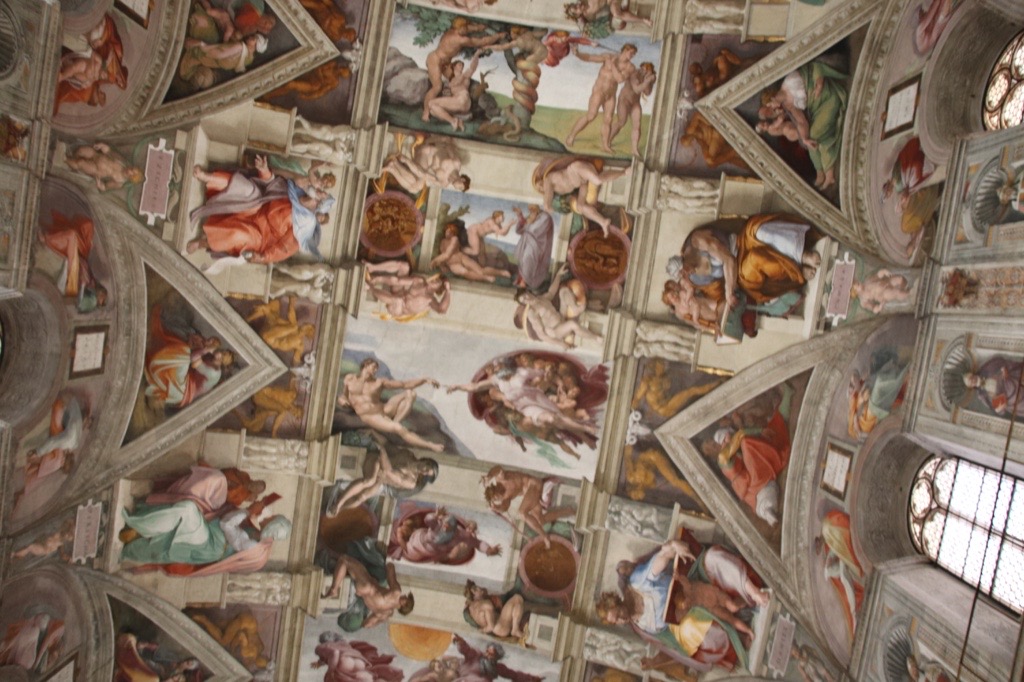
On a screen, the scene often appears as a conventional horizontal rectangle. In the chapel it is overhead, enclosed by painted architecture and surrounded by ignudi, medallions and other components of the vault.[4] Its forms were designed to register across architectural distance.
Broad silhouettes explain part of its force. The divine bodies, circular lights and directional arms remain readable when surface details recede. The relatively spare field prevents the subject from dissolving amid the ceiling’s abundance.
The setting also changes scale. A hand that seems enormous in isolation must communicate from the floor; a small area of plants can nearly disappear. Michelangelo’s composition manages competing thresholds of visibility, allowing the main command to strike immediately while rewarding closer reproduction with the quieter episode.
Smarthistory stresses the physical challenge of looking up at the vast ceiling and the density of its imagery.[5] The present fresco is best understood by moving between views: the complete vault for position, the surrounding bay for architectural relation, and a close view for gesture and paint.
Its Place in the Nine Genesis Stories
The Vatican divides the nine central stories into three broad groups: the origins of the universe, the origins of humanity and the history of Noah.[2] Creation of the Sun, Moon and Plants belongs to the cosmic opening with Separation of Light from Darkness and Separation of the Earth from the Waters.
The physical order from altar to entrance is not identical to the verse order in Genesis. Nor does it establish the order in which each patch of plaster was painted. Biblical narrative, spatial arrangement and working chronology are related but separate matters.
The three cosmic panels share a central challenge: how can a painter make divine acts before human witness intelligible? Michelangelo’s answer is the creator’s body. In the separation scenes, one figure embodies division. Here, repeated appearances distinguish two successive commands.
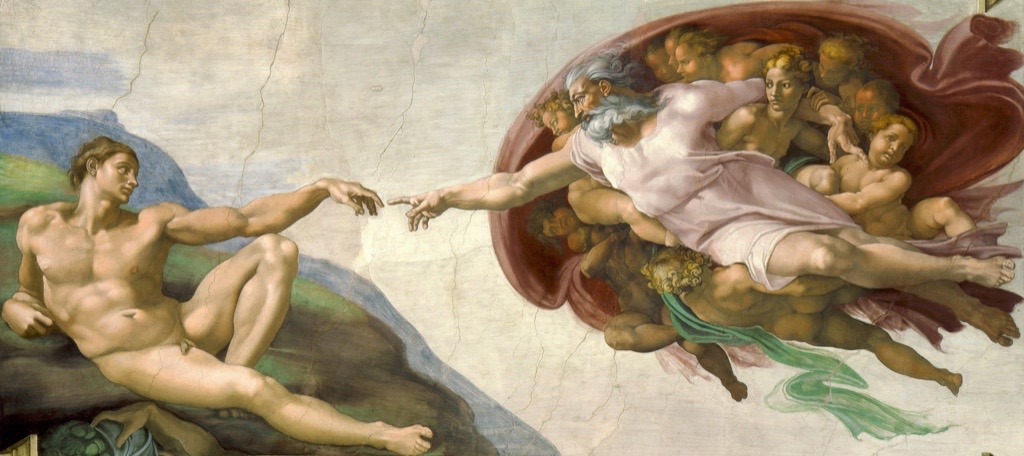
The next major shift is Creation of Adam. There the divine figure approaches a human body and the drama gathers around a narrow interval between hands. In the present scene, the body addresses the whole cosmos, and its reach is centrifugal rather than intimate.
Commission and Working Chronology
Julius II commissioned Michelangelo to repaint the ceiling, and the Vatican records the contract of 8 May 1508. The programme expanded far beyond an initial apostolic scheme and was completed in 1512.[4] Its combination of Genesis, prophets, sibyls, ancestors and corner narratives transformed the chapel’s upper interior.
The first half, extending from the entrance side through the Creation of Eve, was completed by August 1510; the full ceiling was finished by 31 October 1512 and unveiled for papal Mass the next day.[4] Because Creation of the Sun, Moon and Plants lies in the altar-side portion, it belongs broadly to the later phase.
That broad placement should not be turned into a day-by-day schedule. Fresco is executed on fresh plaster in sections, but the official chronology does not isolate an exact date for this panel. The image itself records a finished design, not a complete diary of preparation, transfer, assistance and revision.
Restoration and the Problem of Colour
The modern cleaning of the Sistine ceiling changed public understanding of Michelangelo’s colour. The Vatican places the ceiling phase of the conservation campaign in the 1980s within a longer sequence of work across the chapel.[6][7] Brighter contrasts and sharper passages became newly visible, while the intervention also generated debate about what had been removed and what belonged to the artist’s final effects.
Digital photographs add further variables: lighting, white balance, saturation, compression and screen settings. Differences between reproductions do not necessarily prove changes in the fresco. Historical black-and-white photographs, pre-restoration plates and current digital details each record different conditions.
Colour should therefore be described relationally—the warm sun against the cooler moon, flesh against pale sky, green growth against earth—without pretending that one online file is the neutral original.
Copies, Crops and Later Reception
Later artists and printmakers helped detach individual ceiling scenes from their architectural setting. The National Gallery of Art holds an eighteenth-century print after a drawing by Fragonard, itself after Michelangelo, titled Creation of the Heavenly Bodies and a Prophet from the Sistine Chapel Ceiling.[8] Its chain of mediation is part of its identity.
Such works reveal what later viewers selected. A print can isolate the celestial action, add a neighbouring prophet, reverse an orientation or translate colour into tone. It is evidence for reception rather than a transparent substitute for the fresco.
The history of abbreviated titles similarly records attention. “Heavenly Bodies” makes sense for an object that foregrounds that portion. The Vatican’s full title remains preferable when discussing Michelangelo’s combined scene.
Why the Fresco Matters
This fresco matters because it converts two days of Genesis into a single experience without sacrificing clarity. Michelangelo makes repetition more dynamic than a succession of boxes: the same creator turns through the field, and the world seems to form around his motion.
It matters, too, because its least conspicuous element changes the whole. Notice the plants and the smaller divine figure, and what looked like one spectacular celestial command becomes a meditation on sequence, fertility and time.
Above all, the scene shows Michelangelo thinking sculpturally in paint. Divine power is not an attribute added to the figure. It is conveyed by mass, torsion, reach and the ability of a body to organise space.
Artist Up Close
Michelangelo’s creator is not distant or immobile. He labours through movement. The repeated body allows the artist to show front and back, expansion and recession, as though a sculpted figure had been turned in space. Yet this physicality does not reduce the subject to anatomy. It gives an invisible act a form the eye can follow from the chapel floor. Michelangelo’s audacity lies in making the origin of cosmic order feel inseparable from the exertion of a body.
Frequently Asked Questions
Discussion
Choose a full-scene image, ensemble view or later print. Record crop, orientation, medium, maker, date, source and whether the plants remain visible.
Reader Insights
Describe the two appearances of God without interpreting them. Compare scale, direction, visible body surfaces and gesture.
Cover the vegetation side of the scene and ask how the work’s subject changes. Then restore the full image and compare “Sun and Moon” with “Sun, Moon and Plants.”
Read Genesis 1:9–19 and set its sequence beside the Vatican’s altar-to-entrance order. Identify where biblical and physical arrangements differ.
Join the Conversation
Set the scene beside Creation of Adam. Ask how gesture operates when God addresses heavenly bodies and vegetation rather than a human figure.
References
- Vatican Museums, Creation of the Sun, Moon and Plants”:, View source.
- Vatican Museums, Central Stories”:, View source.
- United States Conference of Catholic Bishops, Genesis, Chapter 1”:, View source.
- Vatican Museums, Sistine Chapel Ceiling”:, View source.
- Smarthistory, Michelangelo, Ceiling of the Sistine Chapel”:, View source.
- Vatican Museums, Sistine Chapel History”:, View source.
- Vatican Museums, The Sistine Chapel Twenty Years Later: New Breath, New Light”:, View source.
- National Gallery of Art, Creation of the Heavenly Bodies and a Prophet from the Sistine Chapel Ceiling”:, View source.