


 by Tom Gurney
Tom Gurney BSc (Hons) is an art history expert with over 20 years experience
Published on June 19, 2020 / Updated on November 6, 2025
Email: tomgurney1@gmail.com / Phone: +44 7429 011000
Michelangelo’s Jesse Spandrel Figure
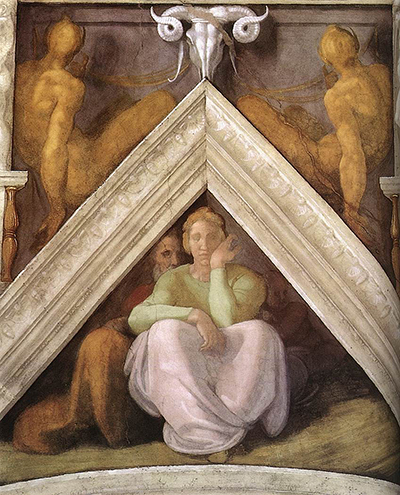
A woman sits on bare ground at the centre of a narrowing triangle. Her feet cross beneath a light violet mantle; a close green garment reveals the strength of her torso. One hand rests upon her legs, while the back of the other touches her cheek. She looks outward with disconcerting steadiness. Behind her, a man and child dissolve into shadow.
This figure occupies the spandrel above the Jesse, David and Solomon lunette in the Sistine Chapel.[1] Calling her the “Jesse spandrel figure” is a location label, not a secure personal identification. The Vatican Museums describes her as enigmatic and states that the eight spandrels probably complete the Ancestors cycle while their precise identities remain disputed.[1][2]
At a Glance
- WorkCentral woman in the spandrel above Jesse, David and Solomon
- ArtistMichelangelo Buonarroti
- Date1508–12, within the Sistine Ceiling campaign[3]
- TechniqueFresco
- LocationTriangular spandrel above the Jesse–David–Solomon lunette, Sistine Chapel
- ProgrammeProbably Ancestors of Christ[2]
- Common route label“Jesse spandrel figure”
- Identity cautionShe is not securely identified as Jesse or another named ancestor
- ExecutionMost of the spandrel painted in one day; lower-right corner separate[1]
- Associated figuresShadowed man and child; bronze-coloured nudes at the edges[1]
- Governing effectFrontal immobility under architectural compression
Contents
- A Location, Not a Name
- What a Spandrel Is
- A Frontal Body
- The Hand Against the Cheek
- A Gaze That Does Not Explain Itself
- Open Eyes and Interpretive Risk
- Green Over a Powerful Torso
- Violet Across the Crossed Legs
- The Shadowed Man and Child
- Painted in One Day
- Cartoon Transfer and Spolvero
- The Separate Lower-Right Corner
- Bronze-Coloured Nudes
- Not an Ignudo
- Waiting Without an Event
- Is She a Mother?
- The Lunette Below
- Seeing from the Chapel Floor
- Conservation and the Gaze
- Artist Up Close
A Location, Not a Name
The spandrel takes its title from the lunette below, whose tablet reads JESSE, DAVID and SOLOMON. That does not make the central woman Jesse.
Jesse is male in biblical genealogy, and no established iconographic system identifies this woman as one of the three tablet names. Some reconstructions place Jesse’s family in the spandrel, but the Vatican retains disagreement over all exact spandrel assignments.[2]
The accurate formulation is “the central woman in the spandrel above the Jesse, David and Solomon lunette.” The shorter route label is useful if its conventional nature remains clear.
Naming the architectural position protects the figure from false biography.
What a Spandrel Is
A spandrel here is a triangular field between the lunettes and the larger painted architecture of the vault. The Sistine Ceiling has eight containing probable ancestor families.[2]
It is not a lunette. Lunettes are broad curved spaces over the windows with central name tablets. Nor is it one of the four great corner pendentives showing miraculous deliverances of Israel.
The distinction matters because shape governs meaning. The spandrel narrows sharply upward, forcing bodies to gather low and close.
Michelangelo’s woman looks monumental precisely because she fills a difficult triangle.
A Frontal Body
The woman sits almost directly facing the viewer.[1] This frontality stabilises the composition beneath the apex.
Her torso rises as the spandrel narrows. Crossed feet establish a compact base, while the arms create an inner frame around body and face.
Unlike turning figures in the lunettes, she does not seem caught between two directions. Her immobility is emphatic.
Architecture compresses her, but the frontal pose answers pressure with resistance.
The Hand Against the Cheek
The back of one hand rests near the cheek, intensifying the outward gaze.[1]
The gesture can suggest thought, fatigue, melancholy or waiting. No single emotional label is secure.
It is different from a hand supporting the full weight of a sleeping head. The torso remains upright and the eyes open. Contact seems to frame reflection rather than surrender to sleep.
Michelangelo makes a small bend at wrist and elbow carry the field’s psychological ambiguity.
A Gaze That Does Not Explain Itself
The Vatican calls the woman enigmatic.[1] Her eyes face outward, but it is difficult to decide whether she meets the chapel viewer or looks beyond.
She does not attend the man and child behind. Their family relation, if any, is not activated through gaze.
This detachment separates visual centrality from social connection. She dominates the composition while appearing inwardly or spatially remote.
The figure is memorable because attention is strong but inaccessible.
Open Eyes and Interpretive Risk
Tiny details around eyes can attract disproportionate certainty in enlarged reproductions. A dark stroke may be read as direct contact, prophetic sight or brooding thought.
At chapel distance, the durable fact is broader: the head faces outward and the pose does not turn towards the family behind. Whether the pupils meet an individual spectator cannot support a named identity.
This is where material caution improves interpretation. The meaning rests on frontality and detachment, not a speculative psychology extracted from one mark.
Green Over a Powerful Torso
Her close green robe adheres sufficiently to reveal pronounced musculature.[1]
Institutional description calls this the masculine musculature typical of Michelangelo’s women. The phrase records a history of gendered expectations: bodily strength is treated as crossing from a male norm.
It is more useful to see how power functions. The robust torso supports a stable frontal silhouette and prevents the woman from seeming crushed by the triangular field.
Green colour keeps that volume vivid at distance.
Violet Across the Crossed Legs
A light violet cloak covers the legs and feet.[1] Its softer hue distinguishes the grounded base from the green torso.
The crossed feet compact the lower body, allowing broad fabric to spread laterally without losing structure.
Colour therefore maps architecture: violet occupies the widening bottom, green rises into the narrowing centre.
Michelangelo uses two chromatic zones to make a difficult seated pose legible.
The Shadowed Man and Child
Behind the central woman, a man and child are sketched in darkness.[1]
Their abbreviated state should not be treated as accidental incompletion. They establish depth, family possibility and contrast with the fully present figure in front.
The man and child appear socially connected to one another more than to the woman, whose gaze remains detached.
Michelangelo can therefore suggest a household while preserving emotional separation inside it.
Painted in One Day
Most of the spandrel was executed within a single giornata, with the lower-right corner belonging to another plaster section.[1]
A giornata is the area of fresh plaster a painter expects to complete before it dries. One-day execution records wall-painting time, not the entire time required for invention.
Drawings, a full-size cartoon, colour decisions and preparation could precede pigment on plaster.
Speed here means Michelangelo translated a resolved system with extraordinary concentration.
Cartoon Transfer and Spolvero
The Vatican states that Michelangelo transferred cartoons for the spandrels using spolvero.[4]
In this method, holes pricked along a full-size design allow charcoal or dark powder to be pounced through onto wet plaster. A dotted guide remains for the painter.
Transfer secures major contours but does not mechanically complete a fresco. Modelling, colour, edge and local adjustment still occur on the wall.
The one-day pace becomes intelligible when visible execution is understood as the final phase of extensive preparation.
Pounced points could disappear under paint or remain detectable along contours. They record translation from paper to wall, but not a frozen command. Michelangelo could strengthen, soften or depart from the guide as the figure took form.
The technique joins precision and freedom. A full-size body arrives prepared; its painted presence remains responsive to plaster and colour.
The Separate Lower-Right Corner
The lower-right corner’s different giornata is a small but important material boundary.[1]
Plaster joins can reveal work sequence even when the image reads continuously. Michelangelo divided labour according to how much surface could remain workable.
The corner also reminds viewers not to imagine the triangular field painted from top to bottom in one uninterrupted gesture.
Fresco time survives inside the apparently timeless figure.
Bronze-Coloured Nudes
At the edges, bronze-toned nude figures turn their backs to the viewer and appear to look upward.[1]
They are not the same category as the central family. Their monochrome colour makes them resemble fictive sculpture integrated into the ceiling’s architectural system.
Their upward attention contrasts with the woman’s direct outward gaze. Edge figures connect the spandrel to structures above; the central body anchors it below.
Michelangelo creates multiple levels of reality—flesh-coloured ancestor, shadowed family and bronze-like ornamental body—within one zone.
The nudes also turn away, so the composition repeatedly withholds faces. The central woman offers the clearest frontality; the family recedes; the bronze bodies present backs. Her gaze becomes dominant through a carefully controlled scarcity of direct address.
Not an Ignudo
The bronze nudes should not be confused with the large, flesh-coloured ignudi seated around the central Genesis panels.
Both are nude inventions within Michelangelo’s painted architecture, but scale, colour and location differ. The bronzed figures behave like decorative sculpture at spandrel edges.
Terminological precision prevents the entire ceiling from collapsing into one undifferentiated population of nudes.
The Jesse figure’s immediate neighbours belong to her architectural frame, not her family group.
Waiting Without an Event
Nothing happens in narrative terms. The woman sits; another pair remains in shadow; the bronze nudes look upward.
This inaction suits the ancestor programme’s long wait for Christ. Yet the hand-to-cheek gesture should not be decoded as a universal symbol of pre-Christian melancholy.
Waiting becomes meaningful because it is bodily specific: crossed feet, upright torso, fixed gaze and suspended hand.
Michelangelo makes duration visible without illustrating a story.
Is She a Mother?
The nearby man and child make a family reading likely at programme level, but the woman does not touch, look towards or visibly shelter them.
Calling her “the mother” may therefore describe a probable group structure while overstating the depicted relation. She could be an adult member of a household whose emotional bonds are intentionally remote.
The distinction matters because Michelangelo’s Ancestors include care and estrangement. A family need not be painted as intimacy.
The Lunette Below
Below, the Jesse, David and Solomon lunette contains a powerful traditionally identified David, a small veiled child and a woman using a wool-winder.[5]
The vertical relation creates a zone of family and work, but exact distribution remains hypothetical. The central spandrel woman is not automatically the mother of any figure below.
Architectural reading should join the fields without erasing their separate evidence.
Names belong to the lower tablet; the upper triangle provides probable continuation.
Seeing from the Chapel Floor
From below, the central figure first registers as green torso over violet base. The man and child recede into a dark mass, while bronze nudes punctuate the edges.
Close photography reveals the unequal finish and material joins. It can also overemphasise brush irregularities never meant to dominate at distance.
Michelangelo designed several scales simultaneously. The woman must command as a silhouette; the shadow pair only needs to emerge gradually.
Optical hierarchy is part of finish.
The triangular field also changes as the visitor moves. Seen obliquely, the woman’s frontal pose compensates for architectural angle; viewed in a photograph, the spandrel is flattened into a self-contained picture. The original encounter never wholly separates figure from vault.
Conservation and the Gaze
Modern cleaning restored stronger colour separation and exposed rapid execution more clearly.[6]
Some details, including eyes and shadow passages, have generated debate because later retouching and cleaning can alter psychological readings disproportionately.
The best interpretation relies on durable structures—frontality, hand, crossed feet and social detachment—rather than claiming certainty from a minute painted mark.
Conservation sharpens looking while also demanding humility.
Artist Up Close
The Jesse spandrel figure shows Michelangelo making immobility monumental.
She cannot be named securely, performs no event and may have been painted largely within one day. Yet her body commands a field shaped to resist it.
Green and violet organise the triangle; a hand frames an unreadable gaze; shadowed relatives and bronze nudes create several depths of belonging.
Her identity is uncertain. Her presence is not.
Frequently Asked Questions
Discussion
What details, sources or comparisons stand out to you in Jesse?
Reader Insights
Which formal detail changes how the work reads?
Which documented source or collection history feels most useful?
Which related Michelangelo work should readers compare next?
Join the Conversation
Add a source-led observation, comparison or question for other readers.
References
- Vatican Museums, Spandrel of the Lunette Jesse, David, Solomon,, View source.
- Vatican Museums, Spandrels,, View source.
- Vatican Museums, Sistine Chapel Ceiling,, View source.
- Vatican Museums, Spandrel of the Lunette Josiah, Jechoniah, Shealtiel,, View source.
- Web Gallery of Art, Jesse—David—Solomon,, View source.
- Vatican Museums, The Sistine Chapel Twenty Years Later: New Breath, New Light,, View source.