


 by Tom Gurney
Tom Gurney BSc (Hons) is an art history expert with over 20 years experience
Published on June 19, 2020 / Updated on November 6, 2025
Email: tomgurney1@gmail.com / Phone: +44 7429 011000
Spandrels of the Sistine Chapel Ceiling
Eight triangular fields sit above the Sistine Chapel's ancestor lunettes. Families rest, sleep, nurse children and gaze outward inside spaces that narrow sharply toward an apex. These are the spandrels: frescoed compartments that probably continue the Ancestors of Christ but whose exact figures remain disputed.[1]
They are neither the four corner pendentives nor the curved lunettes below. Their architecture creates a distinct pictorial problem. Michelangelo had to compress several bodies into a shallow triangle while keeping them legible from the chapel floor.
The result is among the ceiling's quietest painting. No world is created, no giant is slain and no prophet reads a book. Sacred history moves through families waiting between named generations.
At a Glance
- WorkThe eight Sistine Chapel ceiling spandrels
- ArtistMichelangelo Buonarroti
- Date1508–12, within the ceiling campaign
- TechniqueFresco
- LocationTriangular compartments above the ancestor lunettes on the north, south and entrance sides
- Probable programmeContinuation of the Ancestors of Christ
- Textual frameworkThe genealogy of Christ in Matthew 1:1–17
- Identification statusIndividual families and figures remain disputed
- Transfer methodFull-scale cartoons transferred by spolvero, or pouncing
- Documented paceJesse spandrel mostly one day; Josiah spandrel two days[2][3]
- Primary visual problemMultiple bodies compressed into tapering architectural fields
- Essential distinctionSpandrels are not pendentives or lunettes
Contents
- What Is a Spandrel?
- Spandrels Are Not Pendentives
- Spandrels Are Not Lunettes
- The Ancestors Programme
- Why Exact Identities Remain Uncertain
- The Triangle as a Family Shelter
- Bodies Made for an Awkward Field
- The Jesse, David and Solomon Spandrel
- The Bronzed Nudes at the Edges
- The Josiah, Jechoniah and Shealtiel Spandrel
- Spolvero: Transferring the Cartoon
- One Day, Two Days and Fresco Time
- Colour Inside Shadow
- Women and the Visibility of Descent
- Sleep, Waiting and Pilgrimage
- Christian Genealogy and Jewish Ancestry
- The Spandrels in the Ceiling Hierarchy
- From Cartoon to Lost Drawing
- Viewing from the Floor and Through Details
- Restoration and Historical Surface
- How to Look at the Spandrels
- Why the Spandrels Matter
What Is a Spandrel?
In broad architectural language, a spandrel is the area created between an arch and the rectilinear structure around it. On the Sistine vault, the Vatican uses the term for eight triangular “sails” above the lunettes.[1]
The triangle matters. Its broad base can contain reclining or seated bodies; its upper point has little usable width.
Michelangelo does not pretend these are ordinary rooms. Figures bend, overlap and recede into darkness in response to the field.
Painted architecture marks each boundary. The bodies appear contained within a constructed order larger than their domestic lives.
Learning the word is not pedantry. Without it, images from different zones of the ceiling are routinely merged, and the relation between shape and meaning disappears.
Spandrels Are Not Pendentives
The four corner pendentives are much larger curving fields. They contain dramatic stories of Israel's miraculous deliverance: Judith and Holofernes, David and Goliath, the Brazen Serpent, and the Punishment of Haman.[4]
The eight spandrels contain quieter family groups probably associated with Christ's ancestry.[1]
Both are non-rectangular and both mediate between wall and vault, which explains the confusion. Their number, position, shape and programme are different.
A pendentive stages a public rescue narrative. A spandrel compresses people whose biblical importance lies in descent rather than action.
Calling every triangular ceiling field a pendentive substitutes a loose visual resemblance for the chapel's actual organisation.
Spandrels Are Not Lunettes
A lunette is the broad curved field immediately above a window. Michelangelo painted ancestor groups in fourteen surviving lunettes, divided around central tablets bearing genealogical names.
The spandrels rise above them. They contain no equivalent central name tablet, and their figures fit a tapering rather than lateral format.
The Vatican describes the spandrels as probably completing the ancestor series in the lunettes below.[1] “Probably” is essential. Position and subject support the relation, but the absence of direct labels makes exact assignments uncertain.
The two zones work together without becoming interchangeable. The lunette supplies written genealogy; the spandrel turns continuation into an embodied, compact family.
The Ancestors Programme
Matthew opens his Gospel with a genealogy leading from Abraham through David and the Babylonian exile to Joseph, husband of Mary.[5]
The Sistine ancestor cycle gives this written succession physical duration. Adults wait, children cling, mothers nurse and families inhabit time below the prophets and Sibyls.
The spandrels deepen that domestic register. Their groups do not usually enact episodes from an ancestor's biography. They embody generation, displacement, fatigue and continuity.
This restraint separates them from the ceiling's central Genesis narratives. Genealogy is not one spectacular event; it is life extended through many obscure households.
Michelangelo gives those households monumental bodies but little public action.
Why Exact Identities Remain Uncertain
The Vatican states directly that critics disagree about the precise identification of the spandrel figures.[1]
Titles such as “Spandrel of the Lunette Jesse, David, Solomon” identify position above a named lunette. They do not prove that the central woman is Jesse, David or Solomon.
Some family readings are plausible. In the spandrel above Josiah, Jechoniah and Shealtiel, the Vatican proposes Jechoniah with his wife and son.[3] The wording remains probable, not definitive.
Visual attributes rarely settle the matter. A sleeping man, veiled mother or nursing child can express genealogy without functioning as a portrait of one named biblical person.
Uncertainty should guide description toward what the fresco securely shows: relation, posture, colour, direction of gaze and place within the programme.
The Triangle as a Family Shelter
Many groups form low pyramids echoing the surrounding field. An adult reclines along the base; another rises near the centre; a child occupies the protected space between.
The triangle can feel like a tent, roof or pocket within the vast ceiling. It makes the family appear enclosed even where no literal walls are painted.
That shelter is not uniformly comfortable. Bodies may turn away, sleep separately or withdraw into shadow.
Michelangelo exploits the contrast between formal unity and emotional distance. Architecture gathers people whom mood may divide.
The spandrel is consequently not a neutral frame. It acts upon family life, forcing each generation into proximity.
Bodies Made for an Awkward Field
Michelangelo's figures often seem too large for the spaces they inhabit. Knees project, backs curve and heads approach painted boundaries.
This pressure gives stillness energy. A seated woman can appear more monumental because the triangle seems barely able to contain her.
The artist avoids solving every field in the same way. Some groups face outward; others recede. Figures can be sharply lit at the base or nearly disappear toward the corner.
Children help negotiate scale. A small body can occupy a narrowing passage or connect adults whose masses would otherwise remain separate.
Constraint becomes a source of variety rather than a defect to overcome once.
The Jesse, David and Solomon Spandrel
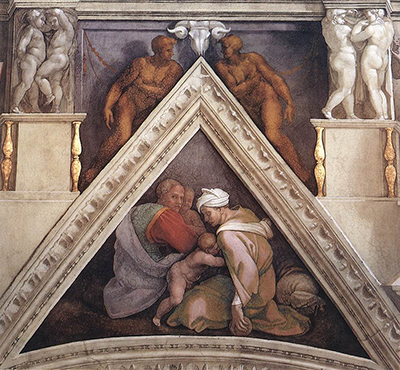
The spandrel above the Jesse, David and Solomon lunette is dominated by an enigmatic seated woman. She faces outward, legs crossed beneath violet drapery, one hand resting on her legs and the back of the other touching her cheek.[2]
A man and child remain behind her in shadow. Her gaze seems detached from them, creating a family group in which emotional connection is not made explicit.
The Vatican notes a close green robe revealing the powerful musculature characteristic of Michelangelo's female figures.[2] Strength and immobility coexist.
Bronze-coloured nudes turn their backs nearby and look upward, connecting the spandrel to the ceiling's fictive sculptural population.
The field was painted mostly in one day, apart from the lower right corner.[2] Speed did not prevent psychological ambiguity.
The Bronzed Nudes at the Edges
Bronze-coloured nude figures occupy parts of the painted architecture around the ancestor fields. In the Jesse spandrel, they turn their backs to the viewer and look upward, answering figures around the opposite compartment.[2]
They are painted bodies made to resemble sculpture. Their metallic tone separates them from the flesh-and-cloth family while linking the spandrel to the ceiling's larger system of fictive materials.
The contrast sharpens the central woman's status. She has the musculature of Michelangelo's monumental figures, but she is not an ornament pretending to be bronze. Colour keeps symbolic ancestor and architectural attendant in different orders.
Their upward gaze also redirects attention. The family remains absorbed in its triangular shelter, while the bronzed nudes acknowledge the more elevated programme above.
Michelangelo thus makes one small zone mediate among domestic life, simulated sculpture and the viewer's ascent through the vault.
The Josiah, Jechoniah and Shealtiel Spandrel
The spandrel above Josiah, Jechoniah and Shealtiel presents three figures on bare ground. A barefoot man sleeps half-reclining in the foreground; behind him, a veiled woman holds a child close to her face.[3]
Bright yellow and white clothing distinguish the sleeper against shadow. The mother sits on a green pallet, her violet tunic and white covering building a more intimate colour group.
The Vatican proposes that they are Jechoniah, his wife and the young Shealtiel, while maintaining the broader uncertainty that governs the spandrels.[3]
The contrast is tender and severe. One adult is unavailable in sleep; the other creates a private enclosure around the child.
This spandrel was completed in two days, demonstrating how rapidly Michelangelo could establish colour, depth and relation at vault scale.[3]
Spolvero: Transferring the Cartoon
The Vatican states that Michelangelo used spolvero in all the spandrels.[3]
A full-scale cartoon was pricked along important contours. It was placed against fresh plaster, and powdered charcoal or another dark material was pounced through the holes, leaving a dotted guide.
The technique allowed complex groups to be planned at working level before painting overhead. It also coordinated a composition with the exact triangle it had to fill.
Pounced dots do not mean execution became automatic. On the wall, Michelangelo still adjusted contours, modelled bodies and resolved colour within the limited lifetime of wet plaster.
Transfer separates invention from final brushwork while keeping them materially linked. The cartoon carried the plan; fresco made it permanent.
One Day, Two Days and Fresco Time
Fresco is painted on fresh plaster in daily sections called giornate. Once plaster dries, pigment no longer bonds in the same way.
The Vatican's statement that the Jesse spandrel was mostly painted in one day and the Josiah spandrel in two does not mean the entire work—from conception to finish—required only those hours.[2][3]
Cartoons, transfer preparation, plastering and earlier design preceded the visible painting campaign.
Still, the pace is extraordinary. Large bodies, garments, shadows and family relations had to be translated decisively.
Differences in finish may reflect this temporal structure. A face crucial to the group receives concentration; a secondary child or shadowed body can be abbreviated without failing at chapel distance.
Colour Inside Shadow
The spandrels are often remembered as dark zones, yet their colours can be sharp: green, violet, yellow, white and warm flesh.
Michelangelo uses colour to separate overlapping bodies where contour alone would become confused. A bright trouser leg can pull a sleeper forward; a white shawl can locate a mother's head inside nocturnal shade.
The colour is architectural as well as naturalistic. It distributes weight across the triangle and prevents one corner from collapsing visually.
Restoration changed modern awareness of these relationships. Older reproductions often flattened the spandrels into brown obscurity, reinforcing the idea that they were subordinate passages.
Their restored colour reveals economy rather than neglect.
Women and the Visibility of Descent
The genealogy tablets in the lunettes primarily list men, following Matthew's structure. The spandrels often make women and children visually dominant.
Pregnancy, nursing and care turn descent from an abstract sequence of names into bodily continuity.
This does not authorize naming every central woman as a specific biblical mother. Her iconographic role can remain collective while her painted presence is intensely individual.
Michelangelo gives these women strength, scale and psychological reserve. They are not ornamental additions to male genealogy.
The spandrels therefore expose a productive difference between text and image. Written descent may be patriarchal in form; painted generation requires the labour and bodies of women.
Sleep, Waiting and Pilgrimage
Sleep recurs across the ancestor cycle. It can suggest exhaustion, inwardness or the long historical wait before Christ.
The Vatican connects the nocturnal Josiah spandrel with Pauline language about pilgrims and strangers seeking a promised homeland.[3]
That interpretation fits the bare ground and family closeness, but it should not become a universal code for every sleeping body.
Michelangelo's figures remain psychologically open. A sleeper may be unaware, burdened, protected or simply resting.
Waiting is the broader action. These families occupy history between great events, making ordinary duration part of salvation's genealogy.
Christian Genealogy and Jewish Ancestry
The spandrels were painted within a Christian chapel as the ancestry of Christ. Their framework claims figures from Hebrew scripture as part of a Christian history culminating in Jesus.
Modern interpretation should recognise that theology without treating the painted families as ethnographic portraits of Jewish life.
Michelangelo did not document contemporary households from a neutral perspective. He created symbolic ancestors for papal Rome.
Their fatigue and distance have sometimes been read through negative Christian stereotypes of people awaiting a fulfilment they cannot yet see. Such readings need historical scrutiny rather than uncritical repetition.
The frescoes are richest when ordinary human absorption is taken seriously while the programme's supersessionist context remains visible.
The Spandrels in the Ceiling Hierarchy
Above and between them sit monumental prophets and Sibyls. Higher still, the central Genesis stories describe creation, fall, flood and renewal.[4]
The spandrels occupy a lower visual register, but they connect those vast narratives to the genealogy leading toward Christ.
Prophets anticipate through words; ancestors continue through bodies. The ceiling joins intellectual foretelling to biological and social descent.
From the chapel floor, this hierarchy is experienced physically through repeated upward looking. Viewers move from families to seers to origins.
The spandrels are structural hinges in that ascent. Ignoring them makes the programme appear to leap directly from Old Testament prophecy to cosmic Genesis.
From Cartoon to Lost Drawing
Because the spandrels were transferred from full-scale cartoons, their execution depended on substantial works on paper. Most of those cartoons have not survived.
The absence changes how we imagine Michelangelo's process. The fresco is the durable endpoint of paper designs that were pricked, handled and often discarded after transfer.
Pounce marks preserve indirect traces of those lost objects. Each dotted contour is evidence of another sheet once aligned to the plaster.
The spandrels therefore contain a hidden archive of drawing. Fresco and paper are not separate careers here; one was physically made through the other.
Loss also warns against assuming that surviving sketches represent every stage of invention.
Viewing from the Floor and Through Details
From below, a spandrel first appears as a triangular mass under a prophet or Sibyl. Colour and large pose register before facial expression.
A close photograph reverses that order. The viewer can inspect the mother's face, pounce marks, hatching or a child's abbreviated hand.
Both scales are necessary. Detail reveals labour, but a crop can detach the family from its architectural pressure and from the lunette supplying its positional title.
The most useful sequence is to locate the spandrel in a full ceiling diagram, examine the whole triangle, and only then approach individual bodies.
Context prevents a seated figure from being mistaken for a free-standing painting.
Restoration and Historical Surface
The Sistine Chapel underwent a major restoration campaign between 1979 and 1999, with the ceiling work completed earlier within that programme.[6]
Cleaning removed layers of grime and later material, renewing visibility of Michelangelo's colour and brushwork while provoking debate about what had been lost or recovered.
In the spandrels, restored contrasts are crucial because so many secondary figures inhabit shadow.
The surface remains historical, not reset to 1512. Cracks, previous interventions, pigment changes and conservation choices mediate what viewers see.
High-resolution digital images add another mediation. They can expose material facts unavailable from the floor while altering colour and scale through screens.
How to Look at the Spandrels
First distinguish the eight spandrels from the four corner pendentives and the lunettes below.
Locate the named lunette beneath a spandrel, but do not turn its tablet into labels for every figure above.
Follow the triangle from broad base to narrow apex. Notice how bodies bend or fade to fit.
Compare the frontal woman above Jesse with the sleeping man and mother-child pair above Josiah.
Then look for evidence of fresco process: daily boundaries, pounced contours and passages resolved with remarkable speed.
Why the Spandrels Matter
The spandrels matter because they make genealogy architectural and bodily. Eight awkward triangles become shelters for families whose obscurity is part of sacred history.
They also reveal Michelangelo's discipline. Monumental figures were planned through full-scale cartoons, transferred by pouncing and painted in astonishingly concentrated giornate.
Most importantly, the spandrels keep the ceiling from being only a sequence of heroes, prophets and divine acts. Children sleep, mothers hold, adults withdraw, and salvation's long history passes through lives that do not know themselves as spectacle.
Frequently Asked Questions
Discussion
What details, sources or comparisons stand out to you in Spandrels?
Reader Insights
Which formal detail changes how the work reads?
Which documented source or collection history feels most useful?
Which related Michelangelo work should readers compare next?
Join the Conversation
Add a source-led observation, comparison or question for other readers.
References
- Vatican Museums, Spandrels., View source.
- Vatican Museums, Spandrel of the Lunette Jesse, David, Solomon., View source.
- Vatican Museums, Spandrel of the Lunette Josiah, Jechoniah, Shealtiel., View source.
- Vatican Museums, Ceiling., View source.
- United States Conference of Catholic Bishops, Matthew 1, View source.
- Vatican Museums, Sistine Chapel., View source.