


 by Tom Gurney
Tom Gurney BSc (Hons) is an art history expert with over 20 years experience
Published on June 19, 2020 / Updated on November 6, 2025
Email: tomgurney1@gmail.com / Phone: +44 7429 011000
Michelangelo’s Nahshon Lunette
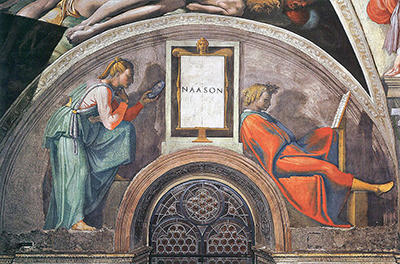
Both figures face the same way. A standing woman bends beneath the curve, one foot raised onto the stone seat while she studies herself in an oval mirror. Across the tablet, a youthful reader leans back with aristocratic indifference, one long leg resting against the lectern that supports his open book. Michelangelo abandons the expected balance of facing pairs and lets the entire lunette flow in one direction.
The Nahshon lunette is one of the rare ancestor fields whose tablet bears a single name.[1] The young man is traditionally identified as Nahshon; the woman remains unnamed. Even here, the title should not turn resemblance into portrait certainty. The fresco’s distinctive content lies in its shared profile, acts of looking and elegant refusal of symmetry.
At a Glance
- WorkNahshon, often spelled Naason in older catalogues
- ArtistMichelangelo Buonarroti
- DateAbout 1511–12[1]
- TechniqueFresco
- LocationSistine Chapel, Vatican City
- ProgrammeAncestors of Christ
- Textual sourceMatthew 1:4[2]
- InscriptionNAASON
- Principal figuresA woman with an oval mirror; a youthful man reading
- Traditional identityThe reader as Nahshon[1]
- Compositional distinctionBoth solitary profiles face the same direction
- Possible antique sourceA sarcophagus relief of the muse Melpomene for the woman’s pose[1]
Contents
- Nahshon in the Genealogy
- A Prince of Judah Outside the Fresco
- Nahshon and Naason
- A Radical Shared Direction
- The Woman and Her Oval Mirror
- Vanity, Prudence or Grooming?
- Bending to the Curve
- Green, Rose and Gold
- An Antique Muse Recast
- The Youthful Reader
- Book, Lectern and Bodily Support
- The Red Mantle
- Two Mirrors: Glass and Page
- Looking Without Meeting
- Solitude Without Melancholy
- Near the Altar and the Lost Pair
- Fresco Economy
- Artist Up Close
Nahshon in the Genealogy
Matthew names Nahshon between Amminadab and Salmon.[2] The line proceeds through Boaz, Obed and Jesse to King David.
In Hebrew scripture, Nahshon is associated with Judah and the wilderness generation. Michelangelo does not give him a tribal standard, public action or narrative episode.
The youthful reader appears absorbed in a book, a Renaissance invention rather than an illustration of a specific biblical deed.
The tablet anchors one link in descent. The image explores attention—towards text and towards reflected appearance.
A Prince of Judah Outside the Fresco
Numbers names Nahshon son of Amminadab as a leader of Judah, and Exodus places his family within the line that will lead to David.[2][6] Later Jewish tradition greatly enlarges his role at the crossing of the Red Sea.
None of that narrative appears here. The young reader has no standard, army or sea, and his elegance is not proof of tribal office.
The textual background nevertheless explains why an otherwise obscure name holds an important genealogical station. Nahshon connects the wilderness generation to Salmon and eventually the Davidic house.
Michelangelo’s refusal to illustrate leadership is therefore striking. Public ancestral authority becomes private reading.
Nahshon and Naason
The painted form NAASON follows Latin and Italian usage; Nahshon is common in modern English Bibles. Both refer to the same name and fresco.
The variant matters because older photographs and catalogues may title the work Naason. It should not be mistaken for another ancestor.
Single-name tablets can seem simpler than those containing three generations. Yet the woman remains outside the inscription, and the young man’s identity is still traditional rather than labelled on his body.
One written name does not eliminate the cycle’s essential ambiguity.
A Radical Shared Direction
Most lunettes oppose figures on either side of the tablet, creating inward or outward symmetry. In Nahshon, both people face the same direction.[1]
The departure changes the field’s energy. Instead of a balanced conversation across the window, one profile follows another like a current.
They do not interact. Shared orientation produces formal unity without emotional contact.
Michelangelo repeated the device in one of the now-lost altar-wall lunettes.[1] That recurrence suggests a deliberate alternative within the cycle’s repeated architecture.
The Woman and Her Oval Mirror
The woman stands with one foot raised on the stone seat. Her elbow rests on the bent knee while she brings an oval mirror towards her face.[1]
This interlocking pose turns self-observation into a total bodily structure. Leg supports arm; arm supports mirror; head inclines to meet the reflection.
The object is small, but it governs every joint. Michelangelo’s invention is not “a woman holding a mirror” added to a static body. It is a body rebuilt around looking.
Her reflection is unavailable to us. We see the act of self-seeing but not the image seen.
Vanity, Prudence or Grooming?
A mirror can signify Vanity, Prudence, self-knowledge or ordinary grooming in Renaissance art. No accompanying attribute here settles one allegory.
Calling the woman Vanity would impose a moral judgement the fresco does not explicitly make. Calling her Prudence would be equally premature.
Within the ancestor programme, the mirror may simply enrich a sequence of ordinary occupations. It can also resonate with genealogy as a structure of likeness across generations.
The strongest interpretation begins with the visible: concentrated self-regard inside a sacred family cycle.
Bending to the Curve
The woman’s back and head follow the upper contour of the lunette.[1] Architecture appears to press the pose into being.
Her raised leg solves the narrowing field by stacking the body vertically and diagonally. Rather than seem confined, she makes the boundary feel purposeful.
This is Michelangelo’s architectural intelligence at a small scale. The figure does not occupy a neutral background; she negotiates masonry, tablet and seat.
The curve becomes a force acting upon the spine.
Green, Rose and Gold
She wears a green overdress tied at the shoulders over a rose blouse with orange-rose shadows.[1]
Her blond hair is elaborately knotted high on the head, from which a long tail descends. A gold earring catches against the neck.[1]
These details create refinement without providing a historical identity. The costume belongs to Michelangelo’s imagined biblical antiquity filtered through contemporary observation and antique sources.
Colour clarifies the complex silhouette: green defines the outer body, warm rose animates the inner garment and gold fixes the profile.
An Antique Muse Recast
The woman’s pose has been connected to a Roman sarcophagus relief showing the muse Melpomene.[1]
Renaissance artists studied ancient reliefs not only for isolated motifs but for solutions to seated and standing bodies within compressed spaces. Michelangelo could adapt such a figure without preserving its original mythological identity.
If the source is correct, a classical muse has been transformed into an unnamed member of Christ’s ancestry. Gesture migrates; meaning changes.
This is not plagiarism in a modern sense. It is creative translation across medium, scale and sacred programme.
The Youthful Reader
The young man sits leaning back against the edge of the tablet, absorbed in an open book.[1]
His extended right leg rests on the wooden base of the lectern; the other bends, while folded arms reinforce a posture of self-contained ease.
Reading usually implies forward concentration. Michelangelo makes it almost languid. The book is supported for him; the body can withdraw while the mind remains engaged.
The result has been described as a slightly sulky adolescent prince.[1] “Prince” conveys elegance and attitude, not a documented rank within the image.
Book, Lectern and Bodily Support
The lectern turns reading into an architectural system. Its wooden pedestal receives the youth’s foot as well as supporting the book.
Object and body share weight. One tool enables attention; the reader casually repurposes it for comfort.
This informality distinguishes him from prophets above who handle books and scrolls as instruments of revelation. The young ancestor reads privately, without announcing a message.
Sacred history includes knowledge absorbed without public performance.
The Red Mantle
An ample red mantle, shaded grey-blue and lined in green, envelops the reader.[1]
Its scale makes the youthful body monumental. Red leads the eye across the lower field while green connects chromatically with the woman opposite.
The hood and blond curls frame a face partly in shadow. Like many Ancestors, he is both visually conspicuous and psychologically remote.
Michelangelo uses brilliant cloth to paint withdrawal rather than spectacle.
Two Mirrors: Glass and Page
The woman looks into a literal mirror; the young man looks into a book. Each object returns something to its viewer—appearance in one case, words or thought in the other.
Neither shares the result. The mirror faces away from us, and the page is unreadable at chapel distance.
The field therefore stages two private technologies of reflection. One is visual and bodily; the other textual and mental.
This parallel is stronger than a forced allegory because it arises directly from objects and poses.
Looking Without Meeting
The common direction might suggest that the pair shares a destination, but their attention never converges. The woman looks at an image returned from inches away; the man looks down towards an open text.
One gaze ends at a surface that reflects the self. The other enters a surface that carries language. Both objects interrupt direct contact with the world beyond the lunette.
This helps explain why the field feels unified and solitary at once. Profile aligns the bodies, while mirror and book keep their mental spaces separate.
Michelangelo turns compositional harmony into a study of parallel privacy.
Solitude Without Melancholy
Many ancestor figures appear weary or distressed. These two are self-absorbed, but not obviously burdened.
The woman actively composes her view; the youth lounges with nonchalance. Their solitude carries elegance and concentration rather than despair.
That tonal difference matters across the full cycle. Michelangelo did not repeat one mood of waiting. He populated genealogy with varied human temperaments.
The shared direction unifies two separate kinds of privacy.
Near the Altar and the Lost Pair
The Nahshon lunette was one of the fields near the altar end. Its two-figure economy contrasts with the six-person density of earlier lunettes near the entrance.[1]
Two ancestor lunettes on the altar wall were later destroyed to make room for the Last Judgement.[3] A lost field apparently shared the same-direction arrangement.[1]
The surviving lunette therefore helps recover a compositional idea once echoed nearby.
Michelangelo’s later masterpiece changed the environment in which his earlier work was read, erasing part of the genealogy it completed.
The loss also prevents complete comparison. The surviving Nahshon cannot prove exactly how Michelangelo varied its same-facing solution in the destroyed field. Engravings and drawn records preserve evidence, but they translate rather than restore the vanished fresco surface.
Survival shapes interpretation: a formal experiment now seems singular partly because its closest partner no longer exists.
Fresco Economy
Only two large profiles occupy the broad field. Reduction increases rather than diminishes their force.
Michelangelo had learned that a few decisive silhouettes could command the chapel from below. Mirror, lectern and garments add specificity without requiring a crowded family.
The shift from dense early lunettes to economical later ones is not a loss of interest. It is a refinement of scale.
Space itself becomes active between the solitary figures.
Artist Up Close
The Nahshon lunette is a study in private reflection. A woman’s body folds around a mirror; a youth’s body unfolds beside a book.
Both are exquisitely dressed, neither performs a famous biblical deed, and only one can even tentatively receive the tablet’s name.
Michelangelo uses antique memory, domestic objects, fresco colour and architectural curve to make two acts of attention monumental.
The genealogy continues not through public heroism but through people looking—at themselves, at words, and away from one another.
Frequently Asked Questions
Discussion
What details, sources or comparisons stand out to you in Naason?
Reader Insights
Which formal detail changes how the work reads?
Which documented source or collection history feels most useful?
Which related Michelangelo work should readers compare next?
Join the Conversation
Add a source-led observation, comparison or question for other readers.
References
- Web Gallery of Art, Nahshon,, View source.
- United States Conference of Catholic Bishops, Matthew, Chapter 1,, View source.
- Vatican Museums, Sistine Chapel,, View source.
- Vatican Museums, Lunettes—South Wall,, View source.
- Web Gallery of Art, The Ancestors of Christ in the Lunettes,, View source.
- United States Conference of Catholic Bishops, Numbers, Chapter 1,, View source.