


 by Tom Gurney
Tom Gurney BSc (Hons) is an art history expert with over 20 years experience
Published on June 19, 2020 / Updated on November 6, 2025
Email: tomgurney1@gmail.com / Phone: +44 7429 011000
Michelangelo’s Salmon Spandrel Figure
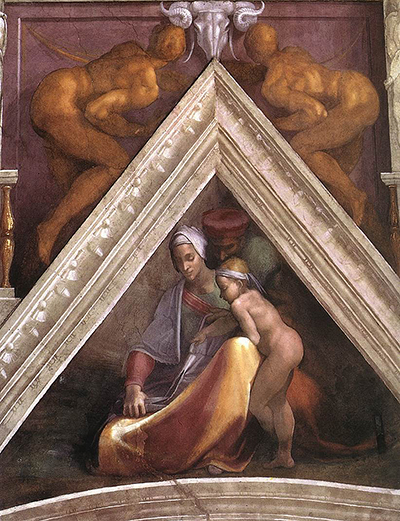
A woman cuts a garment with a pair of shears. A child watches the work at close range, while a man’s face appears behind them. Their gazes and gestures meet around the cloth, making this one of the most socially connected family groups in the Sistine Chapel spandrels. Nothing miraculous occurs. A household is held together by attention, skill and the making of something to wear.
The fresco stands above the Salmon, Boaz and Obed lunette and is conventionally called the Salmon spandrel.[1] The title identifies its architectural position. The boy has often been proposed as Salmon, but no inscription within the triangle confirms that reading.
At a Glance
- WorkFamily group in the spandrel above Salmon, Boaz and Obed
- Common titleSalmon Spandrel
- ArtistMichelangelo Buonarroti
- DateAbout 1511; within the 1508–12 ceiling campaign[1][2]
- TechniqueFresco
- Approximate dimensions245 × 340 cm[1]
- LocationEighth bay, between the Persian Sibyl and Jeremiah, Sistine Chapel
- ProgrammeProbably Ancestors of Christ[3]
- Principal actionA woman cuts cloth while a child observes or assists
- Additional figureA man behind the pair
- Identity cautionThe child may traditionally be Salmon, but the names are disputed
- Governing effectDomestic activity unites a family within a compressed triangle
Contents
- A Title Taken from Below
- The Woman with Shears
- A Child Who Watches and Learns
- The Man Behind
- A Network of Hands and Eyes
- Why Clothing Matters
- Hannah and Samuel: An Analogy, Not an Identification
- Fitting a Family into a Triangle
- Activity Opposite Stillness
- Between Jeremiah and the Persian Sibyl
- The Bronze-Coloured Nudes
- A Late Phase of the Ceiling
- Cartoon Transfer by Spolvero
- Fresco, Surface and Damage
- From Fresco to Engraving
- What “After Michelangelo” Means
- Prints as Evidence—and as Transformations
- Seeing the Work in the Chapel
- Domestic Time and Sacred Time
- Artist Up Close
A Title Taken from Below
The lunette beneath the spandrel bears the names Salmon, Boaz and Obed. It is one of the surviving ancestral fields derived from Matthew’s genealogy of Christ.[4]
Calling the triangle Salmon is therefore convenient and historically established. It does not mean that Michelangelo painted a labelled portrait of Salmon. The Vatican Museums states that the eight spandrels probably complete the ancestor cycle but that critics disagree about exact identities.[3]
The child has often been selected as the most plausible Salmon because he is the youthful focus of a family situated above that name. Plausibility should remain visibly distinct from fact.
The Woman with Shears
The principal woman holds a large pair of shears and cuts into fabric spread across her lap or hands.[1] The tool gives the fresco unusual specificity.
Michelangelo does not merely imply generic female labour. The blades, grip and resistant cloth create a recognisable task. Cutting is the decisive stage before pieces can be sewn into a garment; it demands judgement because an error cannot simply be reversed.
The action brings practical intelligence into the ancestor programme. The woman’s importance arises not from a crown or named identity but from concentrated skill.
A Child Who Watches and Learns
The child leans into the work, following the shears and cloth. He may be observing, holding the material or otherwise assisting.
This closeness makes the group more than a depiction of solitary labour. Knowledge passes through attention. The child learns how a household sustains itself by watching an adult transform material into clothing.
If the boy is Salmon, the future ancestor appears not as a heroic founder but as a dependent participant in domestic work. Even if the name is wrong, the relationship between generations remains central.
The Man Behind
A male face emerges behind the woman and child, slightly foreshortened and partly obscured.[1] His position completes the household without competing with the main action.
He appears to look towards the shared activity. Unlike rear figures who withdraw into darkness elsewhere in the spandrels, this man joins an active circuit of attention.
His exact relationship is unknown. He might be imagined as husband, father or another family member, but the painting supplies no secure personal attribute. His compositional function is clearer: he closes the triangle and confirms that the work matters to the whole group.
A Network of Hands and Eyes
The fresco’s unity depends upon directed attention. The woman’s hands control the shears and cloth. The child turns towards them. The man’s gaze arrives from behind.
These lines converge on a modest centre: not a face, throne or divine sign, but the making of a garment.
Michelangelo thereby gives domestic labour the organising power normally associated with a sacred or narrative focus. Family becomes visible as coordination.
Why Clothing Matters
Clothing protects bodies, distinguishes social roles and carries the marks of work. On a ceiling famous for heroic nudity, a scene devoted to cutting cloth has particular force.
The action answers naked form with the human practice of covering it. Yet Michelangelo does not oppose body and garment simply. The woman’s own pose remains strongly modelled beneath folds, while the cloth in her hands becomes an object under construction.
The fresco therefore joins two of Michelangelo’s enduring concerns: the body as structure and drapery as a second structure shaped around it.
Hannah and Samuel: An Analogy, Not an Identification
The First Book of Samuel tells how Hannah made a small robe for her son Samuel and brought it to him each year.[5] A woman making clothing beside a boy naturally recalls that episode.
The comparison can illuminate the tenderness and foresight implicit in garment-making. It cannot securely rename the figures. The spandrel belongs above the Salmon–Boaz–Obed lunette, and it contains no attribute that decisively identifies Hannah or Samuel.
Iconographic analogy is most useful when it explains how an action could carry maternal meaning without overriding the work’s architectural context.
Fitting a Family into a Triangle
The group is compressed into a field that narrows rapidly above. Michelangelo places the woman low and broad, uses the child to draw attention inward, and raises the man’s head into the reduced space behind.
Bodies overlap rather than line up. This creates depth while preserving a compact silhouette legible from the chapel floor.
The triangle becomes an image of interdependence. No figure is fully isolated, and each helps complete the compositional structure of the others.
Activity Opposite Stillness
Across the vault, the corresponding Jesse spandrel is dominated by a frontal woman who rests a hand near her cheek and looks outward. A shadowed man and child behind her appear detached.
The Salmon group offers a striking contrast. Here hands work, eyes converge and family members participate in a shared task. There, immobility and psychological distance prevail.
The pairing does not require a fixed allegorical code. Michelangelo uses opposing human states—action and suspension, cooperation and isolation—to vary the long passage of ancestry.
Between Jeremiah and the Persian Sibyl
The spandrel occupies the eighth bay between the prophet Jeremiah and the Persian Sibyl.[1] Jeremiah is among the ceiling’s most burdened and introspective seers; the sibyl turns through a different kind of concentrated reading.
The family group below them also concentrates, but upon manual work. Prophetic thought and domestic intelligence occupy neighbouring levels of the same architecture.
This relation enlarges the meaning of attention. Sacred history depends not only on revelation but on ordinary acts that preserve a generation.
The Bronze-Coloured Nudes
At the edges above the cornice, small bronze-toned nude figures bend forward in conspicuous, almost awkward poses, seeming to peer upward.[1]
They belong to Michelangelo’s fictive architectural population rather than to the ancestor family. Their monochrome colour makes them resemble sculptural ornament, unlike the flesh-coloured ignudi surrounding the central Genesis scenes.
Their twisting curiosity contrasts with the family’s inward focus. The ornamental bodies look away or upward; the human household gathers around cloth.
A Late Phase of the Ceiling
The fresco is commonly dated about 1511, in the later working phase of the ceiling.[1] Michelangelo’s figures in this portion are often larger and more immediately legible than those begun nearer the entrance.
The Salmon group nevertheless preserves intimate detail. Monumental bodies do not erase the shears, cloth and exchanged glances.
Scale and domesticity reinforce one another: the practical act can command a chapel precisely because Michelangelo treats it with the structural seriousness of sculpture.
Cartoon Transfer by Spolvero
The Vatican Museums records that cartoons for all the spandrels were transferred by spolvero.[6] In this method, a full-size drawing was pricked along its principal lines and powdered charcoal was pounced through the holes onto wet plaster.
For overlapping figures and a tool with clear geometry, the transferred guide helped preserve exact placement. Painting still required rapid decisions about colour, modelling and edges before the plaster dried.
Preparation and execution are therefore inseparable. The fresco’s apparent naturalness rests upon a carefully designed arrangement translated at full scale.
Fresco, Surface and Damage
In true fresco, pigment bonds with damp lime plaster. The technique produces durable colour but also preserves the history of a wall: joins between working sections, cracks, repairs and later interventions.
Older photographs and descriptions record visible cracking and stucco repairs in the spandrel before modern conservation.[7] Such evidence matters because reproductions from different periods may make contours and colours appear unlike one another.
Damage should not be romanticised as part of Michelangelo’s design. Nor should a cleaned image be treated as untouched. The present fresco is both a sixteenth-century work and a surface that has survived centuries of chapel use.
From Fresco to Engraving
The group circulated beyond Rome through prints. The Metropolitan Museum of Art holds an engraving by Adamo Scultori titled Seated Woman with Children and a Man, Holding Scissors, catalogued as number 73 in a series of studies from the Sistine Ceiling.[8]
The Met correctly distinguishes makers: Scultori made the engraving; the design is “after Michelangelo.” The small sheet, about 14 by 10.5 centimetres, converted a high, coloured fresco into portable black lines.
That change affected viewing. Details difficult to inspect from the chapel floor—the shears, hands and heads—could be owned, studied and copied at close range.
What “After Michelangelo” Means
In print catalogues, “after Michelangelo” does not imply forgery or weak imitation. It identifies a design reproduced by another maker.
The engraver interpreted tone through hatching, translated colour into black and white, and may have simplified or clarified details. The result is an independent object with its own scale, material and publication history.
Confusing Michelangelo with the printmaker erases the very process by which his ceiling entered European visual culture. Attribution must preserve both invention and translation.
Prints as Evidence—and as Transformations
An early print can document how viewers understood the composition, but it is not a neutral photograph. Lines may regularise damaged passages, reverse the original orientation or intensify details that suited engraving.
The Scultori sheet’s descriptive title focuses on the visible action rather than a disputed biblical name. In that respect, it offers a useful interpretive discipline: seated woman, children, man, scissors.
Comparing fresco and print reveals reception as active looking. Each generation does not simply receive Michelangelo; it selects what to make legible.
Seeing the Work in the Chapel
From the floor, the group reads first as a compact knot of bodies. The shears are less immediately commanding than in an enlarged reproduction or print, while the shared direction of the figures remains clear.
The triangular architecture, neighbouring seers and lunette below keep the family within a larger genealogy. A cropped image can make the scene look like an independent genre painting; the chapel makes it part of sacred history.
Both scales are valuable. Distance reveals composition. Closeness reveals work.
Domestic Time and Sacred Time
The woman’s cutting action occupies an ordinary sequence: measure, cut, stitch, wear. Genealogy occupies a much longer one: parent, child, descendant.
Michelangelo aligns these forms of time. The garment being made for a growing body becomes a modest counterpart to the ancestral line unfolding towards Christ.
No emblem announces this idea. It emerges from the fact that care always anticipates a future. Cloth is cut because a body will need it.
Artist Up Close
The Salmon spandrel is extraordinary because its family shares attention.
A blade passes through cloth. A child watches. A man leans into the visual conversation. The triangle that could have confined three separate bodies becomes a chamber of coordinated work.
The exact names remain uncertain, but the action needs no invented certainty. Michelangelo gives ancestry a practical foundation: generations endure because someone measures, cuts, teaches and provides.
Frequently Asked Questions
Discussion
What details, sources or comparisons stand out to you in Salmon?
Reader Insights
Which formal detail changes how the work reads?
Which documented source or collection history feels most useful?
Which related Michelangelo work should readers compare next?
Join the Conversation
Add a source-led observation, comparison or question for other readers.
References
- Web Gallery of Art, Salmon Spandrel,, View source.
- Vatican Museums, Sistine Chapel Ceiling,, View source.
- Vatican Museums, Spandrels,, View source.
- United States Conference of Catholic Bishops, Matthew 1,, View source.
- United States Conference of Catholic Bishops, 1 Samuel 2,, View source.
- Vatican Museums, Spandrel of the Lunette Josiah, Jechoniah, Shealtiel,, View source.
- Antonio Forcellino, discussion of the Sistine Ceiling spandrels and restoration history; contextual image record at Busonero,, View source.
- Metropolitan Museum of Art, Adamo Scultori, Seated Woman with Children and a Man, Holding Scissors (no. 73), from Series of Studies from the Ceiling of the Sistine Chapel,, View source.