by Tom Gurney
Tom Gurney BSc (Hons) is an art history expert with over 20 years experience
Published on June 19, 2020 / Updated on November 6, 2025
Email: tomgurney1@gmail.com / Phone: +44 7429 011000
Michelangelo's Nine Scenes from the Book of Genesis
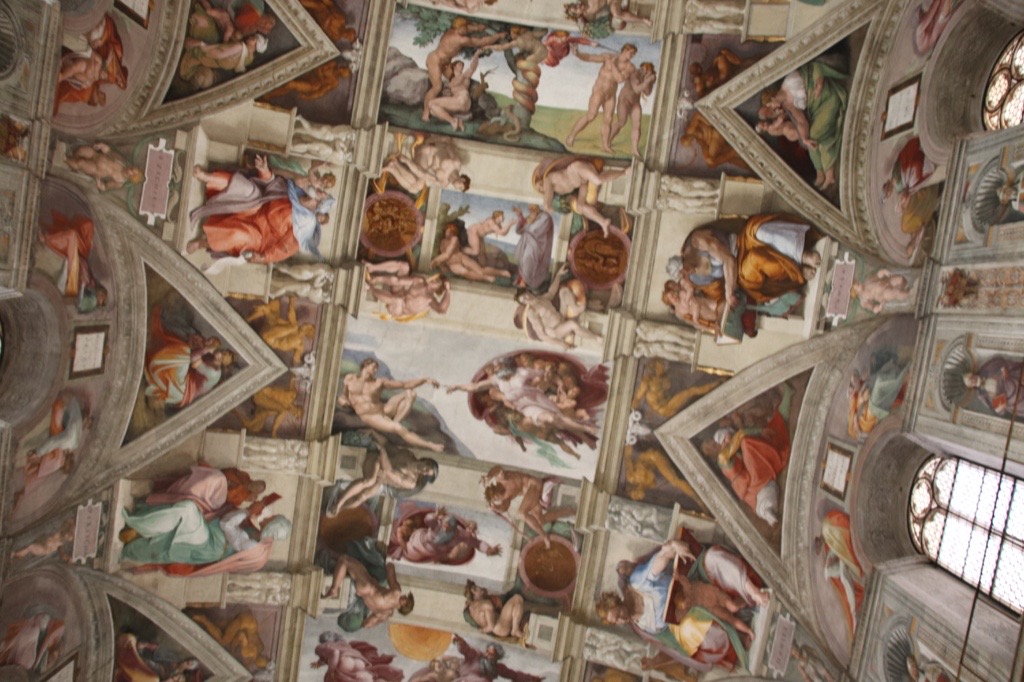
Along the centre of the Sistine Chapel ceiling, Michelangelo moves from the first division of light to a drunken man lying exposed before his sons. Between those extremes, God orders the universe, brings Adam and Eve to life, and watches humanity lose Eden. The world is drowned and begun again, but the final scene offers no easy triumph. Noah's survival does not remove human frailty.
These are the nine scenes from Genesis, painted between 1508 and 1512 as the narrative spine of Michelangelo's ceiling. They are often encountered as isolated masterpieces—above all the Creation of Adam—yet their force depends upon sequence. Divine acts give way to human relationships; a few monumental bodies give way to crowded catastrophe; beginning and aftermath continually reshape one another.[1]
The order is more complex than a straight illustrated Bible. Physical arrangement, scriptural chronology, order of execution and a visitor's path through the chapel do not coincide perfectly. Reading the sequence well means knowing which direction one is travelling and allowing Michelangelo's changes of scale to become part of the story.
At a Glance
- ArtistMichelangelo Buonarroti
- WorkNine central scenes from the Book of Genesis
- Date1508–1512
- MediumFresco
- LocationCentral vault, Sistine Chapel, Vatican City
- PatronPope Julius II
- Contract signed8 May 1508
- First campaign milestoneEntrance half through Creation of Eve completed by August 1510
- CompletionBy 31 October 1512
- Three groupsCreation of the universe; creation and fall of humanity; Noah, destruction and survival
- Number of scenesNine
- Direction used hereFrom the altar toward the entrance
- Important distinctionThe physical Noah sequence places the Sacrifice of Noah before The Flood, although Genesis narrates the sacrifice afterward
- Surrounding figuresIgnudi, medallions, prophets, sibyls, ancestors of Christ and four pendentive narratives[1][2]
Contents
- The Sequence from Altar to Entrance
- First Triad: The Universe in Motion
- Second Triad: The Human Body Awakens
- Third Triad: Noah and an Imperfect Renewal
- Four Different Orders
- Why the Figures Grow Larger
- The Architecture and Figures Around the Nine
- Drawing, Fresco and Distance
- The Nine Scenes Beyond the Ceiling
- Artist Up Close
- A Beginning That Contains Its Consequences
The Sequence from Altar to Entrance
Beginning above the altar and moving toward the chapel entrance, the nine scenes are:
1. Separation of Light from Darkness 2. Creation of the Sun, Moon and Plants 3. Separation of Land from Sea 4. Creation of Adam 5. Creation of Eve 6. Original Sin and Banishment from the Garden of Eden 7. Sacrifice of Noah 8. The Flood 9. Drunkenness of Noah[1]
The first triad concerns the origin of the universe and is dominated by God. The second moves to the origin and fall of humanity through Adam and Eve. The third turns to violence, flood, survival, sacrifice and the persistence of human weakness through Noah.[1]
This direction follows the Vatican Museums' presentation of the central histories. It is not the order in which most visitors first meet them. Entering the chapel, a viewer stands beneath the Noah end and looks toward the cosmic creation scenes above the altar. Physical progress through the room can therefore reverse the conceptual sequence: humanity's troubled aftermath comes first, and the universe becomes newly ordered as the viewer approaches the liturgical focus.
The panels also alternate in size. Smaller fields appear between larger ones, and pairs of nude youths sit beside the smaller scenes. Painted cornices, piers and medallions create a fictive architecture that gives each narrative a boundary while joining it to a larger rhythm.[2]
The titles themselves require attention. Creation of the Sun, Moon and Plants is preferable to a loose “planets” variant because the dedicated Vatican account describes vegetation together with the two heavenly lights and links the scene to Genesis 1:11–19.[3] The sixth panel joins temptation, original sin and expulsion; calling it only the Expulsion suppresses half its composition.[4]
First Triad: The Universe in Motion
The three scenes closest to the altar depict God separating light from darkness, creating the sun and moon with vegetation, and dividing land from water. There is little stable earth and almost no independent human action. God's body becomes the principal agent through which invisible ordering is made visible.[1]
In Separation of Light from Darkness, he is seen in daring foreshortening from below. His raised arms divide the field, while his head twists and his torso presses toward the viewer. The panel is relatively small, but the single body fills it with concentrated force. Light and darkness are not represented as named objects; division appears through the action of God within a contrasting atmosphere.
The scene holds an unusual place in the campaign. It represents the first event in the biblical sequence but belongs broadly to the last part Michelangelo painted, near the altar. Creation begins conceptually where the artist's work approached completion. Biblical and working time move in opposite directions.
Creation of the Sun, Moon and Plants contains two appearances of God in one field. At the right he faces outward, directing the sun and moon with emphatic hands. At the left he is seen from behind as he turns toward the newly created vegetation. The double figure is not an accidental duplication. It is a familiar narrative method in which successive actions share one pictorial space.[3]
The contrasting viewpoints multiply energy. One divine body advances toward the viewer; the other sweeps away. Billowing cloth and clustered attendants intensify both movements. The sun and moon become compact discs governed by enormous gestures, while plants occupy the low ground of the second action.
In Separation of Land from Sea, God travels above the waters with arms extended. The pose is less compressed than in the division of light but still resists quiet frontality. Cloth swells around the creator and small attendants press into its shelter. The emerging world is spare. Michelangelo gives more space to the act of ordering than to a detailed description of the result.
Across the triad, the body of God changes viewpoint so radically that no single, stable portrait results. He is seen from below, frontally, from behind and in flight. Divine constancy is expressed not through a repeated silhouette but through inexhaustible action.
Second Triad: The Human Body Awakens
The centre of the sequence brings Adam and Eve into the world and then drives them out of Eden. The three panels form a compact history of formation, relationship, choice and consequence.[1]
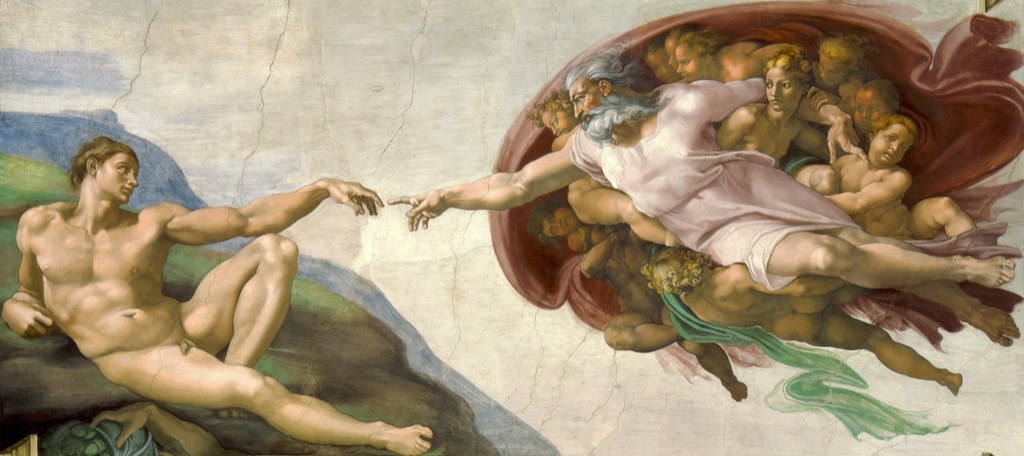
In the Creation of Adam, Adam lies along the earth, his left arm extended toward God. The two index fingers remain separated by a narrow interval. God moves within a mantle crowded with attendants; Adam's body is complete in form but still appears heavy and only partly responsive. The gap concentrates the transition between material body and living likeness.[5]
The scene's extraordinary fame can make it seem self-sufficient. Within the sequence, however, Adam's isolation is temporary. He follows the creation of a habitable universe and precedes Eve, shared action and exile. The open space between the hands is therefore one moment within a history that quickly becomes relational.
Creation of Eve changes the geometry. Adam sleeps heavily in the foreground while Eve rises from his side and joins her hands toward God. The creator stands upon the ground rather than flying, and the three principal figures form a vertical movement from sleeping body to awakening woman to divine address.
The panel marked a documented stage in the work. By August 1510 Michelangelo had completed the first half of the ceiling from the entrance wall through Creation of Eve. The date establishes a campaign boundary, not an exact day for every figure in the scene.[2]
In Original Sin and Banishment from the Garden of Eden, the tree divides two moments. On the left, a serpent with a human upper body coils around the trunk and reaches down with fruit. Adam and Eve participate in taking it. On the right, an armed angel drives them into a barren world.[4]
Michelangelo makes before and after occupy the same continuous landscape. The bodies transform as the eye crosses the tree. In Eden they are strong, open and actively reaching; in expulsion they contract, age and cover themselves. Eve bends with her arms drawn inward. Adam raises a hand toward the angel while moving away.
The tree is therefore more than scenery. It is a vertical hinge separating temptation from punishment and verdant abundance from empty ground. Because the pair appear twice, time becomes visible through changed anatomy and gesture.
The triad also changes the role of touch. Adam almost receives life through a fingertip. Eve's hands answer God in prayer. Adam and Eve then reach toward forbidden fruit and recoil from the angel's weapon. Human contact develops from possibility into relationship, agency and loss.
Third Triad: Noah and an Imperfect Renewal
The three scenes near the entrance show the Sacrifice of Noah, The Flood and the Drunkenness of Noah. They contain more figures and denser action than the cosmic scenes. They were painted in the earlier phase of the campaign, before Michelangelo enlarged and simplified much of the later work.[1][6]
The Sacrifice of Noah gathers a family around an altar. Bodies carry, bend and assist in a ritual offering. The subject is traditionally connected with Noah's thanksgiving after leaving the ark. Yet it appears physically before The Flood in the altar-to-entrance sequence. The disruption may relate to the visual and theological organisation of the ceiling, but no surviving note by Michelangelo explains it.
The Flood is the most crowded central narrative. People struggle toward high ground, shelter beneath a tree, support children and elderly relatives, fight for a boat and gather on a small island. The ark floats in the distance rather than dominating the foreground.[6]
This distribution changes the familiar emphasis of the biblical story. The vessel of survival remains visible, but immediate human desperation occupies most of the panel. No single hero controls the scene. Michelangelo asks the eye to move among fragile local acts of rescue while the rising water overwhelms them.
The crowded figures are relatively small from the chapel floor. Their density can feel like a technical miscalculation compared with the later monumental scenes. More generously, the scale suits a subject about collective catastrophe. The difficulty of seeing every episode becomes analogous to the impossibility of mastering the disaster as a whole.
The Vatican Museums connects the Flood with a Christian baptismal interpretation through the First Letter of Peter: water destroys an old humanity while Noah's family survives into renewal.[7] This theological reading gives the scene a place in the chapel's broader history of salvation, though it does not dissolve the terror of individual bodies left outside the ark.
The Drunkenness of Noah closes the physical sequence near the entrance. Noah lies exposed after drinking wine. One son mocks or points while the others approach with a garment and avert their gaze. Survival has not restored Edenic innocence. The rescued patriarch becomes vulnerable, and the new human beginning immediately contains shame and divided response.
The modest domestic scale of the incident makes a severe conclusion. The sequence has travelled from the making of cosmic light to the ethics of how children see a compromised father. Michelangelo ends not with the ark or covenant but with human dignity placed in the hands of others.
Four Different Orders
The nine scenes can be organised in at least four ways.
Biblical chronology follows Genesis. Creation precedes Adam and Eve; the Fall precedes the Flood; Noah's sacrifice follows survival; drunkenness comes later. Physical order describes the arrangement on the ceiling from altar to entrance or in reverse. Working order concerns the broad progression of Michelangelo's fresco campaign. Visitor order depends upon where a person enters, stands and turns.
These orders overlap without becoming identical. The first act of creation stands near the altar but belonged to the later working phase. The Noah scenes stand near the entrance and were painted earlier. The physical position of the sacrifice precedes the Flood in one direction even though the narrative event follows it.[1][2]
This complexity is not an obscure technicality. It produces meaning. A liturgical movement toward the altar can seem to travel from damaged humanity backward toward divine origin. A conceptual reading from the altar outward moves from creation toward recurring human weakness. The execution sequence moves broadly from crowded earthly histories toward concentrated divine acts.
No secure evidence permits a neat date beside every panel. The contract of 8 May 1508, the August 1510 completion of the first half and the final completion by 31 October 1512 are the principal Vatican milestones.[2] Within them, plastering, surrounding figures, interruptions, drawings and revisions formed a much more intricate daily chronology.
Why the Figures Grow Larger
The change from small crowded bodies near the entrance to larger, clearer forms toward the altar is one of the sequence's most important visual developments. When the first half became visible from below around 1510, Michelangelo could assess how distance transformed it. Later scenes increasingly rely on economy.[8]
In The Flood, dozens of figures distribute the drama. In the Creation of Adam, two opposing bodies and a group within the mantle create the entire event. In Separation of Light from Darkness, one foreshortened God nearly fills the panel. Fewer figures do not mean less meaning; they allow gesture to carry farther.
The alternating panel sizes make the adjustment more striking. Michelangelo could compress a gigantic action into a small field when a single body supplied its structure. Conversely, a large field could become intentionally difficult through the accumulation of human events.
The development extends into surrounding prophets, sibyls and ignudi. Later figures become bolder, and their rotations press more forcefully against painted frames. The ceiling appears to teach its painter how it wishes to be seen.
This should not become a simplistic division between an incompetent first half and a perfect second. The crowded Noah panels create forms of attention unavailable to the cosmic triad. Their small bodies emphasise plurality, vulnerability and the failure of human control. The later economy answers other subjects with another visual language.
The Architecture and Figures Around the Nine
The central histories never appear alone in the chapel. Michelangelo surrounds them with painted cornices, simulated sculptural figures, twenty seated ignudi and medallions that resemble bronze reliefs. Lower down, seven prophets and five sibyls occupy monumental thrones.[2][9]
The prophets and sibyls belong to expectation rather than Genesis narrative. Their inscriptions identify them; their books, scrolls and attendants turn reading and revelation into bodily action. They look inward, outward and upward, creating cross-currents beside the central sequence.[9]
In the lunettes and spandrels, groups associated with the ancestors of Christ inhabit much more compressed spaces. Some genealogical names are present, but the exact identities of many individual figures—particularly in the spandrels—remain disputed.[10] Their domestic waiting gives the cosmic and heroic centre a human margin.
The four corner pendentives depict the Brazen Serpent, Punishment of Haman, David and Goliath, and Judith and Holofernes. These are episodes of Israel's deliverance, not part of the nine Genesis scenes. Their corner positions connect vault and walls.[11]
This surrounding system changes every central panel. The Creation of Adam is bordered by bodies that do not participate in Adam's literal story. The Noah scenes sit within a visual architecture also carrying medallions and nude youths. Sequence and simultaneity coexist: the eye can follow Genesis along the centre or move sideways into prophecy, ancestry and rescue.
Drawing, Fresco and Distance
Michelangelo developed the ceiling through drawing. Studies could isolate a hand, foot, torso, drapery fold or complete pose. More finished cartoons translated figures toward full scale. The Metropolitan Museum's survey of his drawings shows how observation and invention operated across media rather than supplying a single mechanical recipe.[12]
On the wall, fresco required pigment to be applied to fresh plaster. The design had to be divided into workable daily areas, and transfer methods carried prepared contours onto the surface. Michelangelo could revise, but the drying plaster imposed decisions unlike those of a portable oil painting.
The curved vault and distant floor shaped every solution. Deeply modelled forms, sharp silhouettes and strong colour relations keep bodies readable. A reproduction viewed frontally may conceal the degree of foreshortening required to make a figure appear convincing overhead.
Modern restoration further affects perception. The Vatican's broader chapel campaign ran from 1979 to 1999; its detailed conservation chronology places the principal restoration of the ceiling frescoes in 1984–1989. Cleaning revealed bright and varied colour beneath deposits and altered coatings, prompting renewed debate about Michelangelo's painting method.[7][15]
Photographs made before and after conservation can therefore look dramatically different. Crop and rotation introduce another transformation. A detail printed upright lets the viewer examine anatomy but removes the relation between the scene, the curved ceiling and the movement from entrance to altar.
The Nine Scenes Beyond the Ceiling
The sequence belongs to fresco, yet its inventions grew from Michelangelo's work across media. Drawing connected the study of a living body with a figure enlarged beyond life. The Metropolitan Museum's account of Michelangelo as draftsman and designer stresses disegno as both manual drawing and intellectual conception.[12] On the ceiling, that conception governs not only isolated anatomy but the relation among panels, frames and distant viewers.
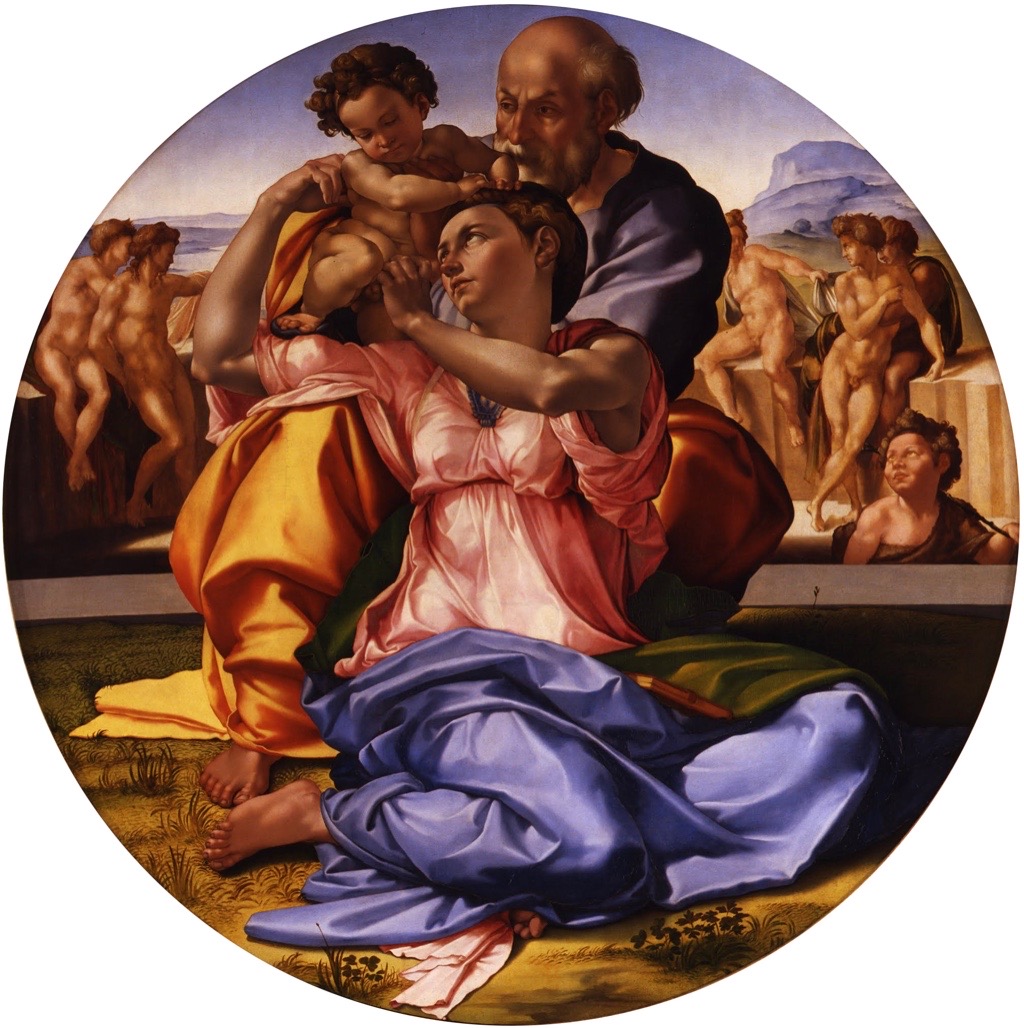
The Doni Tondo, painted around 1505–1506, offers an instructive earlier comparison. Its circular wooden support encloses the Holy Family in a tightly rotating group, executed in tempera grassa. The Genesis scenes are architectural frescoes, yet the panel already shows Michelangelo using bodies to generate compositional structure rather than arranging figures within a passive setting.[14]
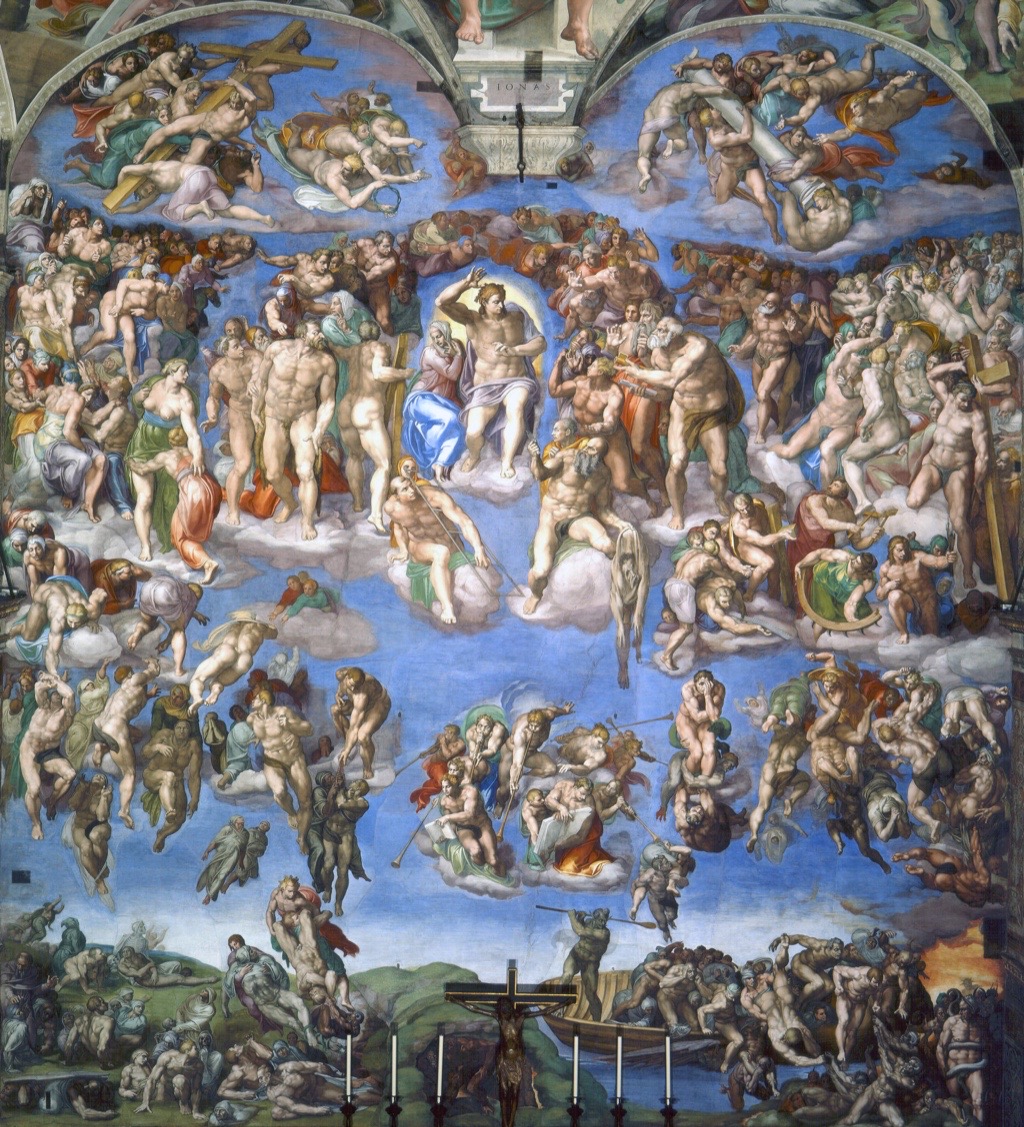
After the ceiling, The Last Judgement transformed the same chapel through an opposite strategy. The central histories divide time into framed episodes. The altar wall, painted from 1536 to 1541, dissolves frames and gathers resurrection and judgement into a single event.[13] Adam's incomplete awakening can be set against the multitude regaining flesh below Christ, but the later fresco is not a continuation numbered ten.
The ceiling's figures also entered later art through prints, casts, paintings, sculpture and innumerable photographic fragments. The almost-touching hands of Adam and God became a sign available for invention, technology, medicine and popular culture. That afterlife confirms the gesture's clarity while making it easy to forget the eight neighbouring histories.
Returning the fragment to the sequence changes it. Adam's hand is preceded by the ordering of the universe and followed by Eve's emergence, the Fall and Noah's world. The famous gap no longer signifies “creation” in general. It becomes one carefully placed threshold within a long account of what embodied freedom permits.
The other panels deserve the same restoration of context. God's double appearance in the creation of the lights is not an oddity when understood as continuous narration. The Flood's tiny ark is not a failed illustration when its crowded foreground is allowed to make catastrophe human. Noah's drunkenness is not an anticlimax when it is seen as the sequence's refusal of easy renewal.
The history of reproduction can therefore be used critically without distrusting images altogether. A detail reveals brushwork and anatomical decisions that the floor conceals. A full ceiling photograph clarifies order. A diagram can establish orientation. Each mode answers a different question, and none replaces the physical work.
Artist Up Close
Michelangelo entered the commission best known as a sculptor and emerged as the maker of one of painting's largest coherent programmes. The nine histories show why the old opposition between sculpture and painting is inadequate. His bodies have mass, but they depend upon colour, painted atmosphere, sequence and the illusion of architecture.
The campaign also reveals an artist willing to learn publicly. Early density did not trap him. Once he saw the work from below, he appears to have enlarged figures and clarified designs. Adaptation became a source of grandeur.
His choice to make bodies carry cosmic events is especially bold. Light and darkness have no natural anatomy, yet their division is represented through God's straining torso and raised arms. Life is invisible, yet it becomes perceptible in the tiny space between two hands. Sin is moral and temporal, yet it becomes a changed posture on opposite sides of a tree.
At the Noah end, individual bodily power reaches its limit. Crowds cannot stop the water; survival does not prevent renewed weakness. The sequence refuses a simple celebration of the heroic nude. Human form can be beautiful, frightened, dependent, ashamed and mortal.
The final physical scene makes this humility personal. Noah, once the means of survival, lies unconscious while his sons decide how to respond. Michelangelo's central history ends with no creator visible and no monumentally self-sufficient hero. Human beings are left responsible for how they look at and cover one another.
A Beginning That Contains Its Consequences
The nine scenes are often described as a story of origins, but they are equally a story of consequences. The creation of a world makes human action possible. Awakening leads to relationship; relationship permits choice; choice leads to exile. Survival after judgement opens another future without abolishing frailty.
Michelangelo compresses that enormous argument into changes of scale and direction. God sweeps through nearly empty space. Adam reclines on new earth. Eve rises. The first pair reaches and then recoils. Crowds struggle in water. Noah lies unable to govern even his own body.
Seen from the entrance toward the altar, those consequences reverse into beginnings. The troubled father and drowning multitudes give way to newly created bodies and finally to divine acts before humanity exists. The ceiling can therefore offer both descent from creation and an imagined return toward it.
No isolated reproduction can fully preserve that double movement. The meaning belongs to the long chapel, the viewer's changing position and the great families of figures around the centre. Each panel is a work of extraordinary invention; together they become an account of why creation remains magnificent even when its human history cannot remain innocent.
Frequently Asked Questions
Discussion
Choose one central scene and identify the nearest prophets, sibyls, ignudi, medallions or architectural divisions. Ask how the surrounding system changes its meaning and scale.
Reader Insights
Sort the nine titles into universe, humanity and Fall, and Noah. Notice what changes as divine action gives way to bodies and crowds.
Place the physical Noah sequence beside Genesis chronology. Ask why a ceiling arrangement and a textual timeline need not be identical.
Compare God across the first three scenes through viewpoint, gesture, fabric and direction without inventing an exact execution date.
Join the Conversation
Record the source, crop, orientation, date and colour state of a ceiling image. Decide which spatial relationships it preserves and which it removes.
References
- Vatican Museums, Central Stories, View source.
- Vatican Museums, Sistine Chapel: Ceiling, View source.
- Vatican Museums, Creation of the Sun, Moon and Plants, View source.
- Vatican Museums, Original Sin and Banishment from the Garden of Eden, View source.
- Vatican Museums, Creation of Adam, View source.
- Vatican Museums, The Flood, View source.
- Vatican Museums, Sistine Chapel: History, View source.
- Smarthistory, Michelangelo, Ceiling of the Sistine Chapel, View source.
- Vatican Museums, Sibyls and Prophets, View source.
- Vatican Museums, Spandrels, View source.
- Vatican Museums, Pendentives, View source.
- Metropolitan Museum of Art, Michelangelo: Divine Draftsman and Designer, View source.
- Vatican Museums, The Last Judgement, View source.
- Uffizi Galleries, Holy Family, Known as the Doni Tondo, View source.
- Vatican Museums, The Sistine Chapel Twenty Years Later: New Breath, New Light, View source.