 by Tom Gurney
Tom Gurney BSc (Hons) is an art history expert with over 20 years experience
Email: tomgurney1@gmail.com / Phone: +44 7429 011000
The Piper (The Bagpipe Player) by Théodore Géricault: Introduction
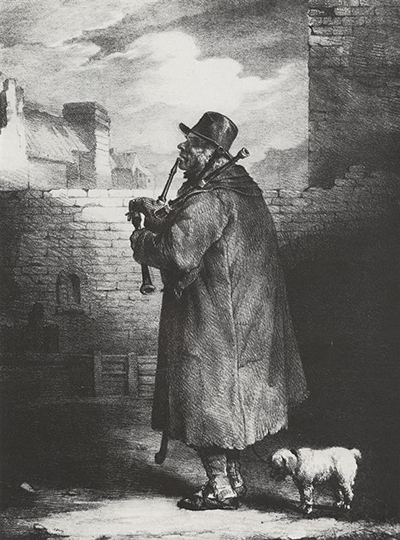
A man plays the bagpipes in an almost empty street. His long coat occupies the centre of the image, a small dog stands beside his feet, and broken stretches of masonry close off much of the space behind them. Géricault’s The Piper, also known as The Bagpipe Player, gives this modest encounter the concentrated attention of a figure portrait. The National Gallery of Art identifies its impression as a lithograph on wove paper, catalogued as Delteil 30. [1]
The composition belongs to the English suite published in London in 1821. Charles Clément’s historical catalogue records its English title, the bagpiper and his accompanying dog, and the publication inscription dated 1 February 1821. Those details establish the subject as a musician carrying and playing bagpipes. The instrument, with its projecting pipes, is essential to the image’s identity. [2]
At a Glance
- PublicationLondon, 1 February 1821 inscription recorded by Clément [2]
- MediumLithograph; NGA impression on wove paper [1]
- CatalogueDelteil 30; NGA accession 2002.157.19 is state II/II [1]
- English suiteTwelve subject plates plus a title sheet [2]
This work across Théodore Géricault’s career
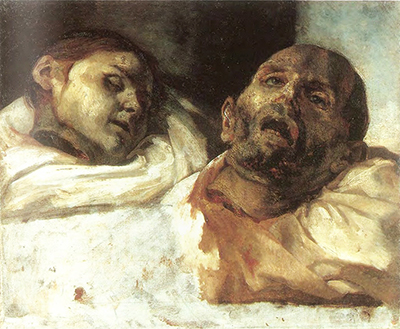
The Severed Heads
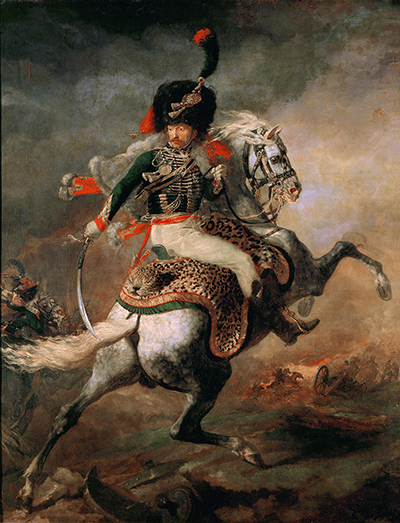
1810s [3]Charging Chasseur
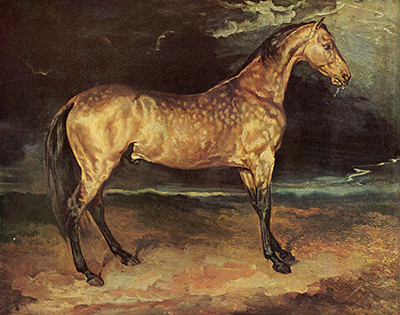
1812 [4]Horse Frightened by Lightning
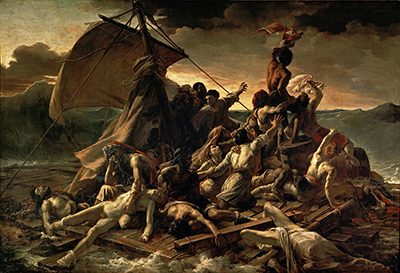
c.1813–14 [5]The Raft of the Medusa
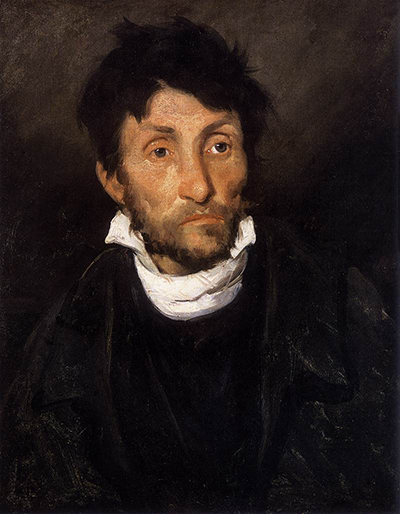
1818–19 [7]Portrait of a Kleptomaniac
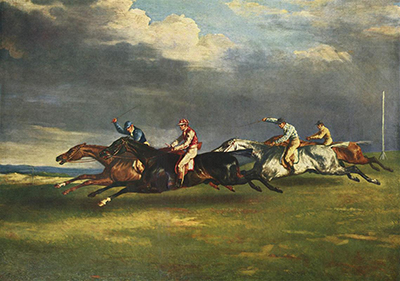
c.1820–24 [9]The Epsom Derby
1821 [10]Contents
- A musician seen from the side
- The dog and the scale of companionship
- Walls, weather and an absent audience
- Tone and texture in the lithograph
- An English print for viewers to examine
A musician seen from the side
The piper faces left, although much of his back remains visible. This oblique position lets the coat spread into a broad, enclosing shape while the face emerges in a narrow profile above it. His hat gives the head a firm dark outline against the paler sky. Below its brim, the nose and beard break the contour into smaller irregularities. From a distance the figure reads as a single mass; closer attention discovers a person within that mass.
His hands gather around the instrument at chest height. The bagpipes interrupt the otherwise downward flow of the coat: narrow pipes rise towards the mouth and extend behind the shoulder, while another part descends in front. These projecting elements give the upper body a framework of diagonals. The arms appear occupied rather than relaxed, and the musician’s stance must accommodate the object he holds. His work is therefore visible through posture as well as through the recognisable instrument.
The lower part of the figure offers a different rhythm. The coat ends unevenly above the ankles, exposing wrapped or layered leg coverings and shoes. One foot projects towards the left; the other anchors the body closer to the dog. The eye can follow a continuous route from the hat, through the shoulder and long garment, to these smaller, more sharply accented forms at ground level. Géricault makes the full standing body important, without reducing the scene to an inventory of costume.
The dog and the scale of companionship
The dog stands low on the right, its pale body clearly picked out against the dark ground behind it. Its small size changes our sense of the man’s height and of the weight of his clothing. The coat almost reaches the animal’s head. Where the man’s outline is tall and tapering, the dog supplies a compact horizontal shape, close to the earth.
That bright patch also prevents the lower right corner from disappearing into shadow. After looking at the face and hands, we are drawn down to the animal and then across the illuminated pavement towards the shoes. The dog participates in the composition’s movement of attention even though it does very little. Its presence makes the man’s solitude more complicated: he is without a visible human audience, but he is accompanied.
Clément describes the musician as blind. This is a historical identification attached to the subject, rather than a diagnosis that can be established by inspecting his eyes in the print. [2] The distinction matters when considering the dog. Its proximity invites thoughts of assistance and dependence, but the image alone cannot supply a history of training or a detailed account of the pair’s life. What it gives us directly is their closeness, their shared patch of street and the contrast between their bodies.
Watch: Géricault and The Raft of the Medusa
Three perspectives on Géricault’s best-known painting, its making and its historical setting.
Gericault, Raft of the Medusa
Smarthistory examines the composition and historical setting of The Raft of the Medusa.
Watch on YouTubeWalls, weather and an absent audience
The setting is unusually restrictive. A low wall runs across the middle distance, while a taller mass of brickwork rises at the right edge. Beyond the lower wall, fragments of roofs and chimneys suggest further buildings. They establish an inhabited place without offering a clear route into it. The musician stands in front of this architecture, separated from much of the space that might contain other people.
The taller wall is particularly effective. Its dark face stands behind the man’s right side, helping the lighter passages of his coat remain visible. Above him, the clouds open into a broad pale interval. The resulting background is neither uniformly light nor uniformly dark: it changes as the figure changes, sharpening some edges and allowing others to merge. The street feels enclosed, but the sky keeps the upper image from becoming solid masonry.
No listeners gather around the piper. That absence is part of the visible arrangement, and it gives the act of playing an unresolved quality. A musician ordinarily directs sound outwards; here the picture contains no clear recipient. We can imagine the sound reaching beyond the frame, yet Géricault offers no response within it. The print makes us attend to a performance whose audience has been withheld.
The clothing, the rough surroundings and the lack of customers allow a reading of precarious street employment. They do not prove the man’s income or tell us what happened that day. The scene’s force comes from bringing a working action into contact with an unresponsive environment. The hands continue their task while the walls and empty ground remain indifferent.
Tone and texture in the lithograph
Looking closely at the monochrome surface reveals how much the image depends on differences within grey. The coat is neither a flat dark silhouette nor a white shape left against black. Its middle tones carry a network of marks that describe folds, worn texture and the turning of the body. Near the shoulder, these marks compress around the arm; lower down they lengthen with the hanging cloth.
The masonry uses a different order of marks. Horizontal courses and irregular block edges organise the wall into small units, contrasting with the softer transitions of the garment. The clouded sky is broader and less sharply articulated. These changes help distinguish cloth, stone and atmosphere without colour. They also determine the pace of looking: the eye catches on the brickwork, follows the folds and moves more freely through the sky.
At the bottom of the image, pale pavement and dark shadows turn the feet into a point of contact. The man does not float in an undefined grey field. The dog’s bright back and the accents around the shoes bring the scene to rest on a tangible surface. This is one reason the composition can feel substantial despite the relatively slender figure and simple setting.
An English print for viewers to examine
Clément places The Piper at the beginning of the twelve subject plates in the English suite, after its title sheet. He records Rodwell and Martin as publishers and Hullmandel’s lithography in the inscription. The suite therefore comprised twelve subject images plus a title, rather than thirteen independent scenes. [2] Within that published sequence, the piper could be encountered alongside other figures, animals and forms of everyday activity. The wider range of Géricault’s lithographs helps place this restrained street subject within his printmaking.
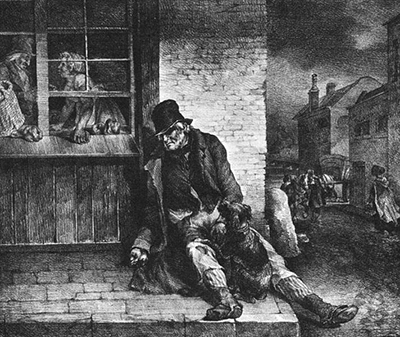
A useful companion is Pity the Sorrows of a Poor Old Man. Clément’s next entry describes a man with a dog outside a baker’s shop. [2] The pairing directs attention towards the relationship between vulnerable people and the public spaces they occupy. In The Piper, the upright figure and working hands keep the action suspended: he is still playing, and the image does not resolve what that effort will bring.
The National Gallery of Art’s sheet measures 42.4 by 34 centimetres and is identified as the second of two states. Those particulars describe that museum’s impression; they should not be transferred automatically to every reproduction of the composition. [1] The enduring subject is the encounter Géricault has arranged within the image: a musician, an animal and a street that gives them space while offering little visible welcome.
Pity the Sorrows of a Poor Old Man
Géricault collection records
Seventy collection records include paintings, drawings and individual print impressions. Different impressions remain separate records; this selection is not a complete catalogue raisonné.
Frequently Asked Questions
Clément’s nineteenth-century catalogue calls him blind. That is a historical description of the subject; the print does not establish a modern medical diagnosis or a documented personal biography. [2]
It is a lithograph. The NGA catalogues its impression on wove paper as Delteil 30, state II/II; those impression details should not automatically be attached to an unidentified reproduction. [1]
Discussion
Look again at the images and ideas explored in The Piper (The Bagpipe Player) by Théodore Géricault. These editorial prompts invite your observations.
Reader Insights
How does the dog change your reading of the musician’s solitude?
Where does the background sharpen the piper’s outline, and where does it let him merge with the setting?
How does the absence of visible listeners change the meaning of the playing hands?
Join the Conversation
Share a detail, comparison or question about The Piper (The Bagpipe Player) by Théodore Géricault below.
References
- National Gallery of Art, The Piper, Théodore Géricault, accession 2002.157.19; medium, sheet dimensions and catalogue identification, Delteil 30, state II/II. View source.
- Charles Clément, Catalogue de l’œuvre de Géricault: Lithographies, 1866, French, English-suite introduction and entries 26–28, printed pp. 13–14 (scan PDF pp. 21–22). View source. (in French).
- Nationalmuseum, The Severed Heads, NM 2113; collection metadata and museum interpretation (Swedish). View source.
- Louvre, Charging Chasseur, INV 4885; collection metadata and museum interpretation (French/English interface). View source.
- National Gallery, Horse frightened by Lightning; collection metadata and museum interpretation (English). View source.
- Louvre, Wounded Cuirassier, INV 4886; collection metadata and museum interpretation (French). View source.
- Louvre, The Raft of the Medusa, INV 4884; collection metadata and museum interpretation (French). View source.
- Gary Tinterow / The Metropolitan Museum of Art, Géricault’s Heroic Landscapes: The Times of Day, Met Bulletin 48/3, Winter 1990–91; consulted main essay and relevant object entries (English). View source.
- Vlaamse Kunstcollectie, Portrait of a Kleptomaniac; collection metadata and museum interpretation (Dutch). View source.
- Louvre, Epsom, MI 708; collection metadata and museum interpretation (French/English interface). View source.