


 by
Tom Gurney
Tom Gurney BSc (Hons) is an art history expert with over 20 years experience
Published on October 6, 2016 / Updated on October 23, 2026
Email:
tomgurney1@gmail.com
/ Phone:
+44 7429 011000
Woman in a Garden
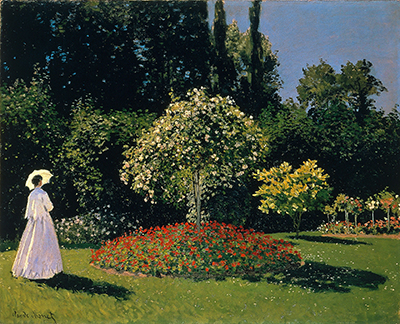
Woman in a Garden is the painting held by the State Hermitage Museum as Lady in a Garden (Sainte-Adresse), dated 1867. [1] A woman in a pale dress stands at the left of a carefully tended lawn. A red flower bed and a flowering rose standard occupy the centre, making the garden as important to the picture as its solitary visitor.
At a Glance
- Artist Claude Monet
- Museum title Lady in a Garden (Sainte-Adresse)
- Date 1867
- Medium Oil on canvas
- Dimensions 82 x 101 cm
- Collection State Hermitage Museum
- Inventory GE-6505. [1]
The Lecadre garden at Sainte-Adresse
The Hermitage identifies the setting as the Le Coteau property belonging to Monet's Lecadre relatives at Sainte-Adresse , near Le Havre. It places the painting among the garden landscapes he made during his stay in the summer of 1867. [1]
This was not yet the garden that Monet would develop at Giverny. Here he was looking at an established family property, with a lawn, shaped planting beds and flowers arranged for ornamental effect. The scene combines private leisure with horticultural order.
The museum's collection catalogue also connects the summer with a letter to Frederic Bazille dated 25 June 1867. Monet described working on a group of canvases that included gardens, figures and marine subjects. [2] That range helps explain the place of this picture within a productive coastal visit. It was one subject among several, rather than proof that he had already settled upon gardens as his exclusive theme.
Who is the woman?
The figure is generally identified as Jeanne-Marguerite Lecadre, the wife of Monet's cousin. The Hermitage catalogue names her, while the Royal Academy's exhibition guide presents the identification more cautiously. [2] [3] She should not simply be assumed to be Camille Monet because a woman appears in a Monet painting.
Her dress and parasol make a light shape against the dark vegetation behind her. The face is small, and the picture does not offer the sustained facial description expected from a close portrait . Identification and visual emphasis are different matters: a known model can still function primarily as a figure within a landscape.
Her position is also unusual. She does not occupy the centre, and her gaze leads towards the planted area rather than out towards the viewer. The garden consequently seems to hold her attention without becoming a stage for a clearly narrated event.
A formal garden of roses and geraniums
The Royal Academy's guide draws attention to the standard roses and the carpet bed of red geraniums. It places these features within the formal garden design fashionable in France at the time, contrasting them with the less regular planting associated with Monet's later garden. [3]
The red bed is especially important to the composition. Its low, rounded outline spreads across the centre of the lawn, while the flowering standard rises above it. One element provides breadth and the other height. Together they give the middle of the picture a structure that can balance the woman at the left.
The bed's near edge is clearly defined, but individual flowers dissolve into small red and green marks. Monet makes the shape legible without describing every plant separately. On the right, another low border carries warm-coloured accents towards the edge. It extends the sense of a maintained garden beyond the central display.
Sunlight and the shapes of shadow
The picture's light is most immediately visible in the dress, the pale flowers and the open lawn. These passages stand out because of the much darker trees and shrubs behind them. The limited patch of sky at the upper right does not dominate the scene; the principal contrast happens within the garden itself.
The woman's shadow stretches across the grass to her right. A much larger shadow follows the flowering standard and its bed. These dark forms connect objects to the lawn and help establish a consistent sense of illumination.
They also prevent the green foreground from becoming an empty interval. Looking across it, the eye encounters the white dress, the dark shadow, the red flowers and another broad dark shape. Monet distributes contrasts across the surface instead of reserving all interest for the background.
This is a useful example of painting light through relationships between adjacent colours. It does not require us to know the exact hour or to imagine that every passage was completed during a single uninterrupted sitting.
Description, distance and brushwork
Different parts of the garden receive different kinds of attention. The rose standard's trunk is relatively firm and vertical. Its crown is a loose cluster of pale touches. The distant vegetation is built from irregular dark and green passages, while the lawn forms a broader, quieter field.
That variation gives the garden depth. The plants behind the woman appear as a dense enclosure, but the grass in front remains open enough for the shadows to register. The red flowers occupy an intermediate position: close enough to command attention, yet described collectively rather than as a botanical illustration.
The woman's outline is more continuous than the scattered marks in the flowers. Her presence would become difficult to read if every edge were equally broken. The picture therefore complicates the idea that Monet's technique always meant applying the same short stroke throughout an entire canvas. Here, differences of handling help distinguish fabric, foliage and open ground.
Not Women in the Garden at the Musee d'Orsay
The similar titles have encouraged confusion with Women in the Garden , the much larger painting in the Musee d'Orsay. That separate canvas shows several women in a garden at Ville-d'Avray and is dated around 1866. Its inventory number is RF 2773. [4]
The Orsay account explains the trench used to lower that large canvas while Monet worked outdoors, and records its rejection by the Salon jury in 1867. Those episodes belong to the Orsay picture, not automatically to the Hermitage painting. [4]
The distinction is visible as well as documentary. The Hermitage composition has one small figure at the edge of a broad garden view. The Orsay painting gives its much larger figures a different relationship to the surrounding foliage. Comparing them reveals related interests in outdoor figures and sunlight without turning two objects into a single story.
Another garden from the same summer
The Metropolitan Museum's Garden at Sainte-Adresse offers a different view of coastal leisure in 1867. Its elevated terrace opens towards the sea, and the Met emphasises the strong horizontal bands formed by garden, water and sky. [5]
Lady in a Garden is more enclosed. Trees largely shut out the horizon, and the red bed draws attention inward. The comparison shows how two garden subjects from the same year could produce very different spatial experiences. One opens towards shipping and the coast; the other concentrates on a private planted enclosure.
Their shared date should not erase their distinct sites, figures and compositional decisions. Nor should either be treated as a direct preview of every garden Monet would paint later.
The painting's later collection history
The Hermitage catalogue traces the painting through the Lecadre family and several French owners or dealers before its acquisition by Pyotr Shchukin in 1899. It subsequently passed to Sergei Shchukin in 1912. [2] Distinguishing the two collectors avoids compressing that history into a single undated purchase.
The current museum record states that the painting entered the Hermitage in 1930 from the State Museum of New Western Art. [1] It is now identified by inventory GE-6505.
Its lasting interest lies in a particular conjunction: a recognisable family garden, one lightly described visitor and a carefully balanced arrangement of sunlight, flowers and shade. The woman supplies scale and human presence, but the garden supplies much of the picture's structure. Looking between them is more rewarding than searching for an unrecorded drama or assigning a definite emotion to the model.
Frequently Asked Questions
The Hermitage's current record dates Lady in a Garden (Sainte-Adresse) to 1867. [1]
No. That account concerns the much larger Women in the Garden in the Musee d'Orsay. [4]
The State Hermitage Museum, inventory GE-6505. [1]
Discussion
Look again at the images and ideas explored in Woman in a Garden. These editorial prompts invite your observations.
Reader Insights
How does the central flower bed balance the figure at the left?
Which shadows make the lawn feel like a continuous space?
How does the enclosed garden differ from the open terrace in Garden at Sainte-Adresse?
Join the Conversation
Share a detail, comparison or question about Woman in a Garden below.
References
- State Hermitage Museum , Lady in a Garden, Sainte-Adresse, exact object record, GE-6505. View source .
- State Hermitage Museum , collection highlights catalogue, entry 197, printed pages 252-253, Lady in a Garden: model, letter and provenance. View source .
- Royal Academy of Arts , Painting the Modern Garden, 2016 large-print guide, page 14, Lady in the Garden. View source .
- Musee d'Orsay , Women in the Garden, RF 2773, separate painting and its production history. View source .
- Metropolitan Museum of Art , Garden at Sainte-Adresse, 1867, accession 67.241, comparative painting. View source .







