 by Tom Gurney
Tom Gurney BSc (Hons) is an art history expert with over 20 years experience
Published on June 19, 2020 / Updated on October 2, 2026
Email: tomgurney1@gmail.com / Phone: +44 7429 011000
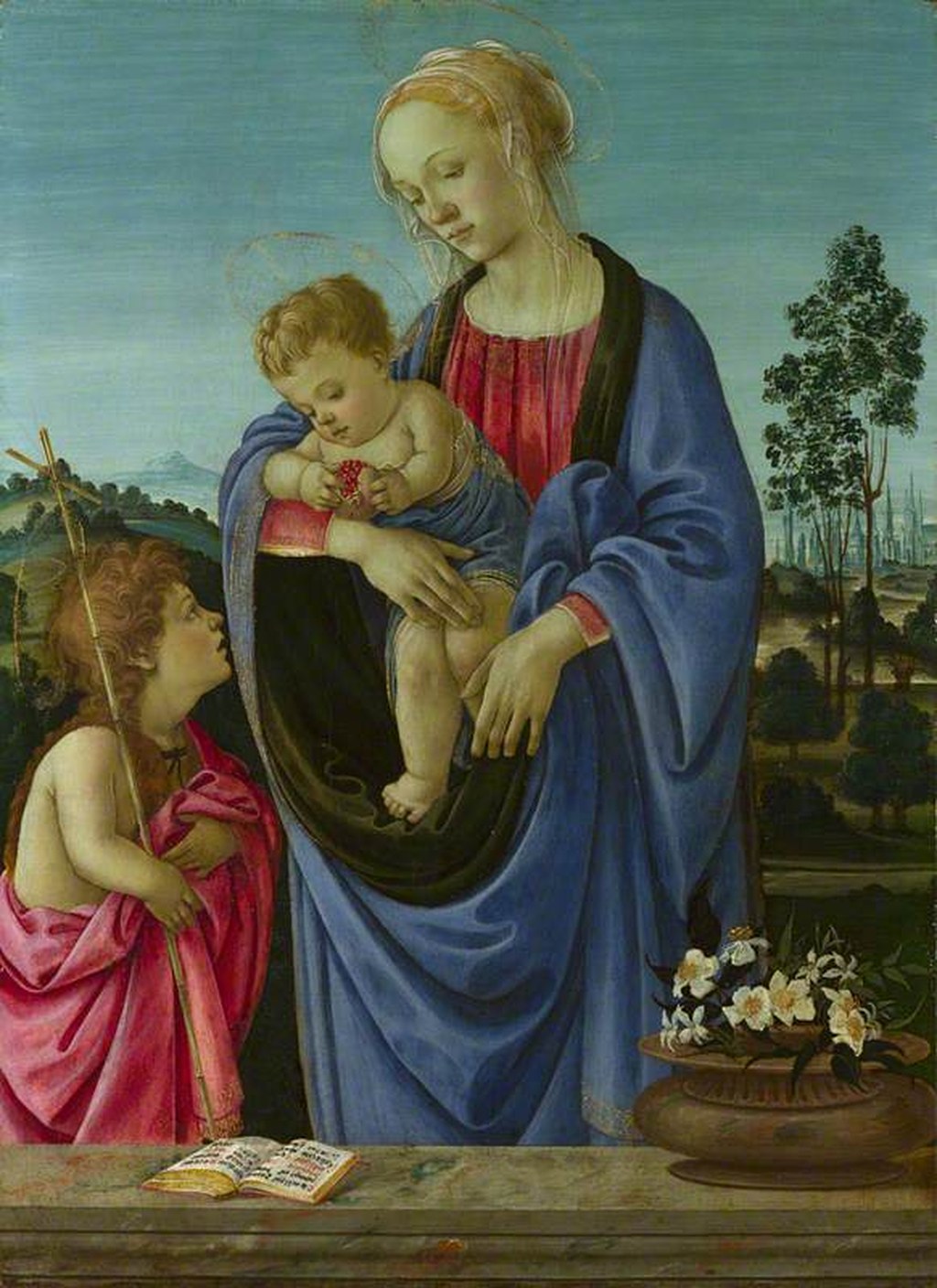
The Virgin and Child with Saint John by Filippino Lippi — National Gallery
Filippino Lippi’s The Virgin and Child with Saint John, painted around 1480 and now in the National Gallery in London, is one of the earliest known works of his career. The painting was probably made while Filippino was still working within Sandro Botticelli’s workshop, making it especially valuable for understanding how an artistic identity emerges from apprenticeship.[1]
The subject is intimate and familiar. The Virgin Mary holds the Christ Child, who reaches into a split pomegranate. The young Saint John the Baptist looks up in wonder, carrying his reed cross and wearing the camel-hair garment that identifies him. A marble sill separates the sacred group from the viewer. On it lie an open book and a vase of yellow flowers. Behind the figures, a mountainous landscape opens into the distance, with a small towered city among tall young trees.
The National Gallery interprets the pomegranate as a symbol of Christ’s future Passion. Its red seeds could recall the blood he would shed at the Crucifixion. Mary’s downward gaze may therefore combine tenderness with foreknowledge.[1] The painting is small, measuring only 59.1 by 43.8 centimetres. This scale suits the domestic devotional market for which such images were often produced. The National Gallery notes that paintings of the Virgin and Child with the young Baptist were an important source of income for Florentine artists and commonly decorated household chambers.[1]
The work is therefore valuable in two distinct ways. It shows the young Filippino learning inside Botticelli’s workshop. It also shows the economic and devotional world that sustained Renaissance workshops through repeated private commissions rather than monumental church projects alone.
At a Glance
- ArtistFilippino Lippi
- TitleThe Virgin and Child with Saint John
- Datec. 1480
- MediumEgg tempera on poplar
- Dimensions59.1 × 43.8 cm
- Current locationNational Gallery, London
- Inventory numberNG1412
- Career significanceamong Filippino’s earliest known paintings
- Workshop contextprobably made while he was still associated with Sandro Botticelli’s workshop
- Principal symbolspomegranate, reed cross, open book, vase of flowers
- Probable original functionprivate household devotion
- Provenanceacquired in Florence by Sir Charles Eastlake and bought by the National Gallery in 1894
Contents
- An Early Filippino
- The Christ Child
- The Diagonal Structure
- The Vase of Flowers
- Egg Tempera
- Devotion and Commerce
- Comparison with the Met Madonna and Child
- National Gallery Acquisition
- An Artist Becoming Visible
- Frequently Asked Questions
- References
An Early Filippino
The painting belongs to a moment when Filippino’s independent identity was still forming. His father, Fra Filippo Lippi, had died in 1469. The young Filippino subsequently entered Botticelli’s workshop.
That transition created an unusual line of artistic inheritance because Botticelli had himself trained with Fra Filippo. Filippino therefore learned from his father’s former pupil. The early style naturally reflects both men.
Botticelli’s Workshop. A Renaissance workshop was not simply a classroom. It was a production system. Assistants learned by preparing materials, copying drawings, repeating successful compositions and contributing to commissioned works.
Small Madonna paintings were especially suited to workshop production because demand was high and familiar figure arrangements could be adapted repeatedly. Filippino’s National Gallery panel belongs to that economy.[1] Its Botticellian character is therefore evidence of successful training rather than lack of originality.
Learning through Repetition. Repetition allowed young painters to master proportion, drapery, gesture and devotional expression. The challenge was not to invent a completely new subject every time. It was to make a familiar subject convincing.
The Virgin, Christ and young Baptist offered an ideal training ground. Artists could vary pose, landscape, colour, objects and emotional tone while preserving the basic sacred relationship. Filippino’s later originality grew from this disciplined repetition.
The Virgin Mary. Mary dominates the vertical composition. The National Gallery notes that she occupies almost the entire height of the panel.[1] Her large blue cloak with green lining wraps around Christ protectively.
The scale creates a strong sense of maternal enclosure. The Virgin is not distant or enthroned. She is physically close. This continues the intimate Marian tradition associated with Fra Filippo Lippi and Botticelli.
The Christ Child
Christ is active. He does not sit rigidly. Mary supports his body while he reaches towards the pomegranate.
This movement gives the child believable physical presence. Theologically, that physicality reinforces the Incarnation. Christ is divine, but he is also represented as a real child requiring support. Private devotional paintings often made sacred doctrine emotionally accessible through precisely this kind of bodily intimacy.
The Pomegranate. The split pomegranate is the painting’s clearest symbol. The National Gallery links its red seeds with Christ’s future Passion and Crucifixion.[1] This creates a painful contrast.
The fruit is attractive and abundant. Its meaning points towards suffering. The child handles the symbol of his own future death. Mary’s gaze therefore acquires emotional complexity. She holds her son in the present while the viewer is reminded of what will happen to him.
Mary’s Expression. The National Gallery describes Mary’s expression as seeming to combine worry and sadness.[1] Interpretation should remain cautious because facial emotion in Renaissance painting is rarely reducible to one precise psychological state. Yet the relationship between her downward gaze and the Passion symbol makes sorrow a reasonable reading.
This is one of the painting’s strongest devotional effects. Maternal tenderness is shadowed by foreknowledge. The image encourages compassion rather than merely doctrinal recognition.
Saint John the Baptist. The young Saint John stands below Christ. He wears camel hair and holds a reed cross. These attributes identify the future preacher before his adult ministry begins.
John looks upwards in wonder. His position creates a diagonal movement from lower left through Christ towards Mary. The National Gallery specifically identifies this step-like arrangement as an important geometric feature of the composition.[1]
The Diagonal Structure
The figures do not simply stack vertically. John begins the visual ascent. Christ occupies the middle.
Mary completes it. This diagonal gives the small panel energy. The arrangement is especially effective because the three figures differ in scale and age.
The eye moves through relationships rather than isolated bodies. The geometry therefore supports meaning. John leads towards Christ. Christ is held by Mary.
John as Florence’s Patron Saint. The Baptist had special significance in Florence. He was the city’s patron saint. Florentine viewers therefore encountered him as both biblical figure and civic protector.
His frequent appearance beside the infant Christ made private devotional images feel locally relevant. A household Madonna with Saint John was not merely generic Christian imagery. It carried a specifically Florentine resonance.
The Reed Cross. John’s small cross anticipates Christ’s future Crucifixion. Together with the pomegranate, it creates a network of Passion references. The children appear young and vulnerable, but their future roles are already present.
John will prepare the way. Christ will die. The painting therefore compresses sacred time. Infancy contains prophecy.
The Open Book. A book lies open on the marble sill. Its text is illegible. This is important.
The book signals learning, scripture or devotion without requiring the viewer to read a specific passage. Its physical presence may have resonated strongly in a household where prayer books and devotional texts were used. The painted book also mirrors the viewer’s own act of contemplation. Image and text belong to the same devotional culture.
The Vase of Flowers
A vase containing yellow flowers stands nearby. The National Gallery suggests that the vessel may allude to Mary, who was sometimes understood metaphorically as the vessel through which Christ entered the world.[1] The flowers also soften the marble foreground. Their delicacy contrasts with the Passion symbolism of the pomegranate and cross. Filippino therefore balances sorrowful anticipation with ordinary beauty.
Objects on the Sill. The sill creates a transitional zone between sacred space and viewer space. Book, flowers and pomegranate occupy that threshold. These objects make the painted world feel physically close.
The viewer could imagine similar things within a domestic interior. This strategy helps sacred figures enter household reality. The painting does not require a gold background or distant heavenly realm. Devotion occurs through familiar materials.
The Mountain Landscape. Behind the figures lies a mountainous landscape. A small towered city appears in the distance. Tall trees separate foreground figures from the remote settlement.
The landscape gives depth to an otherwise tightly compressed composition. It also demonstrates Filippino’s early interest in distant space. This interest would become much more important in works such as the Vision of Saint Bernard and the National Gallery Adoration of the Kings.[1]
A World beyond the Household. Domestic devotional paintings often combine intimacy with distant landscape. The effect is paradoxical. The sacred figures feel close enough to touch.
The background opens far beyond the room. This creates visual expansion. Private prayer becomes connected to a wider created world. Filippino would later exploit that relationship between close sacred figures and expansive environments with increasing sophistication.
Egg Tempera
The National Gallery identifies the medium as egg tempera on poplar.[1] Egg tempera was one of the principal techniques of fifteenth-century Florentine panel painting. Pigments mixed with egg binder dried quickly and supported crisp, controlled modelling. The technique suited the clear contours and precise details visible in Filippino’s early work. His later paintings would increasingly incorporate oil-rich media, making this pure tempera panel useful as an early technical benchmark.
Poplar Panel. Poplar was commonly used for Italian panel paintings. The wooden support had to be carefully prepared before painting. Layers of ground created a smooth surface. The material reminds us that even a small devotional painting required collaboration between woodworking and painting practices. The image began as a constructed object before it became sacred representation.
Household Market. The National Gallery emphasises the economic importance of small Madonna paintings to Florentine workshops.[1] This is a valuable corrective to histories focused only on prestigious altarpieces and fresco cycles. Artists needed regular income.
Household devotion created a large market. Successful workshops could produce variants of popular subjects efficiently. The existence of such demand helped sustain the very workshop system through which painters like Filippino were trained.
Bedrooms and Chambers. These paintings often decorated private chambers. That setting shaped interpretation. A viewer might see the Madonna during daily prayer, illness, childbirth, family ritual or ordinary household life.
The image became familiar through repetition. Its small scale suited close viewing. Unlike a church altarpiece, it did not need to dominate a congregation. Its power came from intimacy.
Devotion and Commerce
The domestic Madonna is a good example of how religious and commercial histories overlap. The work existed because people wanted aids to prayer. It also existed because workshops needed paying customers.
These facts do not cancel one another. Renaissance art was produced within markets. The spiritual function of an image could create economic demand. Filippino’s early career developed inside that reality.
A Standard Subject, an Individual Solution. Because the subject was common, differences matter. Filippino’s step-like geometry gives the panel unusual structure. The pomegranate creates emotional tension.
The book and flowers enrich the foreground. The landscape opens the tight group towards distance. These decisions prevent the painting from becoming a mechanical workshop product. Individuality emerges through variation within convention.
Comparison with Botticelli. The Botticellian influence is clear in graceful contour, facial type and drapery. Yet comparison should not become a search for every difference proving Filippino’s independence. At this stage, similarity is historically expected.
He was still learning. What matters is that certain tendencies already point forward. Geometry is strong.
Landscape matters. Objects create symbolic complexity. These interests would expand rapidly in the next few years.
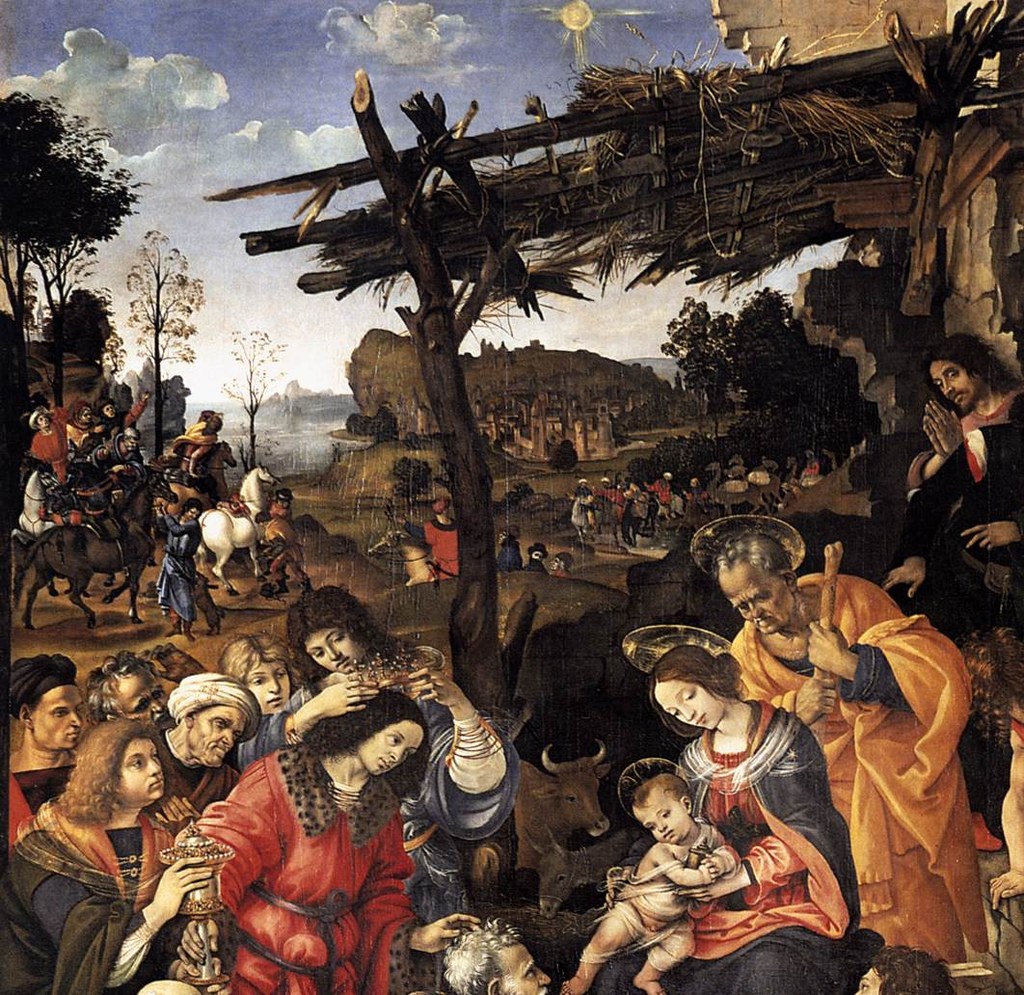
Comparison with the Early Adoration of the Kings. The National Gallery considers the painting broadly contemporary with Filippino’s independent Adoration of the Kings.[1] The two works show very different sides of the same early phase. The Madonna is intimate and domestic. The Adoration is broader, rocky and filled with hermit imagery. Together they demonstrate how quickly Filippino could move between household devotion and more elaborate narrative.
Comparison with the Met Madonna and Child
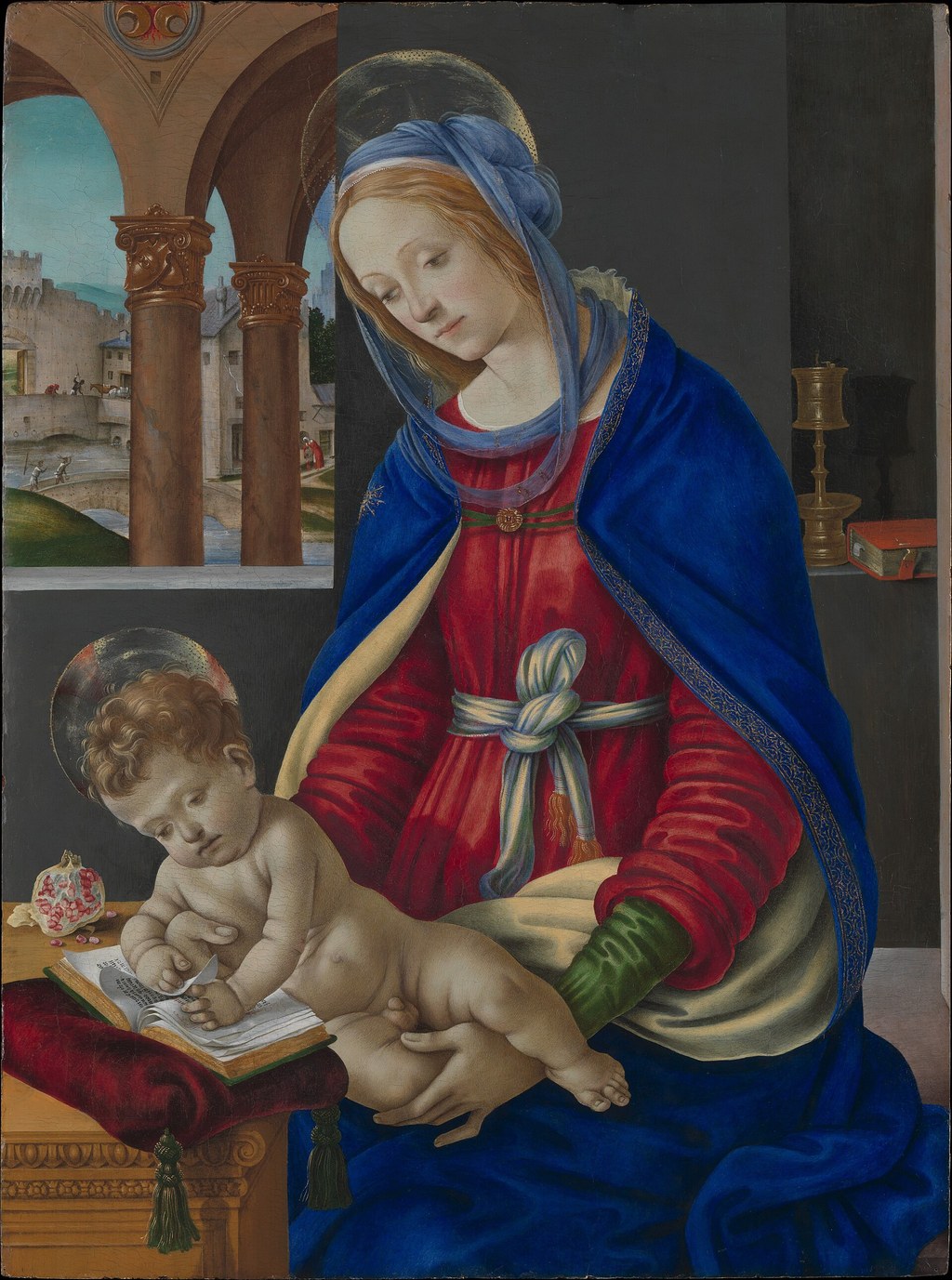
The Met’s Strozzi Madonna and Child of around 1483–84 shows dramatic development within only a few years.[4] The later panel introduces a complex palace setting, Flemish-looking detail, cast shadow, patronal heraldry and sophisticated landscape. Comparing the two paintings is therefore especially useful.
The National Gallery panel shows workshop formation.[1] The Met painting shows mature independent patronage.[4] The subject remains Mary and Christ. The artistic world expands.
Comparison with Fra Filippo Lippi. Filippino’s father had made intimate Madonna imagery central to Florentine painting. That inheritance remains visible. Mary’s emotional accessibility and the child’s bodily activity belong to a tradition Fra Filippo helped establish. Yet Filippino receives that tradition partly through Botticelli. The painting therefore embodies a layered family-workshop inheritance rather than a simple father-to-son transfer.
Sir Charles Eastlake. The painting’s modern history is closely connected with Sir Charles Lock Eastlake. Eastlake was the first Director of the National Gallery and one of the most important nineteenth-century figures in shaping Britain’s collection of early Italian painting.[1] He bought the panel in Florence for his private collection. His interest reflects the growing nineteenth-century reassessment of fifteenth-century Italian masters. Works once overshadowed by Raphael and later painters became central to a new historical understanding of the Renaissance.
Lady Eastlake. After Sir Charles Eastlake’s death, the painting remained with his widow, Elizabeth Rigby, Lady Eastlake. The National Gallery acquired it after her death through the 1894 sale.[1] This provenance connects the object directly with the history of the institution that now owns it. A painting collected privately by the Gallery’s first Director ultimately entered the public collection he had helped shape.
National Gallery Acquisition
The National Gallery bought the work in 1894 through Agnew at the Lady Eastlake sale.[1] By then, the institution had developed a much broader interest in early Renaissance painting than in its first decades. The acquisition therefore belongs to a mature phase of collection building. The panel helped present Filippino not only as Botticelli’s follower but as part of the larger story of Florentine painting.
Exhibition in Cleveland. The National Gallery records that the painting was included in Cleveland’s 2025–26 Filippino Lippi and Rome exhibition.[1] Its inclusion is especially useful because the exhibition focused on Filippino’s transformation through Rome. An early Botticellian Madonna provides the necessary starting point. Without works like this, the mature Roman style cannot be understood as change. The exhibition therefore placed the modest domestic panel into a much larger career narrative.
Early Geometry and Later Filippino. The National Gallery’s emphasis on the step-like diagonal arrangement is particularly useful because geometry remained important throughout Filippino’s career even when his surfaces became much more elaborate.[1] The late frescoes can appear spontaneous or crowded, but beneath that complexity lies disciplined organisation. The small Madonna therefore reveals a structural habit at the beginning of the career.
John, Christ and Mary form a controlled ascent. Later, the same instinct would be applied to far larger crowds and architectural environments. The difference is one of scale and complexity, not the abandonment of design.
An Artist Becoming Visible
Early works are often judged mainly for signs of the famous artist they will become. That can distort them. This panel deserves to be understood as a successful object in its own right: an intimate aid to prayer, carefully made for a domestic market and visually sophisticated within a familiar format.
Its historical importance increases because we know what Filippino later achieved, but its first owners did not. They encountered a devotional painting, not a prophecy of the Carafa Chapel. That distinction keeps the work rooted in its original purpose.
Why the Virgin and Child with Saint John Matters. The painting matters because it preserves Filippino before fame. He has not yet completed the Brancacci Chapel. He has not yet painted the Vision of Saint Bernard.
Rome is years away. The Carafa and Strozzi cycles are unimaginable from this small domestic object. Yet the essential foundations are already present.
He has mastered Botticelli’s workshop language. He understands intimate Marian devotion. He organises figures geometrically.
He uses landscape and objects to deepen meaning. Most importantly, the work reminds us that Renaissance careers were built through ordinary commissions as well as masterpieces. Small Madonnas paid workshops, trained assistants and entered homes.
The famous fresco painter emerged from that commercial devotional culture. The National Gallery panel therefore deserves attention not despite its modest scale but because of it.[1] It shows the everyday artistic system from which Filippino Lippi became an independent master.
Frequently Asked Questions
Discussion
What stands out to you most about Virgin and Child with Saint John in relation to Filippino Lippi's wider career?
Reader Insights
Notice how the page connects close visual detail with patronage, workshop practice and the wider Renaissance setting.
Which comparison elsewhere in the cluster helps clarify this work or theme most strongly?
Join the Conversation
Have a thought or observation about Virgin and Child with Saint John? Share it below. Thoughtful responses may be added to this section.
References
- National Gallery, London, Filippino Lippi, The Virgin and Child with Saint John, NG1412. View Source
- National Gallery, London, in-depth catalogue and provenance for NG1412.
- National Gallery, London, Filippino Lippi, The Adoration of the Kings, for comparison with the artist’s early independent work. View Source
- Metropolitan Museum of Art, Filippino Lippi, Madonna and Child, c. 1483–84, for comparison with the later Strozzi commission. View Source
- Metropolitan Museum of Art, The Drawings of Filippino Lippi and His Circle, 1997. View Source