


 by Tom Gurney
Tom Gurney BSc (Hons) is an art history expert with over 20 years experience
Email: tomgurney1@gmail.com / Phone: +44 7429 011000
Landscape on the Banks of the Lez by Frédéric Bazille: Introduction
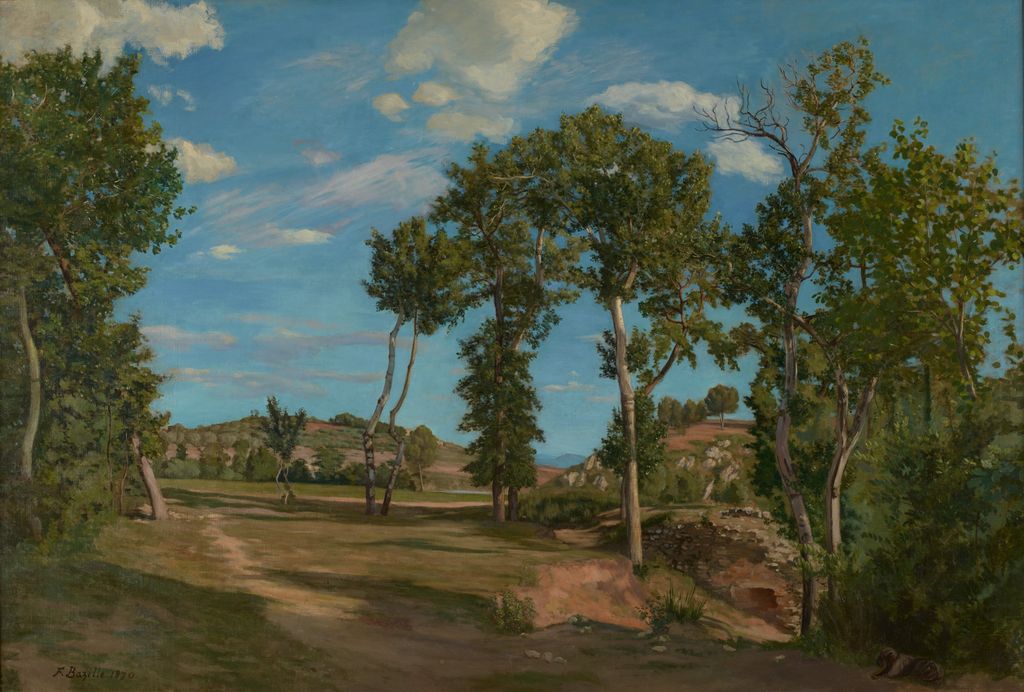
An open stretch of grass, irregular trees and a large blue sky give Landscape on the Banks of the Lez its breadth. The river named in the title barely announces itself. Instead, the eye follows long shadows across the clearing, passes between slender trunks and reaches the low hills beyond. Painted in 1870 and now in the Minneapolis Institute of Art, the canvas gives the southern French countryside the breadth of a major composition. Its calm depends on a carefully built arrangement of land, foliage and light. [1]
There are no visible human figures. Yet the picture is neither lifeless nor untouched: a small dog rests at the lower right, and rough masonry interrupts the stony channel nearby. These modest details complicate the first impression of an empty pastoral setting. The painting belongs to Bazille’s final summer, but neither its precise state of completion nor its position as his supposed last work can be settled simply by looking at its peaceful surface. [2]
At a Glance
- Date1870 [1]
- MediumOil on canvas [1]
- Sight dimensionsApproximately 137.2 × 200.7 cm [1]
- CollectionMinneapolis Institute of Art, 69.23 [1]
This work across Frédéric Bazille’s career
Family Reunion
1867–1868 (museum)Bazille’s Studio, Rue La Condamine
1869–1870Summer Scene (Bathers)
1869–1870Contents
- A large landscape near Montpellier
- How light holds the composition together
- The dog and the masonry
- A pastoral without people
- The evidence from Bazille’s final summer
- Classical order and a modern painter
- Looking beside other Bazille paintings
- From the family to Minneapolis
- Annotated details
A large landscape near Montpellier
The Minneapolis painting is an oil on canvas, accession number 69.23, which the museum calls Landscape by the Lez River. Its sight measurements are approximately 137.2 × 200.7 centimetres: more than two metres across. Michel Schulman’s catalogue raisonné identifies it as MSb-68. This is the broad, tree-framed landscape distinguished by its open clearing and small dog at the lower right. [1] [2]
The landscape belongs to the country around Montpellier, to which Bazille repeatedly returned from Paris. Méric, his family’s estate, gave him access to a setting that could accommodate portraits, groups, outdoor nudes and landscape painting. The Musée Fabre’s account of his last summer places the Lez canvas beside Ruth and Boaz, showing how widely his ambitions still ranged in 1870. A contemporary landscape and a biblical subject were both live possibilities for him. [3]
That setting should not be reduced to an attractive background to his biography. Here the terrain occupies the whole picture. No large sitter gives the foreground an immediate human scale, and no incident dictates where to look first. The width allows the eye to travel sideways before moving into depth. The trees establish intervals, the hills close the distance and the clouds keep the upper half active. The result asks for sustained attention to a place rather than recognition of a person.
How light holds the composition together
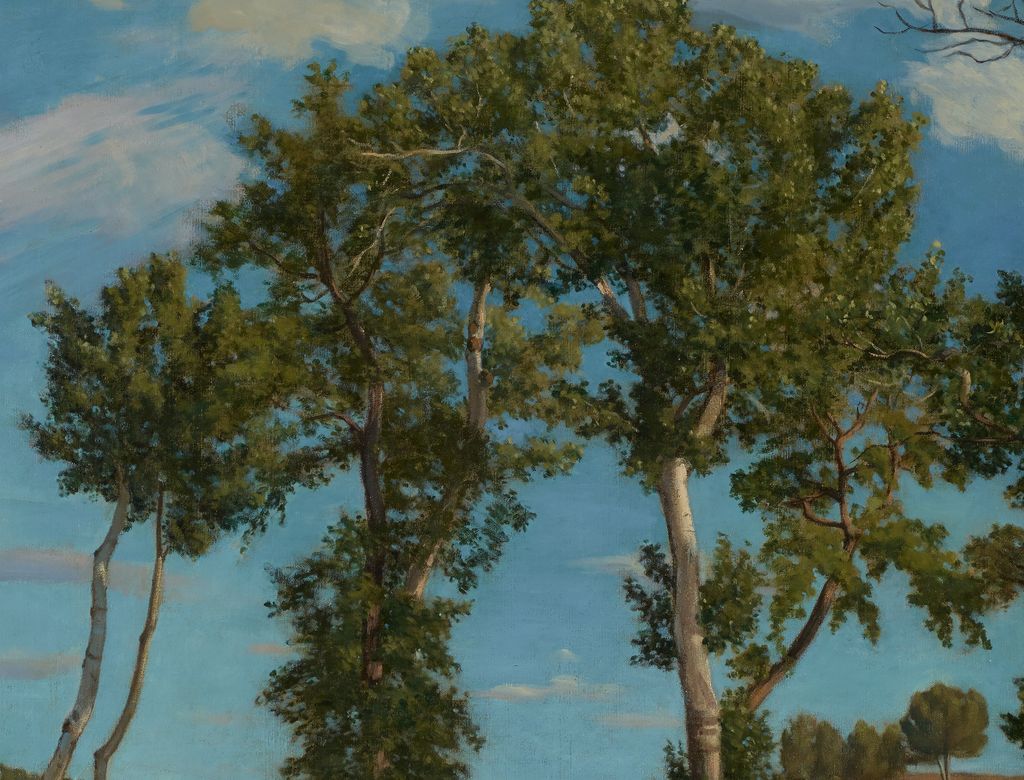
The opening is framed unevenly. A dense mass of foliage presses against the left edge, while a more extensive group of trees occupies the centre and right. Some trunks stand almost upright; others bend or divide. Above the right-hand group, a sparsely leafed branch reaches into the sky. These differences prevent the trees from becoming a repeated decorative border. Each changes the shape of the patch of sky beside it.
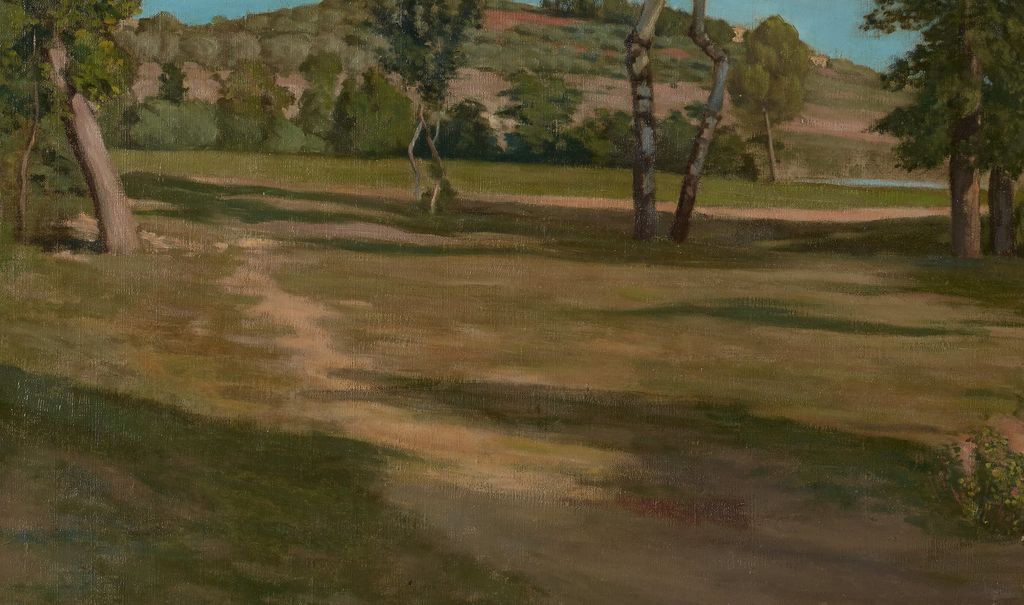
The central clearing remains open enough for the ground to be read as a continuous surface. Broad, pale areas alternate with long darker bands. Bazille gives the viewer several partial routes into the scene: along the sunlit grass, through a gap between trunks, and beside the exposed earth on the right. The shadows make the uneven land legible without turning it into a diagram.
The sky contributes more than an impression of fine weather. Broad cream-coloured clouds gather near the top, while thinner strokes sweep diagonally across the blue. Below them, a paler band of atmosphere separates the hills from the foliage. The sky opens the scene outwards; the foreground shadows bring the attention back towards the viewer. There is movement above a landscape that appears almost motionless.
The painting’s heat is consequently not a simple matter of dazzling brightness. Greens remain substantial, shadows are readable and the warmer earth colours appear in distinct passages. The Musée Fabre connected the work with Bazille’s description of the oppressive summer heat in a letter to his father, dated by its editors to 19 or 26 June 1870. That connection is persuasive as a context for the picture’s stillness, without requiring every colour to become an illustration of the letter. [3]
Surface handling also varies across the scene. Foliage is built from numerous smaller marks, while sky and clearing admit broader strokes. Pale stones form broken, angular patches beside the warmer exposed ground. Trunks cut vertically through these more dispersed areas. At close range the landscape separates into different kinds of touch; from farther away those touches cooperate to hold the large composition together. Its order does not depend on making every surface equally smooth.
Annotated Details from Landscape on the Banks of the Lez
The numbered points identify visible features discussed in this article. Return from each detail to the whole composition. Landscape on the Banks of the Lez Image source. Public domain. Resized proportionally; full painting retained.
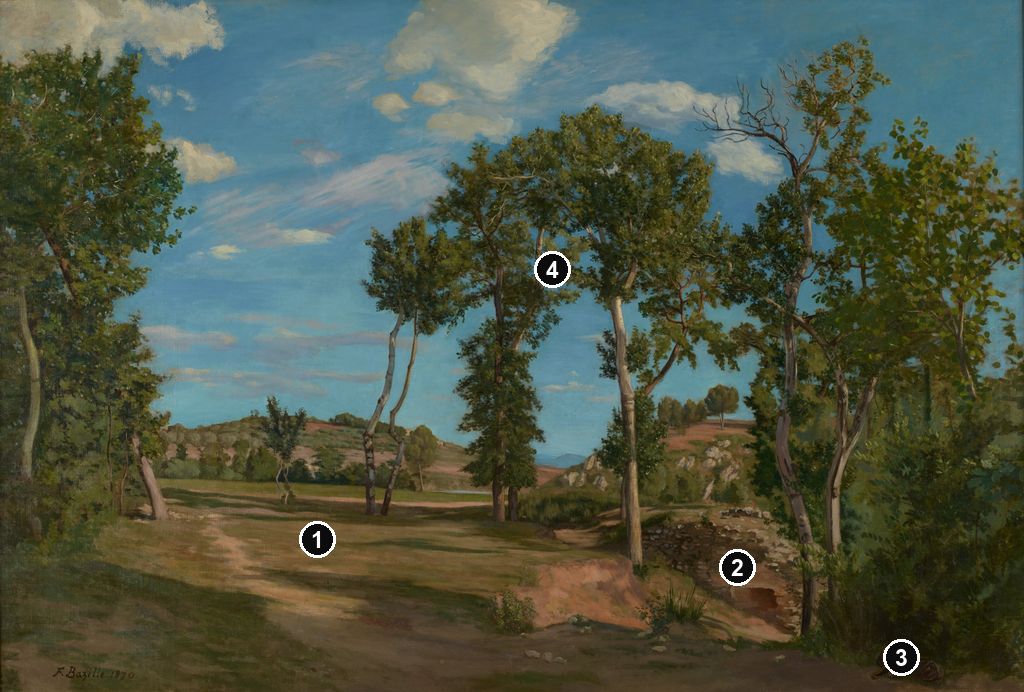
Details from LANDSCAPE ON THE BANKS OF THE LEZ
Compare the cropped details with the complete images above. Notice how their colours, shapes and positions contribute to the larger compositions.
Light across the clearing
Long dark bands cross the open ground while paler patches keep its surface continuous between the trees.
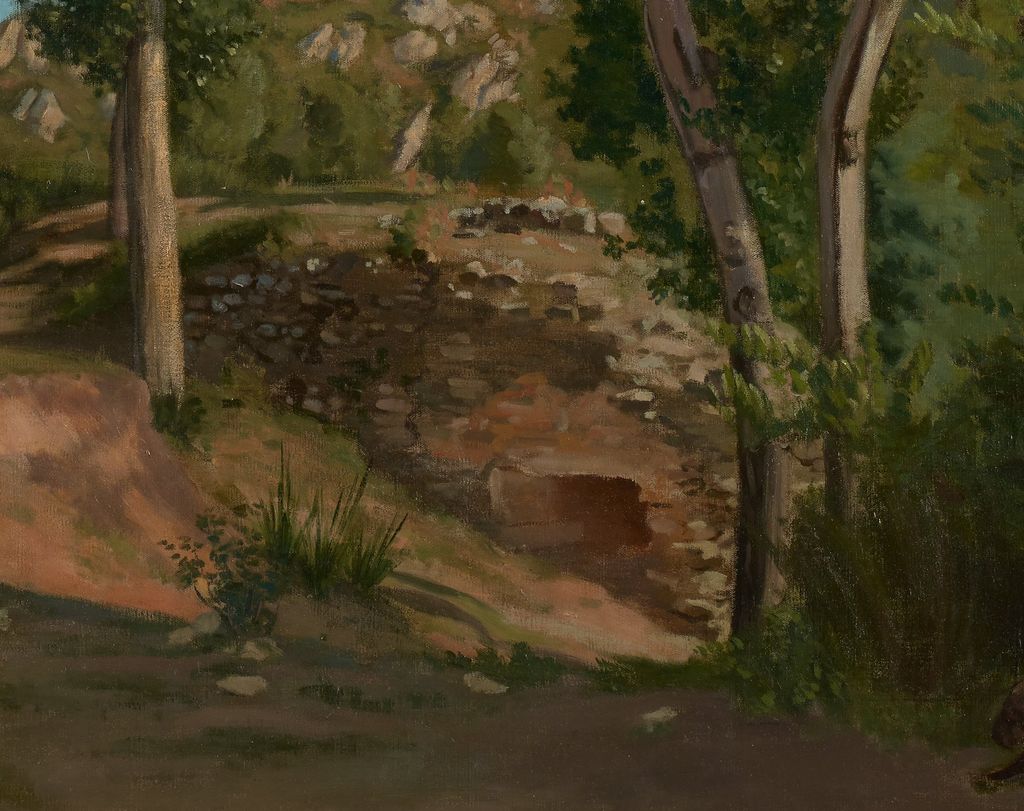
The low masonry opening
Irregular stone and exposed earth interrupt the greens of the clearing, preserving a small trace of construction.
The dog in the near corner
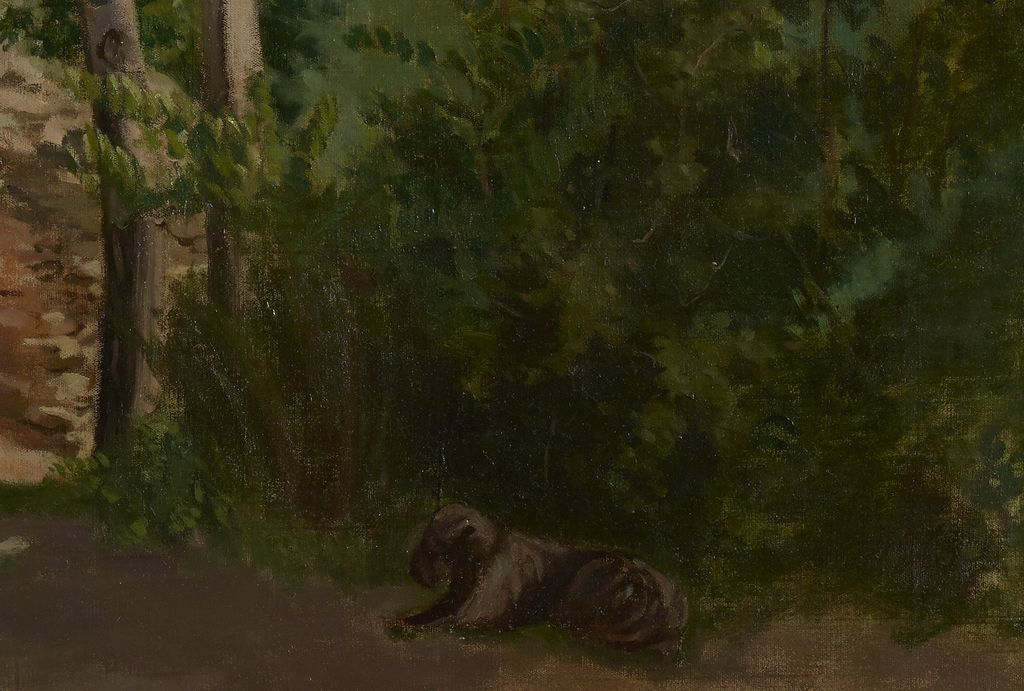
The resting dog is small within the whole canvas but gives the near corner a familiar living scale.
Foliage against open sky
Broken leaf marks gather around upright trunks, while the sky remains visible through uneven openings.
The dog and the masonry
The dog at the lower right is easy to overlook because its dark coat merges with the shaded edge. Its body lies low, with the head raised slightly above the ground. Once noticed, it changes the scale of the trees and clearing: the viewer has a small, familiar creature against which to measure the space. It also gives the nearest corner a quiet point of interest, well away from the open distance.
Schulman draws attention to this animal and reports an earlier suggestion by Sarraute that Bazille may have intended to add human figures to the landscape. That remains a hypothesis. The dog cannot demonstrate a missing group, and the apparently available meadow is not proof that the picture awaited people. The animal’s identity is unknown. [2]
Beside the dog’s shaded corner, the rough channel introduces a different kind of detail. Loose-looking stones and irregular courses of masonry surround a low, dark opening. Ochre and reddish earth stand out against the surrounding greens. The structure makes clear that this countryside bears signs of human intervention, even though its function is not established by the picture. Calling the scene pristine wilderness would miss something Bazille placed prominently in the foreground.
The channel also explains why the title can initially seem surprising. There is no broad expanse of water spreading across the near ground. Thin distant bands and the broken terrain offer a less immediate encounter with the river setting. Rather than making water the spectacle, Bazille paints the land, vegetation and atmosphere around it. The Lez gives the landscape its location without monopolising the composition.
A pastoral without people
The Minneapolis Institute of Art relates the picture to the literary tradition of the eclogue, a pastoral poem associated with rustic speakers in an idealised rural setting. Its interpretation emphasises how the painting’s repose can evoke that tradition even though no people appear. This is a useful way to understand the tension between an observed southern landscape and a composition that seems ready to accommodate a human encounter. [1]
The painting never supplies that encounter. The empty clearing offers room for movement or conversation, but the only visible creature remains at its edge. The trunks create a succession of places in which someone might stand; the foreground gives way to a middle distance that remains unoccupied. The viewer becomes unusually aware of space as something available, rather than as the remainder around a central figure.
That effect need not mean the scene contains a hidden narrative. The masonry, dog and irregular vegetation keep it attached to ordinary material things. At the same time, the generous scale and balanced distribution of masses make it more composed than a casual glimpse of a riverbank. Its pastoral quality lies in this suspension between a recognisable place and the ordered quiet of a pictorial world.
Watch: Bazille and early Impressionism
Explore a Paris studio with Smarthistory, then discover the beginnings of Impressionism with the National Gallery of Art.
Jean-Frédéric Bazille, The Artist’s Studio, Rue Visconti, Paris
A close look at Bazille’s 1867 painting of the studio he shared in Paris.
Watch on YouTubeThe evidence from Bazille’s final summer
The correspondence helps establish the painting’s place in his work without fixing every stage. Schulman associates a letter of about 20 June 1870 with the beginning of a large landscape. He then identifies the Lez canvas with the landscape Bazille described to Edmond Maître on 2 August as nearly finished. The later letter also discusses other work, so it presents an active group of projects rather than the ceremonial completion of a final masterpiece. [2]
Bazille enlisted in the zouaves on 16 August 1870. He was killed at Beaune-la-Rolande on 28 November, aged twenty-eight. These dates explain why the summer paintings have acquired such emotional weight, but they do not establish an exact last painting or prove that war interrupted a particular intended addition to this canvas. The documentary distinction between nearly finished and finished deserves to remain open. [3]
An inscription reading Bazille’s name and the year 1870 appears at the lower left. The museum itself raises the possibility that the signature was added posthumously. It therefore cannot serve as uncomplicated proof that Bazille declared the whole picture complete. The secure date and the uncertain finishing history can coexist: the work is a major landscape of 1870 even if its final intended state remains unresolved. [1]
Knowledge of Bazille’s death can make the stillness feel like a farewell. That is a response available to later viewers, rather than a meaning the artist is known to have assigned to the landscape. The clearing has no visible military presence, and the dog’s rest does not predict what happened months later. Letting the landscape retain its ordinary summer duration allows its emotional force to emerge without turning it into an omen.
Classical order and a modern painter
Writers have often approached the canvas through the classical landscape tradition. Schulman recounts comparisons with Poussin and Claude Lorrain, while the Musée Fabre places Poussin and Corot among the relevant points of reference. Michel Hilaire’s account of Bazille’s final summer stresses the contrast between this unpeopled landscape and the figure-filled Summer Scene. These are interpretations of its structure and place in the career, rather than documentary proof that Bazille copied a particular older painting. [2] [3] [4]
The classical comparison is clearest in the way the scene is organised. Framing foliage, an open middle ground and a measured recession towards low hills give the view a legible sequence. Light connects those zones instead of breaking the landscape into unrelated brilliant fragments. Yet the trees are irregular, the channel is rough and the foreground contains a resting dog. Formal balance does not remove the specificity of the place.
Nor should an interest in earlier art be treated as a sudden reversal of Bazille’s modern commitments. Writing to his cousin Louis on 27 April 1869, he stated, in our translation: “I greatly like Ingres, Corot, Rousseau, Millet, and often Courbet.” That varied list records preferences across different kinds of painting; its qualification about Courbet is part of the statement. It gives direct evidence that admiration for established masters and engagement with recent painting coexisted in his thinking. [5]
The Lez landscape can therefore be understood as another solution within his work, rather than a retreat from an inevitable future style. The broad outdoor light and differentiated brushwork belong to his practical investigation of painting. The ordered spaces connect that investigation to traditions he continued to value. Later comparisons with Cézanne may draw attention to the firmness of the construction, but they should remain comparisons, not claims that Bazille knowingly anticipated another painter’s future achievement. [2]
Looking beside other Bazille paintings
View of the Village, painted in 1868, offers a particularly revealing comparison. There, a seated girl and a tall foreground trunk establish an immediate relationship between figure, shade and sunlit distance. The Lez canvas distributes attention much more widely. Its lack of a dominant person gives the smaller intervals between trunks and patches of ground a greater share of the composition. The comparison shows how the absence of a large foreground figure transforms a familiar landscape problem. [6]
Summer Scene supplies the opposite extreme: bodies standing, reclining, wrestling and swimming make a complex pattern across grass and water. Hilaire’s contrast between that crowded outdoor subject and the Lez landscape is especially helpful because it avoids treating landscape as a lesser activity between figure paintings. In each work Bazille organises an extensive outdoor space; the visible human presence changes the viewer’s route through it. [4]
A different comparison is offered by The Western Ramparts at Aigues-Mortes, dated 1867. Its long wall, broad foreground water and open sky establish strong horizontal divisions. In the Lez painting, trunks interrupt the view at irregular intervals and the water loses its broad foreground role. Both compositions find order in a southern setting, but one depends heavily on the continuity of architecture while the other builds its rhythm from trees, light and uneven ground. [6]
Landscape at Chailly, from 1865, also places rocky terrain beneath a substantial sky. Seen beside the Lez, it brings the importance of landforms into focus. Bazille’s landscapes are not simply records of different weather conditions: stones, slopes, foliage and openings carry much of their spatial construction. The southern picture extends that interest across a notably spacious field. [2] [6]

The Western Ramparts at Aigues-Mortes

View of the Village
From the family to Minneapolis
Schulman records a history beginning with the artist’s family in Montpellier and continuing through his brother Marc and his nephew Frédéric. The subsequent chain includes the Louis Carré and Wildenstein galleries and the collector Walter P. Chrysler. The Minneapolis Institute of Art acquired the painting in 1969 through its Special Arts Reserve Fund. This history places the work within both the family’s preservation of Bazille’s legacy and its later circulation through dealers, collectors and an American museum. [2]
The catalogue also records its presence in the 1927 Bazille retrospective in Montpellier and in later exhibitions that reconsidered the origins of Impressionism. It was included in the 2016–17 Bazille retrospective, and the National Gallery of Art’s checklist identifies the Minneapolis loan as catalogue number 65. Seen in such a retrospective, its large scale and lack of human figures offer a counterpoint to Bazille’s portraits, studio interiors and outdoor figure groups. [2] [6]
In that company, the painting broadens the idea of what Bazille was pursuing. It offers no basis for knowing the career he might have had. It does show an artist able to give sustained pictorial weight to open land, a spare horizon, irregular trees and the unhurried presence of a small animal. The calm is something the composition achieves, while the unfinished questions around its creation remain part of its history.
Bazille catalogue directory
The 284 records comprise 85 painting records,40 separate works-on-paper records and 159 album or study records. They describe the catalogue’s organisation rather than 284 independent objects or unanimously accepted attributions. Recto, verso, albums and multiple studies remain distinct. Dates are qualified where needed; the Drawing filter includes the etching, gouache and mixed works on paper. Manuscript mentions and unproved projects are listed separately below.
Works known through documents
These mentions remain separate from the 284 catalogue records. Some may concern surviving studies or underlying compositions; they cannot simply be added together as missing physical paintings.
- A copy after Rubens mentioned in March 1863 is unlocated.
- A portrait of an unidentified woman was reported completed before July 1866.
- A portrait of Monet and a composition of two life-size women arranging flowers were reported in progress in April 1867. Their mention does not establish two otherwise unknown surviving canvases.
- Gertrude et le père Lapin was at least begun in the summer of 1870.
Further reported works and uncertain attributions
- A Bouquet of Lilacs was reportedly stolen and returned in 1864; a portrait of the friend Theulier and Yellow Narcissi reported by Maître in 1868 are also documentary mentions.
- Unidentified pictures associated with Guillemet and Mme Rolina are reported through later correspondence cited by the catalogue.
- Children Dressed as Bride and Groom was associated with Vallotton’s collection and also attributed to Renoir. Its identification and authorship should remain open.
Projects whose completion is unproved
- A portrait of Pauline was planned in July 1865.
- A portrait of Marc was proposed in April 1866; a related drawing survives.
- A Jardinière project appears in album inscriptions and related figure material. Written plans are not evidence of a completed painting.
| Name | Date | Medium |
|---|---|---|
| Mystic Marriage of St. Catherine | 1863 | Oil on canvas |
| Trees, Study | 1863 | Oil on canvas |
| Farm of Saint-Sauveur | 1863 | Oil on canvas |
| In the Garden of the Parc Monceau, Paris | 1864 | Oil on canvas |
| Naked Woman from Behind | 1864 | Oil on canvas |
| Reclining Nude | 1864 | Oil on canvas |
| Courtyard of the Auberge du Cheval blanc at Chailly near Barbizon | 1864 | Oil on canvas |
| Covered Soup Bowls | 1864 | Oil on canvas |
| Two Herrings | 1864 | Oil on canvas |
| The Pink Dress | 1864 | Oil on canvas |
| The Dog Rita Asleep | 1864 (catalogue); c. 1864 (2017 checklist) | Oil on canvas |
| The Scoter | 1864 | Oil on canvas |
| Naked Reclining Woman | 1864 | Oil on canvas |
| Landscape at Chailly | 1865 | Oil on canvas |
| Rocks at Chailly, Forest of Fontainebleau | 1865 | Oil on canvas |
| Undergrowth at Chailly, Forest of Fontainebleau | 1865 | Oil on canvas |
| Still Life with Grapes and Nuts | 1865 | Oil on canvas |
| Self-Portrait with a Palette — Chicago | 1865 | Oil on canvas |
| Landscape of Saint-Sauveur | 1865 | Oil on canvas |
| Beach at Sainte-Adresse | 1865 | Oil on canvas |
| The Improvised Field Hospital | 1865 | Oil on canvas |
| Village Street, Chailly | 1865 | Oil on canvas |
| Small Valley in the Forest of Fontainebleau | 1865 | Oil on canvas |
| Forest of Fontainebleau | 1865 | Oil on canvas |
| Woman Ironing | 1866 | Oil on canvas |
| The Artist's Studio on the rue de Furstenberg | 1865–66 (museum) | Oil on canvas |
| Still Life with Fish | 1866 | Oil on canvas |
| Little Italian Street Singer | 1866 | Oil on canvas |
| Potted Flowers | 1866 | Oil on canvas |
| The Little Gardener | 1866–1867 | Oil on canvas |
| Young Woman Playing the Piano | 1866–1867 | Oil on canvas |
| End of a Summer Day | 1866–1867 | Oil on canvas |
| A Studio on the rue Visconti | 1867 | Oil on canvas |
| Thérèse Reading in the Park at Méric | 1867 | Oil on canvas |
| Portrait of Verlaine | 1867 | Oil on canvas |
| The Terrace at Méric | 1867 | Oil on canvas |
| Still Life with Heron | 1867 | Oil on canvas |
| The Family Gathering | 1867–68 (museum) | Oil on canvas |
| Oleanders | 1867 | Oil on canvas |
| Woman on the Terrace at Méric | 1867 | Oil on canvas |
| The Ramparts at Aigues-Mortes from South | 1867 | Oil on canvas |
| The Western Ramparts at Aigues-Mortes | 1867 | Oil on canvas |
| Portrait of Edmond Maître — head study | 1867 | Oil on canvas |
| Porte de la Reine at Aigues-Mortes | 1867 | Oil on canvas |
| Portrait of Sisley | 1867 | Oil on wood |
| Portrait of Renoir — Cleveland | 1867 | Oil on canvas |
| Portrait of Renoir — Musée d’Orsay | 1867 | Oil on canvas |
| Self-Portrait with a Detachable Collar — Minneapolis | 1865–67 (museum); 1867–68 (catalogue) | Oil on canvas |
| Vase of Flowers on a Console | 1868 (museum); 1867–68 (catalogue) | Oil on canvas |
| Portrait of a Woman | 1868 | Oil on canvas |
| Young Woman in the Vineyards | 1868 | Oil on card |
| Harvester with a Basket | 1868 | Oil on card |
| Harvester with a Yellow Hat | 1868 | Oil on card |
| Harvester with a Headdress | 1868 | Oil on panel |
| On the Banks of the Lez | 1868 | Oil on canvas |
| After the Bath (attribution questioned) | 1868? | Oil on canvas |
| Young Woman with Lowered Eyes | 1868 | Oil on canvas |
| Fisherman with a Net | 1868 | Oil on canvas |
| View of the Village | 1868 | Oil on canvas |
| Portrait of Bazille (attributed to Monet by Musée Fabre; disputed catalogue attribution) | 1864 (museum); 1868 (catalogue) | Oil on panel |
| Studies for a Grape Harvest (two panels) | 1868 | Oil on canvas (two panels) |
| The Fortune Teller | 1868–69 (catalogue); c. 1869–70 (2017 checklist) | Oil on canvas |
| Harvester with a Cap | 1869 | Oil on card |
| Portrait of Edmond Maître — 1869 | 1869 | Oil on canvas |
| Woman in a Moorish Costume | 1869 | Oil on canvas |
| Young Woman in the Garden | 1869 | Oil on canvas |
| Portrait of Alphonse Tissié in a Cavalryman's Uniform | 1869 | Oil on canvas |
| Portrait of a dragoon | 1869 | Oil on canvas |
| Portrait of Zacharie Astruc | 1869 | Oil on canvas |
| Bunch of Grapes in a Bucket | 1869 | Oil on card |
| Portrait of Edouard Blau | Probably 1869; inscribed 1866 | Oil on canvas |
| Young Male Nude Lying on the Grass | 1870 | Oil on canvas |
| Summer Scene | 1869–1870 | Oil on canvas |
| The Studio on the rue La Condamine | 1869–1870 | Oil on canvas |
| La Toilette | 1870 | Oil on canvas |
| Young Woman with Peonies — Montpellier | 1870 | Oil on canvas |
| Young Woman with Peonies — Washington | 1870 | Oil on canvas |
| Monotonous Chant | 1870 | Oil on canvas |
| Flowers — private collection | 1870 | Oil on canvas |
| Flowers — Musée Fabre | 1870 | Oil on canvas |
| Young Fisherman | 1870 | Oil on canvas |
| Study for Ruth and Boaz | 1870 | Oil on wood |
| Ruth and Boaz | 1870 | Oil on canvas |
| Self-Portrait in Shirt Sleeves | 1870 | Oil on canvas |
| Landscape on the Banks of the Lez | 1870 | Oil on canvas |
| Study after an Alpine Landscape | 1860 | Graphite on watercolour-tinted paper |
| Profile Head | 1862 | Charcoal on laid paper |
| Studies after Delacroix | 1863 | Ink and graphite, with gouache and watercolour, on paper |
| Academic Head | 1863 | Charcoal on paper |
| Study of a Woman's Head in Profile on a Chair | 1863 | Charcoal on paper |
| Academic Head of a Woman | 1863 | Charcoal on paper |
| Academy of Woman | 1863 | Black pencil and charcoal, stumped, on watermarked laid paper |
| Academy of Man | 1863 | Black pencil and charcoal, stumped, on watermarked laid paper |
| Naked Man | 1863 | Charcoal on paper |
| The Pont au Change in Paris | 1864 | Watercolour on paper |
| Study for the Pink Dress or Portrait of Thérèse des Hours | 1864 | Black pencil on paper |
| Naked Woman Standing | 1864 | Pencil on paper |
| Study of a Reclining Nude | 1864 | Charcoal on paper |
| Bathers | 1864 | Charcoal on paper |
| Portrait of a Man | 1864 | Charcoal on paper |
| Study for The Pink Dress | 1864 | Black pencil, squared, on paper |
| Study for Landscape of Saint-Sauveur | 1864 | Graphite on paper |
| Study for Landscape of Saint-Sauveur | 1865 | Pencil on paper |
| Man Taming a Bull | 1866 | Pen and black pencil on paper |
| Man Half Lying on a Sofa | 1866 | Charcoal on paper |
| Study for The Family Gathering | 1867 | Pencil on paper |
| Study for The Family Gathering | 1867 | Graphite, charcoal and black pencil on paper |
| The Embroiderer | 1867 | Pencil on pink paper |
| Study of Children | 1867 | Pencil on paper |
| Women in a Garden | 1867 | Pencil drawing |
| View of the Village | 1868 | Etching on paper |
| Portrait of a Bearded Man (catalogued as Self-Portrait) | Undated (museum); 1869 (catalogue) | Charcoal and brown ink |
| Man Smoking Pipe | 1869 | Watercolour on paper |
| Manet Drawing | 1868–70(?) (museum) | Charcoal and white chalk on paper |
| Study for the Summer Scene | 1869 | Charcoal, pen and ink on paper |
| Family Portrait | 1869 | Pastel and charcoal on paper |
| Study for Ruth | 1870 | Pencil and charcoal on paper |
| Woman Arranging a Hat | 1870 | Pencil drawing |
| Study for Boaz Asleep | 1870 | Pastel and red chalk |
| Boaz Asleep | 1870 | Charcoal and pencil on paper |
| Study for Boaz Asleep | 1870 | Black and beige pastel with red chalk on laid paper |
| Ruth Lying down | 1870 | Charcoal and pastel on paper |
| Head, Arm and Chest of Ruth | 1870 | Charcoal on paper |
| Chest of Ruth | 1870 | Black chalk and charcoal on paper |
| Black Woman with Peonies — gouache | c. 1870 | Gouache, watercolour, pencil and black chalk on card |
| Various Unidentified Subjects | Undated | Pencil drawing |
| Rocky Sea Side | Undated | Charcoal on paper |
| Studies of a Dancing Woman | Undated | Drawing with white chalk |
| Study of a Leg | Undated | Pencil drawing |
| Dancers in Camargue | Undated | Pencil drawing |
| Academy of Woman | Undated | Charcoal |
| Caricature of Venus of Milo and Various Other Caricatures | Undated | Charcoal |
| Caricature | Undated | Pencil drawing |
| Study of Landscape | Undated | Charcoal |
| Caricatures and Seated Monk | Undated | Charcoal |
| Caricatures and Various Subjects | Undated | Pencil drawing |
| Women Carrying a Pitcher | Undated | Pencil drawing |
| The Hanged Man | Undated | Charcoal |
| Castle in the Plain | Undated | Charcoal |
| Naked Woman from Behind | Undated | Charcoal |
| Caricatures | Undated | Charcoal and pencil |
| Unidentified Subjects | Undated | Pencil drawing |
| Landscape with a Castle | Undated | Charcoal |
| Study of Landscape | Undated | Charcoal |
| Horse Rider seen from Behind | Undated | Charcoal |
| Mazeppa | Undated | Pencil and charcoal |
| Study of Rider and Others Subjects | Undated | Pencil, pen and brown ink |
| Study of an Unidentified Man | Undated | Pencil drawing |
| Study for an Unknown Historic Scene | Undated | Pencil drawing |
| Study a Man Reading | Undated | Pencil drawing |
| Study of Men Reading | Undated | Pencil drawing |
| Study of Landscape ? | Undated | Charcoal |
| Study of a Head of a Man | Undated | Pencil drawing |
| Erotic Scene | Undated | Pencil drawing |
| Study of Dog | Undated | Charcoal |
| Studies of Unidentified Subjects and Erotic Scene | Undated | Pencil and charcoal drawing |
| Study for a Theater Scene | Undated | Charcoal |
| Study of a Reclining Naked Woman | Undated | Charcoal |
| Two Studies of Landscape | Undated | Pencil drawing |
| Caricature | Undated | Pencil and charcoal drawing |
| Portrait of an Unidentified Young Man | Undated | Charcoal |
| Study of an Unidentified Subject | Undated | Brown ink drawing |
| Unidentified Man with a Hat | Undated | Pencil and charcoal |
| Study of an Unidentified Women | Undated | Pencil drawing |
| Study for a Theater Character ? | Undated | Pencil drawing |
| Study for a Theater Character ? | Undated | Pen drawing |
| The Pavillon de la Reine in Paris | Undated | Pencil drawing |
| Study of a Horse Rider | Undated | Pencil and charcoal drawing |
| Entwined Couple. Caricature ? | Undated | Pencil drawing |
| Woman Sitting on a Sofa | Undated | Pencil drawing |
| Studies of Unidentified Subjects | Undated | Pencil and charcoal drawing |
| Studies of Animals | Undated | Pencil drawing |
| Study of a Horse Rider in Camargue | Undated | Charcoal |
| Study of Hunting Dogs | Undated | Pencil drawing |
| Study of Soldiers. Caricatures | Undated | Pencil drawing |
| Studies of Hunting Dogs ? | Undated | Pencil drawing |
| Hunting Scene. Hunter Playing the Horn | Undated | Pencil drawing |
| Caricature | Undated | Pencil drawing |
| Study of an Ibex | Undated | Pencil drawing |
| Theater Scene. Caricatures | Undated | Pencil drawing |
| Studies of Animals. Horses ? | Undated | Pencil drawing |
| Caricatures | Undated | Pencil drawing |
| Studies of Various Subjects and Animals | Undated | Pencil drawing |
| Unidentified Subject | Undated | Pencil drawing |
| Rider Taming a Horse [in Camargue ?] | Undated | Pencil drawing |
| Caricature of a Soldier | Undated | Pencil drawing |
| Study of a Woman and Mouse | Undated | Pencil drawing |
| Historic Scene | Undated | Charcoal |
| Architecture Studies | Undated | Pencil drawing |
| Mythologic Scene | Undated | Charcoal |
| Ophelia | Undated | Pencil drawing |
| Mythologic Scene | Undated | Charcoal |
| Studies of Various Subjects | Undated | Pencil and pen drawing |
| Studies of Peasants | Undated | Pencil drawing |
| Historic Scene | Undated | Pencil drawing |
| Historic or Literary Scene | Undated | Pencil drawing |
| Unidentified Historic Scene | Undated | Pencil drawing |
| Studies of Unidentified Subjects | Undated | Pencil drawing |
| Unidentified Study | Undated | Pencil drawing |
| Man in an Armchair | Undated | Pencil drawing |
| Studies of Various Subjects | Undated | Pencil drawing |
| Portraits of Unidentified Men | Undated | Pencil drawing |
| Studies of Various Subjects | Undated | Pencil drawing |
| Horse Rider and Artist | Undated | Charcoal and pencil |
| Study of Unidentified Characters | Undated | Charcoal |
| Dead Horse in a Plain | Undated | Charcoal |
| Study of Various Subjects and Furniture | Undated | Pencil drawing |
| Caricatures and Various Notes about Opéra | Undated | Pencil drawing |
| Galloping Horse | Undated | Charcoal |
| Study for La Toilette | Undated | Pencil drawing |
| Study of a Naked Woman | Undated | Pencil drawing |
| Domestic Scene | Undated | Pencil drawing |
| Physiognomies | Undated | Pencil drawing |
| Study for a Grape Harvest | Undated | Pencil drawing |
| Study for the Summer Scene | Undated | Pencil drawing |
| Female Profiles | Undated | Pencil drawing |
| Various Subjects | Undated | Pencil drawing |
| Study for The Terrace at Méric | Undated | Pencil drawing |
| Study for The Ramparts at Aigues-Mortes | Undated | Pencil drawing |
| Study for The Ramparts at Aigues-Mortes | Undated | Pencil drawing |
| Study for a Grape Harvest | Undated | Charcoal |
| Children Portraits | Undated | Pencil drawing |
| Study for Children's Heads | Undated | Pencil drawing |
| Study of Minerva | Undated | Pencil drawing |
| Study for a Grape Harvest | Undated | Pencil drawing |
| Study for The Family Gathering | Undated | Pencil drawing |
| Study for a Young Fisherman | Undated | Charcoal |
| Self-Portraits | Undated | Black pencil drawing |
| Study of Horses for the Porte de la Reine at Aigues-Mortes | Undated | Ink drawing |
| Study of Horses for the Porte de la Reine at Aigues-Mortes | Undated | Ink drawing |
| Study of Horses for the Porte de la Reine at Aigues-Mortes | Undated | Ink drawing |
| Study for an Outdoor Concert | Undated | Pencil drawing |
| Studies of Legs | Undated | Pencil drawing |
| Study for The Ramparts at Aigues Mortes | Undated | Pencil drawing |
| Studies of Hats | Undated | Pencil drawing |
| Studies of Men | Undated | Pencil drawing |
| Study for The Little Gardener | Undated | Pencil drawing |
| Study for The Ramparts at Aigues Mortes | Undated | Charcoal |
| Studies of Sail Boats | Undated | Pencil drawing |
| Portrait of Marc Bazille | Undated | Charcoal, black pencil and graphite |
| Studies of Children's Heads | Undated | Pencil drawing |
| Study for Aigues-Mortes | Undated | Pencil drawing |
| Studies of Women's Heads | Undated | Pencil drawing |
| Portrait of Camille des Hours and an Unidentified Man | Undated | Charcoal |
| Study of Flying Birds | Undated | Charcoal or graphite |
| Study for the Summer Scene | Undated | Pencil drawing |
| Study of Hands | Undated | Pen drawing |
| Self-Portrait | Undated | Black pencil drawing |
| Study for the Summer Scene | Undated | Pencil drawing |
| Study for the Summer Scene | Undated | Pencil drawing |
| Study for a Grape Harvest | Undated | Pencil drawing |
| Study of Branches | Undated | Pencil drawing |
| Study of a Seated Child | Undated | Pencil drawing |
| Study for a Couple and Unidentified Women | Undated | Pencil drawing |
| Studies of Unidentified Women | Undated | Pencil drawing |
| Study of Buildings | Undated | Pencil drawing |
| Study for a Grape Harvest | Undated | Pencil and charcoal |
| Studies of Boaters | Undated | Pencil drawing |
| Study of a Man Writing at his Table | Undated | Pencil drawing |
| Study of a Woman Cutting Flowers | Undated | Pencil drawing |
| Study of Hand | Undated | Pencil drawing |
| Women in a Garden | Undated | Pencil drawing |
| Studies of Women in Profile | Undated | Pencil drawing |
| Study for Ruth and Boaz | Undated | Charcoal |
| Study for The Family Gathering | Undated | Pencil drawing |
| Study for the View of the Village | Undated | Pencil drawing |
| Study of the View of the Village | Undated | Pencil drawing |
| Study for the Fisherman with a Net | Undated | Pencil drawing |
| Study for the View of the Village | Undated | Charcoal |
| Study for The Little Gardener | Undated | Charcoal |
| Portrait of a Man with a Top Hat | Undated | Pencil drawing |
| Portrait of a Man with a Top Hat | Undated | Pencil drawing |
| Inscriptions | Undated | Pencil inscriptions |
| Study of Tree | Undated | Pencil drawing |
| Caricature of Nina la Belle | Undated | Pencil drawing |
| Study for Saint Sebastian | Undated | Pencil drawing |
| Young Woman Sewing | Undated | Pencil drawing |
| Studies of Hands | Undated | Pencil drawing |
| Woman in a Garden | Undated | Pencil drawing |
| Elegant Woman | Undated | Pencil drawing |
| Various Inscriptions | Undated | Inscriptions (medium unspecified in index) |
| Study of a Man with a Hat | Undated | Pencil drawing |
| Study of a Child | Undated | Pencil drawing |
| Study of a Man with a Hat | Undated | Pencil drawing |
Frequently Asked Questions
It belongs to the Minneapolis Institute of Art, accession 69.23, where it is called Landscape by the Lez River. [1]
No human figures are visible, but a small dog rests at the lower right. Proposals that Bazille intended to add people remain uncertain. [2]
Discussion
An apparently open landscape contains many small interruptions. Follow the riverbank before looking towards the horizon.
Reader Insights
How do the long shadows give the clearing a continuous surface?
What changes when you notice the dog and the low masonry at the right?
Compare the Lez landscape with Summer Scene. How does the absence of large human figures change your route through the space?
Join the Conversation
Share a detail, comparison or question about Landscape on the Banks of the Lez by Frédéric Bazille below.
References
- Minneapolis Institute of Art, Landscape by the Lez River, 1870, accession 69.23, object record, inscription and curatorial text. Collection record. View source.
- Michel Schulman, Landscape on the Banks of the Lez, MSb-68, digital catalogue raisonné, object entry, history, exhibitions and critical essay. Catalogue entry. English translation of a French scholarly catalogue; earlier scholars’ views and the June/August letters are cited here through Schulman. View source.
- Musée Fabre, Frédéric Bazille : la jeunesse de l’impressionnisme, 2016 press dossier, especially pp. 22–23, final summer, letter context and enlistment record. Press dossier (in French). View source.
- Michel Hilaire, Bazille ou la vie brève, 2016, printed pp. 166–172, especially p. 172. Lecture (in French). View source.
- Frédéric Bazille, letter to his cousin Louis, 27 April 1869, Musée Fabre inventory 94.2.1, manuscript p. 3 and museum transcription. English quotation translated from the French. Facsimile and transcription (in French). View source.
- National Gallery of Art, Frédéric Bazille and the Birth of Impressionism, 2017 exhibition checklist, entries for the comparison paintings and Landscape on the Banks of the Lez, catalogue no. 65. Exhibition checklist. View source.
- Joconde/POP, La Robe rose, RF2450. View source. (in French).
- Musée d’Orsay, L’Ambulance improvisée, RF 1967 5. View source. (in French).
- Musée d’Orsay, Réunion de famille,RF2749. View source. (in French).
- Musée d’Orsay, Pierre Auguste Renoir,DL1970 3. View source.
- Musée Fabre, Vue de village, 898.5.1. View source. (in French).
- National Gallery of Art, Young Woman with Peonies,1983.1.6. View source.
- Michel Schulman, painting index and documentary introduction (English titles; French metadata). View source.
- Michel Schulman, works-on-paper index (English titles; French metadata). View source.
- Michel Schulman, albums and studies index (English titles; French metadata). View source.
- Splash image: Landscape on the Banks of the Lez Image source. Public domain. Resized proportionally; full painting retained.


 Frederic Bazille.jpg)


