



 by Tom Gurney
Tom Gurney BSc (Hons) is an art history expert with over 20 years experience
Email: tomgurney1@gmail.com / Phone: +44 7429 011000
Frédéric Bazille: Style and Technique: Introduction
Frédéric Bazille gives people weight. A seated woman retains the firm outline of her dress against a distant village; a bather's back turns through broad planes of light; a family occupies its shaded terrace with the deliberation of a formal portrait. Around these bodies, foliage breaks into small marks, water catches scattered reflections and distant buildings become pale blocks. The interest lies in how these different kinds of painting hold together. Bazille makes outdoor light convincing while preserving the distinct presence of a person, an object or a room.
His place in the beginnings of Impressionism grows from this sustained investigation of modern subjects, colour and painting outdoors. Yet his work also preserves the discipline of figure study and an active interest in older art. The Musée Fabre's retrospective placed his portraits, landscapes, nudes and still lifes together to show how widely he tested the possibilities of painting during the 1860s. Looking across those subjects reveals an artist who repeatedly reorganised what he saw, sometimes changing a picture substantially after its first conception. [1]
At a Glance
- Main concernsSolid figures, outdoor light and varied surfaces [1]
- Working methodsDrawing, revision and reuse of canvases [2]
- Technical studyFourteen paintings by Bazille and artists in his circle [2]
Contents
- Preparing the figure for outdoor light
- Drawing, contour and the decisions beneath the paint
- The nude, the landscape and changes of scale
- Landscape handling and the weather of work
- The studio as a constructed space
- Still life: different ways of making a surface
- Revision, reuse and working beside other painters
- Finish, tradition and the beginnings of Impressionism
Preparing the figure for outdoor light
Bazille stated the relationship between studio training and outdoor painting unusually clearly. Writing to his father on 6 January 1865, he described painting from the living model in Monet's studio. “I must paint a great many figures this winter,” he explained, so that he could make good use of spring and summer in the countryside. The English wording here is a new translation from his French letter. In the same letter he asked for his parasol and folding outdoor stool to be sent with his paintings. Figure practice and portable equipment belonged to one working plan. [3]
That connection helps explain the apparent stillness of many of his outdoor figures. Painting a person in a garden poses several problems at once: the body needs volume, its outline must remain legible against leaves, and the light on skin or clothing must belong to the surrounding atmosphere. Bazille often gives the figure a relatively quiet position within a much more various setting. This allows a shoulder, bent knee or spread skirt to organise the near space while a brighter landscape opens behind it.
In The Pink Dress, begun in 1864 and subsequently reworked, the seated woman turns towards Castelnau-le-Lez. Her dark hair and apron establish compact masses within the long pale dress. Its stripes bend around the waist and descend through the skirt, describing the body without exposing it. The stone parapet makes a second, sturdier band across the foreground. Beyond, the village rises in light-coloured walls and roofs, framed by dark vegetation. The woman's body is close enough to measure against our own; the buildings remain a separate world of small, illuminated shapes. [2]
The comparable arrangement in View of the Village changes the encounter. Here the seated girl turns towards us. A tall trunk reinforces the narrow format; the broad skirt spreads low across it; the distant town and river occupy the bright opening above her shoulder. The red sash gives the shaded figure a strong colour accent without dissolving the surrounding distinction between near shade and distant sunshine. The painting dates from 1868, but its relationship to The Pink Dress is more useful than a simple early-versus-late comparison: Bazille returns to a persistent problem and changes the direction of attention within it. [4]
In Family Reunion, painted in 1867–68, this relationship expands to a group. The canopy gives the sitters a common shelter, but their dresses, suits, faces and poses preserve strong differences. The blue dress at the left makes a large, continuous area of colour; black lace breaks its surface into a more intricate pattern. Across the centre, the turned chair and seated woman provide a hinge between the compact left group and the more widely spaced figures at the right. Bright country appears through the intervals. We register the open air partly because the sitters are protected from its strongest light. [5]
Their composure should not be confused with an unchanging first design. Technical examination revealed an added self-portrait, a repositioned uncle, a central woman changed from standing to seated, and alterations at the right. The finished group therefore records decisions about intervals, directions and bodily scale that continued on the canvas. Its apparent stability is something Bazille worked towards. [2]
Drawing, contour and the decisions beneath the paint
The preparatory drawing for The Pink Dress is revealing precisely because it differs from the painting. The Louvre records black pencil and squaring: a grid that helped organise the enlargement of a composition. The figure's pose, arms and dress were subsequently changed. A preparatory sheet could establish an arrangement while leaving Bazille free to reconsider its central human presence. [6]
Bruno Mottin's laboratory study sharpens that distinction. Infrared examination found pencil drawing in the village and tree contours, but no visible transferred grid on the canvas. The probable industrial white ground and fluid brown-red initial lay-in belong to an early stage of The Pink Dress. Later scraping, possible solvent use and renewed white preparation show how extensively Bazille reopened the painting. Mottin places the substantial reworking after February 1865 and proposes the following summer; that exact season remains a scholarly reconstruction. [2]
The picture also had an intervention Bazille had not requested. His father arranged for it to be photographed, and the photographer-painter Huguet-Moline applied colour to damaged areas. Mottin distinguishes this episode, documented in family correspondence, from Bazille's subsequent extensive reworking. The surface therefore carries a history of early paint failure as well as artistic change. A changed passage needs to be understood through that history before it can be assigned to the painter's intentions. [2]
These findings change how the visible contours can be understood. The edge of the dress, the turn of the torso and the relation of the arm to the apron are choices made through revision. Looking only at the completed image can make them seem inevitable. The drawing and examination restore alternatives: a fuller skirt, different arms, another distribution of the body's weight. Drawing remained active inside the painting, even when a visible pencil line disappeared beneath colour.
Bazille also used drawing to isolate a figure from a distracting setting. In Manet and his Easel, which the Metropolitan Museum dates uncertainly to 1868–70, charcoal and white chalk work on originally blue paper, now faded towards yellow-grey. The dark coat is built through broad rubbing and denser lines, while the profile, hat and poised hand carry sharper decisions. Very little room is needed around the man. The long easel and short floor lines are enough to establish his activity and footing. [7]
The sheet offers a useful comparison with the painted figures. Contour gives a person direction, but tone makes the person substantial. The jacket has breadth because its central darkness is varied; the sleeve turns because the arm is separated from the body. Bazille's interest in a recognisable individual and his interest in construction operate together. His drawings and sketchbooks make that repeated work of positioning, testing and adjusting especially clear.
Mottin also identifies a change in the studied paintings' initial colour construction. The brown-red lay-in of The Pink Dress and the Little Italian Street Singer gives way to preparations closer to local colours in Family Reunion and the women beneath Young Male Nude Lying on the Grass. Such findings concern particular examined works. They do not provide a single recipe for every Bazille canvas. [2]
The nude, the landscape and changes of scale
The figure's firm contour becomes especially conspicuous when clothing no longer mediates between flesh and vegetation. In Fisherman with a Net, painted in 1868, the rear-view body occupies much of the vertical canvas. Its shoulders and hips turn in different directions. The net extends its movement towards the left; the spaced feet anchor it beside the water. A second seated nude establishes a smaller scale farther back. The picture has a preparatory study, and its rejection from the Salon belongs to 1869. [8]
The painting asks the eye to reconcile two different experiences. The large body is continuous and solid, its muscles legible through measured changes of tone. The surroundings are more interrupted: grass blades, scattered leaves, narrow trunks and patches of light. The figure's clarity can seem unusually emphatic within that broken environment. It is also what gives the scene its force. The viewer feels both the exposed body and the cool, inhabited depth of the bank around it.
Summer Scene, developed in 1869–70, distributes this problem among eight figures. The broad, nearly square field permits several activities to coexist: resting, swimming, wrestling, dressing and climbing from the water. Large bodies occupy the lower and side edges, while the wrestlers stand within a more distant clearing. Tree trunks divide the view into vertical intervals without shutting off the sky. Clothing supplies striped, red and blue accents that distinguish bodies within the surrounding greens. [4]
This impression of varied outdoor life was prepared. Schulman's catalogue discusses studies made before the southern campaign and a written reminder on a drawing to compare the tonal values of clear water and sunlit grass. The point concerns relative brightness: a patch of water must work beside a patch of grass, however differently each reflects light. The surviving studies also show changes in the group and framing. The final painting's many activities depend on an arrangement built over time. [9]
The reclining figure at the left of centre is a particularly useful passage to examine. His torso lies across the shaded green bank; a forearm supports it; the bent legs recede. Nearby leaves and grass remain briskly stated, while the body has enough continuous modelling to turn in space. At the right, the reaching arm of the man leaving the water makes a much more forceful diagonal. Bazille varies the figure's relationship to its surroundings through posture as well as illumination.
The late Young Male Nude Lying on the Grass presents another solution. The long body stretches almost across the width, with feet at the left and head resting on folded arms at the right. Its calm silhouette contrasts with the pale, conspicuously unresolved painting below. The canvas contains two unfinished compositions, rather than a completed nude with an unusually abstract foreground. Mottin's technical comparison favours Bazille as the painter of both layers, contesting the older suggestion that the women beneath were Monet's work. [2]
The body's smooth passage across the upper field and the open marks below should both be seen. Together they reveal the distance between establishing a pose and resolving an entire picture. Cropping attention to the nude alone makes the work look more settled than the whole canvas allows.

The Fisherman with a Net
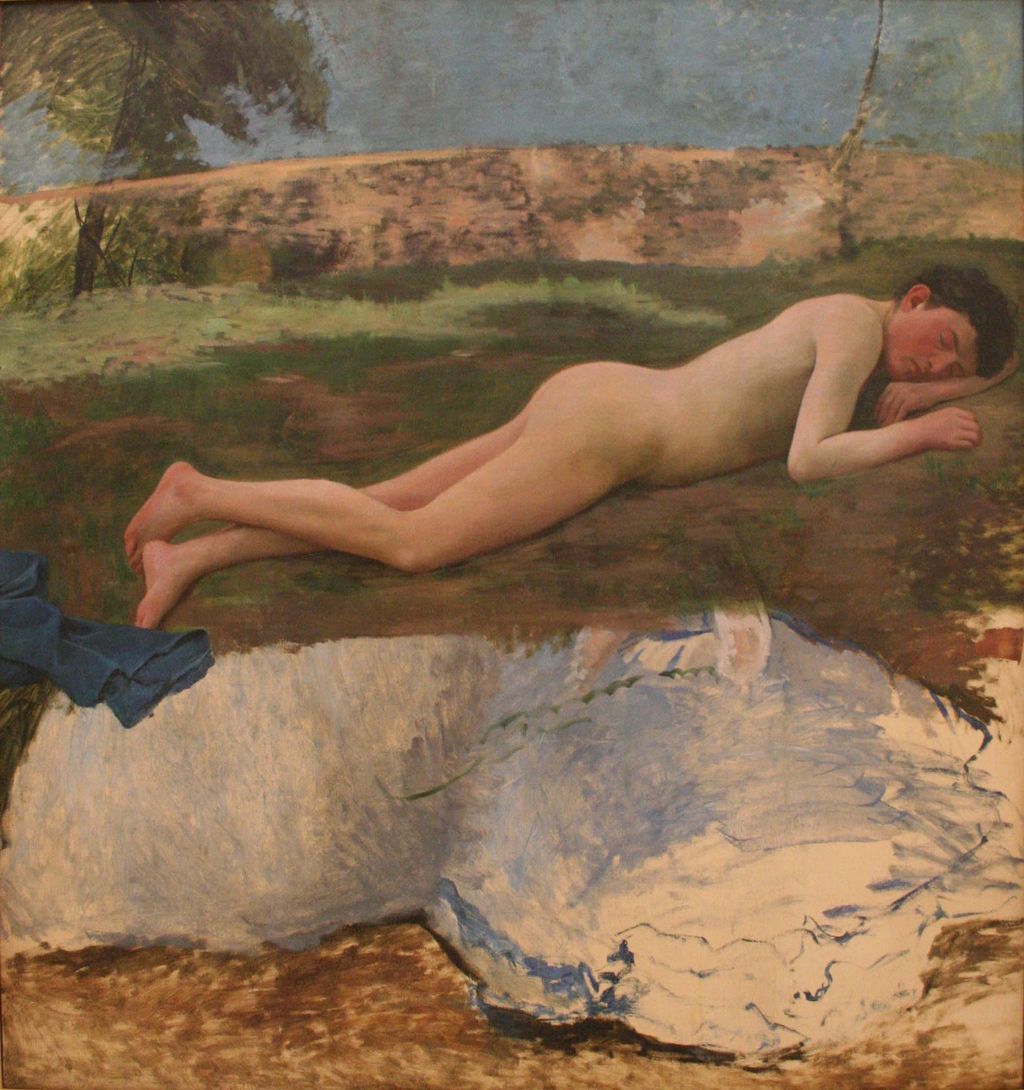
Young Male Nude Lying on the Grass Photograph: Rvalette / Wikimedia Commons. Image source. CC BY-SA 3.0. Resized proportionally; full canvas retained.
Landscape handling and the weather of work
Bazille's landscapes make clear that firmness of construction could coexist with varied brushwork. In Landscape on the Banks of the Lez, dated 1870, the broad sky, broken foliage, upright trunks and rough ground each receive a different kind of mark. Trees frame an opening without forming a symmetrical gateway. Pale stones and a small masonry arch interrupt the foreground; a resting dog occupies the lower-right corner. The landscape contains no visible human figure, but it includes signs of occupation and animal life. [4]
The central clearing is persuasive partly because so much is held back. Long bands of shadow stretch through restrained earth and green tones. More active leaf marks gather overhead. The eye can cross the open ground before being caught by the denser right-hand trees. Bazille does not need equally detailed description everywhere: he distributes activity across the surface to distinguish solid foliage, open air and accessible space.
The northern woodland pictures offer a different balance. Landscape at Chailly gives broken rocks and a large sky an expansive role, whereas Forest of Fontainebleau encloses the foreground beneath darker trees. In each, pale and dark masses establish the space before small details become important. Comparing them with the Lez landscape reveals recurring ways of framing an opening, though the amount of sky and the density of shade change. All three can be approached through the wider selection of Bazille's paintings. [4]
Working outdoors also meant waiting. In a letter assigned to late May 1867, written from Aigues-Mortes, Bazille reported that the weather had allowed him only four working outings. He had started three or four landscapes and envisaged city walls reflected in water at sunset; he thought he needed at least eight fine days. He also asked for very black Conté pencils. The letter records planning, equipment and interrupted opportunities alongside a hoped-for effect of evening light. It does not establish the existence of a fourth surviving view. [10]
That working context is useful beside the surviving Western Ramparts at Aigues-Mortes. Its long wall provides a stable horizontal structure, while the water breaks the reflected forms into separate strokes. Architecture and reflection make different demands on the brush. The picture's spaciousness comes from their relationship, with an open sky above and broad water below. A seemingly simple scene can require prolonged attention to the conditions that make its different surfaces belong together. [4]
Watch: Bazille and early Impressionism
Explore a Paris studio with Smarthistory, then discover the beginnings of Impressionism with the National Gallery of Art.
Jean-Frédéric Bazille, The Artist’s Studio, Rue Visconti, Paris
A close look at Bazille’s 1867 painting of the studio he shared in Paris.
Watch on YouTubeThe studio as a constructed space
Bazille's studio interiors examine the space in which pictures are made, stored and seen. In Studio in the Rue de Furstenberg, chairs, a green-covered table, a stove, pictures and painting equipment occupy a corner of an otherwise unpeopled room. The warm lower walls are divided from the lighter upper area by a horizontal band. Pictures gather high above, while the low paintbox and open floor bring the viewer into the working space. The January 1865 letter already places Bazille at this address; the date of moving in should not be confused with the dating of the painted interior. [3]
Studio of the Rue Visconti, dated 1867, changes the visual pressure. Long floorboards lead towards the back wall, the close easel edge rises at the left and a bench stretches across the middle distance. Small pictures divide the walls into rectangles. A palette near the lower edge gives a direct point of entry into the painter's activity, although no painter appears. The restricted range of grey and green makes the lighter boards and framed images especially noticeable. [4]
These rooms reward attention to empty space. A chair, an easel or a bench interrupts the floor while helping us measure its depth. The walls hold other pictures, which are themselves compressed representations of landscapes, bodies and objects. The studio can therefore become a painting about relationships among paintings, even without an anecdote involving friends.
In Bazille's Studio, Rue La Condamine, dated 1870, that idea becomes explicit. The window dominates the far wall, a staircase cuts across the left, a stove stands near the right edge, and the pianist is separated from the central exchange around an easel. The red-backed, green-seated chair occupies the foreground without a sitter. The wide bare floor gives the smaller social groups room to exist, while the displayed pictures create another set of figures and landscapes above them. [11]
Technical examination shows that the room preceded its occupants; the people and foreground Voltaire chair were added later. Mottin suggests that successive sittings may help explain differences of figure scale. The usual attribution of Bazille's own figure to Manet remains qualified in his account. [2]
The order of work matters to the visible effect. The interior has enough architectural presence to remain the painting's organising subject after people enter it. Their gestures animate an already structured space. The empty chair continues this negotiation: it is both a strongly coloured object and a possible place for someone to sit. Bazille makes a room accommodate work, conversation and music without filling every interval.
Still life: different ways of making a surface
The still lifes test some of the same relationships at close range. In Still Life with Fish, dated 1866, white cloth hangs over a table edge beneath a large golden-scaled fish and a long pale one. An open basket gathers darker shellfish at the left; the upper background recedes almost into black. The Detroit Institute of Arts identifies the work as Bazille's and records its acquisition in 1988. [12]
The cloth performs several jobs. It catches light, makes a setting for the fish and turns over the front edge to establish the table's depth. The large fish is built from repeated scale marks within a strong continuous outline; the fabric opens into broader, less regular folds. Basket weave supplies another rhythm. Bazille differentiates materials through the size, direction and repetition of marks, as well as through colour. The darkness around them concentrates attention on these relations.
In Still Life with Heron, the suspended bird spreads its feathers across a pale cloth. Long flight feathers form overlapping bands, while the body gathers into a narrower central shape. Smaller birds create a second scale of patterned surface below. The gun and dark furniture give the arrangement a firmer surrounding framework. The Musée Fabre's retrospective situated such game paintings beside the older traditions of hunting still life and the contemporary revival of interest in them. This is a useful context for the painting's combination of close observation and staged display. [1]
The flowers extend Bazille's range of surfaces and spatial effects. Potted Flowers, signed and dated 1866, brings plant containers and a paper-wrapped bouquet together. The pots establish relatively simple volumes beneath a more intricate mass of leaves and blooms. The bouquet lies low and forward, giving the arrangement a different direction from the upright plants. Schulman's catalogue distinguishes this painting, exhibited at the Salon in 1868, from the large vase-and-console composition. [13]
In Vase of Flowers on a Console, the floral display extends across an elaborate domestic setting. The decorated ceramic, curved furniture, hanging greenery, loose flowers and patterned seat draw the eye between painted objects and painted ornament. Colours recur in living blooms and woven decoration. Schulman connects the work with the commission for Pauline and Émile Teulon and discusses its relation to Delacroix's flower painting. Its decorative ambition belongs to a specific intended setting and audience. [14]
Such differences prevent still life from becoming a single category of modest exercises. A dark table arrangement, a suspended game bird and a flourishing domestic display ask for different balances of weight, light, texture and colour. Bazille's handling changes with those demands.
Revision, reuse and working beside other painters
Much of the evidence for Bazille's material practice comes from the fourteen paintings by him and artists in his circle examined in the study published by Mottin. Its findings differ among the individual objects. X-rays, infrared images and surface examination can disclose earlier states; identifying the author or purpose of a hidden composition also requires comparison and interpretation. [2]
The physical history can also include repairs during the artist's lifetime. Mottin discusses the unusually early lining of the Portrait of Alphonse Tissié, whose head had been repainted, and reports that Summer Scene required lining after a transport accident. The support and surface of a painting could change for practical reasons as well as compositional ones. These cases are useful reminders that the painting we see has survived movement, handling and treatment. [2]
Ruth and Boaz was painted upside down over the earlier piano composition rejected at the Salon of 1866. The canvas had been kept rolled and was stretched again on a slightly smaller support. The 2016 Musée Fabre exhibition presented this rediscovered composition as an example of how imaging could recover a picture known from documentation. [1] [2]
The change of orientation is particularly striking. A canvas once occupied by a modern musical encounter became the support for a biblical nocturne. Reuse brought together two very different projects within one physical object. It need not be explained by an invented single motive: dissatisfaction, available materials and the desire to begin again are different questions, and the surviving layers cannot by themselves tell us which consideration mattered most.
The Heron similarly covers an inverted woman-with-flowers composition. Mottin, following Paul Perrin's comparison, relates this earlier project to a figure study and the potted-flower painting, making it relevant to Bazille's later women with peonies. Beneath Condamine is a seated female nude: Mottin favours Bazille, working from the same model as Renoir, over the older Renoir attribution. [2]
Working in company did not necessarily mean sharing the application of paint. Bazille and Sisley painted the heron motif alongside one another; Renoir portrayed Bazille at work. Differences in bird placement help connect their successive states. Mottin's suggestion that Monet may have painted the small snow landscape represented inside Renoir's portrait is a hypothesis. His broader conclusion permits limited interventions among friends while resisting the assumption that the underlying paintings must belong to someone other than Bazille. [2]
These distinctions make the studio exchanges more interesting. Painters could use a common subject, see one another's unfinished work, pose, change an arrangement or contribute a passage without becoming interchangeable authors. The canvases preserve individual decisions within close artistic relationships.
Finish, tradition and the beginnings of Impressionism
Visible looseness needs equally careful interpretation. Helga Kessler Aurisch's Museum of Fine Arts, Houston essay on The Little Gardener explains how drawings, altered figures and uneven completion reveal a project developed over several seasons. She notes a female figure outlined over the already painted lawn. The garden existed on the canvas before that figure was added, although people had belonged to the conception. [15]
The same museum essay offers an important comparison with Oleanders. Bazille signed and dated that painting in 1867 despite the lightly stated figure at the right. An unfinished passage within an unfinished picture and an abbreviated passage within a picture the artist signed are different kinds of evidence. Unequal detail alone cannot tell us when he considered a work ready to leave. [15]
His stated tastes also complicate any tidy division between traditional discipline and modern experiment. Advising his cousin Louis on 27 April 1869, Bazille praised Delacroix and wrote that he greatly liked Ingres, Corot, Rousseau, Millet and, with a qualification, often Courbet. He was severe about Cabanel. These opinions were offered in a discussion of buying paintings; they reveal an engaged, selective viewer rather than a declaration of allegiance to one uniform style. [16]
Public exhibition placed different pressures on these experiments. The Salon accepted Still Life with Fish in 1866 while rejecting the piano composition. Fisherman with a Net was refused in 1869; Summer Scene was admitted in 1870. The change cannot be reduced to a simple progression from cautious work to increasingly successful innovation. Different subjects, sizes and treatments met different judgements. Bazille continued to pursue the difficult outdoor figure even after a rejection, and he gave the Fisherman a prominent place on the left wall of the Condamine studio picture. [1] [8] [9]
That breadth helps us approach the work on its own terms. Strong contours can serve modern sitters. A nude studied with care can inhabit a newly observed landscape. Decorative flowers and a biblical subject can coexist with paintings of friends, family and outdoor leisure. Bazille's work brings these interests into contact without requiring them to lose their differences.
The surviving paintings also reached public collections gradually. As Michel Hilaire explains, family preservation and gifts were central to their recovery, beginning with Bazille's mother's gift of View of the Village and the Heron to the Musée Fabre in 1898. The works through which his style is now understood include ambitious exhibition pictures, private portraits, studies and unresolved canvases. Their different purposes and states of finish are part of what they can tell us. [17]
Across them, the most consistent achievement is the negotiation between solidity and light: a body retains weight under trees, a dress occupies shade while a village shines, a room opens around pictures and people. Bazille's technique is the practical means of making those encounters convincing. The contour, preparatory layer, adjusted pose and differently handled patch of paint each contribute to the result.
Bazille catalogue directory
The 284 records comprise 85 painting records,40 separate works-on-paper records and 159 album or study records. They describe the catalogue’s organisation rather than 284 independent objects or unanimously accepted attributions. Recto, verso, albums and multiple studies remain distinct. Dates are qualified where needed; the Drawing filter includes the etching, gouache and mixed works on paper. Manuscript mentions and unproved projects are listed separately below.
Works known through documents
These mentions remain separate from the 284 catalogue records. Some may concern surviving studies or underlying compositions; they cannot simply be added together as missing physical paintings.
- A copy after Rubens mentioned in March 1863 is unlocated.
- A portrait of an unidentified woman was reported completed before July 1866.
- A portrait of Monet and a composition of two life-size women arranging flowers were reported in progress in April 1867. Their mention does not establish two otherwise unknown surviving canvases.
- Gertrude et le père Lapin was at least begun in the summer of 1870.
Further reported works and uncertain attributions
- A Bouquet of Lilacs was reportedly stolen and returned in 1864; a portrait of the friend Theulier and Yellow Narcissi reported by Maître in 1868 are also documentary mentions.
- Unidentified pictures associated with Guillemet and Mme Rolina are reported through later correspondence cited by the catalogue.
- Children Dressed as Bride and Groom was associated with Vallotton’s collection and also attributed to Renoir. Its identification and authorship should remain open.
Projects whose completion is unproved
- A portrait of Pauline was planned in July 1865.
- A portrait of Marc was proposed in April 1866; a related drawing survives.
- A Jardinière project appears in album inscriptions and related figure material. Written plans are not evidence of a completed painting.
| Name | Date | Medium |
|---|---|---|
| Mystic Marriage of St. Catherine | 1863 | Oil on canvas |
| Trees, Study | 1863 | Oil on canvas |
| Farm of Saint-Sauveur | 1863 | Oil on canvas |
| In the Garden of the Parc Monceau, Paris | 1864 | Oil on canvas |
| Naked Woman from Behind | 1864 | Oil on canvas |
| Reclining Nude | 1864 | Oil on canvas |
| Courtyard of the Auberge du Cheval blanc at Chailly near Barbizon | 1864 | Oil on canvas |
| Covered Soup Bowls | 1864 | Oil on canvas |
| Two Herrings | 1864 | Oil on canvas |
| The Pink Dress | 1864 | Oil on canvas |
| The Dog Rita Asleep | 1864 (catalogue); c. 1864 (2017 checklist) | Oil on canvas |
| The Scoter | 1864 | Oil on canvas |
| Naked Reclining Woman | 1864 | Oil on canvas |
| Landscape at Chailly | 1865 | Oil on canvas |
| Rocks at Chailly, Forest of Fontainebleau | 1865 | Oil on canvas |
| Undergrowth at Chailly, Forest of Fontainebleau | 1865 | Oil on canvas |
| Still Life with Grapes and Nuts | 1865 | Oil on canvas |
| Self-Portrait with a Palette — Chicago | 1865 | Oil on canvas |
| Landscape of Saint-Sauveur | 1865 | Oil on canvas |
| Beach at Sainte-Adresse | 1865 | Oil on canvas |
| The Improvised Field Hospital | 1865 | Oil on canvas |
| Village Street, Chailly | 1865 | Oil on canvas |
| Small Valley in the Forest of Fontainebleau | 1865 | Oil on canvas |
| Forest of Fontainebleau | 1865 | Oil on canvas |
| Woman Ironing | 1866 | Oil on canvas |
| The Artist's Studio on the rue de Furstenberg | 1865–66 (museum) | Oil on canvas |
| Still Life with Fish | 1866 | Oil on canvas |
| Little Italian Street Singer | 1866 | Oil on canvas |
| Potted Flowers | 1866 | Oil on canvas |
| The Little Gardener | 1866–1867 | Oil on canvas |
| Young Woman Playing the Piano | 1866–1867 | Oil on canvas |
| End of a Summer Day | 1866–1867 | Oil on canvas |
| A Studio on the rue Visconti | 1867 | Oil on canvas |
| Thérèse Reading in the Park at Méric | 1867 | Oil on canvas |
| Portrait of Verlaine | 1867 | Oil on canvas |
| The Terrace at Méric | 1867 | Oil on canvas |
| Still Life with Heron | 1867 | Oil on canvas |
| The Family Gathering | 1867–68 (museum) | Oil on canvas |
| Oleanders | 1867 | Oil on canvas |
| Woman on the Terrace at Méric | 1867 | Oil on canvas |
| The Ramparts at Aigues-Mortes from South | 1867 | Oil on canvas |
| The Western Ramparts at Aigues-Mortes | 1867 | Oil on canvas |
| Portrait of Edmond Maître — head study | 1867 | Oil on canvas |
| Porte de la Reine at Aigues-Mortes | 1867 | Oil on canvas |
| Portrait of Sisley | 1867 | Oil on wood |
| Portrait of Renoir — Cleveland | 1867 | Oil on canvas |
| Portrait of Renoir — Musée d’Orsay | 1867 | Oil on canvas |
| Self-Portrait with a Detachable Collar — Minneapolis | 1865–67 (museum); 1867–68 (catalogue) | Oil on canvas |
| Vase of Flowers on a Console | 1868 (museum); 1867–68 (catalogue) | Oil on canvas |
| Portrait of a Woman | 1868 | Oil on canvas |
| Young Woman in the Vineyards | 1868 | Oil on card |
| Harvester with a Basket | 1868 | Oil on card |
| Harvester with a Yellow Hat | 1868 | Oil on card |
| Harvester with a Headdress | 1868 | Oil on panel |
| On the Banks of the Lez | 1868 | Oil on canvas |
| After the Bath (attribution questioned) | 1868? | Oil on canvas |
| Young Woman with Lowered Eyes | 1868 | Oil on canvas |
| Fisherman with a Net | 1868 | Oil on canvas |
| View of the Village | 1868 | Oil on canvas |
| Portrait of Bazille (attributed to Monet by Musée Fabre; disputed catalogue attribution) | 1864 (museum); 1868 (catalogue) | Oil on panel |
| Studies for a Grape Harvest (two panels) | 1868 | Oil on canvas (two panels) |
| The Fortune Teller | 1868–69 (catalogue); c. 1869–70 (2017 checklist) | Oil on canvas |
| Harvester with a Cap | 1869 | Oil on card |
| Portrait of Edmond Maître — 1869 | 1869 | Oil on canvas |
| Woman in a Moorish Costume | 1869 | Oil on canvas |
| Young Woman in the Garden | 1869 | Oil on canvas |
| Portrait of Alphonse Tissié in a Cavalryman's Uniform | 1869 | Oil on canvas |
| Portrait of a dragoon | 1869 | Oil on canvas |
| Portrait of Zacharie Astruc | 1869 | Oil on canvas |
| Bunch of Grapes in a Bucket | 1869 | Oil on card |
| Portrait of Edouard Blau | Probably 1869; inscribed 1866 | Oil on canvas |
| Young Male Nude Lying on the Grass | 1870 | Oil on canvas |
| Summer Scene | 1869–1870 | Oil on canvas |
| The Studio on the rue La Condamine | 1869–1870 | Oil on canvas |
| La Toilette | 1870 | Oil on canvas |
| Young Woman with Peonies — Montpellier | 1870 | Oil on canvas |
| Young Woman with Peonies — Washington | 1870 | Oil on canvas |
| Monotonous Chant | 1870 | Oil on canvas |
| Flowers — private collection | 1870 | Oil on canvas |
| Flowers — Musée Fabre | 1870 | Oil on canvas |
| Young Fisherman | 1870 | Oil on canvas |
| Study for Ruth and Boaz | 1870 | Oil on wood |
| Ruth and Boaz | 1870 | Oil on canvas |
| Self-Portrait in Shirt Sleeves | 1870 | Oil on canvas |
| Landscape on the Banks of the Lez | 1870 | Oil on canvas |
| Study after an Alpine Landscape | 1860 | Graphite on watercolour-tinted paper |
| Profile Head | 1862 | Charcoal on laid paper |
| Studies after Delacroix | 1863 | Ink and graphite, with gouache and watercolour, on paper |
| Academic Head | 1863 | Charcoal on paper |
| Study of a Woman's Head in Profile on a Chair | 1863 | Charcoal on paper |
| Academic Head of a Woman | 1863 | Charcoal on paper |
| Academy of Woman | 1863 | Black pencil and charcoal, stumped, on watermarked laid paper |
| Academy of Man | 1863 | Black pencil and charcoal, stumped, on watermarked laid paper |
| Naked Man | 1863 | Charcoal on paper |
| The Pont au Change in Paris | 1864 | Watercolour on paper |
| Study for the Pink Dress or Portrait of Thérèse des Hours | 1864 | Black pencil on paper |
| Naked Woman Standing | 1864 | Pencil on paper |
| Study of a Reclining Nude | 1864 | Charcoal on paper |
| Bathers | 1864 | Charcoal on paper |
| Portrait of a Man | 1864 | Charcoal on paper |
| Study for The Pink Dress | 1864 | Black pencil, squared, on paper |
| Study for Landscape of Saint-Sauveur | 1864 | Graphite on paper |
| Study for Landscape of Saint-Sauveur | 1865 | Pencil on paper |
| Man Taming a Bull | 1866 | Pen and black pencil on paper |
| Man Half Lying on a Sofa | 1866 | Charcoal on paper |
| Study for The Family Gathering | 1867 | Pencil on paper |
| Study for The Family Gathering | 1867 | Graphite, charcoal and black pencil on paper |
| The Embroiderer | 1867 | Pencil on pink paper |
| Study of Children | 1867 | Pencil on paper |
| Women in a Garden | 1867 | Pencil drawing |
| View of the Village | 1868 | Etching on paper |
| Portrait of a Bearded Man (catalogued as Self-Portrait) | Undated (museum); 1869 (catalogue) | Charcoal and brown ink |
| Man Smoking Pipe | 1869 | Watercolour on paper |
| Manet Drawing | 1868–70(?) (museum) | Charcoal and white chalk on paper |
| Study for the Summer Scene | 1869 | Charcoal, pen and ink on paper |
| Family Portrait | 1869 | Pastel and charcoal on paper |
| Study for Ruth | 1870 | Pencil and charcoal on paper |
| Woman Arranging a Hat | 1870 | Pencil drawing |
| Study for Boaz Asleep | 1870 | Pastel and red chalk |
| Boaz Asleep | 1870 | Charcoal and pencil on paper |
| Study for Boaz Asleep | 1870 | Black and beige pastel with red chalk on laid paper |
| Ruth Lying down | 1870 | Charcoal and pastel on paper |
| Head, Arm and Chest of Ruth | 1870 | Charcoal on paper |
| Chest of Ruth | 1870 | Black chalk and charcoal on paper |
| Black Woman with Peonies — gouache | c. 1870 | Gouache, watercolour, pencil and black chalk on card |
| Various Unidentified Subjects | Undated | Pencil drawing |
| Rocky Sea Side | Undated | Charcoal on paper |
| Studies of a Dancing Woman | Undated | Drawing with white chalk |
| Study of a Leg | Undated | Pencil drawing |
| Dancers in Camargue | Undated | Pencil drawing |
| Academy of Woman | Undated | Charcoal |
| Caricature of Venus of Milo and Various Other Caricatures | Undated | Charcoal |
| Caricature | Undated | Pencil drawing |
| Study of Landscape | Undated | Charcoal |
| Caricatures and Seated Monk | Undated | Charcoal |
| Caricatures and Various Subjects | Undated | Pencil drawing |
| Women Carrying a Pitcher | Undated | Pencil drawing |
| The Hanged Man | Undated | Charcoal |
| Castle in the Plain | Undated | Charcoal |
| Naked Woman from Behind | Undated | Charcoal |
| Caricatures | Undated | Charcoal and pencil |
| Unidentified Subjects | Undated | Pencil drawing |
| Landscape with a Castle | Undated | Charcoal |
| Study of Landscape | Undated | Charcoal |
| Horse Rider seen from Behind | Undated | Charcoal |
| Mazeppa | Undated | Pencil and charcoal |
| Study of Rider and Others Subjects | Undated | Pencil, pen and brown ink |
| Study of an Unidentified Man | Undated | Pencil drawing |
| Study for an Unknown Historic Scene | Undated | Pencil drawing |
| Study a Man Reading | Undated | Pencil drawing |
| Study of Men Reading | Undated | Pencil drawing |
| Study of Landscape ? | Undated | Charcoal |
| Study of a Head of a Man | Undated | Pencil drawing |
| Erotic Scene | Undated | Pencil drawing |
| Study of Dog | Undated | Charcoal |
| Studies of Unidentified Subjects and Erotic Scene | Undated | Pencil and charcoal drawing |
| Study for a Theater Scene | Undated | Charcoal |
| Study of a Reclining Naked Woman | Undated | Charcoal |
| Two Studies of Landscape | Undated | Pencil drawing |
| Caricature | Undated | Pencil and charcoal drawing |
| Portrait of an Unidentified Young Man | Undated | Charcoal |
| Study of an Unidentified Subject | Undated | Brown ink drawing |
| Unidentified Man with a Hat | Undated | Pencil and charcoal |
| Study of an Unidentified Women | Undated | Pencil drawing |
| Study for a Theater Character ? | Undated | Pencil drawing |
| Study for a Theater Character ? | Undated | Pen drawing |
| The Pavillon de la Reine in Paris | Undated | Pencil drawing |
| Study of a Horse Rider | Undated | Pencil and charcoal drawing |
| Entwined Couple. Caricature ? | Undated | Pencil drawing |
| Woman Sitting on a Sofa | Undated | Pencil drawing |
| Studies of Unidentified Subjects | Undated | Pencil and charcoal drawing |
| Studies of Animals | Undated | Pencil drawing |
| Study of a Horse Rider in Camargue | Undated | Charcoal |
| Study of Hunting Dogs | Undated | Pencil drawing |
| Study of Soldiers. Caricatures | Undated | Pencil drawing |
| Studies of Hunting Dogs ? | Undated | Pencil drawing |
| Hunting Scene. Hunter Playing the Horn | Undated | Pencil drawing |
| Caricature | Undated | Pencil drawing |
| Study of an Ibex | Undated | Pencil drawing |
| Theater Scene. Caricatures | Undated | Pencil drawing |
| Studies of Animals. Horses ? | Undated | Pencil drawing |
| Caricatures | Undated | Pencil drawing |
| Studies of Various Subjects and Animals | Undated | Pencil drawing |
| Unidentified Subject | Undated | Pencil drawing |
| Rider Taming a Horse [in Camargue ?] | Undated | Pencil drawing |
| Caricature of a Soldier | Undated | Pencil drawing |
| Study of a Woman and Mouse | Undated | Pencil drawing |
| Historic Scene | Undated | Charcoal |
| Architecture Studies | Undated | Pencil drawing |
| Mythologic Scene | Undated | Charcoal |
| Ophelia | Undated | Pencil drawing |
| Mythologic Scene | Undated | Charcoal |
| Studies of Various Subjects | Undated | Pencil and pen drawing |
| Studies of Peasants | Undated | Pencil drawing |
| Historic Scene | Undated | Pencil drawing |
| Historic or Literary Scene | Undated | Pencil drawing |
| Unidentified Historic Scene | Undated | Pencil drawing |
| Studies of Unidentified Subjects | Undated | Pencil drawing |
| Unidentified Study | Undated | Pencil drawing |
| Man in an Armchair | Undated | Pencil drawing |
| Studies of Various Subjects | Undated | Pencil drawing |
| Portraits of Unidentified Men | Undated | Pencil drawing |
| Studies of Various Subjects | Undated | Pencil drawing |
| Horse Rider and Artist | Undated | Charcoal and pencil |
| Study of Unidentified Characters | Undated | Charcoal |
| Dead Horse in a Plain | Undated | Charcoal |
| Study of Various Subjects and Furniture | Undated | Pencil drawing |
| Caricatures and Various Notes about Opéra | Undated | Pencil drawing |
| Galloping Horse | Undated | Charcoal |
| Study for La Toilette | Undated | Pencil drawing |
| Study of a Naked Woman | Undated | Pencil drawing |
| Domestic Scene | Undated | Pencil drawing |
| Physiognomies | Undated | Pencil drawing |
| Study for a Grape Harvest | Undated | Pencil drawing |
| Study for the Summer Scene | Undated | Pencil drawing |
| Female Profiles | Undated | Pencil drawing |
| Various Subjects | Undated | Pencil drawing |
| Study for The Terrace at Méric | Undated | Pencil drawing |
| Study for The Ramparts at Aigues-Mortes | Undated | Pencil drawing |
| Study for The Ramparts at Aigues-Mortes | Undated | Pencil drawing |
| Study for a Grape Harvest | Undated | Charcoal |
| Children Portraits | Undated | Pencil drawing |
| Study for Children's Heads | Undated | Pencil drawing |
| Study of Minerva | Undated | Pencil drawing |
| Study for a Grape Harvest | Undated | Pencil drawing |
| Study for The Family Gathering | Undated | Pencil drawing |
| Study for a Young Fisherman | Undated | Charcoal |
| Self-Portraits | Undated | Black pencil drawing |
| Study of Horses for the Porte de la Reine at Aigues-Mortes | Undated | Ink drawing |
| Study of Horses for the Porte de la Reine at Aigues-Mortes | Undated | Ink drawing |
| Study of Horses for the Porte de la Reine at Aigues-Mortes | Undated | Ink drawing |
| Study for an Outdoor Concert | Undated | Pencil drawing |
| Studies of Legs | Undated | Pencil drawing |
| Study for The Ramparts at Aigues Mortes | Undated | Pencil drawing |
| Studies of Hats | Undated | Pencil drawing |
| Studies of Men | Undated | Pencil drawing |
| Study for The Little Gardener | Undated | Pencil drawing |
| Study for The Ramparts at Aigues Mortes | Undated | Charcoal |
| Studies of Sail Boats | Undated | Pencil drawing |
| Portrait of Marc Bazille | Undated | Charcoal, black pencil and graphite |
| Studies of Children's Heads | Undated | Pencil drawing |
| Study for Aigues-Mortes | Undated | Pencil drawing |
| Studies of Women's Heads | Undated | Pencil drawing |
| Portrait of Camille des Hours and an Unidentified Man | Undated | Charcoal |
| Study of Flying Birds | Undated | Charcoal or graphite |
| Study for the Summer Scene | Undated | Pencil drawing |
| Study of Hands | Undated | Pen drawing |
| Self-Portrait | Undated | Black pencil drawing |
| Study for the Summer Scene | Undated | Pencil drawing |
| Study for the Summer Scene | Undated | Pencil drawing |
| Study for a Grape Harvest | Undated | Pencil drawing |
| Study of Branches | Undated | Pencil drawing |
| Study of a Seated Child | Undated | Pencil drawing |
| Study for a Couple and Unidentified Women | Undated | Pencil drawing |
| Studies of Unidentified Women | Undated | Pencil drawing |
| Study of Buildings | Undated | Pencil drawing |
| Study for a Grape Harvest | Undated | Pencil and charcoal |
| Studies of Boaters | Undated | Pencil drawing |
| Study of a Man Writing at his Table | Undated | Pencil drawing |
| Study of a Woman Cutting Flowers | Undated | Pencil drawing |
| Study of Hand | Undated | Pencil drawing |
| Women in a Garden | Undated | Pencil drawing |
| Studies of Women in Profile | Undated | Pencil drawing |
| Study for Ruth and Boaz | Undated | Charcoal |
| Study for The Family Gathering | Undated | Pencil drawing |
| Study for the View of the Village | Undated | Pencil drawing |
| Study of the View of the Village | Undated | Pencil drawing |
| Study for the Fisherman with a Net | Undated | Pencil drawing |
| Study for the View of the Village | Undated | Charcoal |
| Study for The Little Gardener | Undated | Charcoal |
| Portrait of a Man with a Top Hat | Undated | Pencil drawing |
| Portrait of a Man with a Top Hat | Undated | Pencil drawing |
| Inscriptions | Undated | Pencil inscriptions |
| Study of Tree | Undated | Pencil drawing |
| Caricature of Nina la Belle | Undated | Pencil drawing |
| Study for Saint Sebastian | Undated | Pencil drawing |
| Young Woman Sewing | Undated | Pencil drawing |
| Studies of Hands | Undated | Pencil drawing |
| Woman in a Garden | Undated | Pencil drawing |
| Elegant Woman | Undated | Pencil drawing |
| Various Inscriptions | Undated | Inscriptions (medium unspecified in index) |
| Study of a Man with a Hat | Undated | Pencil drawing |
| Study of a Child | Undated | Pencil drawing |
| Study of a Man with a Hat | Undated | Pencil drawing |
Frequently Asked Questions
His 6 January 1865 letter explains that winter work from the living model would prepare him for spring and summer in the countryside. [3]
Yes. Technical examination documents substantial changes and earlier compositions beneath paintings including Ruth and Boaz, the Heron and the reclining male nude. [2]
No. Context matters. Aurisch distinguishes the unresolved Little Gardener from the signed Oleanders, which also contains an abbreviated figure. [15]
Discussion
Choose a visible revision or contrast of surfaces. How does it alter your understanding of Bazille’s working decisions?
Reader Insights
Choose a passage of skin and one of foliage. How does the handling change while the picture stays coherent?
What does a preparatory drawing reveal that the finished contour conceals?
Which reused canvas most clearly shows the difference between a visible surface and a painting’s material history?
Join the Conversation
Share a detail, comparison or question about Frédéric Bazille: Style and Technique below.
References
- Musée Fabre, Frédéric Bazille: la jeunesse de l'impressionnisme, exhibition press dossier, 2016, especially pp. 8–15 and 18–23. Dossier (in French). View source.
- Bruno Mottin, “L'œuvre de Frédéric Bazille (1841–1870) examiné au laboratoire,” Technè 46 (2018), pp. 30–38, paragraphs 2–23. Article (in French). View source.
- Frédéric Bazille, letter to his father, 6 January 1865, Musée Fabre, inventory 92.2.1, manuscript and transcription. Letter (in French; English quotation newly translated). View source.
- National Gallery of Art, Frédéric Bazille and the Birth of Impressionism, exhibition checklist, 2017. Checklist. View source.
- Musée d'Orsay, Réunion de famille, 1867–68, RF 2749, collection record. Museum record (in French). View source.
- Musée du Louvre, Portrait de Thérèse des Hours, assise sur une terrasse, RF 29730 recto, collection record. Museum record (in French). View source.
- Metropolitan Museum of Art, Manet and his Easel, 1868–70 (?), 1975.1.569, collection record. Museum record. View source.
- Michel Schulman, Fisherman with a Net, MSb-45, digital catalogue raisonné. Catalogue entry (English translation of French catalogue). View source.
- Michel Schulman, Summer Scene, MSb-55, digital catalogue raisonné, discussion of the preparatory studies. Catalogue entry (English translation of French catalogue). View source.
- Frédéric Bazille, letter to his mother, late May 1867, Musée Fabre, inventory 94.7.2, manuscript and transcription. Letter (in French; date editorially assigned). View source.
- Musée d'Orsay, L'Atelier de Bazille, 1870, RF 2449, collection record. Museum record (English presentation with French collection fields). View source.
- Detroit Institute of Arts, Still Life with Fish, 1866, 1988.9, collection record. Museum record. View source.
- Michel Schulman, Potted Flowers, MSb-24, digital catalogue raisonné. Catalogue entry (English translation of French catalogue). View source.
- Michel Schulman, Vase of Flowers on a Console, MSb-44, digital catalogue raisonné. Catalogue entry (English translation of French catalogue). View source.
- Helga Kessler Aurisch, “The Little Gardener,” The Beck Collection, Museum of Fine Arts, Houston, online catalogue, 76.236. Museum essay. View source.
- Frédéric Bazille, letter to his cousin Louis, 27 April 1869, Musée Fabre, inventory 94.2.1, manuscript and transcription. Letter (in French). View source.
- Michel Hilaire, “Bazille ou la vie brève,” Académie des Sciences et Lettres de Montpellier, 2016, pp. 166–172, especially p. 166. Lecture (in French). View source.
- Michel Schulman, painting index and documentary introduction (English titles; French metadata). View source.
- Michel Schulman, works-on-paper index (English titles; French metadata). View source.
- Michel Schulman, albums and studies index (English titles; French metadata). View source.

 Frederic Bazille.jpg)


