


 by Tom Gurney
Tom Gurney BSc (Hons) is an art history expert with over 20 years experience
Email: tomgurney1@gmail.com / Phone: +44 7429 011000
Young Male Nude Lying on the Grass by Frédéric Bazille: Introduction
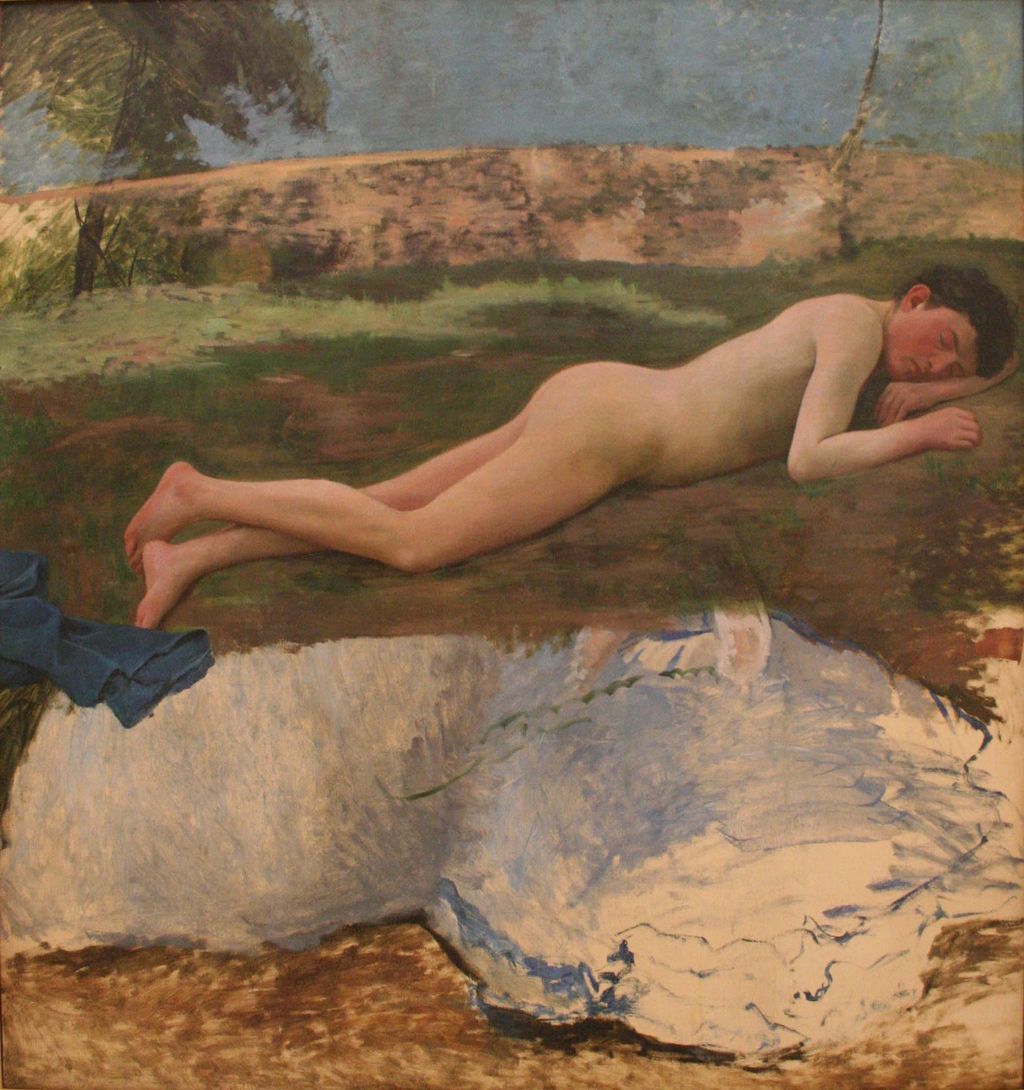
A young man rests on his stomach, his head cushioned by a bent arm and his feet loosely crossed. His pale body stretches almost across the canvas. Below him, great expanses of blue and white paint belong to another picture: an earlier composition of women in a garden. Frédéric Bazille’s Young Male Nude Lying on the Grass brings two unfinished paintings into a single, unusually revealing object. The Musée Fabre in Montpellier calls it Étude de jeune homme nu, or Study of a Young Male Nude, and dates the reclining figure to 1870. [1]
The distinction between the two compositions matters from the first glance. The pale forms below the sleeper are more than an unsettled foreground. They preserve an earlier undertaking that Bazille began to cover. The National Gallery of Art’s retrospective checklist dates that underlying scene to about 1867, separating it from the later nude. Looking at the whole painting means following both the figure’s stillness and the painter’s change of direction. [2]
At a Glance
- Date1870; underlying scene c. 1867 [1] [2]
- MediumOil on canvas [1]
- Dimensions147.5 × 138 cm [1]
- CollectionMusée Fabre, Montpellier, 2002.5.2 [1]
This work across Frédéric Bazille’s career
Family Reunion
1867–1868 (museum)Bazille’s Studio, Rue La Condamine
1869–1870Summer Scene (Bathers)
1869–1870Contents
- A body stretched across the landscape
- The earlier picture remains visible
- What the X-rays changed
- Study, model and uneven finish
- From the fisherman to the reclining nude
- Among the late paintings
- Acquisition and a place in Bazille’s reputation
- Annotated details
A body stretched across the landscape
The reclining figure has a long, unbroken presence. His feet lie towards the left edge and his dark-haired head towards the right. A shallow bend at the knees interrupts the extended legs, while the curve of the hip rises into the back. At the other end, a projecting elbow and the hands gather the pose into a more compact arrangement. The body is at once stretched out and folded in on itself.
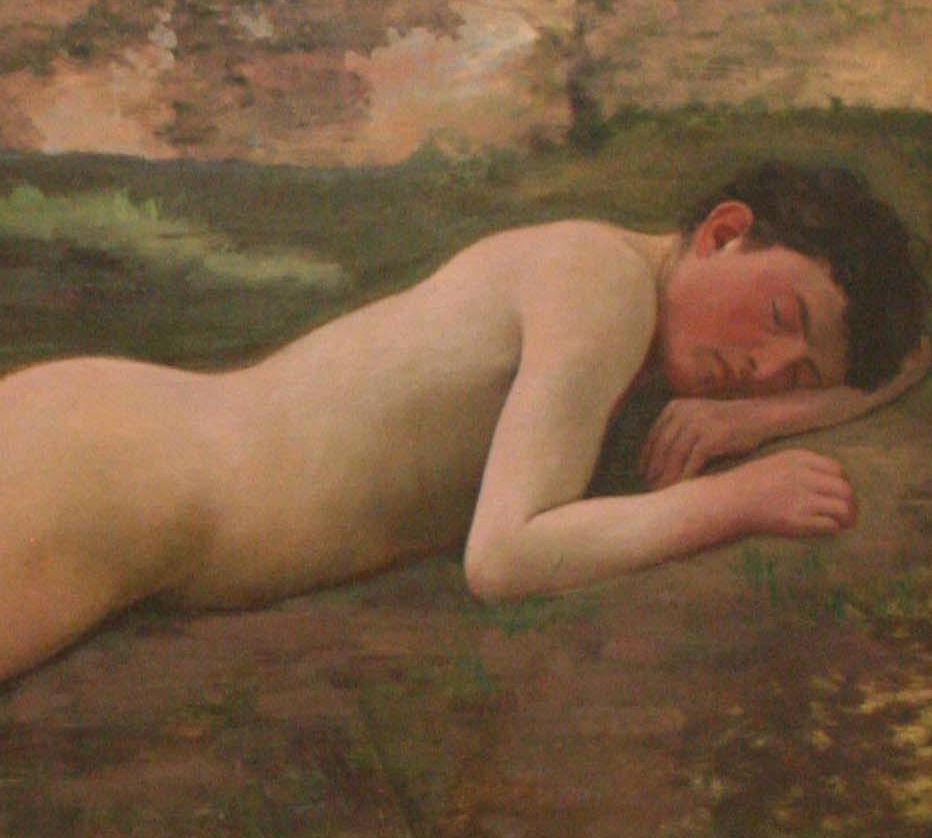
Bazille makes the head unusually prominent. The face turns sufficiently towards us for its closed eyes, cheek and mouth to register, although the sitter directs no answering gaze at the viewer. Redder colour around the face and ear contrasts with the quieter flesh tones along the back. One forearm supports the head; the other rests forward on the grass. These overlapping arms give the sleeping posture a physical explanation. The figure’s weight appears to settle through the chest and elbows into the ground.
Across the torso and legs, transitions are broad. Light follows the shoulder, back and upper surface of the nearer leg, while warmer shadows collect underneath. The flesh remains a large, relatively continuous shape against the more broken browns and greens of the surrounding ground. Its visibility depends on that difference in handling as much as on its pale colour. The outline can be followed easily even where the adjacent landscape remains loosely stated.
Behind the sleeper, a long ochre band crosses the canvas. It reads as a wall, with rougher and darker marks interrupting its surface. Trees and foliage rise above it, and a slender trunk at the right cuts into the muted sky. The setting offers enough structure to place the body outdoors without opening a large prospect into the distance. The wall keeps the eye close to the foreground. Much of the landscape’s movement is lateral, echoing the figure’s extended pose.
A piece of dark blue cloth at the left introduces a sharper, cooler note beside the feet. The museum describes it simply as blue fabric, an appropriately cautious description of the visible folds. It connects the unclothed body to an ordinary material world, while its angular edges contrast with the smoother contour of the leg. No fishing net, athletic action or named mythological incident explains the figure’s presence. The subject is the body at rest. [1]
The museum associates the setting with Méric, the Bazille family’s property near Montpellier. That is a plausible identification within his southern work, though the broadly indicated wall and trees do not establish an exact spot. The scene’s intimacy comes principally from the low viewpoint and the figure’s proximity. We are close enough to register a face, hands and crossed feet, with little intervening space. [1]
The earlier picture remains visible
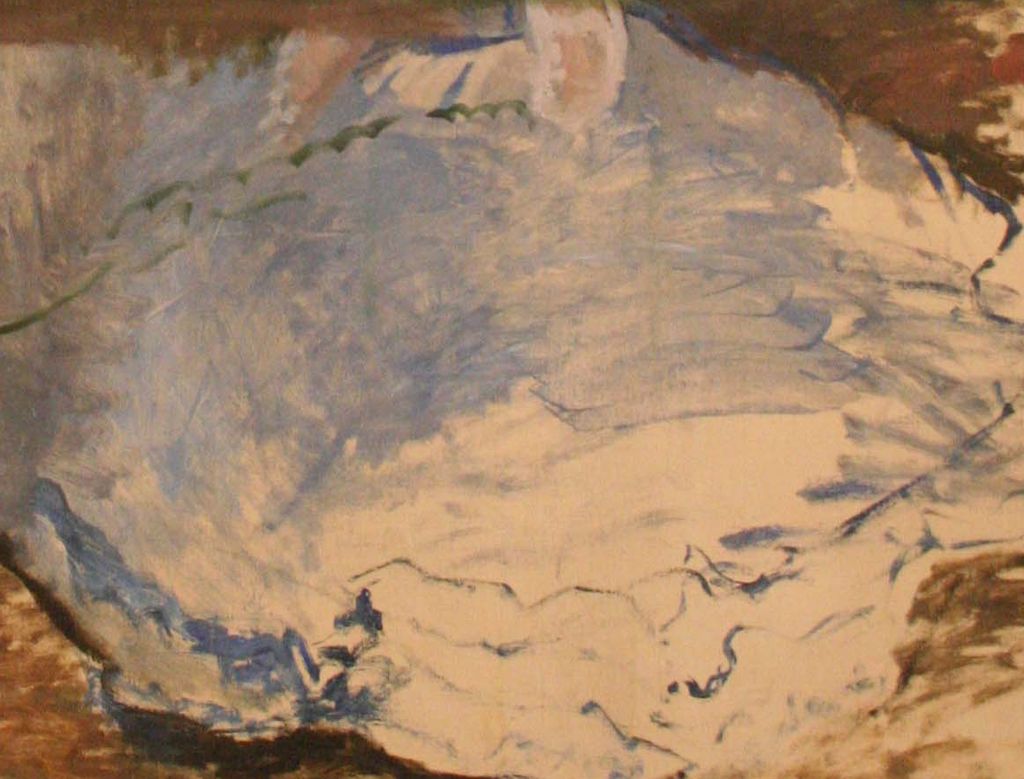
The lower part changes the experience of everything above it. Pale paint spreads over a broad area beneath the sleeper, and blue lines describe a swelling, folded form towards the right. These marks belong to the dress of a woman in the earlier composition. The Musée Fabre identifies that first scene as two women in a garden, one seated on the ground. Its survival gives the canvas two different scales of description: a substantially modelled nude above and a much more openly worked arrangement below. [1] [3]
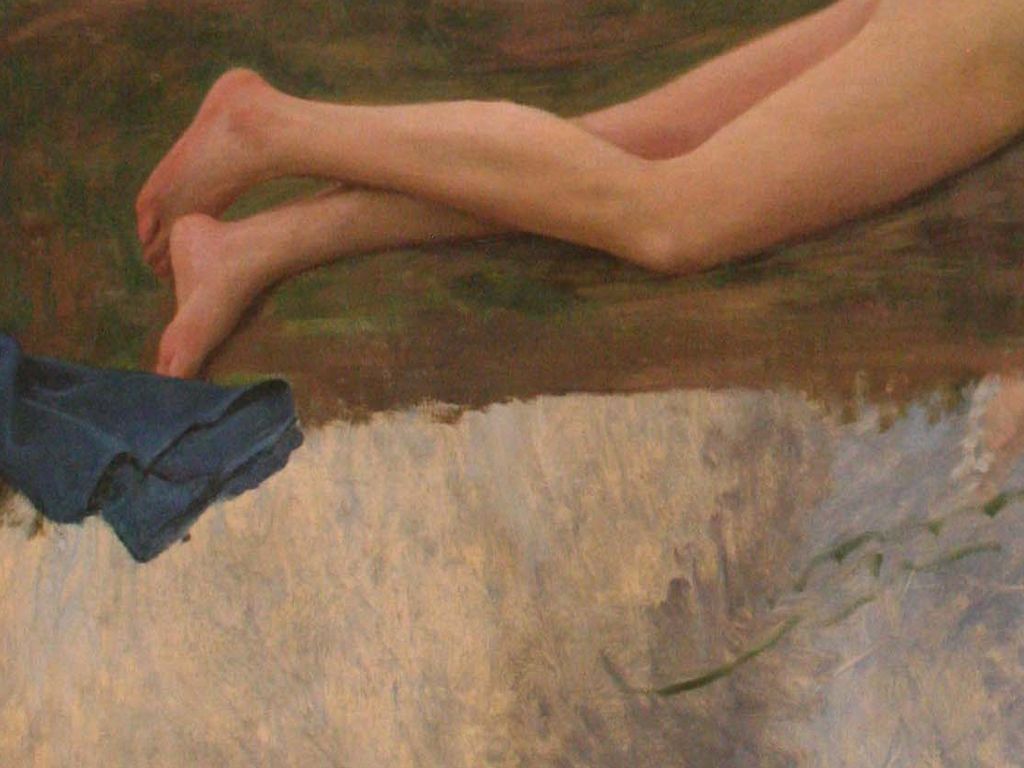
The meeting between them is uneven. The dark ground beneath the legs stops against passages of white and pale blue. At some points the newer landscape seems to cut across the older dress; elsewhere the blue cloth and surrounding paint make the boundary harder to follow. The change is particularly conspicuous near the feet, where the dense blue fabric projects over a much lighter field. A single glance cannot turn all these forms into one consistent foreground.
Seen separately, the pale lower area might be mistaken for a large cloth laid in front of the nude. Once its history is understood, the eye begins to read another arrangement beneath the first. The expansive dress belongs to a seated figure whose upper parts have been obscured by the later work. What remains is sufficient to suggest volume and folds, but insufficient to restore a complete garden scene from the surface alone.
This is an important distinction when describing an unfinished painting. The lower passages are evidence of an earlier subject as well as of a different degree of finish. We cannot assume that Bazille intended to leave them exposed in a completed nude. Nor can we reconstruct the precise foreground he would eventually have painted over them. The surviving canvas records the point he reached, with the two undertakings still visibly entangled.
A letter to his mother, assigned to April 1867, supplies a relevant documentary parallel. Bazille reported that he was working on two life-size women arranging flowers and hoped to finish the picture during the peony season. The subject and approximate date make the letter pertinent to the underlying composition, which the retrospective dated to about 1867. The letter does not itself name this surviving canvas, so the connection remains a proposal rather than an identification proved by the correspondence alone. [4] [2]
Annotated Details from Young Male Nude Lying on the Grass
The numbered points identify visible features discussed in this article. Return from each detail to the whole composition. Young Male Nude Lying on the Grass Photograph: Rvalette / Wikimedia Commons. Image source. CC BY-SA 3.0. Numbers added to a separate overview; detail crops made from the retained original. These derivative photographs are offered under CC BY-SA 3.0.
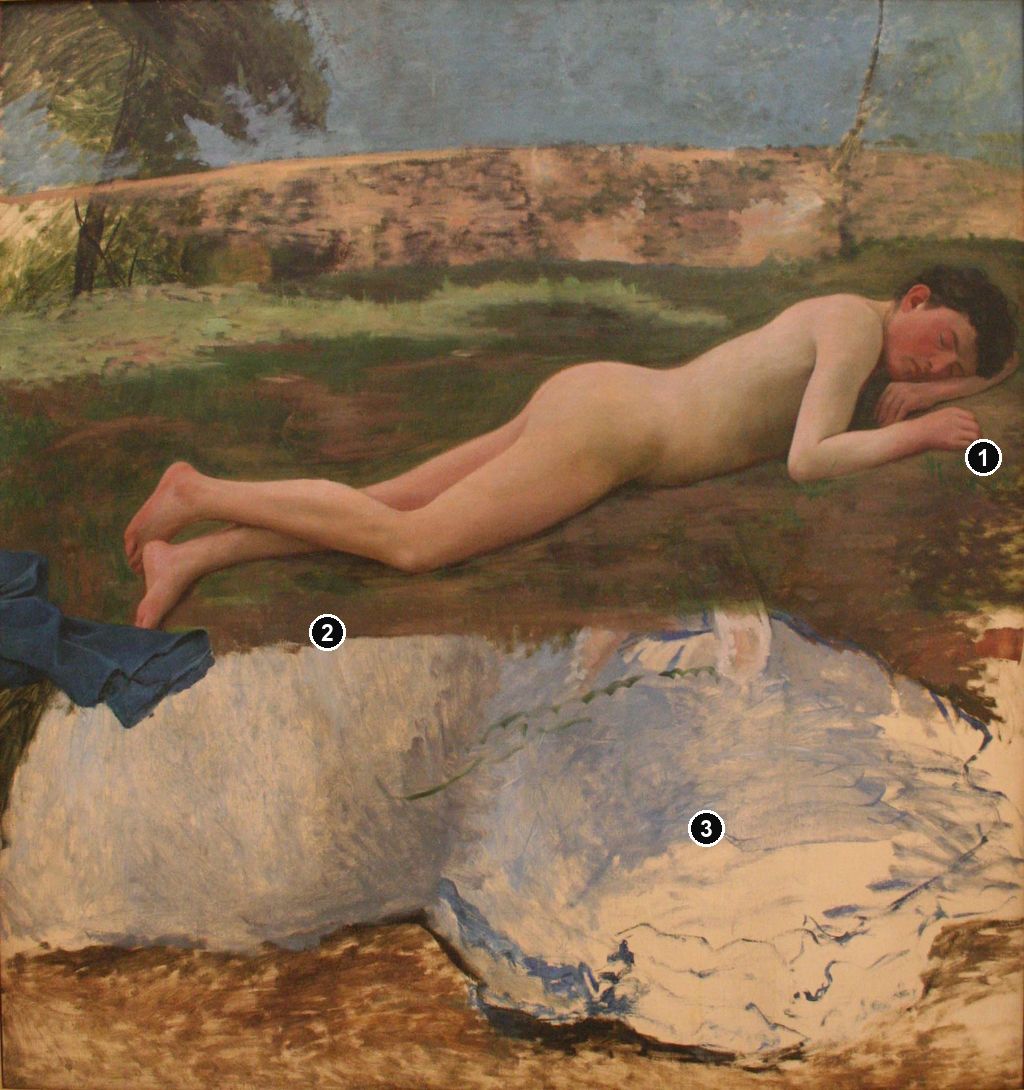
Details from YOUNG MALE NUDE LYING ON THE GRASS
Compare the cropped details with the complete images above. Notice how their colours, shapes and positions contribute to the larger compositions.
The sleeper’s upper body
The folded arms gather around the head while the back extends as one broad pale shape against the darker ground.
Where the campaigns meet
Dark ground and blue fabric stop against much paler forms below. The two arrangements do not resolve into a single consistent foreground.
The exposed lower dress forms
Broad pale shapes and blue lines preserve folds from the earlier composition. They ask to be seen with the nude above.
What the X-rays changed
The earlier women have also raised a question about authorship. A proposal associated with the art historian Kermit Champa gave the underlying composition to Claude Monet. In his 2018 laboratory study, Bruno Mottin tested that suggestion through comparison with radiographs of Monet’s Déjeuner sur l’herbe. He found a substantial difference in technique. In particular, the earlier woman’s face at the right was built with thick, firmly structured paint, unlike Monet’s more fluid handling in the works compared. Its construction resembled that of the nude painted above. On this comparative evidence, Mottin judged that Bazille appears to have painted both compositions. [5]
Mottin also describes the lower composition’s brown, blue and mauve preparatory colours, relating this use of varied local tones to Bazille’s Family Reunion. The earlier scene thus contributes evidence about his way of building a painting before its forms were fully developed. [5]
The X-rays extend what the visible surface can tell us. They do not supply a missing sitter’s name, explain why the first project stopped or establish every stage of the nude’s execution. Their value here is more specific: they allow a partly covered composition to be compared with other paintings and make the canvas’s history less dependent on resemblance at the surface.
Watch: Bazille and early Impressionism
Explore a Paris studio with Smarthistory, then discover the beginnings of Impressionism with the National Gallery of Art.
Jean-Frédéric Bazille, The Artist’s Studio, Rue Visconti, Paris
A close look at Bazille’s 1867 painting of the studio he shared in Paris.
Watch on YouTubeStudy, model and uneven finish
The museum’s use of the word study draws attention to a painting still being worked out. The nude has an emphatic silhouette, yet the background and lower field remain unresolved. Even within the body, the face and limbs have different degrees of definition. The face is compact and strongly coloured; the long torso is quieter, its modelling spread across larger planes. Those differences are visible without requiring a judgement that every passage must have reached the same finish.
Earlier criticism often treated this discrepancy as a fault. Michel Schulman’s catalogue discusses objections to the relationship between the head and body, alongside interpretations that made the picture an expression of Bazille’s inner unease. Those responses belong to the work’s critical history. The canvas itself offers a more limited basis for inference: it shows a painter developing a figure on a support already occupied by another subject. It cannot demonstrate his state of mind. [3]
The sleeper’s source is equally uncertain. A photographic origin, specifically a daguerreotype, has been proposed in the older literature, but no supporting photograph has been identified. Schulman rejects treating the assertion as established. Working from an earlier drawing or from memory is another possibility discussed in the catalogue, rather than a documented account of this particular sitting. Neither the sitter’s personal identity nor a precise age can be recovered from the appearance of the painted figure. [3]
Bazille’s own account of figure practice gives a useful wider context. Writing to his father on 6 January 1865, he explained that he was painting from the living model in Monet’s studio. “I must paint a great many figures this winter,” he wrote, in a new translation from the French, before explaining that this would prepare him to make good use of spring and summer in the countryside. The letter describes an earlier period, but it establishes how deliberately he connected studio preparation with outdoor ambitions. It does not prove that the reclining nude was painted directly from a model outdoors. [6]
The distinction helps us look at the figure without demanding a single uninterrupted encounter between painter, sitter and landscape. Its strong contour may have been developed separately from parts of the setting. The surviving differences in handling allow us to see that relationship still being negotiated, while leaving the exact sequence of work open.
From the fisherman to the reclining nude
The most revealing comparison is with Fisherman with a Net, painted in 1868. There, an upright nude viewed from behind dominates a narrow vertical canvas. A net, a second seated figure and a glimpse of water situate him in an activity. His turned head and spread stance suggest a body gathering itself to work. The painting was rejected by the Salon jury in 1869. [7]
In Young Male Nude Lying on the Grass, the body occupies a broad horizontal interval within a nearly square canvas. Its resting pose gives it a different relation to the ground. The fisherman’s legs establish a stance; the sleeper’s legs extend across the grass. The fisherman’s net carries the eye downward through an active diagonal; the reclining figure’s arms collect around his head. Comparing the two shows how much the same general problem, a nude in an outdoor setting, could change when movement and a working prop were removed.
Summer Scene expands that problem into a group. Developed in 1869–70 and accepted at the 1870 Salon, it distributes eight male figures around water and grass. One reclines, while others swim, wrestle, dress or help a companion out of the water. The reclining man remains involved in a shared setting: he raises his head towards the activity farther back. The sleeper in the present picture closes his eyes and withdraws from any comparable exchange. [2] [8]
The landscapes differ too. In Summer Scene, trees create intervals through which we see bright grass, distant figures and sky. Water establishes a distinct foreground zone. Here, the long wall and subdued ground compress the setting, giving the body a more isolated presence. The comparison explains the different atmosphere through arrangement, posture and colour before any psychological meaning is attached to it.
The Musée Fabre’s 2016 retrospective placed these paintings within the modern nude: Bazille treated ordinary male bodies in contemporary outdoor surroundings, alongside peers reconsidering the genre. That framework makes the absence of a named heroic or mythological role significant. The physical appeal of the figure and its ordinary surroundings become subjects in their own right. [9]
 Frederic Bazille.jpg)
Scène d'été (Bathers Summer Scene)

The Fisherman with a Net
Among the late paintings
The reclining nude belongs beside other projects of 1870, including Ruth and Boaz and Landscape on the Banks of the Lez. Their differences resist the idea of a single final manner. Ruth and Boaz places reclining figures in a literary and biblical night scene; the Lez landscape gives its broad space to trees, sky, earth and stone. The nude concentrates on one resting body. The retrospective presented all three as late works, with the study and Ruth and Boaz retaining unfinished states. [2] [9]
Ruth and Boaz supplies a particularly useful material comparison. Mottin’s examination revealed an earlier piano composition beneath it, painted in the opposite orientation. Both pictures therefore carry the remains of an abandoned subject, although the extent of that history’s visibility differs greatly. In the reclining nude, the older women remain conspicuous to the unaided eye. In Ruth and Boaz, the earlier scene is principally a technical discovery beneath the surface. Reuse was a practical part of Bazille’s work, with different consequences in each canvas. [5]
The museum reads the sleeper’s languor in terms of dream and melancholy. That interpretation responds to the closed eyes, extended body and subdued setting, but it remains a reading of the picture. Its late date places it among several concurrent projects without establishing a definitive last painting. Its interest lies in a particular experiment that remained open, alongside other experiments pursued during the same year. [1] [3]
Acquisition and a place in Bazille’s reputation
The Musée Fabre acquired the painting in 2002, through a purchase by the city supported by the Fonds du patrimoine and the FRAM Languedoc-Roussillon. Its inventory number is 2002.5.2. The museum records an oil on canvas measuring 147.5 × 138 centimetres. These dimensions make the physical presence of the figure important: the work is a substantial canvas, despite the provisional state preserved across much of its surface. [1]
The acquisition continued a much longer formation of the museum’s Bazille collection. As Michel Hilaire explains, the artist’s mother gave View of the Village and Still Life with Heron in 1898, helping bring work preserved within the family into public view. Later gifts and acquisitions broadened that public account. The reclining nude added a different kind of evidence, allowing a museum collection to show experimentation and interruption alongside more resolved paintings. [10]
Its exhibition history also predates the purchase. The museum records appearances in the 1950 Wildenstein exhibition in Paris, the Art Institute of Chicago’s 1978 Bazille exhibition and Montpellier’s 1984 presentation of works from private collections. It was subsequently included in the retrospective shown in Montpellier, Paris and Washington in 2016–17. These repeated encounters helped make an unresolved painting part of the public understanding of Bazille’s work. [1]
The two compositions remain inseparable in that understanding. The nude provides a sustained study of a resting body; the women below preserve an earlier ambition that the new painting only partly displaced. Across their meeting, smooth flesh, loose landscape and exposed dress forms ask for different kinds of attention. The canvas rewards looking at those differences together, as the visible record of Bazille changing a painting while it was still in progress.
Bazille catalogue directory
The 284 records comprise 85 painting records,40 separate works-on-paper records and 159 album or study records. They describe the catalogue’s organisation rather than 284 independent objects or unanimously accepted attributions. Recto, verso, albums and multiple studies remain distinct. Dates are qualified where needed; the Drawing filter includes the etching, gouache and mixed works on paper. Manuscript mentions and unproved projects are listed separately below.
Works known through documents
These mentions remain separate from the 284 catalogue records. Some may concern surviving studies or underlying compositions; they cannot simply be added together as missing physical paintings.
- A copy after Rubens mentioned in March 1863 is unlocated.
- A portrait of an unidentified woman was reported completed before July 1866.
- A portrait of Monet and a composition of two life-size women arranging flowers were reported in progress in April 1867. Their mention does not establish two otherwise unknown surviving canvases.
- Gertrude et le père Lapin was at least begun in the summer of 1870.
Further reported works and uncertain attributions
- A Bouquet of Lilacs was reportedly stolen and returned in 1864; a portrait of the friend Theulier and Yellow Narcissi reported by Maître in 1868 are also documentary mentions.
- Unidentified pictures associated with Guillemet and Mme Rolina are reported through later correspondence cited by the catalogue.
- Children Dressed as Bride and Groom was associated with Vallotton’s collection and also attributed to Renoir. Its identification and authorship should remain open.
Projects whose completion is unproved
- A portrait of Pauline was planned in July 1865.
- A portrait of Marc was proposed in April 1866; a related drawing survives.
- A Jardinière project appears in album inscriptions and related figure material. Written plans are not evidence of a completed painting.
| Name | Date | Medium |
|---|---|---|
| Mystic Marriage of St. Catherine | 1863 | Oil on canvas |
| Trees, Study | 1863 | Oil on canvas |
| Farm of Saint-Sauveur | 1863 | Oil on canvas |
| In the Garden of the Parc Monceau, Paris | 1864 | Oil on canvas |
| Naked Woman from Behind | 1864 | Oil on canvas |
| Reclining Nude | 1864 | Oil on canvas |
| Courtyard of the Auberge du Cheval blanc at Chailly near Barbizon | 1864 | Oil on canvas |
| Covered Soup Bowls | 1864 | Oil on canvas |
| Two Herrings | 1864 | Oil on canvas |
| The Pink Dress | 1864 | Oil on canvas |
| The Dog Rita Asleep | 1864 (catalogue); c. 1864 (2017 checklist) | Oil on canvas |
| The Scoter | 1864 | Oil on canvas |
| Naked Reclining Woman | 1864 | Oil on canvas |
| Landscape at Chailly | 1865 | Oil on canvas |
| Rocks at Chailly, Forest of Fontainebleau | 1865 | Oil on canvas |
| Undergrowth at Chailly, Forest of Fontainebleau | 1865 | Oil on canvas |
| Still Life with Grapes and Nuts | 1865 | Oil on canvas |
| Self-Portrait with a Palette — Chicago | 1865 | Oil on canvas |
| Landscape of Saint-Sauveur | 1865 | Oil on canvas |
| Beach at Sainte-Adresse | 1865 | Oil on canvas |
| The Improvised Field Hospital | 1865 | Oil on canvas |
| Village Street, Chailly | 1865 | Oil on canvas |
| Small Valley in the Forest of Fontainebleau | 1865 | Oil on canvas |
| Forest of Fontainebleau | 1865 | Oil on canvas |
| Woman Ironing | 1866 | Oil on canvas |
| The Artist's Studio on the rue de Furstenberg | 1865–66 (museum) | Oil on canvas |
| Still Life with Fish | 1866 | Oil on canvas |
| Little Italian Street Singer | 1866 | Oil on canvas |
| Potted Flowers | 1866 | Oil on canvas |
| The Little Gardener | 1866–1867 | Oil on canvas |
| Young Woman Playing the Piano | 1866–1867 | Oil on canvas |
| End of a Summer Day | 1866–1867 | Oil on canvas |
| A Studio on the rue Visconti | 1867 | Oil on canvas |
| Thérèse Reading in the Park at Méric | 1867 | Oil on canvas |
| Portrait of Verlaine | 1867 | Oil on canvas |
| The Terrace at Méric | 1867 | Oil on canvas |
| Still Life with Heron | 1867 | Oil on canvas |
| The Family Gathering | 1867–68 (museum) | Oil on canvas |
| Oleanders | 1867 | Oil on canvas |
| Woman on the Terrace at Méric | 1867 | Oil on canvas |
| The Ramparts at Aigues-Mortes from South | 1867 | Oil on canvas |
| The Western Ramparts at Aigues-Mortes | 1867 | Oil on canvas |
| Portrait of Edmond Maître — head study | 1867 | Oil on canvas |
| Porte de la Reine at Aigues-Mortes | 1867 | Oil on canvas |
| Portrait of Sisley | 1867 | Oil on wood |
| Portrait of Renoir — Cleveland | 1867 | Oil on canvas |
| Portrait of Renoir — Musée d’Orsay | 1867 | Oil on canvas |
| Self-Portrait with a Detachable Collar — Minneapolis | 1865–67 (museum); 1867–68 (catalogue) | Oil on canvas |
| Vase of Flowers on a Console | 1868 (museum); 1867–68 (catalogue) | Oil on canvas |
| Portrait of a Woman | 1868 | Oil on canvas |
| Young Woman in the Vineyards | 1868 | Oil on card |
| Harvester with a Basket | 1868 | Oil on card |
| Harvester with a Yellow Hat | 1868 | Oil on card |
| Harvester with a Headdress | 1868 | Oil on panel |
| On the Banks of the Lez | 1868 | Oil on canvas |
| After the Bath (attribution questioned) | 1868? | Oil on canvas |
| Young Woman with Lowered Eyes | 1868 | Oil on canvas |
| Fisherman with a Net | 1868 | Oil on canvas |
| View of the Village | 1868 | Oil on canvas |
| Portrait of Bazille (attributed to Monet by Musée Fabre; disputed catalogue attribution) | 1864 (museum); 1868 (catalogue) | Oil on panel |
| Studies for a Grape Harvest (two panels) | 1868 | Oil on canvas (two panels) |
| The Fortune Teller | 1868–69 (catalogue); c. 1869–70 (2017 checklist) | Oil on canvas |
| Harvester with a Cap | 1869 | Oil on card |
| Portrait of Edmond Maître — 1869 | 1869 | Oil on canvas |
| Woman in a Moorish Costume | 1869 | Oil on canvas |
| Young Woman in the Garden | 1869 | Oil on canvas |
| Portrait of Alphonse Tissié in a Cavalryman's Uniform | 1869 | Oil on canvas |
| Portrait of a dragoon | 1869 | Oil on canvas |
| Portrait of Zacharie Astruc | 1869 | Oil on canvas |
| Bunch of Grapes in a Bucket | 1869 | Oil on card |
| Portrait of Edouard Blau | Probably 1869; inscribed 1866 | Oil on canvas |
| Young Male Nude Lying on the Grass | 1870 | Oil on canvas |
| Summer Scene | 1869–1870 | Oil on canvas |
| The Studio on the rue La Condamine | 1869–1870 | Oil on canvas |
| La Toilette | 1870 | Oil on canvas |
| Young Woman with Peonies — Montpellier | 1870 | Oil on canvas |
| Young Woman with Peonies — Washington | 1870 | Oil on canvas |
| Monotonous Chant | 1870 | Oil on canvas |
| Flowers — private collection | 1870 | Oil on canvas |
| Flowers — Musée Fabre | 1870 | Oil on canvas |
| Young Fisherman | 1870 | Oil on canvas |
| Study for Ruth and Boaz | 1870 | Oil on wood |
| Ruth and Boaz | 1870 | Oil on canvas |
| Self-Portrait in Shirt Sleeves | 1870 | Oil on canvas |
| Landscape on the Banks of the Lez | 1870 | Oil on canvas |
| Study after an Alpine Landscape | 1860 | Graphite on watercolour-tinted paper |
| Profile Head | 1862 | Charcoal on laid paper |
| Studies after Delacroix | 1863 | Ink and graphite, with gouache and watercolour, on paper |
| Academic Head | 1863 | Charcoal on paper |
| Study of a Woman's Head in Profile on a Chair | 1863 | Charcoal on paper |
| Academic Head of a Woman | 1863 | Charcoal on paper |
| Academy of Woman | 1863 | Black pencil and charcoal, stumped, on watermarked laid paper |
| Academy of Man | 1863 | Black pencil and charcoal, stumped, on watermarked laid paper |
| Naked Man | 1863 | Charcoal on paper |
| The Pont au Change in Paris | 1864 | Watercolour on paper |
| Study for the Pink Dress or Portrait of Thérèse des Hours | 1864 | Black pencil on paper |
| Naked Woman Standing | 1864 | Pencil on paper |
| Study of a Reclining Nude | 1864 | Charcoal on paper |
| Bathers | 1864 | Charcoal on paper |
| Portrait of a Man | 1864 | Charcoal on paper |
| Study for The Pink Dress | 1864 | Black pencil, squared, on paper |
| Study for Landscape of Saint-Sauveur | 1864 | Graphite on paper |
| Study for Landscape of Saint-Sauveur | 1865 | Pencil on paper |
| Man Taming a Bull | 1866 | Pen and black pencil on paper |
| Man Half Lying on a Sofa | 1866 | Charcoal on paper |
| Study for The Family Gathering | 1867 | Pencil on paper |
| Study for The Family Gathering | 1867 | Graphite, charcoal and black pencil on paper |
| The Embroiderer | 1867 | Pencil on pink paper |
| Study of Children | 1867 | Pencil on paper |
| Women in a Garden | 1867 | Pencil drawing |
| View of the Village | 1868 | Etching on paper |
| Portrait of a Bearded Man (catalogued as Self-Portrait) | Undated (museum); 1869 (catalogue) | Charcoal and brown ink |
| Man Smoking Pipe | 1869 | Watercolour on paper |
| Manet Drawing | 1868–70(?) (museum) | Charcoal and white chalk on paper |
| Study for the Summer Scene | 1869 | Charcoal, pen and ink on paper |
| Family Portrait | 1869 | Pastel and charcoal on paper |
| Study for Ruth | 1870 | Pencil and charcoal on paper |
| Woman Arranging a Hat | 1870 | Pencil drawing |
| Study for Boaz Asleep | 1870 | Pastel and red chalk |
| Boaz Asleep | 1870 | Charcoal and pencil on paper |
| Study for Boaz Asleep | 1870 | Black and beige pastel with red chalk on laid paper |
| Ruth Lying down | 1870 | Charcoal and pastel on paper |
| Head, Arm and Chest of Ruth | 1870 | Charcoal on paper |
| Chest of Ruth | 1870 | Black chalk and charcoal on paper |
| Black Woman with Peonies — gouache | c. 1870 | Gouache, watercolour, pencil and black chalk on card |
| Various Unidentified Subjects | Undated | Pencil drawing |
| Rocky Sea Side | Undated | Charcoal on paper |
| Studies of a Dancing Woman | Undated | Drawing with white chalk |
| Study of a Leg | Undated | Pencil drawing |
| Dancers in Camargue | Undated | Pencil drawing |
| Academy of Woman | Undated | Charcoal |
| Caricature of Venus of Milo and Various Other Caricatures | Undated | Charcoal |
| Caricature | Undated | Pencil drawing |
| Study of Landscape | Undated | Charcoal |
| Caricatures and Seated Monk | Undated | Charcoal |
| Caricatures and Various Subjects | Undated | Pencil drawing |
| Women Carrying a Pitcher | Undated | Pencil drawing |
| The Hanged Man | Undated | Charcoal |
| Castle in the Plain | Undated | Charcoal |
| Naked Woman from Behind | Undated | Charcoal |
| Caricatures | Undated | Charcoal and pencil |
| Unidentified Subjects | Undated | Pencil drawing |
| Landscape with a Castle | Undated | Charcoal |
| Study of Landscape | Undated | Charcoal |
| Horse Rider seen from Behind | Undated | Charcoal |
| Mazeppa | Undated | Pencil and charcoal |
| Study of Rider and Others Subjects | Undated | Pencil, pen and brown ink |
| Study of an Unidentified Man | Undated | Pencil drawing |
| Study for an Unknown Historic Scene | Undated | Pencil drawing |
| Study a Man Reading | Undated | Pencil drawing |
| Study of Men Reading | Undated | Pencil drawing |
| Study of Landscape ? | Undated | Charcoal |
| Study of a Head of a Man | Undated | Pencil drawing |
| Erotic Scene | Undated | Pencil drawing |
| Study of Dog | Undated | Charcoal |
| Studies of Unidentified Subjects and Erotic Scene | Undated | Pencil and charcoal drawing |
| Study for a Theater Scene | Undated | Charcoal |
| Study of a Reclining Naked Woman | Undated | Charcoal |
| Two Studies of Landscape | Undated | Pencil drawing |
| Caricature | Undated | Pencil and charcoal drawing |
| Portrait of an Unidentified Young Man | Undated | Charcoal |
| Study of an Unidentified Subject | Undated | Brown ink drawing |
| Unidentified Man with a Hat | Undated | Pencil and charcoal |
| Study of an Unidentified Women | Undated | Pencil drawing |
| Study for a Theater Character ? | Undated | Pencil drawing |
| Study for a Theater Character ? | Undated | Pen drawing |
| The Pavillon de la Reine in Paris | Undated | Pencil drawing |
| Study of a Horse Rider | Undated | Pencil and charcoal drawing |
| Entwined Couple. Caricature ? | Undated | Pencil drawing |
| Woman Sitting on a Sofa | Undated | Pencil drawing |
| Studies of Unidentified Subjects | Undated | Pencil and charcoal drawing |
| Studies of Animals | Undated | Pencil drawing |
| Study of a Horse Rider in Camargue | Undated | Charcoal |
| Study of Hunting Dogs | Undated | Pencil drawing |
| Study of Soldiers. Caricatures | Undated | Pencil drawing |
| Studies of Hunting Dogs ? | Undated | Pencil drawing |
| Hunting Scene. Hunter Playing the Horn | Undated | Pencil drawing |
| Caricature | Undated | Pencil drawing |
| Study of an Ibex | Undated | Pencil drawing |
| Theater Scene. Caricatures | Undated | Pencil drawing |
| Studies of Animals. Horses ? | Undated | Pencil drawing |
| Caricatures | Undated | Pencil drawing |
| Studies of Various Subjects and Animals | Undated | Pencil drawing |
| Unidentified Subject | Undated | Pencil drawing |
| Rider Taming a Horse [in Camargue ?] | Undated | Pencil drawing |
| Caricature of a Soldier | Undated | Pencil drawing |
| Study of a Woman and Mouse | Undated | Pencil drawing |
| Historic Scene | Undated | Charcoal |
| Architecture Studies | Undated | Pencil drawing |
| Mythologic Scene | Undated | Charcoal |
| Ophelia | Undated | Pencil drawing |
| Mythologic Scene | Undated | Charcoal |
| Studies of Various Subjects | Undated | Pencil and pen drawing |
| Studies of Peasants | Undated | Pencil drawing |
| Historic Scene | Undated | Pencil drawing |
| Historic or Literary Scene | Undated | Pencil drawing |
| Unidentified Historic Scene | Undated | Pencil drawing |
| Studies of Unidentified Subjects | Undated | Pencil drawing |
| Unidentified Study | Undated | Pencil drawing |
| Man in an Armchair | Undated | Pencil drawing |
| Studies of Various Subjects | Undated | Pencil drawing |
| Portraits of Unidentified Men | Undated | Pencil drawing |
| Studies of Various Subjects | Undated | Pencil drawing |
| Horse Rider and Artist | Undated | Charcoal and pencil |
| Study of Unidentified Characters | Undated | Charcoal |
| Dead Horse in a Plain | Undated | Charcoal |
| Study of Various Subjects and Furniture | Undated | Pencil drawing |
| Caricatures and Various Notes about Opéra | Undated | Pencil drawing |
| Galloping Horse | Undated | Charcoal |
| Study for La Toilette | Undated | Pencil drawing |
| Study of a Naked Woman | Undated | Pencil drawing |
| Domestic Scene | Undated | Pencil drawing |
| Physiognomies | Undated | Pencil drawing |
| Study for a Grape Harvest | Undated | Pencil drawing |
| Study for the Summer Scene | Undated | Pencil drawing |
| Female Profiles | Undated | Pencil drawing |
| Various Subjects | Undated | Pencil drawing |
| Study for The Terrace at Méric | Undated | Pencil drawing |
| Study for The Ramparts at Aigues-Mortes | Undated | Pencil drawing |
| Study for The Ramparts at Aigues-Mortes | Undated | Pencil drawing |
| Study for a Grape Harvest | Undated | Charcoal |
| Children Portraits | Undated | Pencil drawing |
| Study for Children's Heads | Undated | Pencil drawing |
| Study of Minerva | Undated | Pencil drawing |
| Study for a Grape Harvest | Undated | Pencil drawing |
| Study for The Family Gathering | Undated | Pencil drawing |
| Study for a Young Fisherman | Undated | Charcoal |
| Self-Portraits | Undated | Black pencil drawing |
| Study of Horses for the Porte de la Reine at Aigues-Mortes | Undated | Ink drawing |
| Study of Horses for the Porte de la Reine at Aigues-Mortes | Undated | Ink drawing |
| Study of Horses for the Porte de la Reine at Aigues-Mortes | Undated | Ink drawing |
| Study for an Outdoor Concert | Undated | Pencil drawing |
| Studies of Legs | Undated | Pencil drawing |
| Study for The Ramparts at Aigues Mortes | Undated | Pencil drawing |
| Studies of Hats | Undated | Pencil drawing |
| Studies of Men | Undated | Pencil drawing |
| Study for The Little Gardener | Undated | Pencil drawing |
| Study for The Ramparts at Aigues Mortes | Undated | Charcoal |
| Studies of Sail Boats | Undated | Pencil drawing |
| Portrait of Marc Bazille | Undated | Charcoal, black pencil and graphite |
| Studies of Children's Heads | Undated | Pencil drawing |
| Study for Aigues-Mortes | Undated | Pencil drawing |
| Studies of Women's Heads | Undated | Pencil drawing |
| Portrait of Camille des Hours and an Unidentified Man | Undated | Charcoal |
| Study of Flying Birds | Undated | Charcoal or graphite |
| Study for the Summer Scene | Undated | Pencil drawing |
| Study of Hands | Undated | Pen drawing |
| Self-Portrait | Undated | Black pencil drawing |
| Study for the Summer Scene | Undated | Pencil drawing |
| Study for the Summer Scene | Undated | Pencil drawing |
| Study for a Grape Harvest | Undated | Pencil drawing |
| Study of Branches | Undated | Pencil drawing |
| Study of a Seated Child | Undated | Pencil drawing |
| Study for a Couple and Unidentified Women | Undated | Pencil drawing |
| Studies of Unidentified Women | Undated | Pencil drawing |
| Study of Buildings | Undated | Pencil drawing |
| Study for a Grape Harvest | Undated | Pencil and charcoal |
| Studies of Boaters | Undated | Pencil drawing |
| Study of a Man Writing at his Table | Undated | Pencil drawing |
| Study of a Woman Cutting Flowers | Undated | Pencil drawing |
| Study of Hand | Undated | Pencil drawing |
| Women in a Garden | Undated | Pencil drawing |
| Studies of Women in Profile | Undated | Pencil drawing |
| Study for Ruth and Boaz | Undated | Charcoal |
| Study for The Family Gathering | Undated | Pencil drawing |
| Study for the View of the Village | Undated | Pencil drawing |
| Study of the View of the Village | Undated | Pencil drawing |
| Study for the Fisherman with a Net | Undated | Pencil drawing |
| Study for the View of the Village | Undated | Charcoal |
| Study for The Little Gardener | Undated | Charcoal |
| Portrait of a Man with a Top Hat | Undated | Pencil drawing |
| Portrait of a Man with a Top Hat | Undated | Pencil drawing |
| Inscriptions | Undated | Pencil inscriptions |
| Study of Tree | Undated | Pencil drawing |
| Caricature of Nina la Belle | Undated | Pencil drawing |
| Study for Saint Sebastian | Undated | Pencil drawing |
| Young Woman Sewing | Undated | Pencil drawing |
| Studies of Hands | Undated | Pencil drawing |
| Woman in a Garden | Undated | Pencil drawing |
| Elegant Woman | Undated | Pencil drawing |
| Various Inscriptions | Undated | Inscriptions (medium unspecified in index) |
| Study of a Man with a Hat | Undated | Pencil drawing |
| Study of a Child | Undated | Pencil drawing |
| Study of a Man with a Hat | Undated | Pencil drawing |
Frequently Asked Questions
That attribution was proposed, but Mottin’s technical comparison favours Bazille as the painter of both compositions. His conclusion remains an attributed assessment. [5]
The Musée Fabre acquired it in 2002. It measures 147.5 × 138 cm and bears inventory 2002.5.2. [1]
Discussion
The reclining body occupies a green field of broad forms. How do pose and setting establish its physical weight?
Reader Insights
Where does the smooth modelling of the sleeper meet the openly worked lower composition most sharply?
How does the long wall keep attention close to the body?
Compare this sleeper with the reclining figure in Summer Scene. What changes when the surrounding social activity disappears?
Join the Conversation
Share a detail, comparison or question about Young Male Nude Lying on the Grass by Frédéric Bazille below.
References
- Musée Fabre, Étude de jeune homme nu, 1870, inventory 2002.5.2: collection record, acquisition, commentary and exhibition history. Musée Fabre (in French). View source.
- National Gallery of Art, Frédéric Bazille and the Birth of Impressionism, exhibition checklist, 2017, especially catalogue nos. 47, 53, 64, 65 and 72, pp. 6–9. Exhibition checklist. View source.
- Michel Schulman, Young Male Nude Lying, MSb-56, digital catalogue raisonné, critical essay and metadata. Catalogue entry (English translation of French scholarship). View source.
- Frédéric Bazille, letter to his mother, assigned April 1867, Musée Fabre, inventory 94.7.1, transcription p. 4. Letter facsimile and transcription (in French). View source.
- Bruno Mottin, “L’œuvre de Frédéric Bazille (1841-1870) examiné au laboratoire,” Technè, 46, 2018, pp. 30–38, especially paragraphs 12, 15–16 and figure 8. Technical study (in French). View source.
- Frédéric Bazille, letter to his father, 6 January 1865, Musée Fabre, inventory 92.2.1, facsimile p. 2 and transcription p. 4; English quotation translated from the French. Letter facsimile and transcription (in French). View source.
- Michel Schulman, Fisherman with a Net, MSb-45, digital catalogue raisonné, critical essay and metadata. Catalogue entry (English translation of French scholarship). View source.
- Michel Schulman, Summer Scene, MSb-55, digital catalogue raisonné, critical essay and metadata. Catalogue entry (English translation of French scholarship). View source.
- Musée Fabre, Frédéric Bazille: la jeunesse de l’impressionnisme, exhibition press dossier, 2016, especially “Le nu moderne,” p. 19, and “Nouveaux horizons,” p. 22. Exhibition dossier (in French). View source.
- Michel Hilaire, “Bazille ou la vie brève,” Académie des Sciences et Lettres de Montpellier, 2016, pp. 166–172, especially p. 166. Lecture text (in French). View source.
- Joconde/POP, La Robe rose, RF2450. View source. (in French).
- Musée d’Orsay, L’Ambulance improvisée, RF 1967 5. View source. (in French).
- Musée d’Orsay, Réunion de famille,RF2749. View source. (in French).
- Musée d’Orsay, Pierre Auguste Renoir,DL1970 3. View source.
- Musée Fabre, Vue de village, 898.5.1. View source. (in French).
- National Gallery of Art, Young Woman with Peonies,1983.1.6. View source.
- Michel Schulman, painting index and documentary introduction (English titles; French metadata). View source.
- Michel Schulman, works-on-paper index (English titles; French metadata). View source.
- Michel Schulman, albums and studies index (English titles; French metadata). View source.
- Splash image: Young Male Nude Lying on the Grass Photograph: Rvalette / Wikimedia Commons. Image source. CC BY-SA 3.0. Resized proportionally; full canvas retained.


