 by Tom Gurney
Tom Gurney BSc (Hons) is an art history expert with over 20 years experience
Published on June 19, 2020 / Updated on November 2, 2026
Email: tomgurney1@gmail.com / Phone: +44 7429 011000
Oleanders (Les Lauriers Roses) by Frédéric Bazille: Introduction
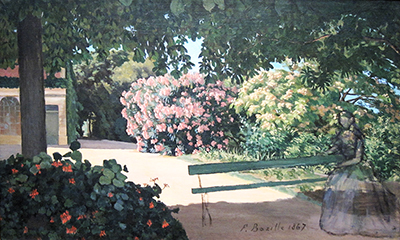
A long green bench stretches across the foreground of Frédéric Bazille’s Oleanders. Behind it, a pale path opens between banks of flowers; above it, foliage closes into a dark roof. The painting makes summer light tangible through the contrast between a place to sit in shade and a garden blazing beyond. The National Gallery of Art’s exhibition checklist dates this oil on canvas to summer 1867 and records it in the Cincinnati Art Museum, with dimensions of 55.2 × 91.4 cm. [1]
The garden is at Méric, the Bazille family’s estate near Montpellier. Its flowers have a much stronger presence than the woman lightly suggested at the bench’s right end. That difference raises a question which remains central to the picture: how much description does a figure need in a landscape? Bazille signed and dated the canvas in 1867, despite leaving this person remarkably sketchy. The signature complicates any simple description of the work as abandoned. [2]
At a Glance
- DateSummer 1867 (2017 checklist) [1]
- MediumOil on canvas [1]
- Dimensions55.2 × 91.4 cm (2017 checklist) [1]
- Collection in 2017 checklistCincinnati Art Museum [1]
This work across Frédéric Bazille’s career
Family Reunion
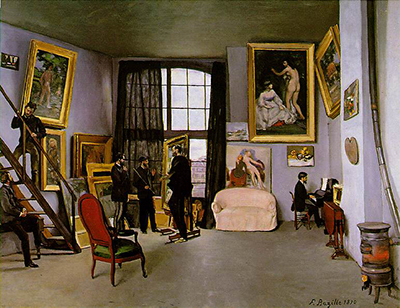
1867–1868 (museum)Bazille’s Studio, Rue La Condamine
1869–1870Summer Scene (Bathers)
1869–1870Contents
- A bench across the path
- Flowers carrying the light
- Méric and the summer of 1867
- The woman and the question of completion
- Other figures in the southern garden
- From a family painting to Cincinnati
A bench across the path
The bench is unusually prominent for so slight an object. Its long green back cuts across the pale ground, supported by narrow, loosely stated legs. It appears almost weightless beside the thick flowering bushes. Yet its position controls the view. We look across its length before entering the space beyond, as though the painter has placed a low barrier between our shaded position and the open path.
The ground remains visible around and beneath it. The bench both interrupts the view and measures the garden’s depth: a familiar object helps establish the distance to the much larger shrubs behind. Its green connects it to the planting, while its straight manufactured line differs sharply from the irregular leaves.
At the left, a dark tree trunk rises from a crowded foreground bed. The trunk and the bench form a rough upright and crossbar, but the arrangement never becomes a rigid framework. Leaves break the upper edge into small openings; flowers spill beyond the beds’ apparent boundaries; the bench runs towards a person whose shape is much less settled. Firm directions coexist with forms that spread and overlap.
The path widens into a brilliant patch behind the bench and narrows towards an opening on the left. It offers a route around the planting rather than a straight vista to a distant horizon. This is an enclosed garden, and Bazille makes its turns interesting. We can follow the ground towards the building, then return across the large flower masses, discovering the composition through short movements between near and far.
A fragment of architecture appears beyond the left-hand tree. Schulman identifies it as Méric’s greenhouse, with an arched opening and window. Only a portion is shown, so its pale wall and dark apertures serve as glimpses of a larger domestic setting. The house and garden are close together, but the vegetation commands the view. [2]
Flowers carrying the light
The two principal flowering masses differ in both colour and shape. Pink blossoms gather into a rounded form near the centre; a paler, cream-coloured mass rises to its right. Dark gaps between the flowers keep these shrubs from dissolving into flat patches. Their density is part of their impact: the light seems to catch many separate surfaces within a substantial volume.
The title directs attention to the oleanders. It names a plant subject within a larger garden scene, rather than promising a close botanical study. Schulman also identifies the low orange-flowered planting at the left as nasturtiums and the large framing tree as a chestnut. These identifications help describe the cultivated setting; the picture’s organisation remains readable through the different heights, textures and colours of the planting. [2]
The low bed has an opposite effect to the pale flowers farther back. Its rounded leaves lie mostly in shadow, punctuated by orange-red touches. Those small hot accents make the foreground active without opening it to the same bright illumination as the path. A leaf can remain dark while a flower beside it flashes into view. Light is distributed selectively across the scene.
Very little uninterrupted sky survives. Small blue and pale openings between leaves are enough to suggest brightness overhead, while the ground does most of the work of conveying the strength of the sun. The pale path has far less internal pattern than the plants around it. Against their busy surfaces, its broad, nearly continuous light becomes a commanding shape.
The canopy has its own variety. Dark clusters overlap lighter leaves, with gaps preventing the upper half from becoming a solid black band. Below, the boundary between shade and sun crosses the ground at an angle. These contrasts allow the garden to feel sheltered and intensely illuminated at once. The viewpoint belongs to the shelter: we encounter the brightness from beneath the trees.
The relationship between exposed ground, shaded ground and foliage catching light establishes the summer atmosphere without fixing a particular hour.
Méric and the summer of 1867
Méric was a recurring source of subjects during Bazille’s returns from Paris. Michel Hilaire describes its planted walks, flowering shrubs, access to the river and gatherings of relatives and friends as an environment particularly suited to his search for contemporary outdoor subjects. A familiar family place could furnish landscapes, portraits and encounters between people and their surroundings. [3]
In Oleanders, that familiarity appears through the garden’s practical organisation. There is a path to walk along, planting to look at, a bench for resting and a building nearby. These ordinary features make the scene habitable. They also show that this landscape has been arranged and tended. The flowers stand within a pattern of human use even where human beings are scarcely described.
The picture belongs to a productive period that also included Bazille’s views of Aigues-Mortes and the beginnings of Family Reunion. The 2017 exhibition checklist places Oleanders in summer 1867 and gives the larger family portrait a working span extending from that summer into early winter 1868. These were related investigations undertaken on very different scales. [1]
The Musée Fabre’s account of this period places modern figures in outdoor settings at the centre of Bazille’s artistic concerns. It also distinguishes The Terrace at Méric, a separate composition rejected by the Salon jury in 1867. Oleanders should not be confused with that larger terrace scene simply because both show the family property. Their shared setting offers points of comparison without making their architecture interchangeable. [4]
Schulman observes difficulties in reconciling the tree and greenhouse in Oleanders with the arrangement visible in The Terrace at Méric. That is a useful warning against reading either painting as a measured plan of the estate. Different viewpoints, omissions and pictorial arrangements can make a familiar place look different. The comparison cannot, on its own, establish that a tree or building was physically moved. [2]
Outdoor figure painting also involved preparation away from the garden. In his letter to his father of 6 January 1865, Bazille wrote, “I must paint a great many figures this winter,” explaining that this practice would help him use the spring and summer in the countryside. The English words here are translated from the French. The letter connects sustained study of the living model with the opportunities of outdoor work. [5]
Watch: Bazille and early Impressionism
Explore a Paris studio with Smarthistory, then discover the beginnings of Impressionism with the National Gallery of Art.
Jean-Frédéric Bazille, The Artist’s Studio, Rue Visconti, Paris
A close look at Bazille’s 1867 painting of the studio he shared in Paris.
Watch on YouTubeThe woman and the question of completion
The lightly described woman becomes easier to notice after the eye has followed the bench towards the right edge. Her full skirt spreads below a small upper body, while the surrounding greens remain visible through loosely indicated passages. She gives the bench an occupant but does not become the picture’s principal point of attention. Her personal identity is not established by the catalogue account. [2]
Flowers resolve into a dense and lively presence; the person remains elusive. The garden can appear almost unoccupied at first, then change as the figure emerges. Her placement makes the bench’s long unoccupied stretch conspicuous. An object intended for people occupies more of the composition than the person who uses it.
Schulman describes the painting as unfinished, while also reporting Paul Perrin’s observation that it is signed. Helga Kessler Aurisch, writing in the Museum of Fine Arts, Houston’s catalogue, draws out the implication: Bazille apparently regarded Oleanders as finished in 1867 despite its sketchy woman. The judgement therefore turns on more than the amount of detail in one figure. [2] [6]
A signature is evidence that the artist put his name to a work, but it cannot explain every decision about its surface. Nor does a loosely stated passage supply a reason why painting stopped. What can be said securely is that the contrast between highly developed flowers and a schematic figure survives alongside Bazille’s signature and date. His intentions beyond that remain uncertain. [2]
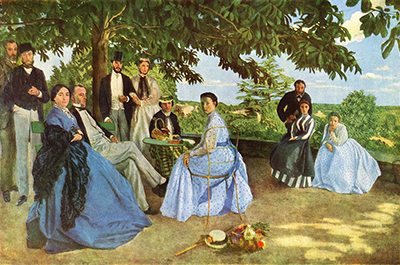
There is a useful distinction from the changes documented in Family Reunion. Bruno Mottin’s laboratory study identifies alterations to figures in that canvas, including the addition of Bazille’s own portrait. Those findings concern the larger painting specifically. They demonstrate how a garden composition could develop through revision, but they do not establish a hidden sequence of changes beneath Oleanders. [7]
The woman’s economical description leaves the picture ambiguous without weakening the garden’s structure. Bench, path and flowers establish a convincing place even though its sole occupant is scarcely brought into focus.
Other figures in the southern garden
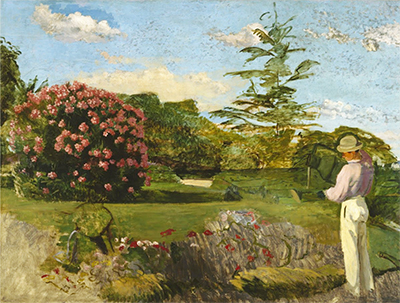
The Little Gardener provides the closest comparison. Aurisch emphasises the pink oleander as a particularly developed and important element within that incomplete Houston painting. She relates it to Oleanders, while noting that the latter’s starting date is undocumented. Her suggestion that Bazille may have worked on the two pictures during overlapping summers remains a possibility, rather than a fixed timetable. [6]
The arrangements differ substantially. The gardener stands at the right of an open lawn, his pale trousers making a firm upright against the planting. In Oleanders, the green bench carries the eye sideways, and the woman’s body is absorbed into the shaded margin. Both compositions allow a flowering shrub to rival the human figure in prominence, but they establish different kinds of occupation: work performed in the garden and a person seated within it.
Aurisch also places these experiments in dialogue with Monet, whose Women in the Garden Bazille acquired and sent to Méric in 1867. Her account treats Monet’s example as part of Bazille’s development of his own outdoor painting. It helps explain why a family garden could become a site of demanding artistic work. [6]
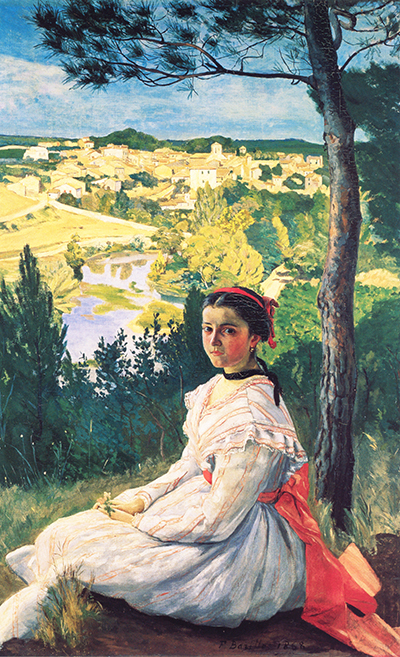
View of the Village, dated 1868, makes another revealing contrast. [1] Its seated girl turns towards the viewer beneath a tall tree, while the bright settlement expands behind her. Her face establishes a strong encounter at the threshold of the landscape. In Oleanders, attention is drawn first towards the illuminated garden, with the woman discovered at its edge. Comparing the two makes the small figure’s role clearer: she supplies human presence without governing our access to the scene.
The Little Gardener
View of the Village
From a family painting to Cincinnati
Schulman traces Oleanders from the artist’s family to his cousin Marguerite Bazille, Mme Émile Gachon, around 1932, and subsequently to her daughter, Mme Jacques Leenhardt, in Algeria around 1952. His provenance then records Wildenstein in New York around 1968 and Mark P. and Jane Thomson Herschede in Cincinnati from 1968 until the gift to the Cincinnati Art Museum in 1976. The approximate dates describe stages in the recorded ownership history, rather than exact transfer days. [2]
Its public history developed alongside that movement out of family ownership. The catalogue lists the Paris retrospective of 1910 and Montpellier retrospective of 1927, followed by exhibitions at Wildenstein in Paris in 1950 and the Musée Fabre in 1959. These appearances belong to the gradual recovery of Bazille’s work that Hilaire describes, supported first by family preservation and then by museums and historians. [2] [3]
After its arrival in Cincinnati, Oleanders appeared in Chicago’s 1978 Bazille exhibition and in Impressionism and the French Landscape in 1984–85. The garden exhibitions in Edinburgh and Madrid in 2010–11 offered another setting for the same canvas. Its inclusion in the 2016–17 Bazille retrospective brought it back into an account of the artist’s whole career; the Washington checklist names Cincinnati as lender and credits the gift of Mark P. Herschede. [2] [1]
These exhibition contexts bring different aspects of the painting forward: Bazille’s individual practice, his place in outdoor painting, and the cultivated garden as a subject. The canvas accommodates all three. The bench keeps the scene close to everyday experience, while the contrast between its fragile lines and the dense flowers leaves a lasting question about where Bazille chose to concentrate his attention.
Bazille catalogue directory
The 284 records comprise 85 painting records,40 separate works-on-paper records and 159 album or study records. They describe the catalogue’s organisation rather than 284 independent objects or unanimously accepted attributions. Recto, verso, albums and multiple studies remain distinct. Dates are qualified where needed; the Drawing filter includes the etching, gouache and mixed works on paper. Manuscript mentions and unproved projects are listed separately below.
Works known through documents
These mentions remain separate from the 284 catalogue records. Some may concern surviving studies or underlying compositions; they cannot simply be added together as missing physical paintings.
- A copy after Rubens mentioned in March 1863 is unlocated.
- A portrait of an unidentified woman was reported completed before July 1866.
- A portrait of Monet and a composition of two life-size women arranging flowers were reported in progress in April 1867. Their mention does not establish two otherwise unknown surviving canvases.
- Gertrude et le père Lapin was at least begun in the summer of 1870.
Further reported works and uncertain attributions
- A Bouquet of Lilacs was reportedly stolen and returned in 1864; a portrait of the friend Theulier and Yellow Narcissi reported by Maître in 1868 are also documentary mentions.
- Unidentified pictures associated with Guillemet and Mme Rolina are reported through later correspondence cited by the catalogue.
- Children Dressed as Bride and Groom was associated with Vallotton’s collection and also attributed to Renoir. Its identification and authorship should remain open.
Projects whose completion is unproved
- A portrait of Pauline was planned in July 1865.
- A portrait of Marc was proposed in April 1866; a related drawing survives.
- A Jardinière project appears in album inscriptions and related figure material. Written plans are not evidence of a completed painting.
| Name | Date | Medium |
|---|---|---|
| Mystic Marriage of St. Catherine | 1863 | Oil on canvas |
| Trees, Study | 1863 | Oil on canvas |
| Farm of Saint-Sauveur | 1863 | Oil on canvas |
| In the Garden of the Parc Monceau, Paris | 1864 | Oil on canvas |
| Naked Woman from Behind | 1864 | Oil on canvas |
| Reclining Nude | 1864 | Oil on canvas |
| Courtyard of the Auberge du Cheval blanc at Chailly near Barbizon | 1864 | Oil on canvas |
| Covered Soup Bowls | 1864 | Oil on canvas |
| Two Herrings | 1864 | Oil on canvas |
| The Pink Dress | 1864 | Oil on canvas |
| The Dog Rita Asleep | 1864 (catalogue); c. 1864 (2017 checklist) | Oil on canvas |
| The Scoter | 1864 | Oil on canvas |
| Naked Reclining Woman | 1864 | Oil on canvas |
| Landscape at Chailly | 1865 | Oil on canvas |
| Rocks at Chailly, Forest of Fontainebleau | 1865 | Oil on canvas |
| Undergrowth at Chailly, Forest of Fontainebleau | 1865 | Oil on canvas |
| Still Life with Grapes and Nuts | 1865 | Oil on canvas |
| Self-Portrait with a Palette — Chicago | 1865 | Oil on canvas |
| Landscape of Saint-Sauveur | 1865 | Oil on canvas |
| Beach at Sainte-Adresse | 1865 | Oil on canvas |
| The Improvised Field Hospital | 1865 | Oil on canvas |
| Village Street, Chailly | 1865 | Oil on canvas |
| Small Valley in the Forest of Fontainebleau | 1865 | Oil on canvas |
| Forest of Fontainebleau | 1865 | Oil on canvas |
| Woman Ironing | 1866 | Oil on canvas |
| The Artist's Studio on the rue de Furstenberg | 1865–66 (museum) | Oil on canvas |
| Still Life with Fish | 1866 | Oil on canvas |
| Little Italian Street Singer | 1866 | Oil on canvas |
| Potted Flowers | 1866 | Oil on canvas |
| The Little Gardener | 1866–1867 | Oil on canvas |
| Young Woman Playing the Piano | 1866–1867 | Oil on canvas |
| End of a Summer Day | 1866–1867 | Oil on canvas |
| A Studio on the rue Visconti | 1867 | Oil on canvas |
| Thérèse Reading in the Park at Méric | 1867 | Oil on canvas |
| Portrait of Verlaine | 1867 | Oil on canvas |
| The Terrace at Méric | 1867 | Oil on canvas |
| Still Life with Heron | 1867 | Oil on canvas |
| The Family Gathering | 1867–68 (museum) | Oil on canvas |
| Oleanders | 1867 | Oil on canvas |
| Woman on the Terrace at Méric | 1867 | Oil on canvas |
| The Ramparts at Aigues-Mortes from South | 1867 | Oil on canvas |
| The Western Ramparts at Aigues-Mortes | 1867 | Oil on canvas |
| Portrait of Edmond Maître — head study | 1867 | Oil on canvas |
| Porte de la Reine at Aigues-Mortes | 1867 | Oil on canvas |
| Portrait of Sisley | 1867 | Oil on wood |
| Portrait of Renoir — Cleveland | 1867 | Oil on canvas |
| Portrait of Renoir — Musée d’Orsay | 1867 | Oil on canvas |
| Self-Portrait with a Detachable Collar — Minneapolis | 1865–67 (museum); 1867–68 (catalogue) | Oil on canvas |
| Vase of Flowers on a Console | 1868 (museum); 1867–68 (catalogue) | Oil on canvas |
| Portrait of a Woman | 1868 | Oil on canvas |
| Young Woman in the Vineyards | 1868 | Oil on card |
| Harvester with a Basket | 1868 | Oil on card |
| Harvester with a Yellow Hat | 1868 | Oil on card |
| Harvester with a Headdress | 1868 | Oil on panel |
| On the Banks of the Lez | 1868 | Oil on canvas |
| After the Bath (attribution questioned) | 1868? | Oil on canvas |
| Young Woman with Lowered Eyes | 1868 | Oil on canvas |
| Fisherman with a Net | 1868 | Oil on canvas |
| View of the Village | 1868 | Oil on canvas |
| Portrait of Bazille (attributed to Monet by Musée Fabre; disputed catalogue attribution) | 1864 (museum); 1868 (catalogue) | Oil on panel |
| Studies for a Grape Harvest (two panels) | 1868 | Oil on canvas (two panels) |
| The Fortune Teller | 1868–69 (catalogue); c. 1869–70 (2017 checklist) | Oil on canvas |
| Harvester with a Cap | 1869 | Oil on card |
| Portrait of Edmond Maître — 1869 | 1869 | Oil on canvas |
| Woman in a Moorish Costume | 1869 | Oil on canvas |
| Young Woman in the Garden | 1869 | Oil on canvas |
| Portrait of Alphonse Tissié in a Cavalryman's Uniform | 1869 | Oil on canvas |
| Portrait of a dragoon | 1869 | Oil on canvas |
| Portrait of Zacharie Astruc | 1869 | Oil on canvas |
| Bunch of Grapes in a Bucket | 1869 | Oil on card |
| Portrait of Edouard Blau | Probably 1869; inscribed 1866 | Oil on canvas |
| Young Male Nude Lying on the Grass | 1870 | Oil on canvas |
| Summer Scene | 1869–1870 | Oil on canvas |
| The Studio on the rue La Condamine | 1869–1870 | Oil on canvas |
| La Toilette | 1870 | Oil on canvas |
| Young Woman with Peonies — Montpellier | 1870 | Oil on canvas |
| Young Woman with Peonies — Washington | 1870 | Oil on canvas |
| Monotonous Chant | 1870 | Oil on canvas |
| Flowers — private collection | 1870 | Oil on canvas |
| Flowers — Musée Fabre | 1870 | Oil on canvas |
| Young Fisherman | 1870 | Oil on canvas |
| Study for Ruth and Boaz | 1870 | Oil on wood |
| Ruth and Boaz | 1870 | Oil on canvas |
| Self-Portrait in Shirt Sleeves | 1870 | Oil on canvas |
| Landscape on the Banks of the Lez | 1870 | Oil on canvas |
| Study after an Alpine Landscape | 1860 | Graphite on watercolour-tinted paper |
| Profile Head | 1862 | Charcoal on laid paper |
| Studies after Delacroix | 1863 | Ink and graphite, with gouache and watercolour, on paper |
| Academic Head | 1863 | Charcoal on paper |
| Study of a Woman's Head in Profile on a Chair | 1863 | Charcoal on paper |
| Academic Head of a Woman | 1863 | Charcoal on paper |
| Academy of Woman | 1863 | Black pencil and charcoal, stumped, on watermarked laid paper |
| Academy of Man | 1863 | Black pencil and charcoal, stumped, on watermarked laid paper |
| Naked Man | 1863 | Charcoal on paper |
| The Pont au Change in Paris | 1864 | Watercolour on paper |
| Study for the Pink Dress or Portrait of Thérèse des Hours | 1864 | Black pencil on paper |
| Naked Woman Standing | 1864 | Pencil on paper |
| Study of a Reclining Nude | 1864 | Charcoal on paper |
| Bathers | 1864 | Charcoal on paper |
| Portrait of a Man | 1864 | Charcoal on paper |
| Study for The Pink Dress | 1864 | Black pencil, squared, on paper |
| Study for Landscape of Saint-Sauveur | 1864 | Graphite on paper |
| Study for Landscape of Saint-Sauveur | 1865 | Pencil on paper |
| Man Taming a Bull | 1866 | Pen and black pencil on paper |
| Man Half Lying on a Sofa | 1866 | Charcoal on paper |
| Study for The Family Gathering | 1867 | Pencil on paper |
| Study for The Family Gathering | 1867 | Graphite, charcoal and black pencil on paper |
| The Embroiderer | 1867 | Pencil on pink paper |
| Study of Children | 1867 | Pencil on paper |
| Women in a Garden | 1867 | Pencil drawing |
| View of the Village | 1868 | Etching on paper |
| Portrait of a Bearded Man (catalogued as Self-Portrait) | Undated (museum); 1869 (catalogue) | Charcoal and brown ink |
| Man Smoking Pipe | 1869 | Watercolour on paper |
| Manet Drawing | 1868–70(?) (museum) | Charcoal and white chalk on paper |
| Study for the Summer Scene | 1869 | Charcoal, pen and ink on paper |
| Family Portrait | 1869 | Pastel and charcoal on paper |
| Study for Ruth | 1870 | Pencil and charcoal on paper |
| Woman Arranging a Hat | 1870 | Pencil drawing |
| Study for Boaz Asleep | 1870 | Pastel and red chalk |
| Boaz Asleep | 1870 | Charcoal and pencil on paper |
| Study for Boaz Asleep | 1870 | Black and beige pastel with red chalk on laid paper |
| Ruth Lying down | 1870 | Charcoal and pastel on paper |
| Head, Arm and Chest of Ruth | 1870 | Charcoal on paper |
| Chest of Ruth | 1870 | Black chalk and charcoal on paper |
| Black Woman with Peonies — gouache | c. 1870 | Gouache, watercolour, pencil and black chalk on card |
| Various Unidentified Subjects | Undated | Pencil drawing |
| Rocky Sea Side | Undated | Charcoal on paper |
| Studies of a Dancing Woman | Undated | Drawing with white chalk |
| Study of a Leg | Undated | Pencil drawing |
| Dancers in Camargue | Undated | Pencil drawing |
| Academy of Woman | Undated | Charcoal |
| Caricature of Venus of Milo and Various Other Caricatures | Undated | Charcoal |
| Caricature | Undated | Pencil drawing |
| Study of Landscape | Undated | Charcoal |
| Caricatures and Seated Monk | Undated | Charcoal |
| Caricatures and Various Subjects | Undated | Pencil drawing |
| Women Carrying a Pitcher | Undated | Pencil drawing |
| The Hanged Man | Undated | Charcoal |
| Castle in the Plain | Undated | Charcoal |
| Naked Woman from Behind | Undated | Charcoal |
| Caricatures | Undated | Charcoal and pencil |
| Unidentified Subjects | Undated | Pencil drawing |
| Landscape with a Castle | Undated | Charcoal |
| Study of Landscape | Undated | Charcoal |
| Horse Rider seen from Behind | Undated | Charcoal |
| Mazeppa | Undated | Pencil and charcoal |
| Study of Rider and Others Subjects | Undated | Pencil, pen and brown ink |
| Study of an Unidentified Man | Undated | Pencil drawing |
| Study for an Unknown Historic Scene | Undated | Pencil drawing |
| Study a Man Reading | Undated | Pencil drawing |
| Study of Men Reading | Undated | Pencil drawing |
| Study of Landscape ? | Undated | Charcoal |
| Study of a Head of a Man | Undated | Pencil drawing |
| Erotic Scene | Undated | Pencil drawing |
| Study of Dog | Undated | Charcoal |
| Studies of Unidentified Subjects and Erotic Scene | Undated | Pencil and charcoal drawing |
| Study for a Theater Scene | Undated | Charcoal |
| Study of a Reclining Naked Woman | Undated | Charcoal |
| Two Studies of Landscape | Undated | Pencil drawing |
| Caricature | Undated | Pencil and charcoal drawing |
| Portrait of an Unidentified Young Man | Undated | Charcoal |
| Study of an Unidentified Subject | Undated | Brown ink drawing |
| Unidentified Man with a Hat | Undated | Pencil and charcoal |
| Study of an Unidentified Women | Undated | Pencil drawing |
| Study for a Theater Character ? | Undated | Pencil drawing |
| Study for a Theater Character ? | Undated | Pen drawing |
| The Pavillon de la Reine in Paris | Undated | Pencil drawing |
| Study of a Horse Rider | Undated | Pencil and charcoal drawing |
| Entwined Couple. Caricature ? | Undated | Pencil drawing |
| Woman Sitting on a Sofa | Undated | Pencil drawing |
| Studies of Unidentified Subjects | Undated | Pencil and charcoal drawing |
| Studies of Animals | Undated | Pencil drawing |
| Study of a Horse Rider in Camargue | Undated | Charcoal |
| Study of Hunting Dogs | Undated | Pencil drawing |
| Study of Soldiers. Caricatures | Undated | Pencil drawing |
| Studies of Hunting Dogs ? | Undated | Pencil drawing |
| Hunting Scene. Hunter Playing the Horn | Undated | Pencil drawing |
| Caricature | Undated | Pencil drawing |
| Study of an Ibex | Undated | Pencil drawing |
| Theater Scene. Caricatures | Undated | Pencil drawing |
| Studies of Animals. Horses ? | Undated | Pencil drawing |
| Caricatures | Undated | Pencil drawing |
| Studies of Various Subjects and Animals | Undated | Pencil drawing |
| Unidentified Subject | Undated | Pencil drawing |
| Rider Taming a Horse [in Camargue ?] | Undated | Pencil drawing |
| Caricature of a Soldier | Undated | Pencil drawing |
| Study of a Woman and Mouse | Undated | Pencil drawing |
| Historic Scene | Undated | Charcoal |
| Architecture Studies | Undated | Pencil drawing |
| Mythologic Scene | Undated | Charcoal |
| Ophelia | Undated | Pencil drawing |
| Mythologic Scene | Undated | Charcoal |
| Studies of Various Subjects | Undated | Pencil and pen drawing |
| Studies of Peasants | Undated | Pencil drawing |
| Historic Scene | Undated | Pencil drawing |
| Historic or Literary Scene | Undated | Pencil drawing |
| Unidentified Historic Scene | Undated | Pencil drawing |
| Studies of Unidentified Subjects | Undated | Pencil drawing |
| Unidentified Study | Undated | Pencil drawing |
| Man in an Armchair | Undated | Pencil drawing |
| Studies of Various Subjects | Undated | Pencil drawing |
| Portraits of Unidentified Men | Undated | Pencil drawing |
| Studies of Various Subjects | Undated | Pencil drawing |
| Horse Rider and Artist | Undated | Charcoal and pencil |
| Study of Unidentified Characters | Undated | Charcoal |
| Dead Horse in a Plain | Undated | Charcoal |
| Study of Various Subjects and Furniture | Undated | Pencil drawing |
| Caricatures and Various Notes about Opéra | Undated | Pencil drawing |
| Galloping Horse | Undated | Charcoal |
| Study for La Toilette | Undated | Pencil drawing |
| Study of a Naked Woman | Undated | Pencil drawing |
| Domestic Scene | Undated | Pencil drawing |
| Physiognomies | Undated | Pencil drawing |
| Study for a Grape Harvest | Undated | Pencil drawing |
| Study for the Summer Scene | Undated | Pencil drawing |
| Female Profiles | Undated | Pencil drawing |
| Various Subjects | Undated | Pencil drawing |
| Study for The Terrace at Méric | Undated | Pencil drawing |
| Study for The Ramparts at Aigues-Mortes | Undated | Pencil drawing |
| Study for The Ramparts at Aigues-Mortes | Undated | Pencil drawing |
| Study for a Grape Harvest | Undated | Charcoal |
| Children Portraits | Undated | Pencil drawing |
| Study for Children's Heads | Undated | Pencil drawing |
| Study of Minerva | Undated | Pencil drawing |
| Study for a Grape Harvest | Undated | Pencil drawing |
| Study for The Family Gathering | Undated | Pencil drawing |
| Study for a Young Fisherman | Undated | Charcoal |
| Self-Portraits | Undated | Black pencil drawing |
| Study of Horses for the Porte de la Reine at Aigues-Mortes | Undated | Ink drawing |
| Study of Horses for the Porte de la Reine at Aigues-Mortes | Undated | Ink drawing |
| Study of Horses for the Porte de la Reine at Aigues-Mortes | Undated | Ink drawing |
| Study for an Outdoor Concert | Undated | Pencil drawing |
| Studies of Legs | Undated | Pencil drawing |
| Study for The Ramparts at Aigues Mortes | Undated | Pencil drawing |
| Studies of Hats | Undated | Pencil drawing |
| Studies of Men | Undated | Pencil drawing |
| Study for The Little Gardener | Undated | Pencil drawing |
| Study for The Ramparts at Aigues Mortes | Undated | Charcoal |
| Studies of Sail Boats | Undated | Pencil drawing |
| Portrait of Marc Bazille | Undated | Charcoal, black pencil and graphite |
| Studies of Children's Heads | Undated | Pencil drawing |
| Study for Aigues-Mortes | Undated | Pencil drawing |
| Studies of Women's Heads | Undated | Pencil drawing |
| Portrait of Camille des Hours and an Unidentified Man | Undated | Charcoal |
| Study of Flying Birds | Undated | Charcoal or graphite |
| Study for the Summer Scene | Undated | Pencil drawing |
| Study of Hands | Undated | Pen drawing |
| Self-Portrait | Undated | Black pencil drawing |
| Study for the Summer Scene | Undated | Pencil drawing |
| Study for the Summer Scene | Undated | Pencil drawing |
| Study for a Grape Harvest | Undated | Pencil drawing |
| Study of Branches | Undated | Pencil drawing |
| Study of a Seated Child | Undated | Pencil drawing |
| Study for a Couple and Unidentified Women | Undated | Pencil drawing |
| Studies of Unidentified Women | Undated | Pencil drawing |
| Study of Buildings | Undated | Pencil drawing |
| Study for a Grape Harvest | Undated | Pencil and charcoal |
| Studies of Boaters | Undated | Pencil drawing |
| Study of a Man Writing at his Table | Undated | Pencil drawing |
| Study of a Woman Cutting Flowers | Undated | Pencil drawing |
| Study of Hand | Undated | Pencil drawing |
| Women in a Garden | Undated | Pencil drawing |
| Studies of Women in Profile | Undated | Pencil drawing |
| Study for Ruth and Boaz | Undated | Charcoal |
| Study for The Family Gathering | Undated | Pencil drawing |
| Study for the View of the Village | Undated | Pencil drawing |
| Study of the View of the Village | Undated | Pencil drawing |
| Study for the Fisherman with a Net | Undated | Pencil drawing |
| Study for the View of the Village | Undated | Charcoal |
| Study for The Little Gardener | Undated | Charcoal |
| Portrait of a Man with a Top Hat | Undated | Pencil drawing |
| Portrait of a Man with a Top Hat | Undated | Pencil drawing |
| Inscriptions | Undated | Pencil inscriptions |
| Study of Tree | Undated | Pencil drawing |
| Caricature of Nina la Belle | Undated | Pencil drawing |
| Study for Saint Sebastian | Undated | Pencil drawing |
| Young Woman Sewing | Undated | Pencil drawing |
| Studies of Hands | Undated | Pencil drawing |
| Woman in a Garden | Undated | Pencil drawing |
| Elegant Woman | Undated | Pencil drawing |
| Various Inscriptions | Undated | Inscriptions (medium unspecified in index) |
| Study of a Man with a Hat | Undated | Pencil drawing |
| Study of a Child | Undated | Pencil drawing |
| Study of a Man with a Hat | Undated | Pencil drawing |
Frequently Asked Questions
The National Gallery of Art’s 2017 exhibition checklist records it in the Cincinnati Art Museum. [1]
Discussion
The garden’s dense plants surround quieter intervals. Where do the bench and lightly indicated woman change your route?
Reader Insights
How does the green bench make you look across the path before entering the garden?
What changes when the lightly indicated woman becomes visible at the right edge?
Compare the flowers’ density with the figure’s abbreviated form. Where does the painting concentrate its attention?
Join the Conversation
Share a detail, comparison or question about Oleanders (Les Lauriers Roses) by Frédéric Bazille below.
References
- National Gallery of Art, Frédéric Bazille and the Birth of Impressionism, exhibition checklist, 2017, p. 5, cat. 39; also cats. 32, 42 and 45. Institutional checklist. View source.
- Michel Schulman, Oleanders (Les Lauriers Roses), MSb-36, Frédéric Bazille: The Digital Catalogue Raisonné, metadata, provenance, exhibitions and critical essay. Catalogue entry (English translation of French catalogue; French metadata). View source.
- Michel Hilaire, “Bazille ou la vie brève,” Académie des Sciences et Lettres de Montpellier, 2016, pp. 166–172, especially pp. 166 and 169–170. Lecture (in French). View source.
- Musée Fabre, Frédéric Bazille: la jeunesse de l’impressionnisme, exhibition press dossier, 2016, pp. 16–18. Museum dossier (in French). View source.
- Frédéric Bazille, letter to his father, 6 January 1865, Musée Fabre, inventory 92.2.1, manuscript facsimile p. 2 and transcription p. 4. Letter (in French; English quotation translated here). View source.
- Helga Kessler Aurisch, “The Little Gardener,” The Beck Collection, Museum of Fine Arts, Houston, main essay. Museum catalogue. View source.
- Bruno Mottin, “L’œuvre de Frédéric Bazille (1841–1870) examiné au laboratoire,” Technè 46 (2018), pp. 30–38, especially paragraphs 11–14. Technical study (in French). View source.
- Joconde/POP, La Robe rose, RF2450. View source. (in French).
- Musée d’Orsay, L’Ambulance improvisée, RF 1967 5. View source. (in French).
- Musée d’Orsay, Réunion de famille,RF2749. View source. (in French).
- Musée d’Orsay, Pierre Auguste Renoir,DL1970 3. View source.
- Musée Fabre, Vue de village, 898.5.1. View source. (in French).
- National Gallery of Art, Young Woman with Peonies,1983.1.6. View source.
- Michel Schulman, painting index and documentary introduction (English titles; French metadata). View source.
- Michel Schulman, works-on-paper index (English titles; French metadata). View source.
- Michel Schulman, albums and studies index (English titles; French metadata). View source.
 Frederic Bazille.jpg)