


 by Tom Gurney
Tom Gurney BSc (Hons) is an art history expert with over 20 years experience
Email: tomgurney1@gmail.com / Phone: +44 7429 011000
Ruth and Boaz by Frédéric Bazille: Introduction
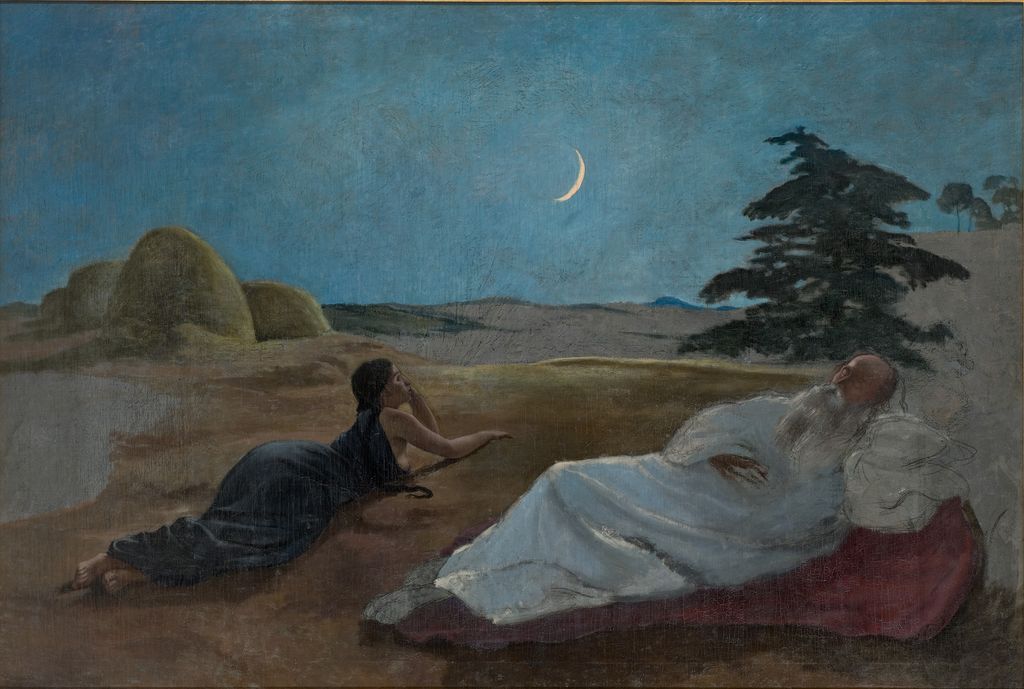
A bright crescent hangs over a wide, quiet landscape. Below it, a woman in dark drapery rests on the ground while a white-bearded man sleeps beside her. Frédéric Bazille's Ruth and Boaz brings a biblical encounter into a spare nocturnal world, where a few large shapes carry almost the entire scene. Painted in 1870 and left unfinished, the oil on canvas measures 137.5 × 202.8 cm. It belongs to the Musée Fabre in Montpellier, which acquired it in 2004. [1]
The subject gives an unexpected turn to Bazille's exploration of people in landscape. Here, contemporary dress and recognisable social encounters give way to ancient figures and a literary night. The Musée Fabre's account places the painting between the Book of Ruth and Victor Hugo's poem Booz endormi, with Millet and Puvis de Chavannes as useful artistic comparisons. Its unfinished passages also make the act of construction unusually visible. [2]
At a Glance
- Date1870; unfinished [1]
- MediumOil on canvas [1]
- Dimensions137.5 × 202.8 cm [1]
- CollectionMusée Fabre, Montpellier, 2004.13.1 [1]
This work across Frédéric Bazille’s career
Family Reunion
1867–1868 (museum)Bazille’s Studio, Rue La Condamine
1869–1870Summer Scene (Bathers)
1869–1870Contents
- Two figures beneath a crescent moon
- The biblical encounter and Hugo's night
- Drawings, an oil study and a changing design
- A place beside Millet and Puvis de Chavannes
- The earlier painting beneath the night scene
- An unfinished work from the final summer
- From private ownership to the Musée Fabre
- Annotated details
Two figures beneath a crescent moon
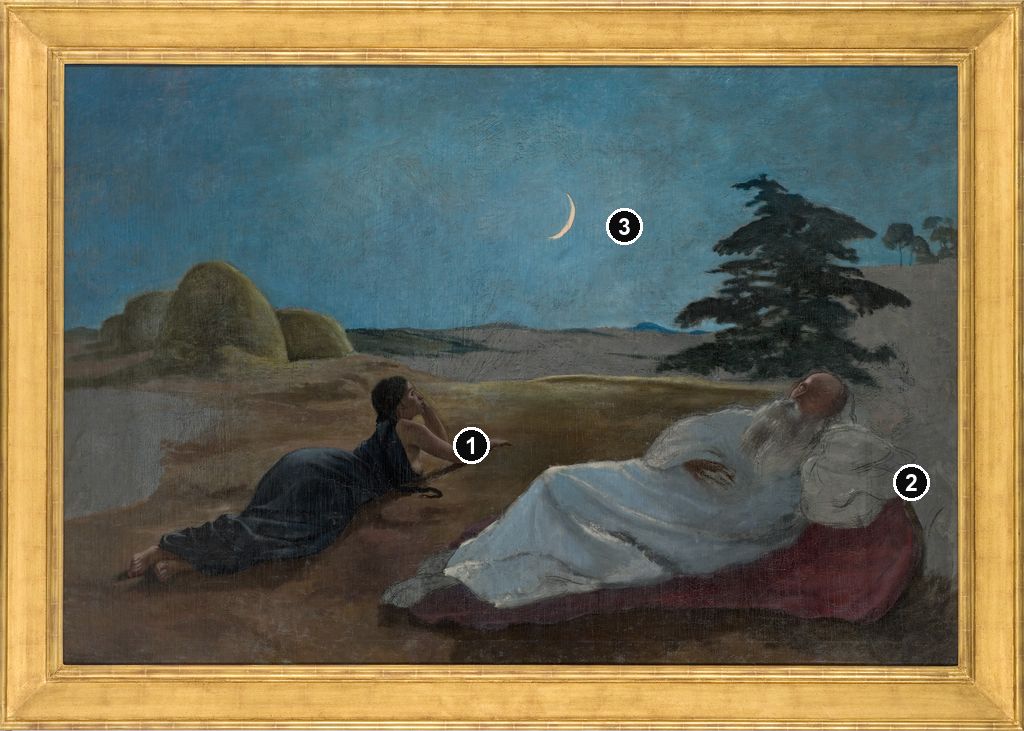
The composition first divides into broad horizontal zones: brown foreground, a low stretch of distant land and an extensive blue sky. Against those bands, the harvest heaps on the left and the dark tree on the right act as uneven weights. The tree rises much higher, but the pale-clothed sleeper beneath it pulls attention back towards the ground. Between the two sides lies an open interval, with the crescent suspended above it.
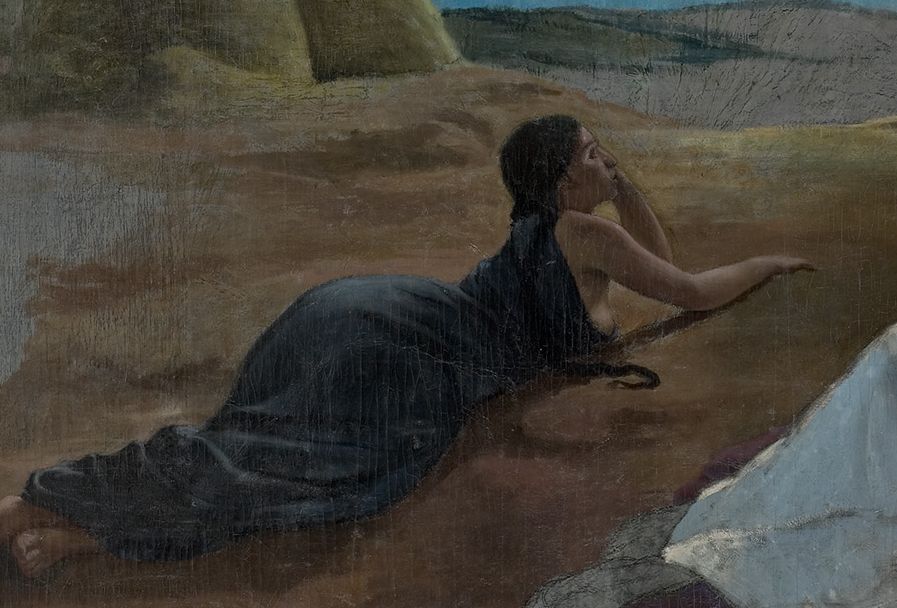
Ruth occupies the left foreground. Her body extends diagonally from the lower-left corner towards the centre, where she raises her head and upper torso. Her dark garment forms a long, folded mass, broken by the exposed arm, shoulder and feet. One hand supports her head; the other arm reaches forward with an open palm. That small gesture matters because so much else is still. It gives her presence an alertness that distinguishes her from the sleeping man.
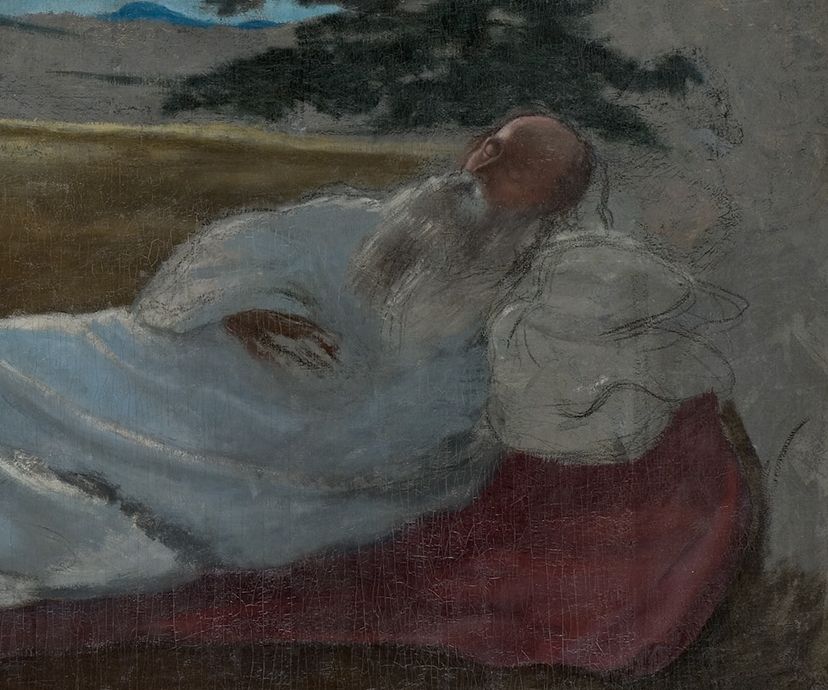
Boaz is larger and nearer. His pale robe spreads across the right foreground, its folds moving towards the left while his head rests near the right edge. A reddish support beneath him separates the light fabric from the earth. The beard descends over his chest, extending the light shape around his face. Yet the area beside his head and supporting arm remains conspicuously unresolved: dark drawn lines describe forms that paint has only partly filled.
The contrast between the figures is more than a difference of colour. Ruth's pose lifts her towards the space above the horizon; Boaz's weight settles into the lower edge. She offers the viewer a way to remain awake within the scene. He makes sleep physically convincing through the long descent of cloth and the reclining head. Neither figure addresses us directly, so looking at the painting feels like entering an interval they do not know is being observed.
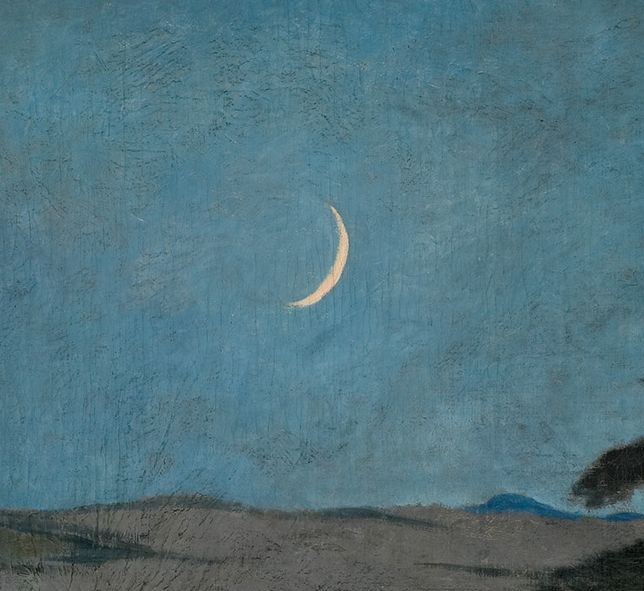
The moon supplies a third focus. Small in area, it is exceptionally clear against the surrounding blue. It neither floods the foreground with theatrical illumination nor turns every object into a sharply lit silhouette. The night remains a field of muted colours. The warm brown ground, blue-black clothing, pale robe and dark green tree can be read separately, although their relationships are quieter than in a daylight scene.
Notice how little architecture or incidental activity interrupts that arrangement. There is no crowd to explain the story and no elaborate building to locate it. Harvest heaps, a tree, distant terrain and two bodies establish the place. This economy gives the crescent unusual importance: the eye can return to it repeatedly without encountering competing detail. It also makes the landscape feel larger than the narrow band of land would suggest.
The biblical encounter and Hugo's night
In the Book of Ruth, the meeting belongs to a story of widowhood, migration, work and family obligation. Ruth, a Moabite widow, accompanies her mother-in-law Naomi and gleans in fields belonging to Boaz. He protects her and allows her to gather grain. Naomi later directs Ruth to approach him at the threshing floor after his meal. Ruth lies at his feet; when he wakes, she asks him to extend his protection as a relative. Their marriage follows the settlement of another kinsman's prior claim. Their son Obed becomes the grandfather of David. The sleeping encounter is therefore one moment in a much longer account of belonging and continuity. [3]
Hugo enlarges the night into a meditation on age, expectation and the heavens. In the closing portion of Booz endormi, Boaz sleeps without knowing that Ruth is beside him. Ruth remains awake beneath a crescent that she imagines as a golden sickle abandoned by a divine harvester among the stars. The harvest on earth acquires a counterpart in the sky. Her looking becomes the poem's final event, replacing outward action with an image that joins the human scene to a much wider order. [4]
The poem appeared in the first series of La Légende des siècles in 1859. The Bibliothèque nationale de France preserves and discusses Hugo's manuscript of Booz endormi, dated 1 May that year. Bazille was thus working with a nineteenth-century reimagining of scripture as well as an ancient story. [5]
The painted crescent makes that literary connection especially persuasive. The biblical chapter describes grain, food, a sleeping place and the conversation after Boaz wakes; Hugo's ending directs attention to Ruth's consciousness of the moon. Bazille's broad sky gives a comparable prominence to looking and waiting. The relationship is strongest at this level of attention and atmosphere; individual objects need not translate particular lines. [3] [4]
There are differences too. Words can tell us what a sleeper dreams or what Ruth wonders; paint has to offer bodies, gestures and surroundings from which we form an understanding. Here the open hand, raised head and isolated crescent make thought imaginable without spelling it out. The distance between the figures helps: they share a night, yet sleep and wakefulness keep their experiences apart.
A biblical subject also allows a religious reading, but it cannot by itself establish the painter's private convictions. The important relationship here is visible and specific: a scriptural story passes through a modern poem into a painting that makes the landscape an active part of the encounter. The subject's religious history and its literary transformation can coexist without reducing the work to an illustration of Bazille's personal faith.
Annotated Details from Ruth and Boaz
The numbered points identify visible features discussed in this article. Return from each detail to the whole composition. Each caption identifies the work shown.
Ruth and Boaz
Ruth and Boaz, photographed with its museum frame. The numbered overview retains the full native photograph. Image source. Public domain. Museum frame cropped from the photograph; painting retained.
Study for Ruth and Boaz
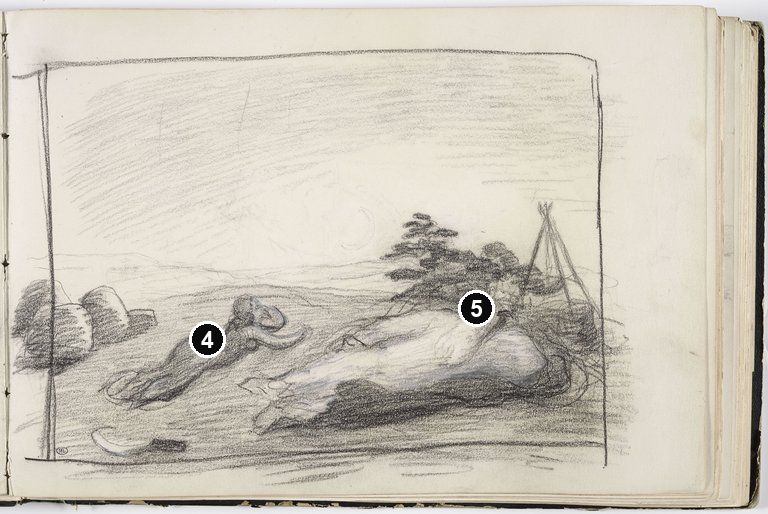
Study for Ruth and Boaz, RF 5259,65 Image source. Public domain. Whole sheet retained; resized only where needed, without enlargement.
Details from RUTH AND BOAZ
Compare the cropped details with the complete images above. Notice how their colours, shapes and positions contribute to the larger compositions.
Ruth and Boaz
Ruth’s raised head and open hand
The dark draped body rises towards an alert head and small open gesture, distinct from the sleeper beside her.
Boaz and the unresolved contours
Pale folds meet exposed drawn lines around the supporting arm and head. Different degrees of resolution remain visible together.
The crescent above the landscape
A small bright crescent interrupts the broad blue field, drawing attention upward from the reclining figures.
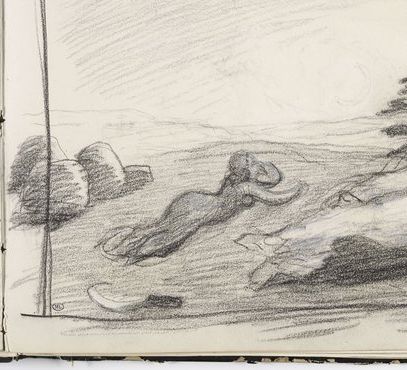
Study for Ruth and Boaz
Ruth and the sickle
The dark reclining pose and the separate sickle occupy the left part of the drawn boundary. Compare these objects with the more economical canvas.
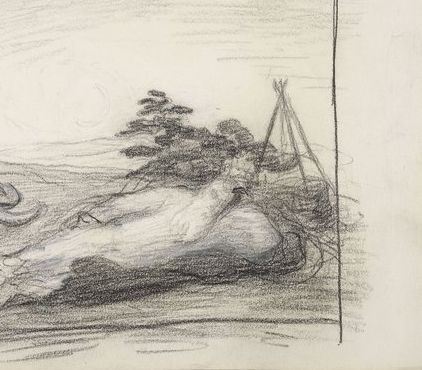
Boaz tree and tripod
Body, tree and tripod are considered together within the outlined field, revealing alternatives to the painted arrangement.
Drawings, an oil study and a changing design
The surviving preparations show sustained work on both individual poses and the whole arrangement. One particularly useful sheet is preserved in the Louvre's Department of Prints and Drawings, within the Musée d'Orsay collection: RF 5259,65, folio 50 verso. The museum dates it approximately 1869–70 and records charcoal and pastel on a sheet measuring 24.1 × 34.6 cm. It entered the collection as a gift in 1921, following André Joubin's deposit, with Marc Bazille recorded as its previous owner. [6]
The distinction between a figure study and a compositional study matters. A drawing of a head or torso can investigate the turn of a body in isolation; a drawing of the entire scene must decide how that body belongs to the landscape. The Louvre sheet belongs to the second kind. It provides a way to consider the positions of figures, horizon and objects together, before those relationships are enlarged onto the final canvas.
A small oil study on wood, catalogued as MSb-65 and dated 1870, tests the scene in colour. Measuring 20 × 32.5 cm, it remains in a private collection. Michel Schulman identifies it as the only preparatory oil sketch presently known. His comparison with the large painting notes a tripod at the right, a more pronounced distant mountain profile, different positions for the harvest heaps and a more emphatic treatment of stars and moon. The sketch also has broader brushwork, less firmly outlined figures and a brighter white robe for Boaz. These differences show how colour, pose and the distribution of landscape forms were still being tested. [7]
The catalogue discussion of the Louvre composition study also identifies a sickle at the lower left and a tripod at the right, neither retained in the large canvas. It notes a drawn boundary around the proposed composition. Such a boundary makes the problem of selection tangible: the artist is deciding what a viewer will see together and how the field of the picture will contain it. [8]
The disappearing props are especially revealing beside Hugo's poem. In the large painting, harvest is communicated by the heaps on the ground and the crescent overhead without a prominently displayed tool. That simplification leaves more space around the figures and keeps the eye moving between earth and sky. It would go too far to say that the physical sickle was deliberately removed to transfer its meaning to the moon; the surviving changes do, however, let us see the resulting visual economy. [4] [8]
These preparations also caution against treating the final image as a sudden visionary departure. Its stillness was worked towards. Changes of scale, props, landscape and pose lie behind the apparent simplicity. Bazille's drawings and sketchbooks give a broader context for this habit of testing a composition before and during work on a canvas.
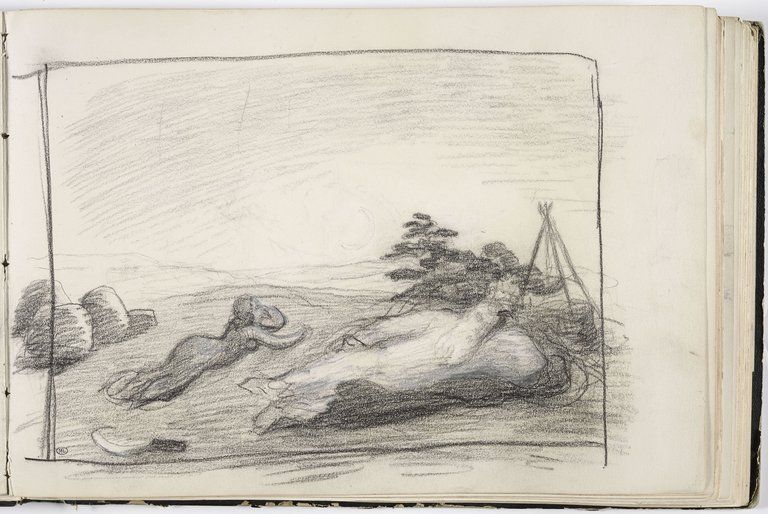
Study for Ruth and Boaz, RF 5259,65 Image source. Public domain. Whole sheet retained; resized only where needed, without enlargement.
Watch: Bazille and early Impressionism
Explore a Paris studio with Smarthistory, then discover the beginnings of Impressionism with the National Gallery of Art.
Jean-Frédéric Bazille, The Artist’s Studio, Rue Visconti, Paris
A close look at Bazille’s 1867 painting of the studio he shared in Paris.
Watch on YouTubeA place beside Millet and Puvis de Chavannes
Michel Hilaire places Ruth and Boaz within Bazille's final summer at Méric and relates its turn towards a remote, spare landscape to Puvis de Chavannes. The Musée Fabre's exhibition account makes the connection more specific, recalling Bazille's admiration for Puvis's Le Sommeil at the Salon of 1867. [9] [2]
Puvis's painting, now in Lille, offers a useful comparison because it also gives repose the scale of a major composition. The museum records it as an oil of 1867, 381 × 600 cm, and describes resting rural figures arranged through a landscape of broad horizontal divisions. It relates the subject to a passage in Virgil's Aeneid. Literary reference, physical exhaustion and a simplified setting meet in one image. [10]
Bazille's night has a much smaller cast and a single bright celestial accent. The connection helps explain the possibility he was exploring: an expansive figure painting could be built from quiet poses and an ordered landscape. It does not establish that he borrowed every formal choice from Puvis. The difference between a group of resting workers and the separate experiences of Ruth and Boaz remains central to Bazille's scene.
Millet supplies another point of contact between a biblical narrative and rural life. A French national collections record identifies a drawing as preparation for the Boston painting Ruth and Boaz, also known as Harvesters Resting, exhibited at the Salon of 1853. The paired titles preserve the connection between scripture and an apparently familiar agricultural subject. [11]
Schulman also compares Bazille's composition with Alexandre Cabanel's treatment of Ruth and Boaz of 1868. The comparison complicates a rigid division between the modern painter and academic subjects: a shared story could sustain different approaches to landscape, incident and finish. Schulman's account records an earlier critic, Gabriel Sarraute, judging Bazille's attempt harshly, while defending its simplified forms himself. Those opposed responses identify a real question in the painting: whether its spareness feels underdeveloped or makes the nocturnal encounter more concentrated. [12]
The unfinished state prevents a complete answer about its intended finish. It does not prevent us from recognising the ambition already present. The work expands the range of Bazille's subjects while continuing his concern with how a human figure occupies open space. It also makes a narrow definition of his modernity inadequate: literature and older pictorial traditions remained available to him alongside contemporary people and places.
The earlier painting beneath the night scene
There is another composition inside this canvas, invisible in an ordinary view. Bruno Mottin's laboratory study reports that Ruth and Boaz was painted over an earlier picture, with the canvas inverted. The support had been kept rolled before being stretched again in a smaller format. X-radiography revealed the underlying piano scene, identified with Bazille's lost Salon submission showing a young woman playing while a young man listens. [13]
The rejected submission belongs to the Salon of 1866. Bazille also submitted a fish still life that year, which was accepted. Hilaire's account and the Musée Fabre chronology establish that sequence; the earlier scene beneath Ruth and Boaz must be distinguished from the biblical composition painted above it four years later. [9] [2]
This finding changes the status of the lost work. Its painted surface survives as an underlying layer rather than as an independently viewable picture. An X-ray establishes that survival without recovering the earlier picture’s original colour appearance. Nor can the visible blue sky and brown ground be read as direct clues to the palette of the buried interior. The two compositions occupy the same physical support but require different kinds of looking. [13]
The change of subject is striking. A contemporary musical encounter gave way to an ancient meeting under the moon. The physical reuse does not prove that Bazille meant the later scene to comment on the earlier one. It records a practical decision about a canvas and preserves an otherwise lost stage of his work.
His Studio in the Rue La Condamine provides a useful counterpart: there, paintings and a piano belong openly to the artist's working environment. In Ruth and Boaz, a musical subject survives out of sight, beneath a different use of the same material.
An unfinished work from the final summer
The exposed drawing around Boaz makes the incompletion evident even before the documentary history is considered. Lines remain active beside finished-looking expanses of robe; the support for the head has not reached the same degree of definition as the face. Across the landscape, too, the density of paint varies. These differences let us distinguish the coherence of the overall design from the unresolved state of particular passages.
Bazille's letter to Edmond Maître of 2 August 1870, discussed by Schulman, places Ruth and Boaz among his current projects. In that account the landscape is nearly complete, while the nude study and Ruth and Boaz are still only halfway through. The letter supports the 1870 dating and gives the unfinished appearance a documentary context. It does not tell us exactly how every remaining passage would have changed. [12]
The related Young Male Nude Lying on the Grass is another late unfinished painting on a reused support. Both retain visible evidence of experiments interrupted before completion. [13] Different projects were developing at once, with earlier material entering new experiments. The Musée Fabre's account places Ruth and Boaz among the works interrupted when Bazille enlisted on 16 August 1870; he was killed at Beaune-la-Rolande on 28 November. [2] [9]
Those events explain why the canvas remained unfinished. They cannot turn its moonlit quiet into a prediction of the painter's death. Its formal decisions belong to an active investigation of a subject: how to make a night landscape hold two figures, a story and a sustained mood with relatively few elements.
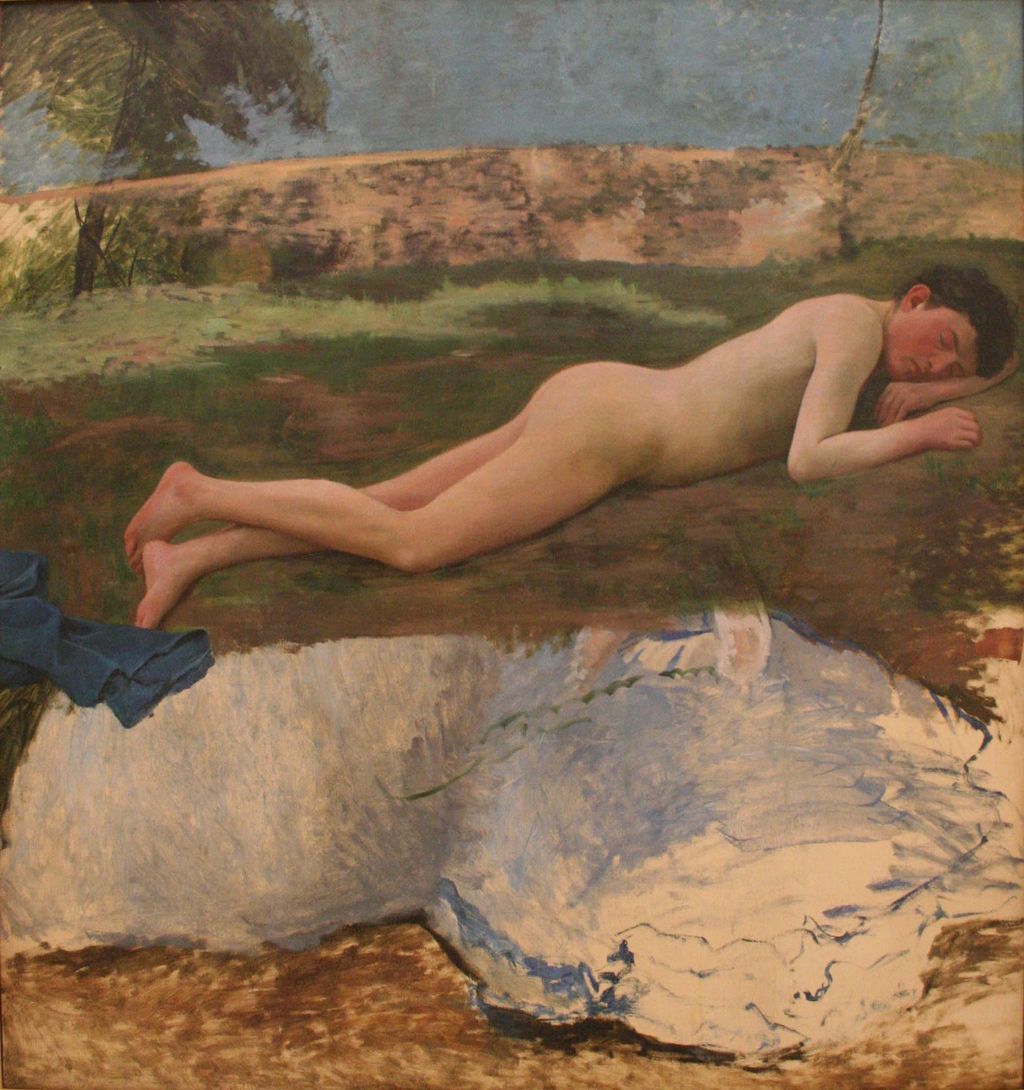
Young Male Nude Lying on the Grass Photograph: Rvalette / Wikimedia Commons. Image source. CC BY-SA 3.0. Resized proportionally; full canvas retained.
From private ownership to the Musée Fabre
The painting's public life developed long after Bazille's lifetime. The Musée Fabre records its appearance at the Wildenstein exhibition in Paris in 1950 and at the Art Institute of Chicago's Bazille exhibition in 1978. Its inclusion in the Grand Palais exhibition La Gloire de Victor Hugo in 1985–86 shows another way it has been understood: as a painting within the afterlife of Hugo's writing. Montpellier's public acquisition in 2004 brought it into the Musée Fabre collection as inventory 2004.13.1. [1]
The painting was subsequently included in the 2016–17 retrospective travelling through Montpellier, Paris and Washington. The National Gallery of Art checklist identifies it as catalogue number 72 and carefully distinguishes the canvas dimensions from its larger framed size. Seen among Bazille's portraits, landscapes and figure paintings, it enlarges the range of a career too often represented by only a few familiar works. [14]
Its special interest is the coexistence of clarity and incompletion. The main relationships are already legible: waking and sleeping, dark and pale drapery, harvested earth and open sky. Around those relationships, the exposed drawing leaves room for decisions that were never carried further. The crescent holds the scene together while the unfinished figure reminds us that its stillness was being made, passage by passage.
Bazille catalogue directory
The 284 records comprise 85 painting records,40 separate works-on-paper records and 159 album or study records. They describe the catalogue’s organisation rather than 284 independent objects or unanimously accepted attributions. Recto, verso, albums and multiple studies remain distinct. Dates are qualified where needed; the Drawing filter includes the etching, gouache and mixed works on paper. Manuscript mentions and unproved projects are listed separately below.
Works known through documents
These mentions remain separate from the 284 catalogue records. Some may concern surviving studies or underlying compositions; they cannot simply be added together as missing physical paintings.
- A copy after Rubens mentioned in March 1863 is unlocated.
- A portrait of an unidentified woman was reported completed before July 1866.
- A portrait of Monet and a composition of two life-size women arranging flowers were reported in progress in April 1867. Their mention does not establish two otherwise unknown surviving canvases.
- Gertrude et le père Lapin was at least begun in the summer of 1870.
Further reported works and uncertain attributions
- A Bouquet of Lilacs was reportedly stolen and returned in 1864; a portrait of the friend Theulier and Yellow Narcissi reported by Maître in 1868 are also documentary mentions.
- Unidentified pictures associated with Guillemet and Mme Rolina are reported through later correspondence cited by the catalogue.
- Children Dressed as Bride and Groom was associated with Vallotton’s collection and also attributed to Renoir. Its identification and authorship should remain open.
Projects whose completion is unproved
- A portrait of Pauline was planned in July 1865.
- A portrait of Marc was proposed in April 1866; a related drawing survives.
- A Jardinière project appears in album inscriptions and related figure material. Written plans are not evidence of a completed painting.
| Name | Date | Medium |
|---|---|---|
| Mystic Marriage of St. Catherine | 1863 | Oil on canvas |
| Trees, Study | 1863 | Oil on canvas |
| Farm of Saint-Sauveur | 1863 | Oil on canvas |
| In the Garden of the Parc Monceau, Paris | 1864 | Oil on canvas |
| Naked Woman from Behind | 1864 | Oil on canvas |
| Reclining Nude | 1864 | Oil on canvas |
| Courtyard of the Auberge du Cheval blanc at Chailly near Barbizon | 1864 | Oil on canvas |
| Covered Soup Bowls | 1864 | Oil on canvas |
| Two Herrings | 1864 | Oil on canvas |
| The Pink Dress | 1864 | Oil on canvas |
| The Dog Rita Asleep | 1864 (catalogue); c. 1864 (2017 checklist) | Oil on canvas |
| The Scoter | 1864 | Oil on canvas |
| Naked Reclining Woman | 1864 | Oil on canvas |
| Landscape at Chailly | 1865 | Oil on canvas |
| Rocks at Chailly, Forest of Fontainebleau | 1865 | Oil on canvas |
| Undergrowth at Chailly, Forest of Fontainebleau | 1865 | Oil on canvas |
| Still Life with Grapes and Nuts | 1865 | Oil on canvas |
| Self-Portrait with a Palette — Chicago | 1865 | Oil on canvas |
| Landscape of Saint-Sauveur | 1865 | Oil on canvas |
| Beach at Sainte-Adresse | 1865 | Oil on canvas |
| The Improvised Field Hospital | 1865 | Oil on canvas |
| Village Street, Chailly | 1865 | Oil on canvas |
| Small Valley in the Forest of Fontainebleau | 1865 | Oil on canvas |
| Forest of Fontainebleau | 1865 | Oil on canvas |
| Woman Ironing | 1866 | Oil on canvas |
| The Artist's Studio on the rue de Furstenberg | 1865–66 (museum) | Oil on canvas |
| Still Life with Fish | 1866 | Oil on canvas |
| Little Italian Street Singer | 1866 | Oil on canvas |
| Potted Flowers | 1866 | Oil on canvas |
| The Little Gardener | 1866–1867 | Oil on canvas |
| Young Woman Playing the Piano | 1866–1867 | Oil on canvas |
| End of a Summer Day | 1866–1867 | Oil on canvas |
| A Studio on the rue Visconti | 1867 | Oil on canvas |
| Thérèse Reading in the Park at Méric | 1867 | Oil on canvas |
| Portrait of Verlaine | 1867 | Oil on canvas |
| The Terrace at Méric | 1867 | Oil on canvas |
| Still Life with Heron | 1867 | Oil on canvas |
| The Family Gathering | 1867–68 (museum) | Oil on canvas |
| Oleanders | 1867 | Oil on canvas |
| Woman on the Terrace at Méric | 1867 | Oil on canvas |
| The Ramparts at Aigues-Mortes from South | 1867 | Oil on canvas |
| The Western Ramparts at Aigues-Mortes | 1867 | Oil on canvas |
| Portrait of Edmond Maître — head study | 1867 | Oil on canvas |
| Porte de la Reine at Aigues-Mortes | 1867 | Oil on canvas |
| Portrait of Sisley | 1867 | Oil on wood |
| Portrait of Renoir — Cleveland | 1867 | Oil on canvas |
| Portrait of Renoir — Musée d’Orsay | 1867 | Oil on canvas |
| Self-Portrait with a Detachable Collar — Minneapolis | 1865–67 (museum); 1867–68 (catalogue) | Oil on canvas |
| Vase of Flowers on a Console | 1868 (museum); 1867–68 (catalogue) | Oil on canvas |
| Portrait of a Woman | 1868 | Oil on canvas |
| Young Woman in the Vineyards | 1868 | Oil on card |
| Harvester with a Basket | 1868 | Oil on card |
| Harvester with a Yellow Hat | 1868 | Oil on card |
| Harvester with a Headdress | 1868 | Oil on panel |
| On the Banks of the Lez | 1868 | Oil on canvas |
| After the Bath (attribution questioned) | 1868? | Oil on canvas |
| Young Woman with Lowered Eyes | 1868 | Oil on canvas |
| Fisherman with a Net | 1868 | Oil on canvas |
| View of the Village | 1868 | Oil on canvas |
| Portrait of Bazille (attributed to Monet by Musée Fabre; disputed catalogue attribution) | 1864 (museum); 1868 (catalogue) | Oil on panel |
| Studies for a Grape Harvest (two panels) | 1868 | Oil on canvas (two panels) |
| The Fortune Teller | 1868–69 (catalogue); c. 1869–70 (2017 checklist) | Oil on canvas |
| Harvester with a Cap | 1869 | Oil on card |
| Portrait of Edmond Maître — 1869 | 1869 | Oil on canvas |
| Woman in a Moorish Costume | 1869 | Oil on canvas |
| Young Woman in the Garden | 1869 | Oil on canvas |
| Portrait of Alphonse Tissié in a Cavalryman's Uniform | 1869 | Oil on canvas |
| Portrait of a dragoon | 1869 | Oil on canvas |
| Portrait of Zacharie Astruc | 1869 | Oil on canvas |
| Bunch of Grapes in a Bucket | 1869 | Oil on card |
| Portrait of Edouard Blau | Probably 1869; inscribed 1866 | Oil on canvas |
| Young Male Nude Lying on the Grass | 1870 | Oil on canvas |
| Summer Scene | 1869–1870 | Oil on canvas |
| The Studio on the rue La Condamine | 1869–1870 | Oil on canvas |
| La Toilette | 1870 | Oil on canvas |
| Young Woman with Peonies — Montpellier | 1870 | Oil on canvas |
| Young Woman with Peonies — Washington | 1870 | Oil on canvas |
| Monotonous Chant | 1870 | Oil on canvas |
| Flowers — private collection | 1870 | Oil on canvas |
| Flowers — Musée Fabre | 1870 | Oil on canvas |
| Young Fisherman | 1870 | Oil on canvas |
| Study for Ruth and Boaz | 1870 | Oil on wood |
| Ruth and Boaz | 1870 | Oil on canvas |
| Self-Portrait in Shirt Sleeves | 1870 | Oil on canvas |
| Landscape on the Banks of the Lez | 1870 | Oil on canvas |
| Study after an Alpine Landscape | 1860 | Graphite on watercolour-tinted paper |
| Profile Head | 1862 | Charcoal on laid paper |
| Studies after Delacroix | 1863 | Ink and graphite, with gouache and watercolour, on paper |
| Academic Head | 1863 | Charcoal on paper |
| Study of a Woman's Head in Profile on a Chair | 1863 | Charcoal on paper |
| Academic Head of a Woman | 1863 | Charcoal on paper |
| Academy of Woman | 1863 | Black pencil and charcoal, stumped, on watermarked laid paper |
| Academy of Man | 1863 | Black pencil and charcoal, stumped, on watermarked laid paper |
| Naked Man | 1863 | Charcoal on paper |
| The Pont au Change in Paris | 1864 | Watercolour on paper |
| Study for the Pink Dress or Portrait of Thérèse des Hours | 1864 | Black pencil on paper |
| Naked Woman Standing | 1864 | Pencil on paper |
| Study of a Reclining Nude | 1864 | Charcoal on paper |
| Bathers | 1864 | Charcoal on paper |
| Portrait of a Man | 1864 | Charcoal on paper |
| Study for The Pink Dress | 1864 | Black pencil, squared, on paper |
| Study for Landscape of Saint-Sauveur | 1864 | Graphite on paper |
| Study for Landscape of Saint-Sauveur | 1865 | Pencil on paper |
| Man Taming a Bull | 1866 | Pen and black pencil on paper |
| Man Half Lying on a Sofa | 1866 | Charcoal on paper |
| Study for The Family Gathering | 1867 | Pencil on paper |
| Study for The Family Gathering | 1867 | Graphite, charcoal and black pencil on paper |
| The Embroiderer | 1867 | Pencil on pink paper |
| Study of Children | 1867 | Pencil on paper |
| Women in a Garden | 1867 | Pencil drawing |
| View of the Village | 1868 | Etching on paper |
| Portrait of a Bearded Man (catalogued as Self-Portrait) | Undated (museum); 1869 (catalogue) | Charcoal and brown ink |
| Man Smoking Pipe | 1869 | Watercolour on paper |
| Manet Drawing | 1868–70(?) (museum) | Charcoal and white chalk on paper |
| Study for the Summer Scene | 1869 | Charcoal, pen and ink on paper |
| Family Portrait | 1869 | Pastel and charcoal on paper |
| Study for Ruth | 1870 | Pencil and charcoal on paper |
| Woman Arranging a Hat | 1870 | Pencil drawing |
| Study for Boaz Asleep | 1870 | Pastel and red chalk |
| Boaz Asleep | 1870 | Charcoal and pencil on paper |
| Study for Boaz Asleep | 1870 | Black and beige pastel with red chalk on laid paper |
| Ruth Lying down | 1870 | Charcoal and pastel on paper |
| Head, Arm and Chest of Ruth | 1870 | Charcoal on paper |
| Chest of Ruth | 1870 | Black chalk and charcoal on paper |
| Black Woman with Peonies — gouache | c. 1870 | Gouache, watercolour, pencil and black chalk on card |
| Various Unidentified Subjects | Undated | Pencil drawing |
| Rocky Sea Side | Undated | Charcoal on paper |
| Studies of a Dancing Woman | Undated | Drawing with white chalk |
| Study of a Leg | Undated | Pencil drawing |
| Dancers in Camargue | Undated | Pencil drawing |
| Academy of Woman | Undated | Charcoal |
| Caricature of Venus of Milo and Various Other Caricatures | Undated | Charcoal |
| Caricature | Undated | Pencil drawing |
| Study of Landscape | Undated | Charcoal |
| Caricatures and Seated Monk | Undated | Charcoal |
| Caricatures and Various Subjects | Undated | Pencil drawing |
| Women Carrying a Pitcher | Undated | Pencil drawing |
| The Hanged Man | Undated | Charcoal |
| Castle in the Plain | Undated | Charcoal |
| Naked Woman from Behind | Undated | Charcoal |
| Caricatures | Undated | Charcoal and pencil |
| Unidentified Subjects | Undated | Pencil drawing |
| Landscape with a Castle | Undated | Charcoal |
| Study of Landscape | Undated | Charcoal |
| Horse Rider seen from Behind | Undated | Charcoal |
| Mazeppa | Undated | Pencil and charcoal |
| Study of Rider and Others Subjects | Undated | Pencil, pen and brown ink |
| Study of an Unidentified Man | Undated | Pencil drawing |
| Study for an Unknown Historic Scene | Undated | Pencil drawing |
| Study a Man Reading | Undated | Pencil drawing |
| Study of Men Reading | Undated | Pencil drawing |
| Study of Landscape ? | Undated | Charcoal |
| Study of a Head of a Man | Undated | Pencil drawing |
| Erotic Scene | Undated | Pencil drawing |
| Study of Dog | Undated | Charcoal |
| Studies of Unidentified Subjects and Erotic Scene | Undated | Pencil and charcoal drawing |
| Study for a Theater Scene | Undated | Charcoal |
| Study of a Reclining Naked Woman | Undated | Charcoal |
| Two Studies of Landscape | Undated | Pencil drawing |
| Caricature | Undated | Pencil and charcoal drawing |
| Portrait of an Unidentified Young Man | Undated | Charcoal |
| Study of an Unidentified Subject | Undated | Brown ink drawing |
| Unidentified Man with a Hat | Undated | Pencil and charcoal |
| Study of an Unidentified Women | Undated | Pencil drawing |
| Study for a Theater Character ? | Undated | Pencil drawing |
| Study for a Theater Character ? | Undated | Pen drawing |
| The Pavillon de la Reine in Paris | Undated | Pencil drawing |
| Study of a Horse Rider | Undated | Pencil and charcoal drawing |
| Entwined Couple. Caricature ? | Undated | Pencil drawing |
| Woman Sitting on a Sofa | Undated | Pencil drawing |
| Studies of Unidentified Subjects | Undated | Pencil and charcoal drawing |
| Studies of Animals | Undated | Pencil drawing |
| Study of a Horse Rider in Camargue | Undated | Charcoal |
| Study of Hunting Dogs | Undated | Pencil drawing |
| Study of Soldiers. Caricatures | Undated | Pencil drawing |
| Studies of Hunting Dogs ? | Undated | Pencil drawing |
| Hunting Scene. Hunter Playing the Horn | Undated | Pencil drawing |
| Caricature | Undated | Pencil drawing |
| Study of an Ibex | Undated | Pencil drawing |
| Theater Scene. Caricatures | Undated | Pencil drawing |
| Studies of Animals. Horses ? | Undated | Pencil drawing |
| Caricatures | Undated | Pencil drawing |
| Studies of Various Subjects and Animals | Undated | Pencil drawing |
| Unidentified Subject | Undated | Pencil drawing |
| Rider Taming a Horse [in Camargue ?] | Undated | Pencil drawing |
| Caricature of a Soldier | Undated | Pencil drawing |
| Study of a Woman and Mouse | Undated | Pencil drawing |
| Historic Scene | Undated | Charcoal |
| Architecture Studies | Undated | Pencil drawing |
| Mythologic Scene | Undated | Charcoal |
| Ophelia | Undated | Pencil drawing |
| Mythologic Scene | Undated | Charcoal |
| Studies of Various Subjects | Undated | Pencil and pen drawing |
| Studies of Peasants | Undated | Pencil drawing |
| Historic Scene | Undated | Pencil drawing |
| Historic or Literary Scene | Undated | Pencil drawing |
| Unidentified Historic Scene | Undated | Pencil drawing |
| Studies of Unidentified Subjects | Undated | Pencil drawing |
| Unidentified Study | Undated | Pencil drawing |
| Man in an Armchair | Undated | Pencil drawing |
| Studies of Various Subjects | Undated | Pencil drawing |
| Portraits of Unidentified Men | Undated | Pencil drawing |
| Studies of Various Subjects | Undated | Pencil drawing |
| Horse Rider and Artist | Undated | Charcoal and pencil |
| Study of Unidentified Characters | Undated | Charcoal |
| Dead Horse in a Plain | Undated | Charcoal |
| Study of Various Subjects and Furniture | Undated | Pencil drawing |
| Caricatures and Various Notes about Opéra | Undated | Pencil drawing |
| Galloping Horse | Undated | Charcoal |
| Study for La Toilette | Undated | Pencil drawing |
| Study of a Naked Woman | Undated | Pencil drawing |
| Domestic Scene | Undated | Pencil drawing |
| Physiognomies | Undated | Pencil drawing |
| Study for a Grape Harvest | Undated | Pencil drawing |
| Study for the Summer Scene | Undated | Pencil drawing |
| Female Profiles | Undated | Pencil drawing |
| Various Subjects | Undated | Pencil drawing |
| Study for The Terrace at Méric | Undated | Pencil drawing |
| Study for The Ramparts at Aigues-Mortes | Undated | Pencil drawing |
| Study for The Ramparts at Aigues-Mortes | Undated | Pencil drawing |
| Study for a Grape Harvest | Undated | Charcoal |
| Children Portraits | Undated | Pencil drawing |
| Study for Children's Heads | Undated | Pencil drawing |
| Study of Minerva | Undated | Pencil drawing |
| Study for a Grape Harvest | Undated | Pencil drawing |
| Study for The Family Gathering | Undated | Pencil drawing |
| Study for a Young Fisherman | Undated | Charcoal |
| Self-Portraits | Undated | Black pencil drawing |
| Study of Horses for the Porte de la Reine at Aigues-Mortes | Undated | Ink drawing |
| Study of Horses for the Porte de la Reine at Aigues-Mortes | Undated | Ink drawing |
| Study of Horses for the Porte de la Reine at Aigues-Mortes | Undated | Ink drawing |
| Study for an Outdoor Concert | Undated | Pencil drawing |
| Studies of Legs | Undated | Pencil drawing |
| Study for The Ramparts at Aigues Mortes | Undated | Pencil drawing |
| Studies of Hats | Undated | Pencil drawing |
| Studies of Men | Undated | Pencil drawing |
| Study for The Little Gardener | Undated | Pencil drawing |
| Study for The Ramparts at Aigues Mortes | Undated | Charcoal |
| Studies of Sail Boats | Undated | Pencil drawing |
| Portrait of Marc Bazille | Undated | Charcoal, black pencil and graphite |
| Studies of Children's Heads | Undated | Pencil drawing |
| Study for Aigues-Mortes | Undated | Pencil drawing |
| Studies of Women's Heads | Undated | Pencil drawing |
| Portrait of Camille des Hours and an Unidentified Man | Undated | Charcoal |
| Study of Flying Birds | Undated | Charcoal or graphite |
| Study for the Summer Scene | Undated | Pencil drawing |
| Study of Hands | Undated | Pen drawing |
| Self-Portrait | Undated | Black pencil drawing |
| Study for the Summer Scene | Undated | Pencil drawing |
| Study for the Summer Scene | Undated | Pencil drawing |
| Study for a Grape Harvest | Undated | Pencil drawing |
| Study of Branches | Undated | Pencil drawing |
| Study of a Seated Child | Undated | Pencil drawing |
| Study for a Couple and Unidentified Women | Undated | Pencil drawing |
| Studies of Unidentified Women | Undated | Pencil drawing |
| Study of Buildings | Undated | Pencil drawing |
| Study for a Grape Harvest | Undated | Pencil and charcoal |
| Studies of Boaters | Undated | Pencil drawing |
| Study of a Man Writing at his Table | Undated | Pencil drawing |
| Study of a Woman Cutting Flowers | Undated | Pencil drawing |
| Study of Hand | Undated | Pencil drawing |
| Women in a Garden | Undated | Pencil drawing |
| Studies of Women in Profile | Undated | Pencil drawing |
| Study for Ruth and Boaz | Undated | Charcoal |
| Study for The Family Gathering | Undated | Pencil drawing |
| Study for the View of the Village | Undated | Pencil drawing |
| Study of the View of the Village | Undated | Pencil drawing |
| Study for the Fisherman with a Net | Undated | Pencil drawing |
| Study for the View of the Village | Undated | Charcoal |
| Study for The Little Gardener | Undated | Charcoal |
| Portrait of a Man with a Top Hat | Undated | Pencil drawing |
| Portrait of a Man with a Top Hat | Undated | Pencil drawing |
| Inscriptions | Undated | Pencil inscriptions |
| Study of Tree | Undated | Pencil drawing |
| Caricature of Nina la Belle | Undated | Pencil drawing |
| Study for Saint Sebastian | Undated | Pencil drawing |
| Young Woman Sewing | Undated | Pencil drawing |
| Studies of Hands | Undated | Pencil drawing |
| Woman in a Garden | Undated | Pencil drawing |
| Elegant Woman | Undated | Pencil drawing |
| Various Inscriptions | Undated | Inscriptions (medium unspecified in index) |
| Study of a Man with a Hat | Undated | Pencil drawing |
| Study of a Child | Undated | Pencil drawing |
| Study of a Man with a Hat | Undated | Pencil drawing |
Frequently Asked Questions
No. The 1870 canvas retains unresolved drawn and painted passages, especially around Boaz. [1]
Discussion
The unfinished biblical scene places small human encounters inside a broad landscape. Where does its dramatic weight settle?
Reader Insights
How does the small crescent hold together the much larger areas of sky and earth?
What makes Ruth feel awake while Boaz’s pose conveys sleep?
Compare the preparatory study’s props with the canvas. How does their removal affect the stillness?
Join the Conversation
Share a detail, comparison or question about Ruth and Boaz by Frédéric Bazille below.
References
- Musée Fabre, Ruth et Booz, inventory 2004.13.1, collection record, acquisition and exhibition history. Source (in French). View source.
- Musée Fabre, Frédéric Bazille: la jeunesse de l’impressionnisme, 2016 press dossier, especially the Salon chronology and “Nouveaux horizons,” p. 22. Source (in French). View source.
- Book of Ruth, chapters 2–4, King James Version. Source. View source.
- Victor Hugo, Booz endormi, closing passage from La Légende des siècles, text reproduced by the Conseil international de la langue française. Source (in French). View source.
- Bibliothèque nationale de France, “Un croyant de l’aurore,” discussion of La Légende des siècles and the manuscript of Booz endormi. Source (in French). View source.
- Musée du Louvre, Étude pour Ruth et Booz, RF 5259,65, album folio 50 verso. Source (in French). View source.
- Michel Schulman, Study for Ruth and Booz, MSb-65, digital catalogue raisonné. Source (English translation of a French scholarly catalogue). View source.
- Michel Schulman, Study for Ruth and Booz, MSb-260, digital catalogue raisonné. Source (English translation of a French scholarly catalogue). View source.
- Michel Hilaire, “Bazille ou la vie brève,” Académie des Sciences et Lettres de Montpellier, 2016, pp. 166–172. Source (in French). View source.
- Palais des Beaux-Arts de Lille, Pierre Puvis de Chavannes, Le Sommeil, collection teaching sheet. Source (in French). View source.
- French Ministry of Culture, POP/Joconde, Jean-François Millet, Le Repas des moissonneurs, related drawing, notice 50350017287. Source (in French). View source.
- Michel Schulman, Ruth and Booz, MSb-66, digital catalogue raisonné; includes discussion of the 2 August 1870 letter and earlier critical responses. Source (English translation of a French scholarly catalogue). View source.
- Bruno Mottin, “L’œuvre de Frédéric Bazille (1841-1870) examiné au laboratoire,” Technè 46 (2018), pp. 30–38, paragraphs 15–16. Source (in French). View source.
- National Gallery of Art, Frédéric Bazille and the Birth of Impressionism, exhibition checklist, 2017, catalogue no. 72. Source. View source.
- Joconde/POP, La Robe rose, RF2450. View source. (in French).
- Musée d’Orsay, L’Ambulance improvisée, RF 1967 5. View source. (in French).
- Musée d’Orsay, Réunion de famille,RF2749. View source. (in French).
- Musée d’Orsay, Pierre Auguste Renoir,DL1970 3. View source.
- Musée Fabre, Vue de village, 898.5.1. View source. (in French).
- National Gallery of Art, Young Woman with Peonies,1983.1.6. View source.
- Michel Schulman, painting index and documentary introduction (English titles; French metadata). View source.
- Michel Schulman, works-on-paper index (English titles; French metadata). View source.
- Michel Schulman, albums and studies index (English titles; French metadata). View source.
- Splash image: Ruth and Boaz Image source. Public domain. Museum frame cropped from the photograph; painting retained.


 Frederic Bazille.jpg)


