


 by Tom Gurney
Tom Gurney BSc (Hons) is an art history expert with over 20 years experience
Published on June 19, 2020 / Updated on November 6, 2025
Email: tomgurney1@gmail.com / Phone: +44 7429 011000
Michelangelo’s Amminadab Lunette
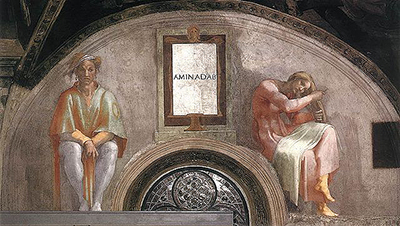
The man on the left confronts the chapel with unnerving stillness. He sits frontally, feet together and hands clasped between his knees, his dark hair held by a white band. Opposite him, a woman twists while combing long fair hair. He is closed and symmetrical; she is active and coiled. Between them, a tablet bears a single name: AMINADAB.
Michelangelo’s Amminadab lunette is part of the Ancestors of Christ surrounding the lower edge of the Sistine Ceiling.[1][2] It may look more readily identifiable than lunettes whose tablets carry several names, but caution still matters. The inscription locates a genealogical field. It does not automatically transform every adjacent body into a named biblical portrait.
At a Glance
- WorkAmminadab, with the inscription spelling AMINADAB
- ArtistMichelangelo Buonarroti
- Date1508–12, within the Sistine Ceiling campaign[2]
- TechniqueFresco
- LocationSouth-wall lunette, Sistine Chapel, Vatican City[1]
- ProgrammeAncestors of Christ
- Textual sourceMatthew 1:4 and the lineage of Judah[3]
- Principal figuresA frontal seated man; a woman combing her hair
- FormatTwo groups divided by a tablet above a window
- Distinctive contrastFrontal restraint versus complex turning movement
- Identity cautionThe Vatican’s ancestor-cycle guidance warns that inscriptions do not securely label adjacent figures[4]
Contents
- Amminadab in the Genealogy
- The Inscription and Its Spelling
- A Frontal Figure Under Pressure
- The White Headband
- The Woman Combing Her Hair
- The Pink Garment and Athletic Arm
- Two Kinds of Self-Containment
- Hair as Time
- A Lunette Built Around a Window
- Genealogy Beyond a Row of Fathers
- Was the Man Intended as Amminadab?
- Fresco Speed and Bodily Planning
- Colour After Restoration
- Artist Up Close
Amminadab in the Genealogy
Matthew names Amminadab between Ram and Nahshon: “Ram the father of Amminadab, Amminadab the father of Nahshon.”[3] The sequence runs towards Salmon, Boaz, Obed, Jesse and David.
Amminadab also appears in Hebrew scripture within the genealogies of Judah and Levi. The Vatican page describes him as a prince of the Levites, reflecting one tradition attached to the name.[1] Yet Michelangelo does not illustrate a recorded public act, priestly office or episode.
Instead, the lunette presents two intensely observed states of being. Genealogical importance is translated into bodies awaiting, grooming and occupying domestic space.
The tablet gives historical direction. The figures make that direction human.
The Inscription and Its Spelling
The painted tablet reads AMINADAB, while many English Bibles and modern titles use Amminadab. The difference is a spelling variant, not evidence for another person or fresco.
Michelangelo’s tablets use Latinised forms that pass through Italian and English catalogues in several ways. Elsewhere in the series, Nahshon becomes Naason and Zadok becomes Sadoch.
Preserving the inscription is valuable because it records what a viewer encounters in the chapel. Using “Amminadab” in prose is equally reasonable because it corresponds to a familiar English biblical form.
Variant spelling should be clarified once, not inflated into controversy. The more important uncertainty concerns the relation between written name and painted body.
A Frontal Figure Under Pressure
The seated man’s pose is exceptionally strict. His torso rises vertically, his feet meet, and his hands interlace between the knees while the forearms rest against the thighs.[1]
Frontal symmetry might suggest calm authority, but Michelangelo makes it psychologically tense. The hands are held tightly. The marked features sit beneath a mass of dark hair bound by a white band. The gaze does not welcome conversation.
This is not the expansive frontality of a ruler enthroned. The body is compressed within itself. Even when shoulders and knees establish breadth, clasped hands close the centre.
His posture makes waiting active. Nothing happens in narrative terms, yet every part seems to sustain an inward effort.
The White Headband
The strip of white around the man’s dark hair is a small but commanding accent. It clarifies the head from a distance and sharpens the contrast between hair, forehead and surrounding field.
It is tempting to turn costume into a precise ethnographic or priestly label. The fresco does not provide enough evidence. Renaissance artists used garments and head coverings to suggest antiquity, difference or biblical time without documenting a single historical wardrobe.
What can be said securely is visual. The headband contains the dark, bushy hair and contributes to the figure’s disciplined construction. It echoes the close joining of hands and feet: three acts of binding within one pose.
Michelangelo turns costume into structure.
The Woman Combing Her Hair
Across the tablet, a woman sits while drawing a comb through long fair hair.[1] The action is ordinary, private and temporally extended. Unlike a single dramatic gesture, combing implies repetition.
Her body refuses the man’s frontal stability. The legs cross, torso rotates and head inclines, producing several contrary directions. The Vatican suggests that the unusual pose was probably studied from life.[1]
That possibility helps explain its bodily conviction, but it does not identify a sitter. A model can supply observed movement without becoming a portrait within the finished sacred programme.
The woman is absorbed in grooming rather than looking towards the named ancestor, the viewer or a divine event. Michelangelo grants private attention monumental scale.
The Pink Garment and Athletic Arm
The woman’s close-fitting pink garment clings to her form. The Vatican compares its effect to wet fabric and notes the athletic, markedly muscular arm.[1]
This combination complicates easy categories. Hair-combing can be coded as feminine and domestic, yet the body possesses the strength Michelangelo often gave figures of every sex. The arm is not an accidental borrowing from a male model that cancels her womanhood; it is part of his broader language of bodily power.
The fabric reveals rather than conceals the turning anatomy. Pink colour and muscular structure coexist, preventing either softness or strength from monopolising the figure.
Michelangelo’s women in the Ancestors frequently carry both nurture and physical monumentality. They are not decorative pauses between named men.
Two Kinds of Self-Containment
At first the figures seem opposed: the man is rigid; the woman moves. Yet both are self-contained.
His clasped hands and direct frontality form a closed circuit. Her action loops inward as hand, comb, hair, head and rotating torso connect. Neither crosses the central inscription to acknowledge the other.
This emotional distance recurs throughout the ancestor lunettes. Family descent does not guarantee visible intimacy. Michelangelo shows households marked by absorption, fatigue, care and separation.
Their inwardness has often been interpreted as humanity waiting before Christ. That theological reading is plausible across the programme, but the painting does not reduce either pose to a single symbol of expectation.
Their silence remains psychological before it becomes doctrinal.
Hair as Time
The woman’s grooming is unusually suited to a genealogical cycle. Hair grows; grooming repeats; generations accumulate through ordinary time.
Michelangelo does not need to have intended such an allegory for the action to affect how the field is experienced. While the tablet compresses descent into one name, the comb makes duration palpable.
The man’s age and deeply marked face offer another kind of time. One half carries repetition; the other, accumulation.
This is how the Ancestors differ from the ceiling’s central Genesis histories. Above, God divides, creates and commands. Here, history advances almost imperceptibly through bodies that sit, wait and maintain themselves.
The sacred future emerges from time that looks ordinary.
A Lunette Built Around a Window
The fresco is not a portable rectangular picture. It occupies a curved architectural field above a real window. The tablet anchors the centre while the figures adapt to narrowing edges.
The window interrupts any continuous room. Man and woman appear adjacent, yet the opening and inscription divide them. Michelangelo turns that physical obstruction into a comparison of poses.
From the chapel floor, the large silhouettes and strong colour contrasts help the figures survive difficult height and light. Close reproductions recover facial and anatomical details, but they can conceal the work’s first task: to hold a coherent place in a vast decorative system.
The lunette is simultaneously image, index and architectural joint.
Genealogy Beyond a Row of Fathers
Matthew’s grammar repeatedly says one man “became the father of” another.[3] Michelangelo’s image is less exclusively male. A woman occupies half the field, and her bodily presence is at least as visually complex as the seated man’s.
She does not need to be assigned a missing biblical name to matter. Her anonymity exposes how written genealogies compress the lives that enable descent.
The Ancestors cycle repeatedly restores women, infants and domestic labour to a nominally patriarchal sequence. This does not make it a modern critique of Matthew. It does make its visual world broader than the list alone.
The title Amminadab therefore names a station in genealogy, not the whole human content of the fresco.
Was the Man Intended as Amminadab?
The Vatican’s individual page calls the seated man Amminadab.[1] That is a traditional and useful reading, especially because only one name occupies the tablet. Its broader lunette pages nevertheless state that attempts to connect inscribed names with figures have not achieved certainty.[4]
Both pieces of information should remain visible. The man is conventionally identified as Amminadab; the attribution is not the equivalent of a labelled portrait with independent evidence.
This is not institutional contradiction so much as two levels of catalogue language: a concise object description and a programme-wide scholarly caution.
Responsible looking can use the traditional name while recognising the limits of proof.
Fresco Speed and Bodily Planning
Fresco requires pigment to be applied while plaster remains fresh. Complex turns therefore depend upon preparation as well as confident execution.
The woman’s crossed legs, bent back, inclined head and active arm could have been studied before work on the wall. The Vatican’s suggestion of a live study points to observation at the design stage, not necessarily direct improvisation in wet plaster.[1]
The man’s strict construction similarly feels tested: paired feet, resting forearms and clasped hands create an interlocking pattern that would be difficult to resolve accidentally.
Michelangelo’s speed is often praised, but speed was the visible end of a longer intelligence involving pose, transfer, colour and adaptation to height.
Colour After Restoration
The bright pink garment, fair hair, white band and stronger colour contrasts belong to the modern experience of a ceiling transformed by twentieth-century conservation.[5]
Cleaning recovered Michelangelo as a much more forceful colourist than older, darkened photographs suggested. It also generated debate about surface history and the degree to which later materials had altered modelling.
For this lunette, colour changes interpretation. The woman is not a shadowy domestic accessory; pink makes her twisting body a major event. The white band prevents the man’s brooding head from sinking into darkness.
Conservation did not create those choices, but it changed how clearly modern viewers can recognise them.
Artist Up Close
The Amminadab lunette displays Michelangelo’s ability to generate drama without narrative incident. A clasp, a comb, crossed legs and a strip of white cloth are enough.
His figures do not illustrate biblical biography. They answer one another formally across the window: vertical against spiral, dark hair against fair, joined feet against crossed legs, pressure against motion.
Yet the contrast never feels like an academic exercise. Each pose describes a person occupied by a private state.
The tablet names descent. Michelangelo paints the irreducible solitude through which that descent passes.
Frequently Asked Questions
Discussion
What details, sources or comparisons stand out to you in Aminadab?
Reader Insights
Which formal detail changes how the work reads?
Which documented source or collection history feels most useful?
Which related Michelangelo work should readers compare next?
Join the Conversation
Add a source-led observation, comparison or question for other readers.
References
- Vatican Museums, Lunette Aminadab,, View source.
- Vatican Museums, Sistine Chapel Ceiling,, View source.
- United States Conference of Catholic Bishops, Matthew, Chapter 1,, View source.
- Vatican Museums, Lunettes—South Wall,, View source.
- Vatican Museums, The Sistine Chapel Twenty Years Later: New Breath, New Light,, View source.