


 by Tom Gurney
Tom Gurney BSc (Hons) is an art history expert with over 20 years experience
Published on June 19, 2020 / Updated on November 8, 2026
Email: tomgurney1@gmail.com / Phone: +44 7429 011000
The Virgin Nursing the Christ Child
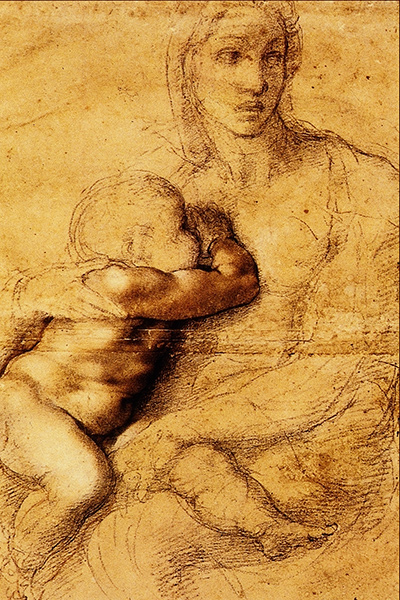
The child feeds, yet the mother looks away. That divided attention gives Michelangelo's Virgin Nursing the Christ Child its unusual emotional force. The subject promises bodily closeness: Mary's breast sustains the infant Christ, and his small hands press into her flesh. But her face turns outward, absorbed by something beyond the child's immediate need. Nourishment and foreknowledge occupy the same sheet.
Casa Buonarroti catalogues the drawing more simply as Madonna and Child, dates it to about 1525 and identifies it as inventory 71 F. It is a large work on paper—54.1 by 39.6 centimetres—made with black and red chalk, white heightening and ink on two joined sheets.[1] Older and alternative titles emphasise the nursing action, but the museum's controlled title is the safest anchor.
No surviving painting or sculpture is known to have been prepared from this design. Although its scale has encouraged the words “cartoon” and cartonetto, Casa Buonarroti cautions that it cannot be connected to a known work by Michelangelo or an associate.[1] The drawing is monumental without being securely preparatory: a sustained meditation that uses the means of a working design but does not lead us to an identified finished object.
At a Glance
- Controlled titleMadonna and Child
- Alternative descriptive titleThe Virgin Nursing the Christ Child
- ArtistMichelangelo Buonarroti
- DateAbout 1525
- MediumBlack chalk, red chalk, white heightening and ink on prepared paper
- SupportTwo sheets joined side by side and subsequently backed
- Dimensions54.1 × 39.6 centimetres
- CollectionCasa Buonarroti, Florence
- Inventory71 F
- Subject typeMadonna Lactans, or nursing Madonna
- FunctionUncertain; no known finished work depends upon it
Contents
- A Sacred Body Feeding a Child
- The Body of the Child
- A Mother Looking Elsewhere
- Pentimenti and the Time Inside the Sheet
- Black Chalk, Red Chalk and White
- Two Sheets Acting as One
- Is It a Cartoon?
- The New Sacristy Context
- From the Madonna of the Stairs to the Pietà
- An Image Without Halos
- Casa Buonarroti and the Drawing's Fame
- How to Look at the Drawing
- Why the Drawing Matters
A Sacred Body Feeding a Child
The nursing Virgin—known as the Madonna Lactans or Virgo Lactans—makes the doctrine of the Incarnation physical. Christ does not merely resemble a human infant. He depends upon a human body for food.
That dependence carried several connected meanings. Mary's milk demonstrated Christ's full humanity; her maternal care made divine love visible as nourishment; and her breast could stand for the Church feeding the faithful. The image joined doctrine to an experience familiar within ordinary households.
Michelangelo had already treated the nursing theme in the Madonna of the Stairs, made when he was still a teenager. He returned to it in drawings and, with greater ambiguity, in the Medici Madonna for the New Sacristy at San Lorenzo.[2] The recurrence matters because it rules out a casual choice of subject. Across several decades, he tested how the closest possible bond between mother and child could also contain separation.
Inventory 71 F gives the theme exceptional scale. It is not a miniature aid for private recollection. The joined sheets allow the seated Virgin to acquire the breadth and gravity of sculpture.
The Body of the Child
Christ turns into his mother's body rather than presenting himself to the viewer. His back, shoulders and bent limbs form a compact knot against her torso.
The pose is observed with a frankness that resists devotional prettification. A feeding infant grips, presses and shifts its weight. Michelangelo makes the child's action convincing through bodily contact, not through a halo or an explanatory attribute.
Casa Buonarroti notes the many revisions visible in the child. The head is softly modelled through delicate light and shadow, while the body is more forcefully built and pictorially finished.[1] Those different modes make the figure feel both intimate and constructed. The head melts into maternal shadow; the torso asserts weight.
The child's turned position also withholds his face. Viewers encounter him first through back and limbs, as if looking at an absorbed domestic act not arranged for their benefit. The denial of direct address intensifies the Virgin's outward gaze. Neither figure meets us in the conventional manner of an icon.
A Mother Looking Elsewhere
Mary's head is the drawing's psychological centre. Her face emerges gradually from dark chalk. The eyes do not descend toward the child but look away into an undefined distance.
This was not Michelangelo's first solution. A major pentimento shows that he initially drew the Virgin in profile, looking down toward Christ.[1] The revision replaced an exchange of gazes with emotional disjunction.
That alteration is more than a change in pose. It moves the image from tenderness readily recognised to tenderness complicated by knowledge. Christian viewers could understand Mary's remote look as a premonition of the Passion: the body she feeds will one day return to her lap after the Crucifixion.
The drawing does not illustrate a specific prophetic episode, so this interpretation should remain responsive rather than absolute. Her expression can carry vigilance, fatigue, sorrow or inward concentration. Its power lies partly in refusing to identify one passing emotion.
Michelangelo makes motherhood neither sentimental nor cold. The feeding action proves care even while the face is mentally elsewhere. Love survives the absence of eye contact.
Pentimenti and the Time Inside the Sheet
A pentimento records an artist changing direction. In this drawing, revisions are not marginal traces beneath a final solution; they preserve the development of the relationship.
The earlier downward-looking head still haunts the visible one. We can mentally compare a mother absorbed in the child with a mother turned toward an unseen future. Michelangelo lets the second conception dominate without entirely erasing the first.
The child's many adjustments produce a different kind of time. They suggest repeated attempts to stabilise a body whose twisting action is naturally difficult to describe. The artist searches through chalk as a sculptor might turn around a small model.
This is one reason the sheet rewards prolonged looking. Its subject is not only Mary nursing Christ. It is also Michelangelo deciding how much intimacy the composition can bear before prophecy interrupts it.
Black Chalk, Red Chalk and White
The materials are unusually varied. Black chalk establishes the Virgin's broad form and deep shadows. Red chalk brings warmth and tactile definition to the child. White heightening retrieves light from the prepared surface, while ink reinforces selected passages.[1]
The combination permits different degrees of presence. Mary's body is immense but incomplete, as though it is surfacing from shade. The child is concentrated into firmer flesh. One figure is atmospheric; the other is insistently corporeal.
Such technical inequality once contributed to doubts about the drawing's authorship. Casa Buonarroti names Bernard Berenson and Luitpold Dussler among the scholars who rejected Michelangelo's hand, while defending the work's authenticity.[1] The disagreement is historically important: uneven finish need not mean uneven authorship.
Michelangelo often varied pressure and completion according to expressive need. In marble, a polished body can meet roughly worked stone; on paper, delicately blended faces can coexist with searching limbs. Here the contrast keeps maternal thought and infant appetite from becoming visually identical.
Two Sheets Acting as One
The support was assembled by joining two pieces of paper side by side. This practical decision produced a field large enough for Michelangelo's conception.[1]
The join reminds us that Renaissance drawings were physical constructions, not disembodied images. Paper came in available sizes; artists pasted, cut, backed and reused it. Monumentality could begin with an alteration to the support.
The sheet was later mounted or backed, and restoration found evidence of a cut across the upper area. Casa Buonarroti believes the trimming probably occurred during framing and removed part of the Virgin's veil.[1]
That loss changes the silhouette we now interpret. The drawing's upper boundary is not exactly the boundary Michelangelo made. Yet the surviving design retains its commanding vertical lift, and the damaged history becomes part of the object's biography.
Is It a Cartoon?
At 54 centimetres high, the drawing can readily be called a small cartoon. The word normally implies a full-scale or enlarged design used to transfer a composition to another surface.
Here size alone does not prove that function. Casa Buonarroti explicitly states that the work cannot be identified as preparation for any known object by Michelangelo or an artist linked with him.[1]
No pouncing pattern, associated painting or documented commission supplies the missing destination. It is therefore better to describe the sheet as cartoon-like in scale and degree of development, while leaving its original purpose open.
It may have been an independent devotional drawing, a private exploration of a recurring subject, or a project whose final stage is lost. None of those possibilities should be promoted to fact.
Uncertainty adds rather than subtracts interest. The drawing demonstrates that intensive artistic thought did not always belong to a commission or survive through a completed work.
The New Sacristy Context
Casa Buonarroti dates the drawing through its stylistic relationship with the Medici Madonna in Michelangelo's New Sacristy at San Lorenzo.[1] The connection places it within the demanding years when he designed architecture, tomb sculpture and allegorical bodies for the Medici chapel.
Both Madonnas combine enormous physical presence with emotional distance. Their children cling or turn, while the mothers' attention extends beyond the immediate embrace.
The resemblance should not be converted into a preparatory relationship. Inventory 71 F is not documented as a study for the marble. The connection is one of shared problem and period.
Paper and stone allowed different answers. The drawing can preserve an abandoned maternal gaze and multiple adjustments in the child. Marble condenses revision into a single durable surface. Seen together, they reveal Michelangelo circling the same idea across media.
From the Madonna of the Stairs to the Pietà
The nursing subject joins the beginning of Michelangelo's career to its later middle. In the Madonna of the Stairs, the breast and the turned infant occupy an exceptionally shallow relief inspired by Donatello. In inventory 71 F, chalk replaces carved planes, yet the child still turns inward and the mother still remains mentally apart.
The shadow of the Pietà also enters the interpretation. Michelangelo repeatedly placed the adult dead Christ across Mary's lap. A nursing infant and a sacrificed son are not the same subject, but Christian devotional thought encouraged viewers to see infancy through the Passion.
The remote gaze creates that temporal reach without adding a cross or goldfinch. Mary can hold present life and future death at once.
This is Michelangelo's characteristic compression: several moments of sacred history inhabit one bodily arrangement. The feeding is immediate, but the mother's consciousness enlarges the scene.
An Image Without Halos
The sheet depends little upon conventional signs of holiness. No elaborate throne, choir of angels or radiant mandorla separates the group from ordinary maternity.
The absence does not secularise the subject. Instead, sacred meaning resides in the impossible weight of foreknowledge placed upon a recognisable act.
The child's lack of direct address makes incarnation more convincing. He is not performing divinity for the viewer; he is feeding. Mary's monumental body turns that vulnerable dependence into a foundation.
The image therefore operates between icon and observation. It is too formally grave to be a casual genre study, but too physically truthful to evade the demands of infancy.
Casa Buonarroti and the Drawing's Fame
Michelangelo the Younger, the artist's great-nephew, recognised the drawing's importance when arranging the family's Florentine house. He placed the cartonetto in the Camera degli Angioli, the spiritual centre of the seventeenth-century rooms he created.[1]
That act helped transform a working or meditative sheet into a family monument. Its display asserted the continuity of Michelangelo's memory within the Casa Buonarroti.
The drawing's public fame increased during the nineteenth century, especially around the Michelangelo centenary of 1875, when an exhibition introduced the house's holdings to an international audience.[1]
Framing and display also exposed it to intervention, including the probable trimming of the veil. Celebration preserved the sheet, but preservation was never passive.
Its present identity therefore has two histories: Michelangelo's making and the Buonarroti family's sustained construction of his legacy.
How to Look at the Drawing
Begin with the child's back and follow the curve into Mary's torso. Notice how bodily contact is made more explicit because both faces turn away.
Then find the earlier position of Mary's head beneath the final one. Imagine the discarded exchange of gazes before returning to her distant look.
Compare the child's warmer, firmer modelling with the Virgin's dark, emerging form. The disparity is an expressive decision, not an area to be mentally “finished.”
Finally, attend to the support: the joined papers and altered upper edge. The object has been assembled, revised, framed, cut, restored and interpreted across five centuries.
Why the Drawing Matters
The Virgin Nursing the Christ Child is one of Michelangelo's fullest examinations of maternity. It joins bodily dependence to emotional distance without cancelling either.
Its revisions let us see tenderness being transformed into foreknowledge. Its mixed materials allow infant flesh and maternal thought to occupy different visual registers. Its uncertain function preserves a major invention outside the usual story of commission and completion.
Most of all, the drawing refuses an easy choice between ordinary motherhood and sacred prophecy. The child feeds because he is human. The mother looks away because, within Christian history, that vulnerable body already carries a future she cannot prevent.
Frequently Asked Questions
Discussion
What details, sources or comparisons stand out to you in La Madonna che Allatta il Figlio?
Reader Insights
Which formal detail changes how the work reads?
Which documented source or collection history feels most useful?
Which related Michelangelo work should readers compare next?
Join the Conversation
Add a source-led observation, comparison or question for other readers.
References
- Casa Buonarroti, Madonna col Bambino,” collection record for inventory 71 F, View source.
- Casa Buonarroti, La Collezione di disegni di Michelangelo della Casa Buonarroti,” especially the discussion of the cartonetto 71 F and its relationship to the Medici tombs, View source.
- Casa Buonarroti, updated inventory of the foundation's artworks, entry for 71 F, View source.
- Museo Casa Buonarroti, English collection record, “Madonna and Child., View source.