Painting in the LACMA collection
For the museum’s illustration and full catalogue entry, see the LACMA collection record in the references.
from Amazon
* As an Amazon Associate I earn from qualifying purchases.
 by Tom Gurney
Tom Gurney BSc (Hons) is an art history expert with over 20 years experience
Published on July 29, 2026 / Updated on October 23, 2026
Email: tomgurney1@gmail.com / Phone: +44 7429 011000
In the Woods at Giverny: Blanche Hoschedé at Her Easel with Suzanne Hoschedé Reading
Claude Monet's In the Woods at Giverny: Blanche Hoschedé at Her Easel with Suzanne Hoschedé Reading is a quiet but unusually revealing picture from 1887. It is not one of the late water-lily panels, not a formal portrait, and not a public statement about Impressionism as a movement. It shows two members of Monet's extended household outdoors at Giverny: Blanche Hoschedé standing at an easel with palette and brush, and Suzanne Hoschedé seated nearby with a book. The Los Angeles County Museum of Art records the work as an oil on canvas made in France in 1887, measuring 36 by 38 1/2 inches, with the accession number M.46.3.4.
That exact museum record matters because the painting can easily be flattened into a generic "women in a garden" scene. Its full title gives the image a sharper human and artistic structure. Blanche is not simply a figure placed in the landscape; she is shown as a painter. Suzanne is not a vague accessory to the composition; she is named as a reader. Monet presents two forms of attention in the same wooded space: one active at an easel, the other absorbed in a book. The painting's intimacy comes from that balance. It lets the viewer see Giverny not only as a site of flowers, fields and later water gardens, but as a working environment shared by people who lived close to Monet's daily practice.
The picture belongs to the years after Monet moved to Giverny in 1883 and before the great serial campaigns of the 1890s. By 1887 he was still moving between figure, landscape and outdoor motif. The wooded setting is dense but open enough for light to break across the ground, dresses, canvas and foliage. Monet does not isolate the women against a neutral background. He places them inside the same flickering web of greens, browns, pale fabric and moving daylight that carries the rest of the scene. The result is neither a studio portrait transported outdoors nor a landscape with incidental staffage. It is an outdoor domestic scene in which making art, reading and observing nature occupy the same visual field.
Blanche and Suzanne at Giverny
Blanche Hoschedé's role is especially important. The Musée d'Orsay identifies Blanche Hoschedé-Monet as Claude Monet's stepdaughter and later the wife of Jean Monet, the artist's elder son. In this painting she appears before that later marital identity, as a young woman at an easel in the orbit of Monet's Giverny household. The image should not be overread as a documentary record of instruction, but it does show that Monet found visual interest in Blanche as someone engaged in painting. Her vertical pose, the easel, the palette and the lifted arm give her a professional attitude within a loose family setting. Monet's attention falls on the act of painting as much as on the person.
Suzanne Hoschedé provides the second anchor. She appears seated on the grass, turning the wooded patch into a place of reading and pause. The contrast between Blanche's standing activity and Suzanne's lowered, absorbed posture gives the composition its rhythm. Monet had already worked with members of the Hoschedé family as models, and Suzanne appears elsewhere in his 1880s figure painting. The Metropolitan Museum of Art's record for The Stroller (Suzanne Hoschedé, later Mrs. Theodore Earl Butler) identifies Suzanne as Alice Hoschedé's daughter and notes Monet's use of her as a model in the years after Camille Monet's death and before he gave up plein-air figure painting around 1890. That broader context helps place the LACMA painting without turning it into biography alone.
Giverny before Water Lilies
The wooded Giverny setting also distinguishes this canvas from better-known Monet subjects. Related subjects such as Water Lilies, Japanese Prints and Artist’s Garden at Giverny introduce the gardens, Japanese sources and later subjects associated with Monet’s home. In the Woods at Giverny offers a different emphasis. It shows Giverny before the water garden became the dominant public image of the place. The picture is closer in feeling to outdoor figure studies and nearby field subjects than to the monumental late decorations. Its canvas is smaller than those later panels, but its dimensions of 36 by 38 1/2 inches give the two figures a substantial presence. The scene centres on private activities and careful observation rather than a grand public event.
The Art Institute of Chicago’s scholarly catalogue provides a useful comparison with Monet’s later work around Giverny. Its entry for Poppy Field (Giverny) also describes Monet's renewed attention to the landscape around his home in the years around 1890, including fields and motifs near Giverny that became testing grounds for color, surface and repetition. That does not make the LACMA painting part of the poppy-field group or a formal series. It does help explain why a wooded Giverny scene from 1887 can sit between figure painting and the later place-based investigations for which Monet is famous.
The date also distinguishes two stages in the making of Monet’s surroundings. The wooded figure scene dates to 1887, while the first acquisition of land for the water garden followed in 1893. The later pond should not be projected backwards into every earlier view of Giverny. [6]
Title, Evidence and Close Looking
Compositionally, the painting is built around a subtle exchange between verticals and dissolving brushwork. Blanche, the easel and the trees provide upright accents. Suzanne's seated form and the low sweep of the grass settle the picture horizontally. The easel is not buried; it is a visible structural hinge. Yet Monet avoids a hard theatrical arrangement. The trees and grasses press forward, softening the distinction between foreground and background. The figures are legible, but they are also partly absorbed into the outdoor atmosphere. That absorption is one of the reasons the work feels recognisably Impressionist without needing to announce itself through a famous urban or exhibition subject.
The painting's title can feel unusually long, but its length is useful. It names the place, the activity and the two people. A shortened title such as In the Woods at Giverny is convenient, but the full LACMA title prevents the page from losing the social and artistic specificity of the scene. Blanche's easel matters because it makes the image about looking and making as well as leisure. Suzanne's reading matters because it gives the scene a second kind of inwardness. The two women are not performing for the viewer. They are shown in occupations that suggest time passing quietly within a familiar landscape.
The painting does not by itself document Monet teaching Blanche or establish a lesson on a particular day. LACMA’s record identifies the artist, title, date, medium, dimensions, collection and accession, but supplies no account of the sitting. Other museum sources establish Blanche’s family relationship to Monet and her identity as an artist. Those biographical facts remain distinct from the evidence of this canvas. It depicts Blanche at an easel and Suzanne reading at Giverny in 1887; an exact position within the property, a precise season, or the women’s private thoughts cannot be established from its title alone.
Giverny, the Household and Related Paintings
Seen alongside Monet's biography and timeline, the painting belongs to a transitional decade. Monet was no longer the young painter of Sainte-Adresse and Argenteuil, but he had not yet narrowed his reputation around the mature serial projects of Haystacks, Poplars and Rouen Cathedral. His household, his landscape and his working methods were becoming more settled. Giverny was becoming both home and motif. In that setting, the sight of Blanche painting outdoors becomes more than anecdote. It reflects an environment in which art-making was woven into the habits of daily life.
The picture also belongs to Monet’s broader interest in women outdoors. Other figure subjects include Woman with a Parasol and Study of a Figure Outdoors: Woman with a Parasol. Those works are not identical in function, but they help frame Monet's recurring concern with figures animated by light, wind, fabric and open air. In In the Woods at Giverny, the movement is quieter. Instead of a figure caught against sky or wind, the women are settled into shade and foliage. The drama lies in attention rather than motion.
Comparisons with other paintings by Claude Monet or the places he painted reveal how the LACMA canvas connects a particular place with the Hoschedé household and Monet’s outdoor practice. Its full title distinguishes the two women and their occupations, keeping family history close to what can actually be seen. The painting offers a specific view of daily life rather than a key that explains his entire career. Giverny is not yet the familiar water-lily setting of his later work, but it is already a lived place where looking, reading, painting and family proximity shape his subject matter.
At a Glance
- ArtistClaude Monet [1]
- Full titleIn the Woods at Giverny: Blanche Hoschedé at Her Easel with Suzanne Hoschedé Reading [1]
- Date and medium1887, oil on canvas [1]
- Dimensions36 by 38 1/2 in. [1]
- CollectionLos Angeles County Museum of Art; accession M.46.3.4 [1]
- Object recordBlanche Hoschedé painting and Suzanne Hoschedé reading at Giverny; LACMA M.46.3.4 [1] [4] [5]
- Museum illustrationLACMA’s catalogue record provides an illustration and the object’s documented details
Contents
- Introduction
- At a Glance
- Blanche and Suzanne at Giverny
- Giverny before Water Lilies
- Title, Evidence and Close Looking
- Giverny, the Household and Related Paintings
Related Monet Reading
Explore Monet’s biography, the chronology of his life and related Giverny paintings.
Claude Monet
Claude Monet
Biography
Life and household context
Timeline
Chronology and Giverny period
Paintings
Artwork hub
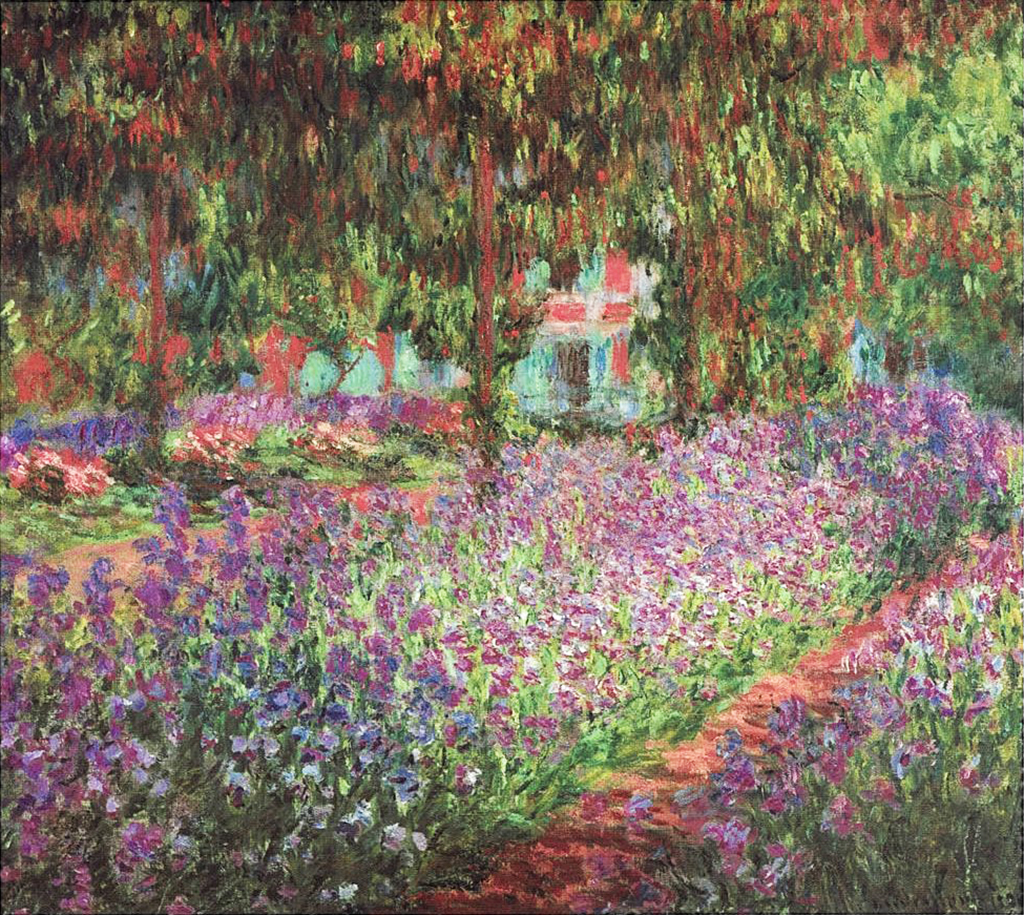
Artist’s Garden at Giverny
Giverny garden painting

Water Lilies
Later Giverny water-garden comparison
Frequently Asked Questions
Discussion
This LACMA painting invites close looking at named sitters, domestic Giverny and the difference between a figure scene and Monet's later garden mythology.
Reader Insights
How does Blanche's easel change the way you read the wooded scene?
What makes this 1887 Giverny picture different from Monet's later Water Lilies world?
Where does the full LACMA title help keep the people and object identity clear?
Join the Conversation
Share your reading of Monet's In the Woods at Giverny below.
References
- LACMA - In the Woods at Giverny: Blanche Hoschedé at Her Easel with Suzanne Hoschedé Reading, accessed 29 July 2026.
- Art Institute of Chicago - Claude Monet, accessed 29 July 2026.
- Art Institute of Chicago - Cat. 26 Poppy Field (Giverny), accessed 29 July 2026.
- Musée d'Orsay - Blanche Hoschedé-Monet, accessed 29 July 2026.
- The Met - The Stroller (Suzanne Hoschedé), accessed 29 July 2026.
- Maison et jardins de Claude Monet – The water-lily pond, land acquired in 1893