 by Tom Gurney
Tom Gurney BSc (Hons) is an art history expert with over 20 years experience
Email: tomgurney1@gmail.com / Phone: +44 7429 011000
Breakfast in Bed by Mary Cassatt: Introduction
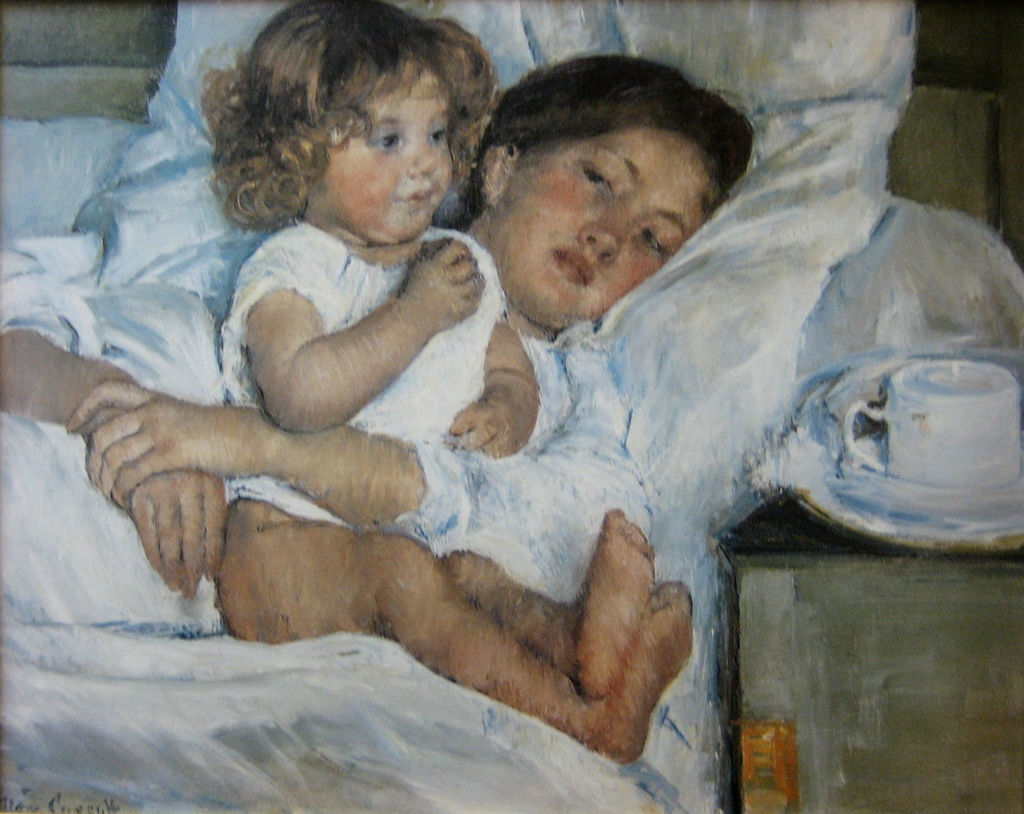
A child sits upright against a reclining woman, surrounded by pale pillows and bedding. The adult’s arms cross around the small body, while the child looks outward. At the right, a cup and saucer stand on a blue-green surface. Cassatt gathers bodies, fabric and one modest domestic object into a close horizontal composition.
The Huntington dates Breakfast in Bed to 1897 and identifies it as oil on canvas, accession 83.8.6. The work measures 58.4 × 73.7 centimetres, with the frame measured separately. Its collection credit is the gift of the Virginia Steele Scott Foundation. Those current museum details identify the particular painting. [1]
At a Glance
- ArtistMary Cassatt [1]
- TitleBreakfast in Bed [1]
- Date1897 [1]
- MediumOil on canvas [1]
- Dimensions58.4 × 73.7 cm (work; frame measured separately) [1]
- CollectionThe Huntington, San Marino [1]
- Accession83.8.6 [1]
- CreditGift of the Virginia Steele Scott Foundation [1]
This work across Mary Cassatt’s career
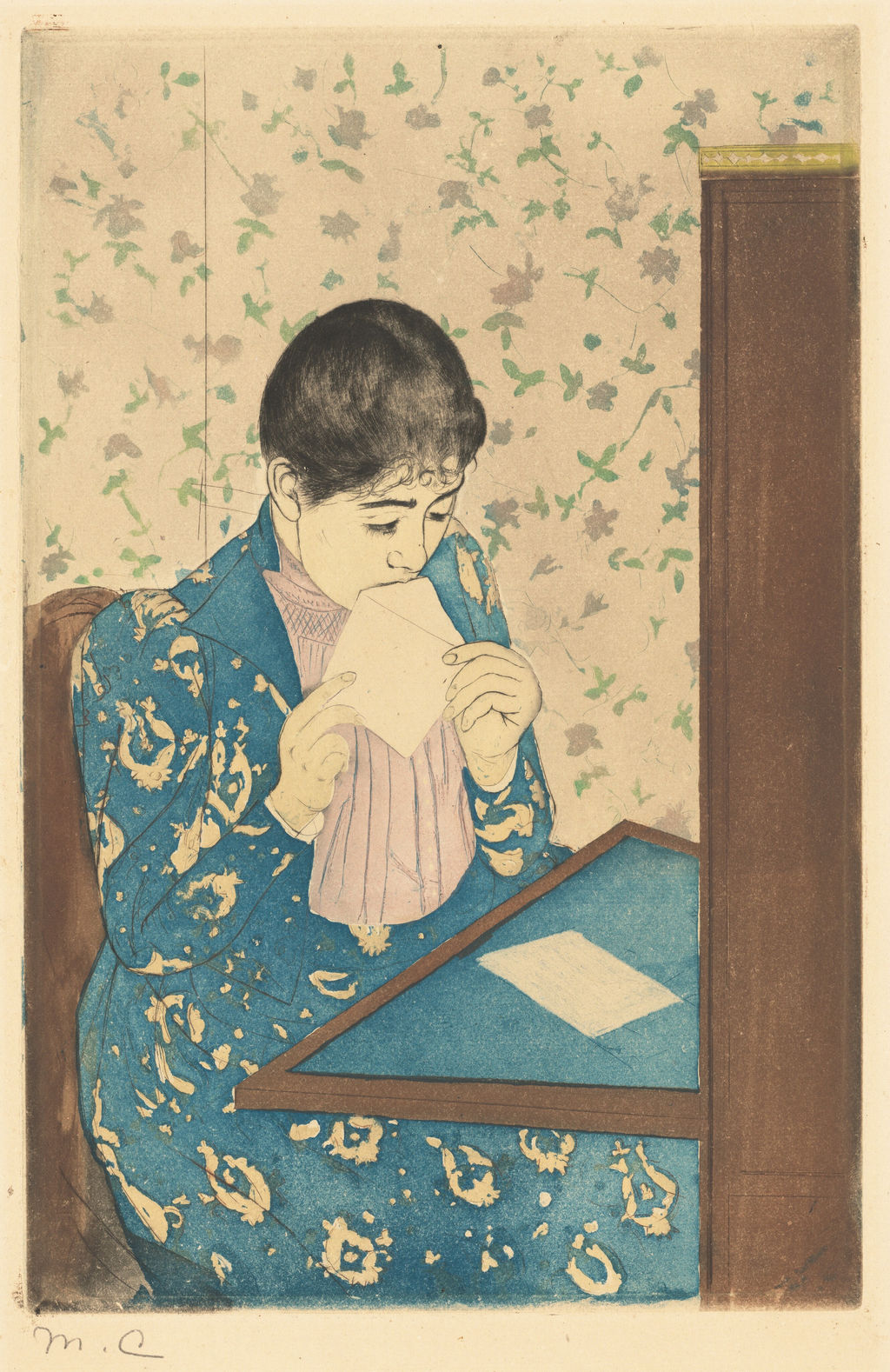
The Letter
1890–91 [6]Modern Woman
1892–93; displayed in 1893 [7] [8] [9]The Boating Party
1893–94 [10]The Child's Bath
1893 [11]Woman with a Sunflower
About 1905 [13]Young Woman in Green Outdoors in the Sun
About 1914 [14]Contents
- A reclining adult and an upright child
- The arms around the child
- Bare legs across the lower field
- Pillows around the heads
- Warm faces within cooler cloth
- The white fabric as an active surface
- The cup and saucer
- Different gazes and the museum’s interpretation
- The 1970 catalogue and present collection
- A 1998 postage stamp
A reclining adult and an upright child
The woman’s head rests against the large pillow at the right of the central group. Dark hair spreads above the warm face, creating a concentrated shape among the much paler fabric. The head tilts to one side rather than rising directly above an upright torso.
The child sits higher and more vertically, with light curls forming another distinct head shape at the left. The difference in posture is one of the composition’s strongest relationships: a small upright body occupies the space before a larger reclining one.
Their faces sit close together without repeating the same angle. The adult’s cheek inclines towards the pillow; the child’s face remains more nearly upright and turned out into the surrounding room. The bodies are connected while their attention appears differently directed.
The horizontal format gives this arrangement space to extend. The child’s legs travel across the lower image, while the pillow rises diagonally behind the adult. The scene is therefore not organised as two vertical figures standing beside one another.
The group also occupies most of the canvas. There is little distance between the viewer and the bedding at the lower edge. The close viewpoint makes the hands, feet and meeting of cloth especially significant.
The arms around the child
The adult’s forearms cross in front of the child’s lower torso. One hand rests across the other arm, while longer fingers descend towards the bedding at the left. Their overlap makes the support a substantial part of the foreground.
The hold is not a small incidental touch. The arms form a broad horizontal connection across the seated child, linking the adult’s reclining body to the more upright figure in front. That structure gives the child a clear place within the group.
At the same time, the child’s own hands remain distinct. A small bent hand is held near the upper chest and light garment. Its more compact scale contrasts with the longer adult fingers below, helping the different bodies remain legible where they overlap.
Fabric passes between and around these contacts. The white sleeve continues towards the adult wrist, while the child’s pale garment ends above the exposed legs. The grouping depends on several small boundaries rather than one continuous dark outline separating every limb.
The actual relationship of the models is not established by the title. A mother-and-child subject can be represented by unnamed sitters. The visible support remains specific without proving biological kinship or identifying a recorded family occasion.
Bare legs across the lower field
The child’s legs extend diagonally towards the lower right, with bent knees and overlapping feet. Warm flesh stands out against the cooler pale bedding. The arrangement gives the small body more reach across the canvas than the upright head alone would suggest.
One foot presents more of its sole, while the other follows a different angle below and behind it. These unequal positions keep the child from becoming an evenly posed seated figure. The limbs retain an irregular, bodily arrangement within the adult’s hold.
The legs also lead the eye towards the cup and bedside surface at the right. They do not touch the vessel, but their direction connects the lower figure with another part of the room. The image’s close bodily group is therefore not completely isolated from its surroundings.
The bedding receives the legs through softer folds and broad light passages. Its surface bends beneath and around the body rather than continuing as a flat white panel. The difference between warm skin and pale cloth clarifies the overlap without requiring a heavily shadowed background.
There is no need to add a medical explanation for the uncovered legs or reclining adult. The title and objects establish a bed scene; illness, recovery or a particular diagnosis would require evidence the picture does not supply.
Pillows around the heads
A large pillow rises behind the adult’s head and continues towards the top. Its pale surface contains changing blue, grey and warmer marks, creating folds and angles rather than one uniformly white field. The darker hair makes the meeting of head and pillow especially clear.
Another light passage rises behind the child. Together, the bedding forms a substantial enclosure around both faces. Their skin and hair remain the most concentrated warm and dark areas within it, directing attention towards the figures.
The pillows also establish different inclinations. The adult’s face rests along a sloping light shape, while the child’s torso remains more upright against the surrounding fabric. The soft forms provide the setting for the contrast between the two poses.
The upper background contains darker green-blue divisions on either side. These suggest the enclosing structure around the bed without describing the whole room. Their firmer edges contrast with the more broken lines and folds of the fabric.
This restraint keeps the composition close. Cassatt does not offer a complete interior inventory. A few structural passages, a pillow and the surface at the right are enough to locate the group while leaving the room beyond largely unspecified.
Warm faces within cooler cloth
Warm pink and reddish passages gather in the faces and exposed limbs. The child’s cheek is especially prominent beside the curls, while darker and warmer accents describe the adult’s eyes and mouth. These small changes prevent either face from reading as one flat patch of flesh colour.
Their warmth is set among much cooler surrounding whites. Blue accents in the pillow and sleeve do not make those objects blue overall, but they change how the adjacent skin appears. The composition’s lightness depends on these differences within pale areas, as well as on the more obvious contrast between dark hair and bedding.
The white fabric as an active surface
Pale fabric occupies a large share of the canvas, but it does not remain empty. Long changes of direction cross the lower bedding, while smaller folds gather around sleeves, wrists and the child’s body. The viewer can follow movement through the cloth even where the colour stays light.
Blue-grey accents help divide adjacent white areas. A sleeve, pillow and bedcover can all appear pale while retaining different edges and directions. Their distinction depends on relationships between marks rather than on assigning a completely different dominant colour to each object.
The lower bedding also gives the scene a broad base. Its folds sweep across the foreground beneath the legs, connecting the left side with the right. The bodies remain close, but the fabric lets the composition expand beyond the small cluster of faces.
The brushwork varies in density. Hair and features receive relatively compact marks; larger fabric areas allow broader strokes to remain apparent. This difference can be examined visually without turning it into an exact account of how quickly Cassatt painted.
The documented medium is oil on canvas. Visible handling does not establish that all colours were used unmixed, nor reveal an exact pigment recipe, layer sequence or treatment history. Those technical questions require object-specific evidence beyond a general description of Impressionist practice. [1]
The cup and saucer
A white cup and saucer occupy the right edge on a blue-green bedside surface. Their rounded rims and curved handle differ from the irregular shapes of the bedding. The small still-life area supplies a firmer arrangement beside the reclining head.
The saucer’s ellipse also establishes a near-horizontal plane. It helps the viewer recognise the surface beneath, which is bounded by straighter furniture edges. The painting moves from soft cloth and bodies to a compact set of harder objects.
The cup contributes to the title’s domestic setting, but the image does not establish its exact contents. No particular meal, hour or preparation is documented. The vessel can anchor the breakfast association without requiring a narrated menu.
Its position near the edge also matters. The object remains partly enclosed within the close composition, rather than forming an independent still life in the centre. It gives the right side a visual destination while the overlapping arms occupy the left and middle.
The blue-green furniture connects with darker passages at the top and cooler marks in the bedding. These related colours keep the cup area integrated with the rest of the painting despite its different textures and geometric shapes.
Watch: Mary Cassatt
Choose a film to explore the artist’s work, its interpretation and its wider setting.
Demonstrating Mary Cassatt's Color Printmaking Techniques
The Philadelphia Museum of Art demonstrates techniques used to make Cassatt’s colour prints.
Watch on YouTubeDifferent gazes and the museum’s interpretation
The Huntington interprets the scene through a contrast between an adult’s focused care and a child’s impulse to explore the surrounding world. Its label relates that reading to the differing directions of the two gazes. This is the museum’s interpretation of the visible arrangement. [1]
The image provides a concrete basis for considering it. The child is physically held within a close group yet looks outward, while the adult remains more deeply settled into the pillow and embrace. Contact and attention do not follow exactly the same route.
That reading does not reveal the sitters’ private intentions. A viewer can notice outward-looking eyes without knowing what the child wanted, what stood elsewhere in the room or what happened next. The museum’s account is most useful when it remains tied to the painting’s visible relationships.
The title also leaves some of the action open. There is no displayed sequence of waking, eating and leaving the bed. One concentrated moment is represented, with enough objects and posture to suggest a setting but no complete timetable for a day.
The 1970 catalogue and present collection
The National Gallery’s 1970 exhibition catalogue included Breakfast in Bed as number 58, Breeskin 275, and reproduced the same composition. Its entry named Dr. and Mrs. John J. McDonough as lenders. That is historical exhibition evidence, separate from the Huntington’s current ownership and gift credit. [15]
The older printed dimensions differ from the current museum measurements. The discrepancy is not resolved by inventing a frame, crop or conversion explanation. The Huntington’s present work measurements are preferred here, while the historical publication remains useful for its image, title and lender record.
An exhibition loan also does not supply a complete chain of transfers. The two records establish different collecting moments, but the path between them should not be filled in from assumption. The Scott Foundation credit is the relevant present museum wording. [1]
A 1998 postage stamp
The United States Postal Service’s historical table records a 32-cent Breakfast in Bed stamp issued on 27 August 1998 as part of Four Centuries of American Art. This is a later public use of the image, more than a century after the oil’s date. [16]
The National Postal Museum’s object metadata places the issue in Santa Clara and within a pane featuring twenty American paintings. It credits Howard Paine’s design and Sennett Security Products’ gravure printing. These details concern the stamp issue, not the making of Cassatt’s canvas. [17]
The stamp gives the painting another history of circulation. A small reproduced image can reach viewers in a context far removed from the museum. That later recognition should not be mistaken for a contemporary response from Cassatt’s lifetime or for evidence about the original models.
The issuer and museum metadata establish the issue information. They do not make the stamp itself a source for judging the oil’s brushwork or exact colour. The painting and the later printed postal object require separate material descriptions.
Young Mother Sewing
Young Mother Sewing, the Met’s oil of 1900, accession 29.100.48, also combines a child’s outward gaze with an adult occupied differently. The museum records unrelated models for that particular painting. That documentation cannot identify the pair in Breakfast in Bed. [12]
The sewing adult sits upright, with raised hands carrying out a small task. The child leans across the lap below. Here the adult reclines, and the arms make a broader support around an upright child, with bedding replacing much of the furniture and window setting.
The comparison reveals different structures of care and attention. A child can be close to an adult while looking outward in both images, but the bodily mechanics are not the same. Sewing hands, enclosing arms and reclining weight give each group its own arrangement.

Young Mother Sewing.
The Child’s Bath
Chicago’s The Child’s Bath is a separate oil of 1893, accession 1910.2. Its steep viewpoint shows bodily support during foot-washing, with adult and child looking down towards the task. Exact dimensions are left aside here because their measurement basis remains unresolved. [11]
The basin creates a clear destination for the downward attention. A hand works near the foot while another supports the child. In Breakfast in Bed, the cup remains to the side, and the child’s outward look does not follow the adult’s hold towards one shared object.
The difference is also spatial. The bath image uses a more upright arrangement viewed from above, with patterned surfaces around the figures. The bed composition extends horizontally through overlapping arms, legs and light fabric. Both describe support through precise bodily contacts, while their settings and activities remain distinct.

The Child’s Bath, 1893. Art Institute of Chicago. Image source. Public domain. Resized only; whole composition retained.
Cassatt artworks and studies
A source-bounded directory of documented works and studies, including the works in the National Gallery’s 2026 checklist and one clearly marked former attribution. Different print impressions are grouped by design and remain searchable by their recorded accessions. This is not a complete catalogue raisonné. Unlinked titles have no individual article here.
| Name | Date | Medium |
|---|---|---|
| A Child’s Bath — LACMA oil | 1880 | Oil on canvas |
| A Goodnight Hug | 1880 | Pastel |
| After the Bullfight | 1873 | Oil on canvas |
| Afternoon Tea Party | 1890–91 | Colour print |
| At the Theatre (Lydia Cassatt Leaning on Her Arms, Seated in a Loge) | About 1879 | Pastel |
| Automne, portrait de Lydia Cassatt | 1880 | Oil on canvas |
| Breakfast in Bed | 1897 | Oil on canvas |
| Bust of Ellen with Bows in Her Hair | 1898 | Pastel |
| By the Pond | About 1896 in Met and Terra records; about 1898 at MoMA | Not established |
| Child Drinking Milk from a Bowl; provisionally identified composition (qualified identification) | About 1890, following inventory and catalogue text | Pastel |
| Child in a Straw Hat | About 1886 | Oil on canvas |
| Child Picking a Fruit | 1893 | Oil on canvas |
| Children Playing on the Beach | 1884 | Oil on canvas |
| Clarissa, Turned Left, with Her Hand to Her Ear | About 1890–93 in Sotheby’s 2012 entry; about 1893 in GCMA notice | Pastel |
| Denise at her Dressing Table | About 1908–09 | Oil on canvas |
| Driving | 1881 | Oil on canvas |
| Eddy Cassatt (Edward Buchanan Cassatt) | 1875 | Oil on canvas |
| Ellen Mary Cassatt in a White Coat | About 1896 | Oil on canvas |
| Emmie and her Child | About 1890 | Oil on canvas |
| Gathering Fruit | About 1893 | Not established |
| Girl Arranging her Hair | 1886 | Oil on canvas |
| Head of a Child with a Red Hat | 1903, signed and dated | Pastel |
| Head of a Woman in a Large Hat | About 1909 | Pastel |
| Head of Simone in a Green Bonnet with Wavy Brim | About 1904 | Pastel |
| In the Garden | 1903 or 1904 | Oil on canvas |
| In the Loge | 1878 | Oil on canvas |
| In the Omnibus | 1890–91 | Colour print |
| In the Omnibus [recto] — preparatory drawing | c. 1891 | Chalk and graphite |
| In the Opera Box (No. 3) [recto] — preparatory drawing | 1880 | Graphite |
| In the Opera Box (No. 3) — print | c. 1880 | Intaglio print |
| Jeune fille au jardin (Young Woman Sewing in a Garden) | 1880–82 | Oil on canvas |
| Jules Dried by His Mother; provisionally identified composition (qualified identification) | 1901, following catalogue text | Oil on canvas |
| Lady in Black, in a Loge, Facing Right | c. 1880 | Etching |
| Lilacs in a Window | About 1880–83 | Oil on canvas |
| Little Girl in a Blue Armchair | 1878 | Oil on canvas |
| Louise Nursing her Child | 1899 in Luxembourg caption; 1898–99 in loan and Arp records | Pastel |
| Madame Gaillard and Her Daughter Marie-Thérèse | 1897, Reynolda collection listing | Pastel |
| Maternal Caress | 1890–91 | Not established |
| Maternal Caress — preparatory drawing | About 1891 | Charcoal and graphite |
| Mathilde Holding a Baby Who Reaches out to the Right | About 1889, Christie’s catalogue | Pastel |
| Mimi as a Brunette | c. 1889 | Drypoint |
| Mimi Holding a Japanese Fan | c. 1889 | Drypoint |
| Modern Woman | 1892–93; displayed in 1893 | Not established |
| Mother about to Wash her Sleepy Child | 1880 | Oil on canvas |
| Mother and Child (Maternal Kiss) | 1896 | Pastel |
| Mother and Child (Nude Dark-Eyed Little Girl with Mother in Patterned Wrapper) | About 1898–99, Sotheby’s catalogue | Pastel |
| Mother and Child (The Oval Mirror) | About 1899 | Oil on canvas |
| Mother Berthe Holding Her Nude Baby | 1898–99 | Pastel |
| Mother in Purple Holding her Child | About 1914, Christie’s catalogue | Pastel |
| Mother Playing with Child | About 1897 | Pastel |
| Mother’s Kiss | 1890–91 | Colour print |
| Nurse Reading to a Little Girl | 1895 | Pastel |
| Poppies in a Field (formerly Cassatt; attributed to Victor Gabriel Gilbert) | About 1880, current museum record | Oil on panel |
| Portrait of an Elderly Lady | c. 1887 | Oil on canvas |
| Portrait of Madame AF Aude and her Two Daughters | 1899, Breeskin 1970 exhibition catalogue | Pastel |
| Portrait of the Artist | 1878 | Watercolour and gouache |
| Reading Le Figaro | 1878, NGA 2026 checklist; about 1877–78 in SAAM’s 2015 caption | Oil on canvas |
| Reflection — drypoint | c. 1890 | Drypoint |
| Sara Holding a Cat | About 1907–08 | Oil on canvas |
| Sara in a Green Bonnet | About 1901 | Oil on canvas |
| Sara with Her Dog, in an Armchair, Wearing a Bonnet with a Plum Ornament | 1901 | Pastel |
| Self Portrait | About 1880 | Watercolour and gouache |
| Simone in Blue Plumed Hat | About 1903 | Pastel |
| Simone Seated on the Grass next to her Mother | 1901–02 | Pastel |
| Sketch of Master St. Pierre | Date not established | Pastel |
| Sleepy Baby | About 1910 | Pastel |
| Smiling Mother with Sober Faced Child | Date not established | Pastel |
| Spanish Dancer Wearing a Lace Mantilla | 1873 | Oil on canvas |
| Summertime, horizontal painting | 1894–95, current Sotheby’s catalogue | Oil on canvas |
| Tea — print | c. 1890 | Drypoint |
| The Bath | 1890–91 | Not established |
| The Boating Party | 1893–94 | Oil on canvas |
| The Caress | 1902 | Oil on canvas |
| The Child's Bath | 1893 | Oil on canvas |
| The Coiffure | 1890–91 | Colour print |
| The Cup of Tea | About 1880–81 | Oil on canvas |
| The Fitting | 1890–91 | Colour print |
| The Lamp | 1890–91 | Colour print |
| The Letter | 1890–91 | Colour print |
| The Loge | About 1878–1880 | Oil on canvas |
| The Mandolin Player | 1868 | Oil on canvas |
| The Manicure (Les Ongles; The Nails) | About 1908 | Intaglio print |
| The Tea; Le Thé | About 1880 | Oil on canvas |
| The Visitor | c. 1880 | Intaglio print |
| Two Sisters | 1896 | Pastel |
| Two Women Seated by a Woodland Stream | About 1869 | Oil on canvas |
| Two Women Throwing Flowers During Carnival | 1872 | Oil on canvas |
| Under the Horse-Chestnut Tree | 1896–97, National Gallery and MoMA records | Not established |
| Woman Bathing (La Toilette) | 1890–91 | Colour print |
| Woman in a Loge (Woman with a Pearl Necklace) | 1879 | Oil on canvas |
| Woman Reading | 1878–79 | Oil on canvas |
| Woman Standing, Holding a Fan | 1878–79 | Distemper |
| Woman with a Fan | c. 1878–1879 | Oil on canvas |
| Woman with a Red Zinnia | 1891 | Oil on canvas |
| Woman with a Sunflower | About 1905 | Oil on canvas |
| Young Girl at a Window | c. 1883–1884 | Oil on canvas |
| Young Girl with Brown Hair, Looking Left | About 1913 (1997 summary catalogue) | Pastel |
| Young Mother Sewing | 1900 | Oil on canvas |
| Young Woman in Green, Outdoors in the Sun | About 1914 | Oil on canvas |
Discussion
Look again at the images and ideas explored in Breakfast in Bed by Mary Cassatt. These editorial prompts invite your observations.
Reader Insights
A child sits upright against a reclining woman, surrounded by pale pillows and bedding. What does this first detail make you notice?
The woman’s head rests against the large pillow at the right of the central group. How does it affect your reading of the whole work?
Do the overlapping arms make the group feel enclosed, or does the child’s outward gaze open the scene?
Join the Conversation
Share a detail, comparison or question about Breakfast in Bed by Mary Cassatt below.
References
- The Huntington, Breakfast in Bed, 1897, 83.8.6; current work and separately labelled frame dimensions, Scott Foundation gift and attributed gaze interpretation. Its broad account of Impressionist colour is not treated as technical analysis of this canvas. View source.
- Denver Art Museum, Whistler to Cassatt Access Guide, The Salon, stop 104. View source.
- Denver Art Museum, Whistler to Cassatt:American Painters in France, bilingual exhibition livret,The Salon,no2. View source.
- National Gallery of Art, Little Girl in a Blue Armchair, 1983.1.18. View source.
- Philadelphia Museum of Art, Driving, 1881. View source.
- National Gallery of Art, The Letter,1943.3.2763. View source.
- Art Institute of Chicago, Ryerson and Burnham Archives, Bertha Honoré Palmer Correspondence Collection finding aid, selected Mary Cassatt entries, Box1Folder3. View source.
- Museum of Modern Art, Mary Cassatt artist essay and print records. View source.
- MaudHoweElliott(ed.) / UniversityofIllinoisUrbanaChampaign scan, Art and Handicraft in the Woman’s Building of the World’s Columbian Exposition,Chicago,1893,Chicago:RandMcNally,1894. View source.
- National Gallery of Art, The Boating Party, 1963.10.94. View source.
- Art Institute of Chicago, The Child’s Bath, 1893, 1910.2; separate oil and its visible foot-washing arrangement, without transferring disputed measurements or model identities. View source.
- Metropolitan Museum of Art, Young Mother Sewing, 1900, 29.100.48; separate oil and model documentation. View source.
- National Gallery of Art, Woman with a Sunflower, 1963.10.98. View source.
- Sotheby’s, Young Woman in Green Outdoors in the Sun, Modern Day. View source.
- Adelyn D. Breeskin, National Gallery of Art, Mary Cassatt 1844–1926, 1970, printed p. 29, entry 58 and corresponding colour plate; historical image and McDonough lender, with the older dimensions left unreconciled. View source.
- United States Postal Service, Women Subjects on United States Postage Stamps, selected Breakfast in Bed row; 32 cents, 27 August 1998. View source.
- Smithsonian National Postal Museum, 32c Breakfast in Bed single, indexed institutional metadata for 2000.2021.176; issue setting, pane, designer and printer. The stamp image and original 1998 Postal Bulletin are not treated as examined evidence. View source.
- Art Gallery of Ontario, Cassatt–McNicoll:ImpressionistsBetweenWorlds. View source.
- Metropolitan Museum of Art, The Bath, 16.2.7. View source.
- National Gallery of Art, Children Playing on the Beach, 1970.17.19. View source.
- Colby College Museum of Art, Explore Inside Out: The Prints of Mary Cassatt; Mother Berthe Holding Her Nude Baby,2013.549. View source.
- Sotheby’s, syndicated auction catalogue hosted by Invaluable, Simone in Blue Plumed Hat, Watson collection, 18 May 2005, lot 20. View source.
- Adelyn Dohme Breeskin / Smithsonian Institution Press; University of California scan indexed by Google Books, Mary Cassatt:A Catalogue Raisonné of the Oils,Pastels,Watercolors,and Drawings,1970,322pp; selected public search snippets pp91–92,143–144,316,318. View source.
- Metropolitan Museum of Art, The Private Collection of Edgar Degas: A Summary Catalogue, Cassatt entries, printed p.7, no.48. View source.
- Art Institute of Chicago, After the Bullfight, 1969.332. View source.
- Smithsonian American Art Museum, Art Inventories, After the Bullfight, siris_ari_180619. View source.
- Smithsonian American Art Museum, The Caress, 1911.2.1. View source.
- Museum of Modern Art, Under the Horse-Chestnut Tree,671.1940. View source.
- National Gallery of Art, Under the Horse-Chestnut Tree,1959.12.4. View source.
- Virginia Museum of Fine Arts, Board of Trustees minutes,17September2020,loan recommendation7:ChildPickingaFruit75.18. View source.
- Cincinnati Art Museum, Les Ongles(The Nails;The Manicure),ca1908,1940.155,secondstate. View source.
- Sotheby’s, Clarissa Turned Left with Her Hand to Her Ear, 2012 lot 51. View source.
- Greenville County Museum of Art, Recent Acquisitions Funded by Sale of Alma Thomas Painting, 2021. View source.
- Metropolitan Museum of Art, The Coiffure,16.2.3. View source.
- Metropolitan Museum of Art, The Cup of Tea, 22.16.17. View source.
- Sotheby’s, Mother and Child (Nude Dark-Eyed Little Girl with Mother in Patterned Wrapper), 19 May 2010, lot 31. View source.
- Metropolitan Museum of Art, Denise at Her Dressing Table, 2005.129. View source.
- Denver Art Museum, Whistler to Cassatt exhibition guide, stop 112: Bust of Ellen with Bows in Her Hair. View source.
- Museum of Fine Arts, Boston, Ellen Mary in a White Coat, 1982.630. View source.
- Amon Carter Museum of American Art, Woman Standing Holding a Fan, 2011.20. View source.
- Smithsonian American Art Museum, Special Installation of Nineteen American Masterworks, 2015. View source.
- Metropolitan Museum of Art, The Fitting, 16.2.8 final state. View source.
- Reynolda House Museum of American Art, Mary Cassatt collection listing: Madame Gaillard and Her Daughter Marie-Thérèse, 1897. View source.
- Wake Forest University, Wake Women 2023 schedule, Highlighting the Art of Women at Reynolda, captioned Cassatt image. View source.
- Detroit Institute of Arts, In the Garden, 36629. View source.
- National Gallery of Art, Gathering Fruit,1943.3.2757. View source.
- Sotheby’s, A Goodnight Hug,N09860lot11,14May2018. View source.
- Sotheby’s, syndicated auction catalogue hosted by Invaluable, Head of Simone in a Green Bonnet with Wavy Brim, Watson collection,18May2005,lot39. View source.
- National Gallery of Art, Girl Arranging Her Hair, 1963.10.97. View source.
- Joslyn Art Museum, Art Break:Woman Reading,1943.38,program object caption. View source.
- Los Angeles County Museum of Art, A Child’s Bath, M.62.8.14. View source.
- National Gallery of Art, The Lamp, 5937. View source.
- Sotheby’s, Tête de Femme au Grand Chapeau, 2008 N08449 lot135. View source.
- Metropolitan Museum of Art, Lilacs in a Window, 1997.207. View source.
- National Gallery of Art, The Loge,1963.10.96. View source.
- Arp Museum Bahnhof Rolandseck, Maestras: Malerinnen1500–1900,25February–16June2024,official five-page flyer. View source.
- Spanish official gazette / exhibition insurance schedule, BOE-A-2023-19808,21September2023,Maestras loan schedule. View source.
- Nationalmusée um Fëschmaart / ArpMuseum CollectionRauforUNICEF, Louise,NursingHerChild,1899,GR1.949;FromRenoirtoMonet2026–27. View source.
- Petit Palais / Paris Musées, Automne, portrait de Lydia Cassatt, PPP706; IIIF manifest 160008392. View source. (in French).
- Metropolitan Museum of Art, Maternal Caress, 16.2.5. View source.
- Philadelphia Museum of Art, Mother and Child Maternal Kiss, object 54049. View source.
- Metropolitan Museum of Art, Maternal Caress, preparatory drawing64.123.3, c1891. View source.
- Christie’s, Mathilde Holding Baby who Reaches out to Right, lot 5459369. View source.
- National Portrait Gallery / Catalog of American Portraits, Madame Meerson and her Daughter, SSSA2282. View source.
- Museum of Fine Arts Boston, In the Loge, 10.35. View source.
- Smithsonian art inventories, Child Drinking Milk from a Bowl, siris_ari_197517. View source.
- MutualArt public auction index; original auctioneer undisclosed without subscription, Child Drinking Milk from a Bowl, public listing dated 2 June 2024. View source.
- National Gallery of Art, Mother's Kiss,1963.10.254. View source.
- National Gallery of Art, Mary Cassatt the Daring Printmaker, 23 January 2026. View source.
- National Gallery of Art, Mary Cassatt An American in Paris checklist, updated 24 February 2026. View source.
- Adelyn D. Breeskin / National Gallery of Art, Mary Cassatt 1844–1926, 1970 exhibition catalogue. View source.
- Metropolitan Museum of Art, Nurse Reading to a Little Girl, 62.72. View source.
- National Gallery of Art, In the Omnibus, 46725. View source.
- Metropolitan Museum of Art, Mother and Child (The Oval Mirror), 29.100.47. View source.
- Philadelphia Museum of Art, Woman in a Loge, 1978-1-5, object72182. View source.
- Metropolitan Museum of Art, Mother Playing with Child, 22.16.23. View source.
- Metropolitan Museum of Art, By the Pond,60.732bis. View source.
- Museum of Modern Art, By the Pond,673.1940. View source.
- Terra Foundation for American Art, By the Pond,1999.25. View source.
- Philadelphia Museum of Art, Poppies in a Field, attributed to Victor Gabriel Gilbert; formerly attributed to Mary Stevenson Cassatt, 1978-1-6. View source.
- Christie’s, Mother in Purple Holding Her Child, lot 5369421. View source.
- Sotheby’s, Tête d’enfant au chapeau rouge, American Art N09229, 20 November 2014, lot 39. View source.
- Christie’s, Sara Holding a Cat, lot 5561267. View source.
- Smithsonian American Art Museum, Art Inventories Catalog, Sara with Her Dog, in an Armchair, Wearing a Bonnet with a Plum Ornament; IAP 80170363 / siris_ari_180925. View source.
- Smithsonian American Art Museum, Sara in a Green Bonnet, 1929.6.11. View source.
- Mary Cassatt Catalogue Raisonné project, with Adelson Galleries, presented on Artnet, Sara with Her Dog, in an Armchair, Wearing a Bonnet with a Plum Ornament, work 424155733. View source.
- Metropolitan Museum of Art, Portrait of the Artist, 1975.319.1. View source.
- National Portrait Gallery, Mary Cassatt Self-Portrait, NPG.76.33. View source.
- Musée d’Orsay, Jeune fille au jardin,RF193720. View source. (in French).
- Sotheby’s, Simone Seated on the Grass Next to Her Mother, 30 September 2020, lot 33. View source.
- Dallas Museum of Art, Sleepy Baby,1952.38.M. View source.
- Sotheby’s, Smiling Mother with Sober Faced Child, 2022. View source.
- Smithsonian American Art Museum, Spanish Dancer Wearing a Lace Mantilla, 1967.40. View source.
- Spencer Museum of Art,University of Kansas, The Manicure,c1908,1991.0266. View source.
- Christie’s, Sketch of Master St Pierre, 2017 online lot. View source.
- National Gallery of Art, Child in a Straw Hat, 1983.1.17. View source.
- Sotheby’s, Summertime, Armand Hammer: The Private Collection, Modern Evening Auction 2026. View source.
- National Gallery of Art, Afternoon Tea Party, 46731. View source.
- Museum of Fine Arts, Boston / Erica E. Hirshler, The Tea, 42.178. View source.
- The Nelson-Atkins Museum of Art, At the Theater,F77-33;French Paintings and Pastels appendixII. View source.
- Metropolitan Museum of Art, Woman Bathing La Toilette, 16.2.2. View source.
- Sotheby’s, Two Sisters, 2005 American Paintings sale N08134, lot 44. View source.
- Wichita Art Museum, Mother and Child, M109.53. View source.
- Smithsonian American Art Museum, Art Inventories, Two Women Seated by a Woodland Stream / Duex femmes assises aupres de l’eau, IAP 80170008. View source.
- Tacoma Art Museum / David Setford, Impressionist Painting: From Pleasure Gardens to the Palais Garnier, 22 October 2019. View source.
- Tacoma Art Museum, French Impressionism and the Northwest, Works of Art Adoption Program, 2019–2020, no. 10 / PDF p. 12. View source.