


 by Tom Gurney
Tom Gurney BSc (Hons) is an art history expert with over 20 years experience
Email: tomgurney1@gmail.com / Phone: +44 7429 011000
The Letter by Mary Cassatt: Introduction
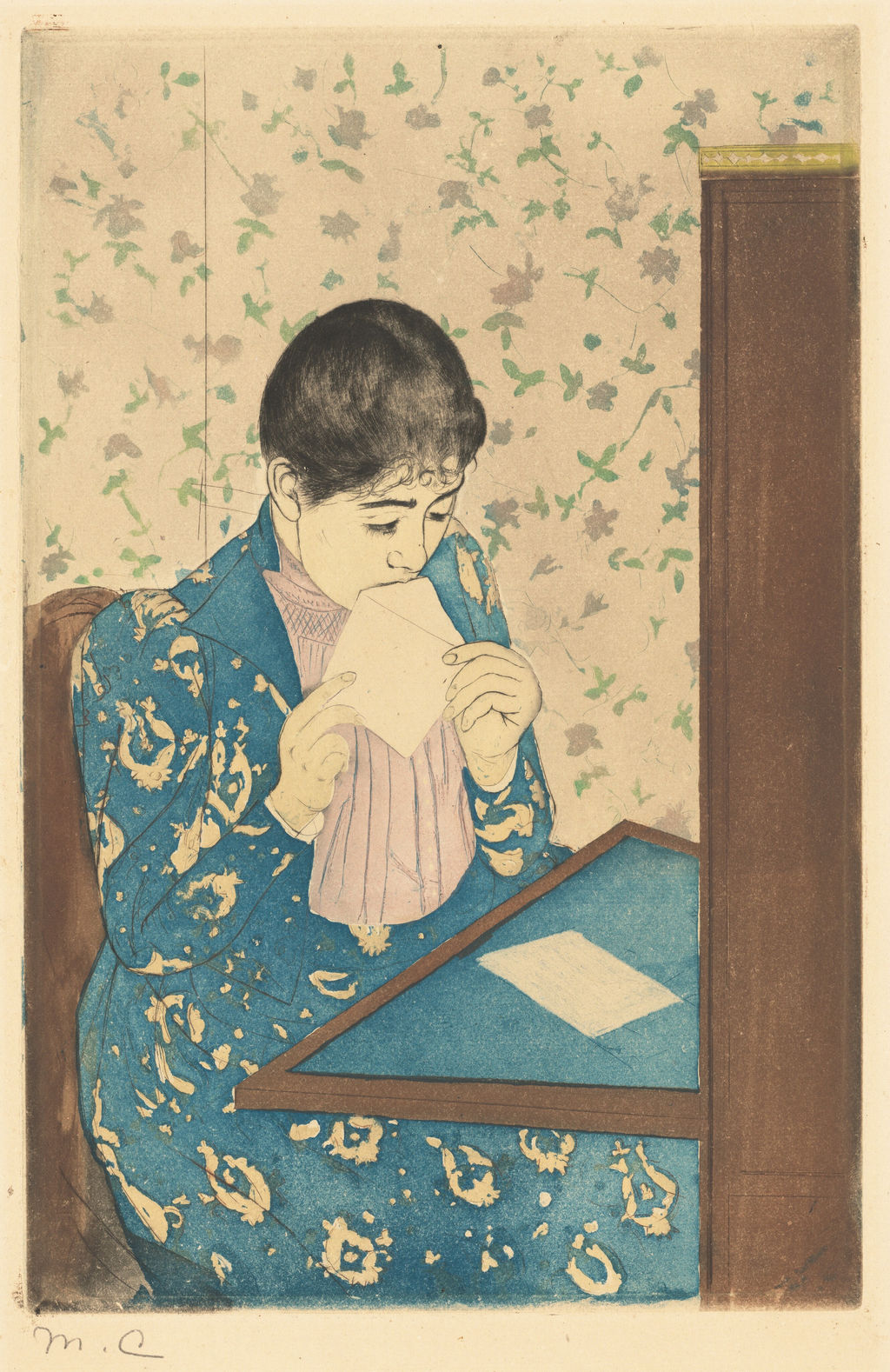
A woman brings an envelope to her mouth, holding it with both hands above a blue writing surface. The blue returns in her patterned garment, while small flowers and leaves cover the wall behind. A tall brown piece of furniture closes the right side. Cassatt makes a brief act of correspondence part of an intricate arrangement of lines, patterns and colour.
The National Gallery of Art dates The Letter to 1890–91. Its Rosenwald Collection impression, accession 1943.3.2763, is colour drypoint, soft-ground etching and aquatint, catalogued as Mathews and Shapiro number 8, fourth state of four. The plate measures 36.6 × 22.6 centimetres; the larger sheet measures 47.7 × 30.8 centimetres. Those measurements describe this particular impression. [1]
At a Glance
- ArtistMary Cassatt [1]
- TitleThe Letter [1]
- Date1890–91 [1]
- MediumColour drypoint, soft-ground etching and aquatint [1]
- Named colour impressionNational Gallery of Art, Rosenwald Collection, 1943.3.2763 [1]
- StateFourth of four; Mathews and Shapiro 8 iv/iv [1]
- Plate dimensions36.6 × 22.6 cm [1]
- Sheet dimensions47.7 × 30.8 cm [1]
- Early comparisonMetropolitan Museum of Art 16.3.2, black drypoint, first state of four [2]
This work across Mary Cassatt’s career
The Letter (current article)
1890–91 [1]Modern Woman
1892–93; displayed in 1893 [7] [8] [9]The Boating Party
1893–94 [10]The Child's Bath
1893 [11]Woman with a Sunflower
About 1905 [13]Young Woman in Green Outdoors in the Sun
About 1914 [14]Contents
- The envelope at the face
- A second pale rectangle
- The blue garment and pale front
- The angled writing surface
- Wallpaper around the head
- A separate first-state impression
- Drypoint and the museum’s burr explanation
- State, impression and sheet
- The Set of Ten and shared printing work
- The Fitting
The envelope at the face
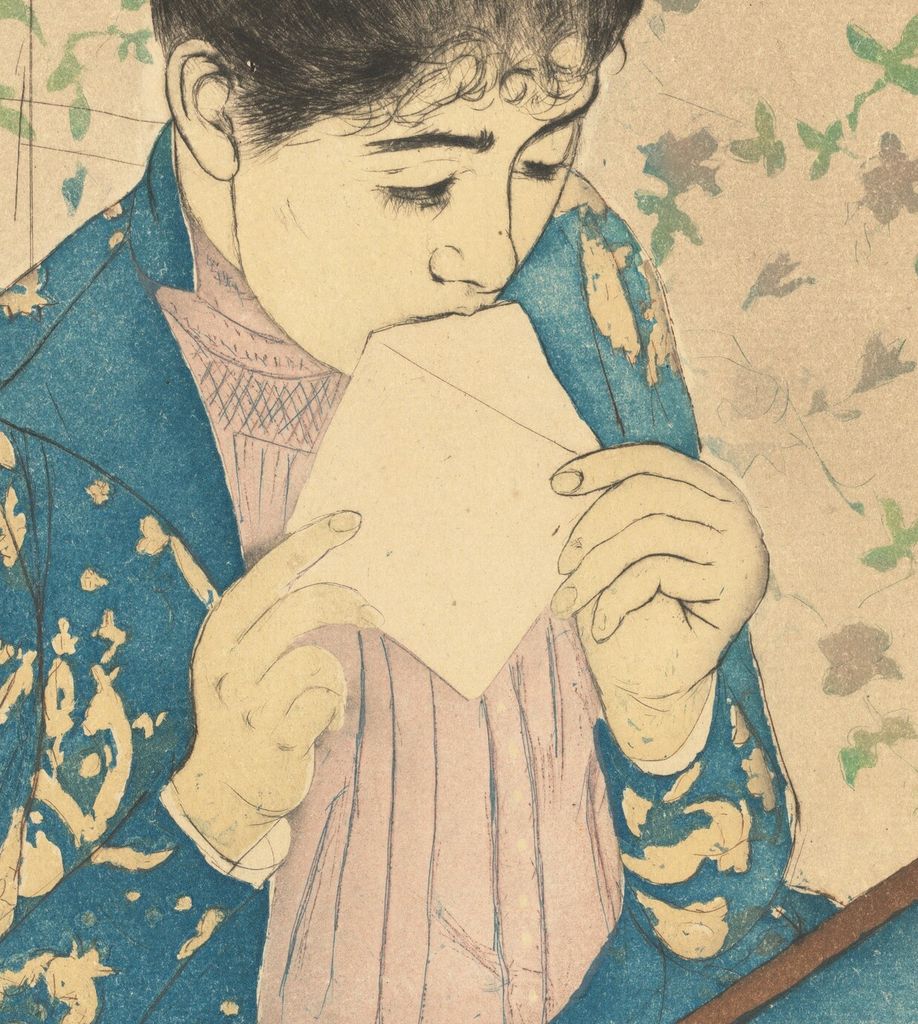
The woman’s head bends towards the envelope. Her dark hair forms a rounded shape above the forehead, with smaller curled marks close to the face. The eyes are lowered, and the mouth meets the edge of the paper in the action generally understood as moistening its flap.
The hands approach from either side. Fingers at the right hold one edge, while the other hand supports the paper nearer the lower left. The envelope occupies the space between them, giving the two gestures a common purpose rather than leaving the raised hands unconnected.
The action is specific but brief. It belongs to preparing correspondence rather than simply reading a sheet or writing with a visible pen. The paper has already been brought close to the face, concentrating attention on a small contact within a much larger patterned figure.
Its pale surface also provides a pause. Hair, garment and wallpaper contain many small marks, whereas the envelope offers a comparatively uninterrupted shape. That difference lets a modest object become prominent without making it the largest or darkest part of the image.
No message is legible. The print does not identify a recipient, the contents of a letter or a romantic relationship. It can make correspondence visually compelling while leaving the actual words and their intended reader outside the scene.
A second pale rectangle
Another pale sheet or envelope lies on the blue writing surface. Its angle differs from the paper at the woman’s mouth, linking the small raised action with the larger desktop below. The two light forms are related without becoming identical in position or function.
The lower rectangle also helps explain the surface beneath it. Its straight edges sit within the broader angled blue plane, giving the viewer a small, manageable shape through which to recognise the desk’s orientation.
It should not be treated as a decipherable second message. A visible paper object does not establish whether it is a finished letter, spare sheet or another envelope. The important compositional relationship is secure even where its exact use remains open.
The repeated paleness creates another link with the face and hands. These smaller light areas are distributed through the upper figure and desktop. Against the stronger blue and brown, they keep attention moving between the act and its immediate setting.
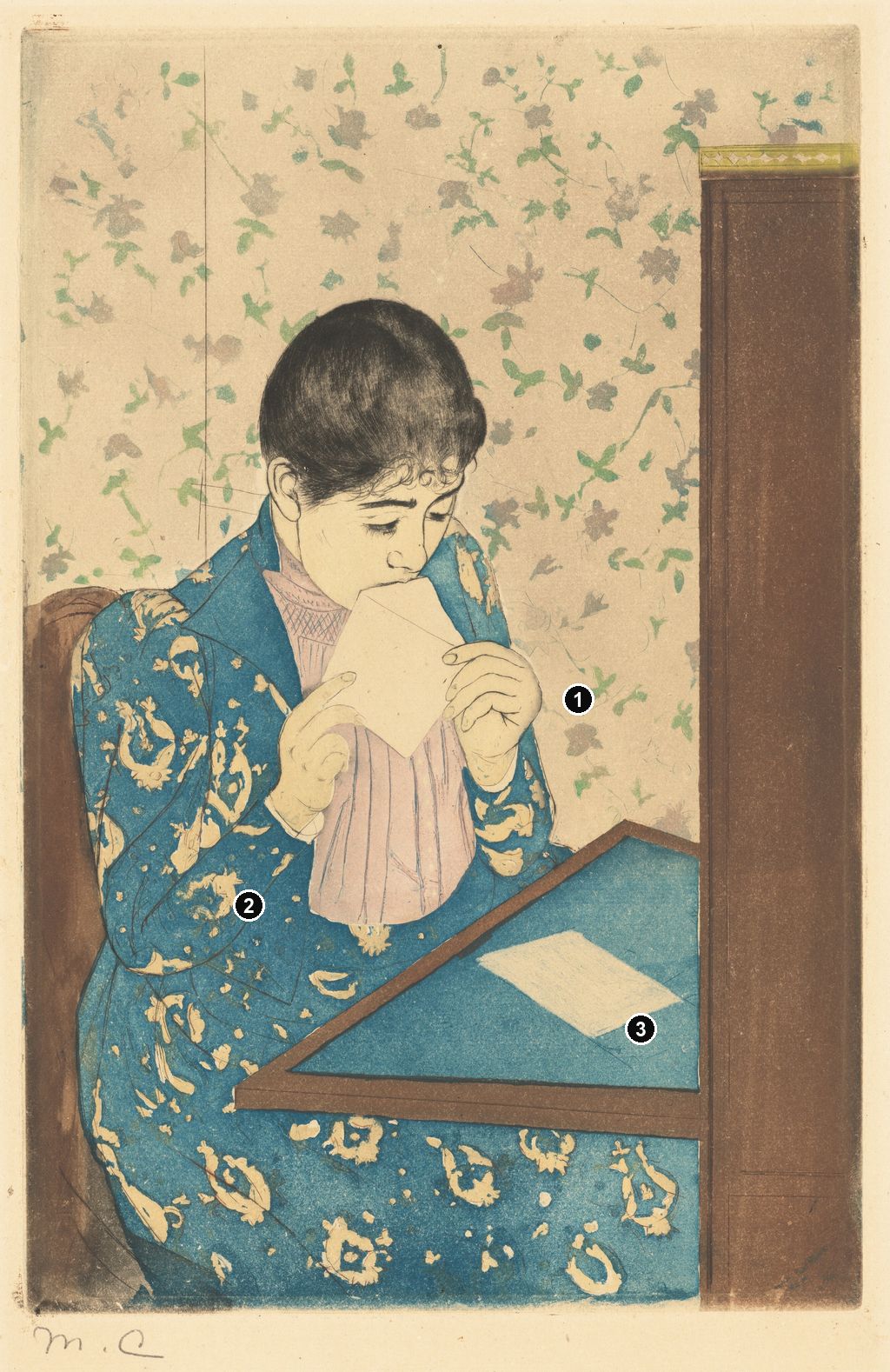
Annotated Details from The Letter
The numbered points identify visible features discussed in this article. Return from each detail to the whole composition. The Letter, 1890–91. National Gallery of Art, Rosenwald Collection, 1943.3.2763; final colour impression. National Gallery of Art, Washington, Rosenwald Collection. Image source. Public domain. Numbered overview and detail crops from the separate source master; original appearance retained.
Details from THE LETTER
Compare the cropped details with the complete images above. Notice how their colours, shapes and positions contribute to the larger compositions.
Hands and envelope
The envelope approaches the woman’s mouth while the hands steady its corners. Small changes of finger position give the otherwise flat pale shape a bodily setting.
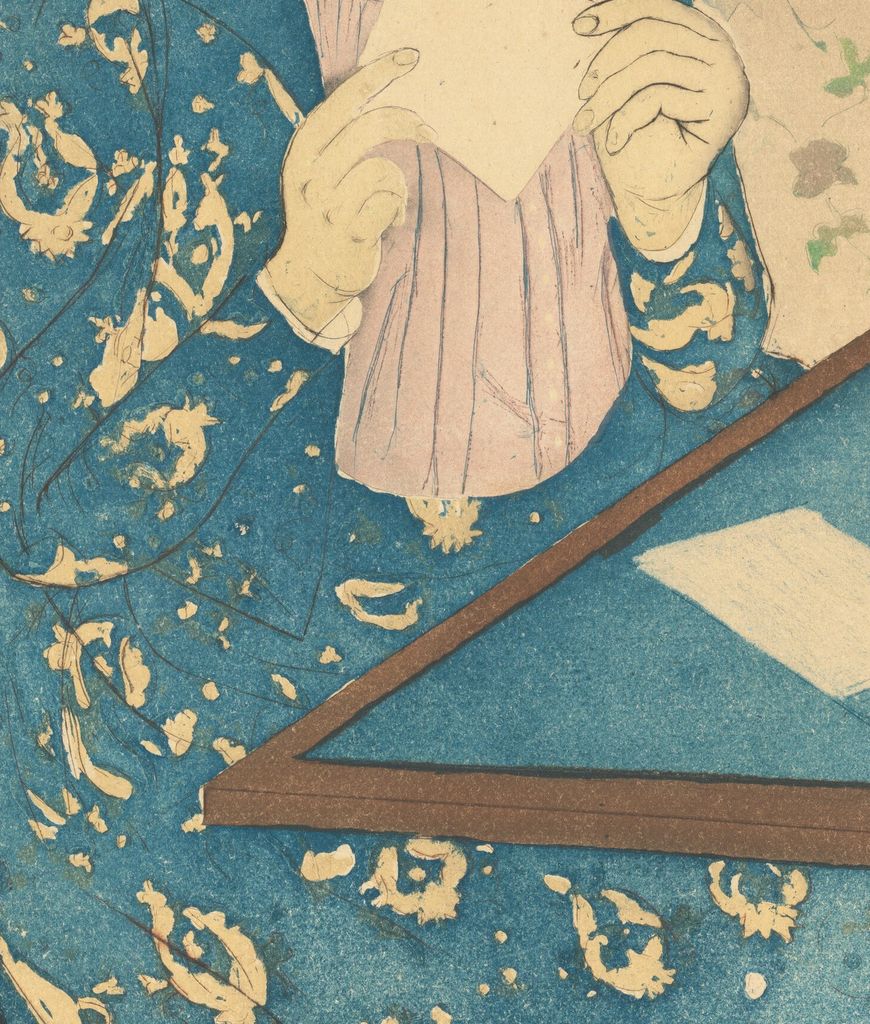
Two kinds of garment pattern
Vertical lines organise the pale bodice while larger ornamental shapes spread across the blue garment. The patterns occupy adjacent parts of the same seated body.
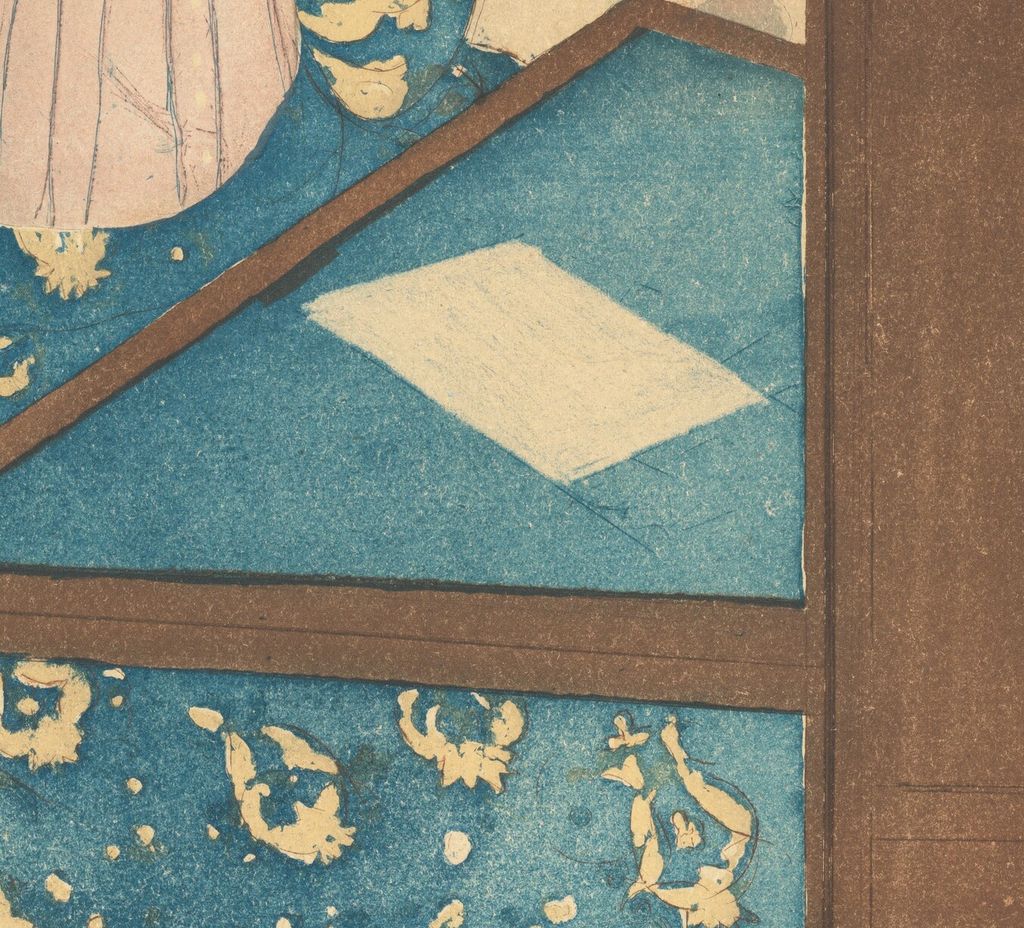
Paper on the angled desk
A pale sheet lies on the blue desk surface. Its simpler outline contrasts with the patterned clothing and wallpaper nearby.
The blue garment and pale front
Blue covers much of the woman’s seated body. Pale motifs interrupt it across sleeve, skirt and shoulder, making the clothing one of the richest patterned areas. The individual shapes vary rather than forming an absolutely even grid.
The pattern follows a body already established by contour. A sleeve curves towards the raised hand; the shoulder slopes beside the neck; the skirt spreads below the desk. Decorative marks occupy those areas without replacing the larger shapes that identify a seated person.
At the chest, a paler vertically lined front separates the two blue sides. Its direction differs from the scattered motifs around it. The contrast helps the torso remain legible within an otherwise visually busy garment.
The neckline sits close beneath the face, while the darker outer collar opens towards the hands. This arrangement concentrates several changes of material and shape within a small area: skin, pale front, blue patterned fabric and envelope.
The face does not need dense shading to stand apart. Fine outlines and a few darker features work beside much larger colour areas. The contrast between a lightly described face and a richly patterned garment becomes one of the print’s defining relationships.
The angled writing surface
The desktop projects from the tall furniture at the right. Its outer brown border makes a strong diagonal across the lower figure, while the blue surface extends behind it. The plane seems to enter the space between viewer and seated woman.
The diagonal is particularly noticeable beside the furniture’s upright edge. One leads across the body; the other rises through most of the right side. Their meeting gives the interior a clear structure even though little of the floor or wider room appears.
The writing surface also conceals part of the skirt. The garment continues below and beyond it, but the furniture interrupts the view. This overlap gives a sense of near and far without requiring deep shadows across every adjoining form.
Blue connects the desk covering and the garment, yet the two remain distinguishable. The covering is comparatively broad and unpatterned; the clothing contains pale motifs and curved boundaries. Repeated colour becomes a means of relation rather than a reason to merge separate objects.
The tall brown area adds another contrast. Its long relatively uninterrupted surface differs from the scattered flowers on the wall and the garment’s pattern. The furniture supplies a strong vertical pause within a composition dense with smaller incidents.
Wallpaper around the head
Small leaves and flowers spread across the background. Green and muted warmer forms repeat over a pale field, extending above the head and towards the furniture. Their repetition establishes a decorated wall without requiring a fully described room.
The scale differs from the clothing motifs. Both are patterned surfaces, but one surrounds the figure and the other follows the body. The hair and face sit between them, providing a more concentrated area of dark and pale shapes.
Some wallpaper marks are close to the head’s boundary. They make the surrounding space active without becoming hair or clothing. Following the outline of the head helps separate these neighbouring patterns and reveals how economically the figure is placed among them.
The wallpaper also extends into the upper part, where no body interrupts it. This larger field balances the more crowded lower half of hands, garment and desktop. Pattern can therefore create space as well as fill it.
The effect is neither an empty background nor an evenly detailed interior. Cassatt concentrates information in selected planes: clothing, wall, desk and tall furniture. Their different patterns and boundaries organise the scene around a compact bodily action.
A separate first-state impression
The Met owns a black drypoint impression, accession 16.3.2, which it identifies as the first of four states and the only known impression of that first state. It was a gift of Arthur Sachs in 1916. The museum gives one plate, 34.4 × 22.7 centimetres, and a sheet of 34.6 × 23.2 centimetres. This is a separate physical object from the final colour sheet at the National Gallery. [2]
In the early image, the head, hands and envelope are already clearly established. The garment’s decorative outlines are also present, together with the angled desk and upright furniture edges. It would be inaccurate to describe the first version as a figure without any surrounding structure or dress pattern.
The space around those outlines is much more open than in the colour impression. Without the large blue and brown fields and the developed wallpaper pattern, the line drawing receives greater attention. The woman’s action can be recognised before the final colour relationships are in place.
The comparison shows a change in emphasis as well as an addition of colour. In the early proof, separate lines describe the garment motifs. In the final image, pale forms within the blue garment work through a stronger contrast of filled and unfilled areas.
The two images do not reveal every intermediate operation. Seeing the beginning and final state establishes visible differences, but does not give access to each trial, adjustment or decision between them. A sequence needs its own surviving evidence rather than a reconstruction from what seems plausible.
Watch: Mary Cassatt
Choose a film to explore the artist’s work, its interpretation and its wider setting.
Demonstrating Mary Cassatt's Color Printmaking Techniques
The Philadelphia Museum of Art demonstrates techniques used to make Cassatt’s colour prints.
Watch on YouTubeDrypoint and the museum’s burr explanation
The Met explains the early impression’s textured lines in relation to drypoint burr: the raised metal created beside a line scratched into copper can hold ink and produce a rich printed effect. This is the museum’s account of the process and appearance. [2]
That explanation helps distinguish a printed line from a pencil mark on the sheet. The visible image has been transferred from a worked plate. The paper carries ink resulting from that process, rather than simply bearing the original scratched design itself.
It does not follow that a reproduction permits microscopic inspection of the burr. The printed appearance can be discussed with the museum’s explanation while the surviving plate surface, exact tool pressure and wear remain separate questions.
The final National Gallery record names drypoint, soft-ground etching and aquatint together. Its medium describes a combination rather than one technique enlarged into an explanation of every passage. The early one-plate black impression should retain its own narrower description. [1]
State, impression and sheet
A state describes a stage in a print’s development, while an impression is an individual sheet printed from the worked matrix. Several impressions can belong to one state. A final-state designation therefore does not mean that only one physical example exists.
The distinction matters particularly here. The National Gallery’s fourth-state Rosenwald sheet and the Met’s first-state Sachs sheet have different accessions, dimensions and collecting histories. Their shared design connects them, but does not make their physical records interchangeable.
Plate and sheet measurements answer different questions as well. The plate dimensions describe the printing matrix’s scale; the sheet includes the paper beyond it. A border around the image should not silently become part of the depicted room or a new measurement of the design.
Other museums hold further colour impressions. Their paper, margins and measurements require their own records. Differences between separately photographed sheets cannot automatically establish fading, repair or a changed state of the plate.
The Set of Ten and shared printing work
The National Gallery’s 2026 account places The Letter within Cassatt’s Set of Ten, developed in 1890–91 after her encounter with Japanese colour woodcuts. It describes her work with the printer Modeste Leroy and the demands of combining colour printing with etched and scratched lines. [15]
The relationship concerns a group of prints and a broader encounter with another tradition. It does not identify a particular Japanese image as the exact source for this woman and envelope. Similarities of flat colour, outline and pattern can be considered without inventing an unverified prototype.
The project also involved practical printing decisions. Different inks and worked surfaces had to produce a coherent image on paper. The final scene’s apparent ease should not be mistaken for proof that it was reached in a single operation.
Artist and printer have related but distinct roles in that work. A general account of collaboration does not make every physical impression identical in its credits or require the same plate count for every design. The named records and actually preserved proofs remain the basis for a precise account.
The Fitting
The Fitting offers another relationship between everyday activity and patterned space. The Met’s colour impression, accession 16.2.8, is the seventh and final state, printed from three plates. A standing woman in a pale patterned gown appears beside a kneeling figure in a darker dress, with a mirror repeating the standing body. [16]
The visible work is distributed between two people. One stands while another attends to the garment near the floor. In The Letter, a single seated figure performs the central action, and the desk supplies the principal angled structure.
The mirror also changes the count of visible bodies. A reflected figure expands the fitting scene without adding another actual worker. The correspondence image instead develops its room through wallpaper and furniture, keeping attention on the relationship between two hands and one envelope.
A depicted fitting can suggest different social roles, just as correspondence can suggest access to written communication. Neither image by itself verifies the models’ real occupations or the exact circumstances of an individual transaction.
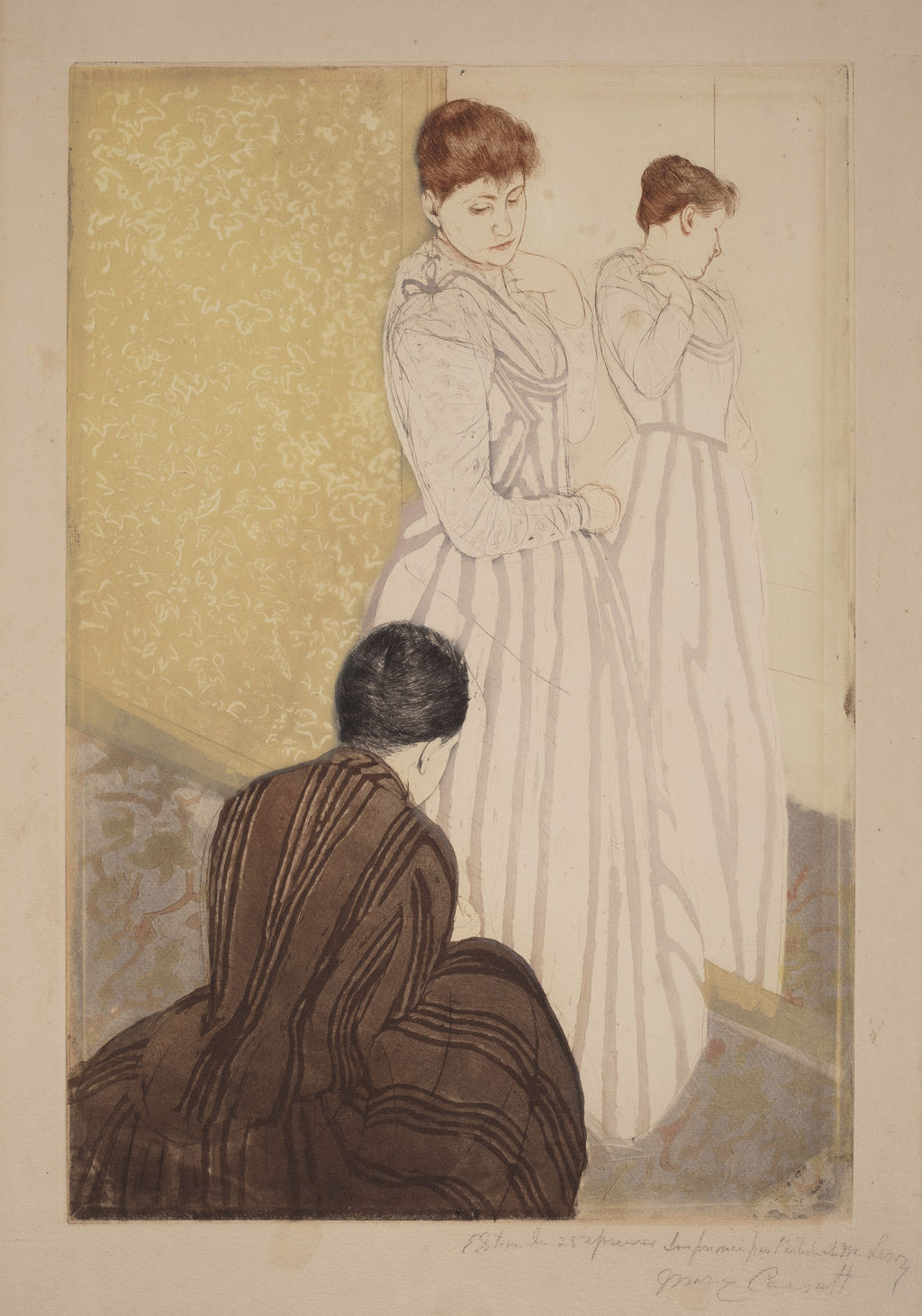
The Fitting, 1890–91. National Gallery of Art, Chester Dale Collection, 1963.10.252; seventh and final state. The article’s Met impression is a separate sheet. National Gallery of Art, Washington, Chester Dale Collection. Image source. Public domain. Resized only; whole sheet and documentary margins retained.
In the Omnibus
In the Omnibus places two adults and a child within public transport. The National Gallery’s final colour impression, accession 1963.10.250, is catalogued as the seventh state of seven. Window divisions and a bench organise the group, contrasting with the more private writing interior. [17]
The National Gallery’s process account uses a preparatory drawing, its reverse and several proofs to discuss that design’s development. It supplies more intermediate evidence than the first-and-final comparison considered here for The Letter. The two projects should retain their separate sequences. [15]
The final images also distribute attention differently. The omnibus passengers occupy a shared seat, with the child creating another centre of contact. The woman at the writing desk concentrates a brief action near her own face. Both make everyday life a subject for elaborate colour printing, while their figures, settings and proof histories remain distinct.
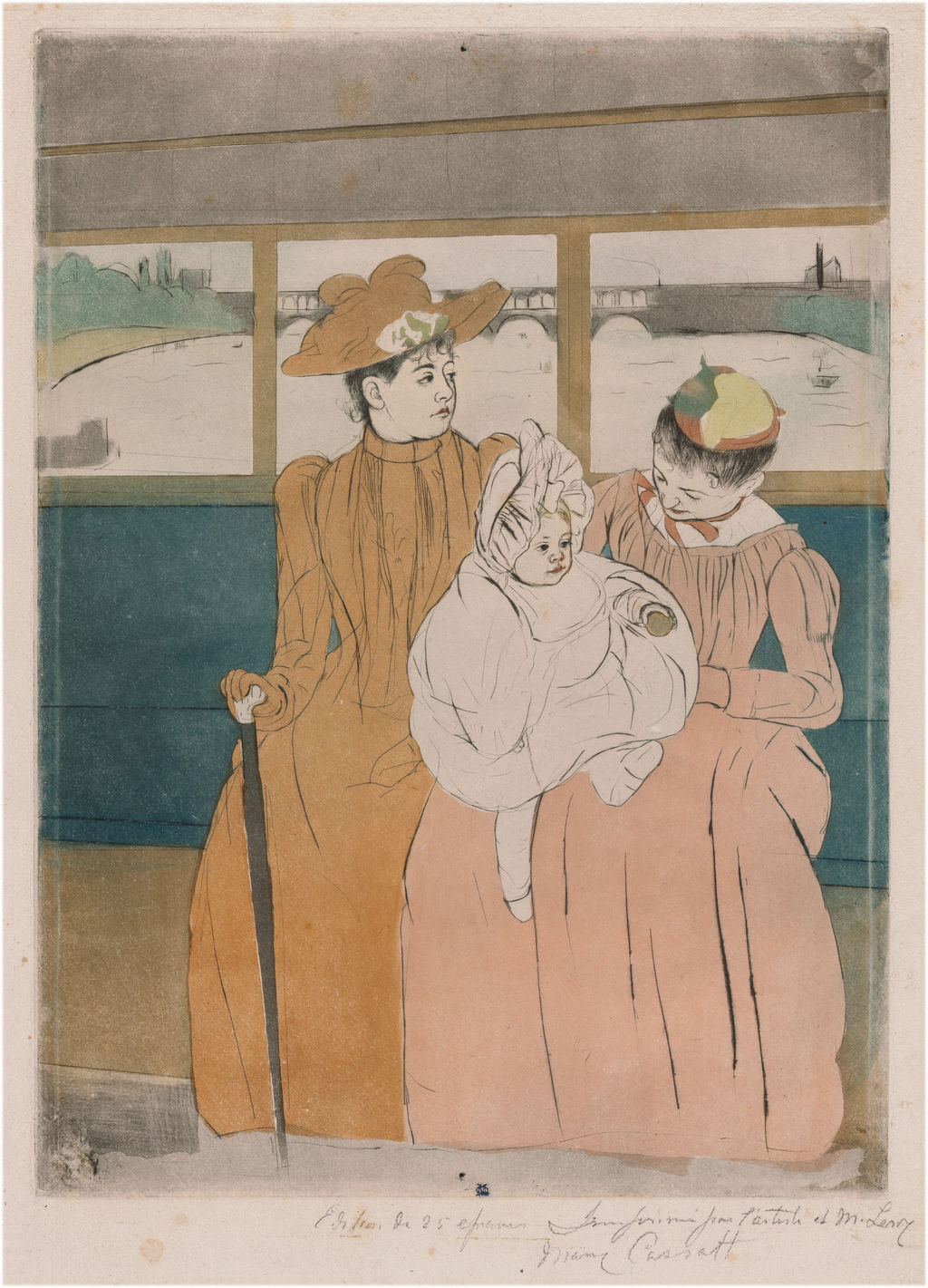
In the Omnibus, 1890–91. National Gallery of Art, Chester Dale Collection, 1963.10.250; seventh and final state. National Gallery of Art, Washington, Chester Dale Collection. Image source. Public domain. Resized only; whole sheet and documentary margins retained.
Cassatt artworks and studies
A source-bounded directory of documented works and studies, including the works in the National Gallery’s 2026 checklist and one clearly marked former attribution. Different print impressions are grouped by design and remain searchable by their recorded accessions. This is not a complete catalogue raisonné. Unlinked titles have no individual article here.
| Name | Date | Medium |
|---|---|---|
| A Child’s Bath — LACMA oil | 1880 | Oil on canvas |
| A Goodnight Hug | 1880 | Pastel |
| After the Bullfight | 1873 | Oil on canvas |
| Afternoon Tea Party | 1890–91 | Colour print |
| At the Theatre (Lydia Cassatt Leaning on Her Arms, Seated in a Loge) | About 1879 | Pastel |
| Automne, portrait de Lydia Cassatt | 1880 | Oil on canvas |
| Breakfast in Bed | 1897 | Oil on canvas |
| Bust of Ellen with Bows in Her Hair | 1898 | Pastel |
| By the Pond | About 1896 in Met and Terra records; about 1898 at MoMA | Not established |
| Child Drinking Milk from a Bowl; provisionally identified composition (qualified identification) | About 1890, following inventory and catalogue text | Pastel |
| Child in a Straw Hat | About 1886 | Oil on canvas |
| Child Picking a Fruit | 1893 | Oil on canvas |
| Children Playing on the Beach | 1884 | Oil on canvas |
| Clarissa, Turned Left, with Her Hand to Her Ear | About 1890–93 in Sotheby’s 2012 entry; about 1893 in GCMA notice | Pastel |
| Denise at her Dressing Table | About 1908–09 | Oil on canvas |
| Driving | 1881 | Oil on canvas |
| Eddy Cassatt (Edward Buchanan Cassatt) | 1875 | Oil on canvas |
| Ellen Mary Cassatt in a White Coat | About 1896 | Oil on canvas |
| Emmie and her Child | About 1890 | Oil on canvas |
| Gathering Fruit | About 1893 | Not established |
| Girl Arranging her Hair | 1886 | Oil on canvas |
| Head of a Child with a Red Hat | 1903, signed and dated | Pastel |
| Head of a Woman in a Large Hat | About 1909 | Pastel |
| Head of Simone in a Green Bonnet with Wavy Brim | About 1904 | Pastel |
| In the Garden | 1903 or 1904 | Oil on canvas |
| In the Loge | 1878 | Oil on canvas |
| In the Omnibus | 1890–91 | Colour print |
| In the Omnibus [recto] — preparatory drawing | c. 1891 | Chalk and graphite |
| In the Opera Box (No. 3) [recto] — preparatory drawing | 1880 | Graphite |
| In the Opera Box (No. 3) — print | c. 1880 | Intaglio print |
| Jeune fille au jardin (Young Woman Sewing in a Garden) | 1880–82 | Oil on canvas |
| Jules Dried by His Mother; provisionally identified composition (qualified identification) | 1901, following catalogue text | Oil on canvas |
| Lady in Black, in a Loge, Facing Right | c. 1880 | Etching |
| Lilacs in a Window | About 1880–83 | Oil on canvas |
| Little Girl in a Blue Armchair | 1878 | Oil on canvas |
| Louise Nursing her Child | 1899 in Luxembourg caption; 1898–99 in loan and Arp records | Pastel |
| Madame Gaillard and Her Daughter Marie-Thérèse | 1897, Reynolda collection listing | Pastel |
| Maternal Caress | 1890–91 | Not established |
| Maternal Caress — preparatory drawing | About 1891 | Charcoal and graphite |
| Mathilde Holding a Baby Who Reaches out to the Right | About 1889, Christie’s catalogue | Pastel |
| Mimi as a Brunette | c. 1889 | Drypoint |
| Mimi Holding a Japanese Fan | c. 1889 | Drypoint |
| Modern Woman | 1892–93; displayed in 1893 | Not established |
| Mother about to Wash her Sleepy Child | 1880 | Oil on canvas |
| Mother and Child (Maternal Kiss) | 1896 | Pastel |
| Mother and Child (Nude Dark-Eyed Little Girl with Mother in Patterned Wrapper) | About 1898–99, Sotheby’s catalogue | Pastel |
| Mother and Child (The Oval Mirror) | About 1899 | Oil on canvas |
| Mother Berthe Holding Her Nude Baby | 1898–99 | Pastel |
| Mother in Purple Holding her Child | About 1914, Christie’s catalogue | Pastel |
| Mother Playing with Child | About 1897 | Pastel |
| Mother’s Kiss | 1890–91 | Colour print |
| Nurse Reading to a Little Girl | 1895 | Pastel |
| Poppies in a Field (formerly Cassatt; attributed to Victor Gabriel Gilbert) | About 1880, current museum record | Oil on panel |
| Portrait of an Elderly Lady | c. 1887 | Oil on canvas |
| Portrait of Madame AF Aude and her Two Daughters | 1899, Breeskin 1970 exhibition catalogue | Pastel |
| Portrait of the Artist | 1878 | Watercolour and gouache |
| Reading Le Figaro | 1878, NGA 2026 checklist; about 1877–78 in SAAM’s 2015 caption | Oil on canvas |
| Reflection — drypoint | c. 1890 | Drypoint |
| Sara Holding a Cat | About 1907–08 | Oil on canvas |
| Sara in a Green Bonnet | About 1901 | Oil on canvas |
| Sara with Her Dog, in an Armchair, Wearing a Bonnet with a Plum Ornament | 1901 | Pastel |
| Self Portrait | About 1880 | Watercolour and gouache |
| Simone in Blue Plumed Hat | About 1903 | Pastel |
| Simone Seated on the Grass next to her Mother | 1901–02 | Pastel |
| Sketch of Master St. Pierre | Date not established | Pastel |
| Sleepy Baby | About 1910 | Pastel |
| Smiling Mother with Sober Faced Child | Date not established | Pastel |
| Spanish Dancer Wearing a Lace Mantilla | 1873 | Oil on canvas |
| Summertime, horizontal painting | 1894–95, current Sotheby’s catalogue | Oil on canvas |
| Tea — print | c. 1890 | Drypoint |
| The Bath | 1890–91 | Not established |
| The Boating Party | 1893–94 | Oil on canvas |
| The Caress | 1902 | Oil on canvas |
| The Child's Bath | 1893 | Oil on canvas |
| The Coiffure | 1890–91 | Colour print |
| The Cup of Tea | About 1880–81 | Oil on canvas |
| The Fitting | 1890–91 | Colour print |
| The Lamp | 1890–91 | Colour print |
| The Letter | 1890–91 | Colour print |
| The Loge | About 1878–1880 | Oil on canvas |
| The Mandolin Player | 1868 | Oil on canvas |
| The Manicure (Les Ongles; The Nails) | About 1908 | Intaglio print |
| The Tea; Le Thé | About 1880 | Oil on canvas |
| The Visitor | c. 1880 | Intaglio print |
| Two Sisters | 1896 | Pastel |
| Two Women Seated by a Woodland Stream | About 1869 | Oil on canvas |
| Two Women Throwing Flowers During Carnival | 1872 | Oil on canvas |
| Under the Horse-Chestnut Tree | 1896–97, National Gallery and MoMA records | Not established |
| Woman Bathing (La Toilette) | 1890–91 | Colour print |
| Woman in a Loge (Woman with a Pearl Necklace) | 1879 | Oil on canvas |
| Woman Reading | 1878–79 | Oil on canvas |
| Woman Standing, Holding a Fan | 1878–79 | Distemper |
| Woman with a Fan | c. 1878–1879 | Oil on canvas |
| Woman with a Red Zinnia | 1891 | Oil on canvas |
| Woman with a Sunflower | About 1905 | Oil on canvas |
| Young Girl at a Window | c. 1883–1884 | Oil on canvas |
| Young Girl with Brown Hair, Looking Left | About 1913 (1997 summary catalogue) | Pastel |
| Young Mother Sewing | 1900 | Oil on canvas |
| Young Woman in Green, Outdoors in the Sun | About 1914 | Oil on canvas |
Discussion
Look again at the images and ideas explored in The Letter by Mary Cassatt. These editorial prompts invite your observations.
Reader Insights
A woman brings an envelope to her mouth, holding it with both hands above a blue writing surface. What does this first detail make you notice?
The woman’s head bends towards the envelope. How does it affect your reading of the whole work?
Does the final colour draw you first to the envelope, the patterned garment, or the diagonal desk?
Join the Conversation
Share a detail, comparison or question about The Letter by Mary Cassatt below.
References
- National Gallery of Art, The Letter, 1890–91, Rosenwald Collection, 1943.3.2763; final colour impression, Mathews and Shapiro 8 iv/iv, with separately labelled plate and sheet dimensions. View source.
- Metropolitan Museum of Art, The Letter, 1890–91, 16.3.2; black drypoint from one plate, first state of four, current only-known-first-state assessment and museum burr explanation. Its restricted public thumbnail is used for the early comparison, not as a production master. View source.
- Denver Art Museum, Whistler to Cassatt Access Guide, The Salon, stop 104. View source.
- Denver Art Museum, Whistler to Cassatt:American Painters in France, bilingual exhibition livret,The Salon,no2. View source.
- National Gallery of Art, Little Girl in a Blue Armchair, 1983.1.18. View source.
- Philadelphia Museum of Art, Driving, 1881. View source.
- Art Institute of Chicago, Ryerson and Burnham Archives, Bertha Honoré Palmer Correspondence Collection finding aid, selected Mary Cassatt entries, Box1Folder3. View source.
- Museum of Modern Art, Mary Cassatt artist essay and print records. View source.
- MaudHoweElliott(ed.) / UniversityofIllinoisUrbanaChampaign scan, Art and Handicraft in the Woman’s Building of the World’s Columbian Exposition,Chicago,1893,Chicago:RandMcNally,1894. View source.
- National Gallery of Art, The Boating Party, 1963.10.94. View source.
- Art Institute of Chicago, The Child’s Bath,1910.2,current expanded collection entry. View source.
- Metropolitan Museum of Art, Young Mother Sewing, 29.100.48. View source.
- National Gallery of Art, Woman with a Sunflower, 1963.10.98. View source.
- Sotheby’s, Young Woman in Green Outdoors in the Sun, Modern Day. View source.
- National Gallery of Art, Mary Cassatt, the Daring Printmaker, 23 January 2026; Set of Ten, Japanese-print context, Leroy collaboration and the separately documented Omnibus proof sequence. Museum-transmitted artist remarks are not quoted as newly checked original letters. View source.
- Metropolitan Museum of Art, The Fitting, 1890–91, 16.2.8; separate seventh-state colour impression from three plates. View source.
- National Gallery of Art, In the Omnibus, 1890–91, 1963.10.250; separate final colour impression, Mathews and Shapiro 7 vii/vii. View source.
- Art Gallery of Ontario, Cassatt–McNicoll:ImpressionistsBetweenWorlds. View source.
- Metropolitan Museum of Art, The Bath, 16.2.7. View source.
- National Gallery of Art, Children Playing on the Beach, 1970.17.19. View source.
- Colby College Museum of Art, Explore Inside Out: The Prints of Mary Cassatt; Mother Berthe Holding Her Nude Baby,2013.549. View source.
- Sotheby’s, syndicated auction catalogue hosted by Invaluable, Simone in Blue Plumed Hat, Watson collection, 18 May 2005, lot 20. View source.
- The Huntington, Breakfast in Bed, 83.8.6. View source.
- Adelyn Dohme Breeskin / Smithsonian Institution Press; University of California scan indexed by Google Books, Mary Cassatt:A Catalogue Raisonné of the Oils,Pastels,Watercolors,and Drawings,1970,322pp; selected public search snippets pp91–92,143–144,316,318. View source.
- Metropolitan Museum of Art, The Private Collection of Edgar Degas: A Summary Catalogue, Cassatt entries, printed p.7, no.48. View source.
- Art Institute of Chicago, After the Bullfight, 1969.332. View source.
- Smithsonian American Art Museum, Art Inventories, After the Bullfight, siris_ari_180619. View source.
- Smithsonian American Art Museum, The Caress, 1911.2.1. View source.
- Museum of Modern Art, Under the Horse-Chestnut Tree,671.1940. View source.
- National Gallery of Art, Under the Horse-Chestnut Tree,1959.12.4. View source.
- Virginia Museum of Fine Arts, Board of Trustees minutes,17September2020,loan recommendation7:ChildPickingaFruit75.18. View source.
- Cincinnati Art Museum, Les Ongles(The Nails;The Manicure),ca1908,1940.155,secondstate. View source.
- Sotheby’s, Clarissa Turned Left with Her Hand to Her Ear, 2012 lot 51. View source.
- Greenville County Museum of Art, Recent Acquisitions Funded by Sale of Alma Thomas Painting, 2021. View source.
- Metropolitan Museum of Art, The Coiffure,16.2.3. View source.
- Metropolitan Museum of Art, The Cup of Tea, 22.16.17. View source.
- Sotheby’s, Mother and Child (Nude Dark-Eyed Little Girl with Mother in Patterned Wrapper), 19 May 2010, lot 31. View source.
- Metropolitan Museum of Art, Denise at Her Dressing Table, 2005.129. View source.
- Denver Art Museum, Whistler to Cassatt exhibition guide, stop 112: Bust of Ellen with Bows in Her Hair. View source.
- Museum of Fine Arts, Boston, Ellen Mary in a White Coat, 1982.630. View source.
- Amon Carter Museum of American Art, Woman Standing Holding a Fan, 2011.20. View source.
- Smithsonian American Art Museum, Special Installation of Nineteen American Masterworks, 2015. View source.
- Reynolda House Museum of American Art, Mary Cassatt collection listing: Madame Gaillard and Her Daughter Marie-Thérèse, 1897. View source.
- Wake Forest University, Wake Women 2023 schedule, Highlighting the Art of Women at Reynolda, captioned Cassatt image. View source.
- Detroit Institute of Arts, In the Garden, 36629. View source.
- National Gallery of Art, Gathering Fruit,1943.3.2757. View source.
- Sotheby’s, A Goodnight Hug,N09860lot11,14May2018. View source.
- Sotheby’s, syndicated auction catalogue hosted by Invaluable, Head of Simone in a Green Bonnet with Wavy Brim, Watson collection,18May2005,lot39. View source.
- National Gallery of Art, Girl Arranging Her Hair, 1963.10.97. View source.
- Joslyn Art Museum, Art Break:Woman Reading,1943.38,program object caption. View source.
- Los Angeles County Museum of Art, A Child’s Bath, M.62.8.14. View source.
- National Gallery of Art, The Lamp, 5937. View source.
- Sotheby’s, Tête de Femme au Grand Chapeau, 2008 N08449 lot135. View source.
- Metropolitan Museum of Art, Lilacs in a Window, 1997.207. View source.
- National Gallery of Art, The Loge,1963.10.96. View source.
- Arp Museum Bahnhof Rolandseck, Maestras: Malerinnen1500–1900,25February–16June2024,official five-page flyer. View source.
- Spanish official gazette / exhibition insurance schedule, BOE-A-2023-19808,21September2023,Maestras loan schedule. View source.
- Nationalmusée um Fëschmaart / ArpMuseum CollectionRauforUNICEF, Louise,NursingHerChild,1899,GR1.949;FromRenoirtoMonet2026–27. View source.
- Petit Palais / Paris Musées, Automne, portrait de Lydia Cassatt, PPP706; IIIF manifest 160008392. View source. (in French).
- Metropolitan Museum of Art, Maternal Caress, 16.2.5. View source.
- Philadelphia Museum of Art, Mother and Child Maternal Kiss, object 54049. View source.
- Metropolitan Museum of Art, Maternal Caress, preparatory drawing64.123.3, c1891. View source.
- Christie’s, Mathilde Holding Baby who Reaches out to Right, lot 5459369. View source.
- National Portrait Gallery / Catalog of American Portraits, Madame Meerson and her Daughter, SSSA2282. View source.
- Museum of Fine Arts Boston, In the Loge, 10.35. View source.
- Smithsonian art inventories, Child Drinking Milk from a Bowl, siris_ari_197517. View source.
- MutualArt public auction index; original auctioneer undisclosed without subscription, Child Drinking Milk from a Bowl, public listing dated 2 June 2024. View source.
- National Gallery of Art, Mother's Kiss,1963.10.254. View source.
- National Gallery of Art, Mary Cassatt An American in Paris checklist, updated 24 February 2026. View source.
- Adelyn D. Breeskin / National Gallery of Art, Mary Cassatt 1844–1926, 1970 exhibition catalogue. View source.
- Metropolitan Museum of Art, Nurse Reading to a Little Girl, 62.72. View source.
- Metropolitan Museum of Art, Mother and Child (The Oval Mirror), 29.100.47. View source.
- Philadelphia Museum of Art, Woman in a Loge, 1978-1-5, object72182. View source.
- Metropolitan Museum of Art, Mother Playing with Child, 22.16.23. View source.
- Metropolitan Museum of Art, By the Pond,60.732bis. View source.
- Museum of Modern Art, By the Pond,673.1940. View source.
- Terra Foundation for American Art, By the Pond,1999.25. View source.
- Philadelphia Museum of Art, Poppies in a Field, attributed to Victor Gabriel Gilbert; formerly attributed to Mary Stevenson Cassatt, 1978-1-6. View source.
- Christie’s, Mother in Purple Holding Her Child, lot 5369421. View source.
- Sotheby’s, Tête d’enfant au chapeau rouge, American Art N09229, 20 November 2014, lot 39. View source.
- Christie’s, Sara Holding a Cat, lot 5561267. View source.
- Smithsonian American Art Museum, Art Inventories Catalog, Sara with Her Dog, in an Armchair, Wearing a Bonnet with a Plum Ornament; IAP 80170363 / siris_ari_180925. View source.
- Smithsonian American Art Museum, Sara in a Green Bonnet, 1929.6.11. View source.
- Mary Cassatt Catalogue Raisonné project, with Adelson Galleries, presented on Artnet, Sara with Her Dog, in an Armchair, Wearing a Bonnet with a Plum Ornament, work 424155733. View source.
- Metropolitan Museum of Art, Portrait of the Artist, 1975.319.1. View source.
- National Portrait Gallery, Mary Cassatt Self-Portrait, NPG.76.33. View source.
- Musée d’Orsay, Jeune fille au jardin,RF193720. View source. (in French).
- Sotheby’s, Simone Seated on the Grass Next to Her Mother, 30 September 2020, lot 33. View source.
- Dallas Museum of Art, Sleepy Baby,1952.38.M. View source.
- Sotheby’s, Smiling Mother with Sober Faced Child, 2022. View source.
- Smithsonian American Art Museum, Spanish Dancer Wearing a Lace Mantilla, 1967.40. View source.
- Spencer Museum of Art,University of Kansas, The Manicure,c1908,1991.0266. View source.
- Christie’s, Sketch of Master St Pierre, 2017 online lot. View source.
- National Gallery of Art, Child in a Straw Hat, 1983.1.17. View source.
- Sotheby’s, Summertime, Armand Hammer: The Private Collection, Modern Evening Auction 2026. View source.
- National Gallery of Art, Afternoon Tea Party, 46731. View source.
- Museum of Fine Arts, Boston / Erica E. Hirshler, The Tea, 42.178. View source.
- The Nelson-Atkins Museum of Art, At the Theater,F77-33;French Paintings and Pastels appendixII. View source.
- Metropolitan Museum of Art, Woman Bathing La Toilette, 16.2.2. View source.
- Sotheby’s, Two Sisters, 2005 American Paintings sale N08134, lot 44. View source.
- Wichita Art Museum, Mother and Child, M109.53. View source.
- Smithsonian American Art Museum, Art Inventories, Two Women Seated by a Woodland Stream / Duex femmes assises aupres de l’eau, IAP 80170008. View source.
- Tacoma Art Museum / David Setford, Impressionist Painting: From Pleasure Gardens to the Palais Garnier, 22 October 2019. View source.
- Tacoma Art Museum, French Impressionism and the Northwest, Works of Art Adoption Program, 2019–2020, no. 10 / PDF p. 12. View source.


