by Tom Gurney
Tom Gurney BSc (Hons) is an art history expert with over 20 years experience
Email: tomgurney1@gmail.com / Phone: +44 7429 011000
Mary Cassatt, Collectors and Her Museum Legacy: Introduction
Mary Cassatt helped artworks travel between artists, dealers, collectors and museums. Sometimes she recommended a purchase; sometimes she judged a work unsuitable, negotiated with a dealer or helped secure delivery. Her own pictures also followed several routes into public collections, including artist gifts, private sales, family inheritance and later bequests.
The Havemeyers form an important part of that history, but they do not explain every museum holding. Following individual objects gives a fuller picture of Cassatt’s influence and its limits. It also distinguishes advice from a collector’s final decision, and ownership from the shipment or temporary loan of a work.
Susan Alyson Stein’s chronology in Splendid Legacy: The Havemeyer Collection supplies a detailed account of many of these relationships. Its letters, stockbooks and museum records are used here through that scholarly transmission; their originals have not all been independently inspected. Current museum records provide a separate basis for the present identification and acquisition history of particular works. [1]
At a Glance
- ScopeArt advice, purchases, exchanges, exhibition loans, gifts and bequests [1] [2] [3]
- NetworksHavemeyer, Pope/Bixby, Stillman, Dreyfus, Dale and Evans [1] [4] [5] [6] [7] [8]
- Key distinctionAdvice, ownership, custody, shipment, loan and accession are different events [1] [9] [4] [7]
Contents
- Louisine before the Havemeyer collection
- Advice within a wider network
- An Old Master reaches Chicago
- Buying a Cassatt: Young Mother Sewing
- A loan is not ownership: Lady at the Tea Table
- The 1915 exhibition and a public cause
- The Havemeyer bequest was a process
- Pope, Bixby and the Los Angeles bath painting
- Stillman and the Detroit garden
- Dreyfus and a still life at the Met
Louisine before the Havemeyer collection
Stein distinguishes several events often compressed into one origin story. Emily Sartain introduced Cassatt to Louisine Elder in June 1874. Louisine’s early Degas purchase, made with Cassatt’s advice, is placed probably in 1877. Harry Havemeyer’s first meeting with Cassatt came much later, in 1889, when Louisine already knew the artist. [1]
Those distinctions matter because Louisine was not simply brought into an existing relationship between two other people. Her early experience of art and her connection with Cassatt preceded the later collecting partnership. A probable purchase date should also remain probable, rather than becoming an exact replacement for a date used in an older memoir.
Cassatt’s 1878 self-portrait supplies an early example of Louisine acquiring the artist’s own work. Stein places the acquisition probably in 1879. The Metropolitan Museum’s current record identifies the watercolour and gouache as Portrait of the Artist, accession 1975.319.1, acquired through Edith Proskauer’s 1975 bequest. An early owner and the eventual museum donor are therefore different people. [10] [1]
A collecting history is often made from precisely those separate stages. The date of creation, an early private acquisition and a much later accession each explain something about the object. None should silently take the place of the others.
Advice within a wider network
Cassatt advised the Havemeyers on older art as well as on Impressionist colleagues. Stein’s account of their 1901 travel includes her evaluation of Italian and Spanish works and her discouragement of a proposed Moroni purchase. Advice involved discrimination and refusal, not merely enthusiasm for adding another famous name. [1]
Other people also contributed. Sara Hallowell, the dealer Portier, the Durand-Ruels and additional advisers appear in specific transactions. A collecting network cannot be reduced to one artist selecting works while everyone else supplied money or transport. Different purchases involved different combinations of access, expertise, negotiation and choice.
The collectors retained agency. Harry rejected Manet’s Street Singer despite Cassatt’s recommendation, while Louisine bought Degas’s Dancers at the Bar anonymously in 1912 and informed Cassatt afterward. These cases prevent influence from becoming a claim of control over every acquisition. [1]
They also make disagreement part of the story. A recommendation could fail, an independent purchase could succeed, and a work’s attribution could later be reconsidered. Historical collecting judgements need to be dated and assessed individually. A later revision does not by itself reveal dishonesty or a private motive in an earlier recommendation.
An Old Master reaches Chicago
El Greco’s The Assumption of the Virgin provides a concrete example beyond Impressionism. Stein describes negotiations involving Cassatt, the Havemeyers and Durand-Ruel. The Art Institute of Chicago’s archived institutional ownership history records Durand-Ruel’s October 1904 purchase with funds supplied by Henry Havemeyer, followed by its sale to the museum on 17 July 1906. [11] [1]
The museum’s credit to Nancy Atwood Sprague in memory of Albert Arnold Sprague identifies another part of the acquisition history. Cassatt’s advice, Havemeyer funding, dealer ownership and the museum gift credit describe different roles. Treating any one of them as the whole transaction would obscure how the work reached its institutional destination. [11]
The case illustrates what transatlantic advocacy could accomplish without making Cassatt the owner of every painting she helped place. It also shows why a museum history needs more than a list of celebrated collectors. The practical relationships among them explain the movement of the object.
Buying a Cassatt: Young Mother Sewing
A purchase of Cassatt’s own work can be equally revealing. Young Mother Sewing passed from the artist to Durand-Ruel on 3 January 1901, then to the Havemeyers on 23 April; payment followed on 12 July. The three dates record an artist-dealer transaction, a collector purchase and a payment. They are not competing dates for a single event. [1]
The Metropolitan Museum dates the oil to 1900 and records its arrival through the 1929 Havemeyer bequest, accession 29.100.48. Its museum identity therefore joins a making date to a later sequence of commercial and institutional events. [12]
The individual painting explains the adult’s raised hands, sewing and the child’s outward gaze. Its collecting history answers another question: how did a picture made in France become part of a major American museum? Following the precise transactions lets the two accounts inform one another without confusing subject, sale and accession.
Stein makes a related distinction for works deposited with a gallery for shipment in 1907. A dealer’s involvement in transport was not necessarily evidence that the work had been bought from that dealer. A deposit, a sale and a dispatch require separate descriptions. [1]
Stein records another long interval for Adaline’s portrait in a white hat, sent in January 1912 after Cassatt had kept it for more than twelve years. That work is distinct from the brown-toned portrait shown in 1898. A late dispatch therefore cannot, by itself, establish a late making date or identify which of several portraits a record means. [1]
A loan is not ownership: Lady at the Tea Table
The Metropolitan Museum’s Lady at the Tea Table entered through a different route. Its current record identifies the sitter as Mary Dickinson Riddle, dates the oil to 1883–85 and credits it as a gift of the artist in 1923. The museum also explains Havemeyer’s encouragement in securing that gift. [9]
Havemeyer’s printed speech of 1915 recalls Cassatt showing her the work and the family’s unfavourable response to it. That is a reported conversation in a contemporary publication, distinct from the later memoir and from a newly inspected letter by Cassatt. It documents Havemeyer’s advocacy without making her the painting’s owner. [13]
Stein separately follows the work’s 1915 custody, its Metropolitan Museum loan in 1918 and its eventual artist gift. Being kept by a friend, lent to a museum and donated to that institution are different legal and historical relationships. [1]
The distinction is useful for reading many provenance records. A work may be physically present in a house, gallery or museum without belonging to that institution or person. The terms used in the record determine what can safely be said about its movement.
The 1915 exhibition and a public cause
The original Knoedler announcement gives the 1915 exhibition a direct political purpose: admission benefited the suffrage campaign. It distinguishes the private view on 6 April from the public exhibition on 7–24 April. Rebecca A. Rabinow’s study explains the planning and Cassatt’s involvement alongside Havemeyer. [2] [3]
Havemeyer’s speech reports Cassatt advising the placement of a Vermeer near Degas so that the public could compare them. The proposal makes exhibition arrangement a form of advocacy: an audience could assess modern work beside an older master rather than encounter it as an isolated departure from tradition. The exact borrowed pair is not identified here from the general examples in the speech. [13]
The printed catalogue contains eighteen Cassatt entries, nine oils and nine pastels. Rabinow’s reconstruction uses additional evidence for works actually shown. A checklist count therefore should not automatically become the final number of objects on the walls. Printed entries, late additions, loans and installation evidence can describe different parts of the same event. [2] [3]
Collecting here became a public resource through temporary use as well as through permanent donation. A privately owned picture could contribute to an exhibition and a cause without changing ownership. Cassatt’s role involved selecting and lending work, advising from France and helping give the event its artistic relationships.
Collecting advice also continued into the later relationship. Stein follows negotiations over works from the Manzi estate in 1916 and a subsequent shipment in 1917. Such activity documents judgement, correspondence and the movement of existing artworks; it should not be used as evidence that Cassatt was then producing new paintings. The professional network remained active in ways that a chronology of finished pictures alone cannot show. [1]
The Havemeyer bequest was a process
In May 1919, Louisine asked Cassatt for advice about works to leave to the Metropolitan Museum. Stein transcribes Cassatt’s reply recommending a selection of French masters across periods. The original autograph has not been inspected here. The advice was influential, but it was not a complete inventory of everything the museum would receive. [1]
The first codicil to Louisine’s will specified 113 objects. A second, in 1922, added twenty-nine pictures, while a third permitted her son Horace to appoint further works. After her death in 1929, the children and museum curators participated in additions, withdrawals and substitutions. The eventual result cannot be attributed solely to Cassatt’s earlier suggestions. [1]
Stein transmits the museum director Edward Robinson’s total of 1,967 objects and notes a different count in later scholarship. Approximately two thousand is a useful scale, provided they are described as objects across media. They were not all paintings, all Cassatts or all individually chosen by Cassatt. [1]
The distinction between initial selection and final accession explains why a bequest can have several valid counts. A will names certain works; discretionary provisions allow additions; family members contribute from their shares; curators assess what the museum can accept. The process is historical evidence in its own right, rather than an inconvenient obstacle to one simple number.
The 1930 installation in six galleries was also a stage, not a permanent arrangement preserved unchanged. The objects subsequently entered the appropriate departments. A historical exhibition or a will’s display provision does not guarantee that every work will always be on view in one room today. [1]
Watch: Mary Cassatt
Choose a film to explore the artist’s work, its interpretation and its wider setting.
Demonstrating Mary Cassatt's Color Printmaking Techniques
The Philadelphia Museum of Art demonstrates techniques used to make Cassatt’s colour prints.
Watch on YouTubePope, Bixby and the Los Angeles bath painting
Other museum routes deserve equal specificity. LACMA’s 1880 Mother About to Wash Her Sleepy Child, currently titled A Child’s Bath, followed a different network. The museum records ownership by Alfred and Ada Pope by 1900, descent to Theodate Pope Riddle, subsequent dealer involvement and sale to Florence Elizabeth “Polly” Bixby in November 1946. Her bequest brought it to LACMA in 1962, accession M.62.8.14. [4]
The chain includes a family inheritance, a partnership between dealers and a later collector’s bequest. None requires the Havemeyer pattern as its explanation. Nor should the date when Pope ownership is documented be treated as a newly established exact purchase date.
This is why following one picture is more informative than listing wealthy patrons. Each transfer supplies a different setting for the work, and the final donor’s name may be far removed from the artist’s first buyer. Museum formation emerges through successive decisions rather than a single direct journey from studio to public gallery.

Mother about to Wash her Sleepy Child.
Stillman and the Detroit garden
The Detroit Institute of Arts records another route for In the Garden, dated 1903 or 1904. Its provenance passes through Durand-Ruel, Cyrus J. Lawrence and the 1910 Lawrence sale, then James Stillman and Dr. Ernest G. Stillman. The latter gave it to the museum in 1922, where it is accession 22.6. [5]
The two Stillman names are distinct stages, not alternative versions of one donor. The dated sale also belongs to the work’s collecting history rather than its creation. Retaining the museum’s approximate making date prevents the ownership sequence from becoming a falsely exact chronology of painting.
Placed beside the Los Angeles bath picture, the garden shows how different private networks could converge on public collections. The donors, intermediaries and intervals differ. Cassatt’s American museum presence grew through that variety, extending beyond her most frequently discussed advisory relationship.

In the Garden.
Dreyfus and a still life at the Met
Lilacs in a Window adds a different kind of subject and collector. The Metropolitan Museum’s 1998 acquisition publication identifies Moyse Dreyfus, a Parisian friend and early patron, as its original owner. Its current record dates the oil to about 1880–83 and credits the gift of Mr. and Mrs. Douglas Dillon in 1997, accession 1997.207. [6] [14]
The older publication describes a partial and promised gift, whereas the current record gives a gift credit without those qualifiers. That difference should not be filled with an invented completion date. Similarly, the early Dreyfus ownership does not establish every transfer between his collection and the Dillons.
A still life also broadens the story beyond the mother-and-child paintings that often dominate Cassatt’s public identity. The object’s subject, early patronage and later museum entry are separate forms of significance. None requires calling it her only still life or assigning it an undocumented exact setting.
Degas, Havemeyer, Dale and the National Gallery
Girl Arranging Her Hair shows how one canvas could connect several collecting histories. Cassatt exchanged the 1886 oil with Degas, then Louisine acquired it from the Degas estate sale in 1918. The National Gallery’s provenance records its sale from her collection on 10 April 1930 to Chester Dale and his bequest to the Gallery in 1963, accession 1963.10.97. [7] [1]
The painting’s presence in Louisine’s collection consequently did not mean it entered the Metropolitan Museum with the bequest. An estate sale provided another destination, followed by a later donor’s museum gift. The Degas and Cassatt relationship explains the first exchange; the subsequent transfers belong to a longer institutional history.
Dale’s The Boating Party followed another path. The National Gallery records his acquisition on 1 October 1929 and the 1963 bequest. Earlier exhibition appearances of the work should not be mistaken for sales, particularly while Cassatt continued to own it. [15]
Even within one museum, different gifts need their own identities. Little Girl in a Blue Armchair belongs to the Paul Mellon collection, accession 1983.1.18; it is not a Dale acquisition merely because other famous Cassatt oils in Washington came through Dale. [16]
Evans and the artist’s own gifts
William T. Evans’s 1911 gift of The Caress supplies another public destination. The Smithsonian American Art Museum records the oil as accession 1911.2.1, and curator Crawford Alexander Mann III reports Cassatt thanking Evans for its entry into the collection. The letter is used through that curatorial account, not an independently inspected autograph. [8] [17]
Together with Cassatt’s own gift of Lady at the Tea Table, the example shows why influence should not be measured only through recommendations made to buyers. She could value the public life of a painting, encourage its destination and participate in a gift. Collectors and museums then continued to shape its availability and interpretation after those decisions.
An artist’s legacy beyond the collection
Public recognition also takes forms other than accession. The United States Postal Service’s historical subject table records Cassatt issues in 1966 and 1988 and a Breakfast in Bed stamp in 1998. Those are later commemorations, not evidence of the artist’s lifetime reception or permission to reproduce stamp designs. A 2003 title Young Mother should not automatically be identified as Young Mother Sewing without inspecting the design. [18]
Such afterlives extend the audience for an image while creating new questions about its identity and presentation. A familiar subject can circulate under a shortened title or in a different format. The full histories of the paintings and prints keep those later uses connected to exact works.
The biography describes Cassatt’s professional life; collecting history explains another part of her continued presence. Advice, purchases, exchanges, loans, gifts and bequests brought different objects to different institutions. Following those decisions preserves both her substantial influence and the agency of the many collectors, families, dealers and curators who shaped the result.
Further reading from museums
These publications offer different routes into the works and their histories.
Splendid Legacy: The Havemeyer Collection. The Metropolitan Museum of Art, 1993.
Museum essays and a detailed chronology place collecting, gifts and individual transactions in context. Open the museum publication.
Cassatt artworks and studies
A source-bounded directory of documented works and studies, including the works in the National Gallery’s 2026 checklist and one clearly marked former attribution. Different print impressions are grouped by design and remain searchable by their recorded accessions. This is not a complete catalogue raisonné. Unlinked titles have no individual article here.
| Name | Date | Medium |
|---|---|---|
| A Child’s Bath — LACMA oil | 1880 | Oil on canvas |
| A Goodnight Hug | 1880 | Pastel |
| After the Bullfight | 1873 | Oil on canvas |
| Afternoon Tea Party | 1890–91 | Colour print |
| At the Theatre (Lydia Cassatt Leaning on Her Arms, Seated in a Loge) | About 1879 | Pastel |
| Automne, portrait de Lydia Cassatt | 1880 | Oil on canvas |
| Breakfast in Bed | 1897 | Oil on canvas |
| Bust of Ellen with Bows in Her Hair | 1898 | Pastel |
| By the Pond | About 1896 in Met and Terra records; about 1898 at MoMA | Not established |
| Child Drinking Milk from a Bowl; provisionally identified composition (qualified identification) | About 1890, following inventory and catalogue text | Pastel |
| Child in a Straw Hat | About 1886 | Oil on canvas |
| Child Picking a Fruit | 1893 | Oil on canvas |
| Children Playing on the Beach | 1884 | Oil on canvas |
| Clarissa, Turned Left, with Her Hand to Her Ear | About 1890–93 in Sotheby’s 2012 entry; about 1893 in GCMA notice | Pastel |
| Denise at her Dressing Table | About 1908–09 | Oil on canvas |
| Driving | 1881 | Oil on canvas |
| Eddy Cassatt (Edward Buchanan Cassatt) | 1875 | Oil on canvas |
| Ellen Mary Cassatt in a White Coat | About 1896 | Oil on canvas |
| Emmie and her Child | About 1890 | Oil on canvas |
| Gathering Fruit | About 1893 | Not established |
| Girl Arranging her Hair | 1886 | Oil on canvas |
| Head of a Child with a Red Hat | 1903, signed and dated | Pastel |
| Head of a Woman in a Large Hat | About 1909 | Pastel |
| Head of Simone in a Green Bonnet with Wavy Brim | About 1904 | Pastel |
| In the Garden | 1903 or 1904 | Oil on canvas |
| In the Loge | 1878 | Oil on canvas |
| In the Omnibus | 1890–91 | Colour print |
| In the Omnibus [recto] — preparatory drawing | c. 1891 | Chalk and graphite |
| In the Opera Box (No. 3) [recto] — preparatory drawing | 1880 | Graphite |
| In the Opera Box (No. 3) — print | c. 1880 | Intaglio print |
| Jeune fille au jardin (Young Woman Sewing in a Garden) | 1880–82 | Oil on canvas |
| Jules Dried by His Mother; provisionally identified composition (qualified identification) | 1901, following catalogue text | Oil on canvas |
| Lady in Black, in a Loge, Facing Right | c. 1880 | Etching |
| Lilacs in a Window | About 1880–83 | Oil on canvas |
| Little Girl in a Blue Armchair | 1878 | Oil on canvas |
| Louise Nursing her Child | 1899 in Luxembourg caption; 1898–99 in loan and Arp records | Pastel |
| Madame Gaillard and Her Daughter Marie-Thérèse | 1897, Reynolda collection listing | Pastel |
| Maternal Caress | 1890–91 | Not established |
| Maternal Caress — preparatory drawing | About 1891 | Charcoal and graphite |
| Mathilde Holding a Baby Who Reaches out to the Right | About 1889, Christie’s catalogue | Pastel |
| Mimi as a Brunette | c. 1889 | Drypoint |
| Mimi Holding a Japanese Fan | c. 1889 | Drypoint |
| Modern Woman | 1892–93; displayed in 1893 | Not established |
| Mother about to Wash her Sleepy Child | 1880 | Oil on canvas |
| Mother and Child (Maternal Kiss) | 1896 | Pastel |
| Mother and Child (Nude Dark-Eyed Little Girl with Mother in Patterned Wrapper) | About 1898–99, Sotheby’s catalogue | Pastel |
| Mother and Child (The Oval Mirror) | About 1899 | Oil on canvas |
| Mother Berthe Holding Her Nude Baby | 1898–99 | Pastel |
| Mother in Purple Holding her Child | About 1914, Christie’s catalogue | Pastel |
| Mother Playing with Child | About 1897 | Pastel |
| Mother’s Kiss | 1890–91 | Colour print |
| Nurse Reading to a Little Girl | 1895 | Pastel |
| Poppies in a Field (formerly Cassatt; attributed to Victor Gabriel Gilbert) | About 1880, current museum record | Oil on panel |
| Portrait of an Elderly Lady | c. 1887 | Oil on canvas |
| Portrait of Madame AF Aude and her Two Daughters | 1899, Breeskin 1970 exhibition catalogue | Pastel |
| Portrait of the Artist | 1878 | Watercolour and gouache |
| Reading Le Figaro | 1878, NGA 2026 checklist; about 1877–78 in SAAM’s 2015 caption | Oil on canvas |
| Reflection — drypoint | c. 1890 | Drypoint |
| Sara Holding a Cat | About 1907–08 | Oil on canvas |
| Sara in a Green Bonnet | About 1901 | Oil on canvas |
| Sara with Her Dog, in an Armchair, Wearing a Bonnet with a Plum Ornament | 1901 | Pastel |
| Self Portrait | About 1880 | Watercolour and gouache |
| Simone in Blue Plumed Hat | About 1903 | Pastel |
| Simone Seated on the Grass next to her Mother | 1901–02 | Pastel |
| Sketch of Master St. Pierre | Date not established | Pastel |
| Sleepy Baby | About 1910 | Pastel |
| Smiling Mother with Sober Faced Child | Date not established | Pastel |
| Spanish Dancer Wearing a Lace Mantilla | 1873 | Oil on canvas |
| Summertime, horizontal painting | 1894–95, current Sotheby’s catalogue | Oil on canvas |
| Tea — print | c. 1890 | Drypoint |
| The Bath | 1890–91 | Not established |
| The Boating Party | 1893–94 | Oil on canvas |
| The Caress | 1902 | Oil on canvas |
| The Child's Bath | 1893 | Oil on canvas |
| The Coiffure | 1890–91 | Colour print |
| The Cup of Tea | About 1880–81 | Oil on canvas |
| The Fitting | 1890–91 | Colour print |
| The Lamp | 1890–91 | Colour print |
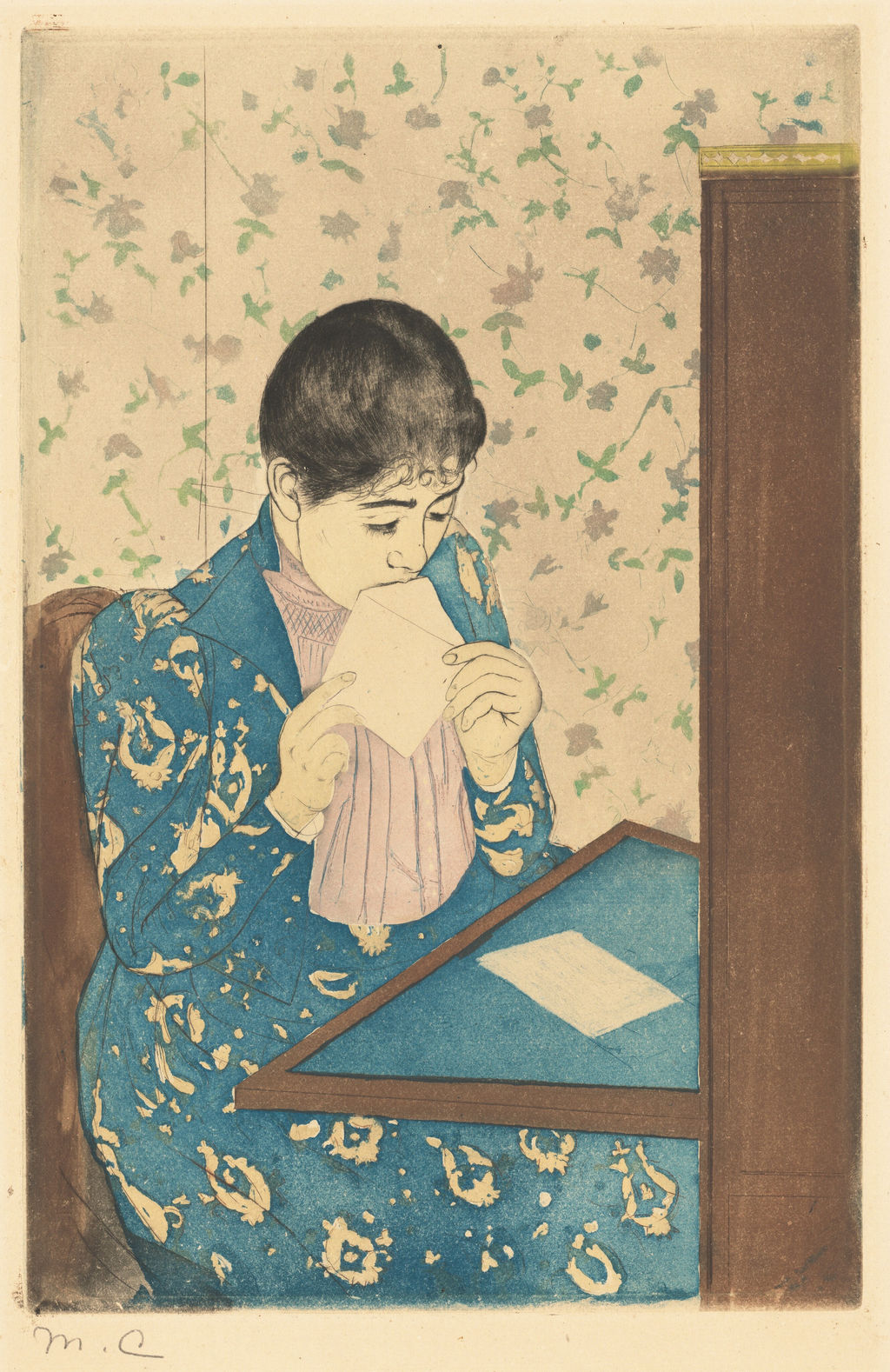
| The Letter | 1890–91 | Colour print |
| The Loge | About 1878–1880 | Oil on canvas |
| The Mandolin Player | 1868 | Oil on canvas |
| The Manicure (Les Ongles; The Nails) | About 1908 | Intaglio print |
| The Tea; Le Thé | About 1880 | Oil on canvas |
| The Visitor | c. 1880 | Intaglio print |
| Two Sisters | 1896 | Pastel |
| Two Women Seated by a Woodland Stream | About 1869 | Oil on canvas |
| Two Women Throwing Flowers During Carnival | 1872 | Oil on canvas |
| Under the Horse-Chestnut Tree | 1896–97, National Gallery and MoMA records | Not established |
| Woman Bathing (La Toilette) | 1890–91 | Colour print |
| Woman in a Loge (Woman with a Pearl Necklace) | 1879 | Oil on canvas |
| Woman Reading | 1878–79 | Oil on canvas |
| Woman Standing, Holding a Fan | 1878–79 | Distemper |
| Woman with a Fan | c. 1878–1879 | Oil on canvas |
| Woman with a Red Zinnia | 1891 | Oil on canvas |
| Woman with a Sunflower | About 1905 | Oil on canvas |
| Young Girl at a Window | c. 1883–1884 | Oil on canvas |
| Young Girl with Brown Hair, Looking Left | About 1913 (1997 summary catalogue) | Pastel |
| Young Mother Sewing | 1900 | Oil on canvas |
| Young Woman in Green, Outdoors in the Sun | About 1914 | Oil on canvas |
Discussion
Look again at the images and ideas explored in Mary Cassatt, Collectors and Her Museum Legacy. These editorial prompts invite your observations.
Reader Insights
Mary Cassatt helped artworks travel between artists, dealers, collectors and museums. What does this first detail make you notice?
Stein distinguishes several events often compressed into one origin story. Which connection would you explore further?
Which matters most in following a painting’s route to a museum: who bought it first, who recommended it or who gave it?
Join the Conversation
Share a detail, comparison or question about Mary Cassatt, Collectors and Her Museum Legacy below.
References
- Susan Alyson Stein, assisted by Rebecca A. Rabinow, chronology in Splendid Legacy: The Havemeyer Collection, 1993, printed pages 201–287; entire chronology chapter read, including captions and notes, not the whole volume or cited archival originals. View source.
- M. Knoedler & Co., Loan Exhibition of Masterpieces by Old and Modern Painters, 1915, original announcement and printed Cassatt list, page 21. View source.
- Rebecca A. Rabinow, The Suffrage Exhibition of 1915, Splendid Legacy, 1993, printed pages 89–95, including notes and identification appendix. View source.
- Los Angeles County Museum of Art, A Child’s Bath, M.62.8.14, current object record and provenance. View source.
- Detroit Institute of Arts, In the Garden, 22.6, current provenance and gift credit. View source.
- Metropolitan Museum of Art, Recent Acquisitions, A Selection: 1997–1998, printed page 58, exact Lilacs entry. View source.
- National Gallery of Art, Girl Arranging Her Hair, 1963.10.97, exact ownership and estate-sale history. View source.
- Smithsonian American Art Museum, The Caress, 1911.2.1. View source.
- Metropolitan Museum of Art, Lady at the Tea Table, 23.101. View source.
- Metropolitan Museum of Art, Portrait of the Artist, 1975.319.1. View source.
- Art Institute of Chicago, El Greco, The Assumption of the Virgin, 1906.99, archived institutional body and ownership history; historical collecting case, not a current display report. View source.
- Metropolitan Museum of Art, Young Mother Sewing, 29.100.48. View source.
- Louisine W. Havemeyer, Remarks on Edgar Degas and Mary Cassatt, 6 April 1915, especially unnumbered scan pages 6 and 10; reported conversations, paraphrased. View source.
- Metropolitan Museum of Art, Lilacs in a Window, 1997.207, current gift credit. View source.
- National Gallery of Art, The Boating Party, 1963.10.94. View source.
- National Gallery of Art, Little Girl in a Blue Armchair, 1983.1.18. View source.
- Crawford Alexander Mann III, Smithsonian American Women’s History Museum, Mary Cassatt Gave Women a Place in the Impressionist Movement, 3 June 2025; donor letter transmitted through curatorial account. View source.
- United States Postal Service, Women Subjects on United States Postage Stamps, selected Cassatt rows only; no stamp image inspected. View source.
- Art Gallery of Ontario, Cassatt–McNicoll:ImpressionistsBetweenWorlds. View source.
- Metropolitan Museum of Art, The Bath, 16.2.7. View source.
- National Gallery of Art, Children Playing on the Beach, 1970.17.19. View source.
- Colby College Museum of Art, Explore Inside Out: The Prints of Mary Cassatt; Mother Berthe Holding Her Nude Baby,2013.549. View source.
- Sotheby’s, syndicated auction catalogue hosted by Invaluable, Simone in Blue Plumed Hat, Watson collection, 18 May 2005, lot 20. View source.
- The Huntington, Breakfast in Bed, 83.8.6. View source.
- Adelyn Dohme Breeskin / Smithsonian Institution Press; University of California scan indexed by Google Books, Mary Cassatt:A Catalogue Raisonné of the Oils,Pastels,Watercolors,and Drawings,1970,322pp; selected public search snippets pp91–92,143–144,316,318. View source.
- Metropolitan Museum of Art, The Private Collection of Edgar Degas: A Summary Catalogue, Cassatt entries, printed p.7, no.48. View source.
- Art Institute of Chicago, After the Bullfight, 1969.332. View source.
- Smithsonian American Art Museum, Art Inventories, After the Bullfight, siris_ari_180619. View source.
- Museum of Modern Art, Under the Horse-Chestnut Tree,671.1940. View source.
- National Gallery of Art, Under the Horse-Chestnut Tree,1959.12.4. View source.
- Art Institute of Chicago, The Child’s Bath,1910.2,current expanded collection entry. View source.
- Virginia Museum of Fine Arts, Board of Trustees minutes,17September2020,loan recommendation7:ChildPickingaFruit75.18. View source.
- Cincinnati Art Museum, Les Ongles(The Nails;The Manicure),ca1908,1940.155,secondstate. View source.
- Sotheby’s, Clarissa Turned Left with Her Hand to Her Ear, 2012 lot 51. View source.
- Greenville County Museum of Art, Recent Acquisitions Funded by Sale of Alma Thomas Painting, 2021. View source.
- Metropolitan Museum of Art, The Coiffure,16.2.3. View source.
- Metropolitan Museum of Art, The Cup of Tea, 22.16.17. View source.
- Sotheby’s, Mother and Child (Nude Dark-Eyed Little Girl with Mother in Patterned Wrapper), 19 May 2010, lot 31. View source.
- Metropolitan Museum of Art, Denise at Her Dressing Table, 2005.129. View source.
- Denver Art Museum, Whistler to Cassatt:American Painters in France, bilingual exhibition livret,The Salon,no2. View source.
- Philadelphia Museum of Art, Driving, 1881. View source.
- Denver Art Museum, Whistler to Cassatt exhibition guide, stop 112: Bust of Ellen with Bows in Her Hair. View source.
- Museum of Fine Arts, Boston, Ellen Mary in a White Coat, 1982.630. View source.
- MaudHoweElliott(ed.) / UniversityofIllinoisUrbanaChampaign scan, Art and Handicraft in the Woman’s Building of the World’s Columbian Exposition,Chicago,1893,Chicago:RandMcNally,1894. View source.
- Amon Carter Museum of American Art, Woman Standing Holding a Fan, 2011.20. View source.
- Smithsonian American Art Museum, Special Installation of Nineteen American Masterworks, 2015. View source.
- Metropolitan Museum of Art, The Fitting, 16.2.8 final state. View source.
- Reynolda House Museum of American Art, Mary Cassatt collection listing: Madame Gaillard and Her Daughter Marie-Thérèse, 1897. View source.
- Wake Forest University, Wake Women 2023 schedule, Highlighting the Art of Women at Reynolda, captioned Cassatt image. View source.
- National Gallery of Art, Gathering Fruit,1943.3.2757. View source.
- Sotheby’s, A Goodnight Hug,N09860lot11,14May2018. View source.
- Sotheby’s, Young Woman in Green Outdoors in the Sun, Modern Day. View source.
- Sotheby’s, syndicated auction catalogue hosted by Invaluable, Head of Simone in a Green Bonnet with Wavy Brim, Watson collection,18May2005,lot39. View source.
- Joslyn Art Museum, Art Break:Woman Reading,1943.38,program object caption. View source.
- National Gallery of Art, The Lamp, 5937. View source.
- Sotheby’s, Tête de Femme au Grand Chapeau, 2008 N08449 lot135. View source.
- National Gallery of Art, The Letter,1943.3.2763. View source.
- National Gallery of Art, The Loge,1963.10.96. View source.
- Arp Museum Bahnhof Rolandseck, Maestras: Malerinnen1500–1900,25February–16June2024,official five-page flyer. View source.
- Spanish official gazette / exhibition insurance schedule, BOE-A-2023-19808,21September2023,Maestras loan schedule. View source.
- Nationalmusée um Fëschmaart / ArpMuseum CollectionRauforUNICEF, Louise,NursingHerChild,1899,GR1.949;FromRenoirtoMonet2026–27. View source.
- Petit Palais / Paris Musées, Automne, portrait de Lydia Cassatt, PPP706; IIIF manifest 160008392. View source. (in French).
- Denver Art Museum, Whistler to Cassatt Access Guide, The Salon, stop 104. View source.
- Metropolitan Museum of Art, Maternal Caress, 16.2.5. View source.
- Philadelphia Museum of Art, Mother and Child Maternal Kiss, object 54049. View source.
- Metropolitan Museum of Art, Maternal Caress, preparatory drawing64.123.3, c1891. View source.
- Christie’s, Mathilde Holding Baby who Reaches out to Right, lot 5459369. View source.
- National Portrait Gallery / Catalog of American Portraits, Madame Meerson and her Daughter, SSSA2282. View source.
- Museum of Fine Arts Boston, In the Loge, 10.35. View source.
- Smithsonian art inventories, Child Drinking Milk from a Bowl, siris_ari_197517. View source.
- MutualArt public auction index; original auctioneer undisclosed without subscription, Child Drinking Milk from a Bowl, public listing dated 2 June 2024. View source.
- Museum of Modern Art, Mary Cassatt artist essay and print records. View source.
- National Gallery of Art, Mother's Kiss,1963.10.254. View source.
- National Gallery of Art, Mary Cassatt the Daring Printmaker, 23 January 2026. View source.
- National Gallery of Art, Mary Cassatt An American in Paris checklist, updated 24 February 2026. View source.
- Adelyn D. Breeskin / National Gallery of Art, Mary Cassatt 1844–1926, 1970 exhibition catalogue. View source.
- Metropolitan Museum of Art, Nurse Reading to a Little Girl, 62.72. View source.
- National Gallery of Art, In the Omnibus, 46725. View source.
- Metropolitan Museum of Art, Mother and Child (The Oval Mirror), 29.100.47. View source.
- Art Institute of Chicago, Ryerson and Burnham Archives, Bertha Honoré Palmer Correspondence Collection finding aid, selected Mary Cassatt entries, Box1Folder3. View source.
- Philadelphia Museum of Art, Woman in a Loge, 1978-1-5, object72182. View source.
- Metropolitan Museum of Art, Mother Playing with Child, 22.16.23. View source.
- Metropolitan Museum of Art, By the Pond,60.732bis. View source.
- Museum of Modern Art, By the Pond,673.1940. View source.
- Terra Foundation for American Art, By the Pond,1999.25. View source.
- Philadelphia Museum of Art, Poppies in a Field, attributed to Victor Gabriel Gilbert; formerly attributed to Mary Stevenson Cassatt, 1978-1-6. View source.
- Christie’s, Mother in Purple Holding Her Child, lot 5369421. View source.
- Sotheby’s, Tête d’enfant au chapeau rouge, American Art N09229, 20 November 2014, lot 39. View source.
- Christie’s, Sara Holding a Cat, lot 5561267. View source.
- Smithsonian American Art Museum, Art Inventories Catalog, Sara with Her Dog, in an Armchair, Wearing a Bonnet with a Plum Ornament; IAP 80170363 / siris_ari_180925. View source.
- Smithsonian American Art Museum, Sara in a Green Bonnet, 1929.6.11. View source.
- Mary Cassatt Catalogue Raisonné project, with Adelson Galleries, presented on Artnet, Sara with Her Dog, in an Armchair, Wearing a Bonnet with a Plum Ornament, work 424155733. View source.
- National Portrait Gallery, Mary Cassatt Self-Portrait, NPG.76.33. View source.
- Musée d’Orsay, Jeune fille au jardin,RF193720. View source. (in French).
- Sotheby’s, Simone Seated on the Grass Next to Her Mother, 30 September 2020, lot 33. View source.
- Dallas Museum of Art, Sleepy Baby,1952.38.M. View source.
- Sotheby’s, Smiling Mother with Sober Faced Child, 2022. View source.
- Smithsonian American Art Museum, Spanish Dancer Wearing a Lace Mantilla, 1967.40. View source.
- Spencer Museum of Art,University of Kansas, The Manicure,c1908,1991.0266. View source.
- Christie’s, Sketch of Master St Pierre, 2017 online lot. View source.
- National Gallery of Art, Child in a Straw Hat, 1983.1.17. View source.
- Sotheby’s, Summertime, Armand Hammer: The Private Collection, Modern Evening Auction 2026. View source.
- National Gallery of Art, Woman with a Sunflower, 1963.10.98. View source.
- National Gallery of Art, Afternoon Tea Party, 46731. View source.
- Museum of Fine Arts, Boston / Erica E. Hirshler, The Tea, 42.178. View source.
- The Nelson-Atkins Museum of Art, At the Theater,F77-33;French Paintings and Pastels appendixII. View source.
- Metropolitan Museum of Art, Woman Bathing La Toilette, 16.2.2. View source.
- Sotheby’s, Two Sisters, 2005 American Paintings sale N08134, lot 44. View source.
- Wichita Art Museum, Mother and Child, M109.53. View source.
- Smithsonian American Art Museum, Art Inventories, Two Women Seated by a Woodland Stream / Duex femmes assises aupres de l’eau, IAP 80170008. View source.
- Tacoma Art Museum / David Setford, Impressionist Painting: From Pleasure Gardens to the Palais Garnier, 22 October 2019. View source.
- Tacoma Art Museum, French Impressionism and the Northwest, Works of Art Adoption Program, 2019–2020, no. 10 / PDF p. 12. View source.