


 by Tom Gurney
Tom Gurney BSc (Hons) is an art history expert with over 20 years experience
Published on June 19, 2020 / Updated on November 6, 2025
Email: tomgurney1@gmail.com / Phone: +44 7429 011000
Michelangelo’s Ezechias Spandrel Figure
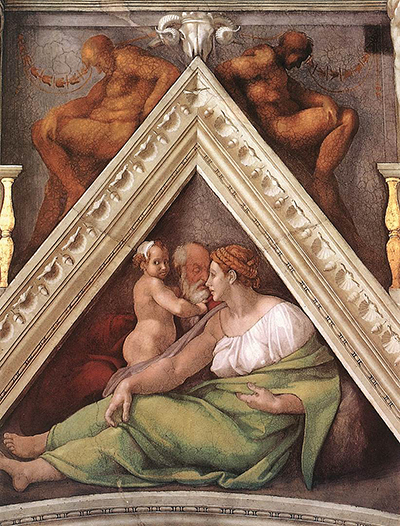
A woman in profile fills a triangular field. Her green mantle catches yellow light, a white sleeve breaks across the centre, and a violet scarf circles the head and shoulders. Immediately behind her, a child turns a clear, watchful face towards the chapel. Farther back an elderly man is almost absorbed by shadow. The group is close enough to imply a household, yet each member inhabits a different degree of light and attention.
This fresco occupies the spandrel above the Hezekiah, Manasseh and Amon lunette on the Sistine Chapel ceiling.[1] Its familiar title, “Ezechias,” uses the Latin or Italian form of Hezekiah inherited from the field below. It names a location and a traditional association, not a securely identified portrait.
At a Glance
- WorkFamily group in the spandrel above Hezekiah, Manasseh and Amon
- Common titleEzechias or Ezechias Spandrel
- ArtistMichelangelo Buonarroti
- DateAbout 1510; within the ceiling campaign of 1508–12[1][2]
- TechniqueFresco
- Approximate dimensions245 × 340 cm[1]
- LocationFourth bay, between the Cumaean Sibyl and Isaiah, Sistine Chapel
- ProgrammeProbably part of the Ancestors of Christ[3]
- Principal figuresA foreground woman, a child and an elderly man
- Identity cautionProposed names remain hypothetical
- Governing effectA family divided by profile, outward gaze and shadow
Contents
- Ezechias Is a Conventional Title
- The Architecture of the Triangle
- A Woman Seen in Profile
- Green, Yellow, White and Violet
- The Child Who Looks Out
- The Elder in Shadow
- A Household Without a Narrative
- Hezekiah in the Biblical Genealogy
- Between the Cumaean Sibyl and Isaiah
- Light as a Family Structure
- Drawing Transferred to Wet Plaster
- Fresco Time and the Ceiling Campaign
- Monumentality Without Heroics
- Looking from the Chapel Floor
- What the Title Can and Cannot Tell Us
- Artist Up Close
Ezechias Is a Conventional Title
The lunette beneath the triangle carries the ancestral names Hezekiah, Manasseh and Amon. “Ezechias” is another form of Hezekiah, but no name tablet appears inside the spandrel itself.
Some interpreters have proposed that the child is the future King Hezekiah, accompanied by his mother and his father Ahaz. The arrangement can support that idea: a prominent child joins an adult woman and an older man in a field linked architecturally with Hezekiah’s genealogy. It does not prove it. The Vatican Museums states that the eight spandrels probably continue the ancestor series while their precise identities remain disputed.[3]
The most secure description is therefore a family group above the Hezekiah–Manasseh–Amon lunette. The traditional title remains useful so long as it is not mistaken for a label written by Michelangelo.
The Architecture of the Triangle
A spandrel is the triangular surface between the curved lunettes and the larger structure of the vault. Its sides rise steeply towards a narrow apex. A standing figure would be difficult to place there; a group must spread across the lower width and diminish as it ascends.
Michelangelo makes the foreground woman answer that geometry. Her seated body supplies a broad base, while her profile and covered head rise into the narrowing upper zone. The child occupies the interval behind her shoulder. The elderly man recedes towards the side and rear.
The figures do not merely fit an awkward field. Their decreasing visibility turns the triangle into depth: full-bodied woman, illuminated child, shadowed elder.
A Woman Seen in Profile
The woman’s face turns decisively to the side. This distinguishes her from the frontal central woman in the opposite Jesse spandrel and from numerous twisting figures elsewhere on the ceiling.
Profile is both clear and withholding. Nose, brow and chin make a legible silhouette, but the viewer cannot meet her eyes. Her attention passes across the surface rather than out of it.
Because her body occupies so much of the field, this refusal of eye contact becomes the group’s dominant psychological fact. Monumentality does not produce access. The largest presence remains self-contained.
Green, Yellow, White and Violet
Colour gives the figure structure at chapel distance. Green covers the largest mass, with yellow or golden changes in its folds. White introduces a brighter interval around the shirt and sleeve. Violet at the head and shoulder supplies a cooler accent.[1]
These are not small decorative notes. They divide a compressed pose into readable zones. Green establishes weight; white redirects attention through the torso; violet helps the profile stand against its surroundings.
The yellow passages are sometimes described as iridescent because they make a single garment seem to shift colour in light. Michelangelo uses such changes across the ceiling to model form forcefully without surrendering chromatic brilliance.
The Child Who Looks Out
Behind the woman, a child turns towards the viewer. The small face is far less physically dominant than the foreground body, yet its outward orientation gives it unusual immediacy.
This gaze creates an internal opposition. The woman looks sideways; the old man withdraws into darkness; the child acknowledges the open space of the chapel. A family group therefore becomes three different relationships to visibility.
The child’s prominence helps explain the traditional Hezekiah proposal. Yet an outward glance is not an identifying attribute. Its stronger function is compositional: it prevents the recessive figures from disappearing and gives the dark rear of the spandrel a point of human contact.
The Elder in Shadow
The elderly man behind the other figures is present more as a subdued head and mass than as a fully illuminated body. His darkness increases the apparent depth of a shallow architectural field.
Traditional readings may call him Ahaz, Hezekiah’s father. That is possible within a genealogical reconstruction, but it remains a proposal rather than visible fact. Age alone cannot establish a biblical name.
Shadow also carries meaning without requiring a specific identity. The elder seems temporally remote, as though a previous generation were receding while the child comes into view. Michelangelo converts illumination into a possible image of succession.
A Household Without a Narrative
The group suggests family life but illustrates no biblical episode. No crown, sceptre, inscription or recognisable event declares a royal story. The figures sit, look and wait.
That lack of action belongs to the wider ancestor cycle. Michelangelo repeatedly represents generations before Christ through ordinary bodies, domestic objects, fatigue, care and suspension rather than through courtly magnificence.
Some arrangements can recall the resting family of the Flight into Egypt: an adult woman, a child and an older male gathered during a journey. Such resemblance is an analogy of pose, not evidence that the spandrel depicts the Holy Family. The architectural programme points instead towards Christ’s human ancestry.
Hezekiah in the Biblical Genealogy
Matthew places Hezekiah between Ahaz and Manasseh in Christ’s genealogy.[4] The Old Testament remembers him as king of Judah and associates him with religious reform, political crisis and illness.
None of those events appears here. The fresco does not show the Assyrian siege, Isaiah’s prophecy or Hezekiah’s recovery. Biblical context explains why the name belongs in the genealogical zone; it should not be used to invent a narrative absent from the paint.
Michelangelo’s restraint is important. A famous king may enter the ceiling not through royal action but through an anonymous-looking household.
Between the Cumaean Sibyl and Isaiah
The spandrel lies in the fourth bay between the Cumaean Sibyl and the prophet Isaiah.[1] These monumental seers belong to a different category from the ancestor family. They announce or anticipate salvation; the family embodies its human lineage.
Isaiah has a particularly rich biblical connection with Hezekiah, advising the king during the Assyrian threat and visiting him during illness. Architectural proximity may make that relationship resonant. It does not transform the spandrel into an illustration of their encounters.
The contrast of scale and function matters. Prophetic knowledge occupies a great throne; generational duration is compressed into a low triangle.
Light as a Family Structure
The woman, child and elder can be read as three levels of illumination. The foreground fabrics are strongly differentiated. The child’s face catches attention. The old man nearly disappears.
This sequence gives pictorial order to figures whose exact names are uncertain. It also prevents the family from becoming a single block. Each presence has its own optical status.
The result can suggest generation without telling a story: the past remains in shadow, youth emerges, and the adult body mediates between them. That interpretation should remain poetic rather than documentary, but it arises directly from the painted organisation.
Drawing Transferred to Wet Plaster
The Vatican Museums records that Michelangelo used spolvero to transfer cartoons for all the spandrels.[5] A full-size paper design was pricked along important contours, then powdered charcoal was pounced through the holes onto fresh plaster.
The process explains how a complex seated group could reach the vault with its proportions already controlled. It does not make the painted result mechanical. Michelangelo still had to establish colour, modelling, edges and shadow before each prepared area dried.
Small pounced points, where preserved or detected, belong to the passage from drawing to wall. They reveal preparation behind apparent spontaneity.
Fresco Time and the Ceiling Campaign
Michelangelo painted the Sistine Ceiling under Pope Julius II between 1508 and 1512.[2] The Ezechias spandrel is commonly dated about 1510, within the earlier portion of the campaign.[1]
In true fresco, pigment is applied to damp lime plaster and becomes bound to the wall as the surface carbonates. Painters prepare only as much plaster as can be completed in a working session, producing sections known as giornate.
Campaign dates therefore differ from execution time. Years encompass design, scaffolding, interruptions and many separate fields; a particular passage might be painted rapidly after extensive study.
Monumentality Without Heroics
The foreground woman has the bodily breadth associated with Michelangelo’s sculptural imagination. Heavy fabric does not conceal the structure beneath it. Shoulder, back and folded limbs remain forceful.
Yet the figure is not heroic in the usual sense. She performs no feat and displays no emblem. Her scale turns an ordinary seated posture into an event of form.
That transformation is central to the ancestors. Michelangelo grants anonymous or uncertain family members the physical authority elsewhere reserved for prophets and athletes, while preserving their fatigue and domestic stillness.
Looking from the Chapel Floor
Close reproductions encourage viewers to study the child’s expression, the elder’s head and individual colour transitions. From the floor, the first effect is broader: a bright green and white mass filling a triangle, with a small face emerging from darkness.
Michelangelo designs both experiences. The silhouette must survive distance, while secondary figures reward sustained looking. The foreground woman’s profile is especially effective from below because it remains intelligible without delicate facial description.
Photography also isolates the spandrel. In the chapel it belongs to a vertical sequence of lunette, triangle, prophet or sibyl, fictive architecture and central history.
What the Title Can and Cannot Tell Us
“Ezechias” guides a visitor to the correct part of the vault. It connects the field with the ancestral names below and preserves a long tradition of cataloguing.
It cannot tell us which painted figure, if any, is Hezekiah. It cannot turn the woman into his mother or the elder into Ahaz. Nor can it erase the possibility that Michelangelo created a representative household rather than a recoverable set of portraits.
Responsible uncertainty does not diminish the fresco. It changes the question from “Which king is this?” to “How does Michelangelo make lineage visible when names are withheld?”
Artist Up Close
In the Ezechias spandrel, Michelangelo builds ancestry out of unequal visibility.
A woman’s profile commands the architecture but refuses the viewer. A child looks directly out. An old man recedes. Green, white, yellow and violet make the family readable across the chapel, while darkness prevents complete possession of it.
The title may remain conventional. The pictorial intelligence is exact: three generations, or three possible family roles, become a study in how bodies enter and leave the light.
Frequently Asked Questions
Discussion
What details, sources or comparisons stand out to you in Ezechias?
Reader Insights
Which formal detail changes how the work reads?
Which documented source or collection history feels most useful?
Which related Michelangelo work should readers compare next?
Join the Conversation
Add a source-led observation, comparison or question for other readers.
References
- Web Gallery of Art, Ezechias Spandrel,, View source.
- Vatican Museums, Sistine Chapel Ceiling,, View source.
- Vatican Museums, Spandrels,, View source.
- United States Conference of Catholic Bishops, Matthew 1,, View source.
- Vatican Museums, Spandrel of the Lunette Josiah, Jechoniah, Shealtiel,, View source.
- University of Michigan Library Digital Collections, Ezechias Spandrel,, View source.