


 by Tom Gurney
Tom Gurney BSc (Hons) is an art history expert with over 20 years experience
Published on June 19, 2020 / Updated on November 6, 2025
Email: tomgurney1@gmail.com / Phone: +44 7429 011000
Michelangelo’s Ozias Spandrel Figure
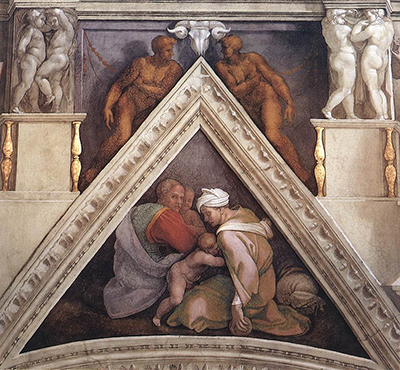
A mother kneels in the centre of a triangular field while a child presses towards her breast. Her rose-coloured mantle changes into green and yellow in the shadows. Behind them, another adult clasps a second child. At the right, a large foreshortened sack seems almost as solid as a body. The family is gathered tightly, but its off-centre balance makes rest feel provisional.
The group is traditionally called Ozias because it occupies the spandrel above the Uzziah, Jotham and Ahaz lunette.[1] Ozias is a form of Uzziah. As with the other Sistine spandrels, that title locates the fresco more securely than it identifies any individual within it.
At a Glance
- WorkFamily group in the spandrel above Uzziah, Jotham and Ahaz
- Common titleOzias or Ozias Spandrel
- ArtistMichelangelo Buonarroti
- DateAbout 1510; part of the 1508–12 ceiling campaign[1][2]
- TechniqueFresco
- Approximate dimensions245 × 340 cm[1]
- LocationFourth bay, between the Erythraean Sibyl and Ezekiel, Sistine Chapel
- ProgrammeProbably Ancestors of Christ[3]
- Principal figuresA kneeling woman and child; another adult and child behind
- Prominent objectLarge foreshortened sack
- Identity cautionIndividual names are conjectural
- Governing effectMaternal care compressed into an unstable, nocturnal triangle
Contents
- Ozias Means Uzziah
- A Pyramid That Refuses Symmetry
- The Kneeling Mother
- A Child Seeking the Breast
- The Second Adult and Child
- The Large Sack
- Bread, Provision and Uncertainty
- Rose Drapery with Green and Yellow Shadows
- A Nocturnal Household
- Not the Flight into Egypt
- Uzziah’s Story Is Not Illustrated
- Between Ezekiel and the Erythraean Sibyl
- Cartoon, Spolvero and Fresco
- Foreshortening at Two Scales
- Care Rather Than Portraiture
- Looking from the Chapel Floor
- Artist Up Close
Ozias Means Uzziah
Uzziah, also known as Azariah, was a king of Judah. “Ozias” reflects the form of his name used in Latin and Italian traditions. Matthew’s genealogy places him between Joram and Jotham.[4]
The name appears in the lunette below, not inside this triangle. Some reconstructions propose that the child nearest the woman is the future Uzziah, accompanied by his mother, his father Jotham and perhaps a brother. Such proposals attempt to distribute genealogical identities through the family.
They remain uncertain. The Vatican Museums explicitly notes disagreement over the precise identification of the figures in all eight spandrels.[3] The fresco can be read confidently as an ancestor family without assigning a royal name to each body.
A Pyramid That Refuses Symmetry
The mother and child form a loose pyramid, a shape well suited to a triangular field. Yet the pyramid is not centred with mathematical calm. The woman leans, the child reaches, the secondary group recedes on one side, and the sack presses forward on the other.
This off-axis construction gives the scene energy without turning it into a dramatic event. Weight is constantly being adjusted. The mother supports both her own kneeling body and the child’s movement.
Michelangelo solves an architectural problem by making imbalance meaningful. The family looks as though it has settled temporarily rather than established a permanent home.
The Kneeling Mother
The principal woman is neither enthroned nor comfortably seated. Kneeling lowers her centre of gravity while making the torso available to the child.
Her pose combines stability and strain. Bent legs anchor the composition, but the turn through shoulders and arms responds to a dependent body. The mother’s form is therefore defined through work: supporting, holding and feeding.
No halo or idealised setting elevates the action into a conventional Madonna image. Michelangelo instead gives ordinary care the physical amplitude of monumental painting.
A Child Seeking the Breast
The child leans towards the mother’s breast, making hunger and dependency visible.[1] The movement is small but governs the central relationship.
This is not a formal presentation of an heir. The child’s body interrupts the mother’s pose and creates a practical demand. Genealogy appears through nurture rather than dynastic display.
The motif may recall images of the Virgin nursing Christ, but context changes its meaning. There is no secure basis for identifying this pair as Mary and Jesus. Within the ancestor zone, maternal intimacy belongs to the long human chain preceding Christ.
The Second Adult and Child
In the darker rear of the triangle, another adult gathers or clasps a second child. The relationship is more compressed and less immediately legible than the foreground pair.
This duplication expands the idea of household. The fresco is not simply a mother-and-infant emblem; it contains at least four bodies with different levels of visibility.
Traditional identifications sometimes make the rear adult the father Jotham and the child a brother of Uzziah. Gender, age and kinship are not securely demonstrated by the surviving image. What can be seen is a second act of bodily protection answering the first.
The Large Sack
At the lower right lies an emphatically foreshortened sack. Its rounded volume projects towards the viewer and helps counterbalance the grouped figures.
The object can imply travel, stored possessions or a household paused on the way. Similar bundles elsewhere in the ancestor fields have encouraged interpretations of Christ’s forebears as pilgrims or strangers awaiting the promised land.[5]
The sack should not be decoded too literally. It does not prove a specific journey, exile or Flight into Egypt. It operates first as a material presence: an irregular, weighty form that converts empty floor into lived space.
Bread, Provision and Uncertainty
The principal woman appears to hold or steady a rounded object, sometimes described as a loaf. If it is bread, the detail would reinforce the scene’s attention to bodily need and travel provisions.
Its small scale and painted condition make certainty difficult. An object that reads as bread in one reproduction may merge with hand or cloth in another.
The safer interpretation begins with function rather than symbolism. Mother, children and baggage define a household concerned with sustenance. A loaf would intensify that theme, but the theme does not depend upon a confident identification of the object.
Rose Drapery with Green and Yellow Shadows
The mother’s mantle is predominantly rose or pink, but folds shift through green and yellow passages.[1] These seemingly unexpected colours give the fabric an iridescent force.
Michelangelo does not model volume only by darkening a single hue. He changes hue itself, allowing warm and cool areas to define turning surfaces. The result remains visible from far below.
Colour also separates the mother from the nocturnal background. Her body becomes the illuminated centre even though the composition leans away from perfect symmetry.
A Nocturnal Household
The rear figures emerge from a dark, almost night-like setting. This atmosphere distinguishes the brilliant foreground mantle and heightens the sense of temporary shelter.
Night need not refer to a particular hour in a biblical story. It can express historical distance, waiting and the precarious condition of travellers.
The Vatican Museums uses the ideas of pilgrims and strangers when describing another spandrel family in the series.[5] That interpretation is especially suggestive here because the sack and gathered children make mobility palpable. It remains a programme-level reading, not an identification of a named migration.
Not the Flight into Egypt
A woman with children, a male companion and baggage can resemble the Holy Family resting during the Flight into Egypt. Renaissance viewers knew that visual type well.
Resemblance does not equal subject. The Ozias group has no donkey, no angel and no narrative marker of Herod’s persecution. Its location in the ancestor sequence points elsewhere.
Michelangelo may draw upon familiar bodily arrangements to make a remote genealogy emotionally immediate. A later sacred family is anticipated through ordinary forms of care without being literally represented.
Uzziah’s Story Is Not Illustrated
The biblical Uzziah enjoyed a long reign, strengthened Judah and later suffered leprosy after unlawfully entering the Temple to burn incense. Those events have distinctive narrative possibilities.
None appears in the spandrel. There is no king, censer, priestly confrontation or sign of disease. Attempting to derive the pose from Uzziah’s biography would force visible evidence into a story the picture does not tell.
The gap is revealing. Michelangelo’s ancestor fields often suspend famous names within undistinguished family existence. Lineage matters before individual glory.
Between Ezekiel and the Erythraean Sibyl
The spandrel belongs to the fourth bay between the prophet Ezekiel and the Erythraean Sibyl.[1] Both seers occupy monumental thrones and turn with intellectual or prophetic intensity.
The family below offers a different kind of anticipation. Prophets and sibyls know or announce; ancestors endure, feed, sleep and generate.
Architectural adjacency makes that contrast visible. The grand theology of the ceiling is supported by vulnerable bodies arranged around a child’s hunger and a traveller’s sack.
Cartoon, Spolvero and Fresco
For the spandrels Michelangelo transferred full-size cartoons to fresh plaster using spolvero.[5] Pricked outlines in the paper allowed charcoal powder to pass through and mark the principal contours on the wall.
This preparation was particularly useful for a composition of overlapping bodies. It fixed relationships before wet-plaster time began.
The guide was not the finished painting. Michelangelo still determined coloured transitions, dark recesses and degrees of edge definition in fresco. The image joins controlled planning with rapid, irreversible decisions.
Foreshortening at Two Scales
The sack is the most overtly foreshortened object, but the bodies also turn through shallow depth. Knees, arms and children overlap rather than spreading like a flat frieze.
From a close photograph, these passages can appear compact or even awkward. From the floor, projection makes the group push out of its recess.
Michelangelo uses distortion in service of the original viewpoint. The painting’s “correct” image is not only the flattened reproduction but the field seen high above a moving spectator.
Care Rather Than Portraiture
The unresolved names can tempt viewers to search every face for a royal personality. The picture offers a more powerful category: care.
One child seeks nourishment. Another is held close. Adults bend and gather. Baggage waits beside them.
These actions make ancestry embodied. Generations continue because vulnerable people are fed, carried and protected. The historical chain in Matthew becomes a physical economy rather than a list.
Looking from the Chapel Floor
At distance the foreground pair and rose mantle register first. The rear group sinks into shadow, while the sack asserts a pale or earth-coloured counterweight.
As the eye adjusts, the triangle reveals several nested relationships. This delayed recognition is part of the design. Not every ancestor needs equal clarity to contribute to the sense of crowded lineage.
The neighbouring prophet and sibyl, architectural ribs and lunette names remain in view. The spandrel was never conceived as an isolated easel painting.
Artist Up Close
The Ozias spandrel makes dependency monumental without making it sentimental.
The child’s need bends the mother’s body. A second embrace occurs in shadow. A sack projects towards the chapel as if the household might depart again. Rose, green and yellow animate the scene while the nocturnal setting preserves its uncertainty.
No figure can be named with confidence. Yet the fresco says something exact about genealogy: before ancestry becomes a tablet of kings, it is the labour of keeping children alive.
Frequently Asked Questions
Discussion
What details, sources or comparisons stand out to you in Ozias?
Reader Insights
Which formal detail changes how the work reads?
Which documented source or collection history feels most useful?
Which related Michelangelo work should readers compare next?
Join the Conversation
Add a source-led observation, comparison or question for other readers.
References
- Web Gallery of Art, Ozias Spandrel,, View source.
- Vatican Museums, Sistine Chapel Ceiling,, View source.
- Vatican Museums, Spandrels,, View source.
- United States Conference of Catholic Bishops, Matthew 1,, View source.
- Vatican Museums, Spandrel of the Lunette Josiah, Jechoniah, Shealtiel,, View source.
- University of Michigan Library Digital Collections, Ozias Spandrel,, View source.