by Tom Gurney
Tom Gurney BSc (Hons) is an art history expert with over 20 years experience
Published on June 19, 2020 / Updated on October 27, 2026
Email: tomgurney1@gmail.com / Phone: +44 7429 011000
American Lake Scene: Introduction
Thomas Cole’s American Lake Scene offers a wide, quiet expanse of evening water, yet its most insistent forms stand close to the viewer: a dark island, a leaning tree and bare branches silhouetted against a luminous sky. Painted in 1844, this oil on canvas belongs to the Detroit Institute of Arts. The museum proposes a New Hampshire setting, while preserving the uncertainty implied by the painting’s broad title. Its interpretation connects the fading light, dying trees and Indigenous figure with a nineteenth-century narrative of loss. That narrative needs careful examination alongside the landscape’s beauty. [1]
At a Glance
- ArtistThomas Cole
- TitleAmerican Lake Scene
- Date1844
- MediumOil on canvas
- Dimensions46.4 × 62.2 cm, unframed
- CollectionDetroit Institute of Arts
- Accession number56.31
- CreditGift of Douglas F. Roby
- SettingProbably based on a lake in New Hampshire; no particular lake securely identified. [1]
This work in Cole’s career
First European journey
1829–1832The Course of Empire
1834–1836The Oxbow
1836The Voyage of Life
1840 and 1842Church’s training
1844–1846Notes and sources
American recognition. Three New York sales brought Cole to the attention of artists and patrons. [2]
First European journey. Looking in Britain and Italy enlarged the repertoire of his American landscapes. [2]
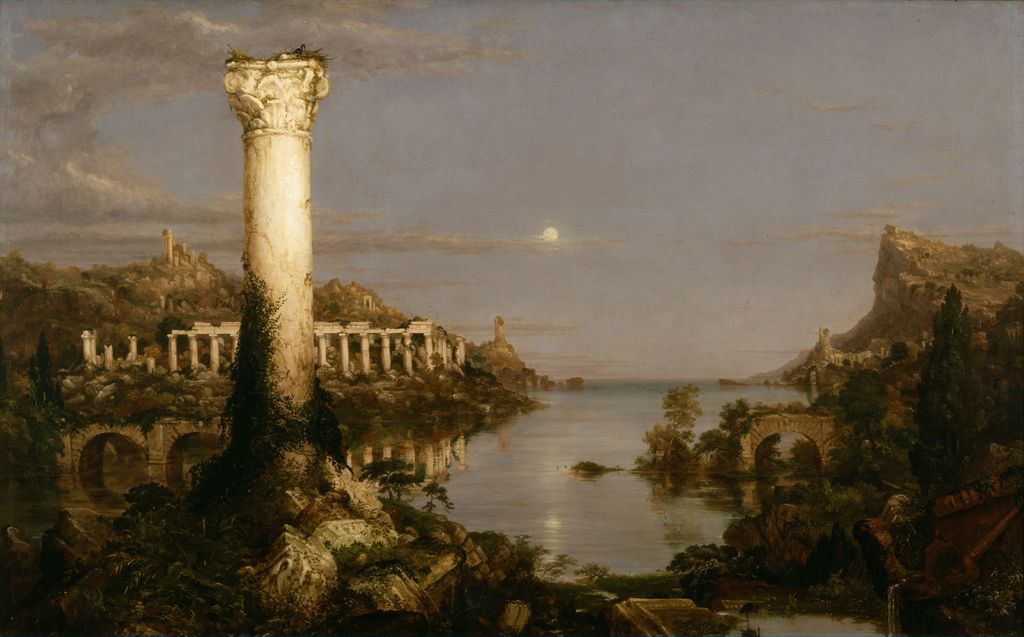
The Course of Empire. Five invented landscapes turn the rise and fall of civilisation into a visual argument. [2]
The Oxbow. An American prospect joined direct observation to a carefully staged view. [2]
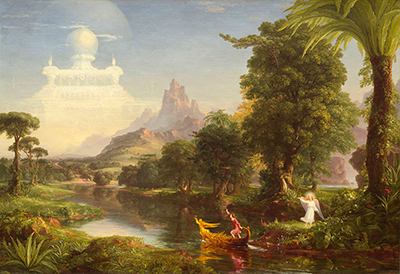
The Voyage of Life. The original cycle and Roman replicas give human life the course of a river. [2]
American Lake Scene. This later lake landscape of 1844 joins evening light and dying trees to a small Indigenous figure, interpreted critically by the Detroit museum. [1]
Church’s training. Cole taught Frederic Edwin Church in Catskill. [2]
Home in the Woods. A late cabin landscape brings settlement and surrounding woodland into one scene. [2]
Contents
- Introduction
- A lake seen through islands
- Evening light and the shape of space
- The Indigenous figure and a constructed story of disappearance
- A later return to trees and water
- The painting in Detroit
A lake seen through islands
The picture opens out from a densely occupied foreground into increasingly spare distances. The nearest island fills much of the lower right, its irregular edge interrupting the smooth water. Farther left, another wooded island spreads horizontally, while a small dark island near the centre appears almost detached from the rest of the land. Behind these separate masses, distant shores remain low and unobtrusive. The intervening water gives each island room to register as a distinct shape.
This arrangement avoids the feeling of a continuous walkable shore. Instead, the viewer looks across intervals of water towards places that seem close enough to inspect but remain physically separate. The foreground island offers the strongest point of attachment. Its dark ground, exposed roots and trees give the eye a place to linger before it travels towards the open lake. The little central island then provides a modest stepping stone into the distance.
Cole makes the nearest tree especially difficult to overlook. Its trunk rises on a diagonal before branching into an uneven, angular crown. Bare limbs stretch above the foliage and into the pale sky. The contrast between this skeleton of branches and the fuller tree to its right brings different states of growth into the same small area. The foreground does not simply present a uniform wall of woodland; its varied forms suggest a landscape with age, damage and continuing life.
The museum identifies two dying trees on the nearest island and a seated man in Indigenous dress to their right. At the scale of an ordinary reproduction, the figure is much less immediately legible than the tree silhouettes. This imbalance matters: human presence belongs to the composition, but it does not dominate the first encounter with it. The museum’s identification helps direct attention towards a figure partly absorbed into the surrounding foliage. [1]
Evening light and the shape of space
The lake’s calm comes largely from its broad horizontal bands. Water, distant land and cloud stretch across the canvas, allowing the eye to move easily from side to side. Against these restful lines, the tall bare branches create a sharper upward movement. Their irregularity gives the picture tension without turning the whole scene into a storm or spectacle. The dark foreground holds its place within an atmosphere that otherwise seems soft and spacious.
The warmth of the sky passes into the water. Pale yellows and muted pinks appear above and below the distant horizon, while reflections beneath the islands anchor the darker forms. The water is neither an empty gap nor a perfectly transparent mirror. Its shifts of brightness connect the islands to the surrounding light and make distance feel gradual. A viewer can follow the lake around the foreground obstruction rather than seeing it as a flat strip behind the trees.
Much of the image’s force comes from this unequal distribution of brightness. The foreground island is heavy and dark; the distance is open and glowing. The bare branches remain clearly defined because their surroundings are so light. Colour therefore does more than establish evening. It controls what appears solid, what seems remote and what draws attention. Even where small details are indistinct, the main relationship between dark land and luminous air remains clear.
The setting sun is part of the museum’s account of the painting. It gives the light a particular direction in time: the scene moves towards night rather than morning. [1] Yet the visual experience is not wholly mournful. The lake retains warmth, the islands carry living foliage, and the reflection extends the brightness across the water. The painting’s tranquillity makes the implications of fading light quieter, and perhaps more unsettling, than an overtly dramatic sky would do.
The Indigenous figure and a constructed story of disappearance
The Detroit Institute of Arts reads the figure symbolically in relation to the declining trees and setting sun. In the museum’s account, these elements express an idea, widespread among Cole’s Euro-American contemporaries, that Indigenous societies or their ways of life were destined to disappear. The museum also interprets the figure’s dress as significant to that imagined picture of the past. [1]
This is a constructed settler narrative, not evidence that living Indigenous communities disappeared. Its premise turns historical dispossession into something resembling a natural cycle: a people supposedly passes away as trees die or daylight fades. Describing that premise is essential to understanding the museum’s interpretation, but accepting it would repeat the ideology the painting can help us examine. An image of loss cannot establish the inevitable extinction of the people it represents.
The composition helps explain how such an association might work. Bare branches and evening light are familiar signs of decline, whereas the human figure is small and visually subdued. Once a viewer follows the museum’s interpretation, those visible conditions can seem to speak on the figure’s behalf. The person becomes part of a broader elegiac landscape rather than the centre of an individual story. That is the interpretive mechanism at issue, rather than proof of a particular sitter’s identity or experience.
The museum’s reading should therefore remain an attributed reading of Cole’s representation. Neither the generic title nor the small figure identifies a named Indigenous community, and the record supplies no personal history for the man. It would be misleading to turn him into a documentary witness to a specific event. Looking closely can reveal how the picture places a human presence among signs of passing time; it cannot recover that person’s biography or replace the histories of Indigenous peoples with the picture’s symbolic arrangement.
Watch: Thomas Cole
Choose a film to explore the artist’s work, its interpretation and its wider setting.
Thomas Cole: Painting the American Landscape (remastered audio)
An introduction to Cole’s landscapes and artistic ambitions.
Watch on YouTubeA later return to trees and water
A useful comparison is Cole’s Lake with Dead Trees, painted in 1825 and now at the Allen Memorial Art Museum in Oberlin. The museum relates that earlier canvas to sketches made during Cole’s Catskill journey and identifies dead trees, fleeing deer and a setting sun among its heightened features. It leaves room for several literary, religious and symbolic interpretations. This is a different painting, with a different location, size and ownership history. [3]
The comparison shows how a lake need not be a neutral setting in Cole’s art. Trees and light can organise a view while also inviting thoughts about time and mortality. In the earlier work, the museum’s discussion stresses the range of possible meanings; in American Lake Scene, Detroit proposes a more specific association between natural decline and an Indigenous figure. The resemblance of motifs makes the comparison productive, but it does not make the two pictures carry an identical message.
The nineteen years between their dates also give the comparison a useful perspective on Cole’s career. American Lake Scene returns to a landscape vocabulary present in a painting associated with his early recognition, but the later canvas deserves attention on its own terms. [1] [3] Its concentrated foreground and expansive light create a particular encounter between intimacy and distance. The value of the comparison lies in noticing both the recurring materials of Cole’s imagination and the different human implications attached to them.
The painting in Detroit
The Detroit record notes a signature and date on the island, identifying the inscription as “T. Cole 1844”. It also traces ownership through the American Art Union, the Young Men’s Mercantile Association in Cincinnati, T. L. Ogden, an unnamed Ogden descendant, John J. Bowden, and Douglas F. Roby. Roby gave the painting to the Detroit Institute of Arts in 1956. The record does not date every preceding transfer, so this sequence should not be mistaken for a fully dated account of each transaction. [1]
The museum’s bibliography lists the work as number seven in the American Art-Union’s 1844 exhibition catalogue. That listing places it within Cole’s contemporary public career, although it does not by itself explain how viewers responded. [1] Today, the painting offers two connected subjects for sustained attention: a carefully arranged evening landscape and the historical assumptions through which a figure within that landscape has been interpreted. Its beauty makes looking inviting; its human implications make looking critically necessary.
Artworks directory
Explore paintings, drawings and studies across Cole’s career. The two Voyage of Life sets appear separately. Dates and study identifications draw on the exhibition and collection catalogues, supplemented by the National Gallery’s drawing records. [2] [4] [5] [6]
| Name | Date | Medium |
|---|---|---|
| The Oxbow | 1836 | Painting |
| The Titan’s Goblet | 1833 | Painting |
| The Architect’s Dream | 1840 | Painting |
| The Course of Empire: The Savage State | ca. 1834 | Painting |
| The Course of Empire: The Arcadian or Pastoral State | ca. 1834 | Painting |
| The Course of Empire: The Consummation of Empire | 1835–1836 | Painting |
| The Course of Empire: Destruction | 1836 | Painting |
| The Course of Empire: Desolation | 1836 | Painting |
| The Voyage of Life: Childhood | 1842 | Painting |
| The Voyage of Life: Youth | 1842 | Painting |
| The Voyage of Life: Manhood | 1842 | Painting |
| The Voyage of Life: Old Age | 1842 | Painting |
| Home in the Woods | 1847 | Painting |
| Distant View of Niagara Falls | 1830 | Painting |
| View on the Catskill—Early Autumn | 1836–37 | Painting |
| Lake with Dead Trees (Catskill) | 1825 | Painting |
| River in the Catskills | 1843 | Painting |
| A View of the Mountain Pass Called the Notch of the White Mountains (Crawford Notch) | 1839 | Painting |
| Expulsion from the Garden of Eden | 1828 | Painting |
| The Subsiding of the Waters of the Deluge | 1829 | Painting |
| The Mountain Ford | 1846 | Painting |
| American Lake Scene | 1844 | Painting |
| A View near Tivoli (Morning) | 1832 | Painting |
| Aqueduct near Rome | 1832 | Painting |
| The Hunter’s Return | 1845 | Painting |
| The Voyage of Life: Childhood (first version) | 1840 | Painting |
| The Voyage of Life: Youth (first version) | 1840 | Painting |
| The Voyage of Life: Manhood (first version) | 1840 | Painting |
| The Voyage of Life: Old Age (first version) | 1840 | Painting |
| Panorama of the Oxbow on the Connecticut River as seen from Mount Holyoke | ca. 1832 (museum); 1833 (2018 catalogue) | Drawing |
| Sketch for The Oxbow | 1836 | Painting |
| From Nature | 1823 | Drawing |
| View of the Round-Top in the Catskill Mountains (Sunny Morning on the Hudson) | 1827 | Painting |
| Scene from The Last of the Mohicans: Cora Kneeling at the Feet of Tamenund | 1827 | Painting |
| View of Monte Video, the Seat of Daniel Wadsworth | 1828 | Painting |
| The Garden of Eden | 1828 | Painting |
| Tomb of General Brock, Queenston Heights, Ontario | 1830 | Painting |
| Effect for Newstead Abbey, Nottinghamshire, England | 1830 | Drawing |
| The Ilissos, from the Parthenon West Pediment | 1829 or 1830 | Drawing |
| Life Study for the Prostrate Shepherd in The Angel Appearing to the Shepherds | 1831–1832 | Painting |
| Interior of the Colosseum, Rome | ca. 1832 | Painting |
| Campagna di Roma (Study for Aqueduct near Rome) | 1832 | Painting |
| Landscape with a Round Temple | ca. 1830s | Painting |
| Stormy Landscape | 1832 | Painting |
| View of Florence from San Miniato | 1837 | Painting |
| Mount Holyoke, Massachusetts (after Basil Hall) | ca. 1829–1831 | Drawing |
| Layout for The Course of Empire | 1833 | Drawing |
| Study for The Course of Empire: The Savage State | ca. 1834 | Painting |
| Study for The Course of Empire: The Arcadian or Pastoral State | ca. 1834 | Painting |
| Study for The Course of Empire: Desolation | 1836 | Painting |
| Study for Dream of Arcadia | 1838 | Painting |
| Clouds | ca. 1830s | Painting |
| Study for The Hunter’s Return | 1845 | Painting |
| Study for Home in the Woods | ca. 1847 | Painting |
| Sunrise in the Catskills | 1826 | Painting |
| Study for The Mountain Ford | 1846 | Drawing |
| Tree Trunks | 1825–1840 | Drawing |
Frequently Asked Questions
Cole painted it in 1844. The Detroit Institute of Arts records the date and an inscription reading “T. Cole 1844”. [1]
The Detroit Institute of Arts suggests that the composition is probably based on a lake in New Hampshire. The record does not securely identify a particular lake, so a more precise location would be speculative. [1]
The museum interprets the figure, dying trees and sunset as expressing a nineteenth-century settler idea that Indigenous societies were destined to vanish. This is an interpretation of a constructed historical narrative, not a statement that Indigenous communities actually disappeared. [1]
The unframed canvas measures 46.4 × 62.2 cm, or 18¼ × 24½ inches. It is an oil painting on canvas, accession number 56.31 in Detroit’s collection. [1]
Discussion
Look again at American Lake Scene and compare your reading with the questions below.
Reader Insights
How does your response to the evening landscape change after considering the museum’s interpretation of the Indigenous figure?
Which creates the strongest sense of passing time for you: the bare branches, the fading light or the contrast between living and dying trees?
Which detail or comparison would you add to this account, and what evidence supports your reading?
Join the Conversation
Share the details that shaped your response, or suggest a comparison for other readers.
References
- Detroit Institute of Arts, “American Lake Scene”, collection record, accession 56.31, undated; object metadata, interpretive text, markings, provenance and published-reference listing. https://dia.org/collection/american-lake-scene/39296
- Elizabeth Mankin Kornhauser and Tim Barringer, Thomas Cole’s Journey: Atlantic Crossings (2018). Career context and artwork/study metadata: catalogue entries 10–66 and chronology, PDF pp. 137–231 and 249–262; related Barringer essay passages, PDF pp. 23–66.
- Allen Memorial Art Museum, Oberlin College, “Lake with Dead Trees (Catskill)”, collection record, object 1904.1183, undated; metadata and interpretive/history text. https://allenartcollection.oberlin.edu/objects/10897/lake-with-dead-trees-catskill
- Franklin Kelly et al., American Paintings of the Nineteenth Century, Part I (National Gallery of Art, 1996). Cole catalogue and both Voyage of Life sets, PDF pp. 91–124.
- National Gallery of Art, Study for The Mountain Ford (1846), accession 2015.19.772. Collection record and open-access image.
- National Gallery of Art, Tree Trunks (1825–1840), accession 2015.19.607. Collection metadata and open-access image.
- Splash image source.
Thomas Cole, American Lake Scene, 1844. Oil on canvas, 46.4 × 62.2 cm. Detroit Institute of Arts; gift of Douglas F. Roby, 56.31.