 by Tom Gurney
Tom Gurney BSc (Hons) is an art history expert with over 20 years experience
Email: tomgurney1@gmail.com / Phone: +44 7429 011000
The Voyage of Life by Thomas Cole: Introduction
A small golden boat carries a traveller through four landscapes. First an infant floats out of a cavern into flowers and morning light. A young man then steers towards a palace suspended in the sky. In the third picture, a storm drives the boat through a rocky gorge; in the fourth, an old man looks beyond dark water towards angels and an opening in the clouds. Thomas Cole makes a lifetime visible by changing the river, the weather and the traveller's relationship to a guardian spirit. His paintings ask how much people can direct their own course, and what might sustain them when direction becomes impossible. [1]
The Voyage of Life exists in two complete sets painted by Cole. The first, completed in 1840 for the New York banker Samuel Ward, belongs to Munson in Utica, New York. Cole painted the second in Rome in 1841–42; those four canvases belong to the National Gallery of Art in Washington. The distinction matters. Their subjects are closely related, but their making, ownership and early exhibition histories differ. The second set also contains deliberate revisions, particularly to the praying traveller in Manhood. [1]
The series joins an unusually clear story to elaborate landscape painting. Cole supplied written explanations of its symbols, so the river need not be decoded through guesswork. Yet the paintings offer more than an illustrated moral. Their changing spaces let viewers experience openness, confidence, danger and release before turning to the artist's words. Looking across all four brings out connections that disappear when the familiar image of Youth is reproduced alone.
At a Glance
- ArtistThomas Cole, painter of both complete sets. [1]
- SubjectA human lifetime represented by a traveller, a river and a guardian spirit. [1]
- Four stagesChildhood, Youth, Manhood and Old Age. [1]
- First setCompleted in 1840 following Samuel Ward's 1839 commission; now at Munson, Utica. [1]
- Second setPainted in Rome in 1841–42; dated 1842; now at the National Gallery of Art, Washington. [1]
- MediumOil on canvas. [1]
- Central ideaLife moves towards death, while Christian faith promises an existence beyond it. This is Cole's allegorical framework. [1]
Contents
- Introduction
- A lifetime carried by landscape
- Samuel Ward's commission and the struggle to exhibit
- Painting the second set in Rome
- Childhood: a beginning without knowledge
- Youth: the goal and the missed turn
- Manhood: control gives way to prayer
- Old Age: the horizon opens beyond the river
- Comparing the two sets
- From exhibition to widespread reproduction
A lifetime carried by landscape
Cole's earliest surviving written outline for the series dates from autumn 1836. He had recently finished The Course of Empire, the five-part rise and fall of an imagined civilisation. Art historian Franklin Kelly connects this moment with Cole's search for another substantial series, while suggesting that the death of his patron Luman Reed that June made the subject of human mortality especially poignant. That relationship is an interpretation of the circumstances, rather than proof that one death alone generated the idea. [1]
The two cycles pose different problems. In The Course of Empire, a recognisable landscape remains while societies transform it. Buildings, populations and political power accumulate and disappear around a recurring mountain. In The Voyage of Life, the traveller moves. Each picture must show both a later age and another stretch of the journey. The river therefore becomes a link between settings that do not share one fixed viewpoint. Cole lets the changing terrain carry part of the narrative that human action would carry in a conventional history painting. [1]
His 1836 outline already contains the essential relationships. A guardian steers a child's boat from a cave, allows the youth to exercise reason, watches the adult from a distance, and returns to guide the old man towards a heavenly destination. Some details subsequently changed, including the visible form of that destination. The conception developed through drawing and painting; it was not simply an instruction written once and mechanically enlarged. [1]
The boat provides continuity without making the landscapes into a literal map. It is the traveller's fragile enclosure, something to recognise amid changing surroundings. Its sculptured figures represent the Hours. Cole explained that people are carried along by passing time, and the boat's condition changes as that time diminishes. The familiar object becomes increasingly vulnerable, reaching Old Age with its ornament broken and drooping. [1]
The sequence also changes the balance between what a person sees and what a viewer knows. The youth sees his goal but misses the river's turn. The adult struggles while a guardian remains above him. The old man finally sees the spiritual presence that has accompanied him. We can compare these moments across the canvases; each traveller can understand only the portion of life immediately before him. This difference gives the series much of its emotional force.
Cole took particular care over the relationship between image and explanation. His early plans considered inscriptions on rocks and at the cave mouth. He eventually abandoned writing those explanations into the painted scenery, but produced detailed descriptions that circulated in exhibition catalogues and magazines, including The Knickerbocker. The viewer could encounter a visually continuous world while also consulting an explicit account of its meaning. That division is useful today: a detail can be observed first, then checked against what Cole said it represented. [1]
The river of life was already familiar in religious and literary culture. Kelly discusses scholarship proposing connections with biblical imagery, Bunyan, Romantic poetry and contemporary sermons, while resisting the idea that a list of possible sources explains the completed pictures. Identifying a familiar metaphor does not explain how Cole gave it a sequence of convincing spaces. Nor does it establish one poem as the definitive origin of his subject. The originality of the paintings is best examined in their sustained arrangement of terrain, time and changing human awareness, alongside the broader traditions from which their imagery draws. [1]
Annotated Details from The Voyage of Life
Follow the changing boat, guardian angel, water and sky through the four 1842 paintings.
Childhood
The 1842 National Gallery of Art version.
Youth
The 1842 National Gallery of Art version.
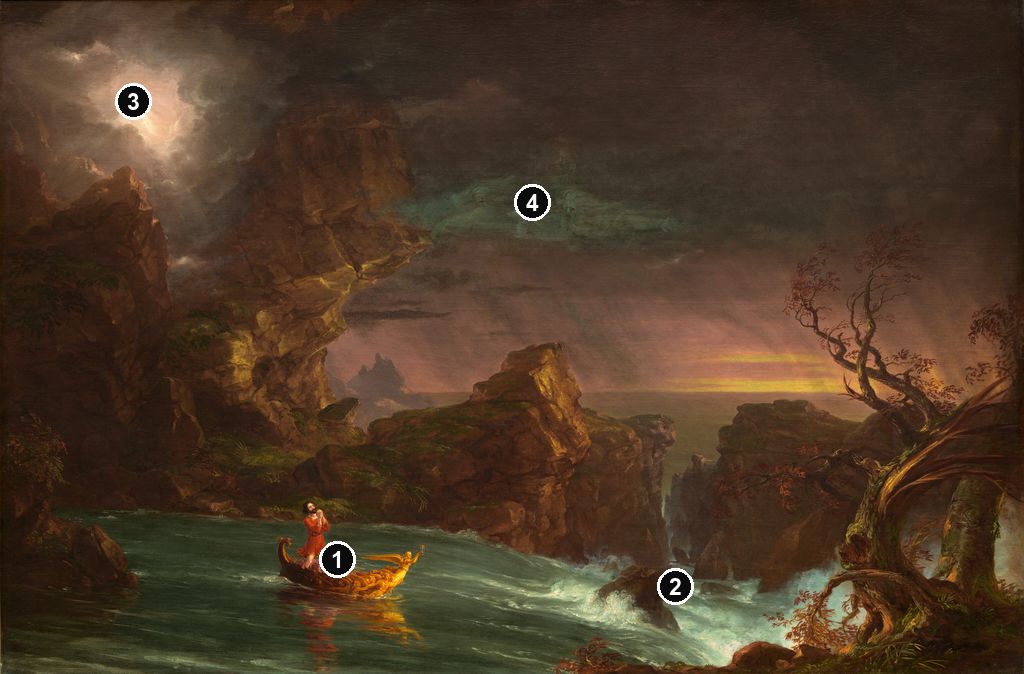
Manhood
The 1842 National Gallery of Art version.
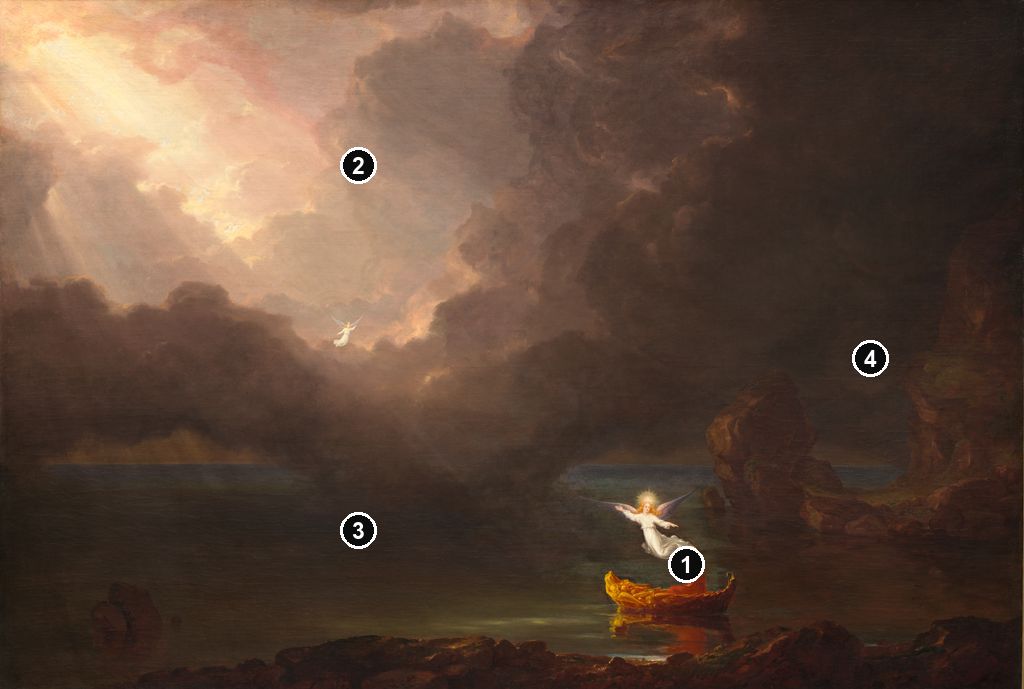
Old Age
The 1842 National Gallery of Art version.
Details from THE VOYAGE OF LIFE
Compare the details within each stage and across the whole sequence.
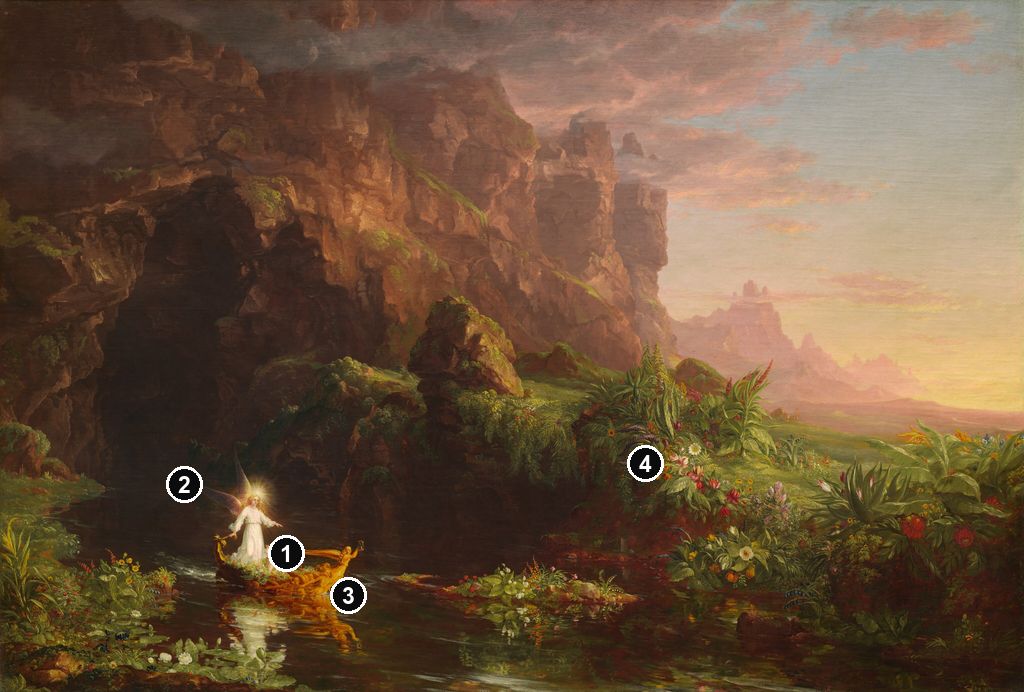
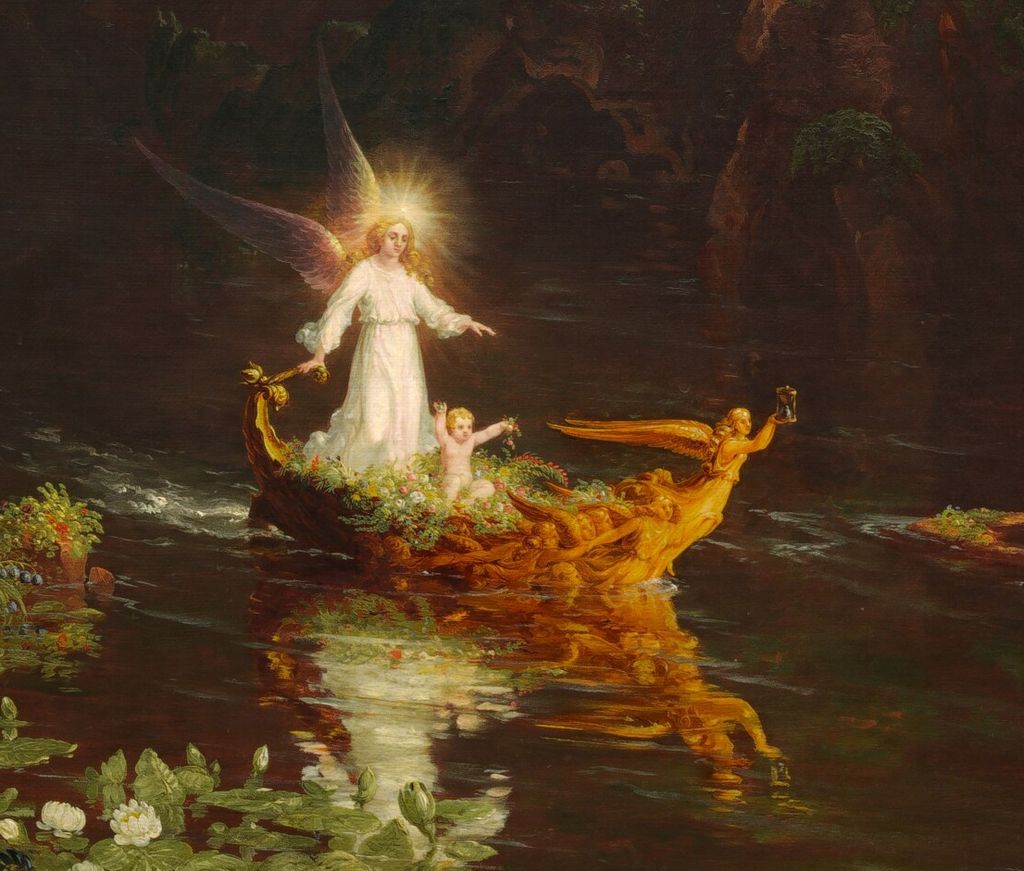
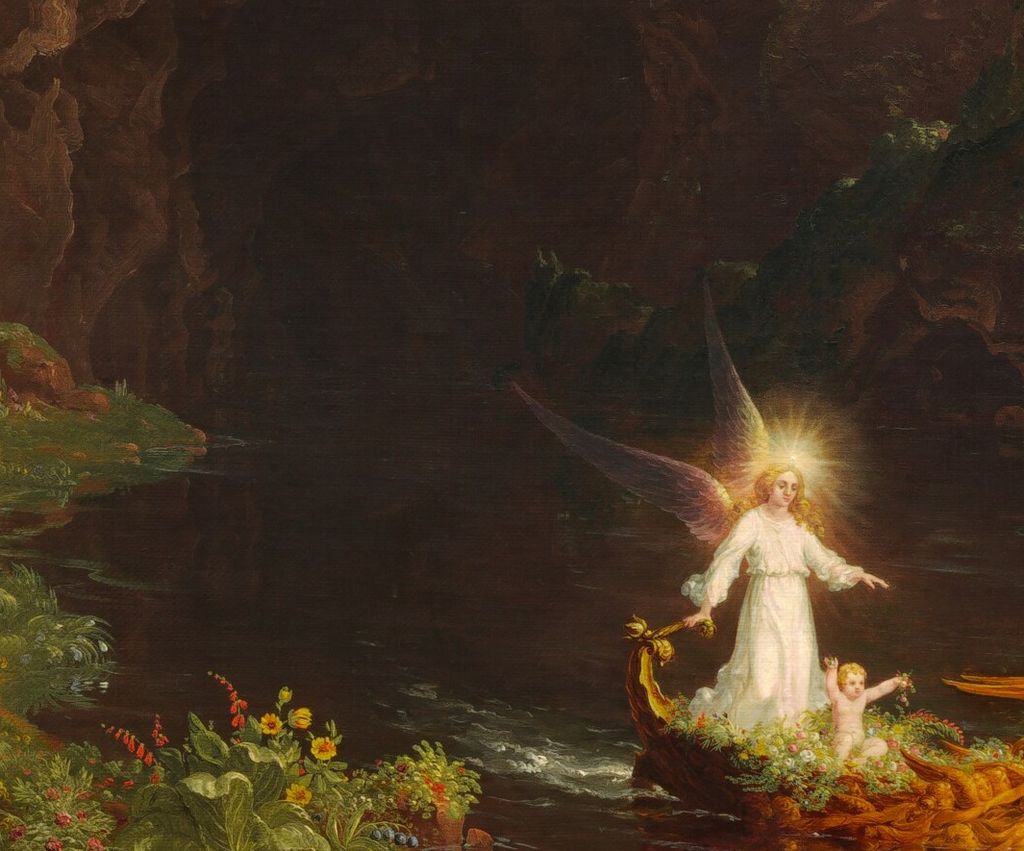
Childhood
The boat and child
A small child travels in the gilded boat with the guardian angel nearby. Their scale makes the surrounding flowers, banks and cliffs feel abundant and protective. [1]
The dark opening
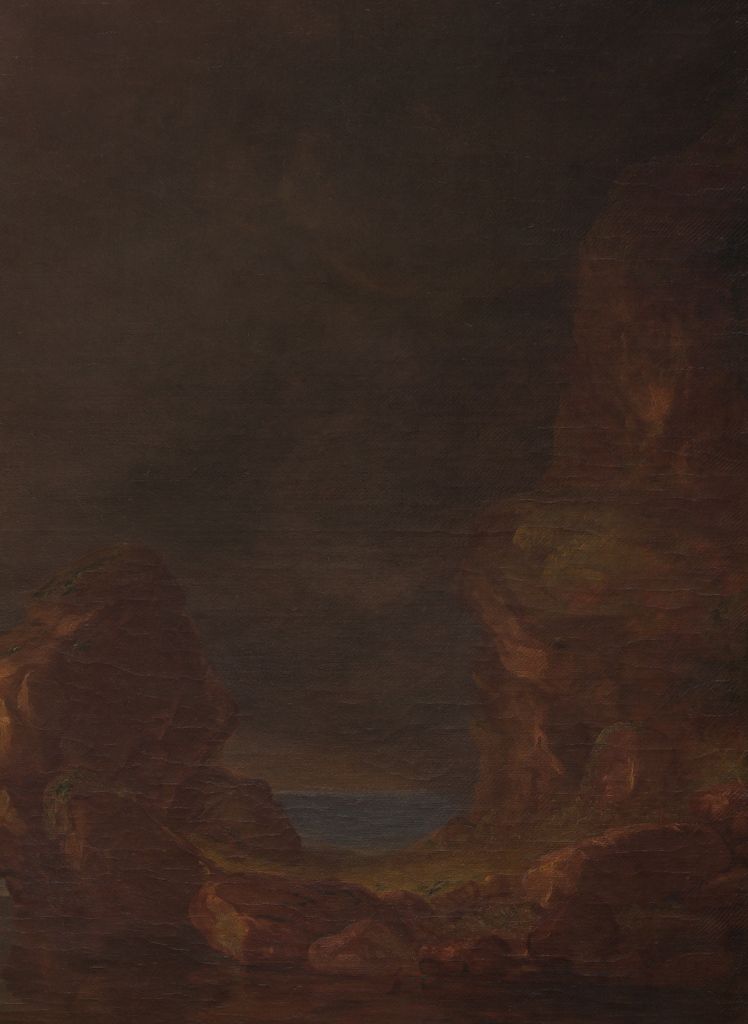
The boat emerges from darkness beneath the rocks into the open landscape. Cole’s explanation gives that movement a place within the allegory of earthly beginnings. [1]
The figure at the prow
The small winged figure at the boat’s prow belongs to a vessel that recurs through the series. Its position helps viewers follow the same traveller despite the changing surroundings. [1]
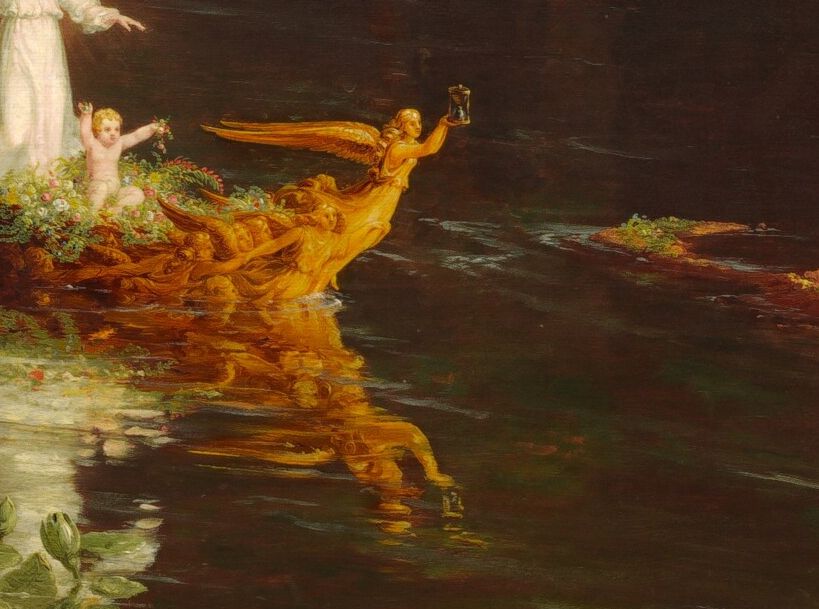
The flowering bank
Flowers and luxuriant foliage occupy the bank beside the infant’s route. Their crowded colour and variety contribute to the childhood scene’s sense of plenitude. [1]
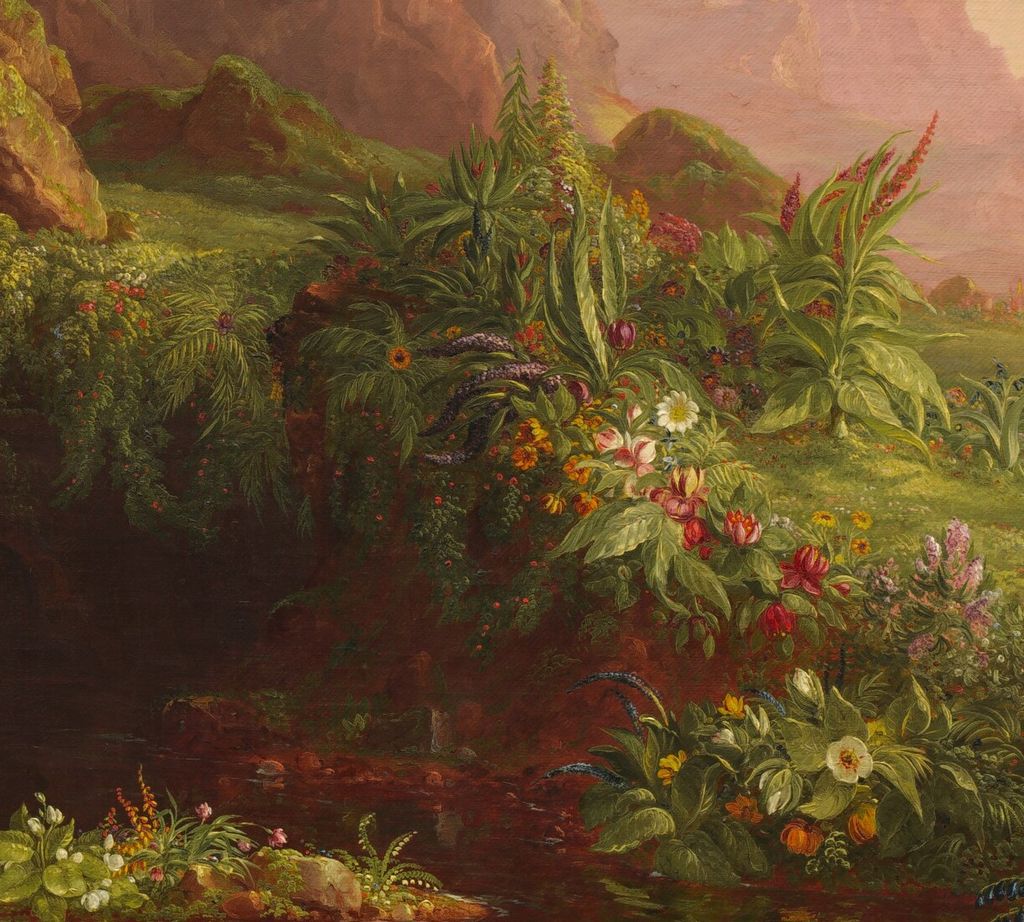
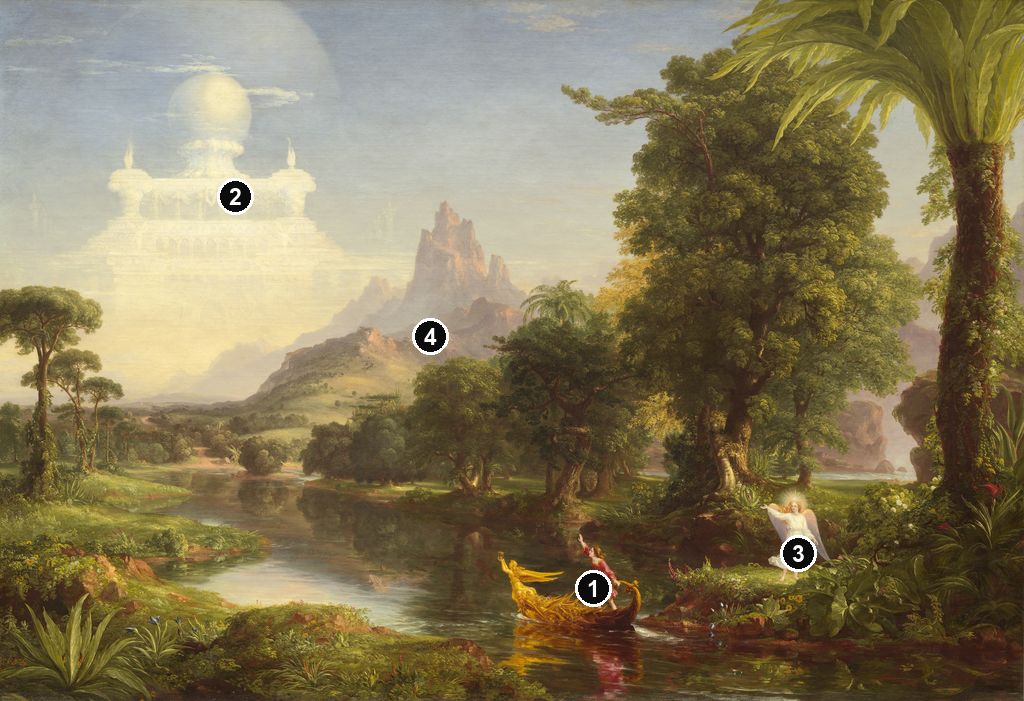
Youth
The voyager steering
The youthful traveller now steers the boat and looks towards the distant vision. The change from infancy makes ambition visible as an active direction of attention. [1]
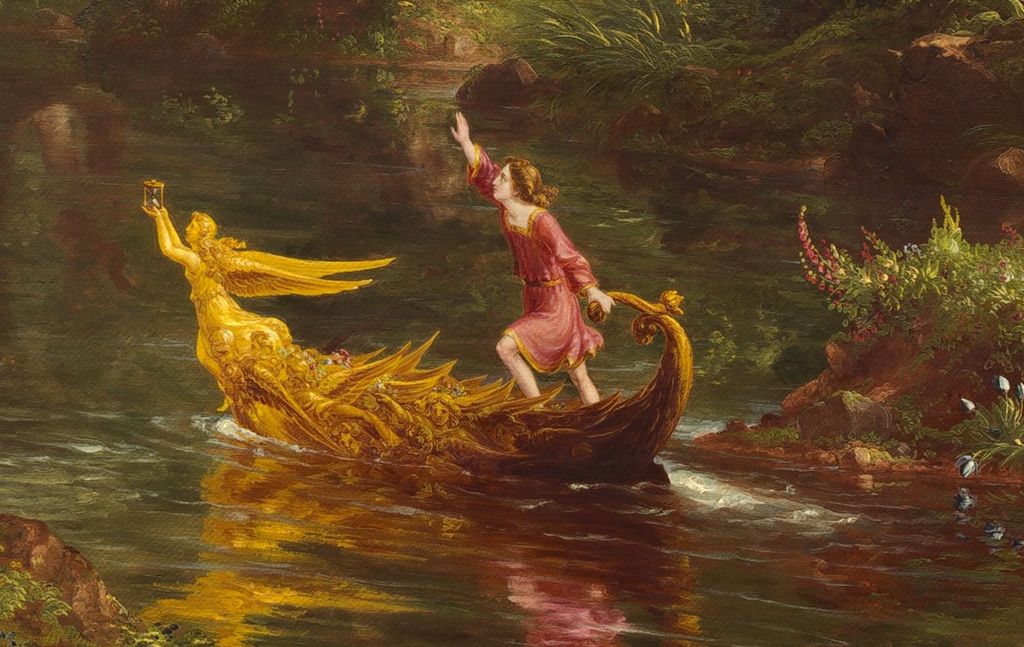
The castle in the clouds
A luminous architectural vision rises above the valley rather than standing on its ground. Cole’s explanation identifies it with youthful aspiration, while the river follows a different course. [1]
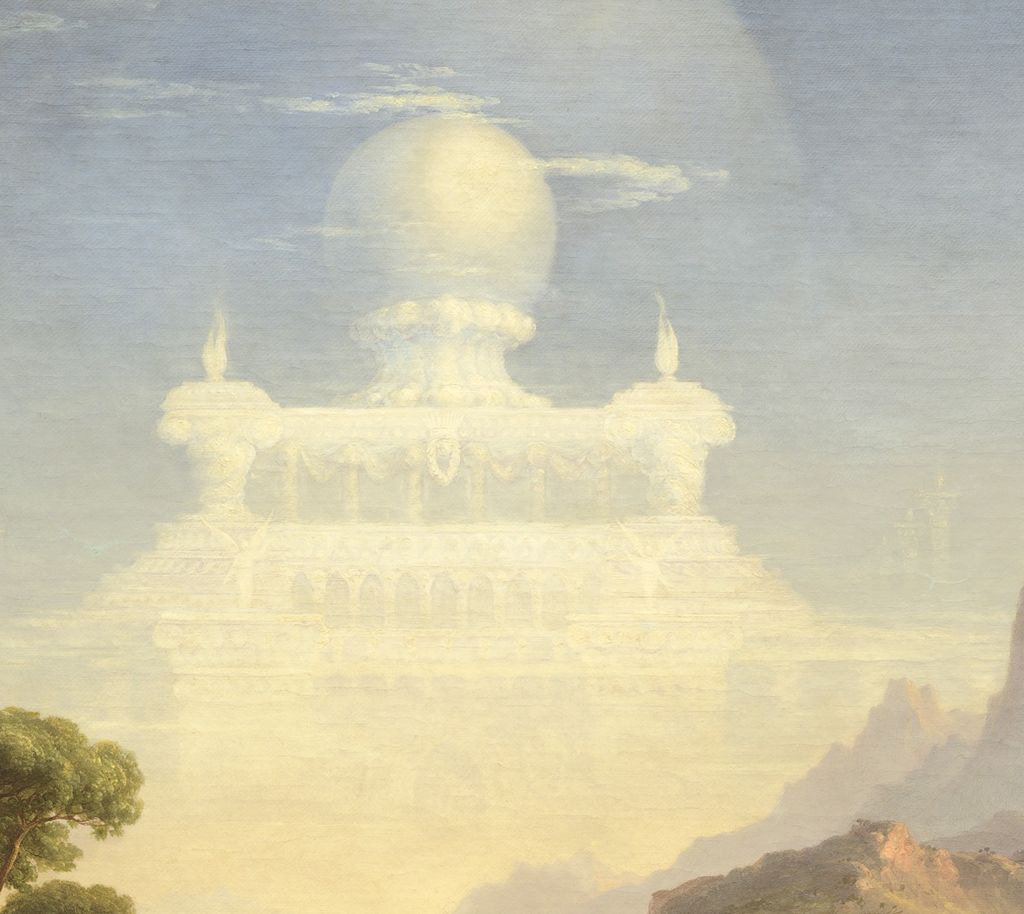
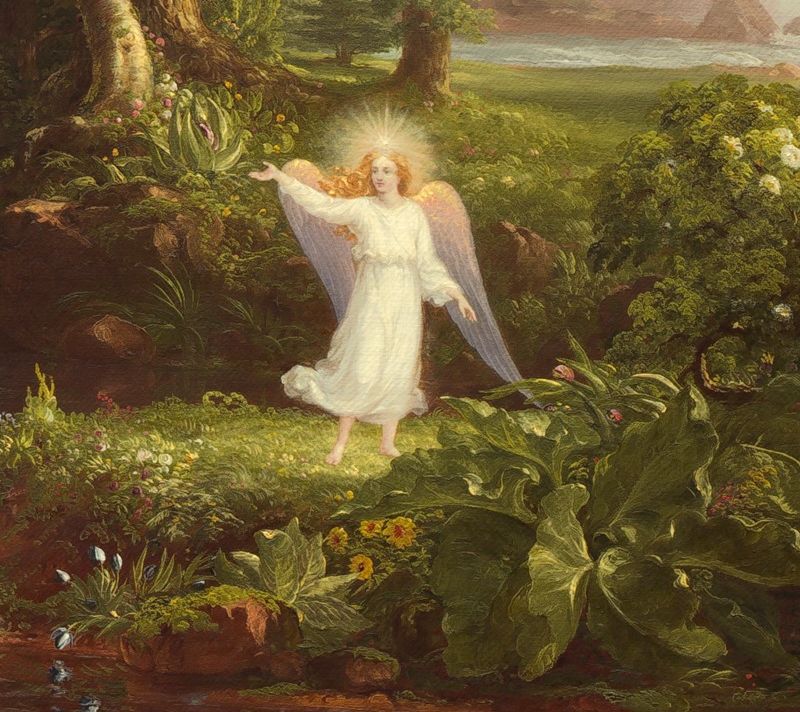
The angel left on the bank
The guardian angel remains on the bank as the boat moves away. The separation distinguishes this hopeful stage from Childhood’s close companionship. [1]
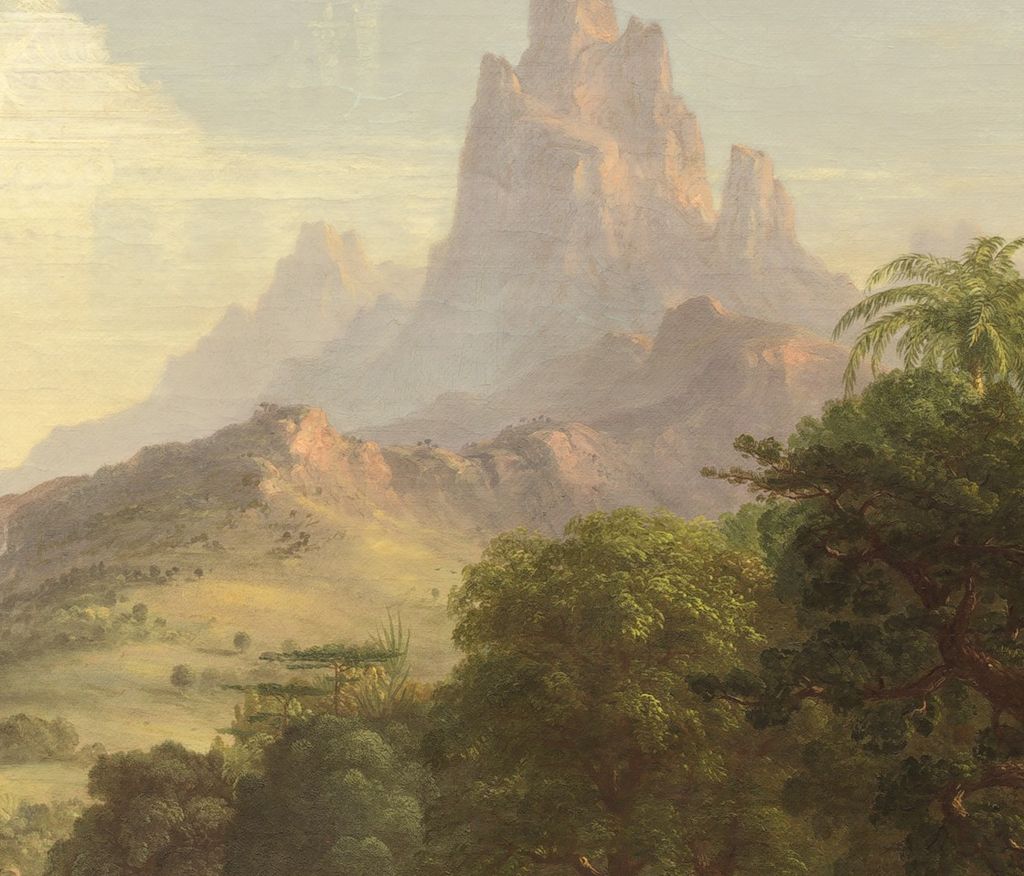
Mountains beyond the vision
Rougher mountains rise beyond the inviting foreground. The changing terrain suggests that the voyager’s desired destination and the route of the river will not coincide. [1]
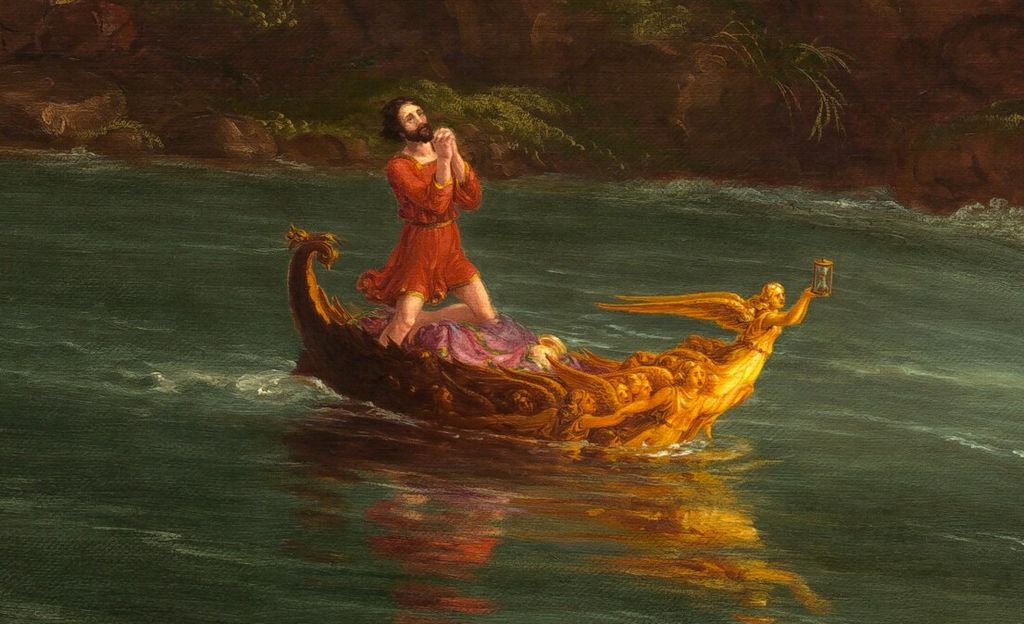
Manhood
The praying voyager
The mature traveller kneels in the boat with hands raised in prayer. This is the 1842 replica’s pose, distinct from the standing figure in the 1840 version. [1]
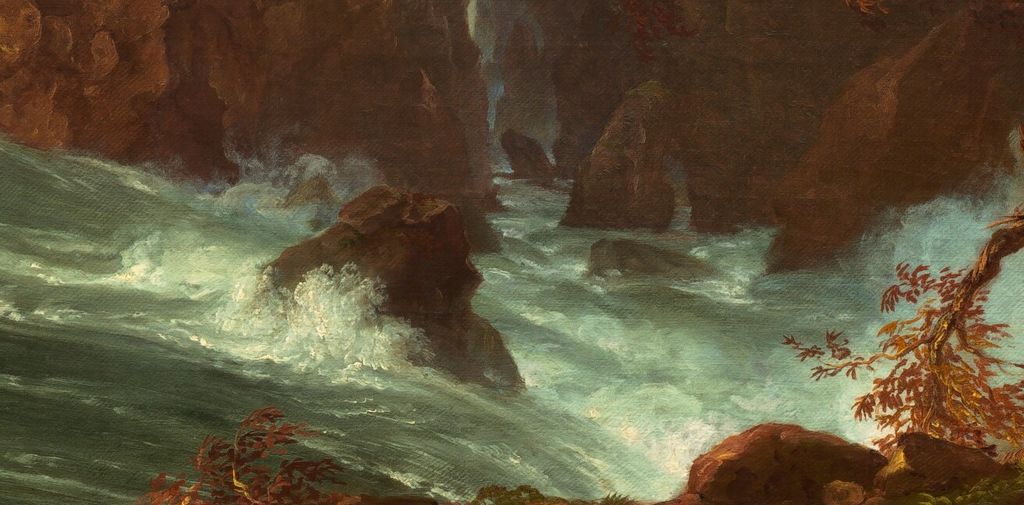
Water over the rocks
Foaming water presses between the rocks below the boat. Its turbulent direction replaces the broad, navigable river of the earlier stages. [1]
The distant guardian angel
The angel is high above the voyager, separated from him by the dark landscape. Cole makes continuing guardianship visible to the viewer even when the traveller appears alone. [1]
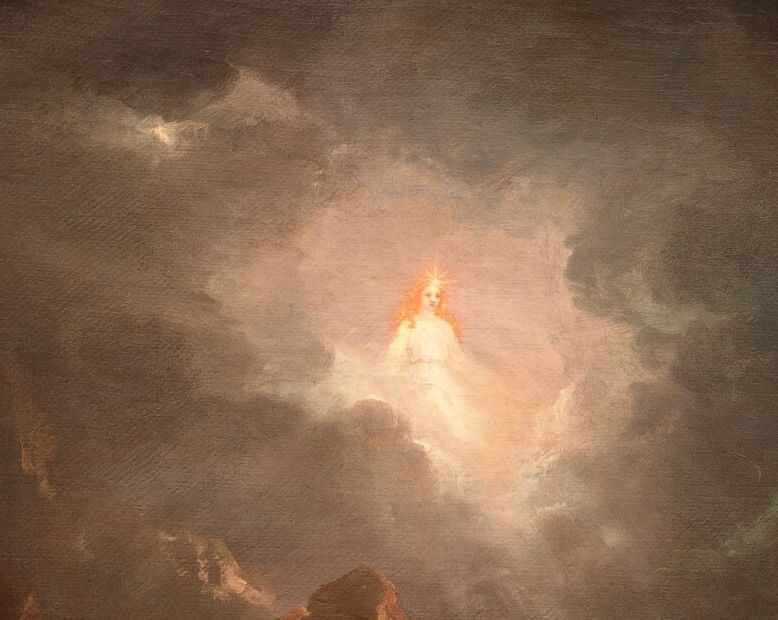
The threatening sky
Dark cloud and the rocky pass limit the boat’s surroundings. The atmosphere turns life’s difficulties into a landscape that offers little clear prospect ahead. [1]
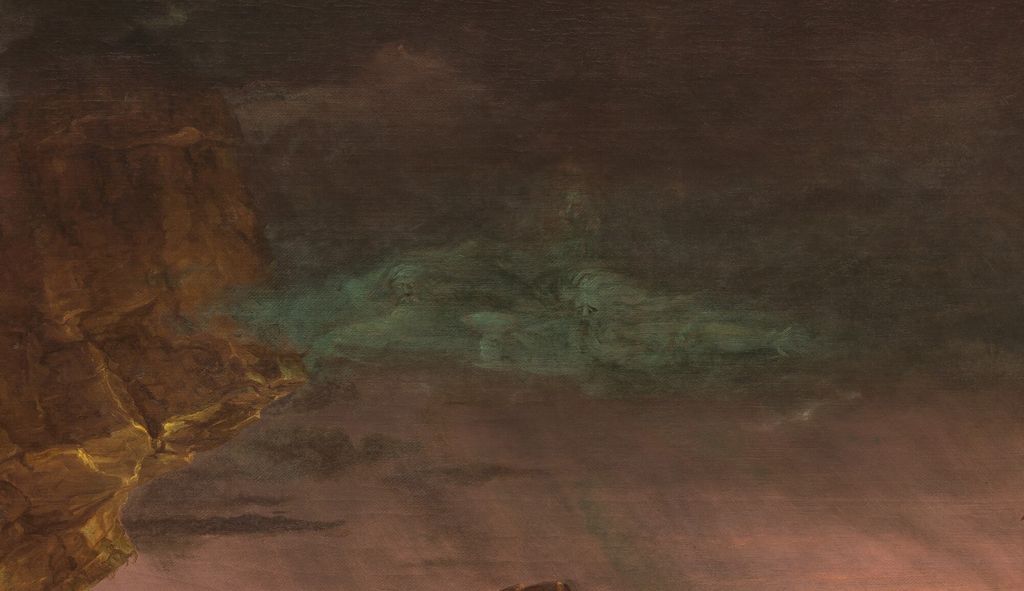
Old Age
The voyager and angel
The aged traveller meets the angel above the boat. Their renewed proximity changes the isolation of Manhood into a scene of guidance and expectation. [1]
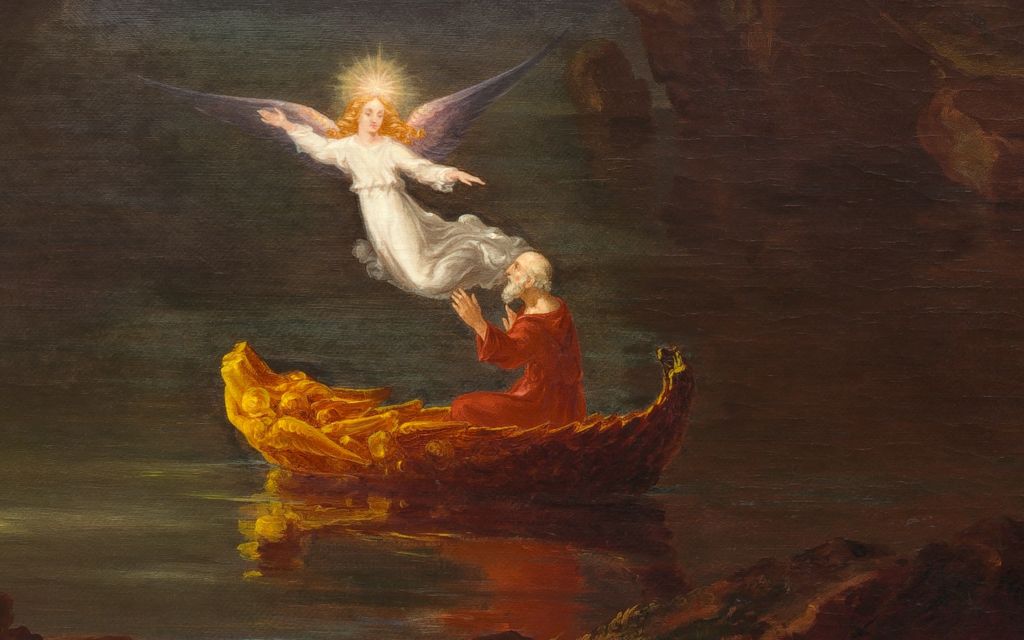
The light beyond the clouds
Light opens through the upper clouds and reveals distant angelic forms. In Cole’s explanation, the opening belongs to a Christian vision of immortality. [1]
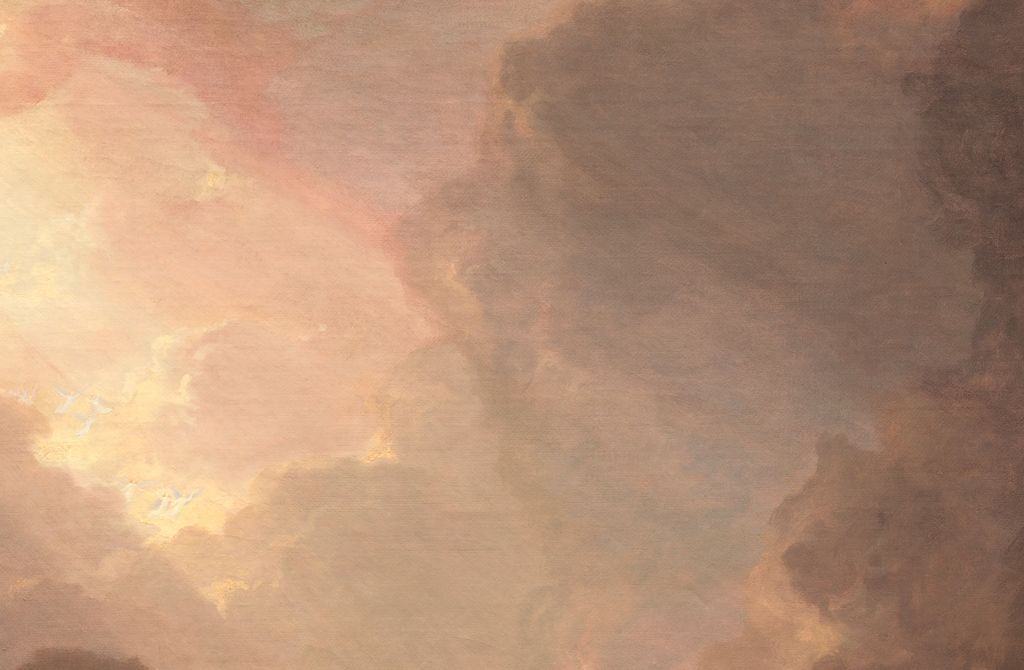
The open water
The river has widened into an expanse with little visible shore ahead. The landscape no longer directs attention towards worldly achievement or a difficult passage between rocks. [1]
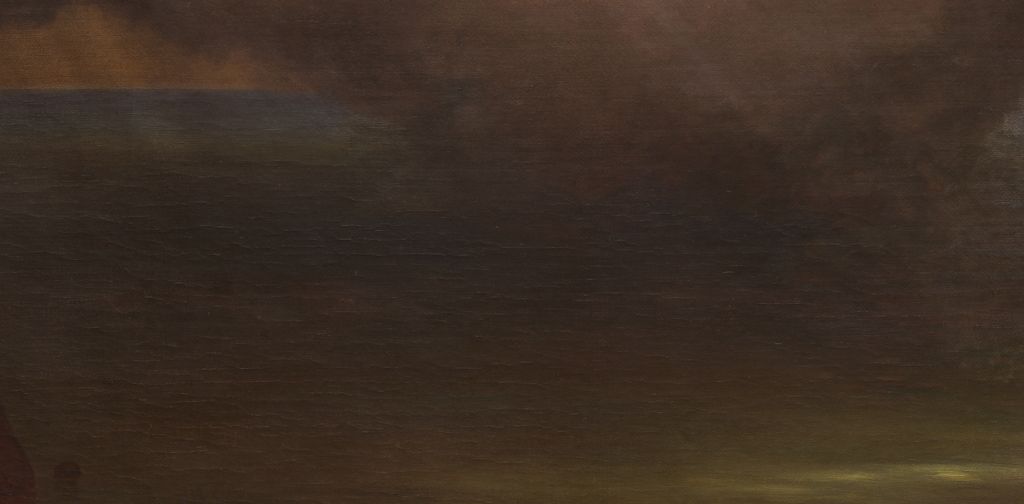
The dark enclosing rocks
Dark cliffs and vegetation remain at the right edge while the boat faces open water and light. The contrast places the departure from earthly surroundings within the composition. [1]
Samuel Ward's commission and the struggle to exhibit
In spring 1839, Samuel Ward commissioned four paintings in the manner of Cole's Course of Empire. The commission gave Cole the means to develop a substantial project conceived several years earlier. His journal entry of 24 March records his hope that the subject would make a powerful moral and religious impression. The ambition was explicit: Cole wanted an intelligible allegory, carried by paintings large enough to command attention. [1] [2]
By 14 September 1839, he told Ward that he had made finished studies, arranging the objects and resolving the distribution of light and shade before beginning the large canvases. These four small oil studies, now associated with the Albany Institute of History & Art, show a crucial stage of the design. Their value lies in the choices they preserve, including relationships that Cole subsequently altered. [1]
Initially, the boat travelled in the same direction in each scene. In the finished series, the direction reverses in Youth and Old Age. Kelly proposes two possible considerations: the difficulty of fitting four large canvases in one continuous row in Ward's home, and Cole's preference for complementary pairs. Neither is established as the sole reason. The important distinction is that these reversals occurred between preliminary designs and the first finished paintings. They are not differences introduced only when Cole painted the Roman replicas. [1]
The last two stages changed more substantially during this development. The preliminary Manhood apparently suggested a stormy coast, whereas the finished picture traps the boat within a gorge. In Old Age, Cole removed almost all land. These decisions sharpen the difference between a traveller hemmed in by danger and a traveller released into an immense space. Even before the second set existed, the paintings had passed through a serious process of reconsideration. [1]
Ward died on 27 November 1839, before the series was completed. Cole feared that his commission might be abandoned, remembering that Reed had also died before seeing his own series finished. The Ward family initially continued the arrangement, but relations grew difficult after their estate affairs were handled by the lawyer James S. Huggins. The most consequential dispute concerned public exhibition. Cole maintained that he could show commissioned works before delivery; Huggins argued that exhibition proceeds should be shared with the estate. [1]
This was more than a disagreement about where pictures would hang. A series required considerable labour, and its public appearance could help an artist establish his reputation and obtain further commissions. Ownership of the canvases did not automatically resolve Cole's expectations about their visibility. The dispute exposes the competing interests of an artist seeking an audience and a patron's estate controlling valuable property.
Cole eventually obtained the family's permission, and the first set went on view at the National Academy of Design in November 1840. He remained anxious about losing access once it was delivered. On 22 November, he and his nephew Henry Bayless resolved to make full-size tracings and oil copies of the figures so that another set could be painted. Those practical preparations gave his later Roman project a foundation. [1]
After delivery, the paintings remained unhung and unseen. Cole considered buying them back, producing a smaller replacement, or taking them to Europe to exhibit and sell. Negotiations with Huggins failed to secure their release without a reserve payment. When Cole left for Europe in August 1841, he had a subject whose first realisation was beyond his control, and the materials necessary to realise it again. [1]
Painting the second set in Rome
The Roman paintings arose from this specific difficulty, rather than from a straightforward commission for duplicates. Cole told his wife at his departure that he intended to paint another set, but he hesitated over the time it would consume. By November 1841, encouragement from acquaintances, including the American consul George Washington Greene, helped persuade him to proceed. He had brought his studies and tracings with him. [1]
He apparently began with Manhood. A December letter reports progress on the third picture, and this is the scene in which he made the most important revisions. The traveller's earlier standing pose became a pose kneeling on one leg. Cole gave him a fuller, darker beard, and reworked trees, rocks and the horizon. Kelly suggests dissatisfaction with the first version as a possible reason for starting here; it remains a scholarly inference. [1]
By mid-March 1842, Cole had completed Childhood, Youth and Manhood, recording that they had taken twelve weeks and six days. Old Age followed by late March or early April. This chronology distinguishes the finished paintings' 1842 date from the project's beginning in 1841. It also shows how concentrated the labour was, although the compositions themselves had developed over several preceding years. [1]
Cole's private journal gives a less triumphant account than the paintings' later fame might suggest. On 28 February 1842, he wondered whether the new pictures were better than Ward's set but admitted that judging them was difficult. He hoped they would be profitable, while worrying that they had absorbed time he wanted to spend studying figures, landscape and art. The entry also expresses longing for his family. The series' spiritual assurance coexisted with an artist's practical uncertainty and homesickness. [2]
Visitors supplied encouragement. In a March entry, Cole recorded the Danish sculptor Bertel Thorvaldsen's favourable response to the allegory, colour and adaptation of scenery to the subject. This is Cole's account of the visit, not an independent transcript of Thorvaldsen's speech. Kelly also traces how Greene circulated the story, helping make the encounter part of the series' early reputation. [1] [2]
The replicas were shown for about six weeks in an exhibition at the Piazza del Popolo, but did not sell. Cole considered taking them to England. His May journal entries weigh anticipated costs, limited resources and the chances of finding a sympathetic audience. He ultimately returned to America in 1842, and the second set was shown in Boston, New York and Philadelphia during 1843–44. A project made to recover control over his own subject became a substantial means of introducing that subject to new viewers. [1] [2]
Childhood: a beginning without knowledge
In Childhood, a river emerges from a deep, dark cavern. The infant's appearance is surrounded by luxuriant plants, flowers and gentle light. The contrast between the cavern and the illuminated setting gives the beginning of life a threshold: the child comes from an unknown past into a world that can be experienced but not yet understood. Cole identifies the cave with earthly origins and the mysterious past, rather than with a named geographical location. [1]
The guardian controls the boat. The child does not need to steer or interpret the surroundings. This is the first form of dependence in the sequence, and it has no sense of shame or failure. An abundant environment and a protective companion make dependence seem natural. Cole described wonder and happiness as the characteristic emotions of childhood; the enclosing riverbanks represent its limited experience and desires. [1]
The scale of the landscape is important to this effect. The infant inhabits a small vessel within a much larger world, yet the immediate setting is sheltering. Tall rocks do not yet function as the threatening barriers they become in Manhood. Darkness remains behind the boat rather than across its route. The picture makes danger possible within the same world that supplies comfort, without placing it at the centre of the child's consciousness.
Cole's explanation also identifies the Egyptian lotus in the foreground as a symbol of human life. The boat's Hours connect its playful passenger with time from the outset. These details prevent the scene from being only a charming infant in a garden. The journey has already begun, and the passage of hours is already carrying the child onwards. [1]
Youth: the goal and the missed turn
Youth opens the landscape. A clear stream, rich trees and distant mountains extend the world beyond the enclosure of the first picture. The traveller takes the helm, while the guardian stands on the bank. Above the distance rises an elaborate castle formed in the clouds. Cole identifies it with youthful dreams of fame and glory, and the expanded setting with the imaginative enlargement of ordinary things. [1]
The most revealing detail is the river's course. For a while it seems to lead directly towards the castle, but then it turns. Through gaps in the trees, the viewer can follow its descent towards the ravine that will become the setting of Manhood. A faint path heads towards the celestial architecture, while the traveller remains committed to the water. The desired route and the actual route diverge. [1]
This is why the castle's splendour does not settle the picture's meaning. Its appeal is essential: without it, the youth's confidence would seem merely foolish. We understand why he looks ahead with eagerness. At the same time, his concentration on a distant ambition allows the more immediate turn to escape his attention. The painting gives beauty and vulnerability the same source in an expansive imagination.
The guardian's departure is equally qualified. It steps out of the boat, but remains near the traveller. Cole's original outline described the youth being left to reason while the spirit watched. The scene therefore represents a change in guidance rather than its complete disappearance. Looking at Youth on its own can obscure that continuing presence, especially when reproduction concentrates attention on the traveller and castle. [1]
Watch: Thomas Cole
Choose a film to explore the artist’s work, its interpretation and its wider setting.
Thomas Cole: Painting the American Landscape (remastered audio)
An introduction to Cole’s landscapes and artistic ambitions.
Watch on YouTubeManhood: control gives way to prayer
In Manhood, the boat enters the threatened passage anticipated in Youth. The current runs through a ravine under storm clouds. The traveller no longer has a helm. Cole places him amid a landscape of damaged trees, precipices and turbulent water, turning outward confidence into an urgent appeal to heaven. In the Roman version, the kneeling pose makes that dependence especially visible. [1]
Here the landscape carries the allegory with unusual intensity. There is little hospitable space in which the eye can rest. Rocks close the route, and water supplies motion without freedom of choice. The river that gently carried the infant and seemed to promise the youth's progress now propels the adult towards dangers he cannot master. Cole does not replace the river with a different symbol; he changes what the same symbol feels like.
His written explanation names the hovering demonic forms as Suicide, Intemperance and Murder. He presents them as temptations arising during extreme distress. These names belong to Cole's moral and religious account of the picture. They should not be treated as a general explanation of mental illness or as an inevitable description of adult experience. The scene expresses his conviction that faith can preserve a person when worldly control has failed. [1]
The guardian remains in the clouds, calmly watching the voyager. The difference between the traveller's fear and the spirit's composure asks the viewer to distinguish felt abandonment from actual abandonment within Cole's story. The presence is apparent to us even when it is unavailable to the man's immediate understanding. This makes the painting more complex than a simple sequence in which an angel leaves and later returns. [1]
Old Age: the horizon opens beyond the river
Old Age exchanges the ravine for a dark ocean. A few barren rocks mark the last shores. The vessel is battered, its figures of the Hours damaged, and the aged traveller looks towards light breaking through clouds. The guardian directs his attention to descending angels. Cole explains the ocean as the destination towards which all earthly life moves, and the illuminated vision as the promise of immortal life. [1]
The spaciousness is striking after the compressed danger of Manhood. Almost nothing remains to measure the water or supply an earthly destination. The loss of landmarks could be frightening, yet the relationship between the traveller and guardian transforms it. Guidance becomes visible again, and the upward gaze replaces the youth's pursuit of a distant worldly ambition.
Cole's accompanying text claims that the earthly world has lost its interest for the old man. That is a feature of his constructed allegory, not a universal truth about ageing. His sequence selects one male traveller and one Christian resolution from the enormous variety of human lives. Recognising that specificity allows the imagery to be examined without asking it to describe everyone's experience. [1]
Death is not simply the final dark space. Within the painting's religious logic, the end of the earthly journey permits another vision to become available. The viewer has followed changes in vegetation, weather and steering; now the most significant change lies beyond those familiar measures. The series closes by making the limits of landscape part of its subject.
Comparing the two sets
Both sets carry the same four-stage narrative, but they are separate works by the same artist. Kelly observes brighter colour in the National Gallery's replicas, especially evident when the sets were displayed together in Utica in 1985. He leaves its cause unresolved: it could reflect a deliberate choice or differences in available pigments. The observation should not be turned into a firm claim about Cole changing the allegory's emotional meaning. [1]
The changed traveller in Manhood offers a more specific comparison. Standing in the first version, he kneels on one leg in the second, with a fuller beard and revisions around him. This is a genuine difference between 1840 and 1842. By contrast, the alternating directions of Youth and Old Age were already present in the first completed set. Confusing these two kinds of revision makes Cole's design history harder to understand. [1]
Technical examination adds evidence about the replicas' construction. The National Gallery catalogue records herringbone twill supports, white grounds with coloured secondary layers, and relatively little underdrawing. Together with surviving tracings bearing red chalk on their reverse, this supports the possibility that Cole transferred designs rather than redrawing every composition extensively on the canvas. It is a reasoned reconstruction of the process, not a record of him demonstrating each transfer. [1]
Those findings concern the 1842 paintings. They cannot establish the fabric, preparation or treatment of the Munson originals. Likewise, the catalogue's account of restoration in 1970–71 is a dated account of the National Gallery set, not a statement of either set's present condition. Keeping the versions distinct makes comparison more useful, because differences can be attached to the paintings in which they were actually documented. [1]
From exhibition to widespread reproduction
The second set helped establish the subject's public reputation through its exhibitions in 1843–44. The first set returned to view at the New-York Gallery of the Fine Arts in 1845–46. Kelly specifically corrects the mistaken identification of that exhibition as a showing of the replicas. The Roman set had been sold to George K. Shoenberger of Cincinnati by May 1846, perhaps as early as 1845; its later ownership history runs separately from that of Ward's paintings. [1]
After Cole's death in February 1848, the first set appeared in his memorial exhibition at the American Art-Union. In June, the organisation voted to purchase it for $2,000 and distribute it through its lottery. J. Taylor Brodt won the paintings in the drawing on 22 December. The purchase gave the original commission another public life, attached to an institution seeking a broad audience for American art. [1]
Reproductive engraving extended that audience far beyond the exhibition room. James Smillie's engraving after Youth became especially influential, and he subsequently engraved the other stages. These were works made by an engraver after Cole's paintings, rather than original etchings executed by Cole. Their distribution helped make the second scene the most familiar image in the cycle. [1]
The reach of reproduction continued through later adaptations. Munson's 2025 exhibition Canvas to Culture explored more than fifty works connected with the series, following it through printed and painted copies into early multimedia presentation and cinema. Its account identifies a translation of Youth in The Jazz Singer of 1927. That exhibition demonstrates the subject's persistence across media; its short public description does not by itself document the details of every adaptation. [3]
Reynolda's 2021 exhibition used The Voyage of Life as a framework for works from three centuries and stories contributed by its community. Among its works was a later Smillie engraving after Youth, dated 1854–55. The exhibition brought Cole's sequence into conversation with lives and artists extending beyond his original model. It shows how a familiar allegory can become a starting point for new questions about what people share and where their experiences differ. [4]
The series' continuing value lies partly in that capacity. Its symbols are unusually legible, but a legible story can still provoke disagreement. Viewers may recognise the intoxicating hope of Youth or the helplessness of Manhood without accepting Cole's sequence as a complete account of life. Returning to all four paintings restores both the strength and the limits of his proposition: the passage of time is unavoidable, human control is incomplete, and, within his Christian vision, guidance persists beyond the traveller's ability to perceive it.
Artworks directory
Explore paintings, drawings and studies across Cole’s career. The two Voyage of Life sets appear separately. Dates and study identifications draw on the exhibition and collection catalogues, supplemented by the National Gallery’s drawing records. [5] [6] [7] [8]
| Name | Date | Medium |
|---|---|---|
| The Oxbow | 1836 | Painting |
| The Titan’s Goblet | 1833 | Painting |
| The Architect’s Dream | 1840 | Painting |
| The Course of Empire: The Savage State | ca. 1834 | Painting |
| The Course of Empire: The Arcadian or Pastoral State | ca. 1834 | Painting |
| The Course of Empire: The Consummation of Empire | 1835–1836 | Painting |
| The Course of Empire: Destruction | 1836 | Painting |
| The Course of Empire: Desolation | 1836 | Painting |
| The Voyage of Life: Childhood | 1842 | Painting |
| The Voyage of Life: Youth | 1842 | Painting |
| The Voyage of Life: Manhood | 1842 | Painting |
| The Voyage of Life: Old Age | 1842 | Painting |
| Home in the Woods | 1847 | Painting |
| Distant View of Niagara Falls | 1830 | Painting |
| View on the Catskill—Early Autumn | 1836–37 | Painting |
| Lake with Dead Trees (Catskill) | 1825 | Painting |
| River in the Catskills | 1843 | Painting |
| A View of the Mountain Pass Called the Notch of the White Mountains (Crawford Notch) | 1839 | Painting |
| Expulsion from the Garden of Eden | 1828 | Painting |
| The Subsiding of the Waters of the Deluge | 1829 | Painting |
| The Mountain Ford | 1846 | Painting |
| American Lake Scene | 1844 | Painting |
| A View near Tivoli (Morning) | 1832 | Painting |
| Aqueduct near Rome | 1832 | Painting |
| The Hunter’s Return | 1845 | Painting |
| The Voyage of Life: Childhood (first version) | 1840 | Painting |
| The Voyage of Life: Youth (first version) | 1840 | Painting |
| The Voyage of Life: Manhood (first version) | 1840 | Painting |
| The Voyage of Life: Old Age (first version) | 1840 | Painting |
| Panorama of the Oxbow on the Connecticut River as seen from Mount Holyoke | ca. 1832 (museum); 1833 (2018 catalogue) | Drawing |
| Sketch for The Oxbow | 1836 | Painting |
| From Nature | 1823 | Drawing |
| View of the Round-Top in the Catskill Mountains (Sunny Morning on the Hudson) | 1827 | Painting |
| Scene from The Last of the Mohicans: Cora Kneeling at the Feet of Tamenund | 1827 | Painting |
| View of Monte Video, the Seat of Daniel Wadsworth | 1828 | Painting |
| The Garden of Eden | 1828 | Painting |
| Tomb of General Brock, Queenston Heights, Ontario | 1830 | Painting |
| Effect for Newstead Abbey, Nottinghamshire, England | 1830 | Drawing |
| The Ilissos, from the Parthenon West Pediment | 1829 or 1830 | Drawing |
| Life Study for the Prostrate Shepherd in The Angel Appearing to the Shepherds | 1831–1832 | Painting |
| Interior of the Colosseum, Rome | ca. 1832 | Painting |
| Campagna di Roma (Study for Aqueduct near Rome) | 1832 | Painting |
| Landscape with a Round Temple | ca. 1830s | Painting |
| Stormy Landscape | 1832 | Painting |
| View of Florence from San Miniato | 1837 | Painting |
| Mount Holyoke, Massachusetts (after Basil Hall) | ca. 1829–1831 | Drawing |
| Layout for The Course of Empire | 1833 | Drawing |
| Study for The Course of Empire: The Savage State | ca. 1834 | Painting |
| Study for The Course of Empire: The Arcadian or Pastoral State | ca. 1834 | Painting |
| Study for The Course of Empire: Desolation | 1836 | Painting |
| Study for Dream of Arcadia | 1838 | Painting |
| Clouds | ca. 1830s | Painting |
| Study for The Hunter’s Return | 1845 | Painting |
| Study for Home in the Woods | ca. 1847 | Painting |
| Sunrise in the Catskills | 1826 | Painting |
| Study for The Mountain Ford | 1846 | Drawing |
| Tree Trunks | 1825–1840 | Drawing |
Frequently Asked Questions
Cole's difficulty obtaining access to the Ward commission helped prompt him to paint a second set. He prepared tracings and figure copies in 1840, then used them while making the replicas in Rome in 1841–42. The second set allowed further exhibition and sale under his own control. [1]
The first set, completed in 1840, belongs to Munson in Utica, New York. The Roman replicas, dated 1842, belong to the National Gallery of Art in Washington. A reproduction's museum credit and date are therefore essential for identifying which version it shows. [1]
Cole described it as an image of youthful aspirations towards fame and glory. Its apparent position ahead of the boat is deceptive: the river turns away towards the ravine of Manhood. The scene combines the beauty of hope with the traveller's limited understanding of his actual course. [1]
Within Cole's explanation, the guardian continues to watch him. Its changing position represents changes in the traveller's awareness and dependence. In Old Age, the spiritual guidance that accompanied him becomes visible to him again. [1]
The series presents landscapes designed for an allegorical journey, rather than an itinerary through four identified locations. Cole's own explanations connect their caves, flowers, ravines and ocean with different stages of life. The changing scenery serves the story as much as the ageing figure does. [1]
Discussion
Look again at The Voyage of Life and compare your reading with the questions below.
Reader Insights
In Youth, does the castle's beauty make the traveller's ambition more sympathetic, or does the river's hidden turn make it seem more dangerous?
How does your reading of the guardian change when you compare its position in all four paintings rather than examining one scene alone?
Which detail or comparison would you add to this account, and what evidence supports your reading?
Join the Conversation
Share the details that shaped your response, or suggest a comparison for other readers.
References
- Franklin Kelly, “Thomas Cole” and “The Voyage of Life”, in American Paintings of the Nineteenth Century, Part I, National Gallery of Art, 1996, printed pp. 95–108, PDF pp. 111–124; text on PDF pp. 111–118 and 123–124, illustrations on PDF pp. 119–122. Catalogue PDF.
- Thomas Cole, Thoughts & Occurrences (journal), transcribed by Peter Fedoryk, Thomas Cole National Historic Site, 2022 transcription; entries of 24 March 1839, 28 February 1842, March 1842, 22 May 1842 and 26 May 1842, PDF pp. 42–43 and 53–54. Journal transcription PDF.
- Munson, Canvas to Culture: Thomas Cole's Voyage of Life Lives On, exhibition description, 28 February–25 May 2025. Exhibition.
- Reynolda House Museum of American Art, The Voyage of Life: Art, Allegory, and Community Response, exhibition description and selected artwork list, 16 July–12 December 2021. Exhibition.
- Elizabeth Mankin Kornhauser and Tim Barringer, Thomas Cole’s Journey: Atlantic Crossings (2018). Career context and artwork/study metadata: catalogue entries 10–66 and chronology, PDF pp. 137–231 and 249–262; related Barringer essay passages, PDF pp. 23–66.
- Franklin Kelly et al., American Paintings of the Nineteenth Century, Part I (National Gallery of Art, 1996). Cole catalogue and both Voyage of Life sets, PDF pp. 91–124.
- National Gallery of Art, Study for The Mountain Ford (1846), accession 2015.19.772. Collection record and open-access image.
- National Gallery of Art, Tree Trunks (1825–1840), accession 2015.19.607. Collection metadata and open-access image.
- Splash image source.
Thomas Cole, The Voyage of Life: Youth, 1842. Oil on canvas, 134.3 × 194.9 cm. National Gallery of Art, Washington, Ailsa Mellon Bruce Fund (1971.16.2). The Roman replica of the first version completed in 1840.