 by Tom Gurney
Tom Gurney BSc (Hons) is an art history expert with over 20 years experience
Email: tomgurney1@gmail.com / Phone: +44 7429 011000
The Course of Empire: Desolation by Thomas Cole: Introduction
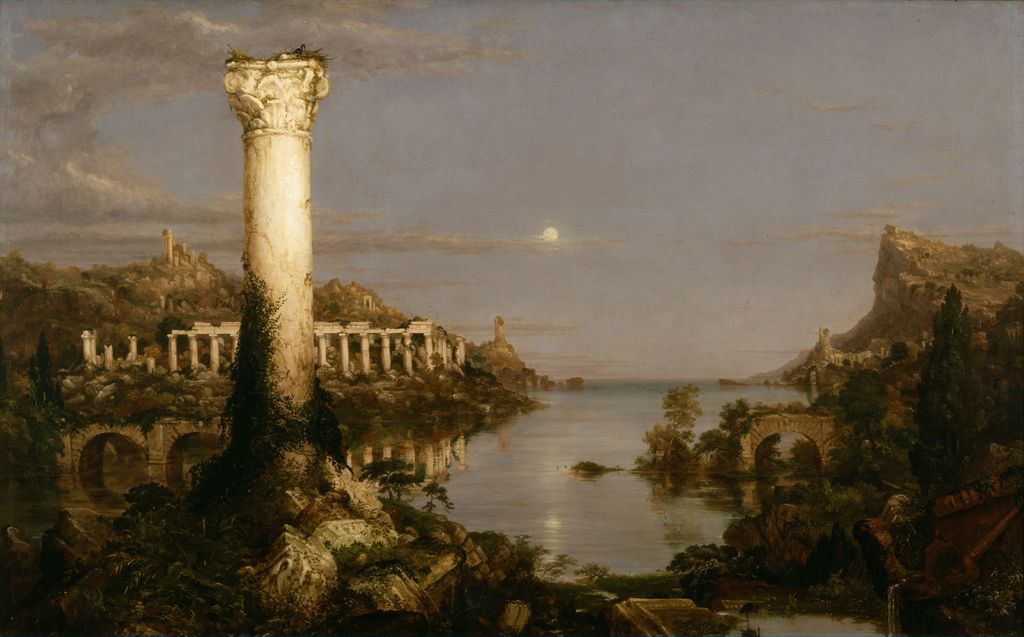
A solitary column rises above a city that has lost its inhabitants. Plants climb its shaft, birds occupy its capital, and the water below reflects broken architecture beneath a pale evening sky. In Desolation, Thomas Cole brings The Course of Empire to an end through stillness. The violence of the preceding painting has passed. What remains is a landscape in which the empire's monuments survive as fragments and animals can move without human pursuit. Painted in 1836, this fifth and final canvas belongs to New York Historical. [1]
The title invites a mournful response, yet the picture offers more than an image of loss. The ruined city has become habitable for other forms of life. Its recognisable coastline connects it with the beginning of the sequence, while sunset and a rising moon make the ending feel suspended between departure and continuation. Cole's achievement lies in holding these responses together: the extinction of a civilisation is terrible, but the world beyond it remains beautiful.
At a Glance
- ArtistThomas Cole, 1801–1848.
- Full titleThe Course of Empire: Desolation.
- Date and medium1836; oil on canvas. [1]
- Dimensions99.7 × 160.7 cm, unframed. [1]
- Place in the seriesFifth and final painting.
- CollectionNew York Historical; gift of the New-York Gallery of the Fine Arts, 1858; accession 1858.5. [1]
This work in Cole’s career
First European journey
1829–1832The Course of Empire
1834–1836The Oxbow
1836The Voyage of Life
1840 and 1842Church’s training
1844–1846Notes and sources
American recognition. Three New York sales brought Cole to the attention of artists and patrons. [2]
First European journey. Looking in Britain and Italy enlarged the repertoire of his American landscapes. [2]
The Course of Empire. Five invented landscapes turn the rise and fall of civilisation into a visual argument. [2]
The Course of Empire: Desolation. The final scene leaves ruins and a solitary column within a landscape returning to vegetation and silence. [1]
The Oxbow. An American prospect joined direct observation to a carefully staged view. [2]
The Voyage of Life. The original cycle and Roman replicas give human life the course of a river. [2]
Church’s training. Cole taught Frederic Edwin Church in Catskill. [2]
Home in the Woods. A late cabin landscape brings settlement and surrounding woodland into one scene. [2]
Contents
- Introduction
- After the last human action
- The column and the life around it
- Sunset, moonrise and the returning landscape
- European ruins and a quieter ending
- Painting the quiet
- The artist's name among the fragments
- Completion, reception and an open conclusion
After the last human action
The first thing to notice is how much of the painting is available to the eye without competition from people. In Destruction, figures fight, flee, fall and struggle through a burning city. Here, the broad centre of the composition opens towards the sea. No procession blocks the shore, and no crowd compels us to choose among urgent incidents. The visual pace has changed. We can follow the reflections, the small plants and the gaps in the masonry at leisure.
Cole's final stage is separated from the battle by the work of time. These are established ruins, with vegetation occupying the places where roofs, walls and human activity once defined the city. Broken arches stand on either side of the water; a colonnade extends across the left bank; smaller remnants punctuate the distance. Enough survives for us to recognise a built environment, but no intact urban whole can be recovered from it. The painting makes disappearance legible by retaining evidence of what has disappeared.
In his explanation of the scene, reproduced in the 2018 catalogue Thomas Cole's Journey: Atlantic Crossings, Cole described violence and time working together to reduce human constructions. He called the process one in which “art is again resolving into elemental nature”. The formulation matters: destruction is followed by a slower transformation of the materials civilisation has arranged. Stone does not vanish instantly when the empire ends. It loses its former relations and enters new ones. [3]
The calm should therefore be understood as the condition reached after catastrophe. It neither denies the previous painting nor simply prolongs its horror. The absence of human bodies removes the immediate suffering from view, leaving us to imagine the interval between the two canvases. Cole does not supply a precise chronology for that interval. The difference is conveyed through the contrast between active conflict and structures overtaken by growth.
That change also alters the viewer's role. Earlier panels invite attention to particular acts: a hunter's pursuit, a child's drawing, an imperial procession. Desolation offers no person through whom to enter its world. Our awareness of human life comes from its traces. Architecture becomes evidence, and the quiet surface of the bay gives those traces a second, wavering existence in reflection. We look at an empire from a position its former inhabitants could never have occupied: after its end.
Annotated Details from Desolation
Compare four details with the full composition, then open the photographs for a closer view.
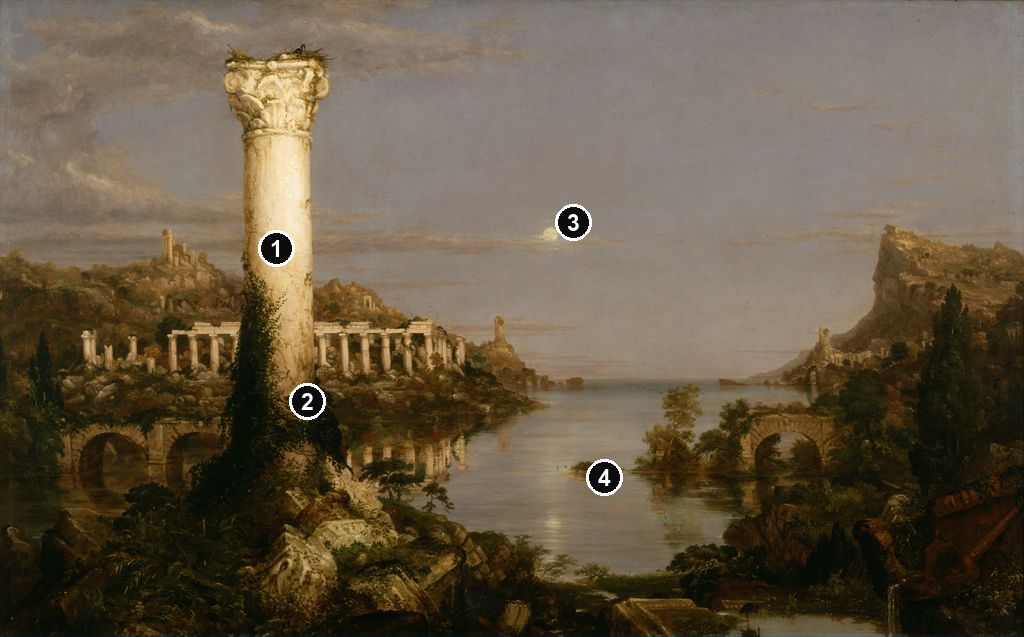
Details from DESOLATION
Each crop comes from the same painting shown above.
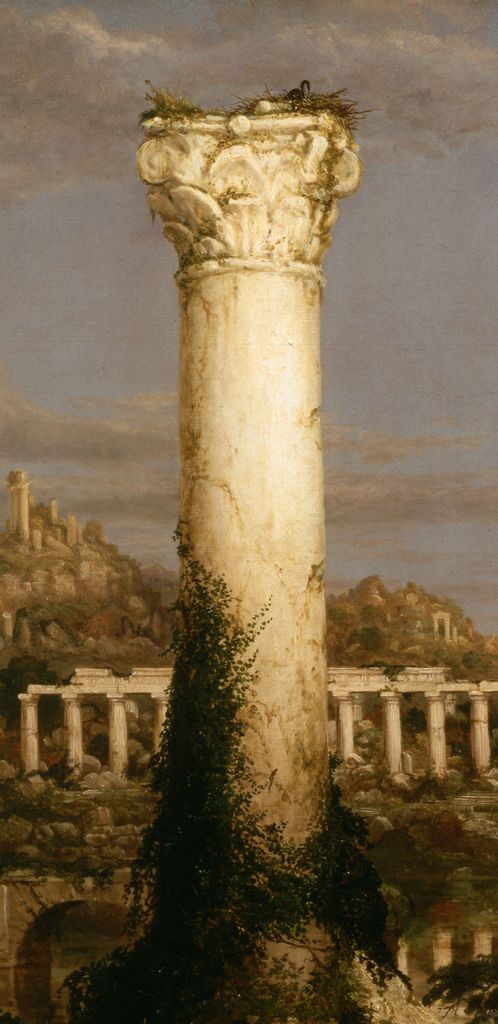
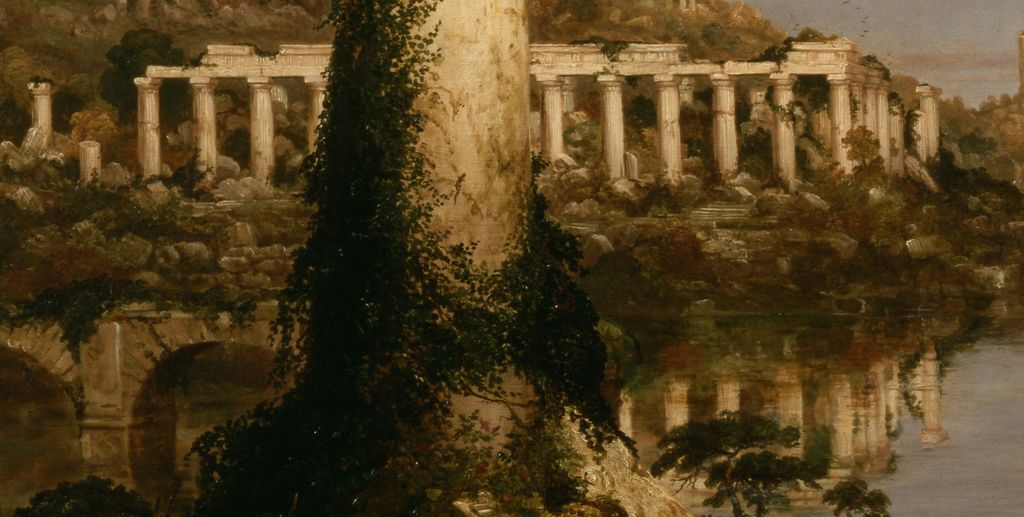
The surviving column
A single column dominates the foreground where the city once displayed its monuments. Vegetation grows around its base and capital, joining architectural survival to natural growth. [1]
Ruins along the shore
Broken arches and fragments recede beside the water. The structures remain legible as ruins, while plants soften their edges and occupy their former spaces. [3]
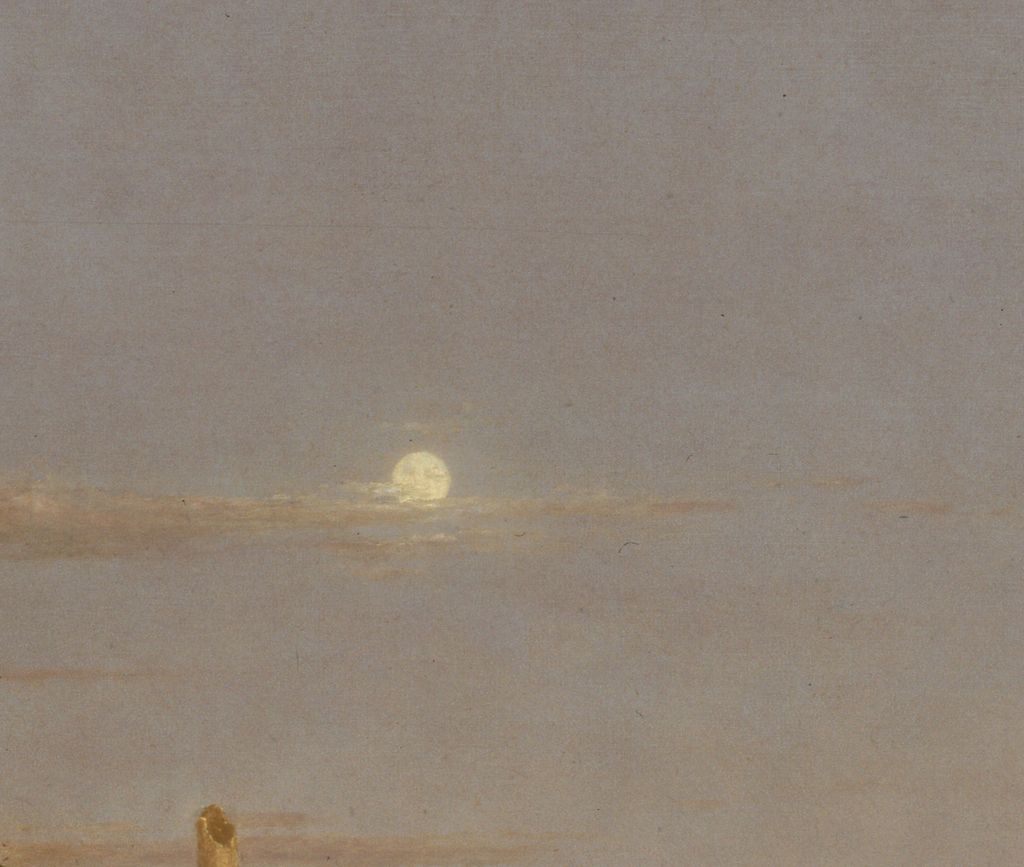
The moon and quiet sky
The moon hangs over an atmosphere without the violence of the preceding panel. Its pale light makes the ending contemplative rather than another scene of action. [1]
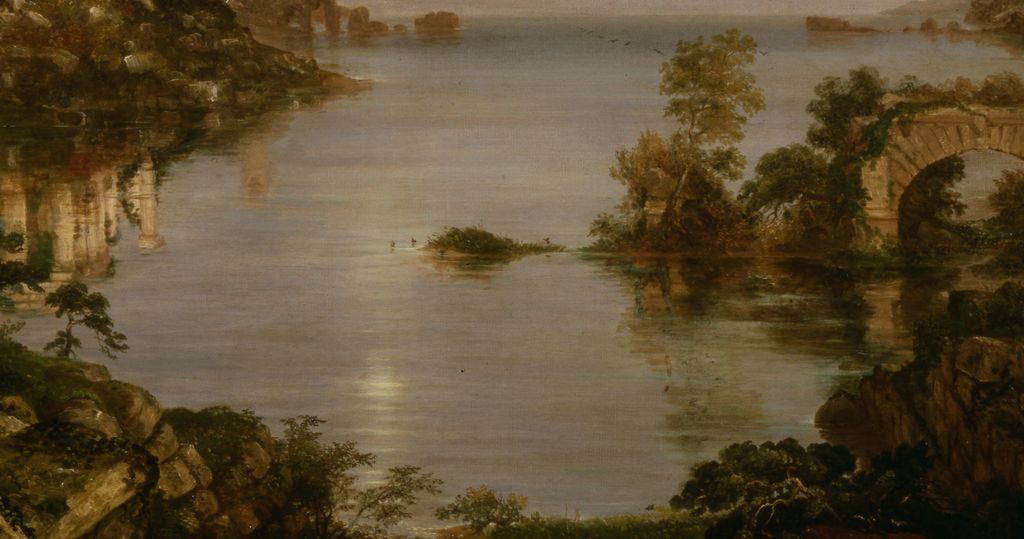
Water through the abandoned city
The water continues between the ruined shores after the human multitude has gone. Its open surface restores a sense of distance within a landscape still bearing traces of the city. [3]
The column and the life around it
The great foreground column holds the composition upright. Its shaft catches the fading light, and its ornate capital remains conspicuous against the sky. Because so much around it is low, broken or absorbed into vegetation, this surviving vertical has unusual authority. It recalls the height and finish of the vanished city, but it cannot restore the building of which it formed part. Architectural splendour has contracted into a single isolated object.
At its base, dark leaves climb over the stone and mingle with fallen fragments. Above, a bird's nest replaces the architectural member the capital once supported. The museum identifies herons nesting on the column and a lizard ascending its shaft. A buck and doe stand near the water beside the remains of a temple. These details make recovery concrete: the abandoned city supplies shelter, surfaces and access to water for creatures with no interest in imperial prestige. [1]
The nest is especially telling because it converts height into protection. The column's original role depended on the weight and order of a larger human construction. Now its usefulness belongs to birds. Its fine carving remains visible, but admiration for the carving is no longer what sustains life around it. Cole sets an achievement of art beside an activity that continues without artists, builders or rulers.
The animals also establish a connection with The Savage State. The series begins with deer pursued by hunters. At its end, the small deer by the ruined temple face no human predator. Tim Barringer draws attention to this reversal in the 2018 catalogue, connecting it with the hunting imagery that recurs elsewhere in the cycle. The final painting changes our understanding of the first: the arrival of human society introduced danger that its disappearance removes. [3]
This is a particular form of recovery, rather than a promise that every consequence of empire can be undone. The masonry remains, and the visible terrain carries the marks of centuries of building. Plants and animals inhabit an altered place. The scene has not returned to an untouched beginning, although its quietness encourages comparison with the landscape before the city existed.
The column helps us hold that distinction in view. It would be easy for a broad expanse of greenery to conceal the history of the setting. This bright survivor prevents such forgetfulness. Even as it supports new life, it continues to announce an earlier human ambition. Its value within the painting comes from this double presence: a monument to what has ended and a structure put to another use.
Sunset, moonrise and the returning landscape
The light is softer than the brilliance of the imperial capital or the storm-darkened glare of its destruction. Warm tones linger on the column and ruined shore, while a cooler atmosphere stretches over the water. The moon sits low in the open sky. The museum describes the sun as setting; Cole's own account places the rising moon near the position occupied by the sunrise in the first painting. Evening and dawn are connected across the sequence without being made identical. [1] [3]
Calling the scene moonlit is useful only if we remember this transitional hour. The moon is visible, but the land retains enough light for the ruin forms and plants to be read clearly. This is twilight, with the day's warmth receding into a broad grey-blue sky. The luminous column appears to hold the last of that warmth. Its isolation gains tenderness from the light, which makes damaged stone attractive without disguising its damage.
The water carries the eye towards an opening between the shores. Its relatively untroubled surface reinforces the sense that agitation has subsided. Ruins on the left and a broken arch on the right give the expanse a measured frame, but they no longer govern it. There are no busy fleets, ceremonial vessels or crowded crossings to establish the bay as an instrument of trade and imperial movement. The distance opens beyond the remains of those activities.
The rocky height at the right restores the series' familiar geography. Across the five canvases, the mountain and its conspicuous summit rock allow recognition despite Cole's changes of viewpoint. In the final scene it is exposed again, free of the mass of architecture that competed with natural features in the prosperous city. Its survival provides a scale of duration against which the empire's apparently permanent works become temporary. [1]
Yet the ending is more complex than the assertion that nature lasts and people perish. The moon's return to the earlier sunrise position produces a visual rhyme, rather than a complete reset. We remember a beginning while looking at an ending. The ruins keep historical time present within the recurring daily cycle. A new dawn may follow this evening, but the picture does not show a new civilisation waiting to arise.
This distinction gives the painting much of its emotional depth. The world continues, although a particular human world has ended. The open sea, the changing light and the animals offer continuity without a human successor. Cole leaves us with a landscape capable of enduring our absence, and with the uneasy beauty of seeing that possibility made visible.
European ruins and a quieter ending
Cole's experience of European ruins gave this imagined city a foundation in things he had seen. He travelled in Europe between 1829 and 1832, encountering both paintings and the remains of ancient buildings. The owning museum cautiously connects the ruins in Desolation with that journey. Barringer's catalogue entry places particular emphasis on Cole's response to the Roman Forum in 1832, where the artist found pleasure inseparable from mourning. The ruined city is fictional, but its emotional appeal belongs to an established practice of contemplating antiquity. [1] [3]
The scene should not be identified as a literal view of Rome. Cole needed a setting that could accommodate every phase of his narrative, and he had already transformed it through hunting grounds, cultivation, spectacle and war. Classical buildings make the empire intelligible without fixing it to a specific excavated site. Familiar architectural types permit recognition; their combination serves an invented history.
A more focused comparison is John Constable's Hadleigh Castle, which Cole saw at the Royal Academy exhibition in London in 1829. Barringer traces the importance of its lonely ruined tower to Cole's later work, including the solitary column in Desolation. In both paintings, a surviving upright structure brings the fragility of human achievement into a broad landscape. The comparison explains a compositional relationship as well as a shared concern with ruin. [4]
Their moods differ. Constable's castle belongs to a landscape still marked by unsettled weather; Cole's city rests in peaceful evening light. In the catalogue, Barringer interprets Constable's ruins through his grief and conservative response to social change. He reads Cole's final painting as less attached to the vanished civilisation: an empire compromised by luxury and domination has brought about its own fall. These are scholarly interpretations of the pictures, rather than meanings that every ruined tower or column automatically carries. [3]
The distinction directs attention back to Cole's visible choices. The column can elicit sympathy because it is beautiful and alone. The vegetation and birds simultaneously make its abandonment productive. Our attachment to the monument meets a landscape that has begun to flourish around it. That encounter prevents the picture from becoming either an uncomplicated lament for former greatness or an uncomplicated celebration of its collapse.
Watch: Thomas Cole
Choose a film to explore the artist’s work, its interpretation and its wider setting.
Thomas Cole: Painting the American Landscape (remastered audio)
An introduction to Cole’s landscapes and artistic ambitions.
Watch on YouTubePainting the quiet
Desolation expresses its changed world through the handling of paint as well as the selection of subjects. Barringer describes the final canvas as more freely worked than its predecessors, contrasting its soft treatment of natural features with the meticulous detail of The Consummation of Empire. The end of the series therefore changes the kind of looking Cole asks from us. The prosperous capital rewards the inspection of crowded particulars; the ruins encourage attention to atmosphere, relations and broad intervals. [3] [4]
The quieter manner does not mean an absence of structure. The column remains sharply dominant, the left-bank architecture gives the middle distance a horizontal rhythm, and the opening to the sea offers a clear route through the composition. Vegetation complicates these forms at their edges. Its less regular growth makes the ruins feel absorbed into a living setting, while their surviving geometry allows us to recognise the earlier ordering of the land.
Cole also made a small oil study for the painting, catalogued in 2018 as an 1836 work on wood panel in the McGuigan Collection. Its dimensions, 24.5 × 40.3 cm, distinguish it from the much larger finished canvas. Barringer notes the study's fluid handling and pinkish sunset tones. The study is a separate object, useful for understanding the way colour and atmosphere contributed to the conception; its material and ownership should not be confused with those of the final painting. [3]
The finished canvas retains a sense of spaciousness compatible with that study. Within the series, this feels like a release of pressure. Building, display and fighting had progressively filled the scene with competing demands. The end makes room for the bay and sky to become experiences in their own right. The painting's silence is visual: fewer interruptions, slower movements of the eye, and forms held together by a common atmosphere.
The artist's name among the fragments
At the lower right, Cole's signature is upside down on a stone partly covered by vegetation. The museum observes that the initial C has disappeared beneath the growth and interprets the placement as an acknowledgement of the artist's mortality. The catalogue likewise records the inverted inscription. This is a small detail with a large consequence: Cole includes his own identifying mark among the things that time can obscure. [1] [3]
A signature ordinarily offers a claim to authorship and survival. It gives a work a maker's name, allowing that name to travel beyond the maker's life. Here it is made to look vulnerable within the invented landscape. The stone bearing it has been displaced; plants interrupt its legibility. The name survives, but it no longer occupies a position of unquestioned control.
That gesture also complicates the apparent distance between artist and empire. Cole has created the scene and stands outside its fictional history, yet he puts a sign of himself within the field of decay. The museum's reading makes this a personal counterpart to the public collapse of architecture. Rulers, builders and painters all produce objects whose future they cannot command.
The effect depends on modest scale. Cole does not insert an imposing self-portrait to explain the end. His name can be overlooked while the column first commands attention. Once discovered, it brings the painting's wider argument close to the act of making and looking at art. The viewer who mourns the empire's lost works must also consider the eventual vulnerability of the image preserving them.
Completion, reception and an open conclusion
The work's own history differs sharply from the disappearance it depicts. Luman Reed commissioned the five-part series in 1833, but died on 7 June 1836 before the last two paintings were made. His family encouraged Cole to finish. According to the researched chronology in Atlantic Crossings, the artist worked on Destruction and Desolation that summer and completed the compositions by the beginning of October. The whole series was exhibited at the National Academy of Design in New York from October to December 1836. [5]
Reed's death gives the completion an unavoidable poignancy, but it does not establish Desolation as his memorial portrait or prove that each detail arose from bereavement. The final stage belonged to the larger conception. Cole's achievement was to complete that planned ending under altered circumstances, with the support of the collector's family. Patronage survived the patron, enabling an image of vanished human achievement to reach its first audience.
The response relieved Cole's anxiety. In his journal entry of 29 October 1836, he recalled fearing that the paintings would disappoint his friends' expectations, then reported his pleasure at their favourable reception. He also recorded writing a descriptive catalogue. His account is valuable as evidence of his response to the exhibition; its enthusiasm should not be treated as a systematic record of every visitor's opinion. [6]
Desolation could also appeal beyond the series' immediate moment. In his essay for American Paradise in 1987, Oswaldo Rodriguez Roque singled out its panoramic breadth, varied landscape, tangible atmosphere and still water, regarding it as the most naturalistic painting of the cycle. He noted the praise it received from the critic S. G. W. Benjamin in 1880, when admiration for the Hudson River School had weakened. This later response suggests why the canvas can command attention on its own: the qualities that convey the conclusion also sustain it as a landscape. [7]
Barringer's more recent interpretation brings its political and environmental dimensions together. He sees the scene as the recovery of a landscape damaged by human history, and the series as a warning shaped by Cole's experience of Britain, Rome and the expanding United States. This reading makes the final calm morally unsettling. The recovery we admire follows the disappearance of humanity from the picture. [4]
Cole gives no human figure the last word. Birds, deer, plants, water and changing light continue around the fragments. The scene offers neither a new ruler nor an announced replacement society. Its final question is left with the viewer: how should we understand the beauty of a world that outlasts the ambitions through which people have tried to possess it?
Artworks directory
Explore paintings, drawings and studies across Cole’s career. The two Voyage of Life sets appear separately. Dates and study identifications draw on the exhibition and collection catalogues, supplemented by the National Gallery’s drawing records. [2] [8] [9] [10]
| Name | Date | Medium |
|---|---|---|
| The Oxbow | 1836 | Painting |
| The Titan’s Goblet | 1833 | Painting |
| The Architect’s Dream | 1840 | Painting |
| The Course of Empire: The Savage State | ca. 1834 | Painting |
| The Course of Empire: The Arcadian or Pastoral State | ca. 1834 | Painting |
| The Course of Empire: The Consummation of Empire | 1835–1836 | Painting |
| The Course of Empire: Destruction | 1836 | Painting |
| The Course of Empire: Desolation | 1836 | Painting |
| The Voyage of Life: Childhood | 1842 | Painting |
| The Voyage of Life: Youth | 1842 | Painting |
| The Voyage of Life: Manhood | 1842 | Painting |
| The Voyage of Life: Old Age | 1842 | Painting |
| Home in the Woods | 1847 | Painting |
| Distant View of Niagara Falls | 1830 | Painting |
| View on the Catskill—Early Autumn | 1836–37 | Painting |
| Lake with Dead Trees (Catskill) | 1825 | Painting |
| River in the Catskills | 1843 | Painting |
| A View of the Mountain Pass Called the Notch of the White Mountains (Crawford Notch) | 1839 | Painting |
| Expulsion from the Garden of Eden | 1828 | Painting |
| The Subsiding of the Waters of the Deluge | 1829 | Painting |
| The Mountain Ford | 1846 | Painting |
| American Lake Scene | 1844 | Painting |
| A View near Tivoli (Morning) | 1832 | Painting |
| Aqueduct near Rome | 1832 | Painting |
| The Hunter’s Return | 1845 | Painting |
| The Voyage of Life: Childhood (first version) | 1840 | Painting |
| The Voyage of Life: Youth (first version) | 1840 | Painting |
| The Voyage of Life: Manhood (first version) | 1840 | Painting |
| The Voyage of Life: Old Age (first version) | 1840 | Painting |
| Panorama of the Oxbow on the Connecticut River as seen from Mount Holyoke | ca. 1832 (museum); 1833 (2018 catalogue) | Drawing |
| Sketch for The Oxbow | 1836 | Painting |
| From Nature | 1823 | Drawing |
| View of the Round-Top in the Catskill Mountains (Sunny Morning on the Hudson) | 1827 | Painting |
| Scene from The Last of the Mohicans: Cora Kneeling at the Feet of Tamenund | 1827 | Painting |
| View of Monte Video, the Seat of Daniel Wadsworth | 1828 | Painting |
| The Garden of Eden | 1828 | Painting |
| Tomb of General Brock, Queenston Heights, Ontario | 1830 | Painting |
| Effect for Newstead Abbey, Nottinghamshire, England | 1830 | Drawing |
| The Ilissos, from the Parthenon West Pediment | 1829 or 1830 | Drawing |
| Life Study for the Prostrate Shepherd in The Angel Appearing to the Shepherds | 1831–1832 | Painting |
| Interior of the Colosseum, Rome | ca. 1832 | Painting |
| Campagna di Roma (Study for Aqueduct near Rome) | 1832 | Painting |
| Landscape with a Round Temple | ca. 1830s | Painting |
| Stormy Landscape | 1832 | Painting |
| View of Florence from San Miniato | 1837 | Painting |
| Mount Holyoke, Massachusetts (after Basil Hall) | ca. 1829–1831 | Drawing |
| Layout for The Course of Empire | 1833 | Drawing |
| Study for The Course of Empire: The Savage State | ca. 1834 | Painting |
| Study for The Course of Empire: The Arcadian or Pastoral State | ca. 1834 | Painting |
| Study for The Course of Empire: Desolation | 1836 | Painting |
| Study for Dream of Arcadia | 1838 | Painting |
| Clouds | ca. 1830s | Painting |
| Study for The Hunter’s Return | 1845 | Painting |
| Study for Home in the Woods | ca. 1847 | Painting |
| Sunrise in the Catskills | 1826 | Painting |
| Study for The Mountain Ford | 1846 | Drawing |
| Tree Trunks | 1825–1840 | Drawing |
Frequently Asked Questions
It is the fifth and final painting, showing the ruined imperial city after the violence of Destruction. Cole completed it in 1836. [1]
It belongs to New York Historical, accession 1858.5. It entered the collection in 1858 as a gift of the New-York Gallery of the Fine Arts. [1]
It preserves a conspicuous fragment of the city's former splendour while supporting a bird's nest. Its changing use makes the return of non-human life visible within the ruins. [1]
It appears on a displaced stone partly covered by vegetation. The museum interprets the inverted, obscured name as a reminder that the artist and his works share the mortality represented by the ruined city. [1]
Discussion
Look again at The Course of Empire: Desolation and compare your reading with the questions below.
Reader Insights
Does the nest on the column make the painting feel more hopeful, or does it deepen the loss of the people who built the city?
How does your response to Desolation change when you compare its deer and evening light with the hunt and dawn in The Savage State?
Which detail or comparison would you add to this account, and what evidence supports your reading?
Join the Conversation
Share the details that shaped your response, or suggest a comparison for other readers.
References
- New York Historical, The Course of Empire: Desolation, collection record for 1858.5, including object metadata, description and provenance.
- Elizabeth Mankin Kornhauser and Tim Barringer, Thomas Cole’s Journey: Atlantic Crossings (2018). Career context and artwork/study metadata: catalogue entries 10–66 and chronology, PDF pp. 137–231 and 249–262; related Barringer essay passages, PDF pp. 23–66.
- Tim Barringer, catalogue entries 59–60, “The Course of Empire: Desolation” and “Study for Desolation”, in Elizabeth Mankin Kornhauser and Tim Barringer, Thomas Cole's Journey: Atlantic Crossings (2018), pp. 216–217, PDF pp. 220–221. Metropolitan Museum of Art catalogue.
- Tim Barringer, “Thomas Cole's Atlantic Crossings”, in Thomas Cole's Journey: Atlantic Crossings (2018), relevant passages pp. 39 and 59, PDF pp. 43 and 63. Metropolitan Museum of Art catalogue.
- Shannon Vittoria, chronology in Thomas Cole's Journey: Atlantic Crossings (2018), pp. 255–256, PDF pp. 259–260. Metropolitan Museum of Art catalogue.
- Thomas Cole, Journals, modern transcription, entry 29 October 1836, PDF p. 24, Thomas Cole National Historic Site.
- Oswaldo Rodriguez Roque, “The Exaltation of American Landscape Painting”, in American Paradise: The World of the Hudson River School (1987), p. 30, PDF p. 49. Metropolitan Museum of Art catalogue.
- Franklin Kelly et al., American Paintings of the Nineteenth Century, Part I (National Gallery of Art, 1996). Cole catalogue and both Voyage of Life sets, PDF pp. 91–124.
- National Gallery of Art, Study for The Mountain Ford (1846), accession 2015.19.772. Collection record and open-access image.
- National Gallery of Art, Tree Trunks (1825–1840), accession 2015.19.607. Collection metadata and open-access image.
- Splash image source.
Thomas Cole, The Course of Empire: Desolation, 1836. Oil on canvas, 99.7 × 160.7 cm. New York Historical, gift of the New-York Gallery of the Fine Arts, 1858 (1858.5).