by Tom Gurney
Tom Gurney BSc (Hons) is an art history expert with over 20 years experience
Published on June 19, 2020 / Updated on October 27, 2026
Email: tomgurney1@gmail.com / Phone: +44 7429 011000
View on the Catskill—Early Autumn: Introduction
A river catches the evening light beneath a broad mountain horizon. Trees shelter its banks, horses cross a meadow, and small figures occupy the grassy foreground. Thomas Cole’s View on the Catskill—Early Autumn invites a long, unhurried look. Its pleasures are immediate: the luminous sky, the variety of green foliage, the spaciousness between the nearest leaves and the distant peaks. Yet this apparent tranquillity has a history of loss behind it. Painted in 1836–37, the canvas preserves a vision of a familiar valley whose woodland Cole had seen damaged by railroad construction. It is now in the Metropolitan Museum of Art, New York. [1] [2]
Cole did not remove human life from this remembered place. He gave it houses, cultivated land, work and family affection. The question raised by the picture is therefore more searching than whether people belong in nature. It asks what kind of presence might allow the beauty of a landscape to survive. The answer is expressed through scale, light and small everyday actions, rather than through a dramatic confrontation. Its quietness becomes more moving when we learn that Cole and its patron, Jonathan Sturges, were also mourning their mutual friend Luman Reed. [2]
At a Glance
- ArtistThomas Cole (1801–1848).
- TitleView on the Catskill—Early Autumn.
- Date1836–37; signed and dated 1837.
- MediumOil on canvas.
- Dimensions99.1 × 160 cm (39 × 63 inches).
- CollectionMetropolitan Museum of Art, New York; accession 95.13.3.
- CommissionPainted for Jonathan Sturges.
- Museum acquisitionGift in memory of Jonathan Sturges by his children, 1895. [1] [2]
This work in Cole’s career
First European journey
1829–1832The Course of Empire
1834–1836The Oxbow
1836The Voyage of Life
1840 and 1842Church’s training
1844–1846Notes and sources
American recognition. Three New York sales brought Cole to the attention of artists and patrons. [3]
First European journey. Looking in Britain and Italy enlarged the repertoire of his American landscapes. [3]
The Course of Empire. Five invented landscapes turn the rise and fall of civilisation into a visual argument. [3]
View on the Catskill—Early Autumn. Made for Jonathan Sturges in 1836–37, this Catskill prospect preserves a pastoral ideal amid growing concern about local development. [2]
The Oxbow. An American prospect joined direct observation to a carefully staged view. [3]
The Voyage of Life. The original cycle and Roman replicas give human life the course of a river. [3]
Church’s training. Cole taught Frederic Edwin Church in Catskill. [3]
Home in the Woods. A late cabin landscape brings settlement and surrounding woodland into one scene. [3]
Contents
- Introduction
- A familiar valley, remembered
- How the eye travels through the painting
- Houses, fields and useful work
- The people beside the river
- Early autumn and evening light
- Railroad construction and the limits of improvement
- A commission shaped by friendship and grief
- Beside River in the Catskills
- The painting’s place in a collection
A familiar valley, remembered
The Catskill in the title is the waterway running through the landscape, with the Catskill Mountains beyond. Elizabeth Mankin Kornhauser identifies the view as looking south-west towards the Catskill Peaks from near Cole’s home. Her catalogue account also makes clear that this was a repeatedly studied subject: he had already painted at least ten views and made two panoramic drawings of the scene before beginning this canvas. Familiarity was essential to its making. He was revisiting a landscape he knew through walks, drawings and earlier pictures, rather than discovering an impressive prospect for the first time. [2]
That familiarity does not make the canvas a straightforward record of the valley on a particular autumn afternoon. Oswaldo Rodriguez Roque’s earlier study explains that Cole returned to sketches made about 1833 or earlier. Roque proposes a large drawing in the artist’s 1832 sketchbook as the most likely basis for the painting, while noting that the foreground trees and figures are absent from it. This distinction matters: the broad configuration of the country could be retained while the nearest part of the scene was developed into a more carefully shaped experience. The drawing relationship is a scholarly identification, not a surviving statement by Cole that settles every stage of the work. [4]
The result brings two kinds of knowledge together. The long mountain ridge gives the prospect geographical coherence, while the trees and people make it emotionally inhabitable. We can imagine standing near the riverbank, shaded by the large trees, without assuming that every foreground element occupied precisely that position outside the studio. The painting’s credibility depends on the convincing relation of its parts: wooded banks enclose the water, open ground lies beyond them, and the mountains rise through softer air. Remembering a place here means reconstructing how its parts could belong together.
Annotated Details from View on the Catskill Early Autumn
Compare four details with the full composition, then open the photographs for a closer view.
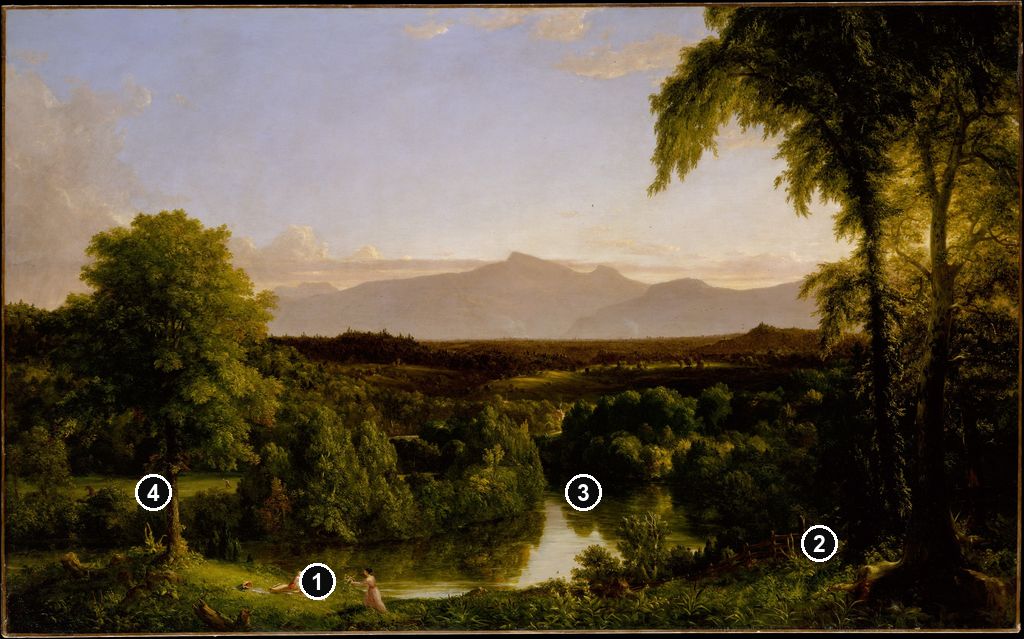
Details from VIEW ON THE CATSKILL EARLY AUTUMN
Each crop comes from the same painting shown above.
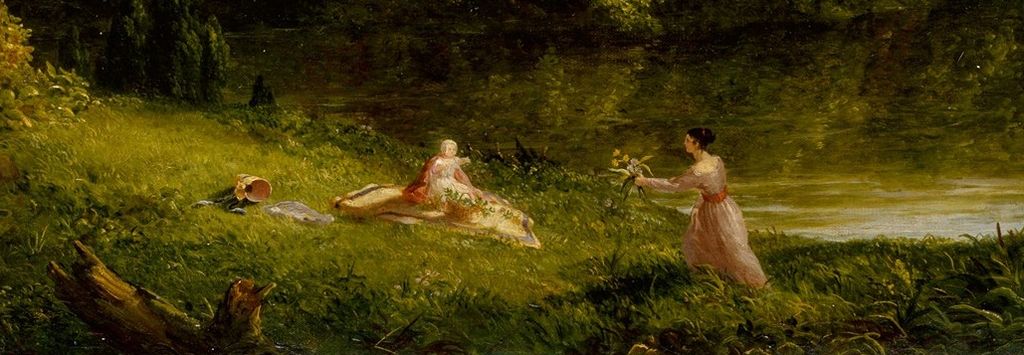
Life beside the water
Small foreground figures give the sheltered riverbank a human centre. Their quiet activity belongs to the same pastoral setting as the fields, water and distant hills. [2]
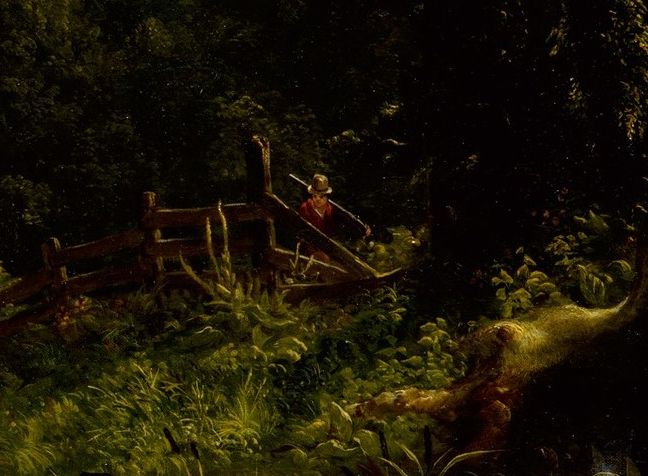
A figure emerging from the woods
A hunter appears within the dark trees at the right. Kornhauser proposes a possible connection with Cole himself, while the figure’s personal identity remains uncertain. [2]
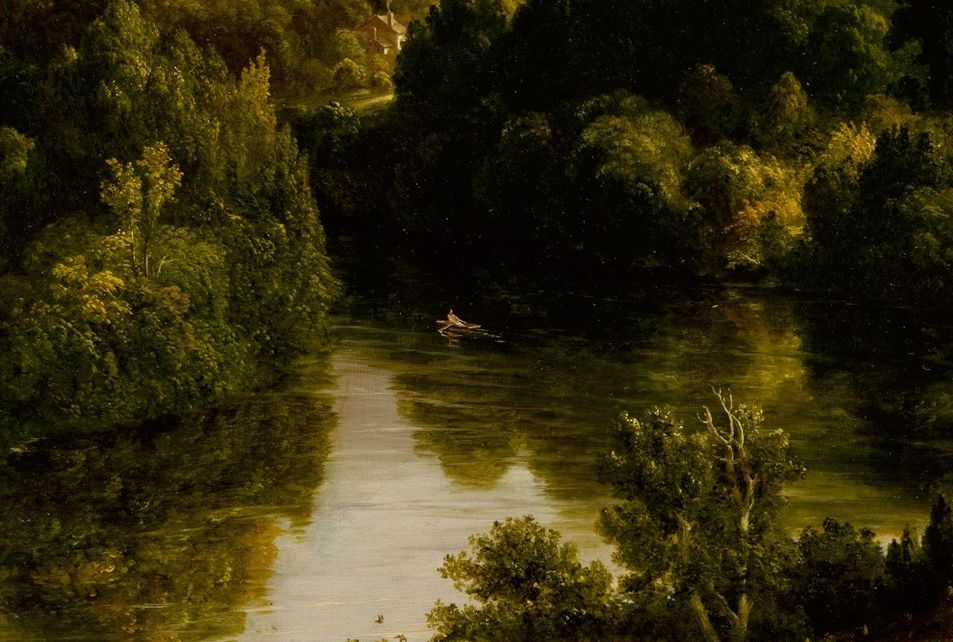
A boat on the river
The small boat occupies the bright channel between wooded banks. River work and movement remain part of the painting’s apparently tranquil landscape. [2]
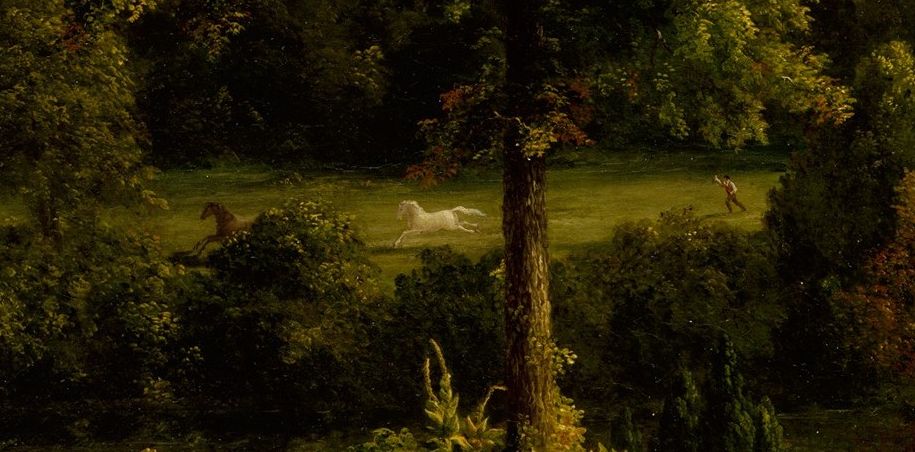
Horses in the meadow
Horses and a small figure occupy cultivated ground across the water. Their activity makes human use of the valley visible without overwhelming its trees and mountain horizon. [2]
How the eye travels through the painting
Cole gives the landscape a broad horizontal form, but he does not let it become a simple succession of bands. The nearest ground slopes towards the river, whose reflective surface draws the eye into the centre. From there, the wooded banks lead towards the meadows and the mountain range. The route into depth is gentle and indirect. It is possible to follow the water, pause over the figures, or look immediately above the dark woodland to the glowing sky. Each approach brings us back to the same spacious whole.
The foreground trees have different visual weights. At the left, a tall tree rises from an open patch of grass, its crown projecting against the sky. At the right, a much heavier mass of trunks, branches and leaves extends down the edge and across the upper corner. The arrangement balances the view without making its two sides identical. One tree stands clearly before us; the others draw us under their canopy. Their contrast helps make the river valley seem accessible while preserving a feeling of wooded enclosure.
Kornhauser connects this framing and the luminous distance with Cole’s admiration for Claude Lorrain. The comparison concerns an artistic language: trees on either side, a measured recession through the land, and light that holds the prospect together. It does not require the Catskill valley to become a disguised Italian landscape. Cole uses that compositional inheritance to give a local subject the poise and dignity of an ideal pastoral. The familiar country gains the scale of a place worth contemplating, rather than merely passing through. [2]
Houses, fields and useful work
The valley is occupied. Its houses are small within the panorama, and the buildings sit among fields and trees rather than dominating the skyline. Kornhauser identifies the historic Van Vechten House near the centre of the composition and interprets it as an emblem of an older rural society threatened by change. The building’s modest visual presence is significant even without accepting that interpretation as its only meaning. It belongs to the landscape’s pattern of settlement; its roof and walls interrupt the foliage without displacing the mountain horizon. [2]
Roque also points to a dam in the stream, suggesting a mill. Cultivation and the use of water are therefore part of the picture’s harmony. The green meadow with its horses is an open space made and maintained by people, rather than a surviving fragment of untouched forest. These details prevent the view from being understood as a simple demand that human activity cease. Cole could make managed land beautiful. The difference lay in the character and consequences of the management. [4]
The smallness of the buildings and workers does not make them unimportant. Their actions give the valley a rhythm alongside the movement of the river. Fields, houses and boats connect the near bank to the country beyond it, allowing the prospect to register as a lived environment. Equally, none of these activities overwhelms the view. There is room for the trees’ irregular growth and the mountains’ remote forms. The painting makes coexistence look possible by showing human occupation as one scale of activity within a much larger place.
This is a rural landscape near Catskill, rather than a crowded representation of the village centre. Its social life is spread through the country. A house, a meadow and a riverbank are enough to suggest a community without creating a bustling town scene. That dispersed occupation is part of the painting’s appeal: useful work can be seen, but the eye still has room to wander. The scene gives cultivation a place within beauty without suggesting that all cultivated land, or every form of expansion, will necessarily preserve it.
The people beside the river
The figures become legible slowly. In the foreground, a woman with flowers approaches a small child, while a reclining figure lies nearby. At the right, a hunter comes through the darker woodland. Across the water, another person follows the horses through the meadow; a boat occupies the river. Kornhauser reads the foreground grouping as a family reunion and identifies the boatman as a rush gatherer. These are modest actions, held within the larger evening landscape, rather than a separate story that takes command of the canvas. [2]
Their placement creates a contrast between intimacy and distance. We can approach the nearest figures as people with immediate relationships, while those beyond the water remain signs of activity. The eye moves from flowers and a child to horses, a boat and cultivated fields. Through this shift in scale, affection and labour become parts of the same environment. The painting does not need a monumental figure to establish that human life matters. Its significance emerges from how securely these small presences seem to belong.
Kornhauser suggests that the returning hunter may represent Cole himself, who had recently married. This is an attractive possibility, especially in a scene whose family life feels so sheltered, but it remains an interpretation. There is no need to identify the man as a literal portrait to understand what the grouping contributes. A person arriving from the woods and a woman attending to a child give the foreground a sense of continuity: people leave, return and care for one another in a place that offers shelter. [2]
The activities also affect the tempo of looking. The horses introduce a little movement into the distant meadow, but neither they nor the hunter create danger. The water can carry a boat without becoming a threatening current. Flowers are gathered and presented rather than being overlooked as anonymous vegetation. Such details give the landscape a human measure of enjoyment. They make clear that the valley’s value includes the ordinary experiences it supports, alongside its grand horizon and the painter’s admiration for its forms.
Early autumn and evening light
The title’s early autumn is conveyed with restraint. This is not a landscape overwhelmed by scarlet leaves or stripped by winter. Most of the woodland remains green, with yellow and warm brown accents beginning to appear. The sense of transition depends as much on the light as on the foliage. Grassy patches brighten beside deeper shadows; the middle distance grows softer; the sky warms towards the mountain ridge. Seasonal change is made perceptible within a scene that still feels abundant.
The sky occupies a large part of the canvas. Pale blue above becomes warmer towards the horizon, where thin clouds stretch over the peaks. The mountains have lost much of the crisp detail visible in the nearest plants and tree bark. That difference creates depth while allowing the far distance to become a quiet resting place for the eye. The mountain silhouettes remain distinct, but their softened colour prevents them from competing with the foreground. Light connects the country by gradually altering how much of it we can see.
Kornhauser identifies the setting sun as a source of melancholy in the picture. Her reading relates the close of the day to Cole’s wish to preserve a vanishing landscape. That is a persuasive connection, although the colour and light can also be enjoyed without translating each warm passage into a symbol. The evening is beautiful before it is explanatory. Its emotional force comes partly from the coexistence of brightness and shadow: the place appears welcoming, yet the illuminated interval will not last indefinitely. [2]
Cole does not need an approaching storm to make change felt. The changing season and fading light supply gentler forms of transience. Both occur regularly in nature, unlike the sudden damage of construction that troubled him. Their inclusion gives the remembered landscape a life beyond the moment preserved on the canvas. It is neither frozen in permanent summer nor already ruined. Early autumn allows fullness and decline to be present together, making the scene capable of holding pleasure and regret without sacrificing either.
Watch: Thomas Cole
Choose a film to explore the artist’s work, its interpretation and its wider setting.
Thomas Cole: Painting the American Landscape (remastered audio)
An introduction to Cole’s landscapes and artistic ambitions.
Watch on YouTubeRailroad construction and the limits of improvement
The construction behind the painting’s history must be distinguished from what appears within it. There is no train in Early Autumn. Cole’s anger at railroad building belongs to its documented circumstances, while the canvas presents a remembered valley with substantial woodland. His letters to Reed in March 1836 express distress over the cutting of trees; the second letter qualifies the vehemence of the first and reports his hope that some trees would be saved. Roque’s account preserves both letters, making it possible to see Cole responding to events rather than speaking in one unchanging register. [4]
His journal entry of 1 August 1836 is still more revealing. After walking above Austin’s Mill, where the railroad was being made, he wrote that the walk had lost its former quietness and solitude. Yet he also insisted that it remained lovely: mountains, surviving woods and the stream retained their power. His complaint did not obliterate his capacity to see beauty. The entry turns from personal disappointment to the conduct of those carrying out the work, condemning destruction that he considered unnecessary. [5]
Crucially, Cole allowed that works needed for commerce could proceed without destroying natural beauty and might sometimes improve access to it. This qualification appears in the fuller journal transcription and deserves a place beside his more often repeated denunciations. He was asking for sensibility and restraint in the use of land, not declaring that all useful construction must be incompatible with scenery. His grief at the cutting of forests was sharpened by his belief that people could have chosen a less damaging course. [5]
The canvas offers a corresponding distinction. A mill, fields and houses can share a valley with trees and water. There are also cut trunks in the foreground, which Kornhauser reads as hints of the creek’s threatened future. The traces of cutting complicate the shelter around the family without turning the whole painting into a scene of devastation. Its beauty is neither evidence that Cole ignored alteration nor proof that he rejected every intervention. It gives the viewer something concrete against which the scale and character of change can be judged. [2]
A commission shaped by friendship and grief
Jonathan Sturges was a New York merchant and Reed’s business partner. By the time Cole painted this canvas, Reed had died, leaving both artist and patron mourning a close friend. Kornhauser places that shared bereavement beside their common concern for the damaged Catskill woodland. The commission brought personal loss and landscape loss into the same relationship, although it would be too specific to claim that every figure or tree is a memorial emblem. The documented connection gives the tranquil scene an emotional setting without requiring a hidden code. [2]
The correspondence also shows that Sturges understood the picture as a recovery of the valley before modern development had altered it. In his letter of 23 March 1837, reproduced by Roque, he expressed confidence in Cole’s painting and a desire that it command attention at the National Academy exhibition. This was more than a private keepsake made solely for an intimate circle. Patron and painter were discussing a substantial work that would ask other viewers to recognise the landscape’s value. [4]
Cole’s journal supplies a particularly useful check on the dates. Looking back on the winter in his entry of 14 May 1837, he listed a view on the Catskill painted for Sturges among the works he had completed. The same entry records his marriage the preceding November and the death of his father in February. It places the picture within a season of work and profound personal change, rather than in the early career of 1825. The museum’s 1836–37 date and the canvas’s 1837 signature belong to this securely documented sequence. [5] [1] [2]
Beside River in the Catskills
The most illuminating companion is River in the Catskills, painted in 1843. Kornhauser compares the two as different accounts of the same valley: the earlier painting evokes a wooded past, while the later one confronts alteration. The locomotive and its train of carriages appear in that later canvas. So do a prominent man with an axe and a foreground marked by felled timber. Those details must remain attached to the 1843 picture, rather than being imported into a description of Early Autumn. [2]
The comparison changes how we understand the earlier framing trees. In isolation, they may appear to be pleasing devices that enclose the view. Beside the more exposed later scene, their shelter becomes a substantive feature of the place. The loss is not only a reduction in the number of trees. It changes the relation between a person standing near the river and the country stretching beyond it. Shade, enclosure and intimate foreground life give way to a more open encounter with the altered land.
Light reinforces the difference. Kornhauser contrasts the earlier evening pastoral with the bright noonday exposure of the later painting. Neither effect is merely decorative. In Early Autumn, light settles on people and objects held within a protective structure of foliage. The comparison makes that protection easier to notice, just as the later axe-bearing figure makes the earlier family grouping seem more fragile. It is not necessary to regard the works as formally commissioned pendants to find a sustained question passing between them: what happens to everyday life when the character of its surroundings changes? [2]
The painting’s place in a collection
The secure outline of the object’s history begins with Sturges’s commission and ends with the Metropolitan Museum’s acquisition. In 1895, his children gave the painting to the museum in his memory. The credit line therefore preserves a second act of commemoration, later than the friendship and bereavement surrounding its making. It is a large oil painting, 99.1 × 160 cm, whose width allows the river valley and the long mountain horizon to unfold without crowding. [1]
That movement into a public collection extends the picture’s original invitation to attention. The scene which Sturges wanted others to stop and consider can now be understood through its surviving canvas, its preparatory relationship to drawings, and the letters and journal entries that explain its circumstances. Those forms of evidence illuminate one another without becoming interchangeable. The documents describe disturbance and grief; the painting gives shape to a place in which shade, cultivation, affection and beauty could still coexist. Its quietness is the means by which that possibility becomes visible.
Artworks directory
Explore paintings, drawings and studies across Cole’s career. The two Voyage of Life sets appear separately. Dates and study identifications draw on the exhibition and collection catalogues, supplemented by the National Gallery’s drawing records. [3] [6] [7] [8]
| Name | Date | Medium |
|---|---|---|
| The Oxbow | 1836 | Painting |
| The Titan’s Goblet | 1833 | Painting |
| The Architect’s Dream | 1840 | Painting |
| The Course of Empire: The Savage State | ca. 1834 | Painting |
| The Course of Empire: The Arcadian or Pastoral State | ca. 1834 | Painting |
| The Course of Empire: The Consummation of Empire | 1835–1836 | Painting |
| The Course of Empire: Destruction | 1836 | Painting |
| The Course of Empire: Desolation | 1836 | Painting |
| The Voyage of Life: Childhood | 1842 | Painting |
| The Voyage of Life: Youth | 1842 | Painting |
| The Voyage of Life: Manhood | 1842 | Painting |
| The Voyage of Life: Old Age | 1842 | Painting |
| Home in the Woods | 1847 | Painting |
| Distant View of Niagara Falls | 1830 | Painting |
| View on the Catskill—Early Autumn | 1836–37 | Painting |
| Lake with Dead Trees (Catskill) | 1825 | Painting |
| River in the Catskills | 1843 | Painting |
| A View of the Mountain Pass Called the Notch of the White Mountains (Crawford Notch) | 1839 | Painting |
| Expulsion from the Garden of Eden | 1828 | Painting |
| The Subsiding of the Waters of the Deluge | 1829 | Painting |
| The Mountain Ford | 1846 | Painting |
| American Lake Scene | 1844 | Painting |
| A View near Tivoli (Morning) | 1832 | Painting |
| Aqueduct near Rome | 1832 | Painting |
| The Hunter’s Return | 1845 | Painting |
| The Voyage of Life: Childhood (first version) | 1840 | Painting |
| The Voyage of Life: Youth (first version) | 1840 | Painting |
| The Voyage of Life: Manhood (first version) | 1840 | Painting |
| The Voyage of Life: Old Age (first version) | 1840 | Painting |
| Panorama of the Oxbow on the Connecticut River as seen from Mount Holyoke | ca. 1832 (museum); 1833 (2018 catalogue) | Drawing |
| Sketch for The Oxbow | 1836 | Painting |
| From Nature | 1823 | Drawing |
| View of the Round-Top in the Catskill Mountains (Sunny Morning on the Hudson) | 1827 | Painting |
| Scene from The Last of the Mohicans: Cora Kneeling at the Feet of Tamenund | 1827 | Painting |
| View of Monte Video, the Seat of Daniel Wadsworth | 1828 | Painting |
| The Garden of Eden | 1828 | Painting |
| Tomb of General Brock, Queenston Heights, Ontario | 1830 | Painting |
| Effect for Newstead Abbey, Nottinghamshire, England | 1830 | Drawing |
| The Ilissos, from the Parthenon West Pediment | 1829 or 1830 | Drawing |
| Life Study for the Prostrate Shepherd in The Angel Appearing to the Shepherds | 1831–1832 | Painting |
| Interior of the Colosseum, Rome | ca. 1832 | Painting |
| Campagna di Roma (Study for Aqueduct near Rome) | 1832 | Painting |
| Landscape with a Round Temple | ca. 1830s | Painting |
| Stormy Landscape | 1832 | Painting |
| View of Florence from San Miniato | 1837 | Painting |
| Mount Holyoke, Massachusetts (after Basil Hall) | ca. 1829–1831 | Drawing |
| Layout for The Course of Empire | 1833 | Drawing |
| Study for The Course of Empire: The Savage State | ca. 1834 | Painting |
| Study for The Course of Empire: The Arcadian or Pastoral State | ca. 1834 | Painting |
| Study for The Course of Empire: Desolation | 1836 | Painting |
| Study for Dream of Arcadia | 1838 | Painting |
| Clouds | ca. 1830s | Painting |
| Study for The Hunter’s Return | 1845 | Painting |
| Study for Home in the Woods | ca. 1847 | Painting |
| Sunrise in the Catskills | 1826 | Painting |
| Study for The Mountain Ford | 1846 | Drawing |
| Tree Trunks | 1825–1840 | Drawing |
Frequently Asked Questions
No. Railroad construction belongs to its historical context, but the visible locomotive appears in Cole’s River in the Catskills of 1843. Early Autumn reconstructs a more wooded, pastoral view. [2]
Jonathan Sturges, the New York merchant and business partner of Luman Reed. Cole and Sturges shared concern about damage to the Catskill landscape and were mourning Reed’s death. [2]
It draws on a real, familiar landscape and earlier sketches, but Cole developed the composition in the winter of 1836–37. Roque notes that important foreground trees and figures do not appear in the drawing he identifies as its likely basis. [4]
It belongs to the Metropolitan Museum of Art, New York, accession 95.13.3. The canvas measures 99.1 × 160 cm. Sturges’s children gave it to the museum in his memory in 1895. [1]
Discussion
Look again at View on the Catskill—Early Autumn and compare your reading with the questions below.
Reader Insights
How do the houses, mill, horses and family figures affect your understanding of the painting as a response to development?
What changes in the meaning of the foreground trees when you compare this sheltered evening scene with River in the Catskills?
Which detail or comparison would you add to this account, and what evidence supports your reading?
Join the Conversation
Share the details that shaped your response, or suggest a comparison for other readers.
References
- Metropolitan Museum of Art, View on the Catskill—Early Autumn, Thomas Cole, 1836–37, collection record for accession 95.13.3; metadata updated 2026. Object data.
- Elizabeth Mankin Kornhauser, catalogue entries for View on the Catskill—Early Autumn and River in the Catskills, in Thomas Cole’s Journey: Atlantic Crossings (2018), printed pp. 222–224. Catalogue.
- Elizabeth Mankin Kornhauser and Tim Barringer, Thomas Cole’s Journey: Atlantic Crossings (2018). Career context and artwork/study metadata: catalogue entries 10–66 and chronology, PDF pp. 137–231 and 249–262; related Barringer essay passages, PDF pp. 23–66.
- Oswaldo Rodriguez Roque, catalogue entry for View on the Catskill—Early Autumn, in American Paradise: The World of the Hudson River School (1987), printed pp. 128–129, including Cole to Reed, 6 and 26 March 1836, and Sturges to Cole, 23 March 1837. Catalogue.
- Thomas Cole, Thoughts & Occurrences, entries of 1 August 1836 and 14 May 1837, transcription by Peter Fedoryk, Thomas Cole National Historic Site (2022), PDF p. 24; entry of 1 August begins on PDF p. 23. Journal transcription.
- Franklin Kelly et al., American Paintings of the Nineteenth Century, Part I (National Gallery of Art, 1996). Cole catalogue and both Voyage of Life sets, PDF pp. 91–124.
- National Gallery of Art, Study for The Mountain Ford (1846), accession 2015.19.772. Collection record and open-access image.
- National Gallery of Art, Tree Trunks (1825–1840), accession 2015.19.607. Collection metadata and open-access image.
- Splash image source.
Thomas Cole, View on the Catskill—Early Autumn, 1836–37. Oil on canvas, 99.1 × 160 cm. Metropolitan Museum of Art, New York, gift in memory of Jonathan Sturges by his children, 1895 (95.13.3).