by Tom Gurney
Tom Gurney BSc (Hons) is an art history expert with over 20 years experience
Email: tomgurney1@gmail.com / Phone: +44 7429 011000
The Course of Empire by Thomas Cole: Introduction
A mountain survives while a civilisation destroys itself. Across the five paintings of The Course of Empire, Thomas Cole transforms the same imagined landscape from a hunting ground into farmland, a spectacular imperial capital, a battlefield and a place of ruins. The changing city commands attention, but the mountain, crowned by its precarious-looking boulder, provides the measure of everything that happens below. Human achievements seem enormous until the sequence sets them against a longer history. Painted between about 1834 and 1836 for the New York collector Luman Reed, the cycle belongs to the collection of New York Historical. [1]
The series rewards more than a quick reading of rise and fall. Each picture offers a different relationship between people and their surroundings; each also changes the viewer's position, the light, the pace of action and the place of art within society. Cole makes his imperial city beautiful enough to attract us before exposing the violence supporting its splendour. He then gives its disappearance an unexpected serenity. Understanding that tension helps explain why the paintings remain compelling without reducing them to a prediction about any single nation.
At a Glance
- ArtistThomas Cole, 1801–1848.
- WorkA cycle of five oil paintings on canvas, made about 1834–1836. [1]
- SequenceThe Savage State; The Arcadian or Pastoral State; The Consummation of Empire; Destruction; Desolation. [1]
- CommissionLuman Reed accepted Cole's proposal in September 1833; the commission was worth $2,500. [2]
- First complete exhibitionNational Academy of Design, New York, October–December 1836. [2]
- CollectionNew York Historical, gift of the New-York Gallery of the Fine Arts, 1858; accession numbers 1858.1–1858.5. [1]
Contents
- Introduction
- A merchant's commission and an artist's ambition
- One landscape, several kinds of time
- The Savage State: energy before empire
- The Arcadian or Pastoral State: a fragile balance
- The Consummation of Empire: splendour and coercion
- Destruction: the city turns against itself
- Desolation: what remains after people
- Poetry, politics and competing meanings
- Exhibition, ownership and the work's continuing challenge
A merchant's commission and an artist's ambition
Cole's reputation began with American landscapes, but his ambitions extended beyond describing attractive places. A sequence allowed him to make landscape carry an argument over time. His December 1829 memorandum, written during his European journey, already outlined wilderness, cultivation, a prosperous city, battle and ruins, all occupying the same setting. London provided the experience of a thriving modern empire; Rome later offered the remains of an ancient one. The idea therefore developed through encounters with living power as well as vanished greatness. [3]
Securing someone willing to pay for that ambition proved harder than conceiving it. Cole painted A Wild Scene in 1831–1832 and hoped that his established Baltimore patron Robert Gilmor would support the larger project. Gilmor accepted that painting but declined the rest of the cycle, preferring more naturalistic landscapes. Daniel Wadsworth also passed over the proposal. These refusals matter because The Course of Empire required a sustained commitment of time, money and exhibition space. Its eventual form depended on a patron willing to support an elaborate imaginary history. [2]
Luman Reed supplied that opportunity. Cole met him late in 1832, when the successful merchant was preparing a gallery on the third floor of his new home at 13 Greenwich Street. In September 1833 Cole proposed five canvases, accompanied by an installation drawing. Reed accepted on 23 September, five days after Cole's letter. The $2,500 commission secured the series, although Reed declined a more extensive scheme for thirty works to decorate the gallery. [2]
Reed's support also complicates any simple claim that the paintings condemn commerce as such. A commercial fortune made the work possible. In the 2018 catalogue, Tim Barringer distinguishes Reed's encouraging, relatively unpretentious manner from the patrician habits of Cole's earlier collectors. The relationship suggests that the artist could value a merchant's public generosity while distrusting the display, speculation and hunger for dominance represented in his fictional capital. The moral question concerns what wealth enables and what it demands from others. [2]
The project occupied several years. Cole finished the first two paintings in 1834, began The Consummation of Empire in spring 1835, and continued struggling with it into 1836. Reed encouraged him to take a break and paint another landscape, leading to the concentrated work on The Oxbow in March and April 1836. Cole recorded completion of Consummation on 22 May, but remained dissatisfied with its perspective, crowded objects and small figures. Reed died on 7 June before the final two canvases were painted; his family supported completion, and Cole finished them by the beginning of October. [2]
The journal reveals a less triumphant reality behind the grand conception. Cole lacked suitable models for the figures and thought a picture of this kind would be better painted in Rome. Reed had offered to pay for a replacement, but Cole worried about the time it would consume and the income he could earn from other work. He was building an image of almost limitless abundance while struggling to meet immediate family expenses. These are documented practical pressures, rather than a reason to assume that every anxious detail in the painting represents his personal circumstances. [4]
The installation drawing shows that Cole also thought about the cycle as a group of pictures occupying a room. In the 2018 catalogue's account of this diagram, the first two scenes stand one above the other to the left of the larger central canvas, and the last two form a corresponding pair to the right. The proposal also included three long, narrow pictures of sunrise, noon and sunset above the principal group. These supplementary images belong to the proposed scheme; they should not be counted as additional finished panels of The Course of Empire. [2]
That arrangement offered several ways of encountering time. A viewer could follow the story from beginning to end, but the larger central painting also invited immediate attention. Its prominence made the empire's apparent success the physical centre of the group, with its origins and consequences visible on either side. The arrangement thus gave prosperity both dominance and limits. Even before inspecting the captives or the ominous toy boat, a viewer looking across the whole ensemble could see that this splendid present was bounded by other conditions of life.
One landscape, several kinds of time
The sequence does not show five consecutive days. Cole's descriptions make clear that ages separate the stages, while changes in daylight compress that long history into a recognisable daily rhythm. Dawn begins the story; the pastoral scene advances the morning; the imperial capital stands in the glare of noon; storm and battle disrupt the afternoon; evening settles over the ruins. Seasonal changes strengthen this association between historical development and organic life. The result is an invented temporal structure, rather than a literal record of events. [3]
The bay and mountain allow us to recognise the setting despite changes in position. Cole varies the viewpoint instead of repeating an identical prospect. This gives him room to foreground the action appropriate to each stage: pursuit, work, ceremony, fighting and finally stillness. The mountain's boulder is especially useful as a visual landmark. What seems a minor geological peculiarity becomes the continuity against which houses, temples, bridges and empires can be measured. [3]
That continuity does not mean nature remains untouched. The early forest gives way to agricultural clearings, then to dense architecture. In the final picture vegetation occupies structures humans have abandoned. The landscape has a history of its own, changed by human labour and then by recovery. Barringer stresses this ecological dimension alongside the political narrative: Cole asks viewers to consider alterations to land as part of civilisation's story, rather than treating scenery as a neutral stage on which history takes place. [3]
Small repeated subjects carry the argument across the canvases. Deer are pursued in the first painting and drink without a human hunter in the last. Human creativity begins with elementary activities and eventually supplies imperial spectacle. Bridges link communities and conduct processions before becoming vulnerable points of conflict. Following one of these threads changes the experience of the series. Instead of identifying a single symbol and moving on, we watch its function alter as the imagined society develops. [3]
Cole even varies his signature. It appears on a rock in The Savage State, as initials near the drawing child in the pastoral scene, and neatly on architecture in Consummation. In Destruction the lettering cuts across the statue's pedestal with aggressive energy; in Desolation it is inverted and partly covered by vegetation. The owning museum interprets the last placement as an acknowledgement that the artist's own work is subject to mortality. His name joins the material things the landscape will eventually absorb. [1]
The Savage State: energy before empire
In The Savage State, the first impression is turbulence. Storm clouds, broken timber, rough ground and the swift action of the hunter produce a landscape with little room for ease. The stag leaps across the foreground while the bowman presses into pursuit. More distant hunters and dogs corner other animals. Cole's dawn of society is already a scene of conflict, rather than an untouched paradise of universal harmony. [5]
Nevertheless, the people do more than compete for survival. Hunting involves cooperation, and a settlement with huts and a fire occupies the distance. In his account Cole identified beginnings of social organisation and art within such activities, including the singing accompanying communal dance. The museum connects the composition with A Wild Scene and with the turbulent landscape tradition of Salvator Rosa. Cole used familiar artistic forms to imagine a supposedly earliest phase of human life. [5]
The title needs historical distance. Its word “savage” belongs to a nineteenth-century hierarchy that ranked peoples as stages of development. It should not be accepted as an objective description of Indigenous societies. Barringer argues that Cole borrowed forms associated with Native American material culture while making the figures into generic ancestors of European civilisation. The image does not document a named community, its practices or its history. Its human subjects serve a speculative account of origins. [3]
This is an important limitation within a work often admired for challenging empire. Cole's warning against conquest coexists with an inherited European framework that placed living non-European peoples in an imagined human past. Barringer relates that framework to the colonial setting of the 1830s, including forced Indigenous removal in the United States. The painting's critique of imperial ambition therefore does not free it from the assumptions through which nineteenth-century viewers understood civilisation. Both aspects belong in an account of the series. [3]
A sculptural echo strengthens the link between this beginning and the later disaster. The hunter's pose draws on the celebrated Borghese warrior, whose form returns as a colossal, headless statue in Destruction. A bodily action associated with obtaining food becomes a monumental emblem overlooking organised violence. This correspondence prevents us from treating the first stage as wholly innocent and the fourth as an entirely new departure. Cole's history changes the scale and machinery of aggression as well as its setting. [3]
The Arcadian or Pastoral State: a fragile balance
The Arcadian or Pastoral State exchanges the first painting's urgency for a more expansive sense of life. Fields, flocks, small buildings and boats occupy land and water without suppressing their shapes. A ploughman and shepherd work; other people dance to a flute. The recurring mountain remains legible within the prospect. Space still belongs largely to the landscape, while human activity has become varied enough to include pleasure, thought and invention. [6]
The foreground makes that development unusually intimate. A man draws a geometric form on the ground, and a boy scratches a stick figure near the footbridge. Cole gives mathematics and the visual arts modest beginnings, rooted in ordinary gestures rather than grand institutions. His initials below the child offer an association between the artist's own profession and this tentative creative activity. The temple recalling Stonehenge adds religion and architecture to the society's accomplishments. [6]
The pastoral ideal owes much to Claude Lorrain, whose landscapes Cole studied during his European journey. Yet the picture does more than quote an admired painter's serenity. Its agricultural labour, village, shipbuilding and growing trade give the idyll an internal history. Cole's earlier name for this stage was Civilization, a telling contrast with the next stage's original designation as Luxury. Development has already reached a desirable form before the arrival of overwhelming imperial wealth. [6]
The distinction is visible in the way work occupies the land. Cultivation creates order, but has not yet turned everything into a resource for a ruler's display. People can be productive without living beneath a monumental city. This makes the second canvas central to the series' moral choices: if every form of settlement were equally destructive, the movement into empire would have less significance. Cole allows viewers to imagine a balance worth preserving. [6]
Even here, the balance is precarious. A military figure emerges within the scene, rams clash behind the flock, and a cut stump marks the loss of a tree. The owning museum notes the soldier as a warning of what lies ahead; Barringer also emphasises the environmental cost of the stump and the possibilities for future maritime power implied by shipbuilding. These details do not erase the painting's beauty. They place unease inside it, making the pastoral moment something that can be lost rather than a permanent escape from history. [3]
The Consummation of Empire: splendour and coercion
At the centre of the sequence, The Consummation of Empire enlarges both the city and the canvas. Measuring 130.2 by 193 centimetres, it is substantially bigger than the other four paintings. Architecture now girdles the water, terraces overflow with spectators, and a ceremonial procession crosses the bridge. The landscape has become a setting for public magnificence. Even the remaining plants appear managed and displayed within the imperial environment. [7]
The elephant drawing the conqueror's chariot gives the triumph an extraordinary focal point. An emperor-like figure in red moves through an abundance of guards, trophies, flowers and drapery. A statue of Minerva holds a small winged Victory above the scene. The museum interprets the goddess of wisdom as an ignored observer of the pageant. Art, architecture and tamed nature have become instruments for glorifying the ruler. [7]
The procession brings the cost of magnificence into view. Cole's description included captives on foot and treasures carried before the conqueror. Barringer reads the painting's association between domination, slavery and riches as suggesting sympathy with abolitionist concerns, while retaining the qualification that this is an interpretation. At a more immediately visible level, the celebrations depend on an unequal relationship: one person's triumph requires other people's subjection. The crowd's delight does not cancel that structure. [3]
At the edge of the great event, a boy uses a stick to sink another child's toy boat. Barringer identifies this small act as a warning of violence to come. It offers a miniature version of the larger story: the capacity to make and enjoy something meets the pleasure of destroying it. The detail is especially effective because it does not announce itself as a separate moral illustration. It inhabits the same world as the city's glittering festival. [3]
The city is an invention assembled from several sources. Turner's Dido Building Carthage helped Cole shape the harbour composition; classical sculpture and architectural publications supplied other elements. Caryatids recall the Erechtheion in Athens, while Barringer also connects the city's neoclassical theatricality to the London Cole knew. Neither the architecture nor the ruler identifies the scene as a straightforward reconstruction of Rome. Its power lies in the combination of recognisable historical languages within a fictional place. [3]
Cole's labour matches that complexity. Dorothy Mahon's technical study found elaborate architectural underdrawing, ruled lines and pinpricks used for perspective. Cole scored details into wet paint with a compass and sharpened others with a stylus. He developed groups of figures in pencil over painted architecture, and evidence indicates that Minerva was traced from a study. The precision supplies the ordered abundance that the next painting will break apart. It also helps explain why the picture consumed so much more time than Cole expected. [8]
Watch: Thomas Cole
Choose a film to explore the artist’s work, its interpretation and its wider setting.
Thomas Cole: Painting the American Landscape (remastered audio)
An introduction to Cole’s landscapes and artistic ambitions.
Watch on YouTubeDestruction: the city turns against itself
In Destruction, ceremonial order becomes violent congestion. The bridge that carried the conqueror now directs people into a dangerous struggle, and the water receives falling bodies and wreckage. Fire consumes buildings; smoke and storm cloud overwhelm the bright sky. The relationships are recognisable even while the structures break. This is why the previous painting matters so much: disaster attacks a city whose surfaces and routes we have already learned to admire. [9]
Cole described an invading enemy entering a civilisation weakened by luxury. Yet the image also permits anxiety about violence arising within society. Barringer situates it among Cole's fears of revolutionary crowds, modern unrest and demagoguery. These readings should not be forced into a single literal battle plan. The painting offers an imagined collapse whose political associations extend beyond the stated invasion. Its horrors are both physical events and consequences of the habits cultivated in the central scene. [3]
The headless statue is among the sequence's most forceful transformations. Its monumental body retains the pose of action while losing the head that would direct it. Placed above scenes of suffering, it makes heroic form feel grotesquely inadequate. Cole did not settle on it immediately. An early drawing placed a large lion fountain in this part of the composition, and he subsequently asked Durand for a model of a rearing horse before arriving at the human statue. The final solution was the outcome of practical revision. [3]
The devastation belongs to a visual culture that included Turner's storm paintings, John Martin's apocalyptic spectacles and popular panoramas. Cole drew on their ability to make vast destructive forces visible while binding his scene to a continuing narrative. The owning museum and Barringer also place the painting in the context of New York's Great Fire of December 1835. That recent disaster could sharpen a viewer's response, but Destruction is not a record of the fire: the projected cycle and its ruined city preceded it. [9]
Desolation: what remains after people
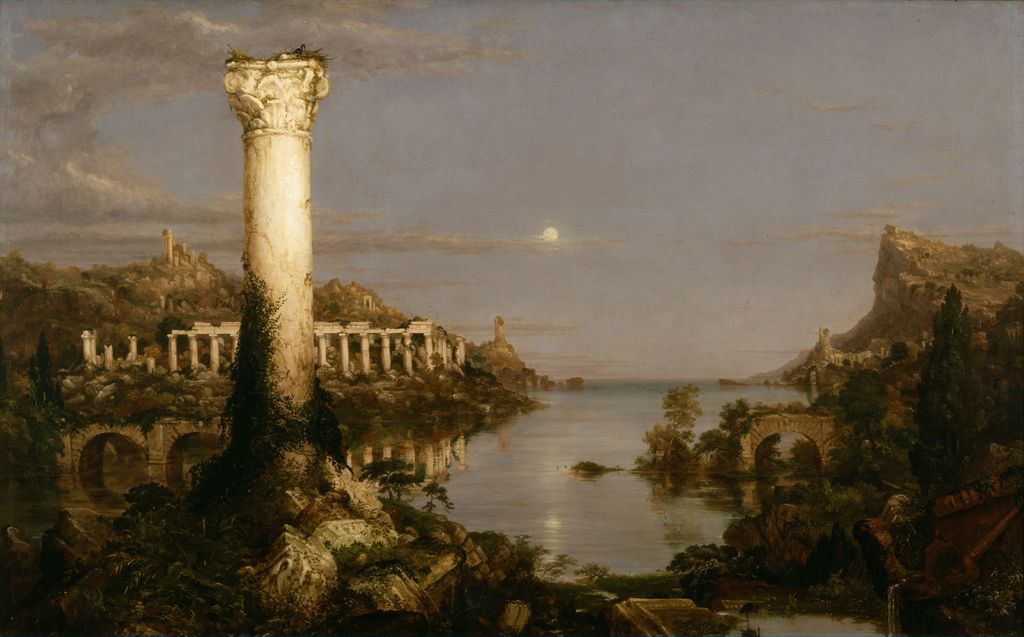
Desolation changes the emotional register completely. There is no new assault and no surviving crowd to bear witness. Broken columns, fragments of a bridge and ruined buildings occupy quiet water and growing vegetation. The sunset and rising moon give the place a rhythm that exceeds the vanished city's ceremonies. The stillness is especially powerful after the density of the previous two canvases: Cole lets the eye rest where it once had to search and struggle. [10]
The absence of people is not the absence of life. Herons nest on the column, a lizard climbs stone, and deer approach water near the ruined temple. The museum highlights these small inhabitants as signs that nature is reclaiming the scene. The deer provide a particularly direct connection with the hunters of The Savage State. What began with human pursuit ends with animals moving through a world in which the pursuers are gone. [10]
Nor is the ending a simple restoration of the first picture. Stonework remains, and the landscape carries traces of the civilisation that altered it. Time has not run backwards. The final canvas permits renewal alongside irreversible loss, leaving a place that has become neither wilderness without history nor a functioning city. The impressive column supplies a perch instead of supporting human magnificence. Its changed use condenses the larger movement from possession to relinquishment.
Barringer relates the picture to the ruins of Rome and to John Constable's Hadleigh Castle, which impressed Cole during his first European journey. He distinguishes Constable's more anguished response to loss from Cole's quieter reckoning with an empire that brought ruin upon itself. Cole's more freely handled vegetation and atmosphere also loosen the exactitude of Consummation. Style participates in the conclusion: the meticulous world of public display yields to a softer landscape that needs no imperial audience. [3]
Poetry, politics and competing meanings
The literary frame was available to the first viewers. Cole used lines from Byron's Childe Harold's Pilgrimage in advertisements for the series, presenting wealth and corruption as parts of a recurring historical pattern. Gibbon's history of Rome supplied another context. The title recalled George Berkeley's verse about empire moving westward, but Cole's sequence gave the phrase a darker outcome than a straightforward celebration of America's future. His journal records choosing the title on 28 July 1835 after rejecting several alternatives. [3] [4]
The borrowing leaves an instructive tension. A phrase associated with westward possibility becomes the heading for a civilisation's extinction. Cole lets the promise of advancement unfold until its own achievements expose the dangers. Poetry and painting operate through a similar reversal: the language of progress acquires another meaning when readers or viewers reach the ending. The title is therefore part of the experience of the sequence, rather than a neutral description attached after its completion. [3]
Modern interpretations have emphasised different parts of that warning. The owning museum presents a broadly cyclical history and identifies the pastoral stage as a desirable balance between humanity and nature. It also notes that some scholars interpret the red-cloaked conqueror as a metaphor for President Andrew Jackson. This is a political reading of the invented ruler, not a secure identification of a depicted portrait. No evidence requires viewers to treat every figure as a coded contemporary individual. [7]
Barringer's 2018 argument gives the series a wider Atlantic scope. Rome supplies the past, London the living imperial metropolis and New York a commercial society confronting its own ambitions. He places Cole's anxiety within conservative republican fears of tyranny, speculation and mass politics, while also stressing ecological damage and colonial assumptions. This reading explains why the paintings could address the United States without representing an exclusively American history. The imagery could speak to more than one centre of power. [3]
Cole's criticism of destructive development was also more discriminating than a blanket hostility to modern life. In his journal on 1 August 1836 he lamented the damage caused by railway construction near Catskill, but argued that works needed for commerce could preserve scenery and sometimes improve access to it. The distinction was between necessary activity and careless devastation. Set beside the productive pastoral community, that passage helps resist an interpretation in which every human alteration of nature must inevitably be wrong. [4]
The paintings make a forceful moral narrative, but they cannot establish a universal law of history. Their societies, transitions and catastrophes are carefully selected constructions. The most productive reading attends to those choices: why prosperity takes the form of conquest, why art serves the ruler, why the pastoral alternative cannot last, and why the final absence of humanity can appear beautiful. Cole's certainty about the narrative's conclusion does not oblige the viewer to surrender judgement about its premises.
Cole's accompanying descriptive catalogue gave the early audience another means of following his argument. His journal notes that he wrote it for the 1836 exhibition. The descriptions distinguish the gathering of people for mutual aid in the earliest stage from their later organisation around imperial triumph; they also identify the weakened society and invading enemy of Destruction. The words therefore supplied narrative causes and social identities that paint alone could leave uncertain. [4] [3]
Those descriptions remain valuable, but their relation to the pictures is not simply that of answers to a puzzle. A viewer can recognise the imperial ceremony as a culmination of achievement and still find its beauty seductive. Likewise, the ending can communicate extinction while the light, water and animals make it feel restorative. Cole's explanation clarifies the intended sequence of events; the pictures preserve emotional responses that cannot be exhausted by naming those events. Reading and looking together brings the work's moral confidence into contact with its visual ambivalence.
Exhibition, ownership and the work's continuing challenge
When the completed cycle was exhibited in rented rooms at the National Academy of Design from October to December 1836, it drew considerable public and press attention. Cole's journal entry of 29 October records relief that the paintings pleased viewers more than he had feared. The 2018 catalogue reports Theodore Allen's enthusiastic assessment of both the financial return and the fame generated by the exhibition. These testimonies establish a strong early reception, while remaining the voices of people close to the work. [2] [4]
James Fenimore Cooper admired the series for elevating landscape to the heroic level of historical composition. His response helps explain its artistic significance: the land itself could sustain an ambitious moral and historical argument, without becoming merely the background to a famous event. The cycle was also accessible through changing moods and recognisable human activities. Its invention required no specialist knowledge of a single ancient campaign, although familiarity with classical history and poetry enriched the experience. [2]
The five paintings stayed together. After Reed's death his collection passed into the enterprise that became the New-York Gallery of the Fine Arts, opened in 1844 through the efforts of associates including Jonathan Sturges. When that organisation ended in 1858, its collection was given to the New-York Historical Society. The owning records trace the Empire canvases through Reed, his widow and the Gallery. Their shared accession history preserves a work whose meaning depends on relationships between images. [1] [2]
Viewing the series together remains crucial. Consummation alone can appear a fantasy of magnificent architecture; Desolation alone can seem a tranquil ruin landscape. The sequence changes both. It makes the crowded city temporary and the quiet ending historically charged. A useful way to look is to return to the second painting after reaching the fifth, asking which kinds of work and pleasure Cole allowed there before power absorbed them. That return keeps the series open to thought, even as its fictional empire closes.
Artworks directory
Explore paintings, drawings and studies across Cole’s career. The two Voyage of Life sets appear separately. Dates and study identifications draw on the exhibition and collection catalogues, supplemented by the National Gallery’s drawing records. [11] [12] [13] [14]
| Name | Date | Medium |
|---|---|---|
| The Oxbow | 1836 | Painting |
| The Titan’s Goblet | 1833 | Painting |
| The Architect’s Dream | 1840 | Painting |
| The Course of Empire: The Savage State | ca. 1834 | Painting |
| The Course of Empire: The Arcadian or Pastoral State | ca. 1834 | Painting |
| The Course of Empire: The Consummation of Empire | 1835–1836 | Painting |
| The Course of Empire: Destruction | 1836 | Painting |
| The Course of Empire: Desolation | 1836 | Painting |
| The Voyage of Life: Childhood | 1842 | Painting |
| The Voyage of Life: Youth | 1842 | Painting |
| The Voyage of Life: Manhood | 1842 | Painting |
| The Voyage of Life: Old Age | 1842 | Painting |
| Home in the Woods | 1847 | Painting |
| Distant View of Niagara Falls | 1830 | Painting |
| View on the Catskill—Early Autumn | 1836–37 | Painting |
| Lake with Dead Trees (Catskill) | 1825 | Painting |
| River in the Catskills | 1843 | Painting |
| A View of the Mountain Pass Called the Notch of the White Mountains (Crawford Notch) | 1839 | Painting |
| Expulsion from the Garden of Eden | 1828 | Painting |
| The Subsiding of the Waters of the Deluge | 1829 | Painting |
| The Mountain Ford | 1846 | Painting |
| American Lake Scene | 1844 | Painting |
| A View near Tivoli (Morning) | 1832 | Painting |
| Aqueduct near Rome | 1832 | Painting |
| The Hunter’s Return | 1845 | Painting |
| The Voyage of Life: Childhood (first version) | 1840 | Painting |
| The Voyage of Life: Youth (first version) | 1840 | Painting |
| The Voyage of Life: Manhood (first version) | 1840 | Painting |
| The Voyage of Life: Old Age (first version) | 1840 | Painting |
| Panorama of the Oxbow on the Connecticut River as seen from Mount Holyoke | ca. 1832 (museum); 1833 (2018 catalogue) | Drawing |
| Sketch for The Oxbow | 1836 | Painting |
| From Nature | 1823 | Drawing |
| View of the Round-Top in the Catskill Mountains (Sunny Morning on the Hudson) | 1827 | Painting |
| Scene from The Last of the Mohicans: Cora Kneeling at the Feet of Tamenund | 1827 | Painting |
| View of Monte Video, the Seat of Daniel Wadsworth | 1828 | Painting |
| The Garden of Eden | 1828 | Painting |
| Tomb of General Brock, Queenston Heights, Ontario | 1830 | Painting |
| Effect for Newstead Abbey, Nottinghamshire, England | 1830 | Drawing |
| The Ilissos, from the Parthenon West Pediment | 1829 or 1830 | Drawing |
| Life Study for the Prostrate Shepherd in The Angel Appearing to the Shepherds | 1831–1832 | Painting |
| Interior of the Colosseum, Rome | ca. 1832 | Painting |
| Campagna di Roma (Study for Aqueduct near Rome) | 1832 | Painting |
| Landscape with a Round Temple | ca. 1830s | Painting |
| Stormy Landscape | 1832 | Painting |
| View of Florence from San Miniato | 1837 | Painting |
| Mount Holyoke, Massachusetts (after Basil Hall) | ca. 1829–1831 | Drawing |
| Layout for The Course of Empire | 1833 | Drawing |
| Study for The Course of Empire: The Savage State | ca. 1834 | Painting |
| Study for The Course of Empire: The Arcadian or Pastoral State | ca. 1834 | Painting |
| Study for The Course of Empire: Desolation | 1836 | Painting |
| Study for Dream of Arcadia | 1838 | Painting |
| Clouds | ca. 1830s | Painting |
| Study for The Hunter’s Return | 1845 | Painting |
| Study for Home in the Woods | ca. 1847 | Painting |
| Sunrise in the Catskills | 1826 | Painting |
| Study for The Mountain Ford | 1846 | Drawing |
| Tree Trunks | 1825–1840 | Drawing |
Frequently Asked Questions
In narrative order they are The Savage State, The Arcadian or Pastoral State, The Consummation of Empire, Destruction and Desolation. All are oils on canvas in New York Historical's collection. [1]
It depicts an invented civilisation. Rome supplied historical and architectural sources, but Cole combined them with other influences. Tim Barringer also relates the cycle to Britain and the United States, including modern London and New York. [3]
Its distinctive boulder helps identify the same fictional setting through changing viewpoints. The recurring mountain allows viewers to measure human alterations against a more enduring landscape. [3]
No. Reed died on 7 June 1836, after Consummation was finished but before the last two canvases were painted. His family supported completion, and the whole sequence was exhibited later that year. [2]
Some scholars interpret him as a metaphor for Jackson's exercise of power. The museum identifies that as a theory. The figure belongs to an invented imperial ceremony and is not established as a literal portrait of the president. [7]
No. Human society has disappeared from the scene, but birds, a lizard, deer and vegetation inhabit the ruins. Their presence is essential to the ending's account of nature reclaiming the imperial landscape. [10]
Discussion
Look again at The Course of Empire and compare your reading with the questions below.
Reader Insights
Which repeated detail—the mountain, deer, bridge, sculpture or artist's signature—most changes your understanding when you follow it across the five paintings?
Does the beauty of The Consummation of Empire strengthen Cole's warning by making prosperity tempting, or leave you less convinced by the catastrophe that follows?
Which detail or comparison would you add to this account, and what evidence supports your reading?
Join the Conversation
Share the details that shaped your response, or suggest a comparison for other readers.
References
- New-York Historical Society, collection records for The Course of Empire, ca. 1834–1836: The Savage State, accession 1858.1; The Arcadian or Pastoral State, 1858.2; The Consummation of Empire, 1858.3; Destruction, 1858.4; Desolation, 1858.5. Metadata, interpretation, signatures and provenance; accessed 6 October 2026.
- Tim Barringer, catalogue entry 52, pp. 204–205, and Shannon Vittoria, chronology, pp. 255–256, in Elizabeth Mankin Kornhauser and Tim Barringer, Thomas Cole's Journey: Atlantic Crossings, Metropolitan Museum of Art, 2018. PDF pp. 208–209 and 259–260.
- Tim Barringer, “Thomas Cole's Atlantic Crossings”, pp. 49–59, and catalogue entries 53–60, pp. 206–217, in Thomas Cole's Journey: Atlantic Crossings, 2018. PDF pp. 53–63 and 210–221.
- Thomas Cole, Journals, transcription, Thomas Cole National Historic Site, 2022 file. Entries 28 July 1835, 22 May 1836, 13 June 1836, 1 August 1836 and 29 October 1836; PDF pp. 18 and 23–24.
- New-York Historical Society, The Course of Empire: The Savage State, ca. 1834, accession 1858.1. Collection interpretation and description; accessed 6 October 2026.
- New-York Historical Society, The Course of Empire: The Arcadian or Pastoral State, ca. 1834, accession 1858.2. Collection interpretation; accessed 6 October 2026.
- New-York Historical Society, The Course of Empire: The Consummation of Empire, 1835–1836, accession 1858.3. Collection metadata and interpretation; accessed 6 October 2026.
- Dorothy Mahon, “Thomas Cole's The Oxbow and The Consummation of Empire: A Technical Comparison”, subsection “The Consummation of Empire: Painting Technique and Materials”, pp. 111–113, in Thomas Cole's Journey: Atlantic Crossings, 2018. PDF pp. 115–117.
- New-York Historical Society, The Course of Empire: Destruction, 1836, accession 1858.4. Collection interpretation and description; accessed 6 October 2026.
- New-York Historical Society, The Course of Empire: Desolation, 1836, accession 1858.5. Collection interpretation; accessed 6 October 2026.
- Elizabeth Mankin Kornhauser and Tim Barringer, Thomas Cole’s Journey: Atlantic Crossings (2018). Career context and artwork/study metadata: catalogue entries 10–66 and chronology, PDF pp. 137–231 and 249–262; related Barringer essay passages, PDF pp. 23–66.
- Franklin Kelly et al., American Paintings of the Nineteenth Century, Part I (National Gallery of Art, 1996). Cole catalogue and both Voyage of Life sets, PDF pp. 91–124.
- National Gallery of Art, Study for The Mountain Ford (1846), accession 2015.19.772. Collection record and open-access image.
- National Gallery of Art, Tree Trunks (1825–1840), accession 2015.19.607. Collection metadata and open-access image.
- Splash image source.
Thomas Cole, The Course of Empire: The Consummation of Empire, 1835–1836. Oil on canvas, 130.2 × 193 cm. New York Historical, gift of the New-York Gallery of the Fine Arts, 1858 (1858.3).