by Tom Gurney
Tom Gurney BSc (Hons) is an art history expert with over 20 years experience
Email: tomgurney1@gmail.com / Phone: +44 7429 011000
Thomas Cole: Style and Technique: Introduction
Thomas Cole makes landscape carry a story. A broken tree can give a peaceful view an unsettling edge; a river can draw the eye into distance or lead a traveller through the stages of life. Buildings may occupy a small place in an expansive valley, or multiply until they almost displace the natural world. His pictures depend on these relationships between parts. Their drama comes from the arrangement of things we recognise: trees, rocks, water, weather and human activity.
That arrangement grew out of sustained observation. Cole gathered drawings, written notes and, increasingly after his first European journey, oil sketches. In the studio he could combine this material into a view of a particular place or an entirely imagined landscape. Christopher Riopelle’s study of his oil sketches explains how empirical information about colour and light served paintings with historical, moral and spiritual ambitions. Studying nature and inventing a composition were connected activities. [1]
Understanding his technique means following those connections without assuming that every painting was made in the same way. A field drawing, a small preparatory oil and a large exhibition canvas each had a different task. Scientific examination can sometimes reconstruct the order in which Cole worked, while a visible storm or warm sunset tells us about the finished picture’s effect. These kinds of evidence answer different questions. Together they reveal a painter whose control included both rapid handling and painstaking construction.
At a Glance
- Central approachClose observation shaped into expressive compositions.
- Field practiceGraphite and pen-and-ink drawings, written annotations and outdoor oil sketches. [1]
- Studio practiceSelection, combination, transfer and revision of gathered material.
- Recurring visual devicesStrong foreground forms, deep prospects, changing weather, small figures and architecture that registers human time.
- Technical examplesThe Oxbow and The Consummation of Empire have different preparations and working sequences; the 1842 Voyage of Life provides another distinct case.
Contents
- Introduction
- Observation and imagination
- Gathering a landscape in the field
- The studio as a place of transformation
- Composing depth and directing attention
- European paintings as practical lessons
- Figures and architecture
- Colour, weather and the experience of light
- Two canvases, two preparations
- Making paint, making space
Observation and imagination
Cole’s account of art helps explain why accuracy did not require him to copy everything before his eyes. In the undated manuscript known as Lecture on Art, composed around 1845, he distinguishes artistic imitation from mere facsimile. The artist selects what is characteristic, beautiful or sublime, separating essential qualities from accidents. His compact phrase “the true student of Art must be a student of Nature” makes looking a requirement of invention. The surviving text is a draft and revision, published in modern transcription; its delivery as a lecture has not been established. [2]
This argument allows a landscape to be recognisable while changing its weather, season or arrangement. Cole was seeking relationships that would express something beyond the isolated appearance of objects. A fallen tree might be recorded with considerable specificity and subsequently placed where its shape strengthened a composition. A distant mountain might anchor an imagined history without ceasing to look geologically substantial. The natural object supplies both a form and a range of associations.
The distinction also makes his smaller works worth looking at in their own right. A quick study can concentrate attention on a passing effect that would be difficult to isolate in a highly finished canvas. Conversely, a large painting can bring together information gathered at different moments. Riopelle distinguishes outdoor studies of individual motifs from preparatory studies made for particular compositions. Both belong to Cole’s practice, and resemblance in their lively brushwork does not establish that both were painted outdoors. [1]
The viewer therefore encounters two kinds of coherence. Particular details persuade us that the artist knew how trees, clouds or ruined walls appeared. The arrangement makes those details act together. Cole’s most ambitious landscapes invite close inspection without allowing the accumulation of particulars to become their only purpose. A small branch may repay attention, but it participates in a larger movement of light, space and feeling.
Gathering a landscape in the field
Cole’s early pen-and-ink tree studies isolated twisting trunks against largely empty paper. Such drawings made distinctive forms available for later consultation. Riopelle notes the relationship between this habit and the use of a gnarled trunk in View of Monte Video several years later. Cole also carried American sketchbooks to Europe, where they enabled him to continue painting subjects from home. Physical distance from the landscape did not prevent him from returning to carefully gathered information about it. [1]
A panorama required another kind of record. The Detroit Institute of Arts holds his Panorama of the Oxbow on the Connecticut River as seen from Mount Holyoke, made in graphite on off-white wove paper and inscribed with notations. Detroit dates it approximately 1832. The sheet preserves an observational drawing rather than a reduced copy of the finished oil painting. [3] [1]
Oil sketching added information that a monochrome outline could not supply as directly. Riopelle places Cole’s adoption of outdoor landscape oil sketches in Florence in mid-1831. John Cranch recorded sketching excursions with him, including the preparation of colours between outings. Pencil and ink remained part of the routine: taking up oil did not erase the older methods. Each medium could preserve a different aspect of a scene, from an architectural contour to an unstable relationship between light and cloud. [1]
These records were useful because they were selective. An artist watching storm clouds move could not give equal attention to every leaf and every building. A drawing might clarify structure while a painted study concentrated on tone. The eventual picture could draw on more than one record, and Cole’s field work offered a store of observations rather than a compulsory recipe. The continuity between sketching and painting lies in the knowledge gathered, even where the finished composition departs from the field view.
The studio as a place of transformation
The studio provided the conditions for turning gathered material into larger pictures. A small oil study could test colour relationships; a pencil design could establish the composition; a tracing could preserve a full-size arrangement for reuse. The visible freedom of a sketch and the careful finish of a canvas need not indicate incompatible artistic values. They reflect different stages and purposes, as Riopelle’s comparison of Cole’s Roman Campagna studies and finished landscape demonstrates. [1]
There was also a human setting for this work. Maureen Hart Hennessey’s research on Cedar Grove describes the use of a room in the house as a painting room before Cole moved into the building now called the Old Studio in late 1839. It also documents Maria Cole reading to her husband while he worked, including a diary entry of March 1843. The evidence brings the studio close to domestic life and shared reading. It does not identify a particular novel as the hidden source of a painting merely because it was read nearby. [4]
In the Campagna material, transformation is especially clear. Cole’s quick study of an aqueduct and medieval tower has thick, energetic paint and a dominant brown tone. Riopelle observes that the related finished composition is wider, smoother in its handling and more sharply organised by sunlight. The study’s approaching weather became a calmer, more deliberate arrangement in the larger picture. The architectural motif survived, while the relationship between earth and sky changed. [1]
The studio could thus extend an encounter without simply repeating it. A fleeting view became something that could be revised, compared and developed. This process helps explain how apparently opposing qualities coexist in Cole: a responsiveness to particular natural effects and an appetite for elaborate invention. His drawings and paintings disclose different parts of that process, and neither gives a complete account by itself.
Composing depth and directing attention
One of Cole’s strongest compositional devices is the transition from a close, substantial foreground to a far-reaching view. Nearby trees and rocks establish scale and a position for the spectator. Beyond them, diminishing forms and changing tones carry the eye towards the horizon. In The Oxbow, the river’s curve supplies a legible shape across the distant valley, while the foreground ledges keep the height of the viewpoint physically present.
This depth also creates a movement between kinds of attention. The rough foreground asks us to inspect texture and contour. The valley offers an overall pattern that can be understood at a glance. Moving between them, the viewer shifts from proximity to survey. Cole can make this movement emotionally charged by placing storm-darkened woods beside sunlit farmland. The opposition is visible before we choose an interpretation of what the different forms of land use mean.
The relation between observation and composition is unusually well documented in Crawford Notch. Franklin Kelly’s National Gallery catalogue compares Cole’s July 1839 drawing with the finished painting. Cole steepened the topography, compressed the rock walls, reorganised foreground stumps into more purposeful forms and moved a barn. He introduced a clearer road, riders and a stagecoach. The autumn colouring could not have been recorded during the July visit. These are identifiable compositional choices, rather than evidence that the artist failed to recognise the site. [5]
The road makes a particularly revealing change. A route into the picture gives human movement a place within imposing terrain. It links the near ground with the inn and the pass, helping the spectator read a difficult landscape as a sequence of spaces. At the same time, small travellers and structures provide a scale against which the mountain’s mass becomes evident. Changes to the view strengthen both its navigability and its sense of natural power.
European paintings as practical lessons
Cole’s European encounters enlarged his resources without giving him a single formula to imitate. Riopelle describes an artist who preferred to gather impressions and ideas rather than systematically copy paintings in galleries. He studied details as well as overall arrangements: a particular green, the effect of sunlight on water, or the way an architectural form held light. Such observations could contribute to later paintings without making the finished result a replica of the work that prompted them. [1]
The chronology compiled by Shannon Vittoria records Cole’s visit to Turner in December 1829, when he saw Dido Building Carthage, The Decline of the Carthaginian Empire and Snow Storm: Hannibal and His Army Crossing the Alps. He also studied Claude’s drawings at the British Museum. These encounters offered different approaches to expansive landscape: classical organisation and luminous distance in one tradition, more violent weather and historical drama in another. [6]
Cole met Constable in England and knew his work, but this connection needs precision. Riopelle relates Cole’s cloud studies to Constable’s example while finding no evidence that Cole learned outdoor oil sketching under his direct instruction. Cole took up that practice in Italy. The suggestion that the painter George Augustus Wallis encouraged him is a reasoned possibility in Riopelle’s essay, not an established account of a formal lesson. [1]
European influence is most useful when understood as an expanded capacity to make decisions. Cole could compare observed scenery with remembered paintings, adopt a method for recording light, or use a classical arrangement to give an American prospect greater reach. These possibilities did not predetermine a painting’s meaning. A balanced composition could hold anxiety, and a storm could be part of a landscape’s continuing life as well as an image of danger.
Figures and architecture
Cole’s people are often small, but they give the landscape a human scale and a direction of thought. A rider approaching water introduces hesitation; a traveller in a boat turns a river into a journey. Scale affects our response: figures may seem vulnerable to the place around them, or crowd together until their activity dominates the scene. Their size alone does not tell us how important they are to the painting’s meaning.
Nor should small figures be explained simply by calling Cole self-taught. Vittoria’s chronology records his admission to the Florentine academy in 1831 and permission to study the live nude model that December. He pursued figure drawing during his European training. The surviving record complicates any account in which he learned only by walking through woods. His landscape skills and his ambition to paint figures developed at different rates, and he was conscious of the demands of both. [6]
His journal makes that consciousness painfully clear. On 22 May 1836, after completing The Consummation of Empire, he criticised its crowded design, perspective and profusion of small objects. He also described the difficulty of painting its figures without models at hand and thought Rome would have been a better place to undertake the work. The remarks belong to this particular architectural composition. They are neither a confession that he never studied figures nor an explanation of every small person in his landscapes. [7]
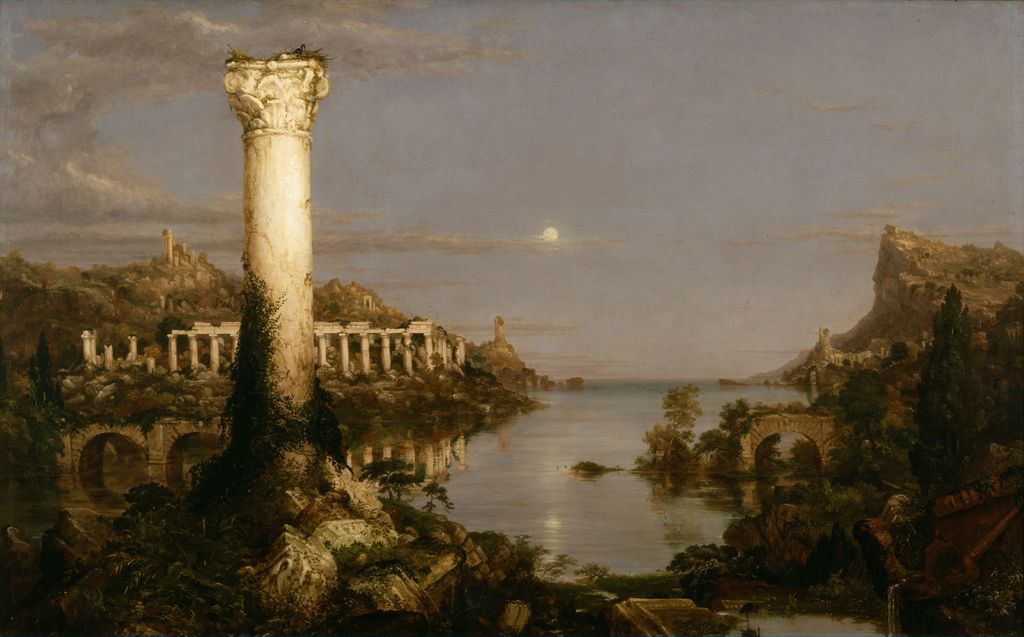
Architecture could structure a view as decisively as a mountain. In Consummation, terraces, colonnades and the bridge distribute people across the city and guide the procession through it. Technical examination shows how much labour went into making those relationships precise. In other pictures a ruined wall may be a modest interruption in vegetation. Cole’s buildings can therefore register organised human power, its vulnerability, or the survival of material traces after their original purpose has passed.
Colour, weather and the experience of light
Colour gives Cole’s landscapes their emotional temperature, but it also makes their spaces intelligible. A warm accent can locate a tiny person against a broad setting. A change from dark foreground tones to pale distance opens the view. In Riopelle’s account of the Campagna study, a shepherd’s red vest animates an otherwise largely brown arrangement. In the small Oxbow study, Mahon identifies a strong crimson stroke as the abbreviated indication of the artist’s sash. [1] [8]
Weather works at a larger scale. Cole can contrast darkness and clearing within one canvas, or use successive canvases to move between conditions. The effect depends on placement as well as brightness: a light opening beyond an obstructing foreground invites the eye forward, while a dark mass above a small traveller can make an open landscape feel enclosing. These are visible relationships. Identifying them does not by itself establish the artist’s religious or political intention.
His preparatory materials give some evidence of how those relationships were developed. Mahon finds that the Oxbow oil study and finished canvas share closely related colour arrangements, explained by their linked execution. Kelly’s account of Crawford Notch, by contrast, shows a substantial imaginative development of sky and season beyond the field drawing. Colour might elaborate an existing record or decisively change the atmosphere of a scene. [8] [5]
The surface beneath the colour could also matter. A coloured preparation may contribute to the tones we see where paint is thin. Yet the effect of a warm landscape is not proof that a particular pigment lies underneath it. That claim requires examination of the object. Cole’s broad use of light becomes more interesting when visible effect and documented material are considered together, with each kept within the limits of its evidence.
Watch: Thomas Cole
Choose a film to explore the artist’s work, its interpretation and its wider setting.
Thomas Cole: Painting the American Landscape (remastered audio)
An introduction to Cole’s landscapes and artistic ambitions.
Watch on YouTubeTwo canvases, two preparations
Dorothy Mahon’s technical comparison of The Oxbow and The Consummation of Empire provides unusually specific evidence. Her investigation combined infrared reflectography, X-radiography, X-ray fluorescence, microscopic examination and analysis of samples in cross-section. The findings concern two named works made around the same period. Their differences demonstrate why a single universal account of Cole’s materials would be misleading. [8]
Both paintings use fine, plain-weave linen, but the supports are not identical. The Oxbow has a thin white ground containing lead white and calcite, followed by a muted pinkish-orange priming of lead white, vermilion and chrome yellow. Consummation has a considerably thicker white ground and an intense vermilion priming. A ground is the prepared layer between support and visible painting; the coloured priming influences the surface on which the design develops. [8]
Mahon connects these differences with the pictures’ demands. The landscape’s thin preparation and generally thin paint retain the canvas weave, whose texture can help articulate clouds, water and vegetation. In places its ground serves as a middle tone. The architectural canvas’s thicker preparation fills the weave and offers a smoother surface for exact buildings and minute figures. Mahon relates its strong orange priming to the effect of high noon. [8]
This account makes material preparation part of composition. Precision or atmospheric softness depends partly on decisions made before a recognisable subject appears. It also preserves a distinction between findings and reconstruction. Mahon regards Cole’s own stretching and priming of the Oxbow support as probable, supported by its physical evidence and correspondence about materials. Probability here is informative; it should not be converted into certainty that he personally prepared every canvas throughout his career. [8]
What lies beneath The Oxbow
Infrared examination revealed architectural pencil designs beneath The Oxbow that resemble elements in Consummation. Their scale, perspective and arrangement do not match the completed city. Mahon interprets them as experiments made on the prepared landscape support while Cole was developing the architectural picture. The discovery concerns preliminary drawing. It does not show that the river landscape covered a completed painting from The Course of Empire. [8]
The small preparatory oil also contains a drawing beneath its seemingly spontaneous surface. Cole loosely established the bend of the river, foreground rocks, distant hills and contrasting weather. A ruled horizontal line relates that design to a corresponding line on the large canvas. Mahon uses their close correspondence to reconstruct a sequence in which the small design was available for transfer before its paint was applied. Preparation was more coordinated than the sketch’s brisk surface alone would suggest. [8]
Changes remained possible. The umbrella is open in the small oil and in the large painting’s underdrawing, but closed in the finished canvas. This is a modest example of a decision made during execution. Cole then painted the large landscape rapidly, mainly with thin applications of wet paint worked into wet paint. Mahon reports few final touches over dried impasto, including leaves and deeper tones. Marks where the frame pressed into still-soft paint give physical evidence of the exhibition deadline’s pressure. [8]
The sequence distinguishes planning from slowness. A carefully established design could permit fast painting; an energetic surface could rest on substantial preparation. This combination helps explain the work’s confidence. It also guards against reading brushwork as a diary of emotion. Swirling strokes record the movement of a tool through paint. Their emotional effect in the finished storm is a further question, involving their scale, placement and relationship to the surrounding landscape.
Drawing within the painting of a city
Consummation followed a more elaborate sequence. Cole established its architecture with precise ruled lines and pinpricks used to organise perspective. He used a compass to score certain circular details into wet paint and a stylus to sharpen Ionic scrolls. These tools account for the painting’s geometry in a particularly concrete way. They are findings for this canvas, not a catalogue of implements used to make every Cole landscape. [8]
Once architectural paint had dried, he developed many groups of figures by drawing on its surface. The imperial procession, terrace groups and decorative features contain searching pencil work. Mahon identifies the statue of Minerva as the feature showing evidence characteristic of tracing from a study. Some other figures and details were painted directly. The complexity arose through several operations, rather than one complete underdrawing followed mechanically by colour. [8]
Revisions changed the balance between city and landscape. Cole replaced painted vegetation in the upper right with large Ionic columns and an entablature. Elsewhere he enlarged a building over a green hillside. He reduced the number of caryatids and drew a soldier over a painted lion. Such findings show an active negotiation of space, decoration and human presence. They also distinguish an actual paint alteration from an abandoned idea that never reached paint. [8]
There is a suggestive relationship between these operations and the finished city’s profusion. Architecture expanded as the work developed, physically covering some natural terrain. That sequence is secure; the precise symbolic motive for each change is not. Cole’s later dissatisfaction with overcrowding adds another perspective. The picture was both an ambitious account of human magnificence and a difficult practical problem whose richness the artist himself questioned. [8] [7]
Repetition, variation and the limits of evidence
The second Voyage of Life offers a different technical case. Cole made full-size tracings from his first set in November 1840, assisted by his nephew Henry Bayless, and took this material to Europe. Kelly’s catalogue connects surviving red-chalk traces on the reverse of drawings with a possible transfer method. The limited underdrawing in the 1842 National Gallery canvases supports transfer rather than a wholesale redesign directly on each canvas, but does not establish every step with certainty. [9]
These four paintings were executed on herringbone twill fabric. Their white grounds have local secondary grounds of different colours, and paint varies from relatively thin passages to thicker details in foliage and figures. They therefore add another set of specific choices to the plain-weave supports examined by Mahon. The catalogue’s reports of lining, varnish removal and restoration in 1970–71 describe historical treatment; they do not supply a current condition report. [9]
Even the earlier preparatory designs involved choices about how the series would be seen. Kelly distinguishes the boat’s initially consistent direction from the reversals in Youth and Old Age in the first finished set. These adjustments belong to the development from small studies to the 1840 paintings, rather than being changes first introduced in the Rome replicas. The position of a traveller within successive landscapes was a compositional problem as well as an allegorical device. [9]
Repetition did not eliminate revision. In Manhood, Cole changed the traveller from standing to kneeling on one leg and gave him a fuller beard. Kelly also notes the brighter colour of the second set while leaving its cause unresolved: it might have been intentional or related to different available pigments. A visible difference between versions does not establish a chemical explanation. Nor do the 1842 findings automatically describe the first set completed in 1840. [9]
Across these examples, Cole’s practice emerges as flexible and purposeful. Observation supplied details; study and transfer helped organise them; prepared surfaces supported different kinds of handling; revision could continue during painting. The strongest conclusions remain attached to named objects and documented passages. That precision does not diminish his imagination. It shows how an imaginative landscape became a physical painting through choices that can sometimes still be traced.
Making paint, making space
The Storehouse Studio made large-scale painting possible through practical arrangements as well as privacy. Cole moved there in 1839 and used the space for seven years. The Historic Site describes a high ceiling suitable for The Voyage of Life, a fireplace for work across the seasons and a large window admitting northern light. There was room to grind pigments, make stretchers, stretch canvas and fit pictures into frames. The studio joined painting to the preparation of its physical supports; artistic invention depended on work that could be strenuous and messy. [10]
Chemical research adds another connection between art and manufacture. Mahon, Centeno and Smieska detected cobalt blue, chrome yellow, zinc white and Prussian blue in the two canvases examined for the 2018 exhibition. They explain that Cole combined chrome yellow and Prussian blue to obtain a bright green. He may have mixed the dry pigments himself or purchased an industrial mixture sold as chrome green; the analysis does not settle which. His materials could therefore benefit from industrial chemistry even while his landscapes questioned destructive development. The precise place where he bought those pigments remains uncertain. [11]
The studio’s preparation of paint also helps explain why finished colour alone is insufficient evidence for a recipe. Different mixtures may yield related appearances, and paint layers affect one another. Scientific identification supplies information that looking cannot securely recover. It strengthens a reading of Cole’s technique by connecting visible effects with identified materials while preserving the uncertainties of purchase and preparation.
Artworks directory
Explore paintings, drawings and studies across Cole’s career. The two Voyage of Life sets appear separately. Dates and study identifications draw on the exhibition and collection catalogues, supplemented by the National Gallery’s drawing records. [12] [13] [14] [15]
| Name | Date | Medium |
|---|---|---|
| The Oxbow | 1836 | Painting |
| The Titan’s Goblet | 1833 | Painting |
| The Architect’s Dream | 1840 | Painting |
| The Course of Empire: The Savage State | ca. 1834 | Painting |
| The Course of Empire: The Arcadian or Pastoral State | ca. 1834 | Painting |
| The Course of Empire: The Consummation of Empire | 1835–1836 | Painting |
| The Course of Empire: Destruction | 1836 | Painting |
| The Course of Empire: Desolation | 1836 | Painting |
| The Voyage of Life: Childhood | 1842 | Painting |
| The Voyage of Life: Youth | 1842 | Painting |
| The Voyage of Life: Manhood | 1842 | Painting |
| The Voyage of Life: Old Age | 1842 | Painting |
| Home in the Woods | 1847 | Painting |
| Distant View of Niagara Falls | 1830 | Painting |
| View on the Catskill—Early Autumn | 1836–37 | Painting |
| Lake with Dead Trees (Catskill) | 1825 | Painting |
| River in the Catskills | 1843 | Painting |
| A View of the Mountain Pass Called the Notch of the White Mountains (Crawford Notch) | 1839 | Painting |
| Expulsion from the Garden of Eden | 1828 | Painting |
| The Subsiding of the Waters of the Deluge | 1829 | Painting |
| The Mountain Ford | 1846 | Painting |
| American Lake Scene | 1844 | Painting |
| A View near Tivoli (Morning) | 1832 | Painting |
| Aqueduct near Rome | 1832 | Painting |
| The Hunter’s Return | 1845 | Painting |
| The Voyage of Life: Childhood (first version) | 1840 | Painting |
| The Voyage of Life: Youth (first version) | 1840 | Painting |
| The Voyage of Life: Manhood (first version) | 1840 | Painting |
| The Voyage of Life: Old Age (first version) | 1840 | Painting |
| Panorama of the Oxbow on the Connecticut River as seen from Mount Holyoke | ca. 1832 (museum); 1833 (2018 catalogue) | Drawing |
| Sketch for The Oxbow | 1836 | Painting |
| From Nature | 1823 | Drawing |
| View of the Round-Top in the Catskill Mountains (Sunny Morning on the Hudson) | 1827 | Painting |
| Scene from The Last of the Mohicans: Cora Kneeling at the Feet of Tamenund | 1827 | Painting |
| View of Monte Video, the Seat of Daniel Wadsworth | 1828 | Painting |
| The Garden of Eden | 1828 | Painting |
| Tomb of General Brock, Queenston Heights, Ontario | 1830 | Painting |
| Effect for Newstead Abbey, Nottinghamshire, England | 1830 | Drawing |
| The Ilissos, from the Parthenon West Pediment | 1829 or 1830 | Drawing |
| Life Study for the Prostrate Shepherd in The Angel Appearing to the Shepherds | 1831–1832 | Painting |
| Interior of the Colosseum, Rome | ca. 1832 | Painting |
| Campagna di Roma (Study for Aqueduct near Rome) | 1832 | Painting |
| Landscape with a Round Temple | ca. 1830s | Painting |
| Stormy Landscape | 1832 | Painting |
| View of Florence from San Miniato | 1837 | Painting |
| Mount Holyoke, Massachusetts (after Basil Hall) | ca. 1829–1831 | Drawing |
| Layout for The Course of Empire | 1833 | Drawing |
| Study for The Course of Empire: The Savage State | ca. 1834 | Painting |
| Study for The Course of Empire: The Arcadian or Pastoral State | ca. 1834 | Painting |
| Study for The Course of Empire: Desolation | 1836 | Painting |
| Study for Dream of Arcadia | 1838 | Painting |
| Clouds | ca. 1830s | Painting |
| Study for The Hunter’s Return | 1845 | Painting |
| Study for Home in the Woods | ca. 1847 | Painting |
| Sunrise in the Catskills | 1826 | Painting |
| Study for The Mountain Ford | 1846 | Drawing |
| Tree Trunks | 1825–1840 | Drawing |
Frequently Asked Questions
He made drawings and oil sketches outdoors. Riopelle dates his adoption of outdoor landscape oil sketching to Florence in 1831. A finished landscape might then be developed in the studio from this material; The Oxbow’s small preparatory oil should not be assumed to have been painted at the site. [1] [8]
Many drew on detailed observation, but he selected and rearranged it. Crawford Notch closely relates to a field drawing while changing topography, foreground details, weather and season. Other compositions are invented rather than portraits of a single place. [5]
The examined works show differences. The Oxbow has a thin preparation with a muted pinkish-orange priming; Consummation has a thicker ground and vermilion priming. The 1842 Voyage of Life uses white grounds with local coloured secondary grounds. These findings cannot be extended to every painting. [8] [9]
Architectural pencil experiments lie underneath it, related to Consummation. They are preliminary designs, not a completed Empire painting covered by the landscape. The finished Consummation occupies a separate support. [8]
Discussion
Look again at Thomas Cole: Style and Technique and compare your reading with the questions below.
Reader Insights
How does your response to a landscape change when you compare its field drawing with the finished painting? Which alteration makes the greatest difference?
In The Oxbow and Consummation, how do texture, precision and the amount of detail affect the relationship between natural space and human activity?
Which detail or comparison would you add to this account, and what evidence supports your reading?
Join the Conversation
Share the details that shaped your response, or suggest a comparison for other readers.
References
- Christopher Riopelle, “Thomas Cole and the Landscape Oil Sketch”, in Elizabeth Mankin Kornhauser and Tim Barringer, Thomas Cole’s Journey: Atlantic Crossings, 2018, pp. 96–105 (PDF pp. 100–109).
- Thomas Cole, Lecture on Art, manuscript composed c.1845, Thomas Cole National Historic Site transcription by Peter Fedoryk, second printing 2021, publisher’s note and pp. 9–10 (PDF pp. 3, 9–10).
- Detroit Institute of Arts, Panorama of the Oxbow on the Connecticut River as seen from Mount Holyoke, collection record, ca.1832, graphite on off-white wove paper, accession 39.566.66, accessed 6 October 2026.
- Maureen Hart Hennessey, Life at Cedar Grove, unpublished research draft, 2011, pp. 59–61 (PDF pp. 59–61), especially the painting room and Maria Cole’s reading.
- Franklin Kelly, Crawford Notch entry, in American Paintings of the Nineteenth Century, Part I, National Gallery of Art, 1996, pp. 89–92 (PDF pp. 105–108).
- Shannon Vittoria, “Chronology”, in Kornhauser and Barringer, Thomas Cole’s Journey: Atlantic Crossings, 2018, pp. 250–253 (PDF pp. 254–257), European visits and Florentine study.
- Thomas Cole, Journal, modern transcription published by the Thomas Cole National Historic Site, 2022, entry 22 May 1836, PDF p. 23.
- Dorothy Mahon, “Thomas Cole’s The Oxbow and The Consummation of Empire: A Technical Comparison”, in Kornhauser and Barringer, Thomas Cole’s Journey: Atlantic Crossings, 2018, pp. 106–115 (PDF pp. 110–119).
- Franklin Kelly, The Voyage of Life entry and technical notes, in American Paintings of the Nineteenth Century, Part I, National Gallery of Art, 1996, pp. 96, 98–100 (PDF pp. 112, 114–116).
- Thomas Cole National Historic Site, “Storehouse Studio”, accessed 6 October 2026. Source.
- Dorothy Mahon, Silvia A. Centeno and Louisa Smieska, “Modern Pigments Found in Thomas Cole’s Paintings Shed New Light on the Artist’s Practice”, Metropolitan Museum of Art, 27 March 2018. Source.
- Elizabeth Mankin Kornhauser and Tim Barringer, Thomas Cole’s Journey: Atlantic Crossings (2018). Career context and artwork/study metadata: catalogue entries 10–66 and chronology, PDF pp. 137–231 and 249–262; related Barringer essay passages, PDF pp. 23–66.
- Franklin Kelly et al., American Paintings of the Nineteenth Century, Part I (National Gallery of Art, 1996). Cole catalogue and both Voyage of Life sets, PDF pp. 91–124.
- National Gallery of Art, Study for The Mountain Ford (1846), accession 2015.19.772. Collection record and open-access image.
- National Gallery of Art, Tree Trunks (1825–1840), accession 2015.19.607. Collection metadata and open-access image.
- Splash image source.
Thomas Cole, View from Mount Holyoke, Northampton, Massachusetts, after a Thunderstorm—The Oxbow, 1836. Oil on canvas, 130.8 × 193 cm. The Metropolitan Museum of Art, New York, Gift of Mrs. Russell Sage, 1908 (08.228).