 by Tom Gurney
Tom Gurney BSc (Hons) is an art history expert with over 20 years experience
Published on June 19, 2020 / Updated on September 6, 2026
Email: tomgurney1@gmail.com / Phone: +44 7429 011000
Hieronymus Bosch Reception and Influence: Introduction
Hieronymus Bosch's reputation was built almost as soon as his paintings began to move through elite collections, but it is safest to describe that reputation through evidence rather than legend. Bosch did not leave a large body of personal writings. What survives instead is a chain of testimony, collecting, copying, printmaking, attribution debate and museum research that shows how viewers have tried to understand his images for more than five hundred years.
That chain matters because Bosch is often treated as if his influence were simply a mood: monsters, Hell, dreams, hybrid creatures and strange symbols. The source-led story is sharper. Early witnesses noticed the extraordinary character of works associated with him; Spanish collectors preserved and debated major paintings; print publishers turned Boschian invention into a wider visual language; later Netherlandish artists, especially Pieter Bruegel the Elder, used that language in new ways; and modern institutions have rebuilt Bosch reception around technical evidence, corpus study and attribution caution [1] [2].
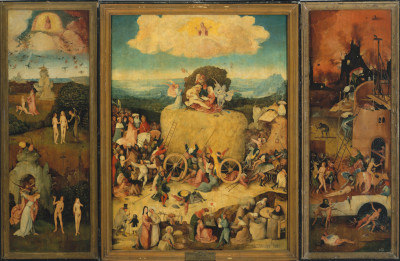
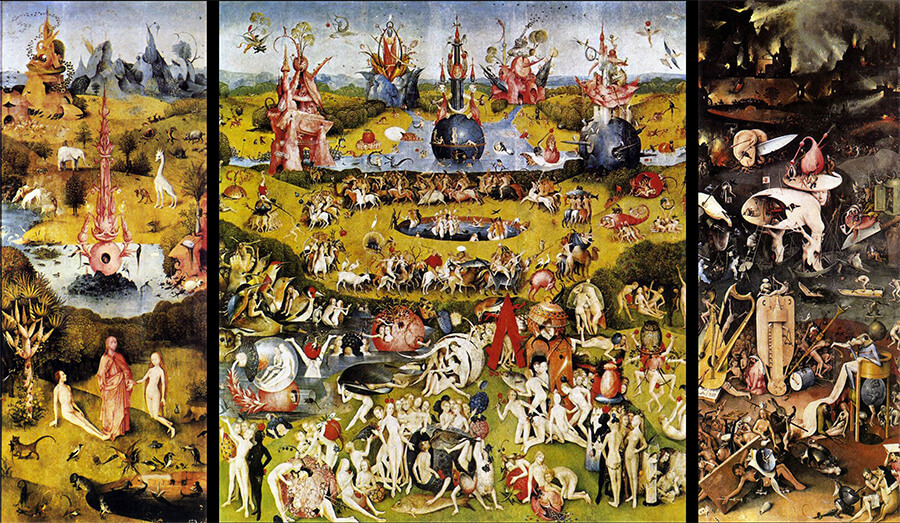
For the core of Bosch's art, begin with the main Hieronymus Bosch overview, the document-led biography, the paintings hub and the major triptychs such as The Garden of Earthly Delights and The Haywain Triptych. This page follows what happened to Bosch's image after it entered documents, collections, copies and later visual culture.
Contents
- Early Witnesses and Written Reception
- Spanish Collecting and the Prado Afterlife
- Copies, Followers and the Boschian Name
- Prints and the Antwerp Market
- Bruegel and Boschian Visual Culture
- Modern Museum and Research Reception
Early Witnesses and Written Reception
The earliest reception of Bosch is not a neat set of quotations by the artist. BoschDoc, the documentary database connected with the Bosch Research and Conservation Project, gathers written material about Bosch, his family, patrons, surroundings and works, especially documents and early printed texts before 1800 [1]. That kind of evidence is valuable precisely because it keeps Bosch grounded in historical records rather than later myth.
One of the most important early witnesses is Antonio de Beatis, who travelled in the Low Countries with Cardinal Luigi of Aragon. In 1517 he recorded seeing a remarkable painted work in the Nassau palace in Brussels. Prado scholarship connects this account with the early history of the Garden, making it one of the key pieces of evidence for the triptych's early reception in an elite courtly setting [3]. De Beatis does not explain Bosch's meaning for us. He shows that a spectacular Boschian work was already being noticed, described and valued soon after the artist's lifetime.
Karel van Mander gave Bosch a different afterlife in print. Writing in the Schilder-Boeck in 1604, Van Mander framed Bosch as a painter of strange ideas and gruesome pictures; the National Gallery's Bosch artist entry preserves this early reception route [4]. Van Mander's importance is not that he reveals Bosch's private intention. He shows how, less than a century after Bosch's death, Bosch was already understood as an artist whose imagination exceeded ordinary description.
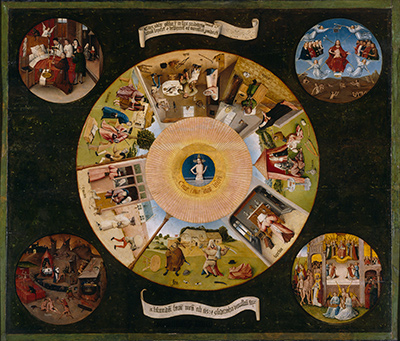
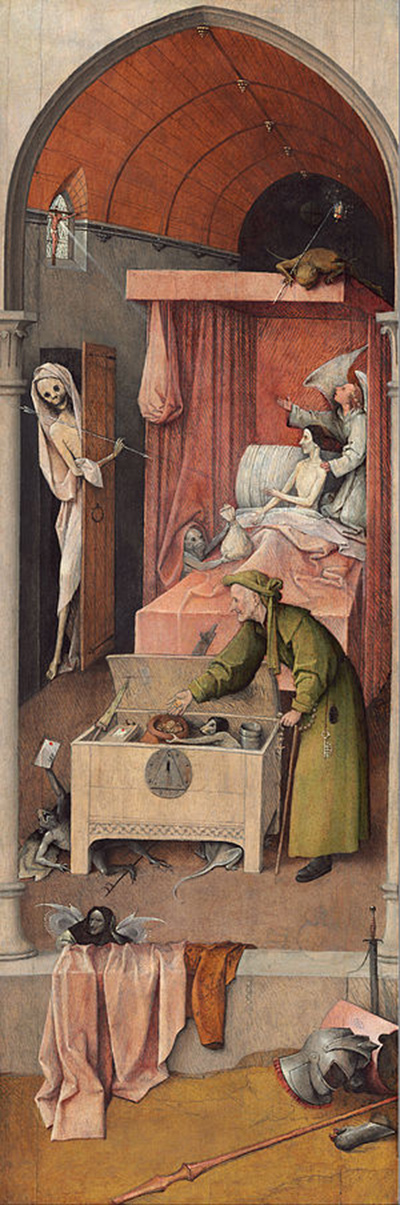
Felipe de Guevara adds a Spanish voice to that early reception. His comments are especially important around the Table of the Seven Deadly Sins and the Four Last Things, a work the Prado attributes to Bosch while acknowledging modern scholarly disagreement [5] [6]. Guevara helps show that Bosch's name was already being discussed through questions of authenticity, copying and collecting, not only through admiration.
For more on this documentary and quoted evidence, see Bosch quotes and reception.
Spanish Collecting and the Prado Afterlife
Bosch's Spanish reception is central because so many major works associated with him entered Habsburg and royal Spanish contexts. The Prado's Bosch holdings are not a neutral accident of survival. They record a powerful history of collecting, preservation, royal taste and later museum interpretation.
The Prado connects the Garden with the Nassau palace at Coudenberg and with early aristocratic ownership before the painting's later Spanish history [3]. The Haywain Triptych has its own complex history: the Prado dates it to 1512-1515 and notes that the version once associated with Felipe de Guevara and Philip II is complicated by technical evidence identifying that version as a copy, while the Prado version is documented in the 1636 Alcazar inventory [7]. That distinction is a perfect example of Bosch reception: one must separate fame, ownership tradition, copy history and the physical object now in the museum.
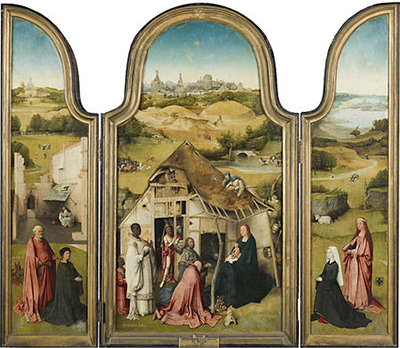
Other Prado works deepen the same story. The Adoration of the Magi was sent by Philip II to El Escorial in 1574 and moved to the Prado in the nineteenth century [8]. The Seven Deadly Sins was also valued in Spanish royal and religious settings, yet its authorship remains debated, making it a key case for the workshop and attribution problem [5] [6].
The Prado's 2016 Bosch centenary exhibition gave this Spanish afterlife a modern public form. It placed major works, technical study and attribution questions before a wide audience, while showing that Bosch's fame depends as much on research discipline as on visual astonishment [9]. The modern Prado Bosch is therefore both an old collecting story and a contemporary research story.
Copies, Followers and the Boschian Name
Bosch's influence cannot be measured only by works securely painted by Bosch. It also appears in the unstable territory of workshop practice, followers, copies and "after Bosch" images. Modern research has made that territory more precise. The Bosch Research and Conservation Project and Closer to Bosch distinguish works by Bosch from workshop material, followers and uncertain cases through object study, high-resolution imaging and technical research [2].
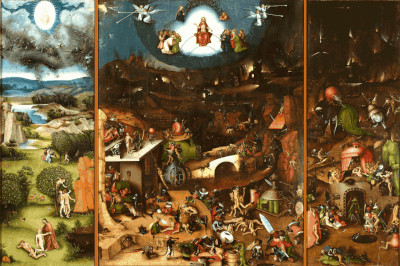
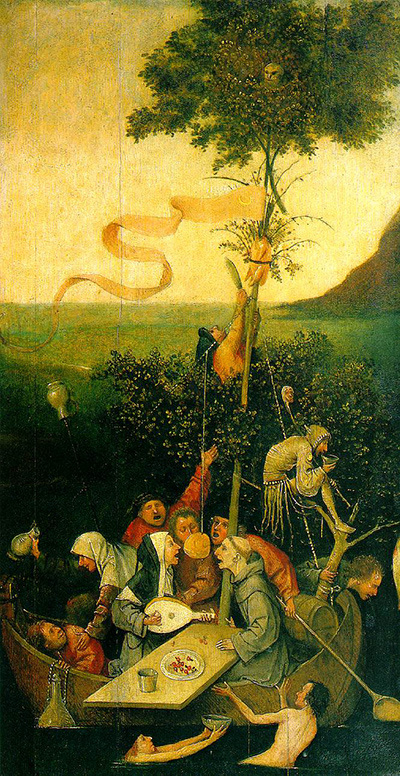
That caution is essential because Bosch's name attracted many later images. Some preserve a composition related to Bosch; some imitate his demons, fools and moral disorder; some are later works that acquired his name because they looked Boschian. A painting such as Concert in the Egg, for example, belongs much more securely to the follower or after-Bosch field than to Bosch's hand. It is useful for reception, but dangerous as evidence of Bosch's own authorship.
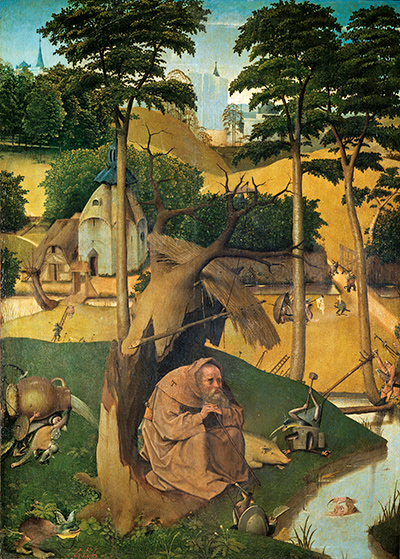
The same is true in a more productive way for copies after major subjects. The Saint Anthony tradition includes the Lisbon triptych, Prado-related panels, copies and prints, all of which show how Boschian temptation imagery circulated across media [10] [11] [12]. These works do not merely dilute Bosch. They reveal which parts of Bosch's visual world later artists and patrons found repeatable: hermits under assault, moral disorder, comic horror, monstrous bodies and landscapes crowded with tests of perception.
Prints and the Antwerp Market
Prints after Bosch were one of the main engines of his visual afterlife. Bosch is not known as an autograph printmaker, so the important phrase is usually "after Bosch" or "Bosch as inventor", not "print by Bosch". That distinction shapes the dedicated prints page, and it also shapes the influence story here.
The Met and the National Gallery of Art both preserve records for The Temptation of St. Anthony prints associated with Jan and Lucas van Doetecum and the Antwerp publisher Hieronymus Cock. These sheets present Bosch as the source of invention while making clear that the physical print belongs to a later sixteenth-century print world [12] [13]. Such records show Bosch's imagery entering a commercial network: repeatable, portable and available to viewers who would never see the original paintings.
The British Museum records several after-Bosch prints that make the transmission even more complex. Shrove Tuesday or the Fool's Kitchen, published by Cock in 1567, is recorded as after Bosch and probably based on a now lost Bosch composition [14]. St Martin and his Horse in a Ship is likewise tied to after-Bosch printmaking, lost or related paintings and later collecting traditions [15]. Sorghelos Leven shows how Bosch's name could be added, debated or reframed across states and attributions [16].
These prints are not secondary footnotes to the paintings. They are evidence of how Bosch became recognisable as a style.
Bruegel and Boschian Visual Culture
Pieter Bruegel the Elder is the most important sixteenth-century artist to discuss in relation to Boschian visual culture. The connection should be handled carefully: Bruegel was not simply repeating Bosch. He learned from Bosch's visual language and used it within his own print and painting worlds.
The Met's record for Bruegel's Sloth (Desidia), from the Seven Deadly Sins series, identifies the print as engraved by Pieter van der Heyden after Bruegel and published by Hieronymus Cock in 1558. The record notes that Bruegel deliberately adopted a Bosch-like manner in this sins series, especially through fantastic creatures and hybrid structures [17]. That is a strong, sourceable influence claim because it is tied to a specific work, series, publisher and visual mode.
Bruegel shows how Bosch's afterlife became a vocabulary. The crowded moral landscape, the comic-grotesque figure, the hybrid creature and the theatre of vice could be used by later artists without becoming simple copying. This is why Bosch belongs beside symbolism, but also why Bosch symbolism must stay source-led. Later viewers learned to recognise Boschian signs; that does not mean every bird, fruit, instrument or monster has one fixed meaning.
Modern Museum and Research Reception
Modern Bosch reception has moved from wonder toward evidence. Wonder is still part of the experience, but the strongest museums and research projects now ask what can be known about materials, underdrawing, revisions, provenance, copies and authorship.
The BRCP and Closer to Bosch have been decisive in this shift. Their work places Bosch's paintings, drawings, workshop and followers inside a technical and art-historical corpus, using imaging and object study to challenge inherited assumptions [2]. Prado research has similarly made the Garden, Haywain, Adoration of the Magi, Seven Deadly Sins and attribution controversies central to modern Bosch interpretation [3] [5] [6] [7] [8] [9].
This is also the best way to handle modern influence. Claims that Bosch directly anticipates later fantasy or Surrealism need careful sourcing, because broad analogy can easily become lazy. The safer claim is that modern viewers, artists and museums have repeatedly returned to Bosch as an image-maker of extraordinary imaginative power, while responsible scholarship keeps the line between influence, analogy and reception visible.
Bosch's influence, then, is not a single inheritance. It is a layered afterlife: early testimony, Spanish collecting, workshop and copy traditions, Antwerp prints, Bruegel's Boschian mode, museum exhibitions and modern technical research. The images still astonish, but their afterlife is best understood through the records that show how each generation made Bosch legible again.
Discussion
Which detail in Reception and Influence most changes how you read Bosch: the moral setting, the strange objects, the devotional context, the attribution evidence, or the way the image asks you to look?
Reader Insights
Start with one precise detail, then ask what it does in the wider scene rather than treating it as a fixed symbol.
Set the image beside Bosch's devotional culture, Netherlandish workshop practice and the current museum record before settling on an interpretation.
Where does the evidence feel strongest, and where does Bosch leave the viewer with useful uncertainty?
Join the Conversation
Have a thought or close-looking observation about Reception and Influence? Share it below. Thoughtful responses may be added to this section as the Bosch pages develop.
References
- BoschDoc database, Huygens ING / KNAW: https://boschdoc.huygens.knaw.nl/
- Closer to Bosch, Bosch Research and Conservation Project: https://closertobosch.org/
- Museo Nacional del Prado, The Garden of Earthly Delights Triptych: https://www.museodelprado.es/en/the-collection/art-work/triptych-garden-earthly-delights/02388242-6d6a-4e9e-a992-e1311eab3609
- The National Gallery, London, Hieronymus Bosch artist page: https://www.nationalgallery.org.uk/artists/hieronymus-bosch
- Museo Nacional del Prado, Table of the Seven Deadly Sins: https://www.museodelprado.es/en/the-collection/art-work/table-of-the-seven-deadly-sins/3fc0a84e-d77d-4217-b960-8a34b8873b70
- Museo Nacional del Prado, "Controversies Regarding Hieronymus Bosch": https://www.museodelprado.es/en/resource/controversies-regarding-hieronymus-bosch/0c390775-54e6-4801-a0f8-cb777d46288c
- Museo Nacional del Prado, The Haywain Triptych: https://www.museodelprado.es/en/the-collection/art-work/the-haywain-triptych/7673843a-d2b6-497a-ac80-16242b36c3ce
- Museo Nacional del Prado, Triptych of the Adoration of the Magi: https://www.museodelprado.es/en/the-collection/art-work/the-adoration-of-the-magi-triptych/666788cc-c522-421b-83f0-5ad84b9377f7
- Museo Nacional del Prado, Bosch. The 5th Centenary Exhibition: https://www.museodelprado.es/en/whats-on/exhibition/bosch-the-centenary-exhibition/f049c260-888a-4ff1-8911-b320f587324a
- Museu Nacional de Arte Antiga, Temptations of Saint Anthony: https://www.museudearteantiga.pt/collections/european-painting/temptations-of-st-anthony
- Museo Nacional del Prado, The Temptations of Saint Anthony: https://www.museodelprado.es/en/the-collection/art-work/the-temptations-of-saint-anthony/c1fb9065-66bd-4a6e-abd8-3b6a75431313
- Metropolitan Museum of Art, The Temptation of St. Anthony, after Hieronymus Bosch, Jan and Lucas van Doetecum: https://www.metmuseum.org/art/collection/search/383046
- National Gallery of Art, Washington, The Temptation of Saint Anthony: https://www.nga.gov/artworks/47586-temptation-saint-anthony
- British Museum, Shrove Tuesday or the Fool's Kitchen: https://www.britishmuseum.org/collection/object/P_1928-1212-11
- British Museum, St Martin and his Horse in a Ship: https://www.britishmuseum.org/collection/object/P_F-1-18
- British Museum, Sorghelos Leven: https://www.britishmuseum.org/collection/object/P_1862-0208-64
- Metropolitan Museum of Art, Sloth (Desidia), from The Seven Deadly Sins: https://www.metmuseum.org/art/collection/search/338700