 by Tom Gurney
Tom Gurney BSc (Hons) is an art history expert with over 20 years experience
Published on June 19, 2020 / Updated on September 6, 2026
Email: tomgurney1@gmail.com / Phone: +44 7429 011000
Hieronymus Bosch Symbolism and Iconography: Introduction
Hieronymus Bosch is tempting to read as if every owl, fruit, funnel, knife, fish, musical instrument and monster had a fixed translation. That temptation is understandable. His paintings look as though they are packed with clues. A bird-headed demon swallows the damned. A giant pair of ears advances with a blade between them. Lovers carry fruit, riders circle a pool, monks appear beside burning buildings, fools crowd into boats, and a lone traveller moves along a road that seems to ask what kind of life he has chosen.
Yet Bosch is most rewarding when he is not treated as a codebook. His symbolism belongs to a late medieval and early Renaissance world of Christian teaching, sermons, devotional images, moral satire, proverbs, popular theatre, manuscript illumination, workshop practice and courtly collecting. Some motifs have strong contextual support. Others remain open, and responsible interpretation should leave them open. The aim is not to flatten Bosch into a dictionary, but to learn how his images make moral, comic and devotional pressure visible.
This guide sits beside the main Hieronymus Bosch overview, the documentary biography, the paintings hub, the individual studies of The Garden of Earthly Delights, The Haywain Triptych, The Last Judgement and The Temptation of Saint Anthony, and the related guides to Bosch's Hell imagery, style and technique and workshop and attribution.
Contents
- Why Bosch Symbols Resist Simple Decoding
- Start With the Triptych
- Sin, Folly and Moral Satire
- Hell: Punishment as Inversion
- Temptation and the Isolated Saint
- Animals, Birds and Hybrids
- Fruit, Bodies and False Delight
- Musical Instruments, Tools and Everyday Objects
- Pilgrims, Pedlars and the Way Through Life
- Devotional Culture and the Viewer
Why Bosch Symbols Resist Simple Decoding
Bosch's pictures often feel mysterious because they combine recognisable moral themes with invented visual forms. The themes are not obscure: sin, folly, temptation, death, damnation, false pleasure, religious hypocrisy, avarice, lust, gluttony and the danger of choosing the wrong path. The forms are the unsettling part. Bosch translates moral ideas into hybrid bodies, impossible buildings, enlarged animals, cracked fountains, burning cities, strange machines and comic cruelties.
The National Gallery in London describes Bosch's mature work as an "original and often macabre language of visual symbolism", sometimes connected to verbal metaphors from the Bible. [1] That phrase is useful because it treats Bosch's symbols as language, but not as a mechanical alphabet. A metaphor can be literalised, exaggerated, inverted or made grotesque. A proverb can be visualised without losing its ambiguity. A monster can be a punishment, a joke, a temptation, a parody of appetite and a brilliant act of invention at the same time.
Modern Bosch research has made caution more important, not less. The Bosch Research and Conservation Project studied paintings, drawings, workshop material and followers through close looking, technical imaging and comparative research. Its work reminds us that a "Boschian" motif is not always by Bosch himself, and that copied or workshop imagery may preserve Bosch's inventions while changing their meaning. [2] The companion Closer to Bosch platform and current museum records are therefore essential for separating what is visible, what is technically supported and what remains interpretation. [3]
That caution should not make Bosch dry. It should make him more interesting. A symbol that refuses one answer can still guide the eye, sharpen a moral question, or show how late medieval viewers were invited to recognise danger in pleasure, comedy in sin and terror in ordinary things.
Start With the Triptych
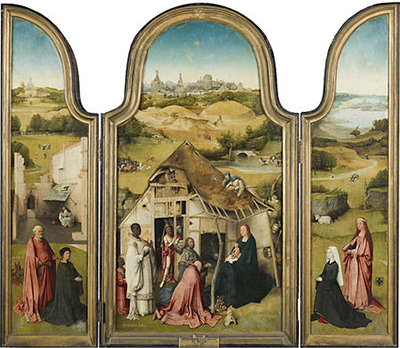
Many of Bosch's most important works are triptychs: three-panel paintings whose wings could close over the centre. This matters because a triptych is not simply a wide image. It is a structured object. Closed wings, outer grisaille scenes, inner colour, left-to-right movement, central emphasis and side-panel contrast all shape the meaning.
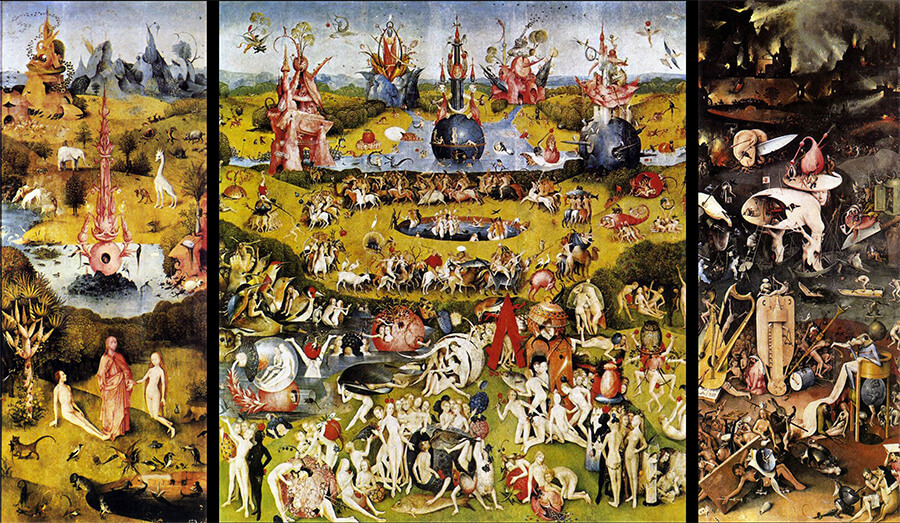
In The Garden of Earthly Delights, the Prado identifies the closed exterior as the Third Day of Creation, painted in grisaille, with God the Father and Latin inscriptions drawn from the Psalms. When opened, the triptych moves through Eden, a central scene of deceptive pleasure, and Hell. The Prado's account stresses sin as the connecting thread, while also noting the complexity of the centre panel and the scholarly debates around its precise interpretation. [4]
That structure changes how individual motifs should be read. Fruit in the central Garden panel is not just fruit. It appears inside a larger sequence from creation to false delight to punishment. Enlarged animals, pools, shells, berries and glassy forms become part of a world where pleasure looks abundant but unstable. The right wing then reveals the moral consequence of that instability, including punishments that turn delight into torment.
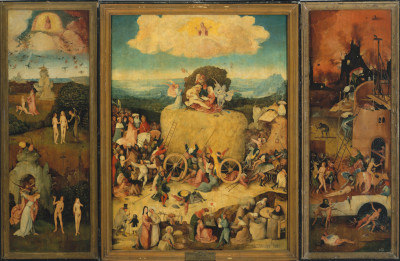
The Haywain Triptych is more explicit in its moral direction. The Prado describes the inside as devoted to sin: the left panel shows its origin, the centre shows humanity following the haywain, and the right panel shows Hell. The hay itself evokes the biblical and proverbial idea of worldly glory as fleeting, supported by the verse from Isaiah that "all flesh is grass". [5] The haywain is therefore not a neutral cart with a symbolic label attached. It is the moving centre of a social satire: rulers, clergy, lovers, beggars and ordinary people all chase a perishable reward while demons pull the procession toward damnation.
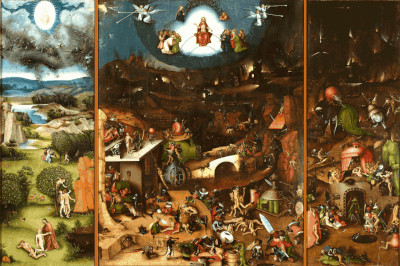
In The Last Judgement, the Academy of Fine Arts Vienna describes a Christian moral programme that runs from the Fall of Man to the Last Judgment and the punishments of the damned. Its outer wings show saints in grisaille, setting models of holy conduct against the inner vision of human failure and punishment. [6] Again, the triptych form controls the symbolism. The viewer moves between concealment and revelation, sober exterior and terrifying interior, saintly example and infernal consequence.
Sin, Folly and Moral Satire
Bosch's symbolism often works through moral satire rather than private dream imagery. Satire lets him make sin ridiculous before it becomes terrifying. Fools, drunkards, quacks, gamblers, corrupt clergy, gluttons and greedy men are not merely condemned; they are exposed as absurd.
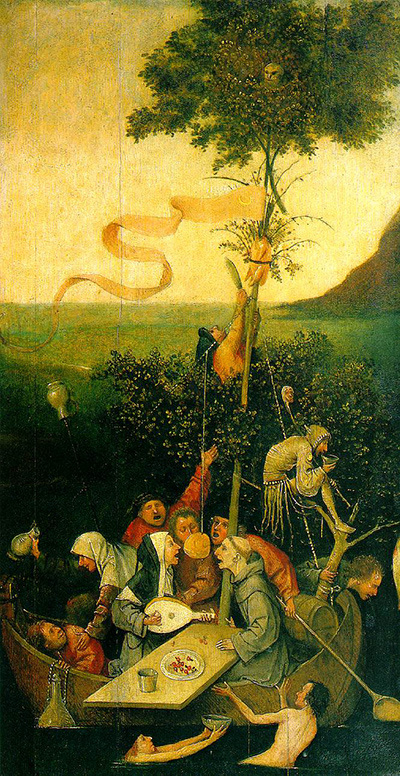
The Ship of Fools tradition is a good example. Bosch's painting belongs to a wider late medieval culture in which folly could be staged as a social condition. A boat full of foolish people is funny because it is unstable and communal: nobody in it is steering wisely, and everyone participates in the disorder. The Louvre connects its Ship of Fools with Sebastian Brant's 1494 book of the same name, while also stressing the painting's later rediscovery and fragmentary triptych context. [7] The symbol is therefore both literary and visual, rooted in a culture that enjoyed exposing folly in public form.
The fool in Bosch is rarely just a harmless comic figure. Foolishness can mean spiritual failure, bad judgment, susceptibility to appetite or the refusal to recognise death. Satire becomes an ethical instrument. It makes the viewer laugh, then asks whether the laughter is safe.
That is also why proverbs matter. Museum Boijmans Van Beuningen, discussing The Pedlar, notes that some details may refer to well-known sayings, while also warning that certainty is impossible. The figure has been read as a traveller through life, a human being weighed down by earthly baggage and moving along a path full of temptations. [8] This is a model for reading Bosch well: proverb culture is real, but not every detail can be pinned to one proverb with confidence.
Hell: Punishment as Inversion
Bosch's Hell imagery is famous because it is spectacular, but its logic is often moral rather than random. Hell turns earthly pleasures into punishments. Music becomes torture. Eating becomes being eaten. Desire becomes exposure. Games become traps. Fire, darkness, frozen water and monstrous bodies transform the habits of life into consequences.
The Prado's interpretation of the right panel of The Garden of Earthly Delights is especially important. It notes the panel's "musical Hell", where instruments are used to punish sinners, and it identifies punishments connected with avarice, gluttony, envy, games and clerical criticism. [4] The point is not simply that Bosch thought lutes and harps were evil. In the world of the painting, instruments that could accompany secular pleasure become devices of pain. The object is inverted.
The same principle runs through the Hell imagery associated with Bosch's larger moral universe. Fire is not just atmosphere. It marks destruction, judgment, spiritual danger and civic terror transformed into theology. Burning cities in the distance create a stage on which private sins have public consequences. Yet caution is needed: unless a reliable source connects a specific Bosch fire to a specific historical event, the flames should not be turned into biography.
Monsters in Hell also work by inversion. A creature may combine bird, human, vessel, weapon and furniture. That hybrid body collapses categories, as if sin has scrambled creation itself. In The Garden, the bird-headed infernal figure who devours and excretes bodies is horrifying because appetite has become judgment. In The Last Judgement, the Academy describes a world of torments, demons and devils under Christ as Judge, with the possibility of heavenly light almost swallowed by darkness. [6]
Bosch's Hell is therefore not a separate fantasy genre. It is the end point of a moral sequence.
Temptation and the Isolated Saint
The symbolism of temptation is different from the symbolism of final punishment. Temptation tests the living person before judgment has been sealed. That is why Saint Anthony became such a powerful subject for Bosch and his circle.
The Lisbon Temptation of Saint Anthony triptych, presented by the Museu Nacional de Arte Antiga through Google Arts & Culture, gathers air, earth, water and fire into a world of monstrous and hybrid assault. The account describes temptation as a central Bosch theme: the just person faces evil in both openly demonic forms and deceptive beauty. [9] That distinction matters. Not every danger in Bosch announces itself as ugly. False beauty, false holiness and false comfort may be just as dangerous as obvious devils.
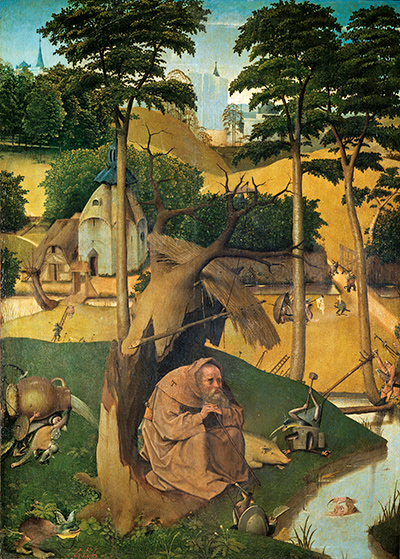
The Prado's workshop panel of The Temptations of Saint Anthony Abbot sharpens this idea. The saint appears in prayer, while the surrounding landscape introduces brothel imagery, Eve's apple, a burning monastery and airborne demonic disturbances. Prado's catalogue-derived text also treats the panel's authorship carefully, connecting it to Bosch's workshop and the problem of copies after lost or masterly designs. [10]
Saint Anthony imagery helps explain Bosch's hybrids. A flying fish, a woman-house, a monkish rider or a vessel-creature can look absurd, but absurdity itself is part of the temptation. The world has become unstable. The saint's task is not to decode every monster; it is to remain spiritually oriented while the visible world tries to confuse him.
Animals, Birds and Hybrids
Animals in Bosch often carry moral pressure, but they should be read by context. An owl, pig, fish, toad, dog, bird or hybrid creature may echo bestiary lore, proverb culture, biblical metaphor, social satire or the immediate action of the painting. The same animal can shift in force from one work to another.
The owl is a useful example. In The Garden of Earthly Delights, the Prado notes owls in the central panel and connects them with evil. [4] That does not mean every owl in every Bosch-related work must be glossed the same way. It means the owl in that context participates in a larger scene of deceptive pleasure, watching and unsettling the viewer.
Pigs, dogs and bird-creatures also depend on setting. In the Garden's Hell, a pig wearing a nun's veil contributes to criticism of corrupt religious life. [4] In Christ Mocked, the National Gallery explains that a spiked collar may connect Christ's attackers with dogs through a late medieval reading of Psalm 21:17. [11] In other contexts, a dog may suggest appetite, loyalty, animality, pursuit or social type. The object does not carry one fixed meaning.
Hybrids are even more flexible. Bosch's hybrid creatures often combine parts of animals, people, objects and architecture. They may embody demonic disorder, but they also parody human vice. A fish that flies, a man transformed into a vessel, a musical instrument used as a rack, or a walking object with ears and a knife all make the created world behave wrongly. That wrongness is funny and frightening at once.
The safest question is not "what does this animal mean?" but "what is this animal doing here?" Is it watching, tempting, punishing, carrying, devouring, disguising, parodying, or obstructing? Bosch's iconography usually begins with action.
Fruit, Bodies and False Delight
Fruit is one of the most dangerous subjects in Bosch interpretation because it invites confident overreading. In The Garden of Earthly Delights, fruit clearly belongs to the central panel's world of sensual pleasure, erotic charge, abundance and fragility. The Prado notes the enlarged plants and fruit, the red and blue colours scattered through the scene, and the centre panel's association with lust and false paradise. [4]
But a strawberry or berry should not be isolated from the triptych. Fruit in the Garden is persuasive because it is shared, carried, entered, bitten, balanced and displayed by human bodies. It is part of a social choreography. Pleasure is not private; it circulates. The figures seem absorbed in play, but the whole scene is enclosed by the triptych's movement toward Hell.
That is why Bosch's bodies matter. The naked figures in the Garden are not painted with the heroic weight of classical nudes. They are pale, busy, numerous and strangely light. They move through shells, pools, fruit skins, animals and glassy structures with little sense of stable individuality. Their bodies become part of the pattern of appetite.
This does not require a single answer to the Garden's central mystery. Some scholars have stressed lust, others courtly love, false paradise, human generation, marriage, alchemy, innocence, or deliberate ambiguity. The evidence supports a strong moral reading, but the painting's force partly depends on Bosch making pleasure look beautiful before he makes it terrible.
Musical Instruments, Tools and Everyday Objects
Bosch repeatedly turns ordinary objects into moral instruments. This is one reason his symbolism feels so immediate. He does not need distant mythological monsters when knives, funnels, stools, ladders, baskets, bells, helmets, skates, tavern furniture and musical instruments can become strange.
In the Garden's Hell, musical instruments punish the damned. [4] The symbolism is not merely anti-music. It is about misplaced delight, bodily indulgence and the reversal of entertainment into pain. A lute becomes a rack, a harp becomes a frame of torture, and written music may become part of a humiliating infernal scene. The cultural object is turned against the user.
Tools often work similarly. In The Cure of Folly, the Prado explains the satirical surgery of extracting the "stone" of madness, with inscriptions, costume details, underdrawing and technical data all contributing to the interpretation. [12] The surgeon's tool does not heal; it exposes fraud, foolishness and social performance. Bosch's objects often ask whether the thing presented as useful is actually corrupt.
Weapons and hunting signs in Christ Mocked show the same sensitivity. The National Gallery notes that an arrow in an attacker's headdress and a spiked collar may carry symbolic force, while the underdrawing shows Bosch adjusting the brutality and ambiguity of the scene. [11] Here objects do not create fantasy; they intensify a devotional image by making cruelty more legible.
Bosch's tools therefore should be read as active agents. They prod, cut, tempt, measure, bind, display, burden or punish. They show the moral status of use.
Pilgrims, Pedlars and the Way Through Life
One of Bosch's most humane symbolic types is the traveller. The figure known as The Pedlar or Wayfarer has been read as homo viator, the human being on the road of life. Museum Boijmans describes him as a vagabond or pedlar with mismatched shoes, a figure burdened by earthly existence and moving along a path full of temptations. [8]
This figure matters because he is not a spectacular sinner in Hell. He is still moving. He has not become a damned body or a comic fool trapped inside a boat. He is a person in between choices. That makes him a key to Bosch's symbolism more broadly. Bosch is not only interested in what sin looks like after judgment; he is interested in the moment when a person can still turn, hesitate, recognise danger or fail to do so.
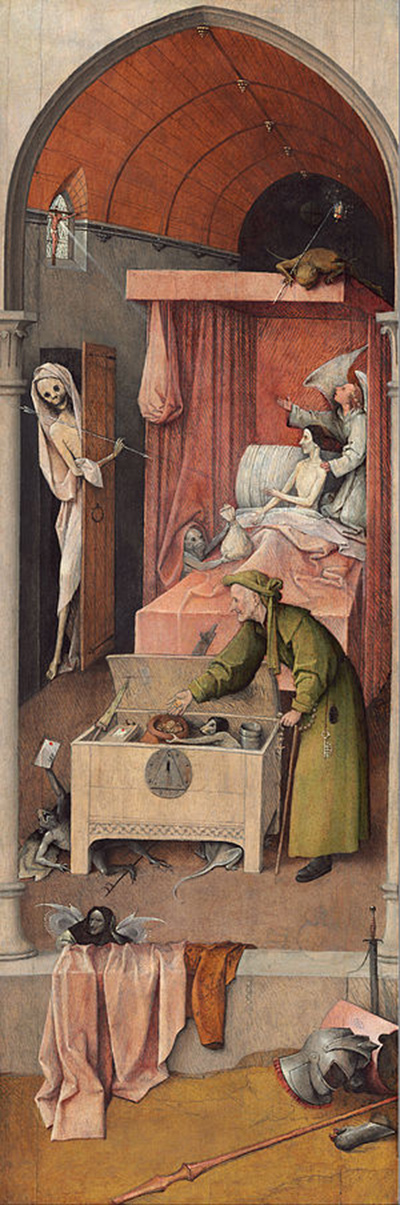
The wayfarer also connects Bosch's symbolism to devotional culture. Late medieval Christianity repeatedly framed earthly life as pilgrimage, testing and preparation for death. Death and the Miser gives the same idea a deathbed form. The National Gallery of Art describes the miser's final choice between demonic gold and the crucifix, with an angel pointing toward salvation and death entering with an arrow. [13] The picture's symbolism is not decorative. It stages the last possible decision.
That is why Bosch's roads, thresholds, doors and bridges are important. They create moral geography. A raised bridge, a narrow path, a bedchamber door, a triptych wing, a Hell gate or a city in flames can turn space into choice.
Devotional Culture and the Viewer
Bosch's symbols were not made only for detached decoding. Many of them were meant to affect the viewer's conscience. Triptychs could belong to devotional settings, private chapels, courtly collections or elite households, but their imagery still works through Christian meditation on sin, judgment, death and salvation.
The Academy in Vienna explicitly describes The Last Judgement Triptych as a three-part winged altarpiece of a type traditionally used in Christian worship, with closed wings and inner panels revealed on Sundays or feast days. [6] Whether Bosch's exact triptych was originally installed in a church or chapel remains uncertain, but the form itself carries devotional memory. It trains the viewer to move from exterior restraint to interior revelation.
The same is true of Passion imagery. In Christ Mocked, Bosch compresses several episodes of Christ's humiliation into a close, claustrophobic image. [11] The surrounding figures can be symbolic, but the central devotional problem is direct: Christ remains calm while human cruelty crowds around him. Here Bosch's strangeness serves meditation rather than spectacle.
Even the comic scenes have a devotional edge. A fool, glutton, miser or false healer is not merely someone else. Bosch's moral satire places the viewer close enough to recognise the joke and then close enough to feel implicated by it.
Ambiguity Is Part of the Meaning
Bosch's ambiguity is not a failure of scholarship. It is part of how the paintings operate. Some details are grounded in biblical texts, saints' lives, moralising literature, proverbs or common visual traditions. Others may come from lost jokes, local sayings, workshop patterns, courtly entertainment, personal invention or combinations we can no longer fully reconstruct.
Boijmans is especially careful on this point in its discussion of Bosch and proverbs: some elements may refer to known sayings, but the museum stresses that Bosch's exact intention cannot be determined with certainty. [14] That caution is not an admission of defeat. It protects the paintings from false neatness.
The same applies to attribution. A symbol in an autograph Bosch painting, a workshop panel, a follower's copy and a later print after Bosch may not carry the same authority. The workshop and attribution question is therefore part of iconography. Before interpreting a motif, it helps to ask what kind of object preserves it: Bosch's hand, workshop practice, a copy after Bosch, or later Boschian reception.
Ambiguity also makes Bosch durable. His paintings have appealed to theologians, collectors, moralists, art historians, psychoanalytic readers, Surrealists and modern viewers because they never reduce completely to a single lesson. But the best modern reading still begins with the historical object: panel, triptych, inscription, subject, patronage, technical evidence, museum record and scholarly debate.
A Responsible Way to Read Bosch
A good method begins with the whole object. Is it a triptych, a fragment, a panel, a drawing, a copy, or a work by a follower? Is it open or closed? What sequence does it create? What does the current museum record say about title, date, authorship and condition?
Then identify the primary moral setting. Is the work about creation, temptation, folly, death, Last Judgment, Hell, Passion devotion, saintly resistance, false pleasure or social satire? Individual motifs make more sense once the larger subject is clear.
Next, follow actions rather than labels. Ask what each creature, object or figure is doing. Is it tempting, punishing, mocking, carrying, consuming, watching, pointing, fleeing or blocking the way? Bosch's symbols are often verbs before they are nouns.
Finally, keep degrees of confidence visible. It is reasonable to say that the haywain represents the perishable rewards of worldly life because the Prado connects it with a biblical and moral tradition. [5] It is reasonable to connect the Garden's musical instruments with infernal punishment because the Prado discusses that panel in those terms. [4] It is less responsible to claim that every shell, berry or bird has one fixed meaning in every Bosch image.
Bosch's symbolism is powerful because it makes moral life strange again. He takes familiar Christian teaching and gives it bodies, tools, weather, roads, taverns, fires and jokes. He makes sin ridiculous before it becomes terrifying. He makes pleasure beautiful before it collapses. He makes the viewer look closely, then asks whether looking is enough.
Discussion
Which detail in Symbolism most changes how you read Bosch: the moral setting, the strange objects, the devotional context, the attribution evidence, or the way the image asks you to look?
Reader Insights
Start with one precise detail, then ask what it does in the wider scene rather than treating it as a fixed symbol.
Set the image beside Bosch's devotional culture, Netherlandish workshop practice and the current museum record before settling on an interpretation.
Where does the evidence feel strongest, and where does Bosch leave the viewer with useful uncertainty?
Join the Conversation
Have a thought or close-looking observation about Symbolism? Share it below. Thoughtful responses may be added to this section as the Bosch pages develop.
References
- The National Gallery, London, "Hieronymus Bosch": https://www.nationalgallery.org.uk/artists/hieronymus-bosch
- Bosch Research and Conservation Project, project information (in Dutch): https://jheronimusbosch.org/index.php?Itemid=113&id=1&lang=nl&option=com_content&view=article
- Closer to Bosch: https://closertobosch.org/
- Museo Nacional del Prado, The Garden of Earthly Delights Triptych: https://www.museodelprado.es/en/the-collection/art-work/the-garden-of-earthly-delights-triptych/02388242-6d6a-4e9e-a992-e1311eab3609
- Museo Nacional del Prado, The Haywain Triptych: https://www.museodelprado.es/en/the-collection/art-work/the-haywain-triptych/7673843a-d2b6-497a-ac80-16242b36c3ce
- Paintings Gallery of the Academy of Fine Arts Vienna, The Last Judgement Triptych by Hieronymus Bosch: https://www.kunstsammlungenakademie.at/en/paintings-gallery/boschs-last-judgement-triptych/
- Louvre, La Nef des fous exhibition note: https://www.louvre.fr/expositions-et-evenements/expositions/figures-du-fou/oeuvres-en-lumiere/la-nef-des-fous
- Museum Boijmans Van Beuningen, The Pedlar: https://www.boijmans.nl/en/collection/artworks/1556/the-pedlar
- Google Arts & Culture / Museu Nacional de Arte Antiga, Lisbon, The Temptations of St. Anthony: https://artsandculture.google.com/asset/the-temptations-of-st-anthony-jheronymus-bosch/sQE5ooCM2Gytuw?hl=en
- Museo Nacional del Prado, The Temptations of Saint Anthony Abbot: https://www.museodelprado.es/en/the-collection/art-work/the-temptations-of-saint-anthony-abbot/96647605-48f3-4250-95c9-729d7d6288ea
- The National Gallery, London, Christ Mocked (The Crowning with Thorns): https://www.nationalgallery.org.uk/paintings/hieronymus-bosch-christ-mocked-the-crowning-with-thorns
- Museo Nacional del Prado, The Extraction of the Stone of Madness: https://www.museodelprado.es/en/the-collection/art-work/the-extraction-of-the-stone-of-madness/313db7a0-f9bf-49ad-a242-67e95b14c5a2
- National Gallery of Art, Washington, Death and the Miser: https://www.nga.gov/artworks/41645-death-and-miser
- Museum Boijmans Van Beuningen, "Jheronimus Bosch - the Devil Maker": https://www.boijmans.nl/en/collection/in-depth/jheronimus-bosch-the-devil-maker