 by Tom Gurney
Tom Gurney BSc (Hons) is an art history expert with over 20 years experience
Published on June 19, 2020 / Updated on September 6, 2026
Email: tomgurney1@gmail.com / Phone: +44 7429 011000
Hieronymus Bosch Workshop and Attribution: Introduction
Hieronymus Bosch is one of the most recognisable painters in European art, yet the body of work attached to his name is smaller and more complicated than many visitors expect. A museum label may say "Hieronymus Bosch" for one painting, "workshop of Bosch" for another, "follower of Bosch" for a third, and "formerly attributed to Bosch" for a fourth. These are not evasions. They are part of how responsible art history works when paintings, drawings, copies and later imitations survive from a world of family workshops, repeated inventions and incomplete records.
Bosch's art also makes the question unusually visible. His demons, hybrids, hollow trees, strange instruments, surgical jokes and moral stage sets were copied and adapted almost immediately. Later artists did not simply imitate his brushwork; they borrowed the idea of a Boschian world. A crowded fantasy scene may look "Bosch-like" without being by Bosch himself. That is why a careful Bosch cluster needs more than a list of famous paintings. It needs a way to understand authorship, workshop practice, copies, technical evidence and shifting museum labels together. [1]
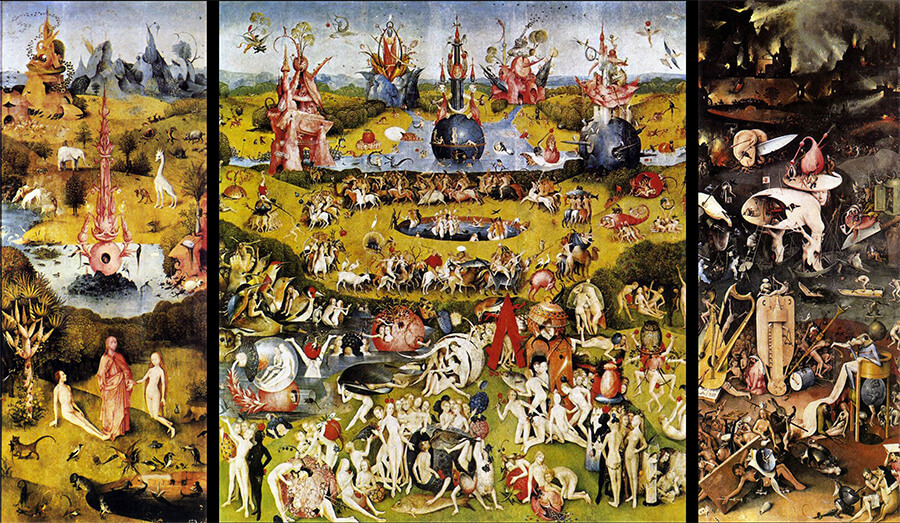
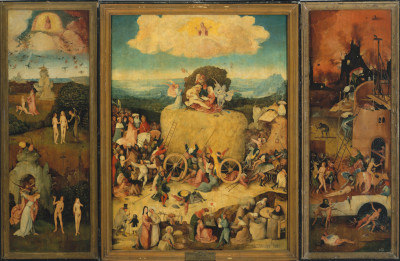
This guide explains how scholars and museums approach Bosch attribution today. It supports the main Hieronymus Bosch overview, the biography, the paintings hub, the style and technique guide, individual works such as The Garden of Earthly Delights and The Haywain Triptych, and attribution-sensitive pictures such as The Seven Deadly Sins and the Four Last Things, Christ Carrying the Cross and The Cure of Folly.
Contents
- Why Bosch Attribution Is Difficult
- The Bosch Research and Conservation Project
- What Technical Evidence Can and Cannot Prove
- Bosch, Workshop, Follower, After Bosch: What the Labels Mean
- Why Museum Labels Sometimes Differ
- Copies, Versions and Lost Compositions
- Drawings, Prints and the Boschian Imagination
- Attribution Changes Do Not Make a Work Less Interesting
- How to Read a Bosch Label
Why Bosch Attribution Is Difficult
Bosch was born Jheronimus van Aken in 's-Hertogenbosch, into a family of painters. Local evidence records the Van Aken family in the city, and heritage research connects the family workshop with De Kleine Winst, a house bought by Bosch's father Anthonis van Aken in 1462. Bosch probably grew up and trained in that family setting, before developing the artistic identity now associated with his adopted surname. [2]
That background matters. In the late fifteenth and early sixteenth centuries, paintings were rarely made under the modern idea of the solitary studio genius. Workshops could include relatives, assistants and specialists. A master might design a composition, paint the most important passages, leave subsidiary areas to assistants, or supervise work made for a client. Workshop members might also make copies, variants or related pieces after a successful design. In Bosch's case, the problem is sharpened by the fact that very few secure documents name specific surviving paintings, and his visual language became highly desirable soon after his death.
The result is a layered corpus. Some works are widely accepted as Bosch's own paintings. Others are connected to his workshop or immediate circle. Some survive as later copies after lost or famous compositions. Others are Boschian in subject and mood but belong to a follower, a later Netherlandish painter or a broader market for moral fantasy. A public museum label tries to compress all of that into a few words.
The safest starting point is to treat "Bosch" as an attribution, not just a brand. When a work is labelled "by Hieronymus Bosch", the institution is making a judgment from evidence. When it says "workshop", "follower", "after", "circle" or "formerly attributed", it is also making a judgment from evidence. The difference is not between certainty and ignorance; it is between different kinds and strengths of evidence.
The Bosch Research and Conservation Project
Modern Bosch attribution has been transformed by the Bosch Research and Conservation Project, usually shortened to BRCP. The project began in 2010 in preparation for the 2016 Bosch anniversary exhibitions, with the aim of increasing knowledge of Bosch's paintings, drawings, workshop and followers, and of improving preservation. Its research brought together art historians, conservators, scientists and imaging specialists, and it led to the major 2016 catalogue raisonne Hieronymus Bosch, Painter and Draughtsman. [1] [3]
The BRCP is important because it treats attribution as a material question as well as a stylistic one. Its work uses close visual study, infrared reflectography, infrared photography, visible light photography, X-radiography where available, dendrochronology and conservation records. The companion platform Closer to Bosch presents high-resolution images and technical explanations for many works associated with Bosch, arranged in categories such as Bosch, workshop, followers, and workshop or follower. [4]
This matters for readers because technical study can alter the conversation. It may reveal underdrawing beneath paint, show whether a composition was developed freely or copied from a model, identify changes made during painting, or test whether an oak panel could have been used during Bosch's lifetime. It can also complicate an attractive old story. A painting might look Boschian in subject but lack the exploratory underdrawing expected in his secure works. Another might have a plausible date but show a mechanical relationship to a known composition. A third might preserve a powerful invention while being too late or too dependent to be by Bosch himself.
The BRCP did not end debate. In several cases, it sharpened debate. That is healthy. It gave museums, scholars and readers better evidence to argue from, especially when long-standing labels rested on tradition, collection history or visual resemblance alone.
What Technical Evidence Can and Cannot Prove
Technical evidence is powerful, but it does not operate like a fingerprint in a detective story. It usually narrows possibilities rather than delivering a single dramatic answer.
Dendrochronology, the study of tree rings, can help establish the earliest plausible date for an oak panel. If the wood could not have been ready before a certain year, a proposed early date becomes impossible. But a panel might sit in storage before use, so the wood date does not by itself give the painting date. A technical study of The Cure of Folly, for example, has to be read alongside subject, patronage, inscription, underdrawing and institutional interpretation, not as a single number that resolves everything. [5]
Infrared reflectography can reveal underdrawing: the preparatory drawing beneath the paint surface. In Bosch studies, underdrawing is especially valuable because secure works often show changes of mind, searching outlines and inventive development. A copy may instead reproduce a known design more rigidly. Yet this distinction is not absolute. Assistants could work from master drawings; later painters could be inventive; conservation history can obscure evidence. Technical images help scholars ask better questions, but they still need interpretation.
X-radiography, paint sampling, ultraviolet photography and surface examination can reveal changes, damage, restorations and hidden earlier work. The National Gallery in London notes, for instance, that Christ Mocked (The Crowning with Thorns) contains underdrawing that was more brutal than the finished painting, and that an unfinished Saint Christopher lies beneath the surface. That kind of evidence helps place the painting inside Bosch's working practice rather than simply inside an iconographic tradition. [6]
The best attribution arguments combine these threads: support, ground, paint handling, underdrawing, composition, provenance, documentary evidence, copies, early descriptions and comparison with secure works. A label changes when the balance changes.
Bosch, Workshop, Follower, After Bosch: What the Labels Mean
"By Hieronymus Bosch" normally means the museum or scholar accepts the work as substantially autograph: made by Bosch himself, though not necessarily without any workshop help. For late medieval and Renaissance works, even a confident attribution can allow for assistants in less central passages. The important claim is that Bosch's own hand or controlling authorship is present.
"Workshop of Bosch" means the work is associated with Bosch's studio environment, likely made by someone working under or close to him, or from patterns and practices directly connected with his shop. It may preserve his invention or supervision, but the institution is not presenting it as a fully autograph painting.
"Follower of Bosch" usually means a later artist working in Bosch's manner. The follower may have admired Bosch, served a market for Boschian scenes or learned from compositions circulating after him. This does not make the work unimportant. It may be valuable evidence for Bosch's reception, for the spread of his inventions, and for the appetite for moral fantasy in the sixteenth century.
"After Bosch" generally means a work based on a Bosch composition, often a print or copy made from a known painting, lost painting or circulating design. The after-Bosch category is especially important for Bosch prints, because Bosch himself is not known primarily as a printmaker. Prints after Bosch and Boschian prints helped spread his imagery, including temptations, devils, fools and moral allegories, into a wider visual culture. [7]
"Attributed to Bosch" signals a more cautious claim than "by Bosch". "Formerly attributed to Bosch" tells readers that a work once carried his name but is no longer accepted as such by the current source. "Circle of Bosch" is broader than workshop and usually less direct. These terms are not always used identically by every institution, but they all try to place a work on a scale from direct authorship to later response.
Why Museum Labels Sometimes Differ
Museum labels differ because institutions weigh evidence differently and update records at different speeds. A national museum may have a long collection history, a conservation department, a recent exhibition catalogue and a curatorial tradition tied to a work. A research project may compare the same object across the full Bosch corpus and decide that the evidence points elsewhere. Neither position should be dismissed casually.
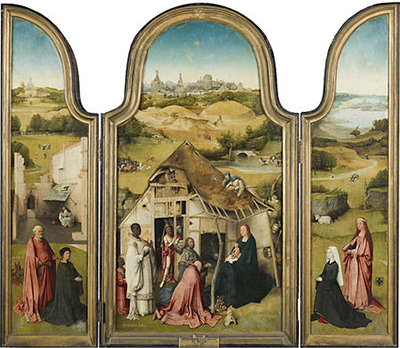
The Prado is the clearest example because it holds several of Bosch's most famous paintings and has also been central to public debate. The Prado continues to present The Garden of Earthly Delights, The Haywain Triptych, The Adoration of the Magi, The Seven Deadly Sins and the Four Last Things and The Cure of Folly in its Bosch context, while also publishing material that acknowledges controversies around attribution. [5] [8] [9] [10]
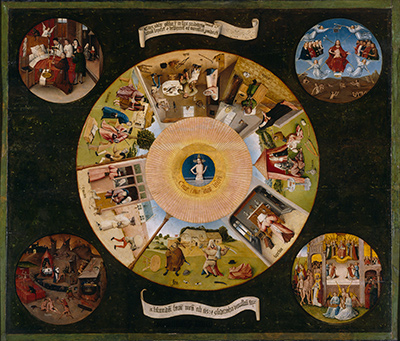
The disagreement around The Seven Deadly Sins and the Four Last Things is especially useful for understanding the issue. The Prado attributes the work to Bosch and discusses arguments for its authenticity, including historical reception and the passage by Felipe de Guevara often brought into the debate. BRCP-linked scholarship has challenged the attribution, placing pressure on how readers understand the object. A responsible article should not pretend the debate does not exist, but it also should not reduce the painting to a dispute. Its circular structure, moral scheme and history in Spanish royal collecting remain important even while authorship is discussed. [8] [10]
The same principle applies to The Cure of Folly. The Prado's record offers rich material: inscription, satirical surgery, dendrochronology, underdrawing, patronage and a proposed date. At the same time, Prado's own controversy material identifies the work among the difficult cases raised by BRCP discussions. For readers, the point is not to choose a side quickly. The point is to see how attribution, technical study and interpretation interact. [5] [10]
Other museums present different kinds of caution. The Museum of Fine Arts in Ghent and related Flemish collection material identify Christ Carrying the Cross in connection with Bosch while noting debate around authorship. That does not make the painting unworthy of attention. It means its late Passion imagery, compressed faces and devotional intensity need to be discussed with authorship in view. [11]
Copies, Versions and Lost Compositions
Bosch attribution is not only about deciding whether one painting is "real" or "fake". Some of the most interesting cases involve copies and versions that preserve evidence of lost or altered compositions.
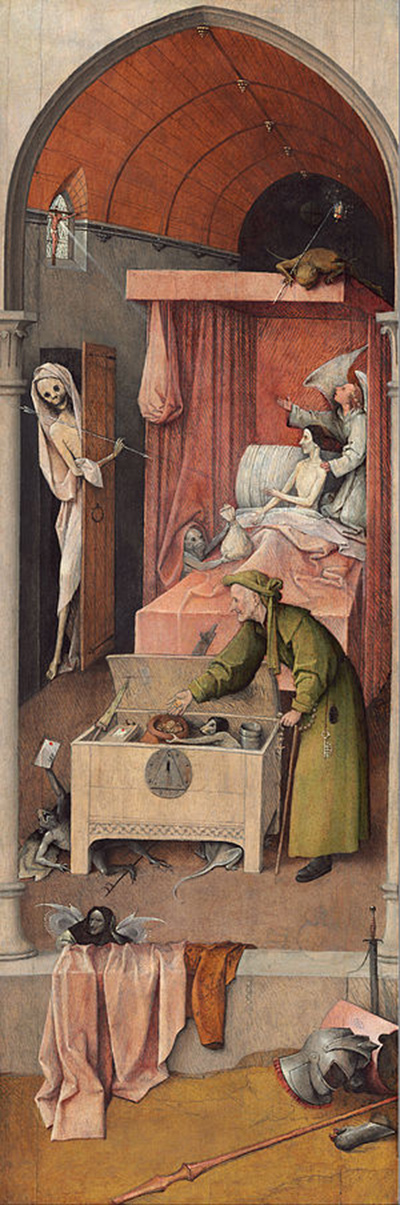
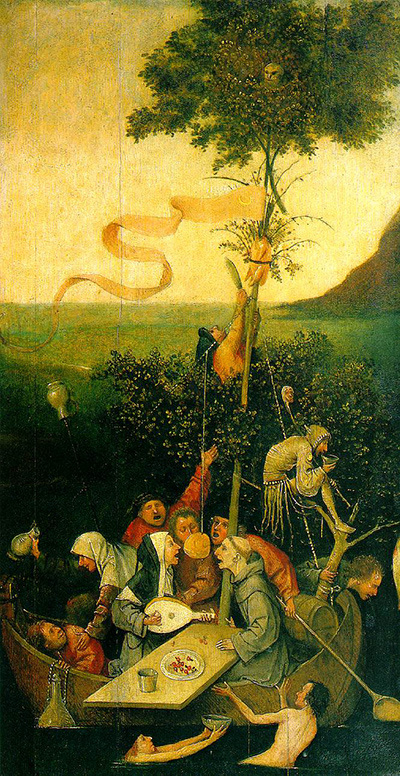
The group around The Pedlar, also known as The Wayfarer, shows how complex this can become. Museum Boijmans Van Beuningen identifies The Pedlar as Bosch and explains that the panel was assembled from the outside wings of a triptych. The surviving inside elements are connected with Ship of Fools in the Louvre, Allegory of Gluttony and Lust in Yale, and Death and the Miser in the National Gallery of Art, Washington. The central panel is unknown. [12] [13] [14]
That network changes how a reader sees each object. Ship of Fools is not only a satirical scene of folly. Death and the Miser is not only a moral drama at a deathbed. The Pedlar is not only an isolated figure on the road. Together, they suggest a dismantled moral structure whose original form is partly recoverable and partly lost. Careful scholarship can reconstruct relationships, but it must also leave space where evidence ends.
Copies also affect famous triptychs. The Prado's account of The Haywain Triptych distinguishes its own painting from another version connected with earlier royal collecting, noting that technical analysis showed that other version to be a copy. [9] That does not weaken the Prado painting. It clarifies why old provenance claims must be sorted carefully. In Bosch studies, a version may preserve a historical memory while not being the prime object.
The market for Boschian imagery continued through the sixteenth century. Works such as Concert in the Egg, often linked to followers or after-Bosch traditions, demonstrate the strength of Bosch's visual afterlife. Such works are not useful because they are secretly Bosch. They are useful because they show how quickly Bosch became a style, a reputation and a set of pictorial possibilities.
Drawings, Prints and the Boschian Imagination
Drawings and prints require special caution. A drawing with monsters, beggars or grotesque heads may feel close to Bosch's imagination, but drawings often survive without the same provenance or technical context as major panel paintings. The BRCP and Closer to Bosch material are therefore essential for distinguishing autograph drawings, workshop material and later sheets connected with Bosch's pictorial world. [1] [4]
Prints raise a different issue. Prints after Bosch are central to his reception, but they should not be treated as prints made by Bosch unless a source supports that claim. The Metropolitan Museum of Art, the National Gallery of Art, the British Museum and the Rijksmuseum preserve important after-Bosch and Boschian print material. These works show how Bosch's demons, temptations and moral satires circulated through print culture and reached audiences far beyond the original panel paintings. [7] [15] [16]
This is also where Pieter Bruegel the Elder enters the story. Bruegel's printed and painted inventions sometimes work consciously in a Boschian manner, especially in moral and monstrous imagery. That relationship is better understood as reception and transformation, not as simple imitation. Bosch gave later artists a language for folly, sin and absurdity; they used it for their own audiences.
Attribution Changes Do Not Make a Work Less Interesting
Readers sometimes experience a changed label as a loss. A painting once loved as "a Bosch" may now appear as "workshop of Bosch" or "follower of Bosch", and the new label can feel like demotion. But art history gains something when a work is placed more accurately.
A workshop painting can tell us how Bosch's designs were produced and transmitted. A follower's painting can show what later collectors wanted from the Bosch name. A copy can preserve a lost composition or document the fame of a specific invention. A disputed object can reveal how scholars balance visual resemblance, technical data, provenance and documentary history. These categories are not failures of knowledge. They are ways of being precise.
That precision is particularly important for Bosch because his name is so magnetic. Without it, every devilish scene, every hybrid creature and every satirical crowd risks being pulled toward him. Good attribution protects Bosch's achievement by separating his own works from the visual world he inspired.
It also protects the works around him. A follower's painting does not need to pretend to be Bosch in order to matter. A later Boschian picture can be a strong witness to taste, collecting, religious satire, print culture or the commercial demand for strange moral imagery. Once the label is clear, interpretation becomes fairer.
How to Read a Bosch Label
When you see a Bosch label, start with the exact wording. "Hieronymus Bosch" is not the same as "attributed to Hieronymus Bosch", and "after Bosch" is not the same as "workshop of Bosch". The small words carry the historical claim.
Then look for the date. A work made after Bosch's death in 1516 cannot be an autograph painting, though it may copy a lost Bosch composition or continue his style. A date range that begins during his lifetime but extends beyond it may signal uncertainty, later workshop production or a cautious institutional range.
Next, check the evidence behind the label. Does the record mention underdrawing, dendrochronology, provenance, early inventories, copies, restorations or catalogue debate? Does it cite a major conservation study or catalogue raisonne? A short object label may be simpler than the full scholarly record behind it.
Finally, separate authorship from meaning. A disputed attribution does not make every interpretation doubtful. The moral imagery of The Seven Deadly Sins, the satire of The Cure of Folly, the devotional pressure of Christ Carrying the Cross and the fantasy of a Boschian follower picture can still be discussed. What changes is the claim about whose hand, workshop or later imagination made the object.
That is the most useful way to approach Bosch: with curiosity rather than suspicion. His world is full of uncertainty, but not the vague kind. It is an evidential uncertainty, built from panels, paint layers, documents, copies, collectors, restorations and the long afterlife of a painter whose inventions were too vivid to stay in one studio.
Discussion
Which detail in Workshop and Attribution most changes how you read Bosch: the moral setting, the strange objects, the devotional context, the attribution evidence, or the way the image asks you to look?
Reader Insights
Start with one precise detail, then ask what it does in the wider scene rather than treating it as a fixed symbol.
Set the image beside Bosch's devotional culture, Netherlandish workshop practice and the current museum record before settling on an interpretation.
Where does the evidence feel strongest, and where does Bosch leave the viewer with useful uncertainty?
Join the Conversation
Have a thought or close-looking observation about Workshop and Attribution? Share it below. Thoughtful responses may be added to this section as the Bosch pages develop.
References
- Bosch Research and Conservation Project, project information (in Dutch): https://jheronimusbosch.org/index.php?Itemid=113&id=1&lang=nl&option=com_content&view=article
- Erfgoed 's-Hertogenbosch, "De Kleine Winst, atelier Van Aken" (in Dutch): https://www.erfgoedshertogenbosch.nl/verhalen/de-kleine-winst-atelier-van-aken
- Yale University Press, Hieronymus Bosch, Painter and Draughtsman: Catalogue Raisonne: https://yalebooks.yale.edu/book/9780300220148/hieronymus-bosch-painter-and-draughtsman/
- Closer to Bosch: https://closertobosch.org/
- Museo Nacional del Prado, The Extraction of the Stone of Madness: https://www.museodelprado.es/en/the-collection/art-work/the-extraction-of-the-stone-of-madness/313db7a0-f9bf-49ad-a242-67e95b14c5a2
- The National Gallery, London, Christ Mocked (The Crowning with Thorns): https://www.nationalgallery.org.uk/paintings/hieronymus-bosch-christ-mocked-the-crowning-with-thorns
- The Metropolitan Museum of Art, The Temptation of St. Anthony, after Hieronymus Bosch: https://www.metmuseum.org/art/collection/search/383046
- Museo Nacional del Prado, Table of the Seven Deadly Sins: https://www.museodelprado.es/en/the-collection/art-work/table-of-the-seven-deadly-sins/3fc0a84e-d77d-4217-b960-8a34b8873b70
- Museo Nacional del Prado, The Haywain Triptych: https://www.museodelprado.es/en/the-collection/art-work/the-haywain-triptych/7673843a-d2b6-497a-ac80-16242b36c3ce
- Museo Nacional del Prado, "Controversies Regarding Hieronymus Bosch": https://www.museodelprado.es/en/resource/controversies-regarding-hieronymus-bosch/0c390775-54e6-4801-a0f8-cb777d46288c
- Museum of Fine Arts Ghent, Christ Carrying the Cross: https://www.mskgent.be/en/collection/1902-h
- Museum Boijmans Van Beuningen, The Pedlar: https://www.boijmans.nl/en/collection/artworks/1556/the-pedlar
- Louvre Collections, La Nef des fous: https://collections.louvre.fr/en/ark%3A/53355/cl010062860
- National Gallery of Art, Washington, Death and the Miser: https://www.nga.gov/artworks/41645-death-and-miser
- The British Museum, Shrove Tuesday or the Fool's Kitchen: https://www.britishmuseum.org/collection/object/P_1928-1212-11
- The Metropolitan Museum of Art, Pieter Bruegel the Elder and Pieter van der Heyden, Sloth: https://www.metmuseum.org/art/collection/search/338700