 by Tom Gurney
Tom Gurney BSc (Hons) is an art history expert with over 20 years experience
Published on June 19, 2020 / Updated on September 6, 2026
Email: tomgurney1@gmail.com / Phone: +44 7429 011000
Hieronymus Bosch Style and Technique: Introduction
Hieronymus Bosch's style is easy to recognise and hard to explain. A Bosch painting may contain demons with pots for helmets, birds larger than people, bodies turned into instruments, translucent spheres, burning cities, saints under attack and crowds so small that they seem to multiply as the viewer looks. Yet Bosch was not an undisciplined fantasist. His strangeness depends on highly controlled craft: oil paint on carefully prepared panels, triptych structures that open and close, fine underdrawing, precise colour design, and a habit of filling large moral dramas with minute, legible incidents.
That combination is what makes Bosch so powerful. The surface seems inexhaustible, but the paintings are built from material decisions. Oak panels, hinges, grisaille exteriors, full-colour interiors, repeated figure types, altered underdrawings, hidden compositions and later restoration histories all shape what we see. Modern research has made this clearer. The Bosch Research and Conservation Project and Closer to Bosch have brought art history, conservation, high-resolution imaging and technical study together, using visible light, infrared, infrared reflectography and digitised X-radiography where available to study Bosch, his workshop and his followers [1] [2].
This guide sits beside the main Hieronymus Bosch overview, the paintings hub, the drawings guide, Bosch symbolism, and the separate guide to Bosch workshop and attribution. Its focus is not only what Bosch painted, but how his pictures were made, revised, preserved and studied.
Contents
- Oil on Panel
- Triptychs and Hinged Seeing
- Grisaille and Colour
- Underdrawing and Revision
- Scale, Detail and the Discipline of Invention
- Conservation Evidence
- Technical Study and Attribution
- Bosch's Hybrid Imagination
- How to Look at Bosch's Technique
Oil on Panel
Bosch worked in the late fifteenth and early sixteenth centuries, when Netherlandish painters had developed a refined tradition of oil painting on wooden supports. Many of his major works are painted on oak panel. The Prado records The Garden of Earthly Delights as grisaille and oil on oak panel, dated 1490-1500, and The Haywain Triptych as oil on panel, dated 1512-1515 [3] [4]. The National Gallery in London identifies Christ Mocked (The Crowning with Thorns) as oil on Baltic or Polish oak, about 1510 [5]. Museum Boijmans Van Beuningen records Saint Christopher as oil on panel [6].
Panel painting gave Bosch a hard, smooth surface on which tiny forms could be drawn and painted with great clarity. It also created vulnerabilities. Wood responds to humidity and structural stress. Panels can split, warp or be thinned, cradled, joined, cut down and restored. The apparent immediacy of Bosch's inventions therefore sits on objects with long physical histories. A painting may now look like one coherent surface while also carrying evidence of joined boards, old repairs, changed varnish, overpaint, losses and earlier conservation decisions.
The panel support matters for dating and attribution as well. Dendrochronology, the study of tree-ring patterns in wood, can sometimes establish the earliest possible date at which an oak panel could have been used. This does not prove the exact date of a painting, because panels could be stored before use, but it can make some proposed dates impossible or more plausible. In Bosch studies, that kind of evidence is most useful when combined with underdrawing, paint handling, provenance, copies and current museum research.
Triptychs and Hinged Seeing
Bosch's most famous technical and imaginative format is the triptych. A triptych is a three-part work, usually with hinged wings that could be closed over a central panel and then opened. In a religious setting, such winged altarpieces might remain closed for ordinary viewing and be opened for Sundays, feast days or special occasions. Even when the original setting is uncertain, the format creates a double experience: a restrained exterior and a revealed interior.
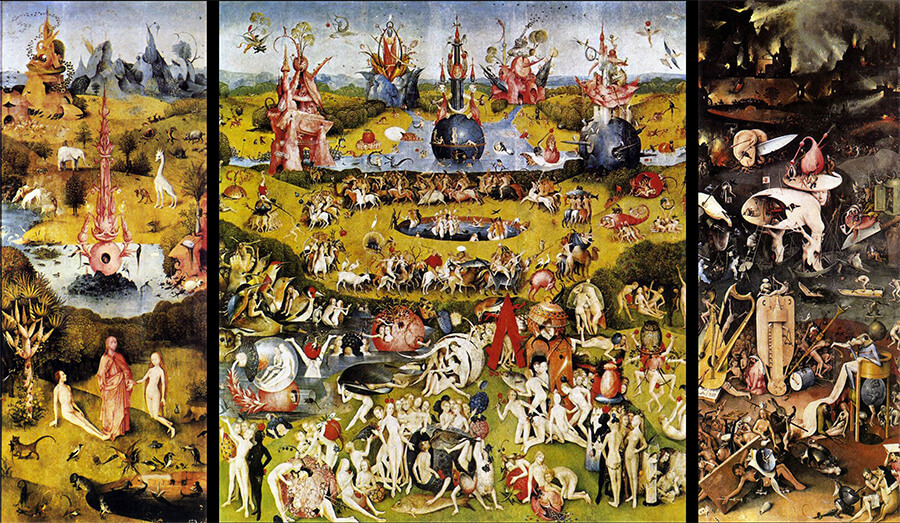
The Garden of Earthly Delights is the most famous example. Closed, the Prado identifies the exterior as the Third Day of Creation, painted in grisaille. Opened, the triptych shifts into brilliant colour: Eden on the left, a crowded central field of sensual and moral ambiguity, and Hell on the right [3]. The contrast is not decorative. The exterior suggests the world before humanity; the interior shows humanity inside a moral drama.
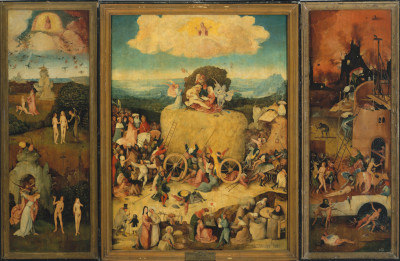
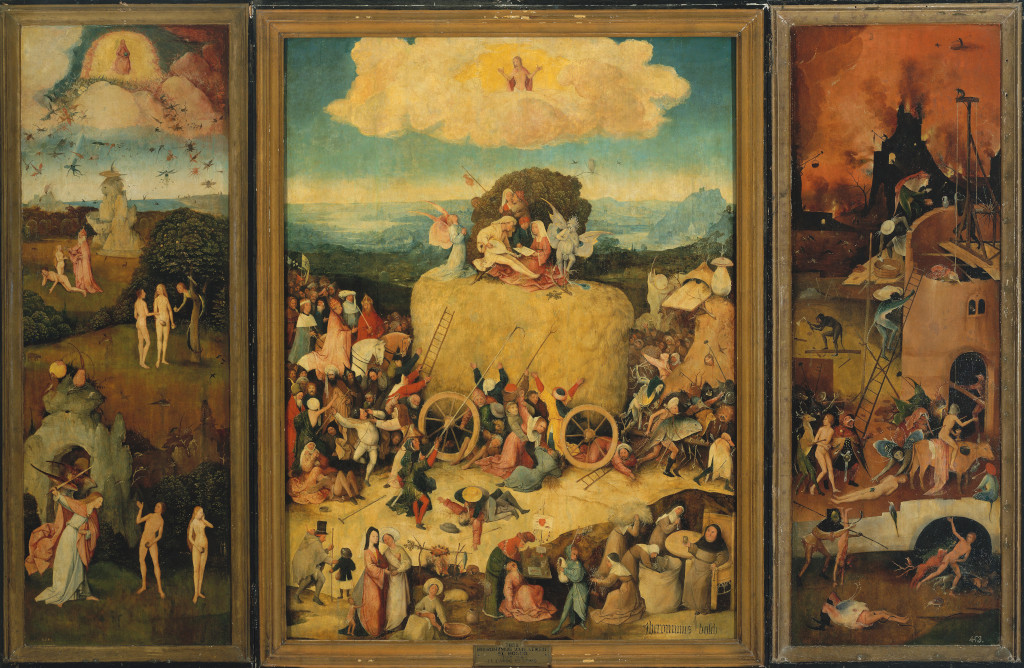
The Haywain Triptych uses a related structure with a different emphasis. The Prado describes its interior as devoted to sin, beginning with the fall of the rebel angels, Adam and Eve, and expulsion from Eden, then moving toward the hay wagon and the infernal consequence at the right [4]. Here the triptych acts almost like a moral procession. The eye travels from origin to worldly pursuit to punishment.
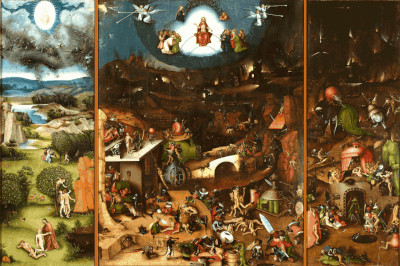
The Academy of Fine Arts Vienna describes The Last Judgement as a three-part winged altarpiece and places its creation broadly between about 1490 and 1505 [7]. Its left panel shows Paradise, Fall and expulsion; its central and right panels unfold judgement, punishment and hell. The Academy also notes that the outer wings are painted in shades of grey, a grisaille contrast to the colourful inner panels [7].
Bosch understood that a hinged painting changes meaning through time. A closed triptych can be quiet, devotional and sculptural in effect. An opened triptych can become dazzling, overcrowded and morally overwhelming. The style depends on that movement from withheld image to revelation.
Grisaille and Colour
Grisaille is painting in shades of grey, often used to imitate sculpture or to create a subdued exterior. Bosch used it with particular force. In the Garden, the closed exterior's grey Creation scene makes the opened interior feel shockingly alive. The Prado specifically contrasts the grisaille exterior with the colour of the inner triptych [3]. In the Last Judgement, the Vienna Academy makes the same point: the grey outer wings sharpen the contrast with the colourful, densely detailed inner panels [7].
This shift from grey to colour is central to Bosch's technique. Grisaille slows the viewer down. It asks for contemplation before spectacle. The exterior wings often carry saints, Creation imagery or devotional counterpoints. They are not empty covers; they prepare the viewer for what happens when the image opens.
Inside, Bosch's colour is not merely bright. It is organisational. Pale flesh, blue water, green landscape, white cloth, red clothing, black interiors, yellow fire and grey architecture help the eye move through dense scenes. In the Garden, colour separates air, water, bodies, shells, fruit, animals and infernal darkness. In the Haywain, it helps turn a crowded procession into a readable moral theatre. In Christ Mocked, the National Gallery describes a carefully structured design of shape and colour, with Christ's pale robe setting him apart from the coloured tormentors around him [5].
Bosch's colour often works with scale. A tiny white body may stand out against a dark opening; a red garment may pull attention across a crowded field; a pale face may anchor a whole group. The paintings reward close looking because their colour accents guide the eye without reducing the image to a single focal point.
Underdrawing and Revision
Technical study has made Bosch's working process more visible. Infrared reflectography can reveal underdrawing, the preparatory drawing beneath the paint layer. In many Netherlandish paintings, underdrawing is essential evidence because it shows how a composition was planned, changed or transferred.
Bosch's underdrawing is especially important because his accepted works often appear inventive rather than mechanical. Researchers look at whether forms were freely sketched, adjusted and rethought, or whether they follow a known pattern more rigidly. This is not a rule by itself. A workshop assistant might work from a master's design; a copyist might still change details; damage or paint layers may hide evidence. But underdrawing gives scholars a rare view of decision-making beneath the finished surface.
The National Gallery's account of Christ Mocked is one of the clearest public examples. The Gallery explains that Bosch toned down the violence of the scene as he painted. In the underdrawing, the tormentors treated Christ more brutally: gestures and hands were originally more aggressive, and some details were altered in the final paint layers [5]. The finished painting is therefore not simply the execution of a fixed design. It is the result of revision.
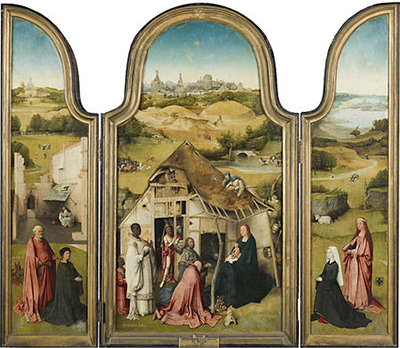
The Prado records underdrawing and compositional change in the Triptych of the Adoration of the Magi, including changes to contours and positions and curtains painted over completed figures [8]. In The Extraction of the Stone of Madness, the Prado notes technical data, underdrawing and a careful surface associated with its attribution and dating discussion [9]. Such evidence matters because Bosch's style is not just in the final oddity of a demon or satire. It is also in how forms were imagined, tested and revised.
Scale, Detail and the Discipline of Invention
Bosch is often described through his monsters, but his greatest technical gift may be the control of scale. In the major triptychs, large theological structures are carried by hundreds of small incidents. The viewer can read the whole and then keep discovering parts: a procession, a falling body, a weaponised instrument, a tiny animal, a strange building, a staged punishment, a saint under pressure.
This miniature density is not random. Bosch uses repeated rhythms of looking. A viewer moves from the main axis to the margins, from bright bodies to dark openings, from comic absurdity to moral threat. The same object may be funny and frightening. A musical instrument may be a pleasure object in one context and an engine of torment in another. A hollow tree, bird head, funnel, knife or vessel may carry symbolic pressure without always allowing a single fixed translation.
That is why Bosch's symbolism should be read with caution. The paintings are not simple codebooks. His style works through clusters of association: sin, temptation, appetite, folly, false healing, pilgrimage, inversion, judgement and the fragility of the body. Technical precision makes that ambiguity convincing. The monsters are fantastic, but they are painted with the crispness of observed things.
Bosch's scale also changes the viewer's physical experience. Large triptychs such as Garden, Haywain and Last Judgement ask the eye to travel. Smaller paintings such as Christ Mocked concentrate pressure. In the National Gallery work, Bosch compresses the Passion into a half-length confrontation. The scale is intimate, the faces are close, and the reduced space makes the moral encounter immediate [5]. Bosch could expand a world across panels or tighten it into a single suffocating frame.
Conservation Evidence
Conservation does not simply clean pictures. It can reveal how they are made, how they have aged and how previous interventions changed their appearance. It can also remind viewers that the painting seen today is a survivor.
Museum Boijmans Van Beuningen's restoration material for Saint Christopher is unusually helpful for understanding Bosch as a panel painter. The museum describes preliminary examination with paint samples, ultraviolet photographs and raking light; the use of XRF images, infrared images and X-rays; problems including rotten wood, a fixed parquet or cradle at the back, yellowed varnish and loose paint; and the careful loosening of the cradle so the panel could move without harming the paint layers [10]. The restoration also included varnish removal, removal of old retouching, consolidation of loose paint, filling and retouching of losses, and a new varnish layer [10].
This kind of evidence is practical rather than glamorous, but it is crucial. It explains why a painting may look dark, cracked, flattened or uneven. It shows why old cradles, varnishes and retouchings can affect both appearance and interpretation. It also shows why conservation choices must be reversible where possible and carefully documented.
The Stadel Museum's Ecce Homo offers a related lesson. The museum notes that damaged donor sections were overpainted at an early date and that remnants of the donor family were uncovered only much later. It also records that an X-ray examination in 1983 revealed that a donor family had once been portrayed in the foreground and then painted over [11]. The rediscovery changes how the painting is understood: what looked like a Passion scene without those figures becomes a work tied to patronage, prayer and social status.
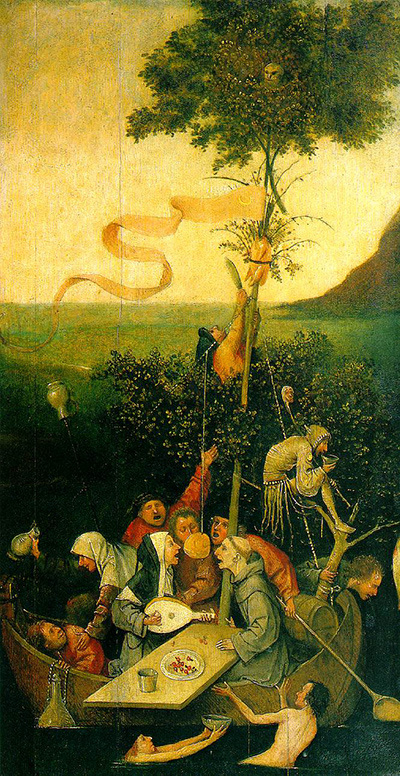
The Louvre's restoration material for Ship of Fools, cited in the Bosch planning research, is another reminder that old varnish and repainting can obscure iconography. Cleaning and technical examination do not make interpretation certain, but they can restore details that earlier viewers could not read clearly.
Technical Study and Attribution
Bosch's style became famous quickly, and that fame created an attribution problem. Later painters and printmakers could imitate his devils, fools and monstrous hybrids. A picture might look Boschian because it belongs to the visual culture that Bosch helped create, not because Bosch painted it. Technical study is therefore central to attribution.
The BRCP's purpose was not only to catalogue images but to improve knowledge of Bosch's paintings, drawings, workshop and followers, and to preserve them for the future [1]. Closer to Bosch presents that research through high-resolution and technical study, separating works associated with Bosch from workshop and follower material [2]. These categories matter because Bosch's style is partly material: underdrawing habits, panel construction, paint handling, changes during execution and relationships to known works all help scholars judge authorship.
The evidence is strongest when several forms of inquiry converge. Dendrochronology may show that a panel could belong to Bosch's lifetime. Infrared reflectography may show exploratory underdrawing. X-radiography may reveal changes, hidden compositions or structural features. Provenance may connect a work to early collectors. Copies and versions may show whether a composition circulated during or after Bosch's life. None of these elements alone is a magic key. Together, they build a case.
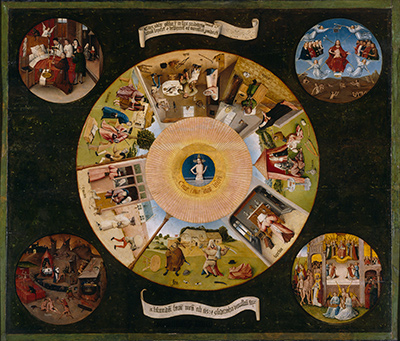
This is why disputed works require careful language. The Prado continues to present works such as The Seven Deadly Sins and The Extraction of the Stone of Madness in Bosch's context, while its own material also discusses controversies around attribution [9] [12]. Current Ghent and Flemish collection material for Christ Carrying the Cross preserves the painting's significance while noting debate around authorship [13] [14]. A technical account should help readers understand the debate, not flatten it into a yes-or-no drama.
For more on labels such as Bosch, workshop, follower and after Bosch, see Bosch Workshop and Attribution. The short version is simple: technical evidence can make attribution more responsible, but it still needs art-historical judgement.
Bosch's Hybrid Imagination
Bosch's inventions are often called fantastical, but their power comes from hybrid logic. He combines the familiar with the impossible. A bird becomes a devouring judge. A human body becomes furniture or instrument. A fruit becomes architecture. A tavern scene becomes a moral trap. A saint's landscape becomes a testing ground full of strange creatures. His style depends on making impossible things feel materially specific.
That specificity is technical. Bosch gives bizarre figures clear silhouettes, weight, texture and function. A creature may have a beak, a pot, a ladder, a knife, a shell, a human backside and a musical instrument, but the parts are arranged so the viewer can inspect them. The invention is outrageous, yet the painting often behaves like close observation.
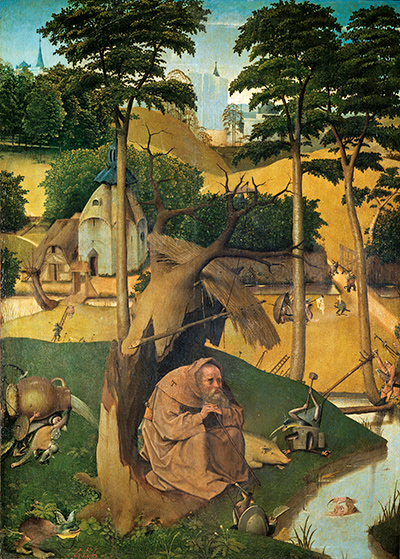
The same discipline appears in his landscapes. Wide distances, blue-green recession, rivers, burning cities, fragile towers and tiny travellers make moral space feel expansive. In Saint Christopher, Boijmans notes the extensive landscape filled with strange creatures and situations [10]. In the Garden, landscape becomes a whole world-system. In Last Judgement, the interior panels turn landscape into a theatre of judgement and torment [7].
Bosch's hybrid style also depends on moral inversion. Tools are misused. Pleasure becomes punishment. Music becomes torture. Food becomes danger. Bodies become containers or exposed mechanisms. The technique serves the thought: the more precisely the impossible thing is painted, the harder it is to dismiss as mere fantasy.
How to Look at Bosch's Technique
Start with the object. Is it a panel, a triptych, a fragment, a drawing, a copy, a follower's work or a disputed attribution? The answer changes what kind of evidence matters. A triptych asks to be read closed and open. A fragment may belong to a larger lost structure. A drawing may show invention without the same security as a major panel. A copy may preserve a lost design while not being Bosch's own hand.
Then look at the surface. Bosch often guides the eye through contrasts: grey exterior and colourful interior, pale flesh and dark openings, tiny figures and large moral structures, comic incidents and serious judgement. The small details are not ornamental extras. They are how the argument unfolds.
Next, ask what technical study adds. Infrared reflectography may reveal underdrawing and changes. X-radiography may show hidden work or structural features. Dendrochronology may test whether the wood support fits a proposed date. Conservation records may explain varnish, retouching, damage, old cradles or rediscovered details. Each method adds evidence; none removes the need for careful interpretation.
Finally, keep style and meaning together. Bosch's technique is not separate from his imagination. His oil surfaces, panel supports, grisaille wings, full-colour interiors, precise underdrawing and layered revisions all help create the moral pressure of the pictures. The same hand that painted grotesque hybrids also controlled architectural space, devotional focus, colour balance and tiny narrative cues.
Bosch's art endures because it is both materially disciplined and imaginatively unstable. The paintings look as if they might never finish revealing themselves, but they are not shapeless dreams. They are made things: oak, oil, hinges, drawing, colour, revision, damage, restoration and judgement. The technique is the reason the visions still hold.
Discussion
Which detail in Style and Technique most changes how you read Bosch: the moral setting, the strange objects, the devotional context, the attribution evidence, or the way the image asks you to look?
Reader Insights
Start with one precise detail, then ask what it does in the wider scene rather than treating it as a fixed symbol.
Set the image beside Bosch's devotional culture, Netherlandish workshop practice and the current museum record before settling on an interpretation.
Where does the evidence feel strongest, and where does Bosch leave the viewer with useful uncertainty?
Join the Conversation
Have a thought or close-looking observation about Style and Technique? Share it below. Thoughtful responses may be added to this section as the Bosch pages develop.
References
- Bosch Research and Conservation Project, project information and publications: https://jheronimusbosch.org/index.php?Itemid=113&id=1&lang=nl&option=com_content&view=article
- Closer to Bosch, Bosch Research and Conservation Project platform: https://closertobosch.org/
- Museo Nacional del Prado, The Garden of Earthly Delights Triptych: https://www.museodelprado.es/en/the-collection/art-work/the-garden-of-earthly-delights-triptych/02388242-6d6a-4e9e-a992-e1311eab3609
- Museo Nacional del Prado, The Haywain Triptych: https://www.museodelprado.es/en/the-collection/art-work/the-haywain-triptych/7673843a-d2b6-497a-ac80-16242b36c3ce
- The National Gallery, London, Christ Mocked (The Crowning with Thorns): https://www.nationalgallery.org.uk/paintings/hieronymus-bosch-christ-mocked-the-crowning-with-thorns
- Museum Boijmans Van Beuningen, Saint Christopher Carrying the Christ Child: https://www.boijmans.nl/en/collection/artworks/101481/saint-christopher-carrying-the-christ-child
- Academy of Fine Arts Vienna, The Last Judgement Triptych: https://www.kunstsammlungenakademie.at/en/paintings-gallery/boschs-last-judgement-triptych/
- Museo Nacional del Prado, Triptych of the Adoration of the Magi: https://www.museodelprado.es/en/the-collection/art-work/triptych-of-the-adoration-of-the-magi/666788cc-c522-421b-83f0-5ad84b9377f7
- Museo Nacional del Prado, The Extraction of the Stone of Madness: https://www.museodelprado.es/en/the-collection/art-work/the-extraction-of-the-stone-of-madness/313db7a0-f9bf-49ad-a242-67e95b14c5a2
- Museum Boijmans Van Beuningen, "Jheronimus Bosch in the Restauration Studio": https://www.boijmans.nl/en/collection/in-depth/jheronimus-bosch-in-the-restauration-studio
- Stadel Museum, Ecce Homo: https://sammlung.staedelmuseum.de/en/work/ecce-homo
- Museo Nacional del Prado, "Controversies Regarding Hieronymus Bosch": https://www.museodelprado.es/en/resource/controversies-regarding-hieronymus-bosch/0c390775-54e6-4801-a0f8-cb777d46288c
- Museum of Fine Arts Ghent, Christ Carrying the Cross: https://www.mskgent.be/en/collection/1902-h
- Flemish Art Collection, Christ Carrying the Cross: https://vlaamsekunstcollectie.be/en/collection/1902-H