 by Tom Gurney
Tom Gurney BSc (Hons) is an art history expert with over 20 years experience
Published on June 19, 2020 / Updated on October 30, 2026
Email: tomgurney1@gmail.com / Phone: +44 7429 011000
Number 1A, 1948 by Jackson Pollock: Introduction
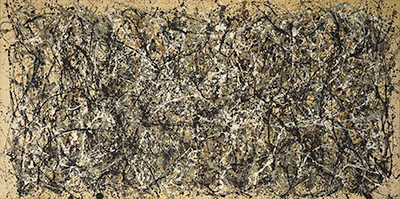
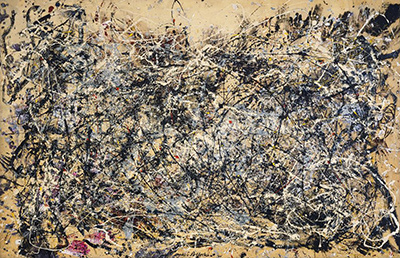
Jackson Pollock's Number 1A, 1948 brings the artist's hand unusually close to the surface. MoMA draws attention to the black handprints at the upper right, describing them as a particularly direct autograph. Within a painting associated with fluid, airborne marks, a recognisable bodily impression offers an immediate point of contact, something familiar within the surrounding abstraction. The painting belongs to the Museum of Modern Art in New York, where its record identifies oil and enamel paint on canvas, measuring 172.7 × 264.2 centimetres, and the accession number 77.1950. These particulars distinguish a specific, substantial object from the general idea of a Pollock “drip painting.” [1]
At a Glance
This work across Jackson Pollock’s career
The Flame
c.1934–38The She-Wolf
1943Mural
1943Alchemy
1947Blue Poles
1952The Deep
1953White Light
1954Contents
- A number with a history
- Movement and intervals
- Different paints, different gestures
- An earlier surface, a later atmosphere
- A painting enters the museum
A number with a history
The title has its own small history of exhibitions and unsold paintings. Elizabeth Levine and Anna Indych's chronology records the canvas in the Betty Parsons exhibition of 24 January–12 February 1949, among paintings made the previous year. It returned to the gallery in the exhibition of 21 November–10 December. Several older works were then being shown alongside the new paintings of 1949; an A was added to their numbers to keep them distinct. Number 1, 1948 thus became Number 1A, 1948. The suffix belongs to this practical history of showing the work. It provides no evidence of a preliminary version, a subordinate canvas or a hidden mathematical sequence. The painting's present name preserves both its year of making and the later need to identify it accurately in a growing body of numbered works. [2]
Lee Krasner explained the move toward numbers in Berton Roueche's 1950 interview: “Numbers are neutral.” Her point was that a title should allow attention to settle on the painting itself. Pollock's own My Painting, published in winter 1947–48, describes working around a canvas from four sides and becoming acquainted with what he had made before making changes. Read together, these statements give useful bearings for Number 1A. A numbered title can leave the encounter open, while the account of changing a painting makes room for judgment after the first impulse. Neither statement is a diary of this canvas's execution. They offer a vocabulary for looking at a work in which bodily movement and subsequent decisions can coexist. The broader account of Pollock's technique follows the different ways he put that relationship into practice. [3]
Movement and intervals
The early reception is especially helpful because some reviewers wrote about this particular painting. Paul Mocsanyi's report of 9 February 1949 identified its horizontal, 68-by-104-inch format and described whirling lines set against quieter expanses. Movement and repose were already being noticed together. On 19 February, Clement Greenberg singled out Number One as a decisive advance, even while acknowledging limitations elsewhere in Pollock's colour. Other responses to the exhibition were less convinced: Sam Hunter admired the individual rhythm but questioned its resolution, while Emily Genauer wanted greater organisation. Those reservations concerned the show more broadly; they should not all be attached to this one canvas. Mocsanyi's account supplies a useful way in: attend to the intervals as well as the crossing lines. Greenberg's enthusiasm then becomes one forceful contemporary judgment within a disputed reception, rather than a verdict every visitor was expected to share. [4]
Bernice Rose's account of Pollock's drawing offers another approach to the relationship between a moving line and a completed painting. She argues that the poured line brought drawing and painting together: a line could retain its separate identity while contributing to a materially built surface. In her reading, the mature works also changed scale by loosening the usual hierarchy between depicted objects and the spectator. Applied as a question to Number 1A, this encourages attention to how a mark works at more than one level. A line can be followed along its course, then encountered again as one part of a larger field. The distinction helps explain why recognising individual gestures need not exhaust the experience of the whole painting. Rose's argument concerns Pollock's wider practice; it supplies an interpretive lens, not a recovered plan for this particular composition. [5]
Watch: Jackson Pollock
Choose a film about Pollock’s paintings and ways of working.
Different paints, different gestures
A 2016 study mapped four areas, distinguishing eleven paints; X-ray fluorescence identifies elements, leaving many pigment assignments tentative. Early brick-red palm marks, mostly left, preceded later matte-black handprints; white returned as fine lines after broader contact strokes, with red and yellow intervening. White mixed with glossy black made gray; cream and glossy black marbled while wet. This order suggested work in successive passages across the canvas, although only the four selected areas had been mapped. The mapped sequence ended with matte black. [6]
The authors report unprimed cotton duck, possibly sized, and commercial paints with different binders: oleoresinous glossy black, alkyd cream and linseed-oil silver; others were expected to be artists' oils. Differing flows accommodated brush or stick contact, tube-squeezed red and yellow, and pours; silver and cream could also be splattered. They also record soot from MoMA's 1958 fire, historical cleaning with residue-forming agents and later retouching—part of the object's subsequent material history. [6]
The blue provides an instructive example of how that knowledge develops. In 2025, Alexander J. Heyer and colleagues used Raman spectroscopy to confirm manganese blue in Number 1A, 1948. The earlier study had proposed it for the turquoise paint from its combination of elements. Such a combination was suggestive: some of those elements could also belong to fillers or substances added to help paint dry. The later identification gave the colour a firmer material basis. The researchers also investigated why this pigment looks blue. Its electronic structure produces absorptions on either side of the blue light that is reflected, helping account for its vivid hue. This explains a physical property of a particular pigment; it leaves the painting's expressive effects open to experience. The finding belongs to this work and does not identify every blue Pollock used across his career. [7]
An earlier surface, a later atmosphere
Full Fathom Five offers a useful earlier comparison. MoMA describes that 1947 painting as beginning on an easel, with a brush-and-palette-knife underlayer, before being moved to the floor and receiving poured black and silver enamel. Nails, cigarettes, buttons, coins and a key became embedded in its surface. That account shows how a poured network could grow out of a painting already possessing considerable physical substance. It also gives a reason to resist imagining a single, unchanging method behind every Pollock. The transition between the two modes could happen within one work. Approaching the later canvas with that history in mind makes the question of method more exact: what sort of mark was possible with a particular material, at a particular stage of the painting? [8]
A different comparison also resolves an easy confusion of titles. Number 1, 1950 (Lavender Mist) is the later painting in the National Gallery of Art in Washington. The gallery describes pale salmon, teal and steel-gray passages and white handprints near the upper corners; it is a separate canvas, measuring 221 × 299.7 centimetres. In the gallery's audio transcript, curator Harry Cooper invites both physical attention to its making and optical attention to the experience of the painting on a wall. That double approach is useful here too. Knowing how a work was made can sharpen attention without requiring every line to become a reconstruction of an action. Number 1A, 1948 and Lavender Mist can be considered together while retaining their different dates, surfaces and colour effects. [9]
A painting enters the museum
MoMA acquired Number 1A, 1948 in January 1950. Kirk Varnedoe and Pepe Karmel describe the purchase as an important source of funds toward central heating and hot water for Pollock and Krasner's Long Island home. They also record Alfred Barr's selection of the canvas for the Venice Biennale that summer. A qualification in their notes makes the acquisition history more precise: the museum had already bought the smaller poured work on paper Number 4, 1948: Gray and Red in January 1949, then traded it as part of the price of the larger canvas a year later. The collection grew through a choice between works as well as through simple addition. For Pollock and Krasner, this institutional recognition also had practical consequences at home; for the painting, it opened a public life beyond the commercial gallery. [10]
Pollock artworks directory
Explore the distinct works discussed in these guides. This selection is not a complete catalogue. Green Silver and Untitled, 1949 are two guides to the same painting.
Discussion
Look again at the images and ideas explored in Number 1A, 1948 by Jackson Pollock. These editorial prompts invite your observations.
Reader Insights
Which detail in “A number with a history” changes how you understand this work?
What comparison comes to mind after “Movement and intervals”?
What would you like to discuss about “Different paints, different gestures”?
Join the Conversation
Share a detail, comparison or question about Number 1A, 1948 by Jackson Pollock below.
References
- The Museum of Modern Art, “Jackson Pollock. Number 1A, 1948. 1948”, object 77.1950; collection fields and gallery labels, 2010–11 and 2018. Accessed 25 October 2026. View source.
- Elizabeth Levine and Anna Indych, chronology, p. 323, in Kirk Varnedoe with Pepe Karmel, Jackson Pollock. New York: The Museum of Modern Art, 1998. View source.
- Jackson Pollock, “My Painting,” Possibilities 1 (winter 1947–48), and Berton Roueche, “Unframed Space,” The New Yorker, 5 August 1950; reprinted in Pepe Karmel, ed., Jackson Pollock: Interviews, Articles, and Reviews. New York: The Museum of Modern Art, 1999, pp. 17–19. View source.
- Francis V. O'Connor, Jackson Pollock. New York: The Museum of Modern Art, 1967, pp. 45–47; contemporary reviews by Paul Mocsanyi, Clement Greenberg, Sam Hunter and Emily Genauer, with original dates and publications. View source.
- Bernice Rose, Jackson Pollock: Drawing into Painting. New York: The Museum of Modern Art, 1980, pp. 8–10, 20. View source.
- A. Martins et al., “Jackson Pollock’s Number 1A, 1948: a non-invasive study using macro-x-ray fluorescence mapping (MA-XRF) and multivariate curve resolution-alternating least squares (MCR-ALS) analysis”, Heritage Science 4, 33 (2016), PDF pp. 4, 7–12. DOI: 10.1186/s40494-016-0105-2. View source.
- Alexander J. Heyer, Abed Haddad, Racquel Scott, Glen Kowach and Edward I. Solomon, “Action painting under spectroscopic light: Excited-state exchange interactions behind the vibrant blue in Jackson Pollock’s Number 1A, 1948”, PNAS 122, no. 39, e2513166122 (2025), significance, abstract and introduction. View source.
- The Museum of Modern Art, “Jackson Pollock. Full Fathom Five. 1947”, object 186.1952; gallery label, 2010–11, and course text, 2017. Accessed 25 October 2026. View source.
- National Gallery of Art, “Number 1, 1950 (Lavender Mist)”, object 1976.37.1; visual description, object fields and English audio transcript featuring Harry Cooper. Accessed 25 October 2026. View source.
- Kirk Varnedoe and Pepe Karmel, “Introduction: Pollock and The Museum of Modern Art,” in Jackson Pollock: New Approaches. New York: The Museum of Modern Art, 1999, pp. 10, 13, notes 9–10. View source.