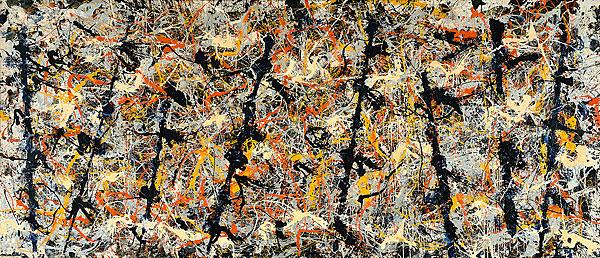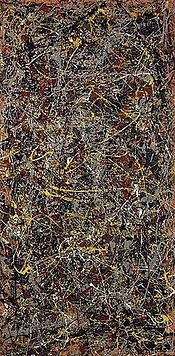
One: Number 31, 1950 — an example of Pollock’s painting.
 by Tom Gurney
Tom Gurney BSc (Hons) is an art history expert with over 20 years experience
Published on October 30, 2026 / Updated on October 30, 2026
Email: tomgurney1@gmail.com / Phone: +44 7429 011000
Jackson Pollock Technique and Materials: Introduction
Jackson Pollock's technique developed through repeated changes of position, material and scale. A canvas could begin on an easel and finish on the floor; brushwork could remain beneath poured paint. Following these changes makes his paintings more interesting: each surface records a particular sequence of decisions. [1]
At a Glance
- ApproachesBrushwork, pouring and dripping
- SurfacesEasel and floor
- Related guidePaintings
Contents
- Before the floor paintings
- Mural: speed within a longer process
- Moving around the canvas
- Different paints, different possibilities
- Flow, gravity and scale
- Drawing with paint and ink
- Reading a surface that has changed
Before the floor paintings
Pollock's training gave him experience of composed, ambitious pictures well before his mature poured works. He entered Thomas Hart Benton's class at the Art Students League in 1930 and pursued drawing, mural work and sculpture during the following years. Mexican mural painting offered another example of how to organise an expansive surface: he saw José Clemente Orozco's Prometheus in California in 1930. In 1936 he participated in David Alfaro Siqueiros's experimental workshop in New York, where modern liquid paints and alternative ways of applying them were explored. These encounters belong to a developing practice, with different lessons becoming useful at different times. [2]
Pouring and dripping already had a history. Alex Dean's account for the National Gallery of Art describes Siqueiros's workshop experiments with spraying, pouring, embedded materials and lacquer, and also identifies Janet Sobel's allover paintings as an impression on Pollock during the 1940s. Pollock's contribution becomes clearer when we ask what he made possible through the sustained use of a fluid line, rather than assigning him the invention of a single gesture. [3]
Surrealism supplied another kind of freedom. Bernice Rose argues that automatic drawing helped Pollock loosen the connection between a line and a predetermined figure. In her account, the hand could invent forms while the picture developed. That freedom could coexist with the ordering of a composition, a tension that matters throughout his later work. [4]
Mural: speed within a longer process
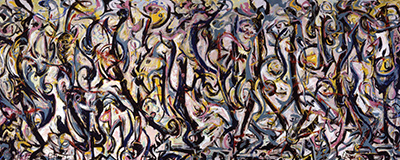
The vast Mural of 1943 shows how much depends on the individual painting. Getty researchers found strong documentary evidence that Pollock worked on a stretched canvas leaning against a wall. Most paint was applied upright. They investigated a stringy pink passage that resembled later poured paint and reproduced a comparable effect by flicking suitably fluid paint at an upright test canvas. Their conclusion makes horizontal working on this particular picture unlikely. A looping or splashed mark, by itself, cannot establish the position of the canvas. [5]
The paint layers tell a similarly particular story. Getty identified an initial application of four diluted colours—lemon yellow, teal, red and umber—worked wet into wet. This first composition may have developed quickly. Many subsequent layers, however, crossed paint that had already dried; Tom Learner explained that days or weeks could have separated sessions. Most of the painting used high-quality artists' oils on Belgian linen, with white house paint introduced late to recover areas of lightness. The familiar story of a complete painting made overnight compresses this layered history into one dramatic event. Speed belongs to part of the evidence; drying, returning and adding belong to it too. [6]
The University of Iowa Stanley Museum of Art identifies the medium as oil and casein on canvas. Casein is therefore part of Mural's material identity, alongside the more detailed distinctions supplied by Getty's research. Even an ordinary museum medium line can remind us that a painting contains more than the one material associated with its maker's reputation. [7]
Moving around the canvas
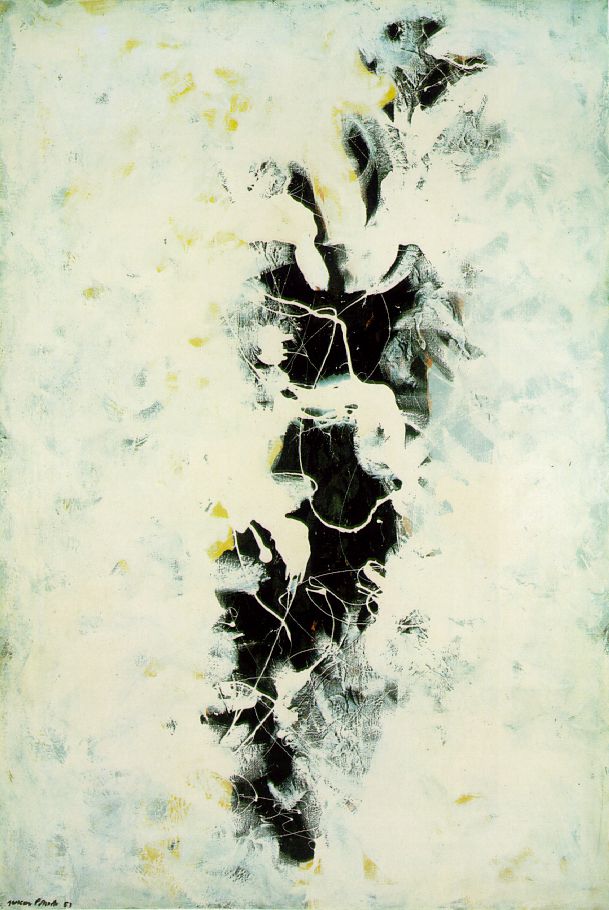
By 1946 Pollock was already working on the floor in a much smaller domestic setting. The Art Institute of Chicago describes The Key as having been made on the floor of an upstairs bedroom, approached from all sides. The work belongs to the Accabonac Creek series and is catalogued as oil on linen. The museum relates its gestural handling and quasi-Surrealist imagery to the later allover compositions. Floor working and the mature poured surface were developing through overlapping experiments: the change of position could precede the particular appearance now associated with it. [8]
Full Fathom Five, made in 1947, carries a transition within its own layers. MoMA describes a beginning on an easel, with paint built up using a brush and palette knife. Pollock embedded objects, including a key, cigarettes and nails, before taking the canvas to the floor and adding black and silver enamel drips. The raised, crowded surface and the lines crossing it belong to different operations. The museum's account lets us follow a painting being changed through its making, while the earlier brushwork continues to contribute to the finished result. [1]
Pollock explained the attraction of unstretched canvas in “My Painting,” published in winter 1947–48: a hard wall or floor offered resistance, and the floor allowed access from four sides. He named sticks, trowels and knives among his tools, and described returning to understand and change a developing picture. His interview with William Wright links altered tools to freedom of movement and stresses learned control of flow: “Technique is just a means of arriving at a statement.” [9]
Different paints, different possibilities
The materials changed within this developing practice. A Peggy Guggenheim Collection study of eleven works dating from 1942 to 1947 documented alkyd binder in the orange paint of Eyes in the Heat, 1946, earlier than researchers had previously established. Glossy and matte black alkyd paints were identified in Alchemy and Enchanted Forest of 1947. The same institutional account describes the transitional impastos of Croaking Movement and Eyes in the Heat as paint squeezed directly from tubes. These results link particular colours and works to particular materials; they do not replace every medium description with “house paint.” Alkyds' drying and flow properties helped open possibilities that differed from those of traditional tube oils. [10]
Francesca Rosi and her colleagues describe alkyd in the black and yellow poured paints of Untitled, 1946, more cautiously, as a possibility. The orange result in Eyes in the Heat securely documents use in 1946. Drawing on earlier analyses, they also report dark blue and dark orange alkyd in Full Fathom Five, alongside artists' oils and oleoresin house paints. Their methodological warning matters: tiny samples and individual measurement points represent only portions of a complex painting. Identifying one binder does not establish the composition of every layer. [11]
In Alchemy, the complexity is also physical. The Peggy Guggenheim Collection's conservation account describes layers of enamel, alkyd resin and oil colours, together with string, sand and small stones. Thick accumulations, splashes and drips create a surface with substantial relief. Research and cleaning carried out with Florence's Opificio delle Pietre Dure, completed in January 2015, addressed accumulated dirt that had dulled the colours and diminished the perception of this depth. Here the materials determine both the original texture and the problems of seeing it after decades of change. [12]
Sea Change offers an especially clear example of revision. Seattle Art Museum reports that Pollock began it in 1946 as a brushed easel painting with blues and pinks. In 1947 he placed it on the floor and transformed it with gravel, aluminium paint and glossy black house paint. Conservation showed that parts of the earlier composition were preserved while others were covered; tube-squeezed colour supplied further adjustments. An earlier painting could thus become the ground for another phase of work. Its surviving forms and later additions ask to be understood together, as a sequence, rather than as one uninterrupted release of feeling. [13]
Watch: Jackson Pollock
Choose a film about Pollock’s paintings and ways of working.
Flow, gravity and scale
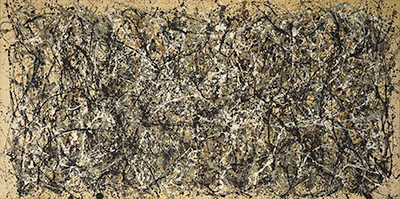
A fluid line carries information about both movement and material. In their first close account of One: Number 31, 1950, MoMA conservators James Coddington and Jennifer Hickey described paint thin enough to stain the canvas, wet layers that mingle, smoother glossy accumulations and thicker passages that dried with wrinkled skins. The same painting contains several relationships between paint and support. A line may remain on the surface or partly enter its fibres; neighbouring wet colours may merge while another application keeps a distinct edge. The effect depends on what the paint does after it has left the tool as well as on the movement that placed it there. [14]
Their later process study found One predominantly industrial paint, with occasional passages of Naples yellow artists' oil, and identified concentrated medium applied separately. Hazy mixing may indicate turpentine introduced onto wet paint. They also argued that late rust-brown drips probably formed while the canvas hung upright; nearby pink spots seemed more likely to be studio accidents. Each proposal answers a local feature. Their comparison with Full Fathom Five, where even some flowing tendrils are artists' oils, shows why appearance alone cannot reliably name a paint. [15]
Scale changes the encounter with these marks. The Kunstsammlung Nordrhein-Westfalen records Number 32, 1950 as Duco lacquer paint on canvas, measuring 269 × 457.5 centimetres. Those measurements describe a surface extending far beyond an ordinary arm's reach. Even before tracing a line, a viewer has to adjust between the extent of the whole and the size of an individual mark. The support is a large field within which marks have their own scale, rather than an enlarged sheet carrying an enlarged image. [16]
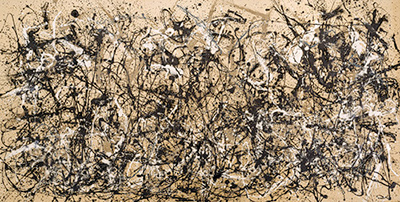
Autumn Rhythm: Number 30, 1950 extends farther horizontally: the Met records a width of 528.3 centimetres and a height of 269.9 centimetres. Its medium is oil-modified alkyd resin on canvas. The museum connects this large-scale work to the muralism of Benton and Siqueiros. That connection makes the format part of the technique's history. Paint could produce a direct, mobile line while the finished canvas retained the ambition of a wall-sized picture; the width asks the eye to move across a field that cannot be absorbed as a single small cluster of gestures. [17]
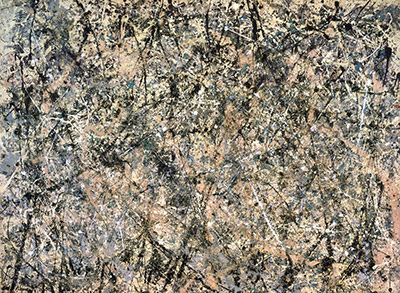
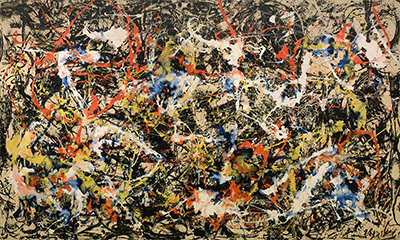
Number 1, 1950 (Lavender Mist) introduces another material and colour relationship. The National Gallery of Art lists oil, enamel and aluminium on canvas, and documents a network of black, white, pale salmon, teal and steel-grey marks against the light ground. Its account describes several means of delivering fluid paint, including sticks, brush handles and pouring from a can. Together with the other large works, it shows the range concealed within the convenient phrase “drip painting”: different combinations of colour, paint and open ground could organise the surface. [3]
Drawing with paint and ink
In Echo: Number 25, 1951, the relationship between tool and canvas becomes particularly intimate. Coddington and Hickey found thin internal spines visible from the reverse within broader black marks. They interpreted these as traces of a turkey baster touching the canvas while pulses of paint spread outward, producing the rhythmic bulges seen from the front. Drawing through contact joins the airborne applications associated with Pollock's better-known working image. [15]
MoMA catalogues Echo as enamel paint on canvas and contrasts its economy with the multidirectional energy of One. The museum also draws attention to its suggestions of figures. A reduced palette brings the divisions between dark marks and exposed ground into sharper play. A line can seem to describe a body and then continue as an independent movement, allowing recognition to arise within the painting's abstract structure. The material practice changes alongside the pictorial question: how much can a black mark suggest, and how much can the ground contribute? [18]
Paper made absorption still more active. In its account of Untitled, approximately 1951, accession 153.1978, MoMA explains that Pollock stacked sheets of absorbent Japanese paper and applied ink to the top one. Ink seeped into the sheets below, producing related compositions with progressively less distinct marks. The work is catalogued as ink and coloured ink on Japanese paper. Its soft-edged pools therefore arise through a relationship between liquid and a permeable support. Repetition takes place through transfer between sheets, with the paper helping to determine the character of each impression. [19]
Rose describes further choices within such sequences: sheets could be removed, reversed and reworked, so an inherited stain might prompt another image. Her discussion distinguishes groups and uses Japanese, rice-paper and mulberry terminology in particular contexts. She also reads the black canvases through changing figure-and-ground relations: black may establish a contour while exposed canvas supplies an edge or shape. Absorbency, scale and the intervals between marks help explain why Pollock's drawings and paintings remain closely connected. [4]
Reading a surface that has changed
Conservation adds another time scale to the story. When MoMA investigated unfamiliar passages on One, the question was whether they belonged to Pollock or to a later intervention. Correspondence suggested restoration in the mid-1960s, before the museum's 1968 acquisition, but did not explain precisely what had been done. A detail photograph taken by art historian Charles Rhyne in 1962 showed the original surface before the disputed paint appeared. Because Pollock had died in 1956, the comparison ruled out his authorship of those additions. A later layer had to be separated historically from the artist's own revisions before it could be assessed materially. [20]
Scientific examination then established how the layers differed. Radiographs showed cracking in original paint beneath overpaint that extended over intact areas. X-ray fluorescence distinguished pigments: in the studied blue passages, the later paint contained cobalt while the corresponding original did not. Binder analysis using Fourier transform infrared spectroscopy identified alkyd in Pollock's original paint and poly(vinyl) acetate in the restoration paint. That chemical distinction made selective removal possible. These findings describe the materials sampled in One and the treatment problem they presented; their value lies in linking visible difference to the painting's documented history. [21]
The treatment account published in May 2013 describes the removal of overpaint after nine months of research and work. The underlying original surface was stable but naturally cracked. Conservators restricted their own retouching to selected deep, separated cracks with old gesso fills, using watercolour to reduce their prominence. They also reduced uneven canvas darkening while accepting remaining signs of age. The result preserved differences within the original surface instead of covering them with a uniformly renewed appearance. Cracking, pigment, canvas and restoration each have a history, and the decision about what should remain visible affects how the composition is read. [22]
Mural had a different conservation history. A 1973 wax-resin lining helped stabilise flaking paint but fixed a sag into the canvas; the accompanying varnish later dulled colours and variations of sheen. During the 2012–14 Getty project, grime and aged varnish were removed and a slightly curved stretcher was made to follow the painted edges. These changes affected the appearance of colour, depth and boundaries. Understanding Pollock's technique therefore includes the material life of each work: how its layers were made, how they aged and how later care changed what viewers can see. [5]
Pollock artworks directory
Explore the distinct works discussed in these guides. This selection is not a complete catalogue. Green Silver and Untitled, 1949 are two guides to the same painting.
Discussion
Look again at the images and ideas explored in Jackson Pollock Technique and Materials. These editorial prompts invite your observations.
Reader Insights
Which detail in “Before the floor paintings” changes how you understand this work?
What comparison comes to mind after “Mural: speed within a longer process”?
What would you like to discuss about “Moving around the canvas”?
Join the Conversation
Share a detail, comparison or question about Jackson Pollock Technique and Materials below.
References
- The Museum of Modern Art, Full Fathom Five, 1947, object 186.1952; 2010–11 gallery label and 2017 course text. View source.
- Elizabeth Levine and Anna Indych, chronology, pp. 317–318, in Kirk Varnedoe with Pepe Karmel, Jackson Pollock (New York: The Museum of Modern Art, 1998), PDF pp. 340–341. View source.
- Alex Dean, “The Energy and Motion of Jackson Pollock's ‘Number 1, 1950 (Lavender Mist)’”, National Gallery of Art, 12 January 2026, “Pollock's Action Painting” and “Making Lavender Mist.” View source.
- Bernice Rose, Jackson Pollock: Drawing into Painting (New York: The Museum of Modern Art, 1980), pp. 13, 20–21; PDF pp. 16, 23–24. View source.
- Getty, “Jackson Pollock's Mural”, project summary, “Prior Conservation,” “Researching Technique,” “Recreating Conditions” and “Conservation Challenges.” View source.
- J. Paul Getty Trust, “Getty Completes Conservation of Milestone Painting by Jackson Pollock”, 21 January 2014, findings on initial colours, subsequent layers and white house paint. View source.
- University of Iowa Stanley Museum of Art, “Jackson Pollock, Mural”, object 1959.6. View source.
- Art Institute of Chicago, The Key, 1946, object 1987.261, institutional collection description and medium record. View source.
- Jackson Pollock, “My Painting,” Possibilities 1 (winter 1947–48), and interview with William Wright, reprinted in Pepe Karmel, ed., Jackson Pollock: Interviews, Articles, and Reviews (New York: The Museum of Modern Art, 1999), pp. 17–18, 20–23. View source.
- Peggy Guggenheim Collection, “New Paints for a New Way of Painting”, institutional summary of the 2013–15 comparative study. View source.
- Francesca Rosi, Costanza Miliani, John Delaney, Kathryn Dooley, Lena Stringari, Grazina Subelyte and Luciano Pensabene Buemi, “Jackson Pollock's Drip Paintings: Tracing the Introduction of Alkyds Through Non-invasive Analysis of Mid-1940s Paintings”, in Science and Art: The Contemporary Painted Surface, ed. Antonio Sgamellotti, Brunetto Giovanni Brunetti and Costanza Miliani (Royal Society of Chemistry, 2020), chapter 1, pp. 1–18, especially pp. 9, 13–16. View source.
- Peggy Guggenheim Collection, “Alchimia” conservation case study, sections on the Opificio delle Pietre Dure and the completed conservation project (Italian). View source.
- Seattle Art Museum, Sea Change, 1947, object 58.55, collection label and medium record. View source.
- James Coddington and Jennifer Hickey, “Looking Closely at One: Number 31, 1950”, MoMA, 8 January 2013. View source.
- James Coddington and Jennifer Hickey, “Insight into the Artist's Process”, MoMA, 17 April 2013, passages on Full Fathom Five, One and Echo. View source.
- Kunstsammlung Nordrhein-Westfalen, Number 32, 1950, inventory 1006, medium and image measurements (German). View source.
- The Metropolitan Museum of Art, Autumn Rhythm: Number 30, 1950, object 57.92, collection commentary and artwork details. View source.
- The Museum of Modern Art, Echo: Number 25, 1951, object 241.1969, medium and gallery label. View source.
- The Museum of Modern Art, Untitled, c. 1951, object 153.1978, medium and 2015–16 gallery label. View source.
- James Coddington and Jennifer Hickey, “One: Number 31, 1950—Characterizing the Paint Surface Part 1: The Archival Record”, MoMA, 22 February 2013. View source.
- James Coddington and Jennifer Hickey, “One: Number 31, 1950—Characterizing the Paint Surface Part 2”, MoMA, 14 March 2013. View source.
- James Coddington and Jennifer Hickey, “Wrapping Up Treatment of One: Number 31, 1950”, MoMA, 29 May 2013. View source.