Jackson Pollock.jpg)
 by Tom Gurney
Tom Gurney BSc (Hons) is an art history expert with over 20 years experience
Published on June 19, 2020 / Updated on October 30, 2026
Email: tomgurney1@gmail.com / Phone: +44 7429 011000
Jackson Pollock Drawings: Introduction
Jackson Pollock’s drawings bring us close to the changing work of his line. Animals, people and signs gather on paper; coloured marks cross them; ink opens into pools. A sheet can be a finished work with its own relationships to the paintings. Untitled (Animals and Figures) is a particularly rich place to begin. [1]
Drawing also offers a different way into Pollock’s scale. A pencil sheet invites attention to the movement of a contour, while a black canvas can carry a drawing across a space larger than the viewer. Pollock himself called his black work “drawing on canvas in black”. The phrase opens a useful question: what does a line do, wherever he places it? [2]
At a Glance
- SubjectsFigures, signs and abstract marks
- MaterialsPencil, ink, gouache and other media
- Related guidePrintmaking
Contents
- Learning to make a figure
- A drawing can stand on its own
- The pressure of War
- Colour changes the space
- Small sheets and a larger gesture
- When the paper carries the ink
- A notebook becomes a sketchbook
- Drawing across canvas
Learning to make a figure
Pollock entered Thomas Hart Benton’s class at New York’s Art Students League in September 1930. His training included mural composition. His early practice included small sketches for proposed murals at Greenwich House that were never executed. Drawing belonged to this practical education in organising bodies and surfaces. Later, in 1939, he repeatedly visited Picasso’s Guernica and its preparatory studies in New York. The encounters brought different kinds of figure making into his working life. [3]
The Met’s three early sketchbooks show how sustained this study could be. It dates Book I to about 1933–38, with forty-five studies largely after El Greco; Book II to about 1937–38, centred on Michelangelo’s frescoes; and Book III to about 1938–39, concerned with Mexican muralism. The museum identifies Rubens and Tintoretto among Pollock’s wider sources, many known through reproductions. It also records visits to Orozco’s murals at Pomona in 1930 and Dartmouth in 1936. Acquired from Krasner’s estate in 1984, the books preserve a different rhythm from a single finished sheet: returning to earlier artists could become a continuing exercise in composition. The Met also holds forty drawings Krasner gave in 1982. [4]
The pencil and coloured pencil Untitled, dated about 1938–41, gives this early period a particular presence. MoMA identifies two hooded figures, one bowing its head and another raising its hands near its face, and connects their interlocking rhythms with José Clemente Orozco. At 35.6 × 27.9 cm, the sheet places this bodily drama within a small vertical format. The museum’s reading directs attention to how gestures fit together: a raised hand and lowered head make an exchange across the composition, even as the surrounding space remains hard to settle. That is a useful starting point for looking at Pollock’s figures as arrangements of moving lines. [5]
A different kind of invention appears in Untitled (Sheet of Studies), about 1939–42, made in black coloured pencil. MoMA distinguishes a bull’s head associated with Picasso from Pollock’s own constellations of stick figures. Its label also connects the juxtaposed signs with his interest in the Surrealist idea of the unconscious, presenting that explanation as a possibility. The sheet’s modest 27.8 × 35.4 cm format holds several kinds of mark together. Following one motif and then another is more rewarding than trying to translate the whole into a single story. An identifiable artistic reference and an invented sign can hold our attention in different ways. [6]
Explore Pollock drawings
 Jackson Pollock.jpg)
 Jackson Pollock.jpg)
 Jackson Pollock.jpg)
 Jackson Pollock.jpg)
 Jackson Pollock.jpg)
 Jackson Pollock.jpg)
 Jackson Pollock.jpg)
 Jackson Pollock.jpg)
 Jackson Pollock.jpg)
 Jackson Pollock.jpg)
 Jackson Pollock.jpg)
A drawing can stand on its own
In Untitled (Animals and Figures), 1942, gouache and ink spread this activity across a sheet measuring 57.1 × 76 cm. MoMA describes simplified creatures and human forms overlaid by brightly coloured lines. It relates the drawing to Stenographic Figure and The She-Wolf, while emphasising its independence. The important relationship is between two kinds of organisation: individual figures offer points of recognition, while the crossing marks draw them into a larger pattern. A shared vocabulary can move between works without making this sheet a plan for either painting. [1]
Bernice Rose’s Jackson Pollock: Drawing into Painting argues that his mature art developed through exchanges between the two media. In her account, poured line could simultaneously draw and build a painted surface. [7]
That makes the drawings rewarding companions to the paintings. Comparisons can begin with a question about a line’s job: does it enclose a body, link separate forms, or lead the eye across the whole work? Looking this way leaves room for the individual sheet to surprise us.
The pressure of War
War, in the Metropolitan Museum of Art, demonstrates how forcefully figure and line can interact. The drawing is inscribed 1947; the museum connects its imagery with Pollock’s work of about 1943–44. Ink and coloured pencils crowd the paper, with red and yellow intensifying the graphic movement. The Met identifies a human figure and bull thrown onto a pyre, alongside a suggested crucifixion, and points to Picasso’s The Dream and Lie of Franco and Guernica as precedents. Its interpretation brings the violence of the imagery together with the violence of its execution. Lines can partly conceal what they describe, requiring us to work through their density before a body becomes legible. The inscription and the earlier visual connections belong together in understanding the drawing’s history. [8]
Colour changes the space
MoMA’s Untitled of 1945, made in pastel, gouache and ink, presents two facing figures in a vertical sheet measuring 77.7 × 56.9 cm. The museum explains a striking reversal: the paper remains white inside the bodies, while blue occupies the interval between them. The spaces around a figure therefore become as insistent as the figure itself. Calligraphic marks and splashes further pull attention towards the paper’s surface. This is a helpful drawing for following the move between recognition and abstraction. Begin with the two figures, then attend to the coloured spaces that give their outlines force. The same contour can make a body readable and divide areas of colour. [9]
Another Untitled, dated about 1945, brings crayon, coloured pencil, ink and watercolour together on a horizontal sheet measuring 51.5 × 63.5 cm. This is MoMA’s accession 662.1983, a different work from the vertical pastel drawing. Its combination of dry and fluid media offers another point of entry into colour on paper. Looking between the two sheets raises questions about the different work a pencil, a crayon and a wash can perform within the same practice. Their materials widen the possibilities of a drawn line. [10]
Rose suggests that the fluid ink and watercolour of certain mid-1940s drawings enabled rhythms harder to achieve with stiff tube paint. She traces connections with Miró and Kandinsky while treating the drawings as a place of formal invention. [7]
Watch: Jackson Pollock
Choose a film about Pollock’s paintings and ways of working.
Small sheets and a larger gesture
For about 1950–51, Rose distinguishes open india-ink drawings from a denser group on similarly sized Japan paper. She proposes that these helped stimulate the black canvases, linking enlarged scale with a change in gesture. That sequence remains her interpretation. [7]
The small works deserve attention at their own size. MoMA’s Untitled, about 1950, accession 663.1983, is catalogued as ink on paper and measures 47.9 × 63.1 cm. Its straightforward description provides a useful anchor among the many untitled sheets. It can be approached alongside the larger canvases without having to turn it into a miniature version of one of them. The paper gives a different compass to the encounter: the eye can take in the sheet, return to a passage and follow the line again within an intimate field. [11]
Scale also changes from canvas to canvas. MoMA’s Number 7, 1950 is only 58.5 cm high but extends to 268.6 cm in width. Its oil, enamel and aluminium paint lie over a rust-orange ground. The museum relates the long format to Pollock moving from end to end, distinguishing this movement from the work around larger, squarer canvases. Placed beside drawings, the painting makes format an active part of the discussion. A line can invite a long sideways journey or gather movement into a more compact space. The dimensions help us understand why reproductions reduced to similar sizes can conceal important differences between works. [12]
When the paper carries the ink
In Untitled, about 1951, MoMA’s accession 153.1978, ink and coloured ink meet Japanese paper across a sheet measuring 62.1 × 87.3 cm. The museum describes a procedure in which Pollock stacked absorbent sheets, put ink on the uppermost one and allowed it to pass downwards. Related compositions appeared on the lower sheets with less distinct marks. Here the paper participates in the making: its absorbency carries the image beyond the first surface. The museum connects the process with the drawing’s pooled ink and soft edges. A mark can therefore record both Pollock’s application and what happened as liquid travelled through the support. [13]
The contrast between ink travelling into paper and enamel building a painted surface makes the support part of the comparison, alongside the gesture. [13] [3]
The 1980 exhibition checklist groups related sheets under the term mulberry paper and records further work on transferred images, including reversals from front to back and changes in orientation. It also separates these from Japan-paper works and from drawings on Howell paper. A transferred image could acquire further marks, become a mirror image, or be turned upside down before more work began. The checklist includes watercolour, ink and gesso on Howell paper, as well as black ink on pink paper: colour could enter through the support as well as through an added mark. Its grouped drawings reveal repeated engagements with an image as it passed from one sheet to another and became available for another decision. [14]
Rose reconstructs sequences of transferred and reworked sheets, interpreting poured ink as a renewed wash technique. She also describes coloured fibres becoming part of other drawings and tentatively identifies contact-made marks in a 1951 sheet. Paper, wash and touch remain active variables in her account. [7]
These drawings invite a slower kind of looking. Follow the edge of a pool, the space left around it and the way a line continues across the sheet. The question becomes how a particular mark belongs to its particular surface.
A notebook becomes a sketchbook
The Morgan Library & Museum’s Sketchbook, 2010.130, brings drawing back to the bound page. Its early names, notes and doodles suggest that Pollock first used it as a telephone pad. The last fourteen pages contain ink drawings that the Morgan describes as predominantly abstract, with suggestions of animals, stars, waves and an eye. The museum relates these to his black, partly figurative paintings of 1951. Porous-point pen, black and blue inks, grey wash and graphite on Asian paper gave this small book its own range of marks. Its leaves measure about 14.3 × 30.1 cm. [15]
The book is undated. The Morgan catalogues it about 1950–53, reporting William S. Lieberman’s proposal of 1950 to no later than 1953 alongside the catalogue raisonné’s broader about 1950–56 range. A note dated 22 May 1950 helps establish its use as a notebook; it does not date every drawing. The changing use of its pages gives a particularly intimate setting to the continuing encounter between an abstract mark and a recognisable form. [15]
Drawing across canvas
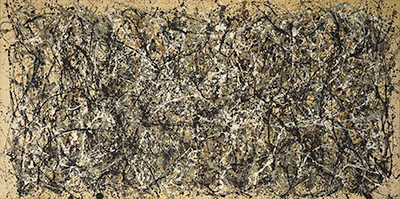
Echo: Number 25, 1951 brings that question back to painting. Its medium is enamel on canvas, and it measures 233.4 × 218.4 cm. MoMA stresses its economy and its approach towards figuration when comparing it with the previous year’s One. Pollock’s description of drawing on canvas gives a name to an activity already capable of crossing the boundary between media. The canvas asks for a different bodily encounter from a sheet held close, while preserving the possibility that a line may begin to suggest a figure. [2]
Pouring also coexisted with more direct contact. In his discussion of Full Fathom Five, Kirk Varnedoe describes squeezed or brushed final strokes responding to earlier poured paint. That mixture of procedures makes it worth following the particular mark before imagining the hand’s distance from the surface. The broader account of Pollock’s technique explores these material differences. [3]
Works on paper lead towards another medium too. MoMA’s printmaking exhibition account follows Pollock from lithography in the 1930s into engraving and screenprinting, emphasising his experiments with line, coloured inks and papers. The prints give this exploration a further material setting. They reward attention to how an image is made and transferred, just as the stacked ink drawings do, although their processes differ. [16]
For a first route through the drawings, start with the early hooded figures and Sheet of Studies, then spend time with Animals and Figures and the vertical 1945 Untitled. Move next to the ink drawings and finally compare them with Echo. At each stage, ask what the line allows you to recognise and what it sets in motion. The changing answer gives each work its own reason to hold our attention.
Pollock artworks directory
Explore the distinct works discussed in these guides. This selection is not a complete catalogue. Green Silver and Untitled, 1949 are two guides to the same painting.
Discussion
Look again at the images and ideas explored in Jackson Pollock Drawings. These editorial prompts invite your observations.
Reader Insights
Which detail in “Learning to make a figure” changes how you understand this work?
What comparison comes to mind after “A drawing can stand on its own”?
What would you like to discuss about “The pressure of War”?
Join the Conversation
Share a detail, comparison or question about Jackson Pollock Drawings below.
References
- MoMA, Untitled (Animals and Figures), 1942, 12.1958; object record and 2015–16 gallery label. View source.
- MoMA, Echo: Number 25, 1951, 241.1969; object record and gallery label. Letter corroborated in Levine–Indych chronology, p. 326. View source.
- Elizabeth Levine and Anna Indych, chronology, pp. 317, 319; Kirk Varnedoe, essay, p. 50, in Jackson Pollock, MoMA, 1998. View source.
- Department of Modern and Contemporary Art, “Jackson Pollock’s Sketchbooks and Other Works on Paper at The Met”, digital feature accompanying Krasner and Pollock: Past Continuous, Metropolitan Museum of Art, 2026; introduction and sketchbook descriptions. View source.
- MoMA, Untitled, c. 1938–41, 665.1983; object record and 2015–16 gallery label. View source.
- MoMA, Untitled (Sheet of Studies), c. 1939–42, 712.1980; object record and 2015–16 gallery label. View source.
- Bernice Rose, Jackson Pollock: Drawing into Painting, MoMA, 1980, pp. 8–9, 14–15, 19, 21–22. View source.
- Metropolitan Museum of Art, War, 1982.147.25; object record and curatorial commentary. View source.
- MoMA, Untitled, 1945, 13.1958; object record and 2015–16 gallery label. View source.
- MoMA, Untitled, c. 1945, 662.1983; object record. View source.
- MoMA, Untitled, c. 1950, 663.1983; object record. View source.
- MoMA, Number 7, 1950, 719.1993; object record and 2015–16 gallery label. View source.
- MoMA, Untitled, c. 1951, 153.1978; object record and 2015–16 gallery label. View source.
- MoMA, Jackson Pollock: Drawing into Painting, final checklist, 1980, PDF pp. 9–12, entries 45–84. View source.
- Morgan Library & Museum, Sketchbook, c. 1950–53, 2010.130, Thaw Collection; object record and Notes. View source.
- MoMA, “Rare Prints by Jackson Pollock on View at The Museum of Modern Art”, 1998, PDF p. 1. View source.