


 by
Tom Gurney
Tom Gurney BSc (Hons) is an art history expert with over 20 years experience
Email:
tomgurney1@gmail.com
/ Phone:
+44 7429 011000
Ajax by John Steuart Curry: Introduction
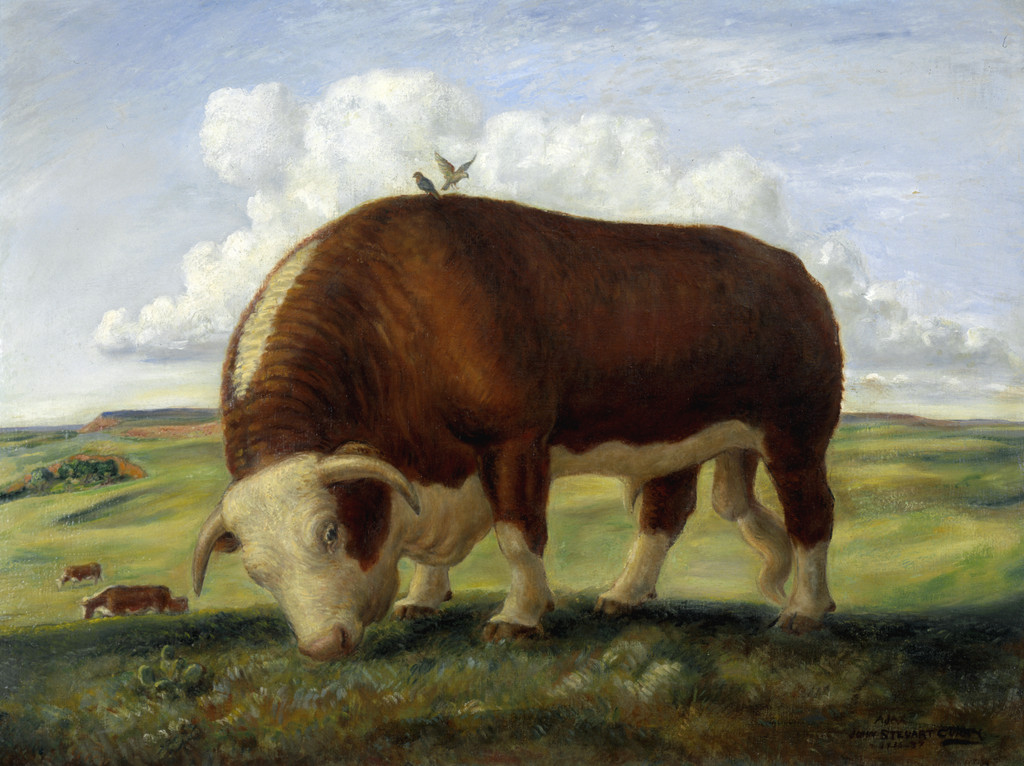
A huge bull lowers its head into a green pasture while two tiny birds occupy the space above its back. John Steuart Curry’s Ajax gives an ordinary grazing animal the scale and presence of a monumental portrait. The contrast between its massive body, the birds and the distant herd makes the subject both imposing and quietly playful.
The Smithsonian American Art Museum dates the oil painting to 1936–37. It measures 92 by 122.5 centimetres and entered the collection as a gift from Peter and Paula Lunder, accession 2001.95. A related lithograph predates this canvas, showing that Curry developed the bull’s image across different works and media. [1]
At a Glance
- Artist John Steuart Curry, 1897–1946.
- Title Ajax .
- Date 1936–37.
- Medium Oil on canvas.
- Dimensions 36¼ × 48¼ inches, or 92 × 122.5 centimetres.
- Collection Smithsonian American Art Museum, Washington, DC.
- Credit Gift of Peter and Paula Lunder.
- Object number 2001.95.
- Related print Amon Carter Museum of American Art, 1983.32, dated 1931, printed 1932.
This work across John Steuart Curry’s career
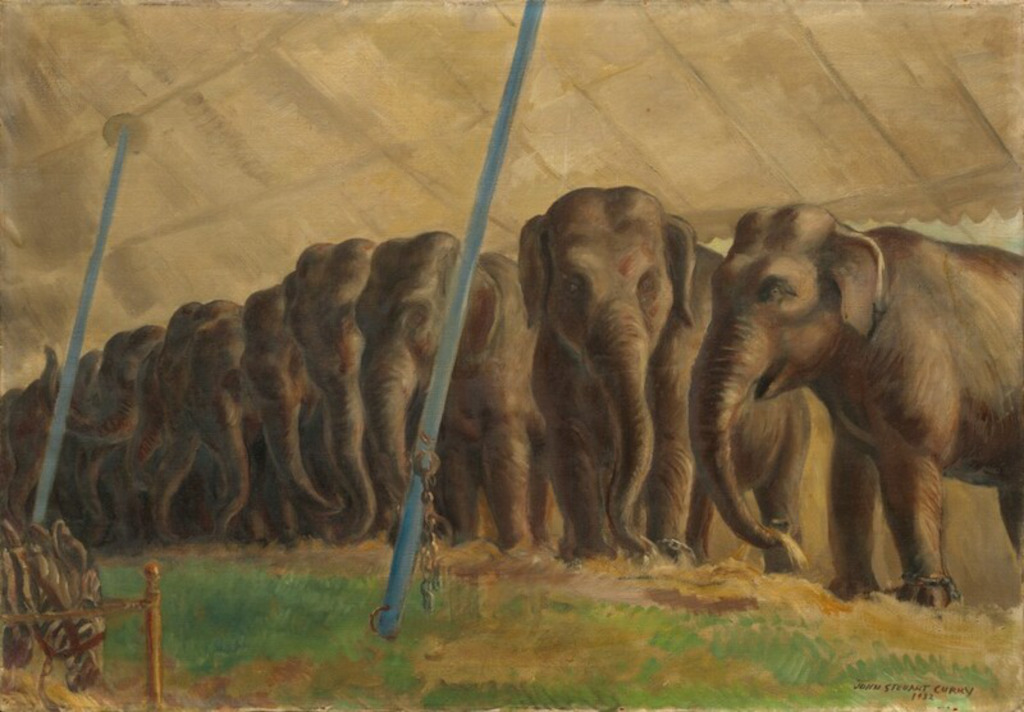
Circus Elephants
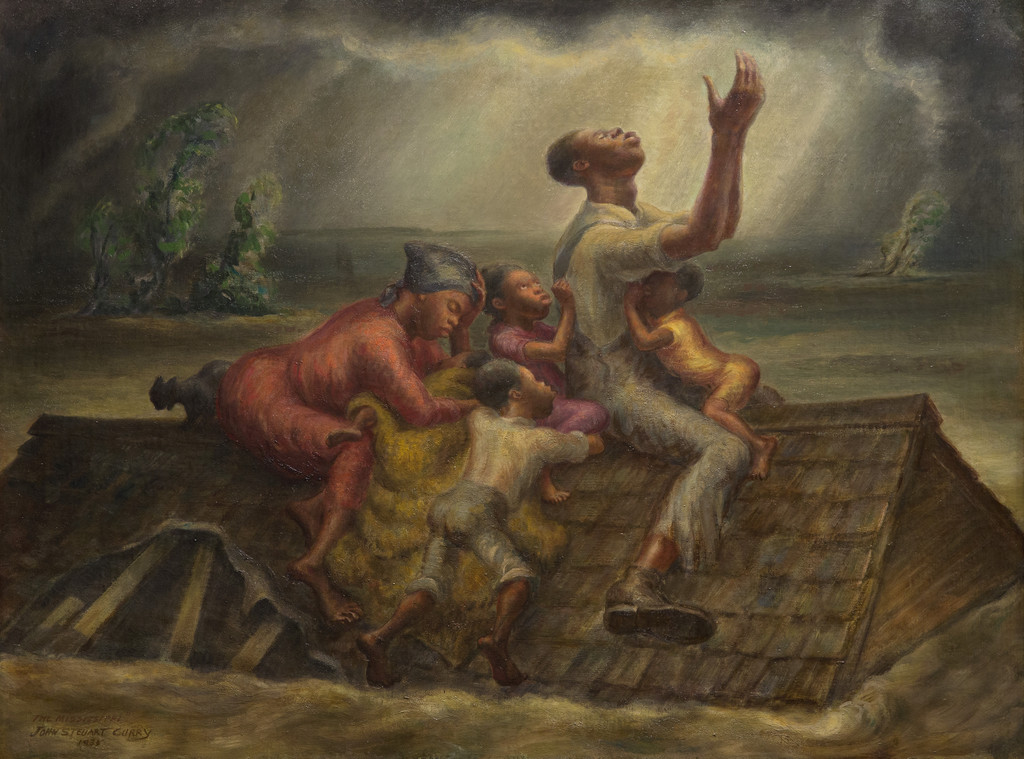
1932 paintingThe Mississippi
1935 paintingAjax (current article)
1936–37 oil paintingTragic Prelude
1938–40; project 1937–42Wisconsin Landscape
1938–39Our Good Earth
1942 oil paintingNotes and sources
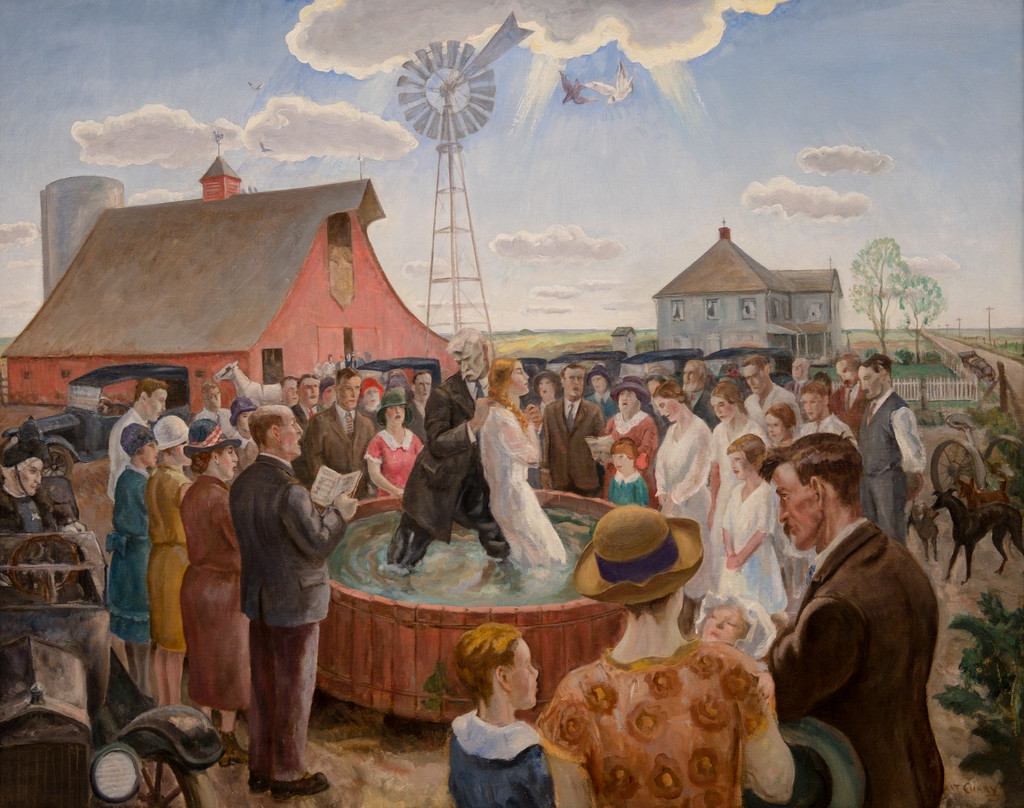
Baptism in Kansas. A remembered Kansas ceremony is staged within a working farmyard. [2]
Tornado Over Kansas. A Kansas storm and a family seeking shelter, painted in Curry’s Westport studio. [3]
Circus Elephants. Elephants and handlers occupy the working space beneath a circus tent. [4]
The Mississippi. A family occupies a roof amid floodwater; the painting is tempera on canvas mounted on panel. [5]
Ajax (current article). The monumental bull in the Smithsonian oil differs from the earlier lithograph. [1]
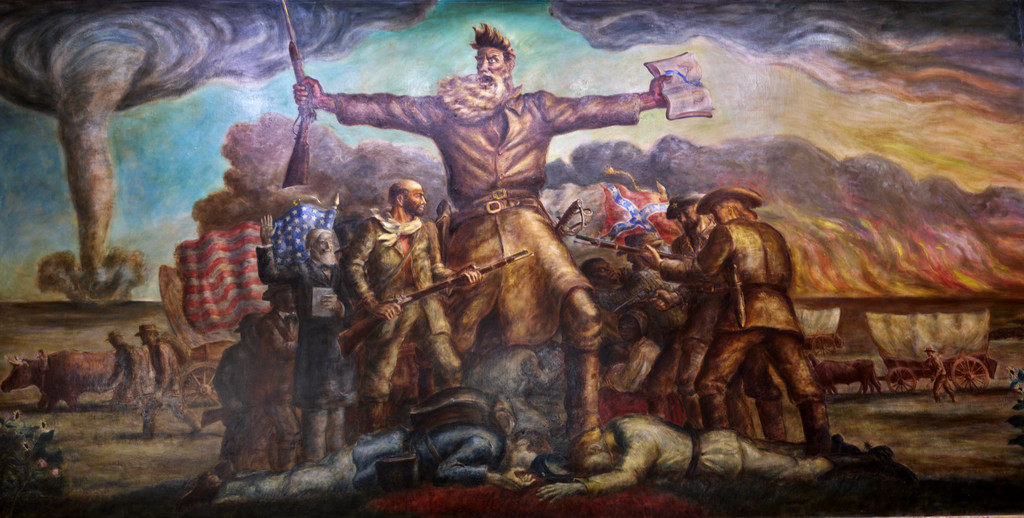
Tragic Prelude. John Brown stands at the centre of a Kansas State Capitol mural continuing across adjoining walls. [6]
Wisconsin Landscape. An extensive farm panorama, distinct from the separately catalogued preparatory study. [7]
Our Good Earth. The Chazen painting is distinct from the watercolour study, lithographs and wartime posters. [8]
Contents
- A bull that fills the landscape
- Weight, lowered head and grazing movement
- Cowbirds and the comparison of scales
- Clouds, pasture and the farm setting
- The title and the museum’s mythological reading
- An earlier image in lithography
- Animals across Curry’s work
- Annotated details
A bull that fills the landscape
The animal’s body stretches across most of the picture. Its high back stands against the sky, while its head reaches down toward the lower edge. This arrangement makes the bull dominate both the horizontal and vertical dimensions of the scene. There is room for a landscape around it, but very little doubt about where attention belongs.
Its reddish-brown coat forms a broad area of warmth against the cooler pasture and pale blue sky. White markings beneath the body and across the face interrupt that mass. The legs remain visible enough to establish its stance, while the rounded flank and shoulders give the torso a weight far greater than that of the distant animals.
The low horizon reinforces this effect. Much of the bull rises above the line where land meets sky, so the body appears to belong partly to each. The pasture places it in a working agricultural environment; the open sky gives its silhouette the clarity of an emblem.
The painting’s size makes this treatment more than a small animal vignette. A canvas approximately four feet wide allows the bull to command substantial wall space. Curry gives a farm animal the kind of concentrated attention that a commanding human figure might receive in a portrait.
Annotated Details from Ajax
The numbered points identify visible features discussed in this article. Return from each detail to the whole composition. The captions keep each work’s identity, date and medium separate.
Ajax - 1936-37 oil
John Steuart Curry, Ajax, 1936–37, oil on canvas. Smithsonian American Art Museum, 2001.95. Image source. CC0 / public domain. Editorial numbers added to the overview; detail crops retain the source image’s appearance.
Ajax - 1931 lithograph printed in 1932
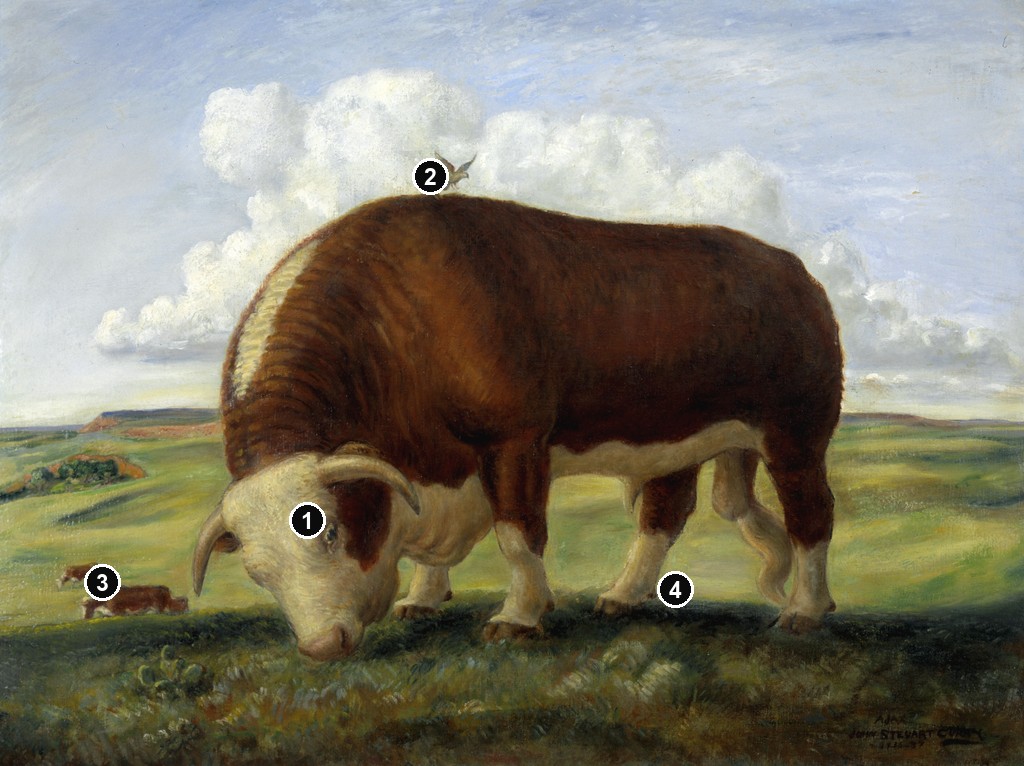
John Steuart Curry, Ajax, 1931, printed 1932, lithograph. Amon Carter Museum of American Art, 1983.32. The earlier print differs from the 1936–37 oil. Image source. Public domain. Editorial numbers added to the overview; detail crops retain the source image’s appearance.
Details from AJAX
Compare the separately identified oil painting and earlier lithograph. The changed orientation and tonal treatment belong to different works.
Ajax - 1936-37 oil
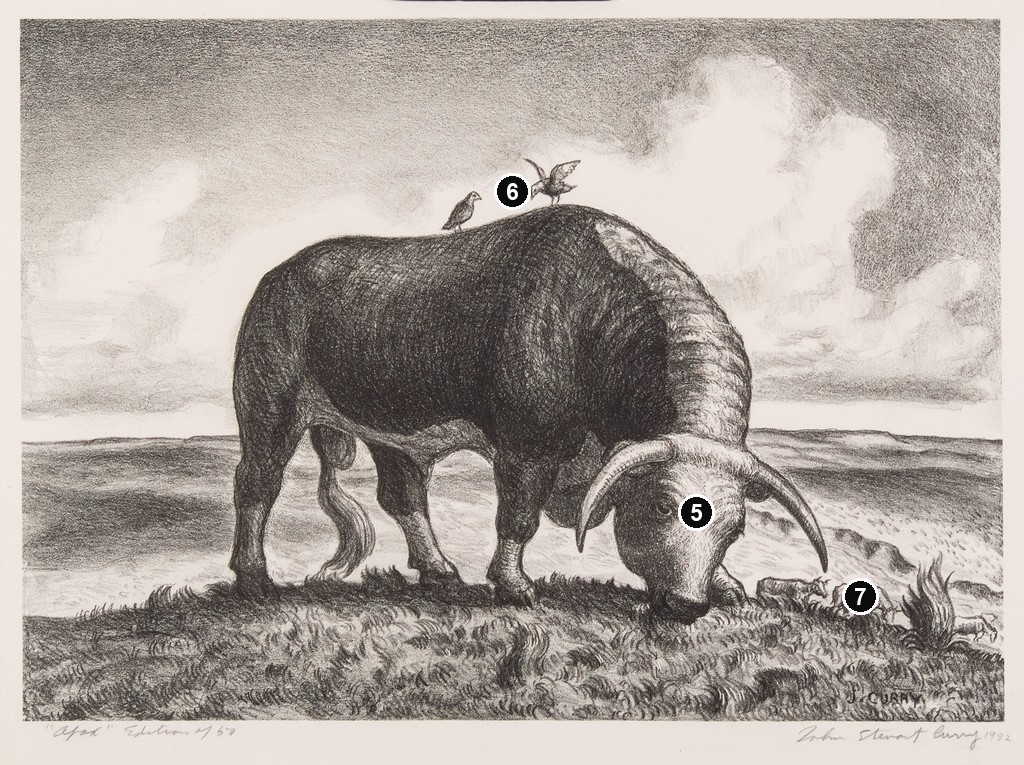
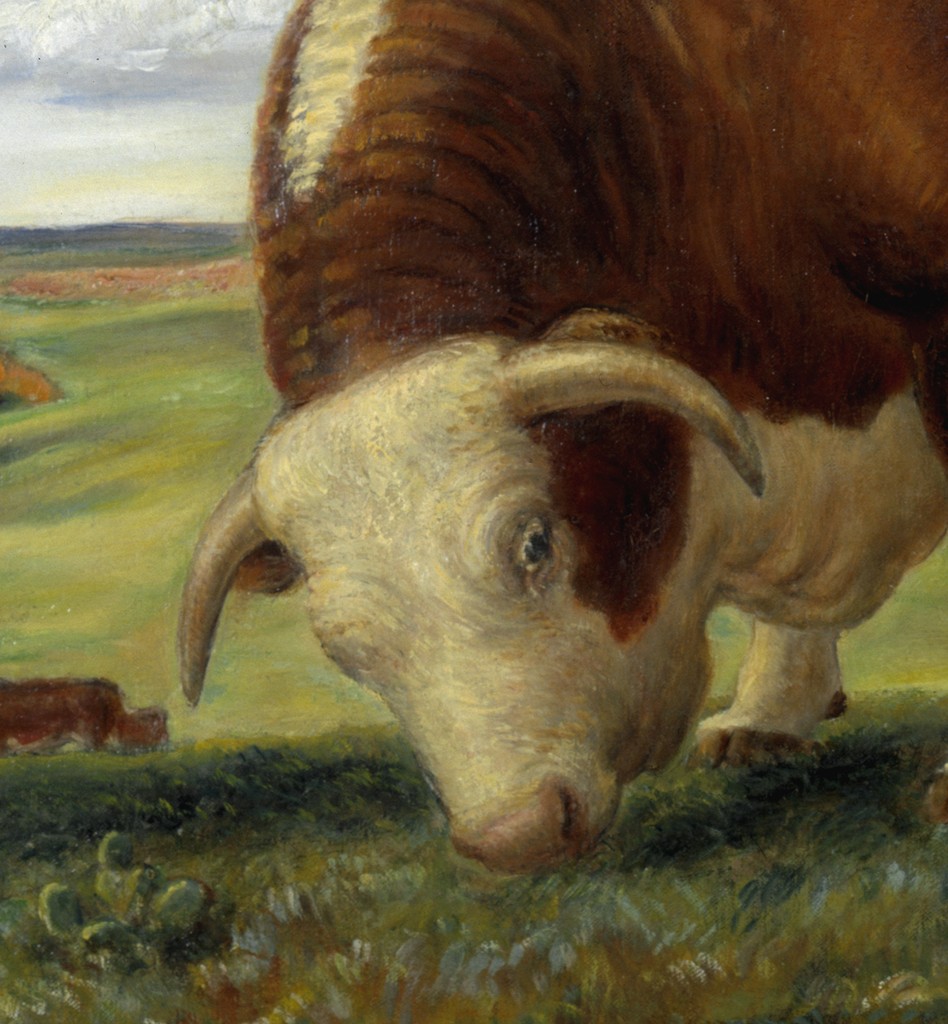
The lowered head and curved horns
The pale face and sweeping horns turn down towards the pasture. The lowered head gives the bull a grazing action while preserving the animal’s great physical weight.
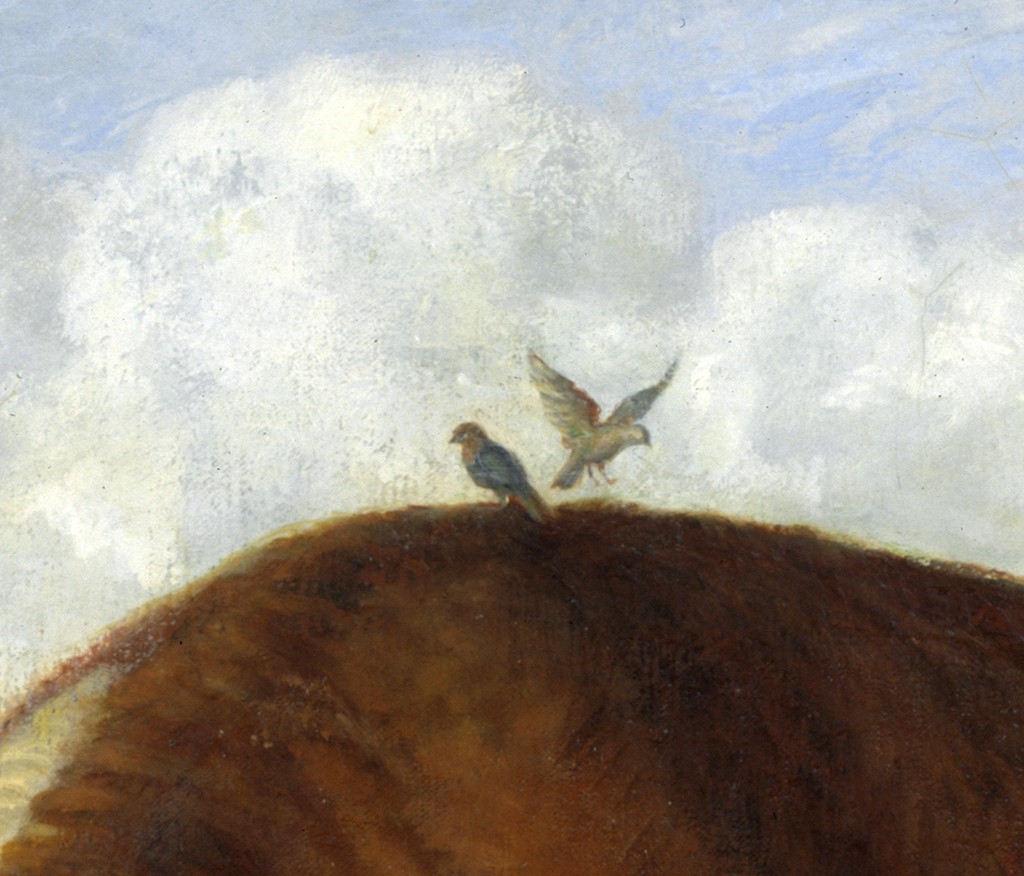
Small birds above the back
Two small birds interrupt the bull’s broad upper contour. Their delicate shapes provide a compact comparison with the heavy body beneath them.
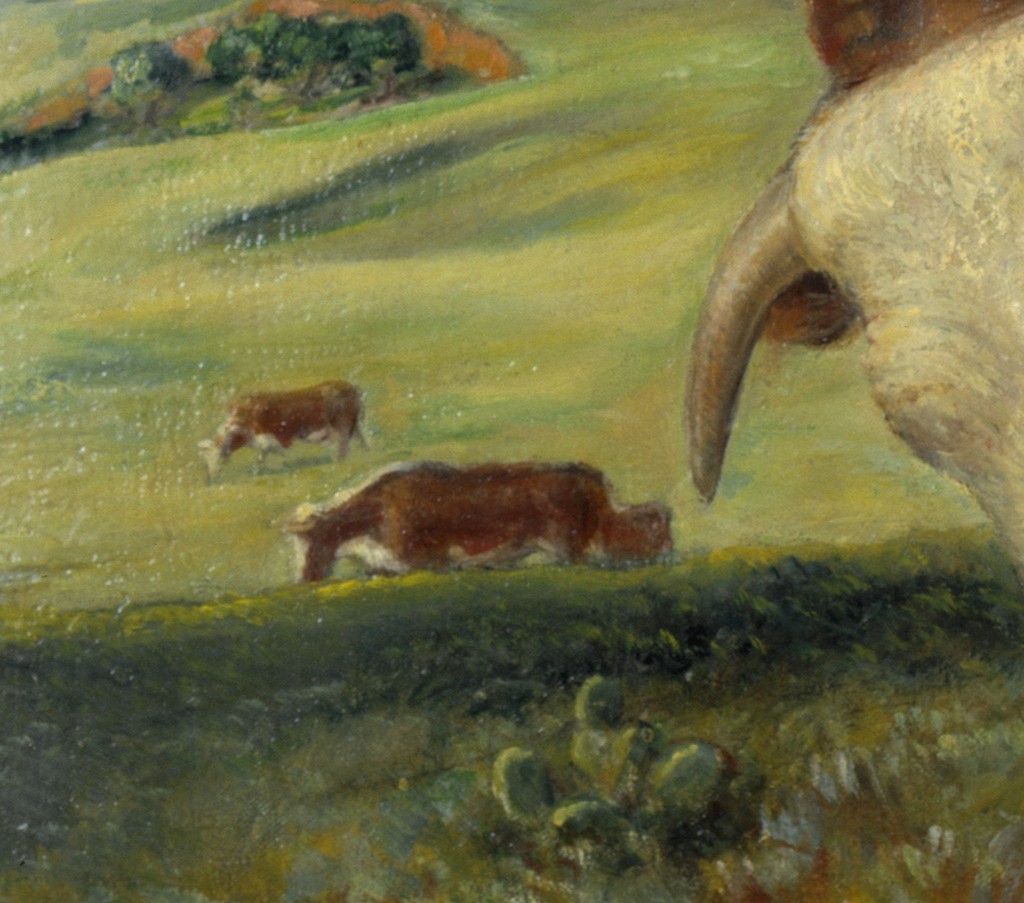
Distant cattle in the pasture
The much smaller cattle at the left establish another scale within the landscape. Their distance makes the foreground bull appear still more substantial.
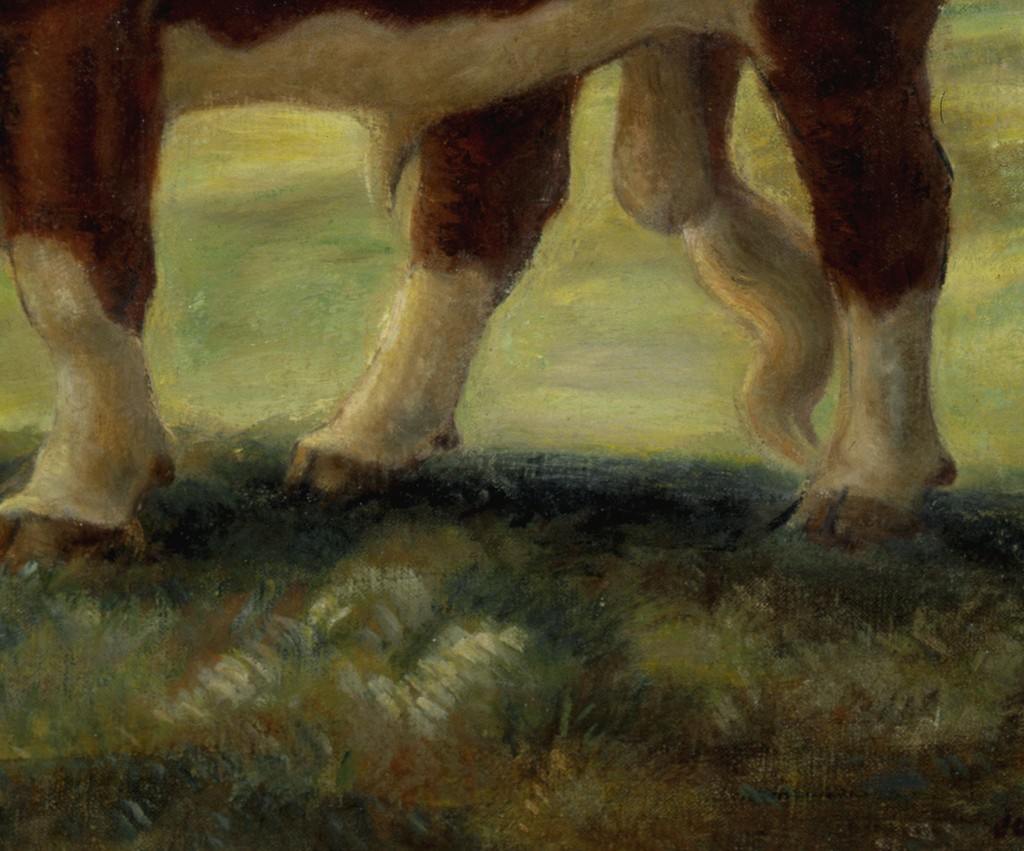
Legs, pale underside and shadow
The pale underside and lower legs separate the animal from the dark patch of ground. This meeting of body and shadow helps anchor the large figure in the pasture.
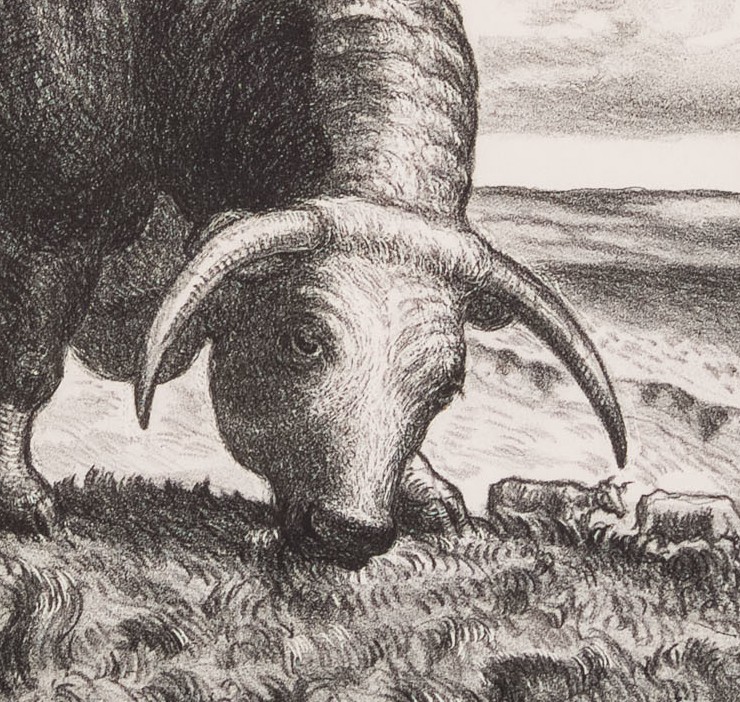
Ajax - 1931 lithograph printed in 1932
The head turns towards the right
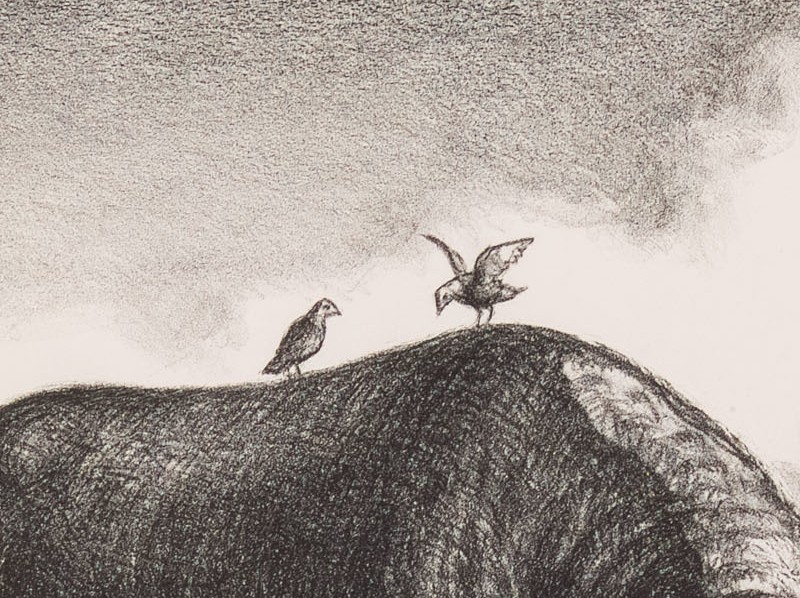
In this lithograph the bull’s head descends towards the right, reversing the broad orientation seen in the later oil. Horns and the pale face remain central to the animal’s forceful outline.
Birds and the shaded upper contour
Small birds stand against the open sky above the bull’s dark back. Their outlines and the changing density of printed marks give scale to the broad form below.
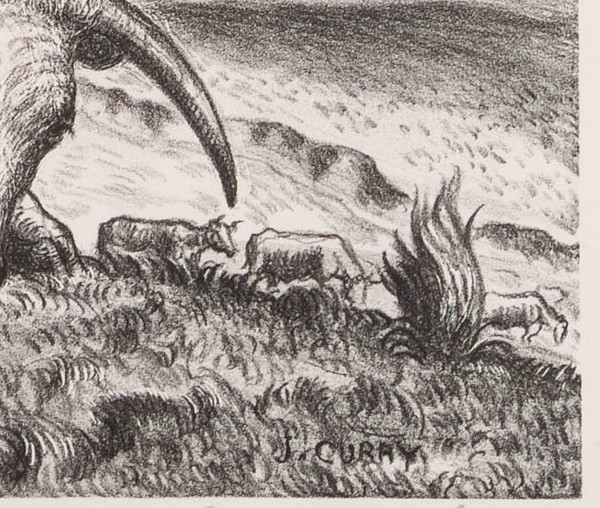
Small cattle beyond the foreground
Small cattle appear beside the foreground animal’s lowered head. The contrast between these distant bodies and the densely marked nearer bull organizes the pasture through differences of size and tone.
Weight, lowered head and grazing movement
The lowered head brings the animal close to the viewer. Its pale forehead and muzzle are large enough to compete with the broad brown torso. The horns frame the face, while the visible eye adds a point of alertness within an otherwise downward-directed movement.
The angle of the neck is important to the impression of weight. It carries the body’s mass toward the ground rather than lifting the head into a conventional heroic pose. The bull remains impressive while doing something ordinary. Strength is made visible through grazing, planted feet and bodily volume.
The ground beneath it is darker than the pasture farther away. This shadowed foreground helps anchor the legs and muzzle, while the lighter distance opens behind them. The animal seems close enough to interrupt the viewer’s access to the wider field, even though the eye can still move around its outline.
The small herd at the left supplies another measure of size. Those animals occupy the same general kind of setting, but their reduced scale makes the central bull seem extraordinary. The contrast turns physical proximity into pictorial importance: the nearer animal becomes the subject through which the rest of the pasture is understood.
Cowbirds and the comparison of scales
The birds make the bull’s bulk especially apparent. One sits on its back, while the other lifts its wings just above it. Their small bodies remain clearly distinguishable against the light cloud. The huge animal provides them with a place to perch without losing its own unhurried presence.
The Smithsonian identifies them as cowbirds and describes their feeding on insects around the bull. That account introduces a practical relationship between the animals, alongside the visual contrast in their sizes. The birds belong to the same inhabited pasture, even though their movements are very different from those of the grazing bull. [1]
Their positions also direct attention toward the upper contour. Following the body from the lowered head up the neck leads to the back and the two small interruptions above it. The birds keep that large outline from becoming entirely static. They add a quick, delicate rhythm to a composition otherwise dominated by weight.
The difference can make the picture humorous without turning the bull into a caricature. Something so substantial appears undisturbed by such small companions. The painting allows the viewer to notice that disproportion while continuing to take the animal’s physical presence seriously.
Clouds, pasture and the farm setting
The land rolls away behind the bull in green and yellow bands. Its openness gives the central body room to stand out, while the distant herd keeps the scene connected with agricultural life. The setting offers context without introducing a busy narrative that could compete with the animal.
Large white clouds rise behind the back and shoulders. Their pale masses repeat something of the body’s rounded shape, but their lighter colour and broken edges produce a very different effect. Solid flesh and open sky meet along a strong contour.
The foreground remains more varied. Plants, shadows and patches of colour surround the head and feet, giving the bull an immediate environment rather than an empty platform. These nearer details lead into the larger, simpler shapes beyond them. The picture combines close attention to one animal with a broad sense of open country.
Watch: John Steuart Curry
Choose a film to explore the artist’s work, its interpretation and its wider setting.
Look at This: John Steuart Curry at MOWA
An exhibition interview with Graeme Reid considers Curry’s work and life in Wisconsin.
Watch on YouTubeThe title and the museum’s mythological reading
The Smithsonian connects the title with Ajax of the Trojan War, whose madness led him to attack cattle after mistaking them for enemies. Its interpretation imagines a reversal of that story: the bull stands between the viewer and the herd, with an eye that might suggest the animals could take their revenge. [1]
This reading introduces an undercurrent of danger into the pastoral scene. The lowered head and alert eye can then appear more complicated than signs of contented feeding. The myth makes the title a prompt to look again at an animal that might initially seem entirely reassuring.
The museum also reads the green pasture and well-fed cattle as a response to Americans’ exhaustion during the Dust Bowl years. Those are curatorial interpretations of the image’s wider meaning. They can illuminate its mixture of abundance, strength and unease without being presented as a surviving statement of Curry’s precise intention.
An earlier image in lithography
The Amon Carter Museum of American Art owns a lithograph titled Ajax , accession 1983.32, dated 1931 and printed in 1932. Its bull lowers its head toward the right, reversing the general orientation seen in the later oil painting. The birds remain above the back, while smaller cattle appear in the background at the right. [9]
The print uses strong dark areas and lighter passages to give the body volume. Its pale face stands out against the darker torso, and the cloud forms provide a light background around the upper silhouette. The shared motif is recognizable, but the medium and orientation make it a separate pictorial encounter.
Below the image, the reproduced Carter impression retains the pencilled title and Curry’s signature with the year 1932. These marks place the composition within the physical life of a print. The dark animal and pale sky occupy a bounded image area, while the writing sits outside it, giving the viewer another way to encounter the work as an object rather than only as a scene.
The Carter’s catalogue also contains an unresolved discrepancy: its edition field gives twenty-five, while the inscription transcription records fifty. Both statements belong to the record and should be distinguished. Neither number describes the Smithsonian oil painting, and neither is a reason to assume that every work titled Ajax has the same production history. [9]
The National Gallery of Art holds another lithograph under the title, dated 1932, accession 1991.116.28. Its record identifies black printing on Rives BFK paper. These early print records matter because the lithograph cannot simply be described as a reproduction made after the Smithsonian’s 1936–37 canvas. [10]
Comparing the works reveals a sustained interest in the subject. Curry returned to the relationship between the large bull, the birds and the open pasture, while allowing their presentation to change. Recognizing that continuity does not require treating the separate prints and oil as one object with interchangeable dates.
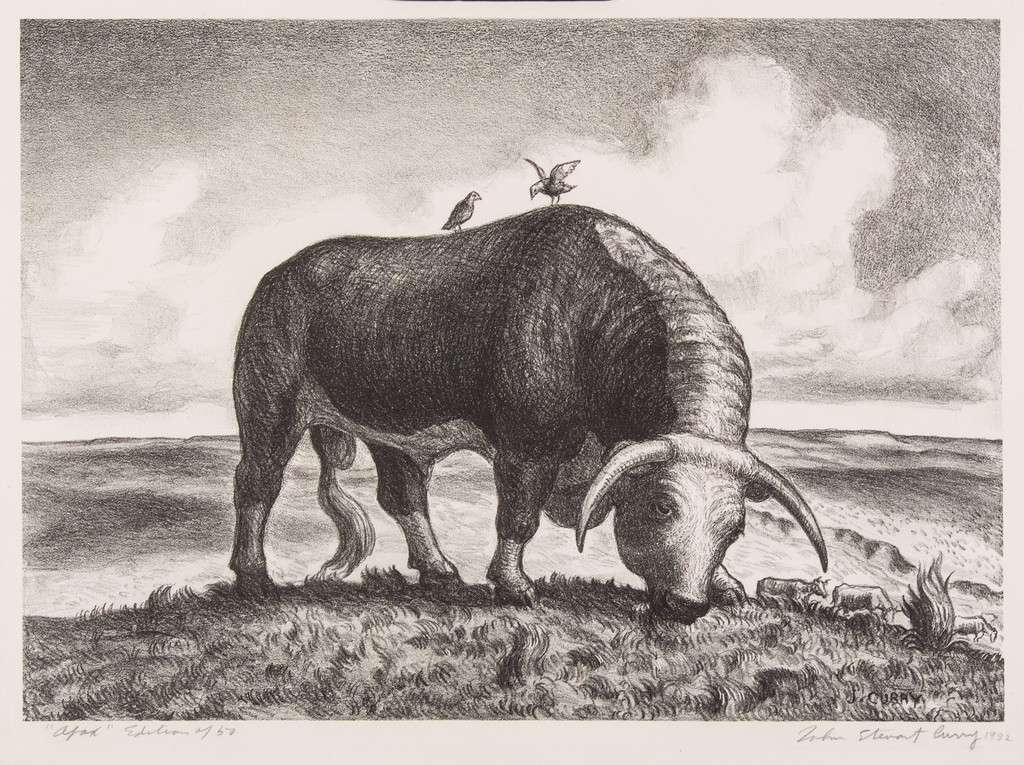
John Steuart Curry, Ajax, 1931, printed 1932, lithograph. Amon Carter Museum of American Art, 1983.32. The earlier print differs from the 1936–37 oil.
Image source
.
Public domain
. Proportionally resized; original appearance retained.
Animals across Curry’s work
Ajax belongs beside other works in which Curry gives animals substantial pictorial attention. His 1932 Circus Elephants places them within a travelling spectacle, an environment distinct from the open pasture. The National Gallery’s account connects that painting with his journey alongside the circus. [11]
The comparison shows how much the setting contributes to an animal subject. In Ajax , the low horizon, green land and small herd make the bull part of an agricultural world. Its huge body carries the picture’s force, but the birds and title keep that force from becoming a single uncomplicated message. The result can sustain admiration, amusement and uncertainty within one apparently simple scene.
Artworks and versions directory
Browse 84 selected object, version, edition and reproduction records. Several concern related images or different impressions; this is not a complete lifetime catalogue or a count of unique compositions. Search also finds prints, photographs and reproductions; the medium filter groups paintings and drawings.
Frequently Asked Questions
The Smithsonian dates the oil painting to 1936–37. The related lithographs belong to an earlier stage of his work on the subject.
It belongs to the Smithsonian American Art Museum, accession 2001.95. Collection ownership does not guarantee current display.
The Smithsonian identifies them as cowbirds and interprets their presence through their feeding relationship with the bull.
No. The Carter and National Gallery lithographs are separate prints. The Smithsonian owns the later oil painting on canvas.
Discussion
Look again at the images and ideas explored in Ajax by John Steuart Curry. These editorial prompts invite your observations.
Reader Insights
How do the small birds affect your sense of the bull’s scale and character?
Does knowing the mythological interpretation change the way you read the lowered head and eye?
What changes when the bull faces the other direction in the lithograph?
Join the Conversation
Share a detail, comparison or question about Ajax by John Steuart Curry below.
References
- Smithsonian American Art Museum , Ajax, 1936–37, oil on canvas, 2001.95: metadata and curatorial interpretation. View source
- Whitney Museum of American Art, John Steuart Curry | Baptism in Kansas | Whitney Museum of American Art. View source
- Muskegon Museum of Art, Tornado Over Kansas - Muskegon Museum of Art. View source
- National Gallery of Art, Circus Elephants: collection object record. View source
- Saint Louis Art Museum, The Mississippi,1935,7:1937: collection record and provenance. View source
- Kansas Historical Society, Kansas State Capitol - Online tour - Tragic Prelude - Kansas Historical Society. View source
- Metropolitan Museum of Art, Wisconsin Landscape. View source
- Chazen Museum of Art, Our Good Earth | 1873 |Chazen Museum of Art. View source
- Amon Carter Museum of American Art , Ajax, 1931, printed 1932, lithograph, 1983.32: catalogue, inscriptions and public-domain record. View source
- National Gallery of Art , Ajax, 1932, lithograph in black on Rives BFK paper, 1991.116.28. View source
- National Gallery of Art , Circus Elephants, 1932: American Paintings, 1900–1945 online edition, essay on the circus journey. View source
- Splash image source.
John Steuart Curry, Ajax, 1936–37, oil on canvas. Smithsonian American Art Museum, 2001.95. CC0 / public domain . Proportionally resized; original appearance retained.
View source
More CURRY Paintings
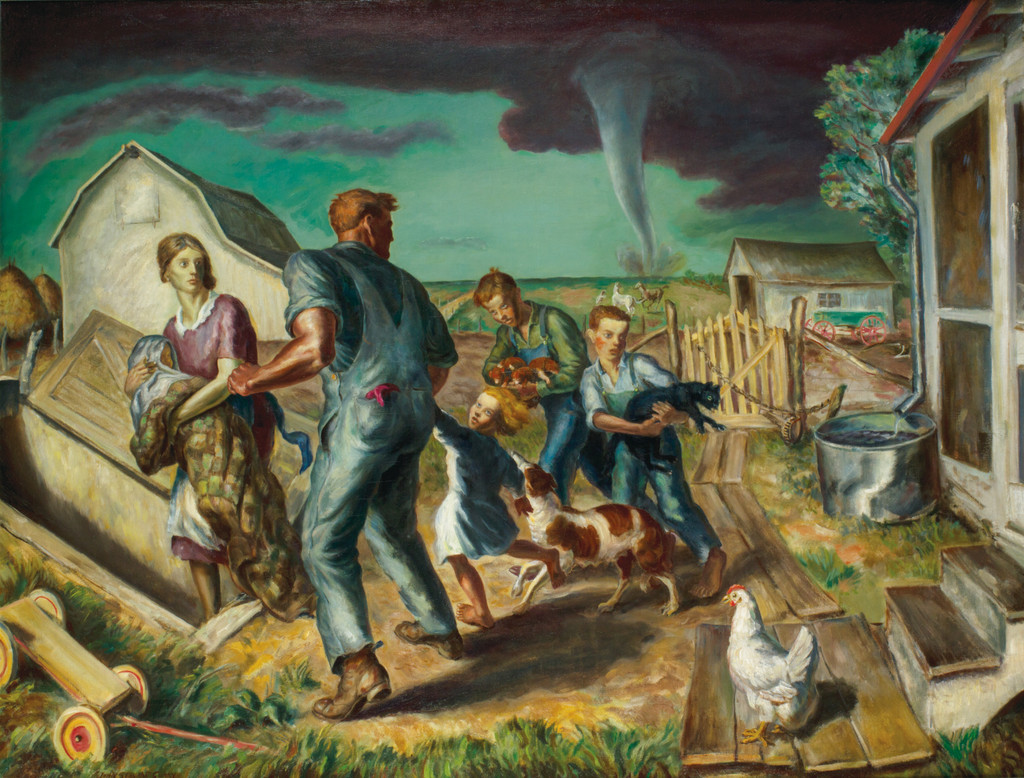
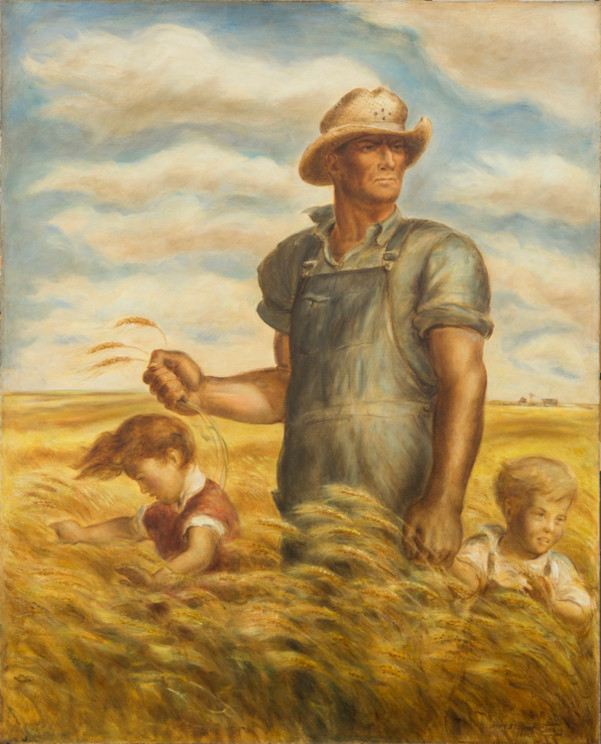
Our Good Earth
1942 painting and its related prints and wartime imagery.
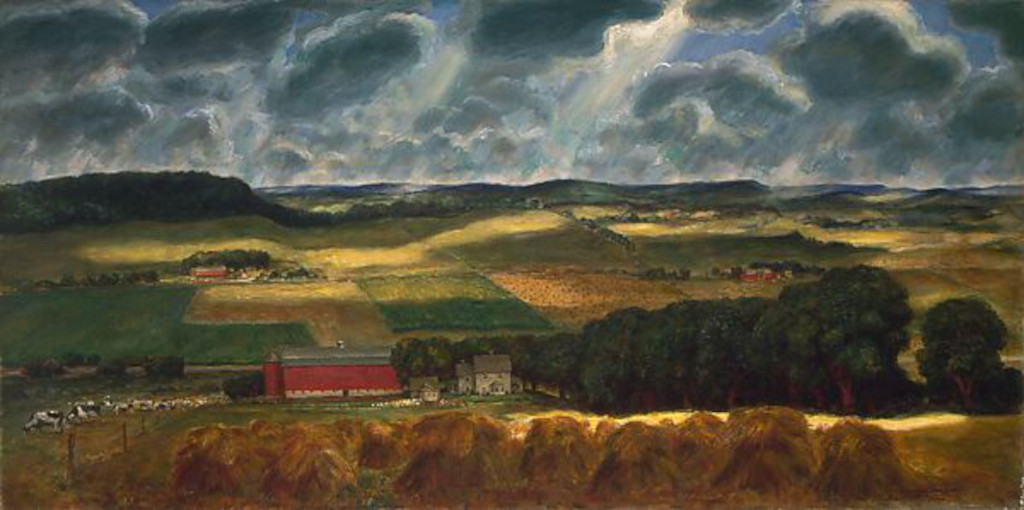
Wisconsin Landscape
1938–39 panorama of working farmland, held by The Met.


Circus Elephants
1932 painting of elephants, handlers and the work behind the circus.