


 by
Tom Gurney
Tom Gurney BSc (Hons) is an art history expert with over 20 years experience
Email:
tomgurney1@gmail.com
/ Phone:
+44 7429 011000
Our Good Earth by John Steuart Curry: Introduction
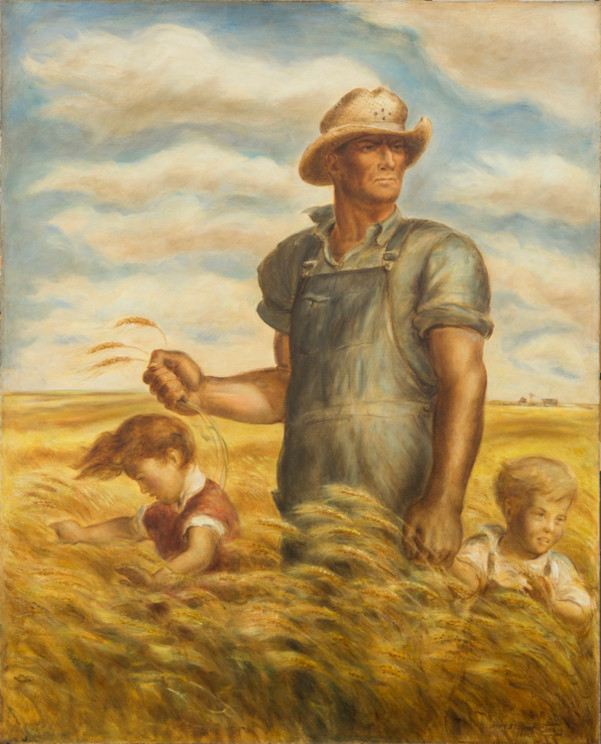
A farmer stands above a field of wheat with two children close beside him. His large body, work clothes and handful of grain connect agricultural labour with the land’s future. John Steuart Curry’s Our Good Earth gave that subject a particularly direct public role when its imagery became part of a wartime appeal to buy bonds.
The title belongs to several distinct objects. The Chazen Museum of Art records a large 1942 oil painting on hardboard, while the Smithsonian American Art Museum owns a smaller watercolour study. A related lithograph and printed war-bond posters carried the farmer-and-children image to other audiences. Following those versions reveals how a rural figure could become both a work of art and an instrument of public persuasion. [1] [2]
At a Glance
- Artist John Steuart Curry, 1897–1946.
- Title Our Good Earth .
- Principal painting 1942, oil on hardboard.
- Painting dimensions 60⅛ × 48⅛ inches.
- Painting collection Chazen Museum of Art, University of Wisconsin–Madison, inventory 3.1999.1.
- Watercolour study 1942, Smithsonian American Art Museum, 2001.4.
- Illustrated lithograph Princeton University Art Museum, 1995-296; catalogued 1938, with a different publication date in the Associated American Artists index.
- Public use Wartime bond-poster imagery.
- Version distinction The painting, watercolour, lithographs and posters are separate physical objects.
This work across John Steuart Curry’s career
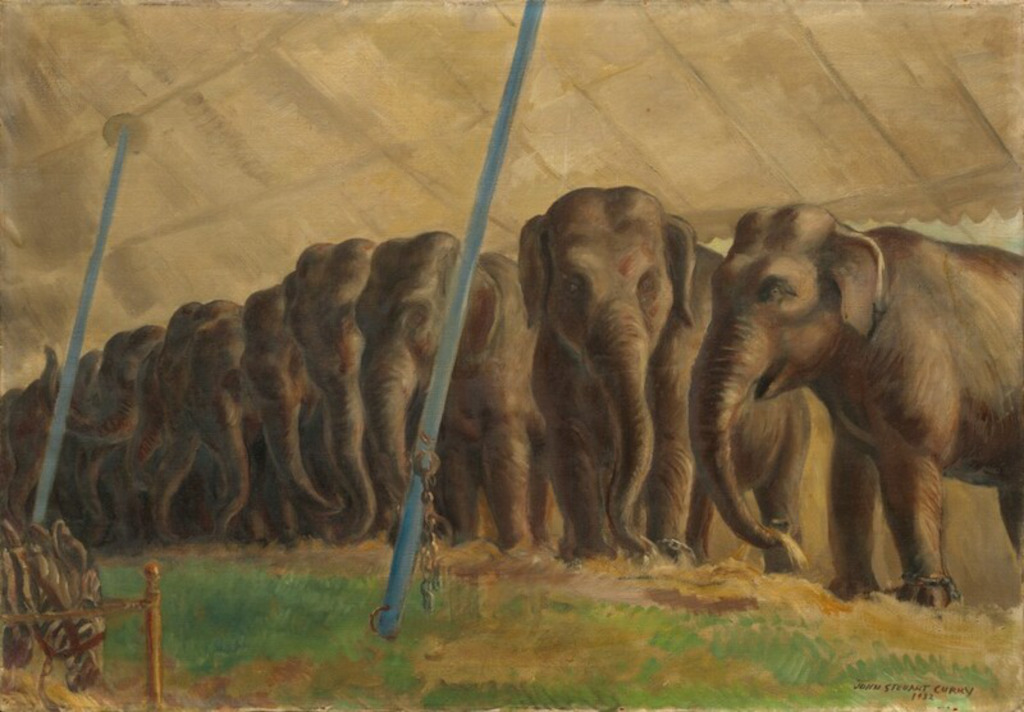
Circus Elephants
1932 paintingThe Mississippi
1935 paintingAjax
1936–37 oil paintingTragic Prelude
1938–40; project 1937–42Wisconsin Landscape
1938–39Our Good Earth (current article)
1942 oil paintingNotes and sources
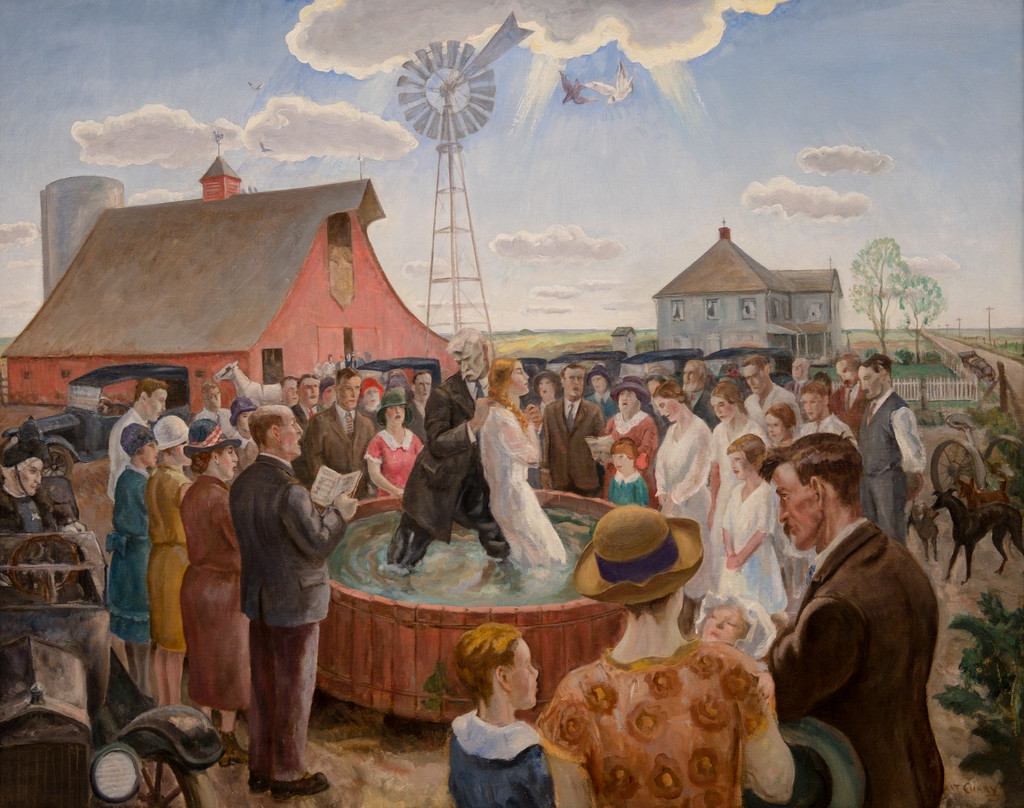
Baptism in Kansas. A remembered Kansas ceremony is staged within a working farmyard. [3]
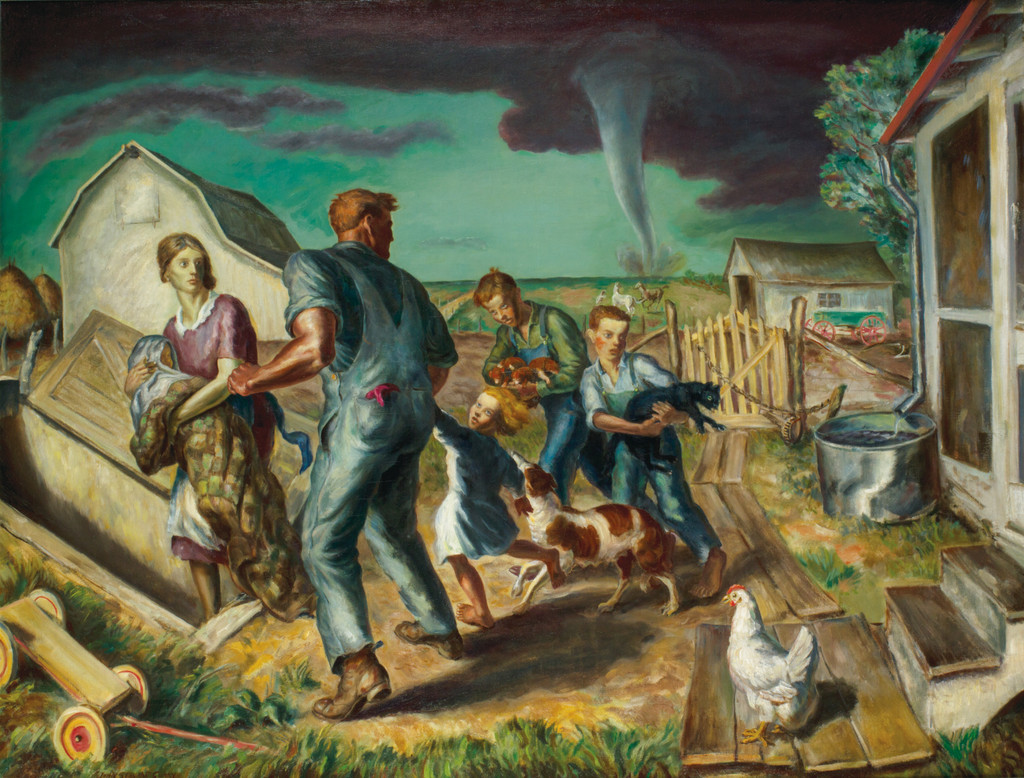
Tornado Over Kansas. A Kansas storm and a family seeking shelter, painted in Curry’s Westport studio. [4]
Circus Elephants. Elephants and handlers occupy the working space beneath a circus tent. [5]
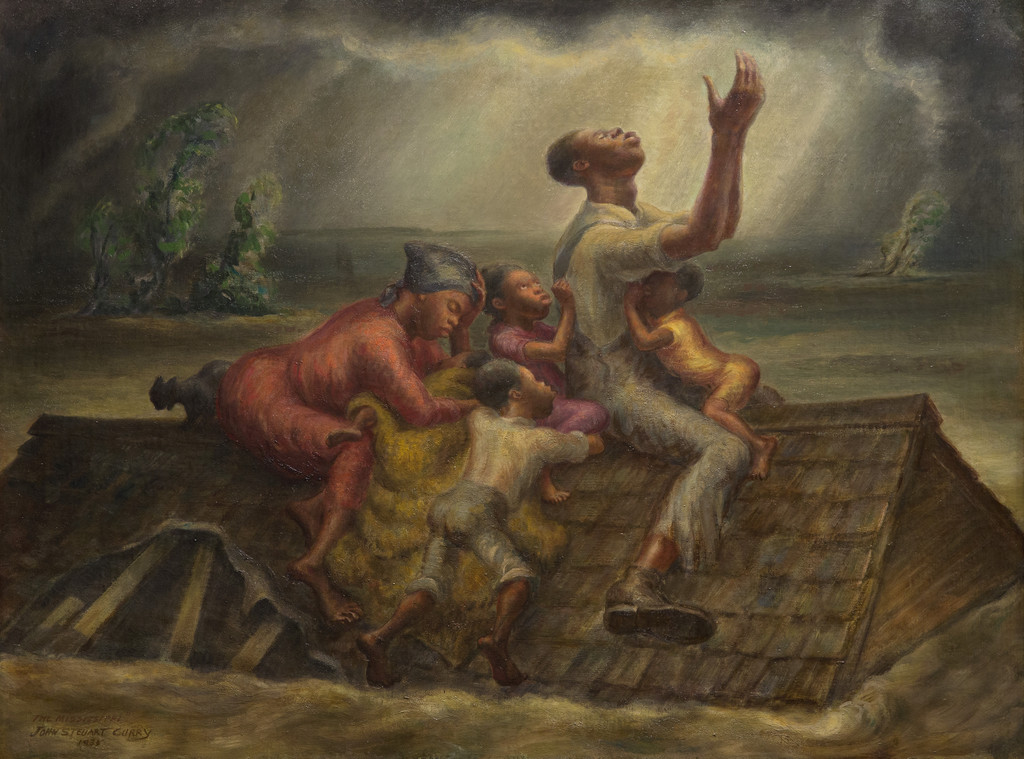
The Mississippi. A family occupies a roof amid floodwater; the painting is tempera on canvas mounted on panel. [6]
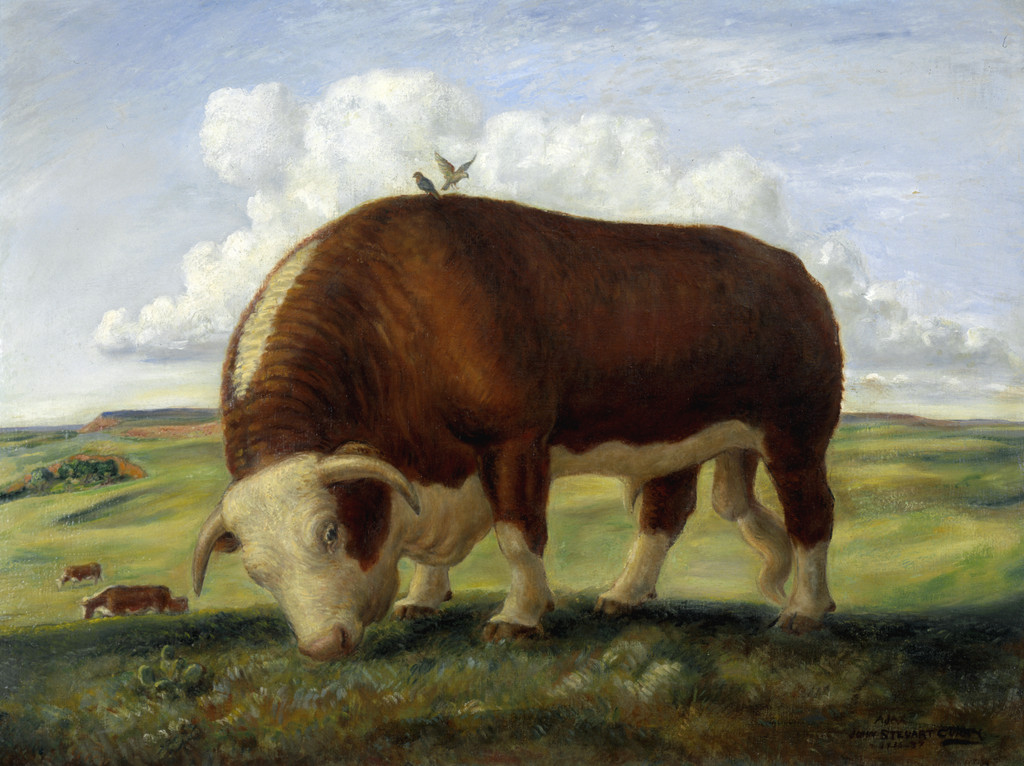
Ajax. The monumental bull in the Smithsonian oil differs from the earlier lithograph. [7]
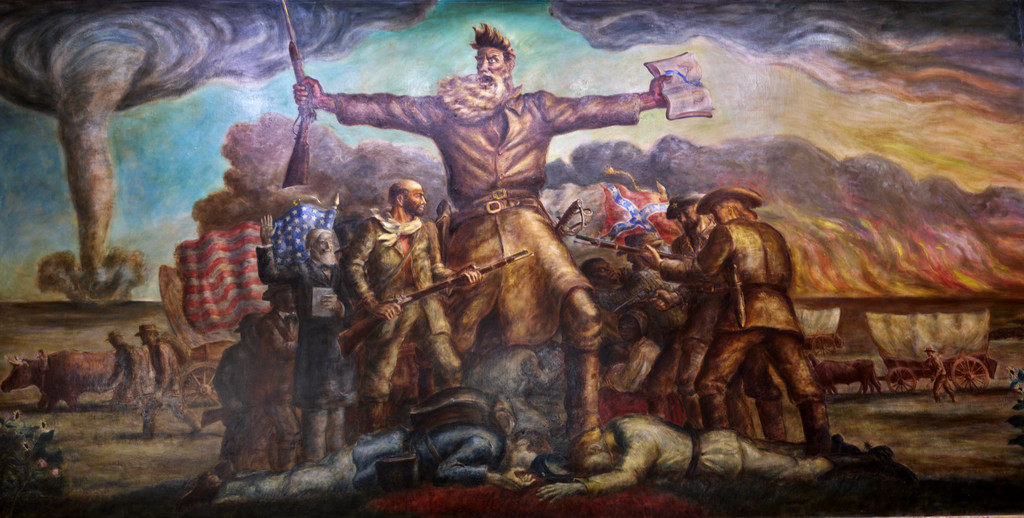
Tragic Prelude. John Brown stands at the centre of a Kansas State Capitol mural continuing across adjoining walls. [8]
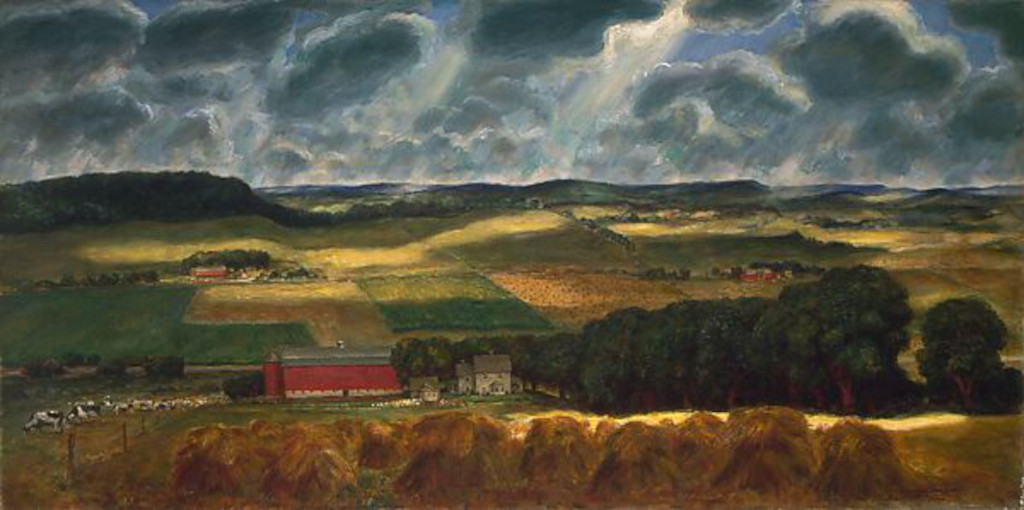
Wisconsin Landscape. An extensive farm panorama, distinct from the separately catalogued preparatory study. [9]
Our Good Earth (current article). The Chazen painting is distinct from the watercolour study, lithographs and wartime posters. [1]
Contents
- The farmer and the wheat field
- Children, scale and the idea of continuity
- The 1942 painting in Wisconsin
- A watercolour on illustration board
- The lithograph and its disputed date
- How lettering changes the image
- Farming and the public audience
- Gift, university and museum history
- Whose good earth?
- Annotated details
The farmer and the wheat field
In the Princeton lithograph, the farmer occupies the centre of a tall composition. His head rises against an extensive sky, while the wheat reaches across the foreground and partly conceals the lower body. The horizon sits low enough to give him unusual visual weight. A distant farmstead at the right makes the contrast between human scale and landscape especially apparent. [10]
His work clothes make the figure immediately legible. Rolled sleeves reveal substantial forearms, and the bib of the overalls forms a broad dark area across the torso. The straw hat shades the face while giving the head a strong outline against the clouds. These elements establish a working identity without needing a specific occupation written beneath him.
The raised hand holds several heads of wheat. It presents the crop at a scale that can be seen separately from the dense field below. The gesture is neither the full action of harvesting nor a casual empty-handed pose. It makes a small sample of grain stand for the much larger agricultural world around the figure.
The turned head directs attention beyond the immediate group. He stands among the children and wheat, but his gaze extends outward. That combination allows the figure to appear rooted in one place while remaining alert to something beyond it. In the later bond-poster setting, the same arrangement could suggest watchfulness as well as physical strength.
Annotated Details from Our Good Earth as a wartime poster
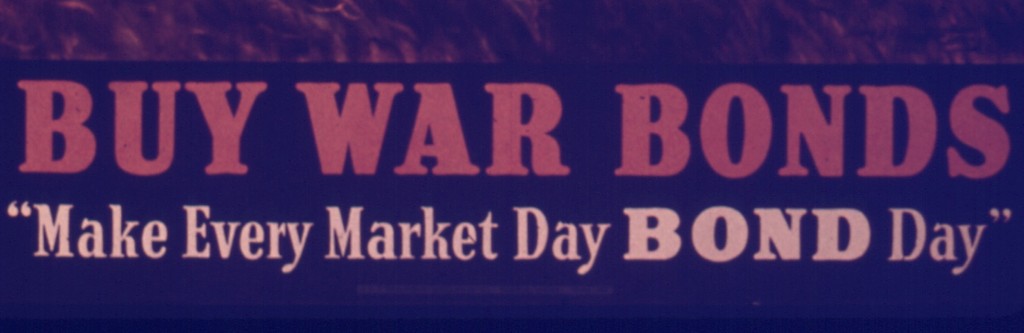
The numbered points identify visible features discussed in this article. Return from each detail to the whole composition. Our Good Earth … Keep It Ours, United States Treasury war-bond poster using Curry’s design, 1941–45. National Archives, 44-PA-1480, NAID 515145. A printed wartime adaptation, distinct from the oil painting. Image source. Public domain. Editorial numbers added to the overview; detail crops retain the source image’s appearance.
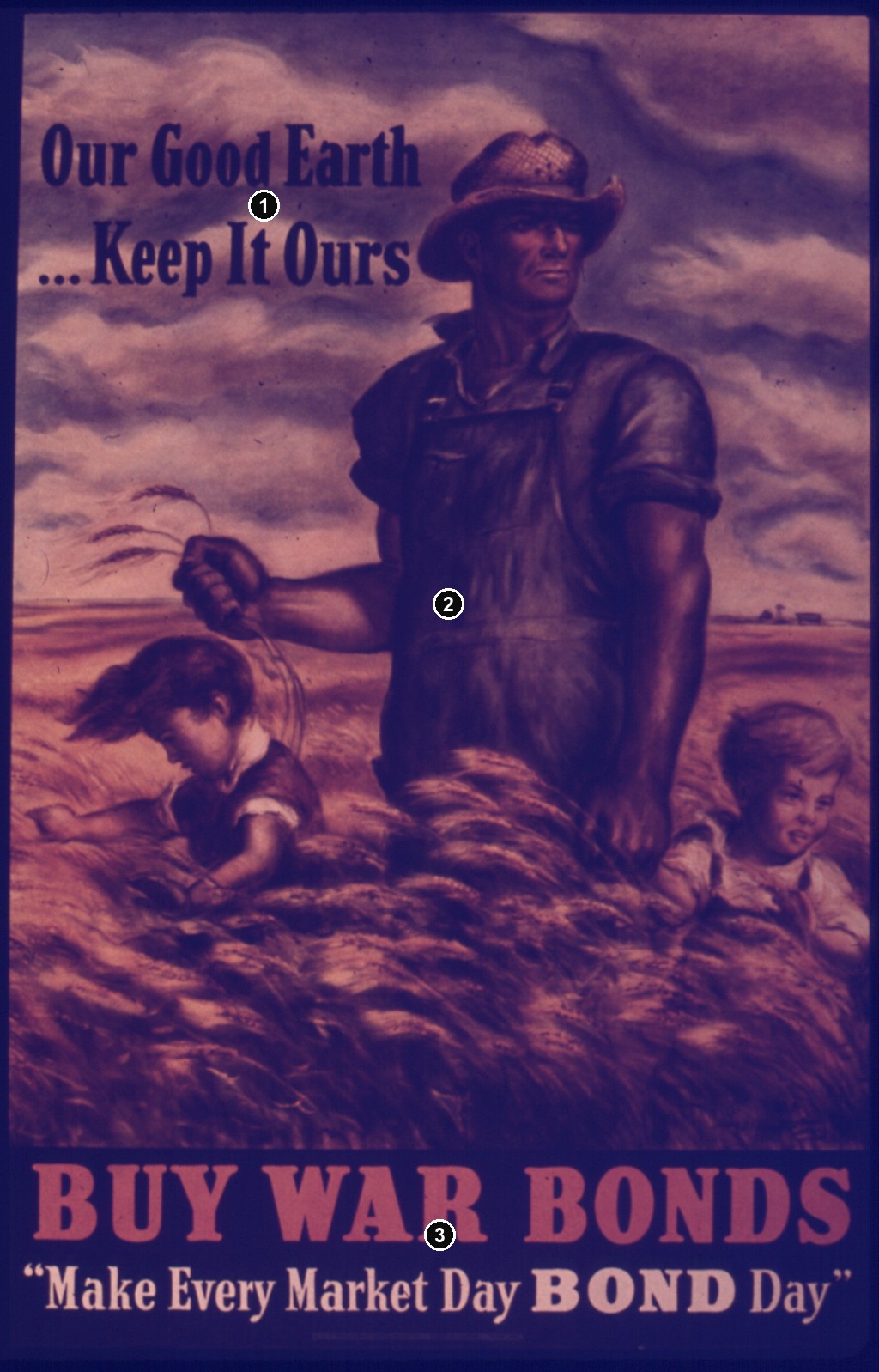
Details from OUR GOOD EARTH AS A WARTIME POSTER
Read the poster’s wording beside its agricultural figures. This printed wartime adaptation is distinct from the oil painting and the lithograph.
The headline addresses the viewer
The title becomes an appeal when it is followed by the instruction to keep the land ours. Large lettering joins the agricultural image to a claim about shared possession and responsibility.
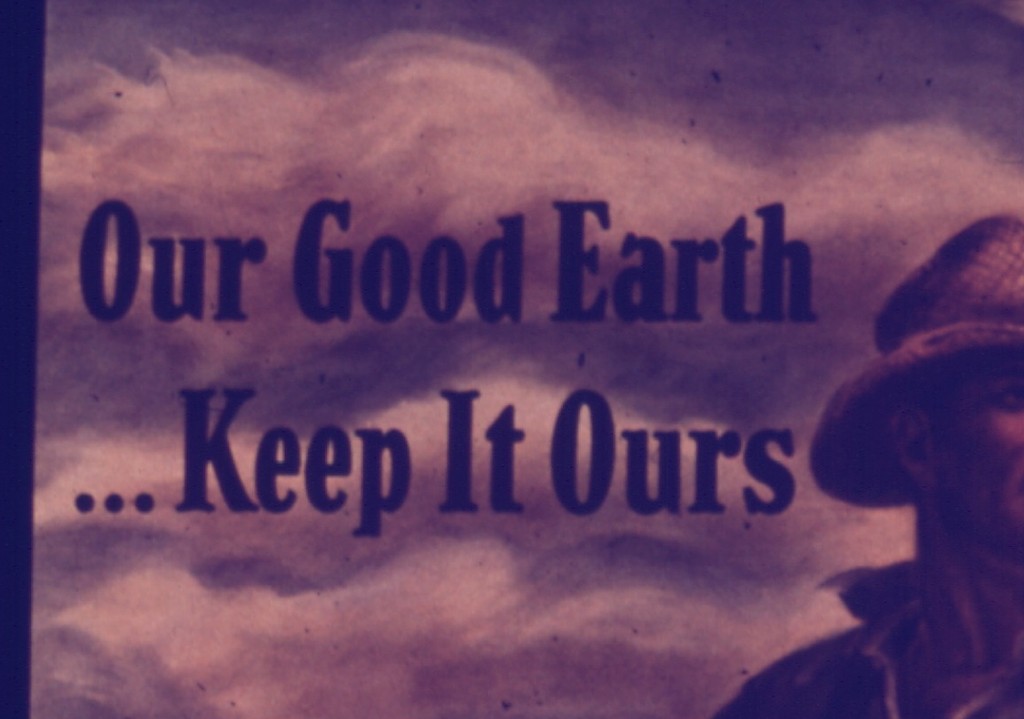
An adult, children and wheat
The large adult body rises above the children and the field of wheat. Within the poster, this difference of scale gives the agricultural group a protective, forward-looking emphasis.
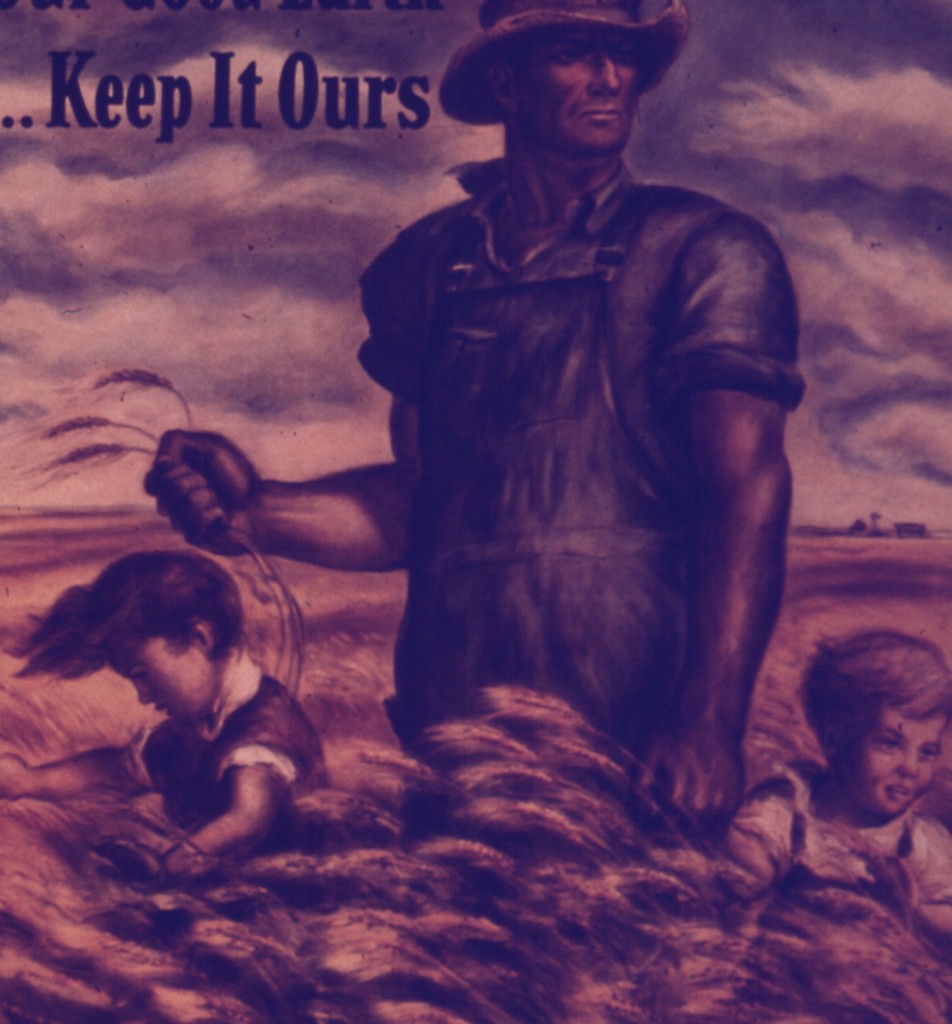
The direct instruction to buy bonds
The broad lower strip turns the image into a specific request to buy war bonds. A second line links that request with market day, connecting wartime finance to an agricultural routine.
Children, scale and the idea of continuity
The two children occupy much smaller areas beside the farmer’s lower body. Their heads remain well below his shoulders, emphasizing his breadth and height. At the same time, they prevent the image from becoming a portrait of an isolated adult. The figure belongs to a group whose members differ in size, attention and apparent experience.
In the print, the child at the left bends toward the wheat, with hair swept sideways. The child at the right turns outward and brings a different expression into the scene. Neither simply repeats the farmer’s pose. Their separate orientations create activity around his relatively firm central stance.
The wheat connects them visually. It passes in front of the adult and across the children, making the crop a shared environment. The image gives agricultural work a bodily and generational setting: the mature worker dominates, but younger lives occupy the same field. A reading concerned with continuity emerges from that arrangement without requiring the children to be identified as particular historical individuals.
Scale is therefore doing more than creating an impressive adult. It helps establish relationships of dependence, protection and succession. Those ideas become especially forceful when the image is used during a war, when defending a present community can be connected with safeguarding its future. They remain interpretations of the picture’s structure, rather than proof of what each painted person represents.
The 1942 painting in Wisconsin
The Chazen identifies its Our Good Earth as oil on hardboard, measuring just over five feet high. That size gives the farmer a substantial physical presence beyond what a small reproduction can suggest. The support is hardboard, so the work should not be described as an oil on canvas merely because other paintings by Curry use that material. [1]
The museum describes a field of golden wheat, the farmer’s blue-green shirt and overalls, and a child’s red dress beneath a broad sky. Those colours belong to its account of the oil painting. The monochrome lithograph and the strongly tinted archive reproduction of the poster offer different kinds of visual evidence; neither should be used as an exact record of the painting’s palette.
The distinction matters because the image’s familiarity can conceal its material variety. A viewer may recognize the farmer instantly and overlook the difference between pigment on a large board, a small watercolour and ink on paper. Yet size, surface and setting affect how directly the central figure confronts the audience.
The large painting also belongs within Curry’s years at the University of Wisconsin–Madison. He had become artist in residence in 1936, and agricultural subjects continued to matter in his work. The painting’s university history connects its image of rural labour with an institution in which Curry encouraged artistic activity beyond a narrowly professional audience. [11]
A watercolour on illustration board
The Smithsonian’s version is a watercolour on illustration board, dated 1942 and measuring 34 by 27.9 centimetres. Its accession number is 2001.4. The museum identifies it as a study for the painting that was reproduced in a war-bond poster, establishing a relationship between the objects while preserving the study’s own identity. [2]
The difference in scale is considerable. The oil painting is more than five feet high; the watercolour is only a little over thirteen inches high. A preparatory work of that size can be handled and considered differently from the larger painted object. The shared subject does not make the two experiences equivalent.
The study relationship also gives the word “original” more than one possible meaning. The watercolour is an original work by Curry, even though it serves a preparatory purpose. The oil is a separate original painting. A printed poster reproducing their imagery belongs to another category of object again, with its own paper, wording and means of circulation.
Keeping the materials in view makes the creative process easier to understand. Curry’s monumental farmer did not exist only as a single finished picture. The museum’s documented connection between study, painting and poster shows an image moving through stages and formats as its intended audience expanded.
The lithograph and its disputed date
Princeton’s lithograph, accession 1995-296, is catalogued as 1938. Its recorded image measures 32.5 by 25.7 centimetres, within a larger sheet of 42.9 by 32.1 centimetres. The museum names Associated American Artists as publisher and records both initials in the image and Curry’s graphite signature below it. Those details identify a particular print, not the Chazen painting. [10]
The reproduction retains the paper surrounding the image. Its broad lower margin separates the pictorial scene from the edge of the physical sheet, while the signature sits in that intervening area. The distinction between image size and sheet size is therefore visible, as well as recorded in the catalogue. A measurement of the entire paper would describe a different boundary from one taken around the farmer, sky and wheat.
Within that boundary, the monochrome arrangement gives the overalls substantial darkness against the lighter field and sky. The children emerge from a foreground whose directional patterns suggest the movement of grain. These broad tonal relationships allow the figure to remain forceful without the colour described in the oil painting. The print has its own means of organizing attention, even where its central forms are familiar from other versions.
The surrounding paper also changes the way the image ends. Wheat meets a definite printed border instead of continuing to the edge of the sheet. Looking at the complete object brings that border into the experience, reminding the viewer that this apparently expansive landscape occupies a small, portable surface.
Gail Windisch and Sylvan Cole Jr.’s Index of AAA Prints , published in 2016, gives Our Good Earth a publication date of 1942. Entry 491 records an edition of 250 and identifies George C. Miller of New York as printer. The index’s date concerns publication or first offering; it does not automatically settle when the lithographic image was made. [12]
The difference should remain visible. Princeton’s 1938 catalogue date and the index’s 1942 publication date cannot simply be made identical by choosing whichever better fits the oil painting’s year. Establishing the exact sequence would require evidence connecting preparation, printing and publication, rather than assuming that every date describes the same event.
A GSA collection record adds another lithograph under the title, with a broad 1935–42 date range and a Federal Art Project credit. That range concerns its own record. It does not resolve the Princeton discrepancy, nor does the programme credit establish that every painting and poster with this composition was a WPA commission. [13]
The versions can therefore be compared as related images without forcing them into a falsely certain chronology. The important established facts are their separate media, collections and recorded histories. Recognizing where those histories remain unsettled makes the comparison more informative.
Watch: John Steuart Curry
Choose a film to explore the artist’s work, its interpretation and its wider setting.
Look at This: John Steuart Curry at MOWA
An exhibition interview with Graeme Reid considers Curry’s work and life in Wisconsin.
Watch on YouTubeHow lettering changes the image
The wartime poster preserved as National Archives item 515145 places the farmer-and-children composition within an explicit appeal. Above the figures, the wording joins “Our Good Earth” to “Keep It Ours.” Below them, a large command reads “Buy War Bonds,” followed by a line connecting market day with bond day. The lettering turns a recognizable rural image into an instruction. [14]
The upper text occupies part of the sky, where it can remain clear without covering the people. The lower band interrupts the image’s movement into the foreground wheat. A viewer’s eye can pass from the title to the farmer, then down through the children and crop to the request for action. The layout gives the agricultural scene a destination beyond contemplation.
The language also changes the title’s possessive force. “Our” now addresses a public imagined as sharing the land and a responsibility to defend it. “Keep” introduces the possibility of loss. The image’s strong central worker and younger companions become part of an argument about what should be protected and how the viewer should contribute.
The National Archives copy is catalogued within a broad wartime range, 1941–45. Hoover’s separate record for poster US 1695A gives 1942 and identifies the Treasury’s War Finance Division and the Government Printing Office. These records document the poster’s official setting, but they should not be treated as descriptions of the same physical copy. [15]
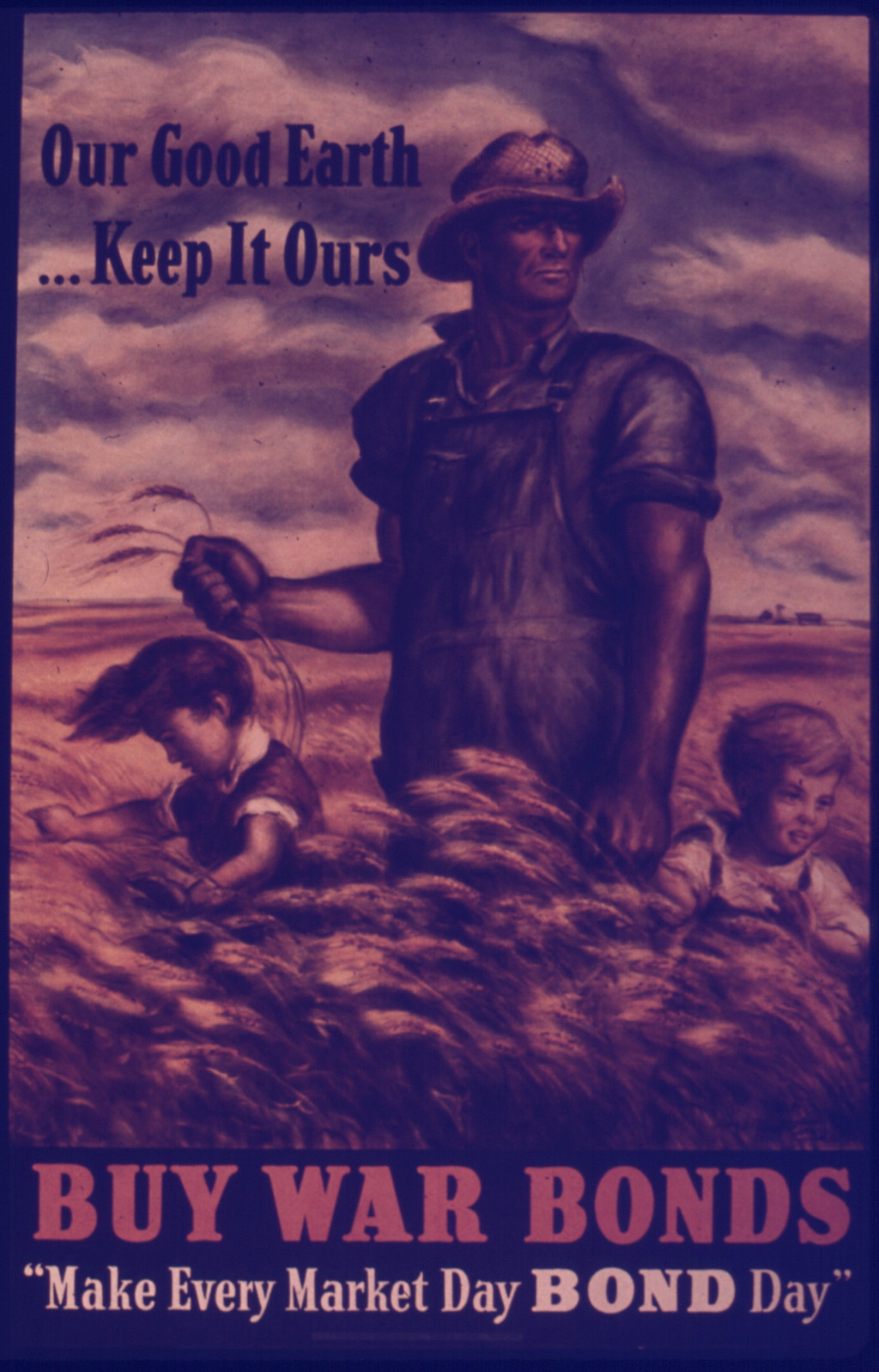
Our Good Earth … Keep It Ours, United States Treasury war-bond poster using Curry’s design, 1941–45. National Archives, 44-PA-1480, NAID 515145. A printed wartime adaptation, distinct from the oil painting.
Image source
.
Public domain
. Proportionally resized; original appearance retained.
Farming and the public audience
The Smithsonian interprets the farmer’s imposing form as an emphasis on agriculture’s importance to the war effort. The subject makes rural production part of a national undertaking. Rather than showing a battle, the image supplies a worker, a crop and children as the visible reasons for supporting the campaign. [2]
The market-day wording gives that appeal a practical social setting. It connects the request to buy bonds with an activity associated with the agricultural audience. The poster does not merely ask viewers to admire the farmer’s strength. It directs that response toward a purchase presented as a contribution to collective security.
The lithograph had another route to its public through Associated American Artists. A signed print could circulate as an artwork, with a publisher and an edition, while the poster carried an openly persuasive message. A common composition could thus support different encounters: collecting, private display, public instruction or wartime fundraising.
These uses should not be collapsed into a single response. Someone looking at a lithograph on a domestic wall is not necessarily responding to the explicit command found on a bond poster. The difference in lettering, format and context changes what the image asks of its audience, even when the central farmer remains recognizable.
Gift, university and museum history
The Chazen’s provenance records a 1943 gift from the U.S. Treasury Department to the University of Wisconsin’s College of Agriculture, now the College of Agricultural and Life Sciences. In 1999 the work was deposited as a long-term loan with the Elvehjem Museum of Art, subsequently renamed the Chazen Museum of Art. These are stages in the painting’s institutional history, separate from its execution in 1942. [1]
The university connection is particularly appropriate to Curry’s Wisconsin career . His presence brought a practising painter into contact with students, agricultural communities and people making art outside professional circles. The farmer image could be understood within that relationship as well as within its wartime use.
At a museum, the work acquires another setting for attention. Its material, dimensions and provenance become part of the encounter, alongside its public history. A visitor can consider the artist’s decisions and the image’s later circulation without assuming that its meaning ended with the bond campaign.
Whose good earth?
The title invites a question about who is included in its collective identity. Princeton’s gallery interpretation asks whether the idealized agrarian world of American Regionalism could also be exclusionary. It treats the relationship between accessible art, regional identity and populism as a problem for discussion, rather than a simple celebration of rural unity. [10]
That question can be brought to the image without denying the farmer’s visual force. The work gives one kind of worker an exceptionally prominent body and setting. It does not provide a complete account of the different people, forms of labour or claims to land that agricultural life involves. Its power depends partly on concentrating attention, and concentration inevitably leaves other histories outside the frame.
Reading Our Good Earth closely therefore involves both recognition and inquiry. The grain, work clothes and children make its appeal immediately understandable. The separate painting, watercolour, lithograph and poster histories show how that appeal could be shaped for different purposes. Together they reveal an image whose apparent simplicity rests on deliberate choices about scale, identity and the public it addresses.
Artworks and versions directory
Browse 84 selected object, version, edition and reproduction records. Several concern related images or different impressions; this is not a complete lifetime catalogue or a count of unique compositions. Search also finds prints, photographs and reproductions; the medium filter groups paintings and drawings.
Frequently Asked Questions
The 1942 oil on hardboard is in the Chazen Museum of Art’s collection at the University of Wisconsin–Madison, inventory 3.1999.1. Collection ownership does not guarantee current display.
No. The Smithsonian American Art Museum owns a separate 1942 watercolour study on illustration board, accession 2001.4.
Princeton catalogues its print as 1938, while the AAA print index gives publication in 1942. Publication and execution need not be the same event, and the precise chronology remains unsettled.
It was reproduced in posters encouraging the purchase of war bonds, adding wording such as “Keep It Ours” to the farmer-and-children image.
Discussion
Look again at the images and ideas explored in Our Good Earth by John Steuart Curry. These editorial prompts invite your observations.
Reader Insights
How does the farmer’s size affect your understanding of the children and the field?
What changes when the image is presented with a command to buy war bonds?
Who do you imagine is included in the title’s word “our,” and what might the image leave outside that idea?
Join the Conversation
Share a detail, comparison or question about Our Good Earth by John Steuart Curry below.
References
- Chazen Museum of Art , Our Good Earth, 1942, oil on hardboard, 3.1999.1: object record and provenance. View source
- Smithsonian American Art Museum , Our Good Earth, 1942, watercolour on illustration board, 2001.4: study and war-bond context. View source
- Whitney Museum of American Art, John Steuart Curry | Baptism in Kansas | Whitney Museum of American Art. View source
- Muskegon Museum of Art, Tornado Over Kansas - Muskegon Museum of Art. View source
- National Gallery of Art, Circus Elephants: collection object record. View source
- Saint Louis Art Museum, The Mississippi,1935,7:1937: collection record and provenance. View source
- Smithsonian American Art Museum, Ajax. View source
- Kansas Historical Society, Kansas State Capitol - Online tour - Tragic Prelude - Kansas Historical Society. View source
- Metropolitan Museum of Art, Wisconsin Landscape. View source
- Princeton University Art Museum , Our Good Earth, lithograph, 1995-296: collection data, signature, dimensions and gallery interpretation. View source
- Käri Knutson , Museum featuring works of UW’s John Steuart Curry, University of Wisconsin–Madison, 8 September 2014. View source
- Gail Windisch and Sylvan Cole Jr. , Index of AAA Prints, Art for Every Home: An Illustrated Index, 2016, entry 491, printed p. 60; selected reading. View source
- U.S. General Services Administration , Our Good Earth: lithograph record, broad 1935–42 date range. View source
- National Archives , Our Good Earth—Keep It Ours, NAID 515145, 44-PA-1480: supplied poster and imported record via Wikimedia Commons. View source
- Hoover Institution Library & Archives , Our good earth: keep it ours, 1942, poster US 1695A, XX343.24233. View source
More CURRY Paintings
Our Good Earth
1942 painting and its related prints and wartime imagery.
Wisconsin Landscape
1938–39 panorama of working farmland, held by The Met.


Circus Elephants
1932 painting of elephants, handlers and the work behind the circus.