


 by
Tom Gurney
Tom Gurney BSc (Hons) is an art history expert with over 20 years experience
Email:
tomgurney1@gmail.com
/ Phone:
+44 7429 011000
Baptism in Kansas by John Steuart Curry: Introduction
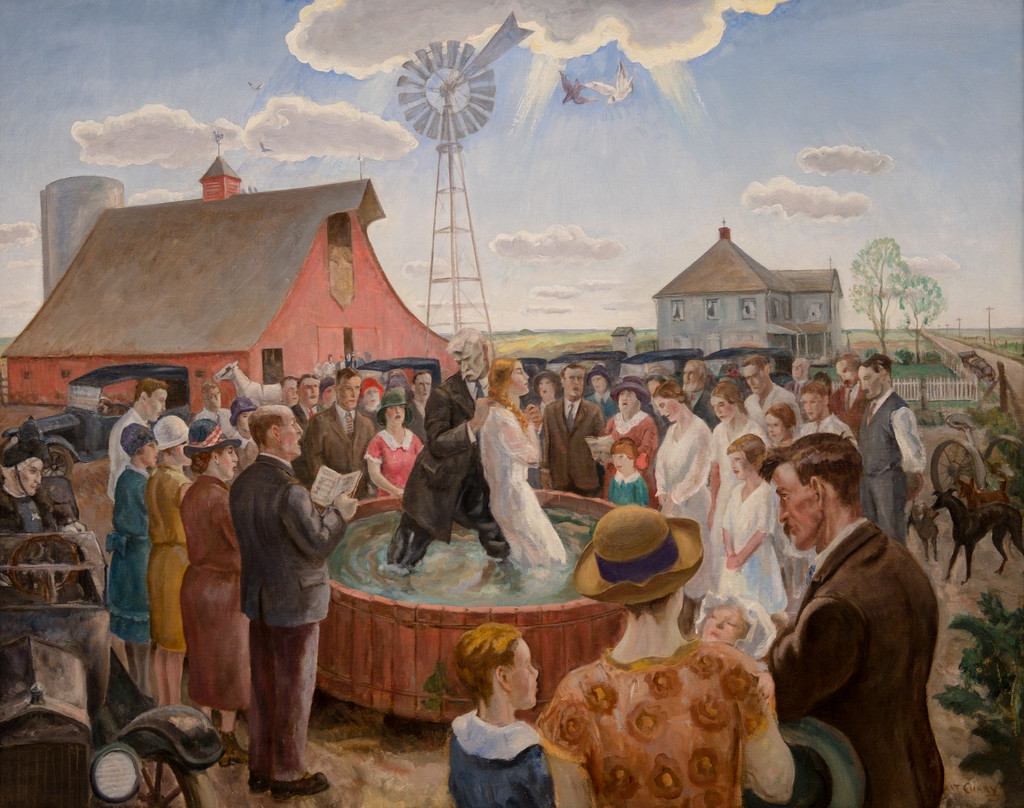
A minister stands knee-deep in a farm water tank, preparing to immerse a young woman dressed in white. Around them, a congregation gathers between parked cars, agricultural buildings and the open prairie. John Steuart Curry’s Baptism in Kansas makes this improvised place of worship the centre of an unusually concentrated rural scene.
Painted in 1928, the oil on canvas recalls a ceremony Curry witnessed in 1915, when dry creeks forced worshippers to find another source of water. It now belongs to the Whitney Museum of American Art. The distance between the remembered event and the finished painting matters: Curry presents the experience through an arrangement of people, machines, landscape and biblical associations, giving a local recollection a much wider significance. [1]
At a Glance
- Artist John Steuart Curry, 1897–1946.
- Title Baptism in Kansas .
- Date 1928.
- Medium Oil on canvas.
- Dimensions 40¼ × 50¼ inches, or 102.2 × 127.6 centimetres.
- Collection Whitney Museum of American Art, New York.
- Credit Gift of Gertrude Vanderbilt Whitney.
- Accession number 31.159.
- Remembered event A 1915 immersion baptism near Dunavant, Kansas.
- First exhibition Corcoran Gallery of Art, Washington, DC, 1928.
This work across John Steuart Curry’s career
Circus Elephants
1932 paintingThe Mississippi
1935 paintingAjax
1936–37 oil paintingTragic Prelude
1938–40; project 1937–42Wisconsin Landscape
1938–39Our Good Earth
1942 oil paintingNotes and sources
Baptism in Kansas (current article). A remembered Kansas ceremony is staged within a working farmyard. [1]
Tornado Over Kansas. A Kansas storm and a family seeking shelter, painted in Curry’s Westport studio. [2]
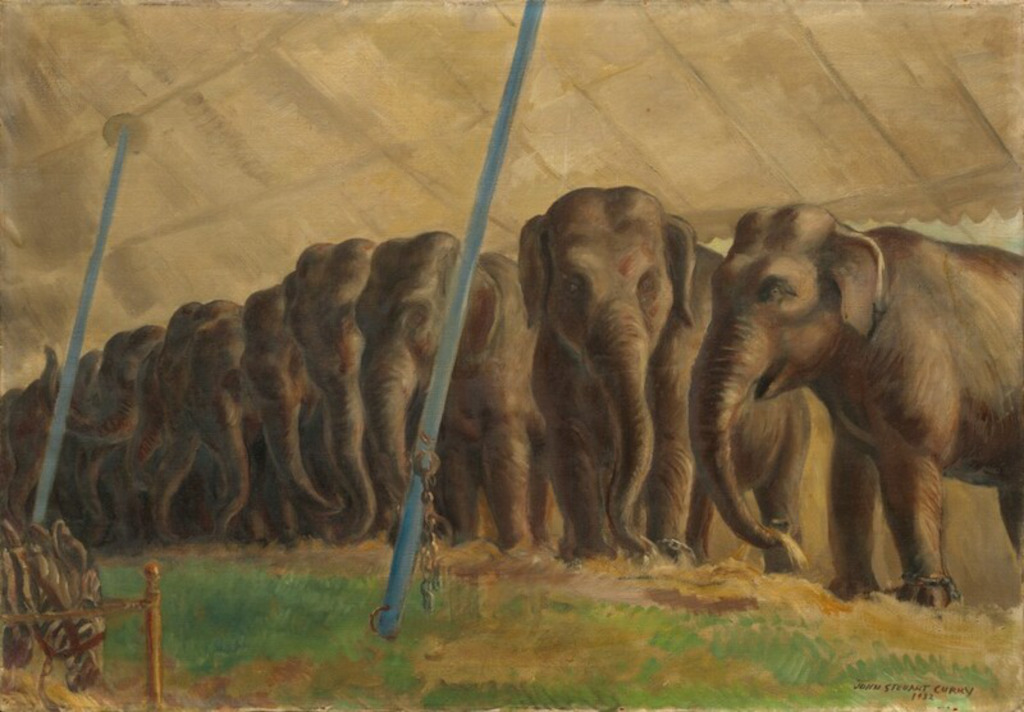
Circus Elephants. Elephants and handlers occupy the working space beneath a circus tent. [3]
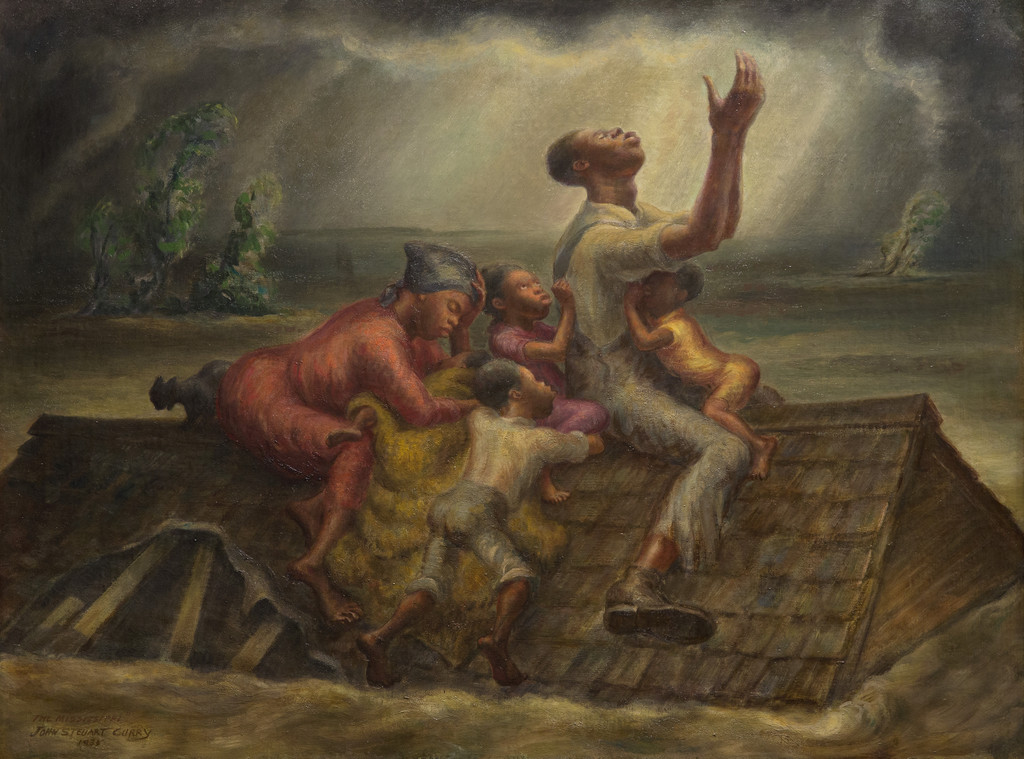
The Mississippi. A family occupies a roof amid floodwater; the painting is tempera on canvas mounted on panel. [4]
Ajax. The monumental bull in the Smithsonian oil differs from the earlier lithograph. [5]
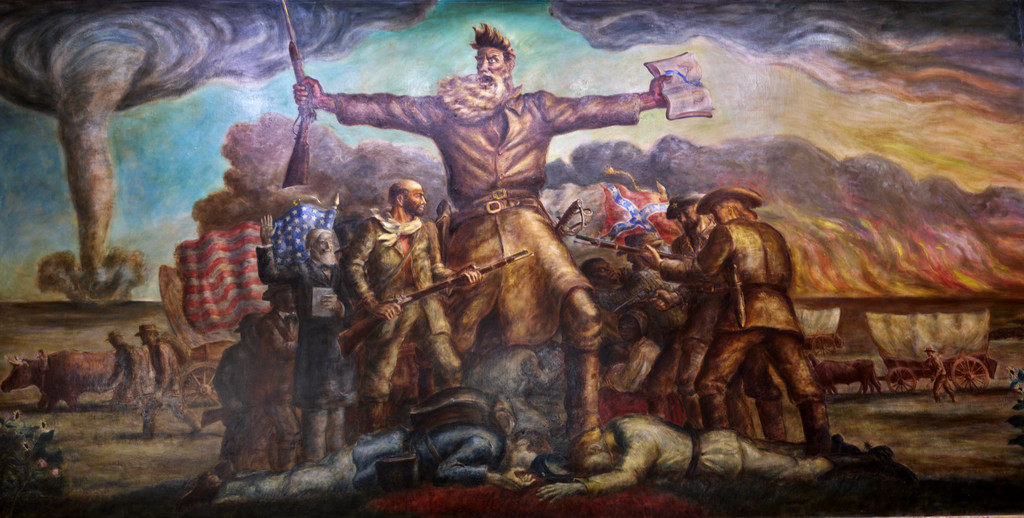
Tragic Prelude. John Brown stands at the centre of a Kansas State Capitol mural continuing across adjoining walls. [6]
Wisconsin Landscape. An extensive farm panorama, distinct from the separately catalogued preparatory study. [7]
Our Good Earth. The Chazen painting is distinct from the watercolour study, lithographs and wartime posters. [8]
Contents
- A baptism in a farm water tank
- The minister and the woman in white
- Witnesses around the rim
- Colour and the space around the gathering
- Remembering a ceremony from 1915
- Windmill, cars and the working farm
- Dunavant and the historical map
- Birds, sunlight and biblical associations
- Sincerity, satire and the problem of expression
- Annotated details
A baptism in a farm water tank
The circular tank gives the picture a firm centre. Its reddish wooden sides occupy the lower middle of the canvas, while the rim forms an ellipse around the minister and the woman. The water within it is restless, worked into pale blue, green and cream shapes that gather around their legs. A container associated with livestock becomes the setting for a human ceremony.
Its construction remains visible. Vertical boards and dark horizontal bands make the tank an ordinary manufactured object rather than an elaborate religious furnishing. That practical character is essential to the scene. The painting does not transform the farmyard by hiding its equipment; it makes the ceremony take place among things that retain their everyday uses.
The curved rim also organizes the people around it. At the left, a man holds an open book close to the water; at the right, women in pale clothes lean toward the central action. Their bodies continue the tank’s shape, creating a circle of attention that extends beyond its physical boundary. The composition makes the group appear to gather around a shared purpose.
The tank is large enough to hold the two participants but small enough to concentrate their movement. The minister’s dark legs break the water’s surface, and the young woman’s white dress runs into it. Their immediate surroundings have the intimacy of a close encounter, even as the prairie opens beyond the buildings. That difference between contained action and extensive setting remains one of the painting’s strongest tensions.
Annotated Details from Baptism in Kansas
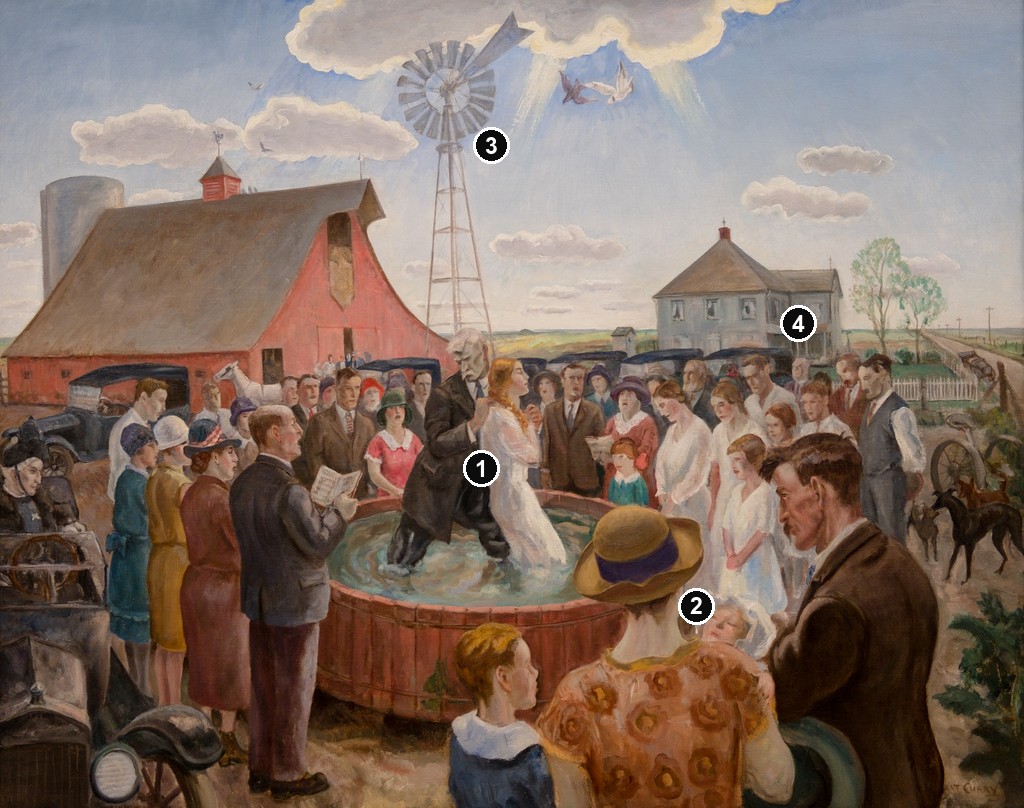
The numbered points identify visible features discussed in this article. Return from each detail to the whole composition. The captions keep each work’s identity, date and medium separate.
Baptism in Kansas - 1928 oil photographed in 2018
John Steuart Curry, Baptism in Kansas, 1928, oil on canvas, Whitney Museum of American Art. Photograph by Mollerus, 2018; the painting is seen at an angle. Image source. CC BY 2.0 photograph; underlying painting public domain. Editorial numbers added to the overview; detail crops retain the source image’s appearance.
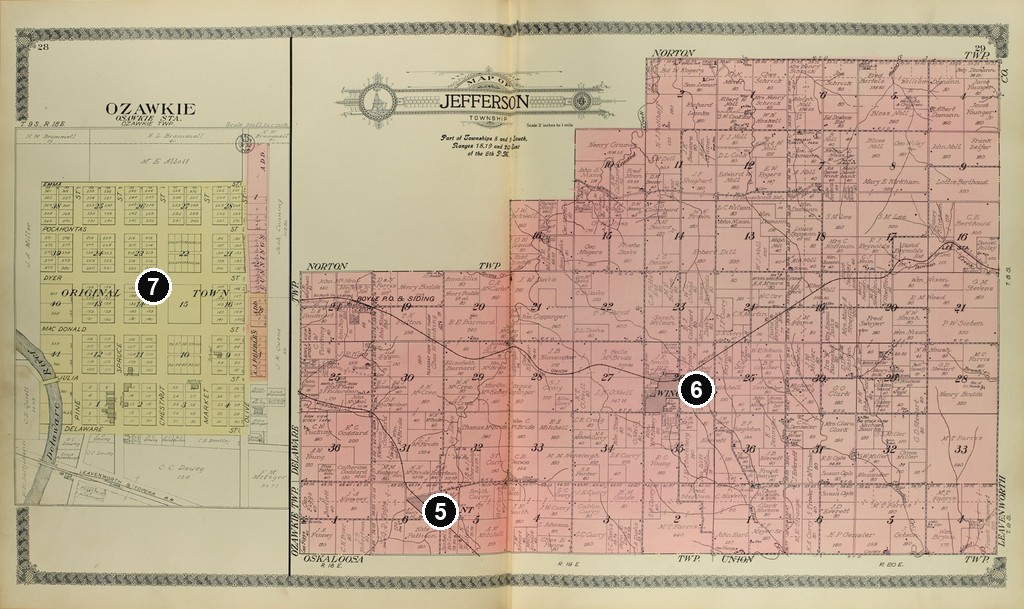
Jefferson Township - 1916 atlas spread
Jefferson Township, Jefferson County, Kansas, in a 1916 Ogle atlas. Historical geographical context for the Dunavant area; not a map drawn by Curry. Image source. Public domain. Editorial numbers added to the overview; detail crops retain the source image’s appearance.
Details from BAPTISM IN KANSAS
Read the painting photograph and the 1916 atlas as separate kinds of evidence: a pictured ceremony and its wider regional setting.
Baptism in Kansas - 1928 oil photographed in 2018
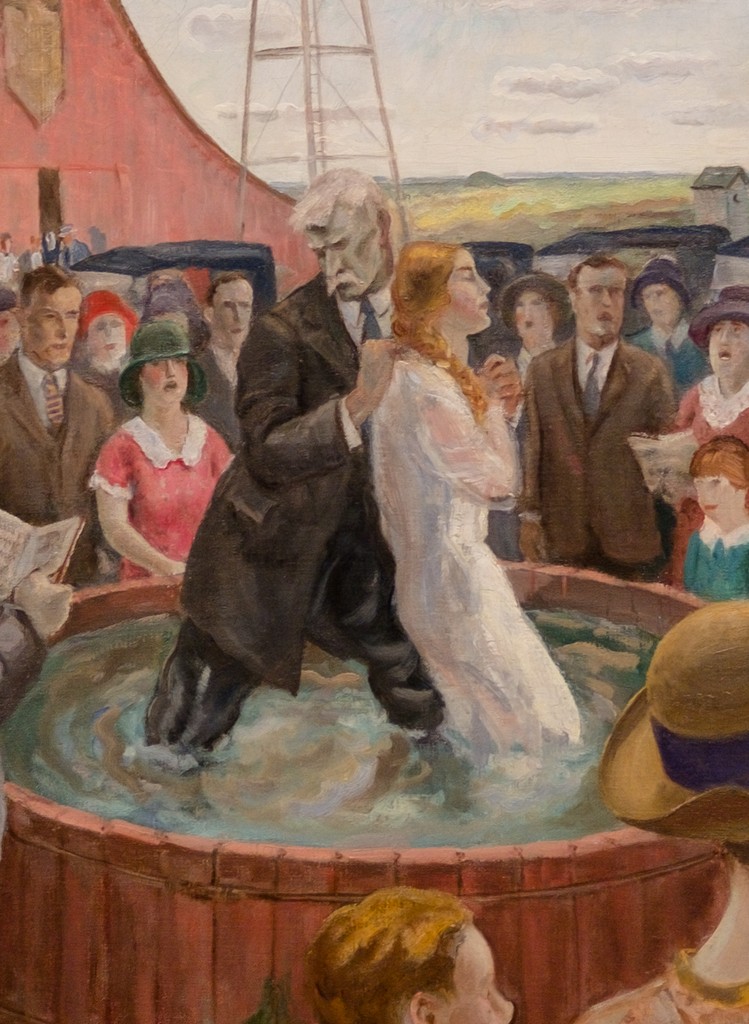
Minister and candidate in the tank
The dark-clothed minister and the woman in white rise above the circular rim. Their joined action creates a central group around which the witnesses and farm buildings are arranged.
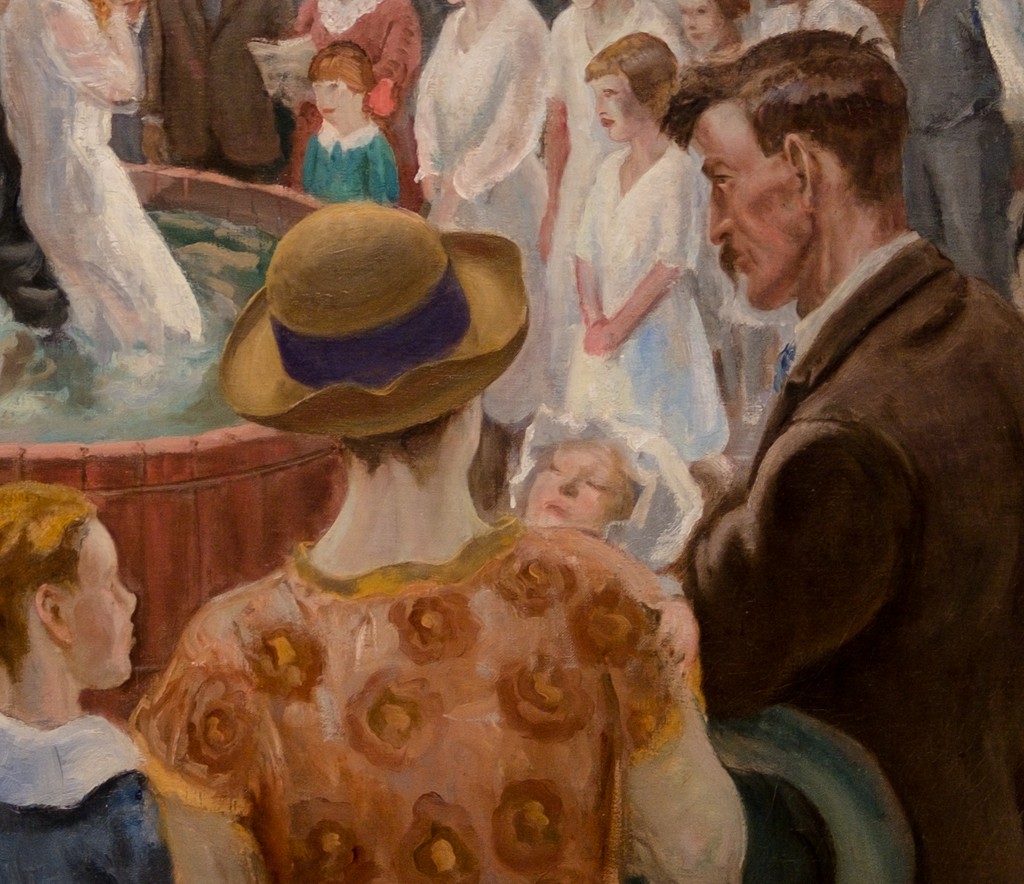
Witnesses seen from the foreground
Large heads and shoulders at the front partly overlap the tank and the people beyond it. These differing viewpoints place the viewer among the gathering rather than outside an evenly spaced row.
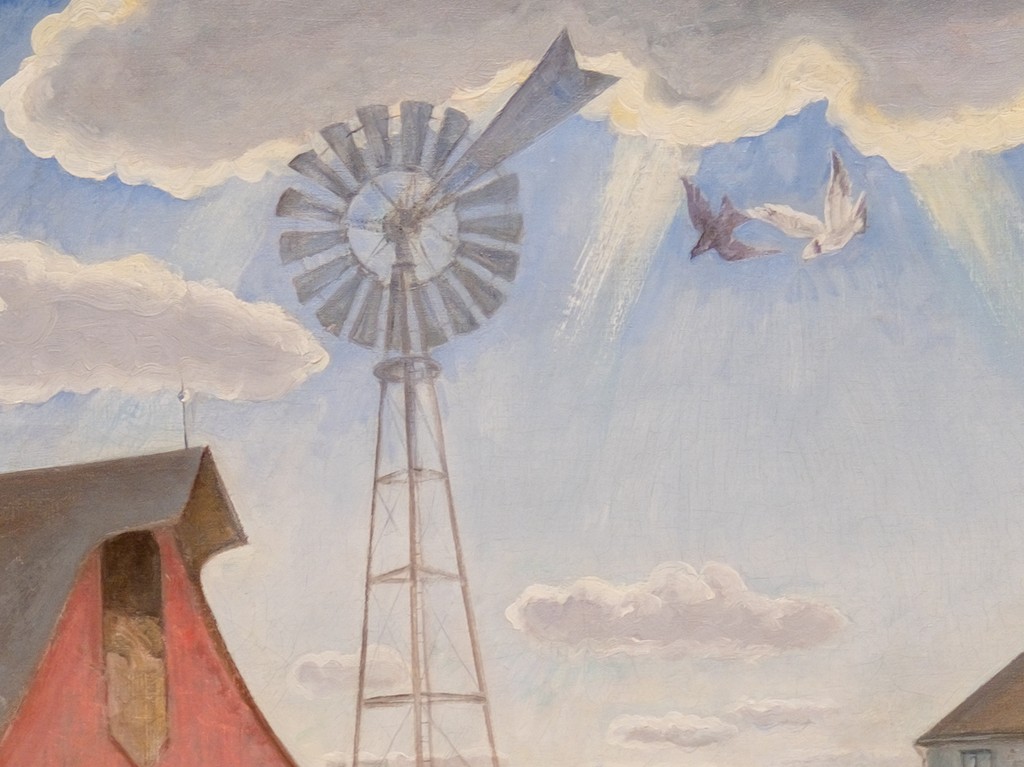
Windmill, birds and clouds
The windmill and birds interrupt the broad sky above the ceremony. Farm equipment and the bright cloud opening occupy the same setting as the religious action below.
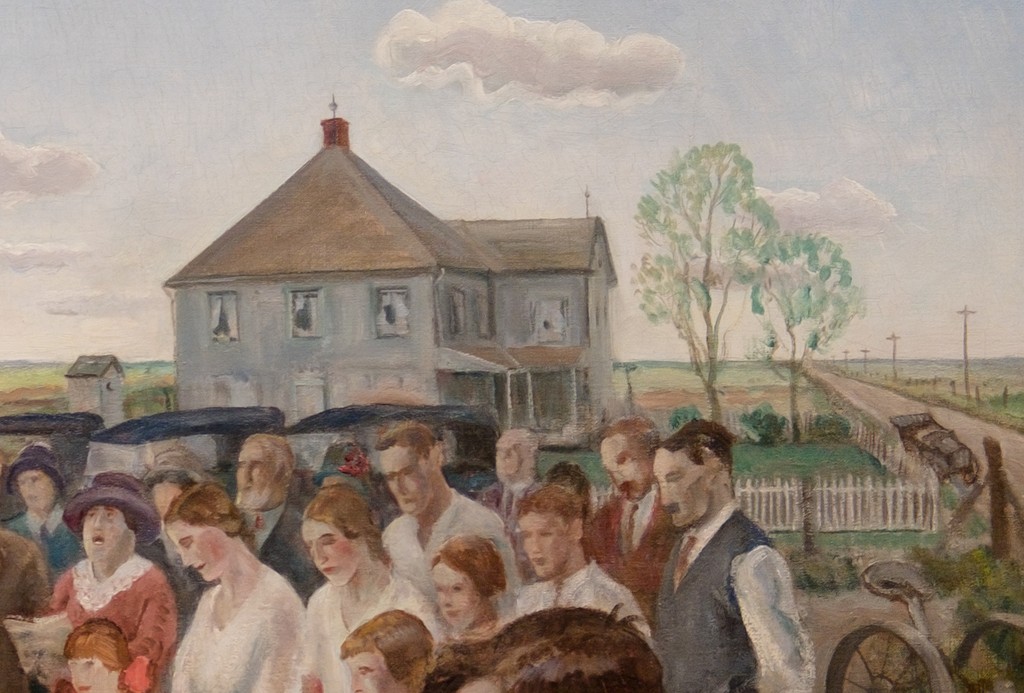
House, cars and the receding road
Cars line the farmyard near the house, while a road continues towards the horizon. These details connect the gathered people with travel and the wider countryside.
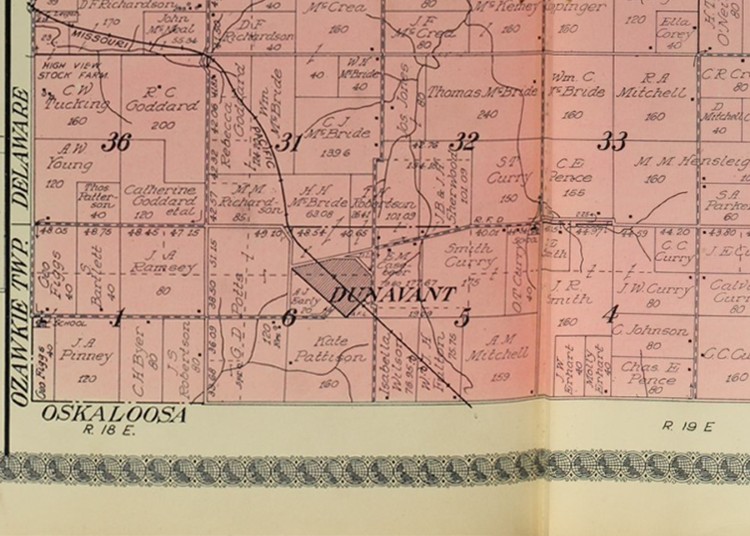
Jefferson Township - 1916 atlas spread
Dunavant on the township map
The printed Dunavant label locates the town within a network of parcels and transport lines. This 1916 atlas provides regional context for the earlier ceremony discussed in the article.
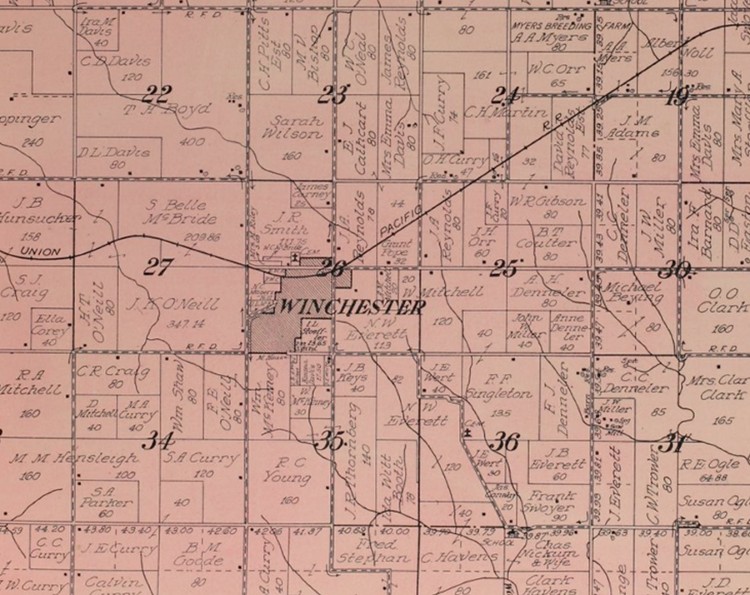
Winchester and the surrounding grid
Winchester appears farther across the township, beside the map’s lines and parcel divisions. Reading the two town labels helps establish a wider geographical setting around Dunavant.
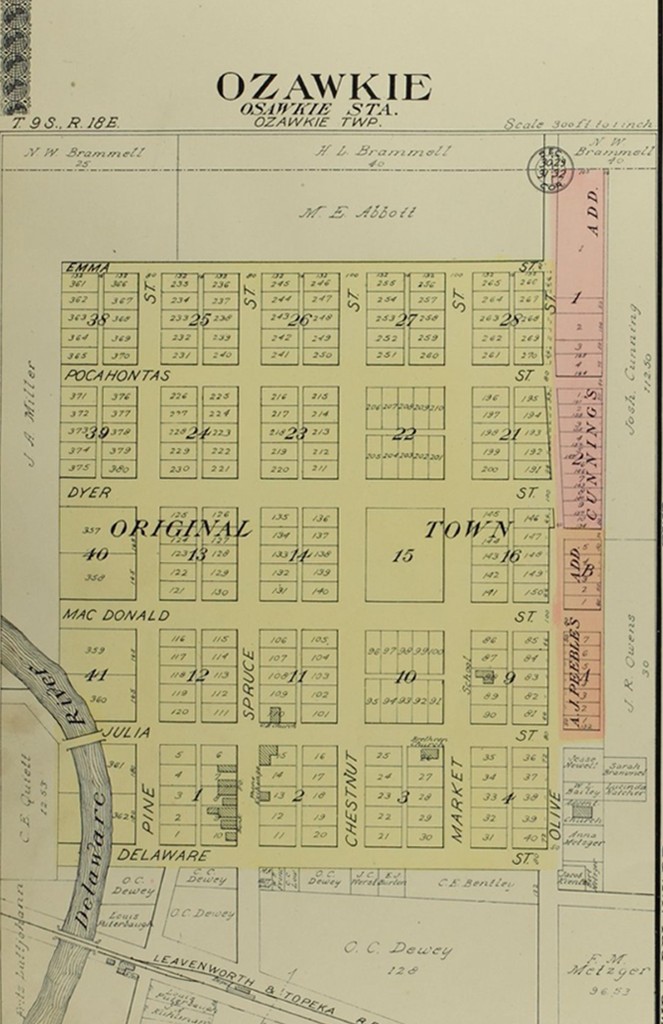
Ozawkie in a separate inset
The Ozawkie plan occupies its own clearly bounded part of the spread. Its separate title and street grid distinguish this town plan from the larger Jefferson Township map.
The minister and the woman in white
The minister’s black suit creates a central dark shape against the surrounding faces and bright clothing. His pale, severe face turns toward the woman, and his bent arms bring his hands close to her shoulders and neck. The combination of formal clothing and physical exertion makes the action feel unusually forceful.
The woman leans backward within his grasp. Her white garment catches the light, while her face turns upward. The painting holds the instant before immersion: the intended downward movement can be understood, but it has not yet carried her beneath the surface. The viewer is left to anticipate the next stage of the ceremony.
Their contrasting clothes help separate the bodies even where the gestures overlap. The minister’s bent knee and dark sleeve make angular interruptions; the dress produces a longer, lighter line toward the water. The colours make the encounter readable from across the room, before the smaller expressions around the rim become clear.
The closeness of the gesture can produce different reactions. A viewer familiar with immersion baptism may understand the minister’s hold as part of supporting the candidate. Another may first notice the apparent imbalance of power between the standing man and the backward-leaning woman. The picture makes that ambiguity visible without supplying either person’s thoughts.
The woman’s central position should also keep her from disappearing behind the minister’s striking appearance. The action concerns her participation in the rite, and the people gathered around watch her as well as him. Her bright figure becomes the point at which the crowded circle, the water and the descending light converge.
Witnesses around the rim
The crowd is carefully differentiated. Women wear hats, light blouses and dresses of red, green, yellow and white. Men appear in coats and ties. Some mouths are open, some faces look downward, and several people seem absorbed in the central action. The congregation forms a group without becoming a row of identical responses.
At the left foreground, the man with the open book occupies a particularly clear position beside the tank. The pale pages turn toward his face, connecting sight, reading and the suggestion of song. Across the water, the cluster of women in white repeats the brightness of the baptismal candidate’s dress without displacing her from the centre.
Children introduce another level of attention. The small boy near the lower edge faces toward the gathering, while the infant at the right foreground rests within the family group. Their presence makes this a mixed community rather than an assembly composed only of the two central adults and their immediate attendants.
The family seen from behind at the lower right changes the viewer’s position within the scene. The woman’s patterned dress and broad hat occupy substantial foreground space, while the man’s dark profile partly closes the right edge. We look past these bodies toward the tank. The painting therefore makes access to the ceremony feel shared with other spectators.
The crowd’s closeness can appear supportive or confining. Almost every available gap around the water is filled by a person, a vehicle or a piece of farm equipment. Yet the open sky remains expansive above them. Curry maintains both conditions at once: the participants gather tightly around a temporary centre, while a much larger world continues beyond it.
Colour and the space around the gathering
Large areas of colour give the small figures a setting that can be understood quickly. The barn’s warm red establishes the left side, while the cooler farmhouse stands at the right. Between them, the windmill remains visually light because its framework is open. Its narrow supports divide the sky without giving it the weight of a solid building.
The tank repeats some of the barn’s warmth closer to the viewer. Reds also appear in the women’s clothing, helping to carry the eye across the crowd. These connections join objects at different distances without requiring them to touch. The scene holds together through colour as well as through the circle around the water.
The farmhouse and road offer different ways into the distance. The building gives the eye a place to pause, while the narrowing road leads it outward. Above both, the sky occupies a substantial area with comparatively few objects. This alternation between crowded and open passages allows the ceremony to feel intimate without making the surrounding landscape disappear.
The figures themselves provide a further measure of space. The foreground family blocks part of the view, the congregation fills the middle, and smaller people appear near the barn. These changes in scale make the yard readable as an inhabited place, even while the circular arrangement gives it the concentrated form of a stage.
Remembering a ceremony from 1915
The year of the subject and the year of the painting are thirteen years apart. The Whitney identifies the scene as a recollection of a baptism witnessed when nearby creeks had dried. The dry conditions explain the unusual location without requiring the event to be moved forward into the Dust Bowl of the 1930s. [1]
Art historian Jeffrey Richmond-Moll places the remembered ceremony at Will McBride’s farm and identifies the worshippers as Disciples of Christ, also known as Campbellites. Immersion was central to their religious practice, making access to water a practical concern as well as a spiritual one. [9]
A remembered subject allows different kinds of knowledge to enter the image. Curry knew the character of a Kansas farmyard and could organize the scene around the action that had stayed with him. That does not make every painted face an identifiable historical portrait, or every small object proof of its exact position on the day. The work preserves an experience through pictorial decisions.
The distinction is especially useful when looking at the sky. The clouds, birds and light participate in the scene’s meaning, but they should not be treated as a meteorological report. Their arrangement makes the central ceremony stand out within the surrounding world. Memory gives Curry a subject; painting gives him the means to shape its emotional and symbolic emphasis.
Windmill, cars and the working farm
The tall windmill stands above the people and slightly to the left of the central pair. Its open framework allows the sky to remain visible through it, while the wheel supplies a large circular form above the circular tank. These related shapes connect the farm’s equipment with the organization of the scene.
The windmill is also a conspicuous vertical line between the two main buildings. It connects the tank with the farm’s means of obtaining water when surface supplies failed. [9] At the left, the broad red barn spreads across much of the middle ground. At the right, the farmhouse presents a smaller, cooler block of colour. Their different roofs and volumes keep the farmyard from becoming a featureless stage behind the people.
The row of black automobiles creates another kind of boundary. Their roofs and upright frames repeat across the background, just above the crowd’s shoulders. Near the left edge and lower corner, closer vehicle parts extend that presence into the foreground. The gathering belongs to a countryside in which cars have become familiar equipment.
Horses and older farm implements remain in the same space. Their presence beside the vehicles prevents the setting from falling neatly into an entirely old or entirely new rural world. The painting shows several forms of movement and work occupying the yard together. The ceremony takes place among those overlapping material conditions.
The road at the right opens the enclosed gathering toward distance. Utility poles diminish as the pale strip recedes, and a small vehicle can be seen farther along it. The road suggests that the farm is connected to places beyond the picture. The congregation has assembled at this particular spot, but the route continues after the viewer’s eye leaves the tank.
Dunavant and the historical map
A map of Jefferson Township in the 1916 Standard Atlas of Jefferson County, Kansas helps place the remembered ceremony within a divided and connected landscape. Published by George A. Ogle and Company, the atlas spread includes Dunavant, Winchester, roads, railways, waterways and numerous named properties. It presents a different kind of information from the painting. [10]
On the map, the countryside is crossed by lines and broken into parcels. Settlements and transport routes organize the page; the farm holdings are recorded through names and boundaries. In Curry’s painting, the same general world becomes a field of bodily experience, with people, water, sunlight and machinery occupying the foreground.
The two images complement each other without serving as exact equivalents. The map helps establish a local geography. It cannot identify every figure in the painting, establish the appearance of the yard during the ceremony or show how the congregation felt. Its authority concerns the information it records, which differs from the work of a remembered narrative scene.
The atlas also gives scale to the idea of a neighbourhood. Farms that appear as separate named properties still share roads and waterways. A gathering at one farm can therefore be understood within a wider network of places. The painting concentrates on the assembled people; the map makes it easier to imagine the countryside beyond the frame.
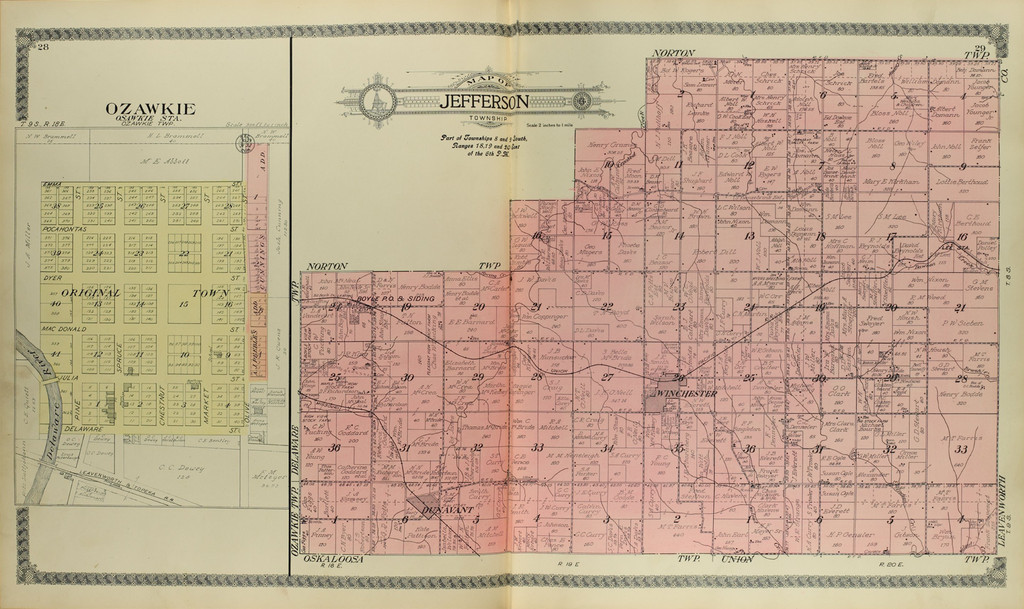
Jefferson Township, Jefferson County, Kansas, in a 1916 Ogle atlas. Historical geographical context for the Dunavant area; not a map drawn by Curry.
Image source
.
Public domain
. Proportionally resized; original appearance retained.
Watch: John Steuart Curry
Choose a film to explore the artist’s work, its interpretation and its wider setting.
Look at This: John Steuart Curry at MOWA
An exhibition interview with Graeme Reid considers Curry’s work and life in Wisconsin.
Watch on YouTubeBirds, sunlight and biblical associations
Above the baptism, two birds cross an area of descending light beneath a large cloud. The darker bird and the pale bird repeat, on a much smaller scale, the contrast between the minister’s black clothing and the woman’s white dress. Their position directs attention back toward the event below.
The Whitney identifies the pair as a raven and a dove, recalling the birds Noah released from the ark after the Flood. This reading places the local ceremony beside a biblical story concerned with water and renewal. It also makes the dryness that caused the worshippers’ difficulty an especially suggestive part of the subject. [1]
The light performs a related function through composition. Its pale streaks descend toward the two participants, while brighter edges around the clouds open the sky above them. The people remain in an ordinary yard, but the illumination makes their action appear connected to something larger than its immediate surroundings.
No single symbol operates alone. The tank contains the necessary water, the windmill rises above the gathering, the birds cross the light, and the central figures repeat the contrast of dark and pale forms. These relationships allow religious meaning to emerge through the visible organization of the farmyard.
The painting nevertheless retains enough ordinary detail to resist becoming a wholly separate sacred realm. The cars, barn, house and spectators remain recognizable and insistently present. The force of the image comes from allowing the ceremony to acquire significance within that material world. The viewer can move between the particulars of a rural gathering and the broader associations suggested by sky and water.
Sincerity, satire and the problem of expression
Early viewers disagreed about the painting’s attitude. Richmond-Moll recounts Nathaniel Pousette-Dart’s sympathetic reading of Curry’s relationship to rural people and Edward Alden Jewell’s interpretation of the work as satire directed at religious extremity. Those critical responses are historical interpretations, rather than interchangeable statements of Curry’s own intention. [9]
The image offers reasons for the disagreement. The minister’s severe face and emphatic movement can make the rite appear unsettling. The encircling crowd can suggest the strength of shared belief, but its closeness can also make the action feel exposed to social pressure. The same visible forms support more than one response.
Clothing and posture complicate any simple division between dignified participants and caricatures. Many figures stand quietly, while others appear to sing or lean inward. The central drama is embedded in a gathering whose members have different degrees of involvement. Looking only at the minister risks flattening this variety into a single judgement about the community.
The painting’s emotional complexity is part of its durability. It lets a viewer take the importance of the ceremony seriously while still noticing how unfamiliar, strenuous or disconcerting the act may appear. Respect for the participants and discomfort at the gesture need not cancel each other out. The picture keeps both responses available.
Recognition at the Corcoran and the Whitney
Baptism in Kansas attracted attention at the Corcoran Gallery’s 1928 biennial in Washington. The National Gallery of Art’s account of Curry’s career places its favourable reception after his return from Paris to Westport in 1927, followed by Gertrude Vanderbilt Whitney’s financial support. The Kansas subject thus became central to a reputation being established through eastern American institutions. [11]
The Whitney’s Breaking Ground exhibition account records Curry’s membership in the Whitney Studio Club in 1928 and the two-year stipend provided by Whitney and Juliana Force. It also identifies his January 1930 one-artist exhibition at the Whitney Studio. These events distinguish institutional support, a solo exhibition and the later life of a painting within a museum collection. [12]
Whitney purchased the painting in 1930, according to Richmond-Moll’s account. Its accession number, 31.159, should not be used by itself to shift that purchase to 1931. The number identifies the object within the museum; it is not a complete chronology of the earlier relationship between artist, patron and exhibition venue. [9]
The Art Institute of Chicago’s 1933 Century of Progress catalogue lists Baptism in Kansas as entry 536, lent by the Whitney Museum of American Art. That contemporary listing records another stage in the painting’s public circulation. The picture’s village ceremony could now be encountered far from its remembered setting, carrying an image of Kansas into a major exhibition. [13]
This movement between local subject and wider audience is important to its place in American Regionalism . The image makes a small community highly visible, but it reaches its viewers through exhibitions, patrons and museums operating beyond that community. Its regional character is produced through circulation as well as attachment to place.
The creek baptism and a different setting
Curry also treated immersion baptism in the lithograph Baptism in Big Stranger Creek . The example illustrated in Richmond-Moll’s article belongs to the Philadelphia Museum of Art, accession 1950-111-4. The scene places the ceremony beneath trees beside a creek, with spectators spread along its banks. [10]
The comparison makes the tank painting’s choices easier to see. The oil gathers attention around a clearly bounded container in an exposed yard. The print gives vegetation and the banks of a watercourse a much larger role in enclosing the ceremony. The change of setting alters the relationship between the people and their surroundings.
It is useful to compare these broad arrangements without treating the lithograph as a monochrome copy of the oil. A new setting produces a different composition, with its own distribution of trees, figures and open water. The common subject does not make the objects identical, or make one an exact documentary correction of the other.
In both, a religious action creates a temporary focus within a larger landscape. The tank picture makes the practical problem of finding water particularly visible. Its unusual container gives the ceremony a concentration that depends on the very circumstances that forced the gathering away from a creek.
Religious life in a changing countryside
Richmond-Moll reads Curry’s religious pictures through mobility: cars and roads helped people assemble for worship even as rural communities changed. In this interpretation, the vehicles belong to the subject’s spiritual and social meaning, as well as to its period setting. [9]
That connection is visible in the painting’s arrangement. The crowd occupies the foreground, the cars line the middle distance, and the road leads away at the edge. Gathering and movement are present together. The farmyard becomes a place of shared attention without being cut off from the routes that connect it to the wider countryside.
The relationship also offers a useful comparison with Curry’s The Gospel Train , another work in which religious expression and a vehicle occupy the same image. Different communities and settings require their own histories, but the connection draws attention to Curry’s repeated interest in belief as part of everyday material life.
Baptism in Kansas brings that interest into a remarkably compact arrangement. The water tank gives the scene a centre; the people make it a community; and the farm, vehicles and sky connect it to a larger world. Its achievement lies in holding those relationships together while leaving the viewer room to consider the ceremony’s seriousness, strangeness and power.
Artworks and versions directory
Browse 84 selected object, version, edition and reproduction records. Several concern related images or different impressions; this is not a complete lifetime catalogue or a count of unique compositions. Search also finds prints, photographs and reproductions; the medium filter groups paintings and drawings.
Frequently Asked Questions
He painted it in 1928. The subject recalls a ceremony witnessed in 1915, thirteen years earlier.
Nearby creeks had dried, so the congregation used a farm tank for the immersion ceremony.
It belongs to the Whitney Museum of American Art in New York, accession 31.159. The collection location does not guarantee that it is currently on display.
The Whitney interprets them as the raven and dove released by Noah, connecting the scene with the biblical Flood and the renewal associated with water.
Discussion
Look again at the images and ideas explored in Baptism in Kansas by John Steuart Curry. These editorial prompts invite your observations.
Reader Insights
How does the circular tank shape your experience of the surrounding crowd?
Do the cars and windmill change your understanding of the relationship between religious tradition and modern rural life?
Which details make the ceremony appear solemn, unsettling or welcoming to you?
Join the Conversation
Share a detail, comparison or question about Baptism in Kansas by John Steuart Curry below.
References
- Whitney Museum of American Art , Baptism in Kansas, 1928, 31.159: object metadata and interpretation. View source
- Muskegon Museum of Art, Tornado Over Kansas - Muskegon Museum of Art. View source
- National Gallery of Art, Circus Elephants: collection object record. View source
- Saint Louis Art Museum, The Mississippi,1935,7:1937: collection record and provenance. View source
- Smithsonian American Art Museum, Ajax. View source
- Kansas Historical Society, Kansas State Capitol - Online tour - Tragic Prelude - Kansas Historical Society. View source
- Metropolitan Museum of Art, Wisconsin Landscape. View source
- Chazen Museum of Art, Our Good Earth | 1873 |Chazen Museum of Art. View source
- Jeffrey Richmond-Moll , Holy Rollers: Religion and Modern Mobility in the Art of John Steuart Curry, Panorama 9, no. 2 (Fall 2023), especially pp. 1–7 and 12–15. View source
- Panorama , Holy Rollers: figure 1, original 1916 atlas spread, and figure 6, Baptism in Big Stranger Creek; captions and illustrated objects. View source
- National Gallery of Art , John Steuart Curry: career account, including 1928 Corcoran reception and Whitney support. View source
- Whitney Museum of American Art , Breaking Ground: The Whitney’s Founding Collection, 2011: Curry section. View source
- Art Institute of Chicago , Catalogue of a Century of Progress exhibition of paintings and sculpture, 1933: entry 536, Baptism in Kansas. View source
- Splash image source.
John Steuart Curry, Baptism in Kansas, 1928, oil on canvas, Whitney Museum of American Art. Photograph by Mollerus, 2018; the painting is seen at an angle. CC BY 2.0 photograph; underlying painting public domain . Proportionally resized; original appearance retained.
View source
More CURRY Paintings
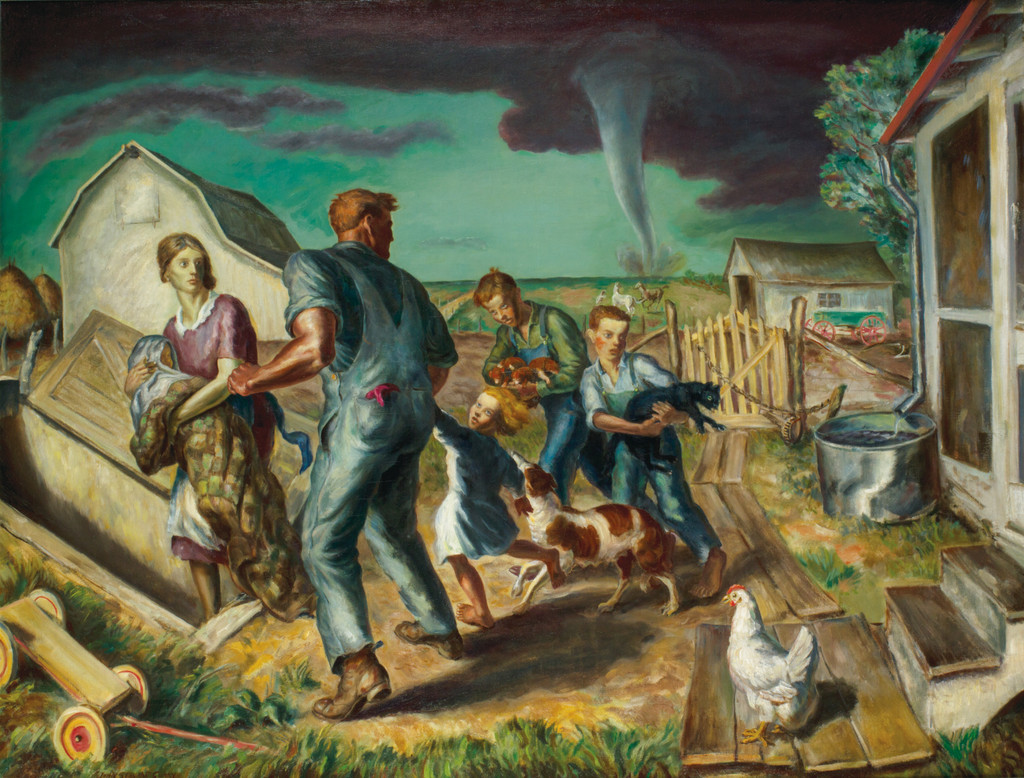
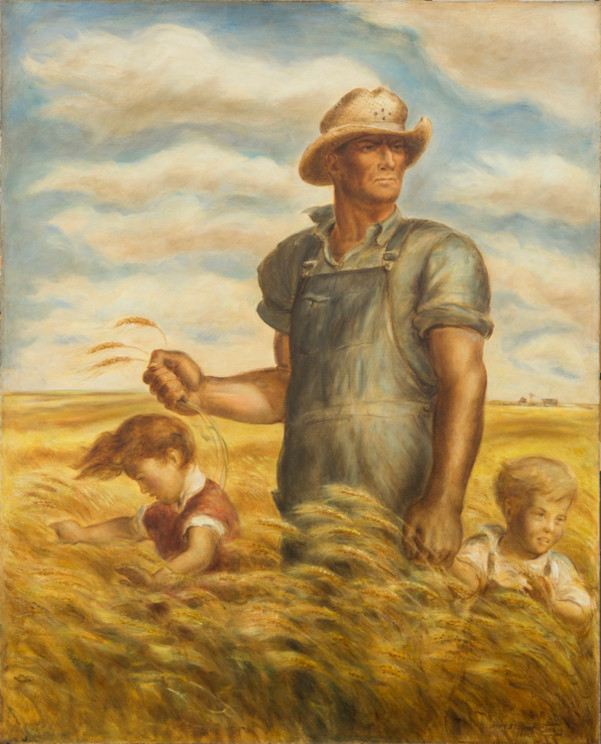
Our Good Earth
1942 painting and its related prints and wartime imagery.
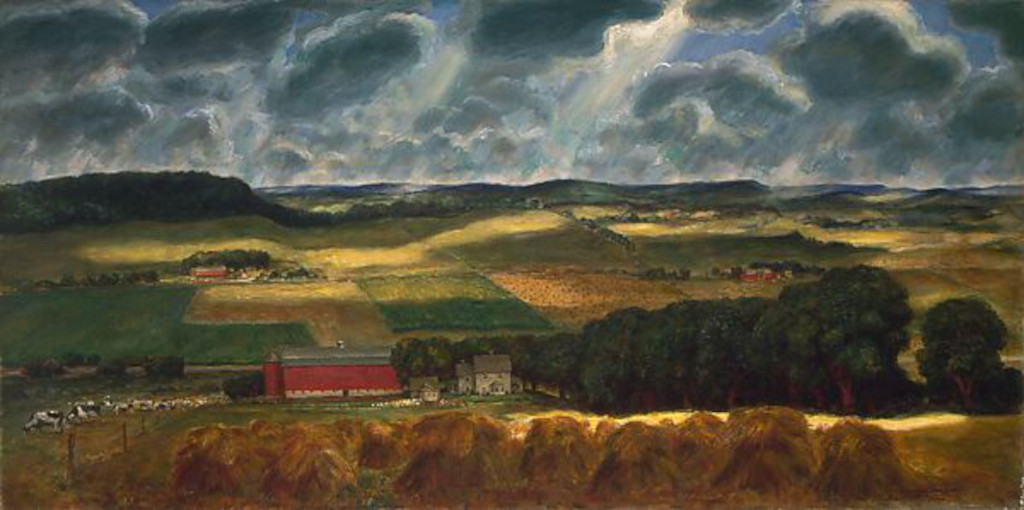
Wisconsin Landscape
1938–39 panorama of working farmland, held by The Met.


Circus Elephants
1932 painting of elephants, handlers and the work behind the circus.