


 by
Tom Gurney
Tom Gurney BSc (Hons) is an art history expert with over 20 years experience
Email:
tomgurney1@gmail.com
/ Phone:
+44 7429 011000
Tornado Over Kansas by John Steuart Curry: Introduction
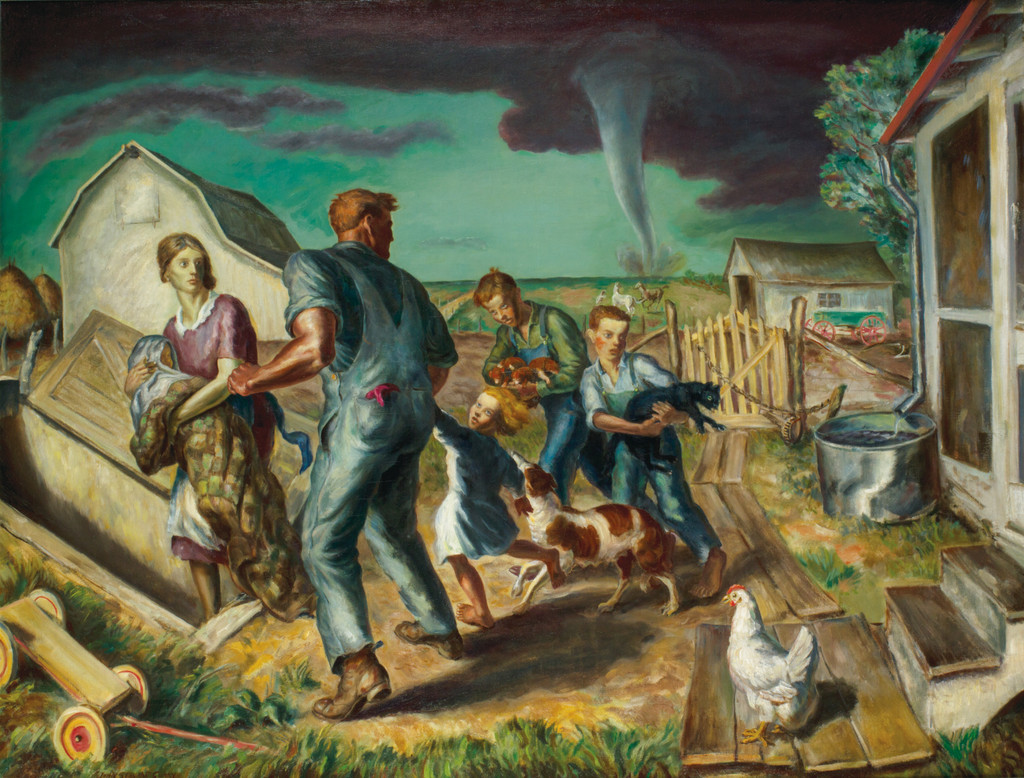
A farm family moves toward an open storm cellar while a tornado descends from a dark cloud beyond the yard. Adults, children and animals crowd the foreground, their different actions held together by the approaching danger. John Steuart Curry’s Tornado Over Kansas , also known as The Tornado , turns a landscape subject into a concentrated account of a household under pressure.
The painting dates from 1929 and belongs to the Muskegon Museum of Art. Its force comes from the relationship between the distant funnel and the closely observed family, but also from the objects, buildings and spaces connecting them. Looking through those relationships explains how Curry makes an instant of uncertainty remain compelling. [1]
At a Glance
- Artist John Steuart Curry, 1897–1946.
- Titles Tornado Over Kansas ; The Tornado .
- Date 1929.
- Medium Oil on canvas.
- Collection Muskegon Museum of Art, Michigan.
- Credit Hackley Picture Fund.
- Object number 1935.4.
- Place of painting Westport, Connecticut.
- Related object A reworked lithograph, The Tornado , dated 1932.
This work across John Steuart Curry’s career
Circus Elephants
1932 paintingThe Mississippi
1935 paintingAjax
1936–37 oil paintingTragic Prelude
1938–40; project 1937–42Wisconsin Landscape
1938–39Our Good Earth
1942 oil paintingNotes and sources
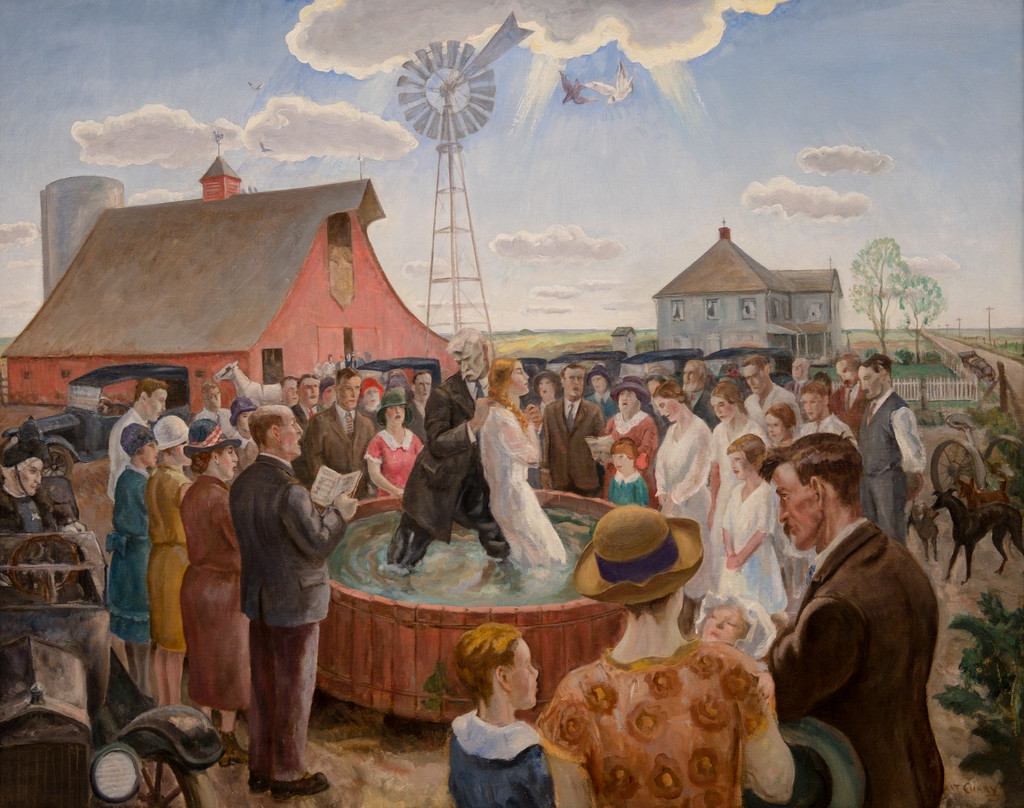
Baptism in Kansas. A remembered Kansas ceremony is staged within a working farmyard. [2]
Tornado Over Kansas (current article). A Kansas storm and a family seeking shelter, painted in Curry’s Westport studio. [1]
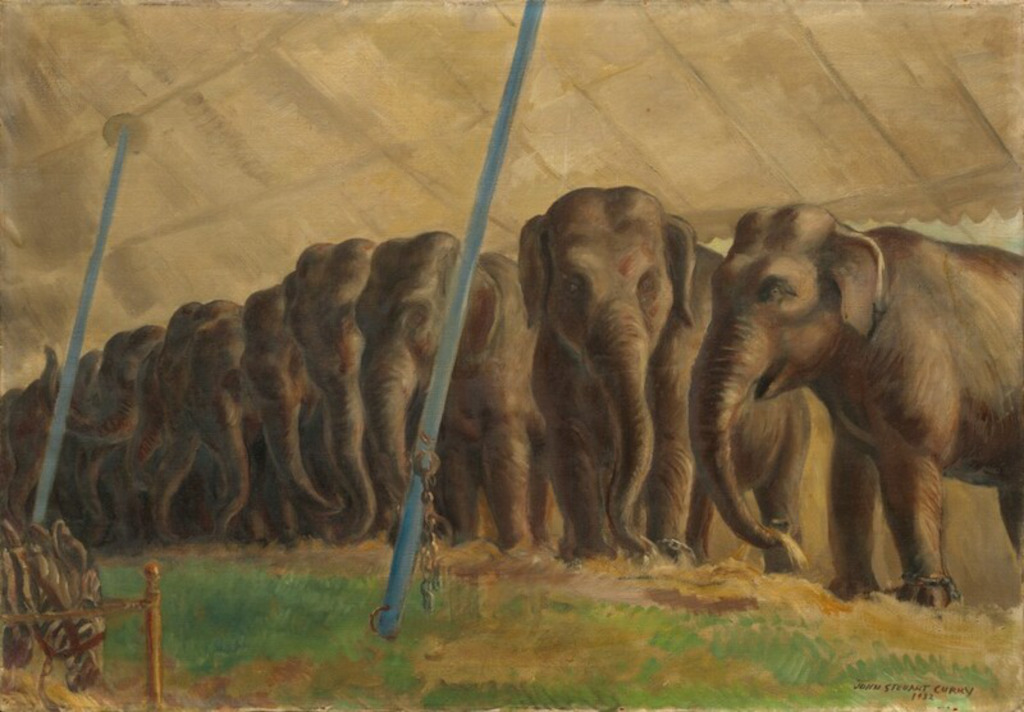
Circus Elephants. Elephants and handlers occupy the working space beneath a circus tent. [3]
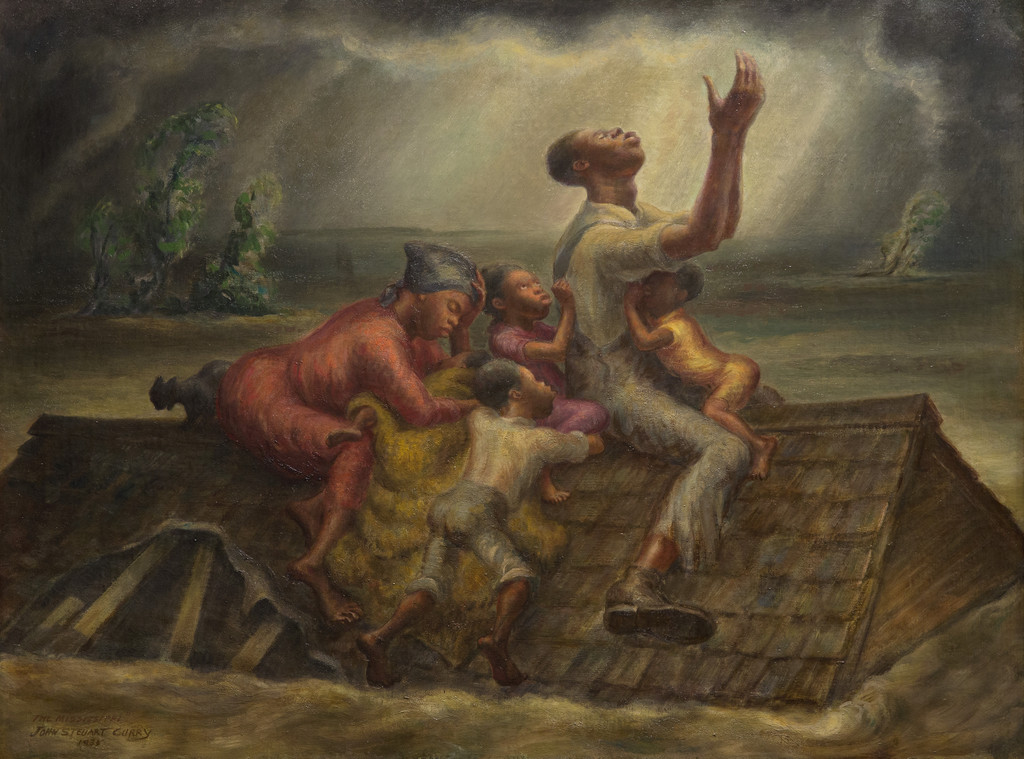
The Mississippi. A family occupies a roof amid floodwater; the painting is tempera on canvas mounted on panel. [4]
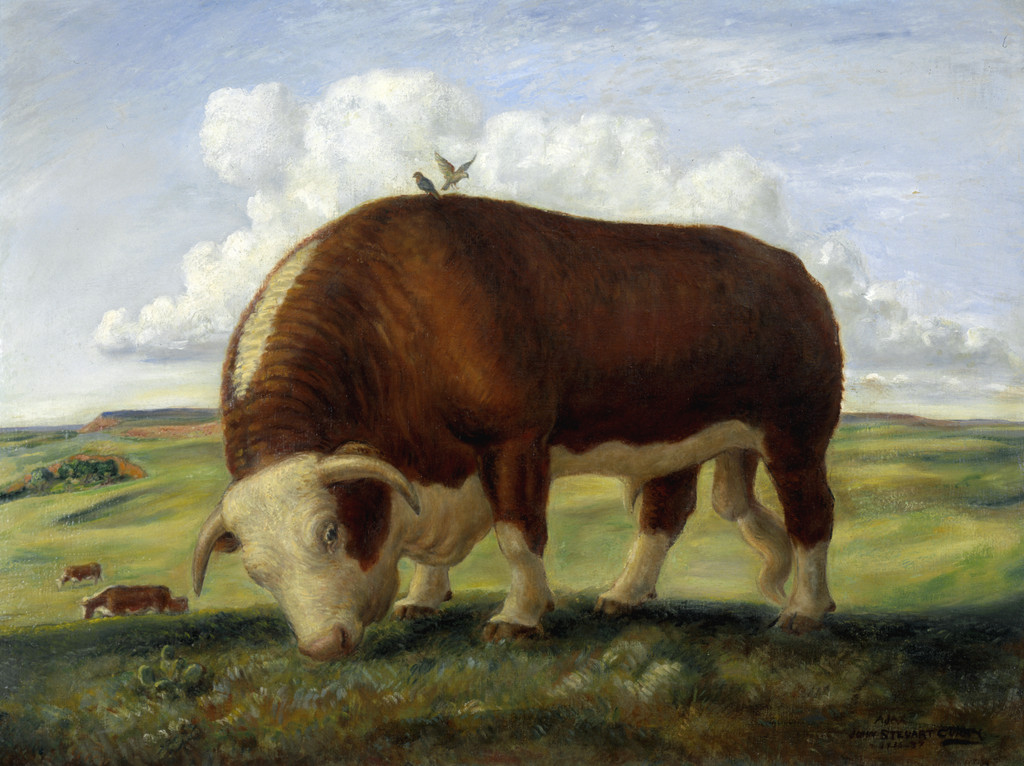
Ajax. The monumental bull in the Smithsonian oil differs from the earlier lithograph. [5]
Tragic Prelude. John Brown stands at the centre of a Kansas State Capitol mural continuing across adjoining walls. [6]
Wisconsin Landscape. An extensive farm panorama, distinct from the separately catalogued preparatory study. [7]
Our Good Earth. The Chazen painting is distinct from the watercolour study, lithographs and wartime posters. [8]
Contents
- A family between the house and the cellar
- The father’s turn and the child’s movement
- The storm beyond the farmyard
- Animals, objects and the interrupted household
- Colour and the viewer’s route
- A Kansas subject painted in Connecticut
- The painting and the later lithograph
- Prizes, purchase and a public image of Kansas
- Weather, stereotype and the limits of a literal reading
- Annotated details
A family between the house and the cellar
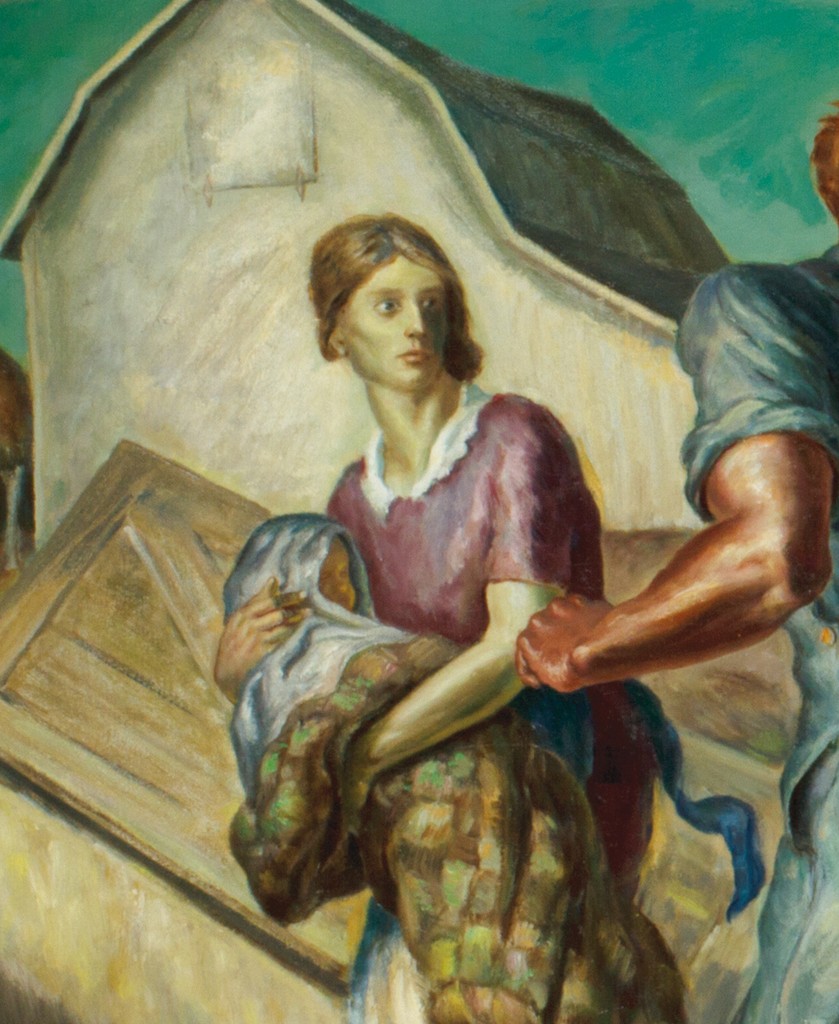
The open cellar gives the family’s movements a destination. At the left, its raised wooden door forms a large diagonal beside the woman carrying a baby. Her body and the child’s covering introduce softer, curved shapes against the angular structure. Safety is suggested through an opening in the ground, while the surface of the farm remains exposed to the sky.
The man occupies the centre with his back partly turned toward the viewer. His blue work clothes give him a broad, substantial presence. Around him, a small girl reaches upward and the boys attend to animals. Their positions prevent the family from becoming a single undifferentiated group. Each person appears occupied with an action that contributes to the household’s response.
The buildings and fence establish the space in which those actions occur. The barn at the left and the house at the right hold the figures within a relatively narrow yard. Beyond them, a fence leads toward an outbuilding and open country. The scene therefore offers several depths at once: the cellar entrance, the close group, the working yard and the threatened landscape beyond it.
Those spatial relationships give the picture its narrative clarity. The viewer can identify the danger and understand the movement toward refuge without needing a written explanation. Yet the story remains suspended. The family has not disappeared into shelter, and the tornado has not reached the foreground. The painting holds attention in the interval between recognizing danger and completing an escape.
Annotated Details from Tornado Over Kansas
The numbered points identify visible features discussed in this article. Return from each detail to the whole composition. John Steuart Curry, The Tornado (Tornado Over Kansas), 1929, oil on canvas. Muskegon Museum of Art. Image source. Public domain. Editorial numbers added to the overview; detail crops retain the source image’s appearance.
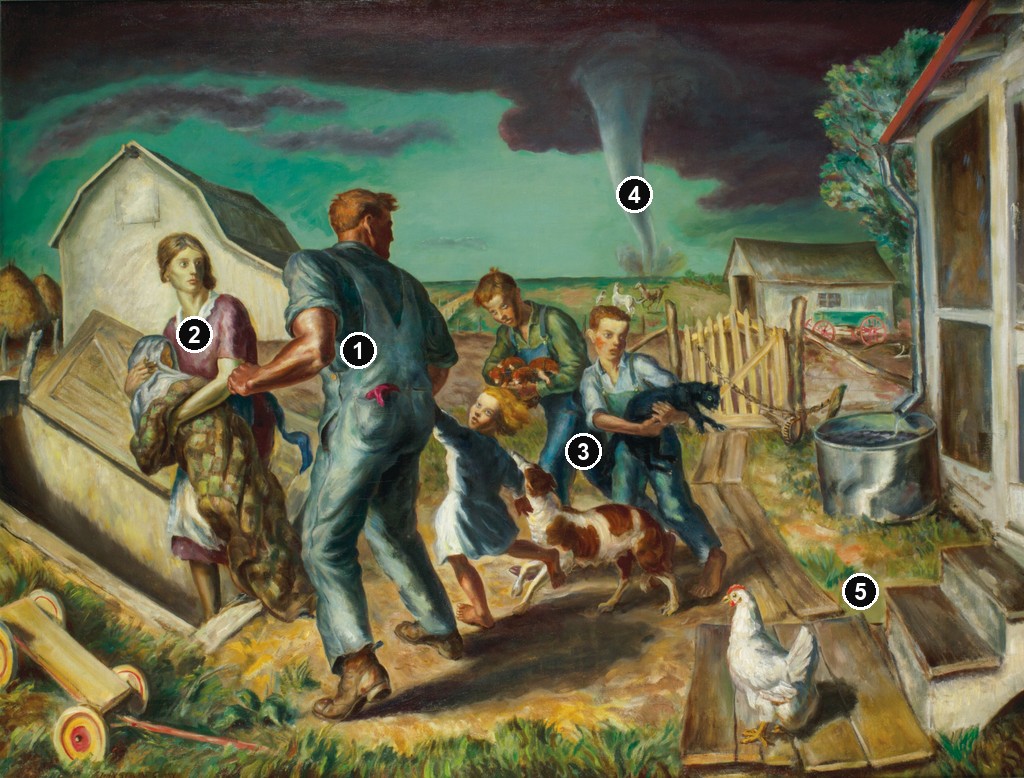
Details from TORNADO OVER KANSAS
Compare the cropped details with the complete images above. Notice how their colours, shapes and positions contribute to the larger compositions.
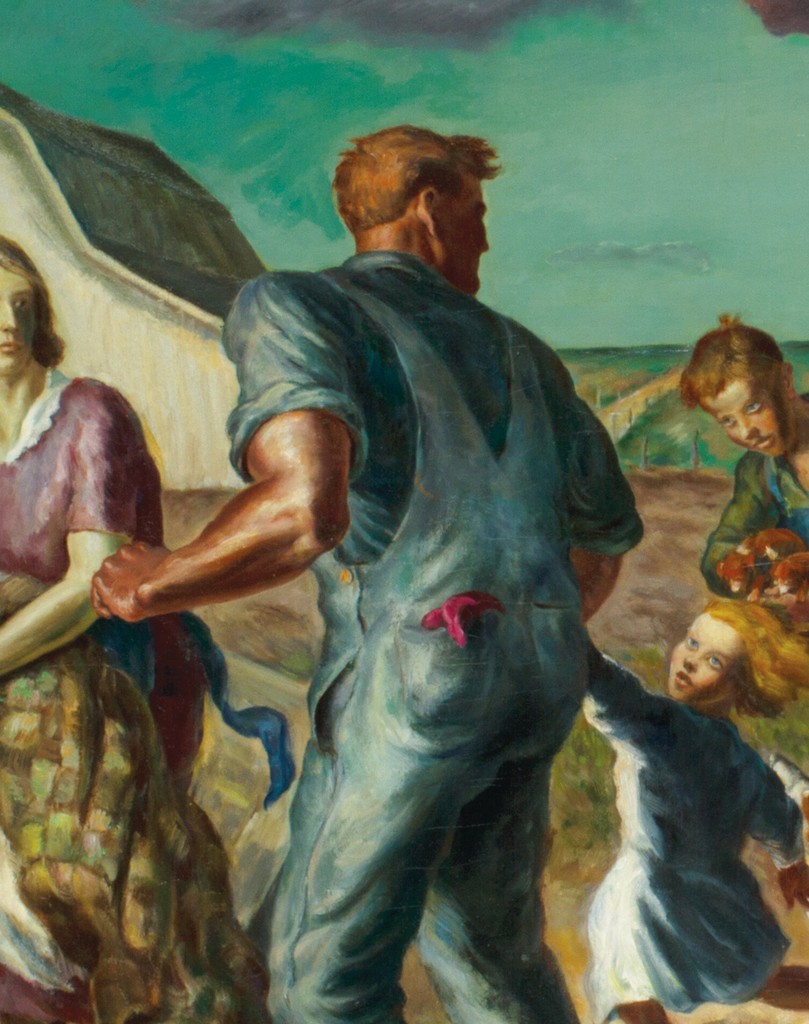
The father turns across the movement
The father’s turned head and outstretched arm interrupt the family’s leftward route. His large back forms a hinge between the nearer household and the approaching storm.
Mother, infant and quilt
The mother carries the infant close to her body, with patterned fabric gathered around them. The small face and supporting arms give the larger emergency a domestic scale.
Children carrying animals
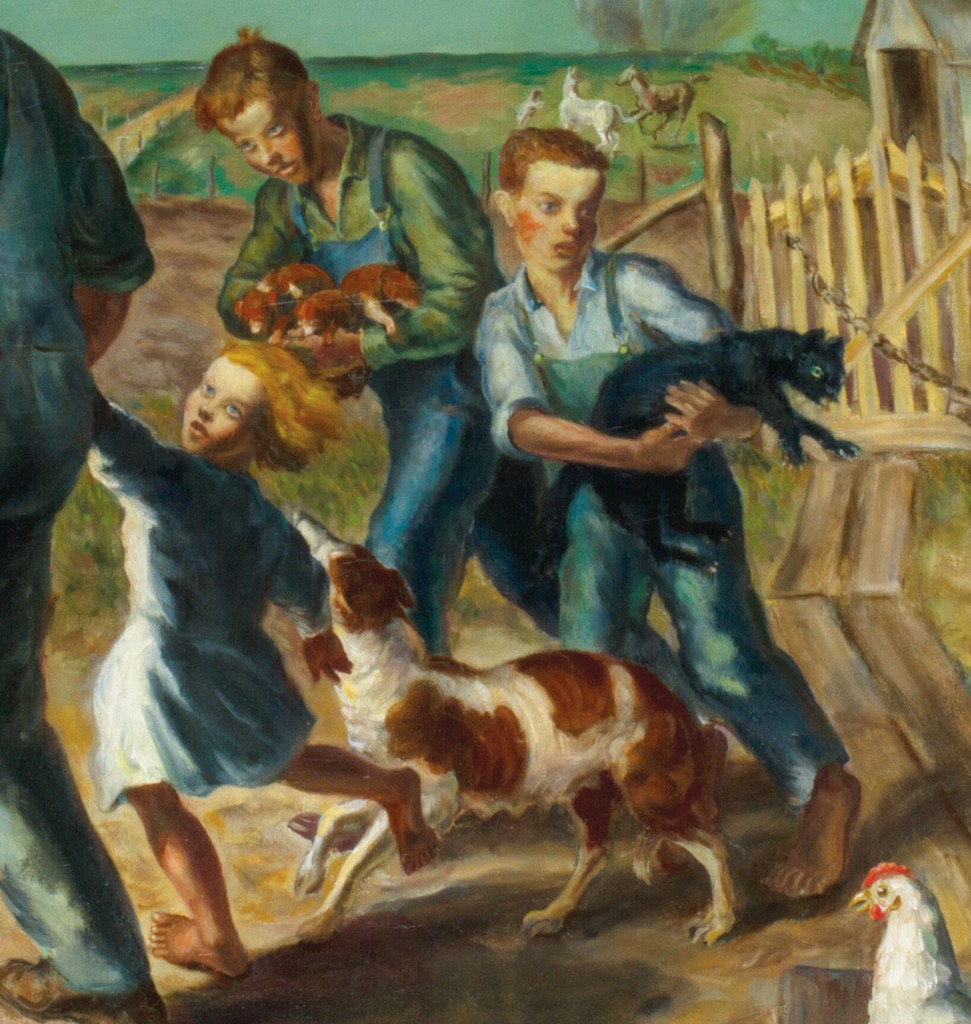
The children respond through different actions: carrying small animals, turning towards an adult and moving past the dog. Their bodies make the route to shelter crowded and uneven.
The funnel beyond the fence
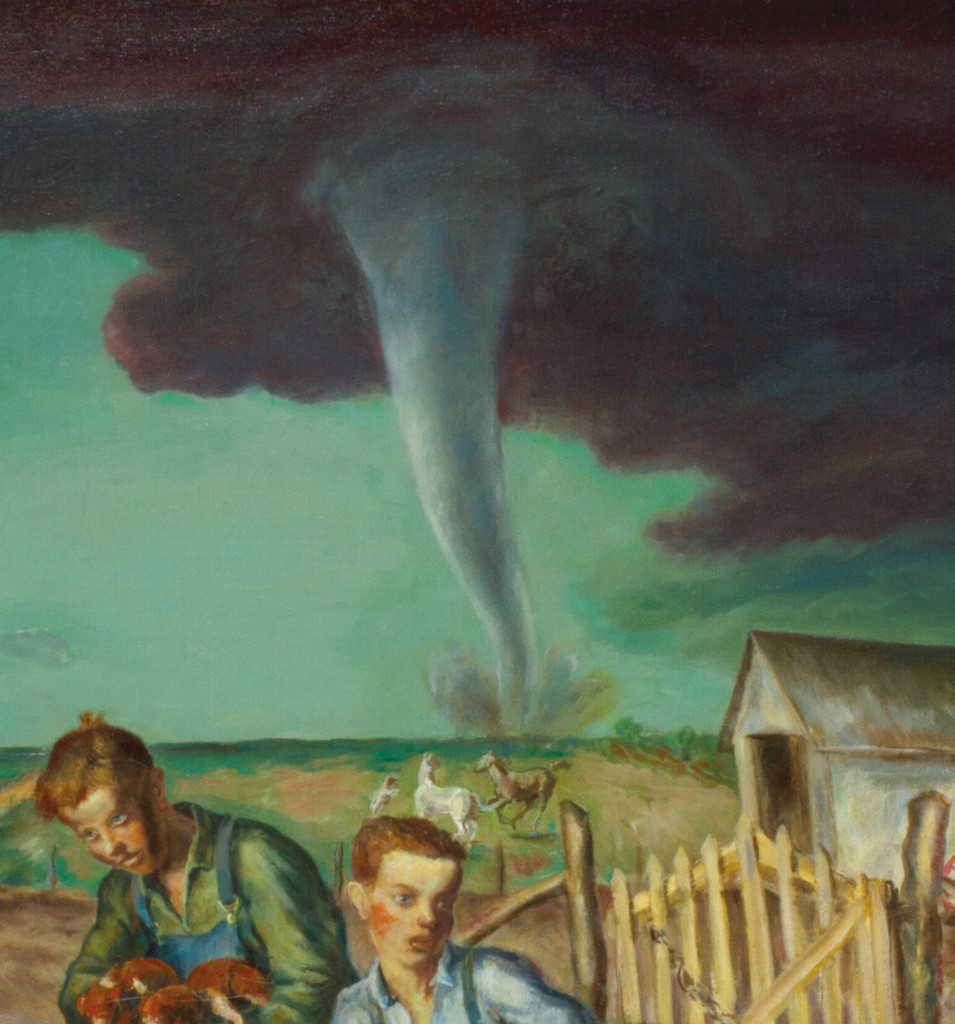
The funnel descends from the dark cloud into the open country beyond the household. The interval of land between it and the family makes the danger both distant and imminent.
Water basin and porch objects
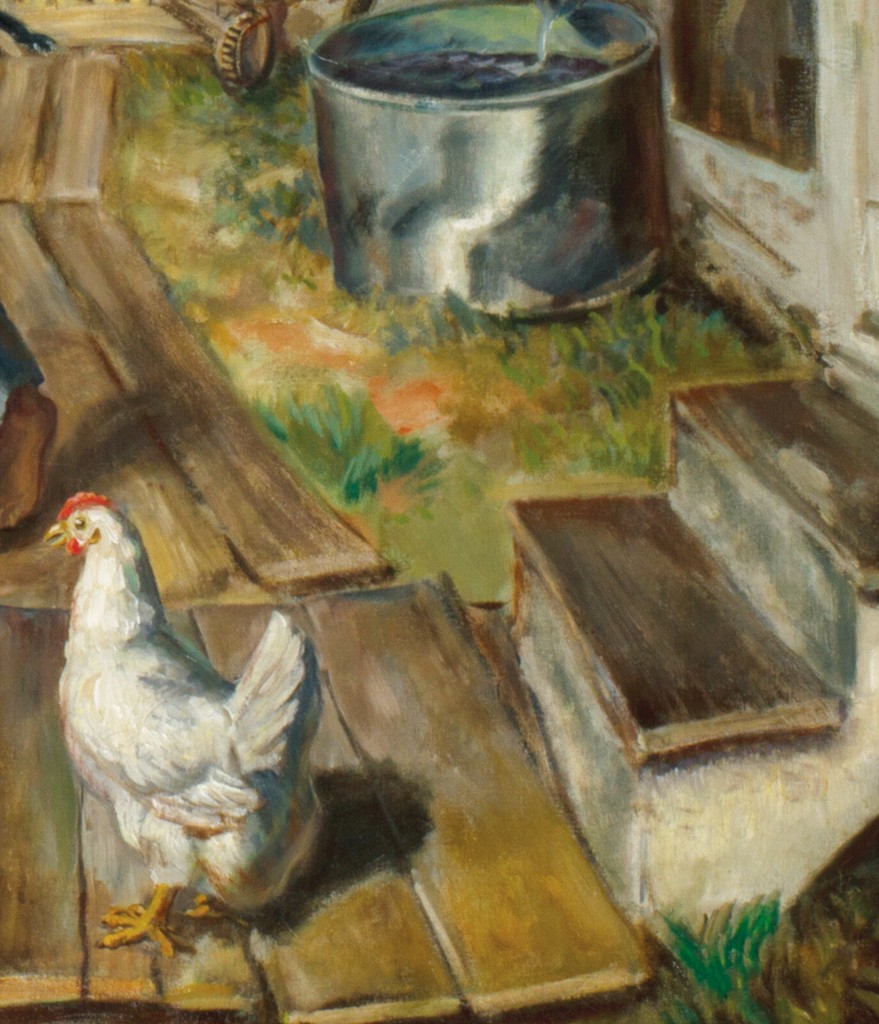
The basin, boards and chicken belong to the farm’s ordinary surroundings. Seen beside the hurried figures, these small things help make the emergency an interruption of everyday life.
The father’s turn and the child’s movement
The father’s turned body connects two directions of attention. His arm reaches toward the woman while his head turns toward the storm. His stance belongs to the movement of the family, but his profile directs awareness outward. This divided orientation makes him a link between the people close to him and the larger event beyond the yard.
The small girl adds a different scale of action. She looks upward toward him, reaching across the space beside his body. Her position makes dependence visible through the relationship between their sizes and gestures. The boy carrying the black cat occupies another part of that network, combining concern for an animal with the effort of moving through the crowded foreground.
Muskegon’s educational interpretation reads the father as a protector and the family’s grouping as an expression of their connection. That reading gives the scene a particular model of family responsibility. The visible actions also allow attention to spread beyond the central adult: the woman carries the baby, the children gather pets, and several kinds of care happen at once. [9]
The people’s faces and postures introduce different responses to the same threat. The woman’s pale face contrasts with the man’s turned profile; the girl looks toward a person nearby; the boys concentrate on their immediate tasks. Curry distributes attention through those differences. The storm becomes a shared danger experienced through individual bodies, rather than one emotion repeated across every figure.
The storm beyond the farmyard
The tornado’s narrow form extends from the dark cloud mass toward the distant ground. Its position makes the open country behind the family feel much closer to the household’s urgent activity. The funnel does not need to occupy most of the canvas to organize the whole scene. Once noticed, it changes the significance of the figures, the open cellar and the animals.
The sky supplies a strong contrast of colour and shape. Deep cloud shadows stretch across the upper picture, while green light opens between the clouds and the horizon. The funnel emerges through that interval as a pale, tapering form. Beneath it, the warmer colours of the yard and the family’s clothing keep the foreground visually distinct.
The contrast joins distant and immediate kinds of scale. The cloud system extends beyond the edges of the view, while the people remain specific and physically close. A small hand, a carried cat and a lifted foot can be read against a force too large for the family to control. That relationship gives the weather an emotional consequence without making the household disappear beneath spectacle.
The buildings continue to stand, and much of the ordinary farm remains recognizable. Curry places the viewer before the outcome. The picture’s tension depends on what may happen to this inhabited place, rather than a detailed display of the damage after a storm. It is a painting about anticipation as much as about violent weather.
Animals, objects and the interrupted household
The animals give the family’s actions a practical and emotional focus. A boy holds a black cat, another child bends over a smaller animal, and a brown-and-white dog moves beside the figures. Their inclusion expands the household beyond its human members. Rescue involves gathering living creatures whose movements may not be as orderly as the adults’ intentions.
The white hen at the lower right occupies a different position. Set among wooden boards in the foreground, it remains outside the main group’s closely linked actions. Its small, sharply visible body adds another point of attention near the edge of the picture. It also helps make the yard feel like a place in use before the approaching storm interrupted it.
A small wheeled cart lies at the lower left. Nearby are the cellar door and the edges of the ground opening; at the right, a bucket stands beneath the house’s downpipe. Farther back, another wagon remains near the outbuilding. These objects establish ordinary activity at several scales, from a child’s possessions to the equipment of a working farm.
Their presence gives the emergency something concrete to interrupt. The picture does not require every object to carry a hidden symbolic meaning. Familiar things can make the place convincing and show how much must be left exposed as the people move toward shelter. Looking away from the funnel toward these smaller details changes the scene from an image of weather into a picture of lives conducted beneath it.
Colour and the viewer’s route
Colour helps connect the separate figures. Variations of blue recur in the father’s clothing, the girl’s dress and the boy at the right, while the woman’s purple blouse and patterned skirt distinguish her within the group. The pale baby covering and the woman’s face concentrate light near the cellar entrance. The girl’s bright hair creates another small focus beside the larger blue figure of the man.
Smaller colour accents carry attention into the surroundings. The red wheels of the cart at the lower left find a distant echo in the wagon beside the outbuilding. The white hen stands out against darker boards, while the pale barn catches light above the woman. These contrasts give the eye several points of entry into the scene. A viewer can begin with the storm, the man or a small foreground object and still be drawn toward the relationships among them. The composition remains organized even as attention moves between its principal drama and the ordinary things around it.
A Kansas subject painted in Connecticut
Muskegon identifies the painting’s place of execution as Curry’s studio in Westport, Connecticut. Its Kansas subject drew on memories of the storms of his youth. The distance between subject and studio is central to the picture’s history: a recognizable rural setting was developed as a painting intended to be seen well beyond that setting. [1]
The biography follows the training and illustration work that preceded Curry’s national recognition. His experience of visual storytelling is relevant to the farmyard’s legibility. Figures have distinct tasks, the central event can be grasped quickly, and the background supplies the cause of the foreground’s movement. The finished composition gathers those elements into a sustained arrangement.
Memories, drawings and photographs belong to different kinds of evidence about such a process. A related subject does not automatically identify the immediate model for a finished painting. The Beach Museum catalogues an ink-over-chalk drawing titled Winchester, Kansas, Tornado, May 1, 1930 . Its stated date is later than the 1929 oil, while the same collection also lists related studies dated 1929. These records require attention to exact objects and chronology before proposing a direct preparatory relationship. [10]
The painting itself offers a constructed scene. Its arrangement tells us how Curry organized a family, a farm and a storm within a canvas. It does not establish a particular tornado’s path or prove that every building and figure records one witnessed event. Keeping that distinction allows the picture’s dramatic invention to remain part of its achievement.
Watch: John Steuart Curry
Choose a film to explore the artist’s work, its interpretation and its wider setting.
Look at This: John Steuart Curry at MOWA
An exhibition interview with Graeme Reid considers Curry’s work and life in Wisconsin.
Watch on YouTubeThe painting and the later lithograph
Curry returned to the subject in the 1932 lithograph The Tornado . The Beach Museum’s educational publication identifies its impression as 2003.222. The print retains the family, the storm and the move toward shelter, but reorganizes their relationship. The result should be understood as another composition in a different medium. [11]
In the print, the woman carrying the baby stands at the right beside the cellar entrance. The man occupies the centre, a boy with an animal stands to the left, and a child bends near the opening. The house and bucket appear on the left, while the barn and windmill occupy the right. These changes affect the routes through which the viewer follows the family and understands the surrounding space.
The shift to black and white also changes the means of emphasis. Dense printed marks give weight to the clothes and storm clouds; lighter passages separate faces, buildings and the tornado. The family’s actions remain clear, but they emerge through contrasts of tone and the direction of marks. The print makes the story work through the resources of lithography.
The National Gallery of Art holds another impression, dated 1932 and catalogued as 2008.115.48. Its record identifies the lithograph and supplies inscription and collection information. Those details belong to the print, not to Muskegon’s 1929 canvas. The drawings and prints overview considers how such distinctions matter across Curry’s graphic work. [12]
Comparing the two compositions makes Curry’s decisions more visible. A recurring subject could be revised rather than merely copied. The family’s relationship to the cellar remains the basis of the story, while the distribution of people, animals and buildings changes the way that story unfolds across the image.
Prizes, purchase and a public image of Kansas
The painting’s early public history moved through exhibitions, a purchase offer and reproduction. Muskegon records a 1930 showing at the Whitney Studio Galleries and a 1931 offer from H. Tracy Kneeland. The museum’s account of his letter describes memories of threatening weather during his own Michigan childhood. The Kansas scene could prompt recognition beyond the state named in its title. [1]
Muskegon also records second prize at the 1933 Carnegie International and a colour reproduction in the 24 December 1934 issue of Time . The Hackley Art Gallery, now Muskegon Museum of Art, purchased the painting from Ferargil Galleries in 1935. The earlier offer and the eventual institutional purchase are different events in that history. [1]
Reproduction gave the picture a life beyond its physical location. Viewers could encounter the scene in print and come to associate Curry’s name with an image of the Midwest under threat. The strong central figures, dark sky and visible funnel make the subject immediately recognizable, even when encountered at a smaller scale.
Later museum activity continued that public life. Muskegon’s 2024 exhibition John Steuart Curry: Weathering the Storm , organized with art historian Patricia Junker, placed the painting within a wider account of his work. Its institutional fact sheet also notes the image’s appearance in the 1996 film Twister . Such reports trace a changing afterlife through exhibitions and popular media without making the original painting reducible to one famous reproduction. [13] [14]
Weather, stereotype and the limits of a literal reading
A familiar regional image can produce different kinds of recognition. One viewer may respond to childhood memories of a threatening storm; another may object that the scene makes violent weather seem the defining feature of a place. The Beach Museum’s discussion connects Curry’s tornado imagery with criticism that he perpetuated a negative picture of Kansas. [11]
That question also appears in the history of his Kansas State Capitol murals. The Kansas Historical Society records objections to the prominence of tornadoes and John Brown in an official account of the state. The dispute concerned which experiences should represent Kansas publicly. Danger and conflict had a different meaning for viewers hoping to see an image of progress and security. [15]
The farmyard painting contains material for more than one response. The storm threatens an ordinary household, but the family also acts with purpose and attends to its most vulnerable members. Their coordination gives the scene a measure of resilience. The picture’s force comes from holding those possibilities together, while leaving the actual outcome beyond its painted moment.
Comparisons with other Curry works sharpen that reading. Baptism in Kansas gathers a community around a ceremony; The Tornado gathers a household around the need for shelter. In Tragic Prelude , storm and fire belong to a historical composition whose imagery the Kansas Historical Society connects with the approach of war. The recurring weather form can serve different subjects and arguments. [2] [6]
Read within American Regionalism , Tornado Over Kansas offers a particular vision of rural experience rather than an inventory of everything a state contains. Its farm buildings, animals and figures make the place tangible; its arrangement makes the threat intelligible. The enduring drama lies in that combination of ordinary life, collective action and an event whose next moment the viewer cannot see.
Artworks and versions directory
Browse 84 selected object, version, edition and reproduction records. Several concern related images or different impressions; this is not a complete lifetime catalogue or a count of unique compositions. Search also finds prints, photographs and reproductions; the medium filter groups paintings and drawings.
Frequently Asked Questions
Curry painted the 1929 oil in Westport, Connecticut, drawing on a Kansas subject. [1]
It belongs to Muskegon Museum of Art, Michigan, object number 1935.4. [1]
Discussion
Look again at the images and ideas explored in Tornado Over Kansas by John Steuart Curry. These editorial prompts invite your observations.
Reader Insights
Which small detail first makes the household feel like a place occupied before the storm?
Compare the father, the woman carrying the baby and the children with animals. How does Curry distribute responsibility across their different actions?
How does moving the family and cellar entrance in the lithograph change your reading of the scene?
Join the Conversation
Share a detail, comparison or question about Tornado Over Kansas by John Steuart Curry below.
References
- Muskegon Museum of Art , Tornado Over Kansas, 1929, object 1935.4: metadata and collection essay. View source
- Whitney Museum of American Art , Baptism in Kansas, 1928, 31.159. View source
- National Gallery of Art, Circus Elephants: collection object record. View source
- Saint Louis Art Museum, The Mississippi,1935,7:1937: collection record and provenance. View source
- Smithsonian American Art Museum, Ajax. View source
- Kansas Historical Society , Tragic Prelude: online mural tour. View source
- Metropolitan Museum of Art, Wisconsin Landscape. View source
- Chazen Museum of Art, Our Good Earth | 1873 |Chazen Museum of Art. View source
- Muskegon Museum of Art , Tornado Over Kansas: educational notes, PDF page 2; family interpretation. View source
- Beach Museum of Art , Winchester, Kansas, Tornado, May 1, 1930, 2002.885; related studies listed separately. View source
- Beach Museum of Art , Extremes in Weather, PDF pp. 8–9: The Tornado, 1932, lithograph, 2003.222. View source
- National Gallery of Art , The Tornado, 1932, lithograph, 2008.115.48. View source
- Muskegon Museum of Art , Summer 2024 Journal, PDF page 4: John Steuart Curry: Weathering the Storm. View source
- Muskegon Museum of Art , Weathering the Storm event fact sheet, 2024. View source
- Kansas Historical Society , Kansas State Capitol: Curry murals. View source
- Splash image source.
John Steuart Curry, The Tornado (Tornado Over Kansas), 1929, oil on canvas. Muskegon Museum of Art. Public domain . Proportionally resized; original appearance retained.
View source
More CURRY Paintings
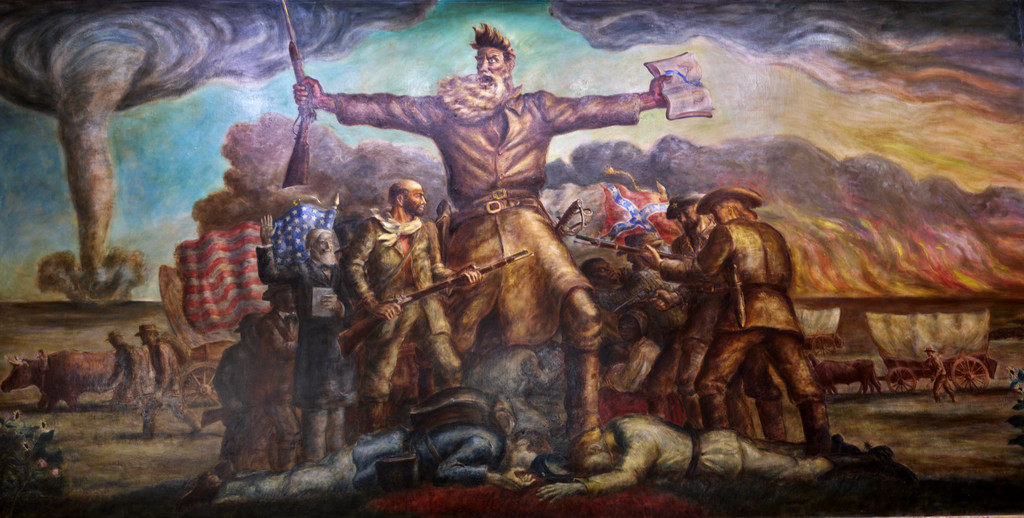
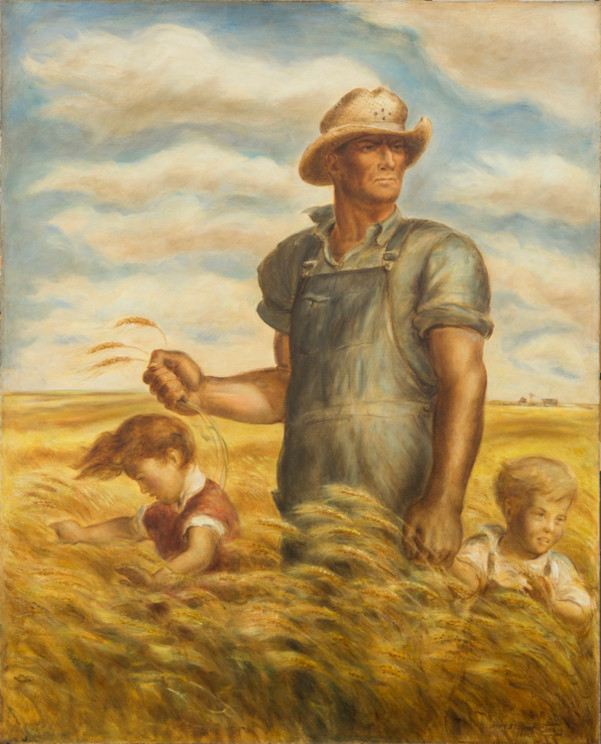
Our Good Earth
1942 painting and its related prints and wartime imagery.
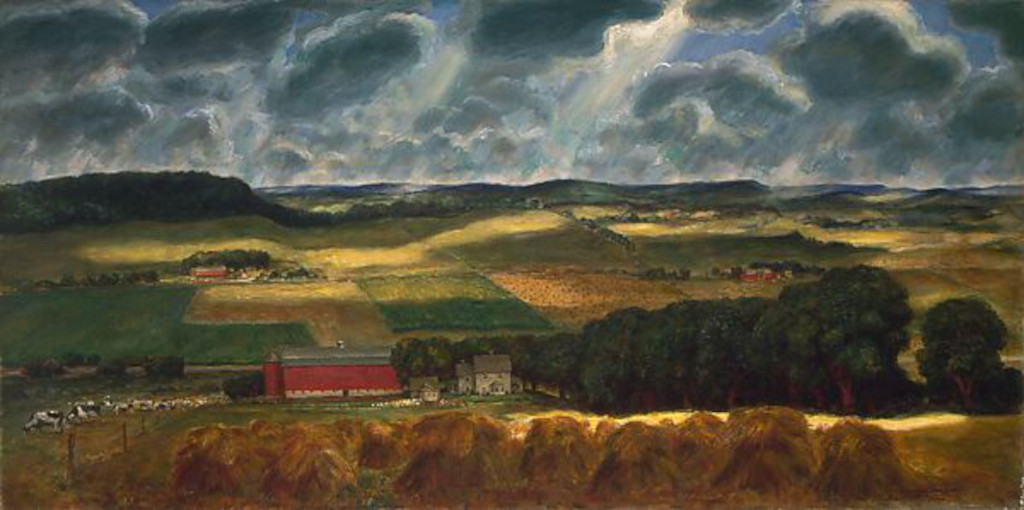
Wisconsin Landscape
1938–39 panorama of working farmland, held by The Met.


Circus Elephants
1932 painting of elephants, handlers and the work behind the circus.