


 by
Tom Gurney
Tom Gurney BSc (Hons) is an art history expert with over 20 years experience
Email:
tomgurney1@gmail.com
/ Phone:
+44 7429 011000
John Steuart Curry: Style and Technique: Introduction
John Steuart Curry gives bodies a forceful presence within carefully arranged scenes. People bend, reach, run or stand their ground; animals occupy the foreground with conspicuous weight. A storm can spread the action across the sky, while a low horizon makes a single figure seem exceptionally large. These effects connect his familiar subjects with decisions about scale, rhythm, light and space.
His materials were equally varied. Oil painting, tempera underlayers, different grounds and surface coatings appear in the documentary and conservation record. Looking at particular works reveals a painter who continued to experiment, with results that could be visually powerful and technically troublesome. The paintings overview introduces his subjects; this account considers how the pictures work and how they were made.
At a Glance
- Associated movement American Regionalism and the American Scene.
- Compositional concerns Action, bodily weight, changing weather and the relationship between figures and landscape.
- Preparatory work Sketchbooks, drawings and studies in several media.
- Painting materials Oil, tempera and combinations of media, varying by work.
- Supports Canvas and several kinds of board appear in museum records.
- Technical evidence Object examination, conservation reports and documentary research.
- Important distinction A visible effect does not establish a pigment, binder or layer structure.
- Useful comparisons Tornado Over Kansas , Ajax , Baptism in Kansas , The Line Storm and Circus Elephants .
Contents
- A scene built around a human action
- Weight, scale and the monumental figure
- Weather as a compositional force
- Memory, drawing and studio construction
- Oil, tempera and experiments with layers
- Grounds, scratching and the painted surface
- Varnish, dealers and changing expectations
- What conservation can establish
- Annotated details
A scene built around a human action
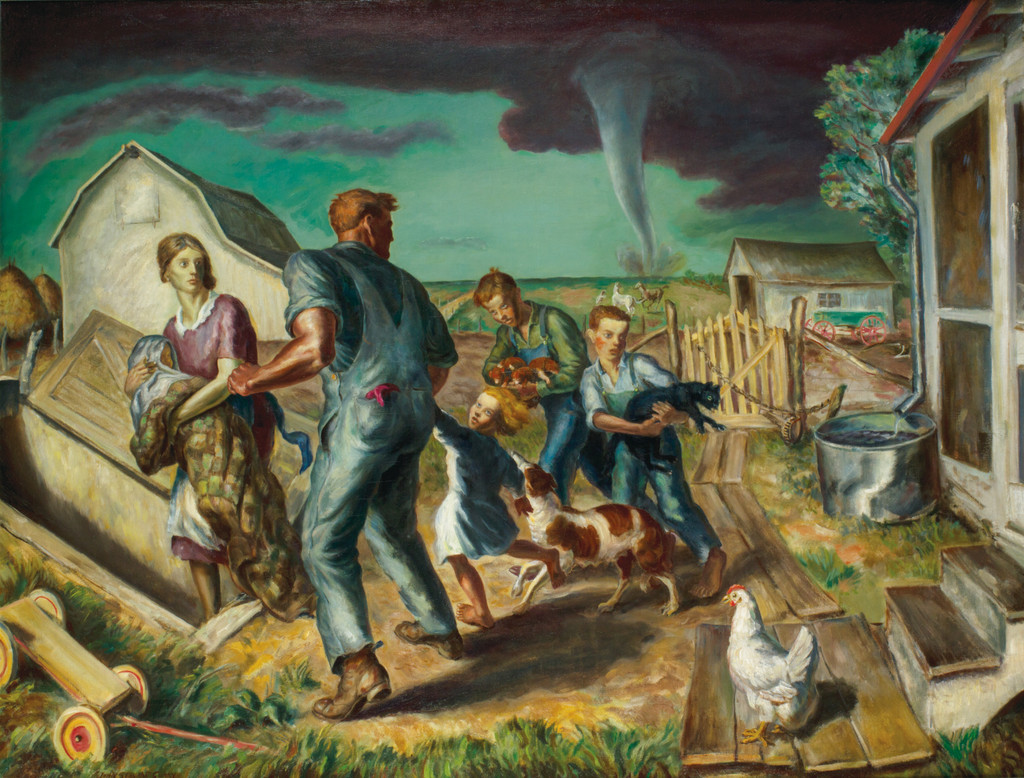
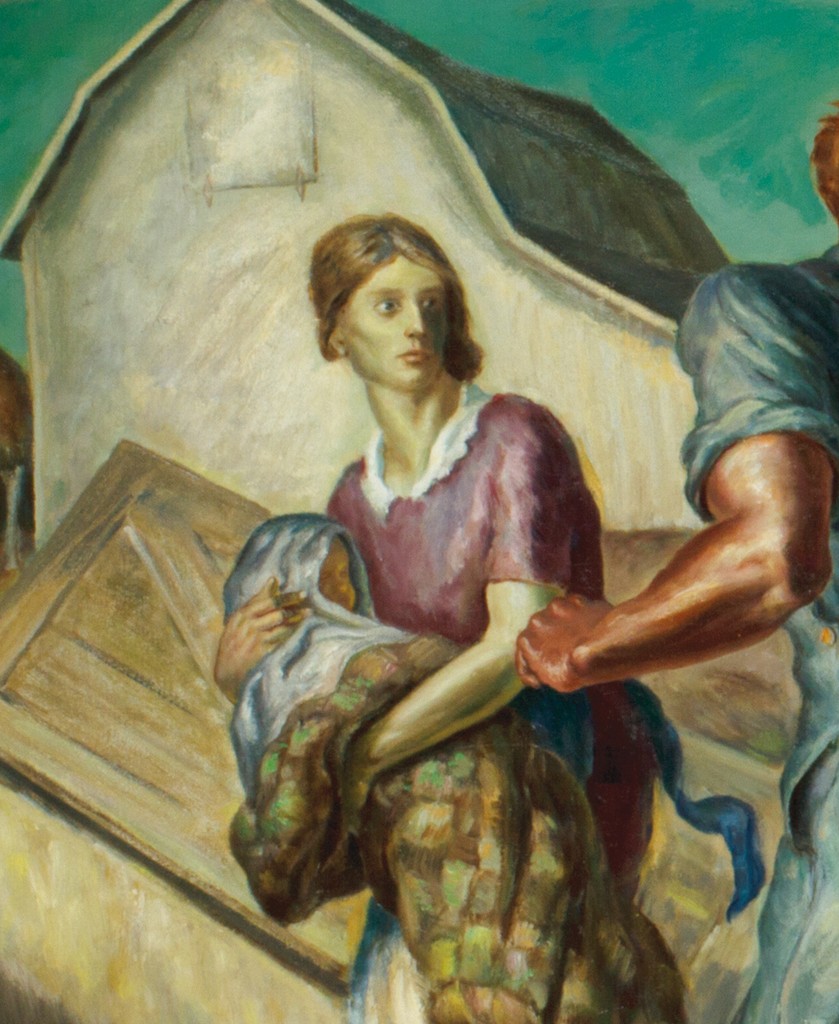
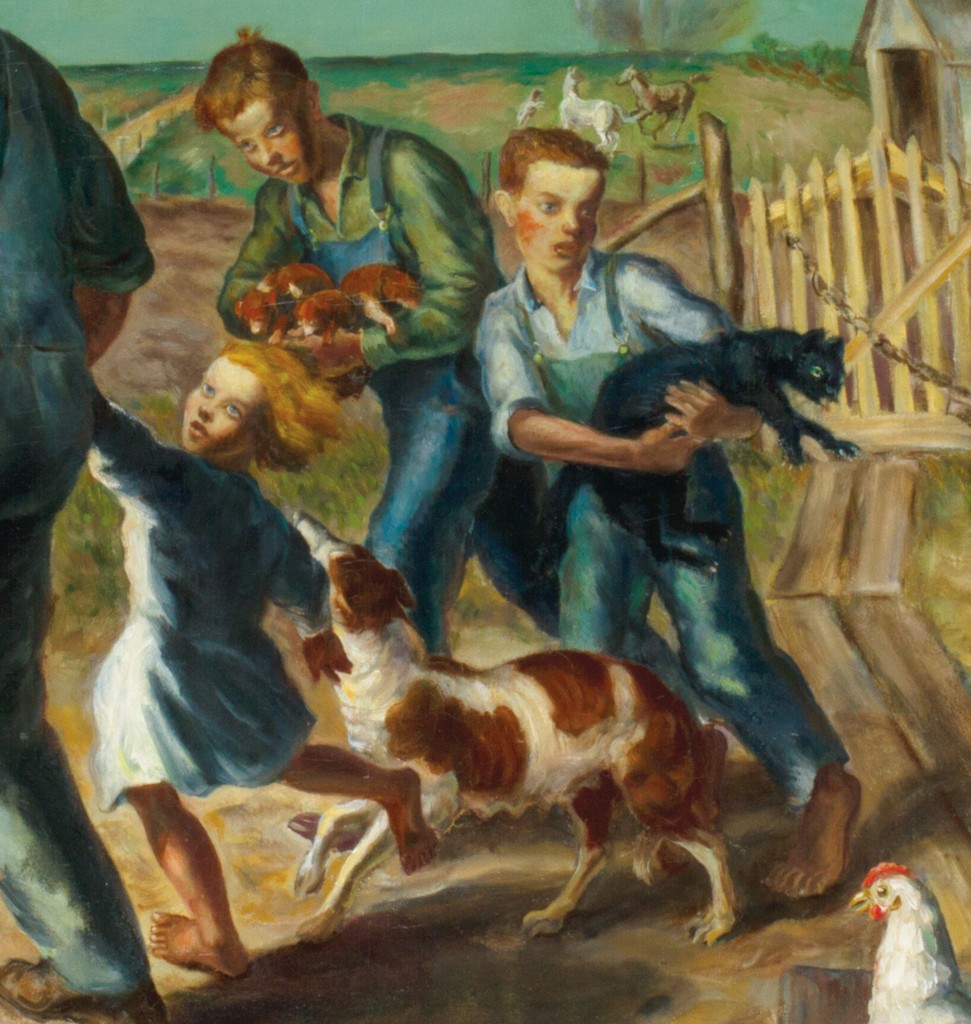
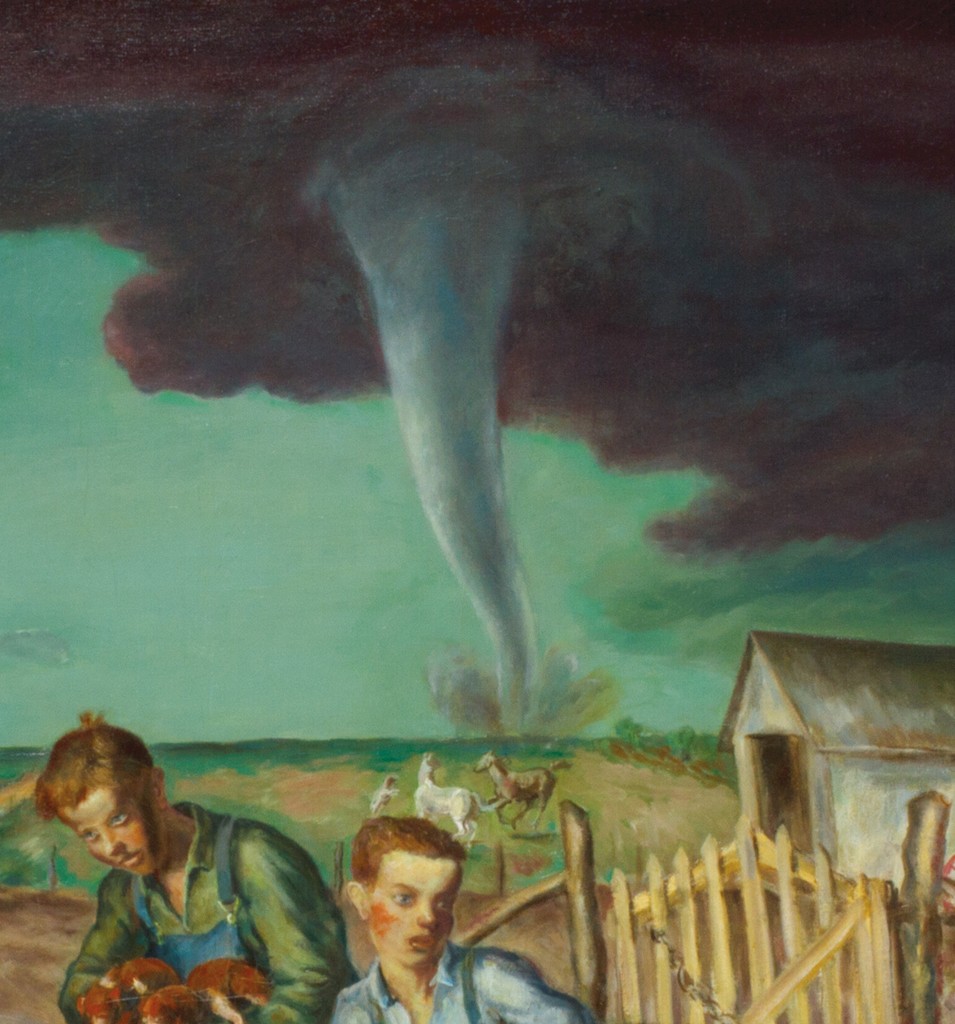
Tornado Over Kansas makes action readable through a sequence of bodies. The woman carrying a baby approaches the cellar entrance, the man turns toward the sky, and the children gather animals. These movements connect the foreground’s different parts. The distant funnel gives their activity a common urgency, but the family’s gestures explain what that danger means for the household. [1]
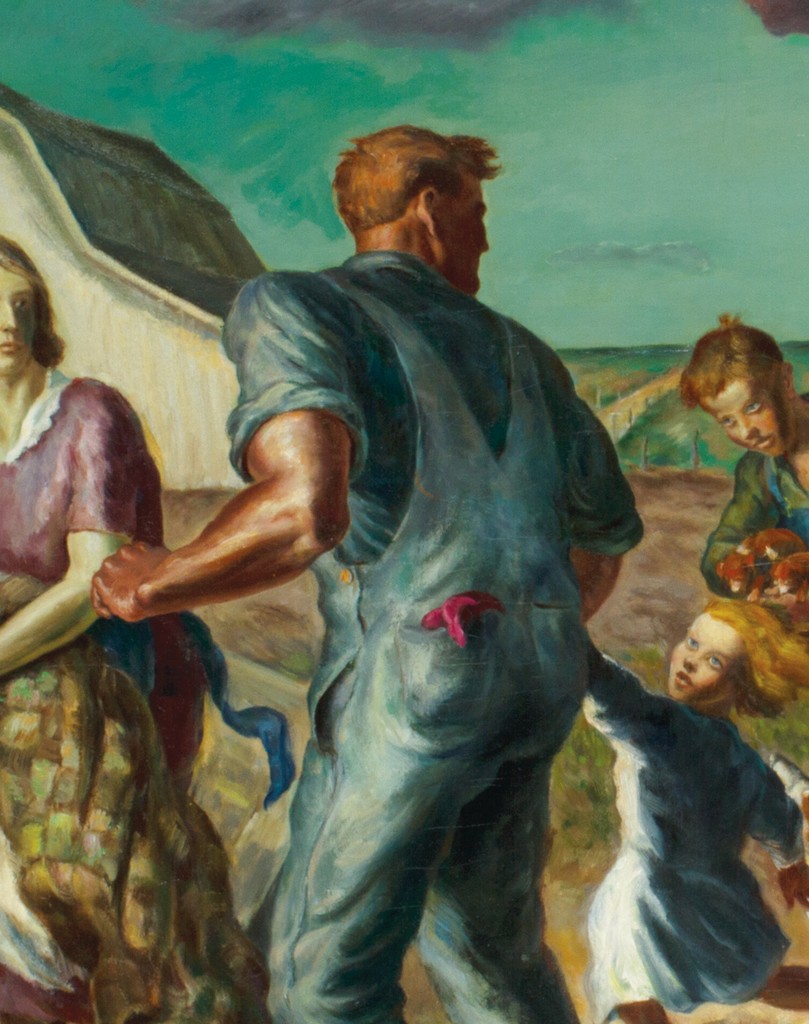
Look at the spaces between the figures. The man’s extended arm connects him with the woman, while the small girl reaches toward him from the other side. The children’s varied positions carry attention across the yard. Curry organizes a crowded scene through actions that remain distinct enough to follow, even when the viewer notices several at once.
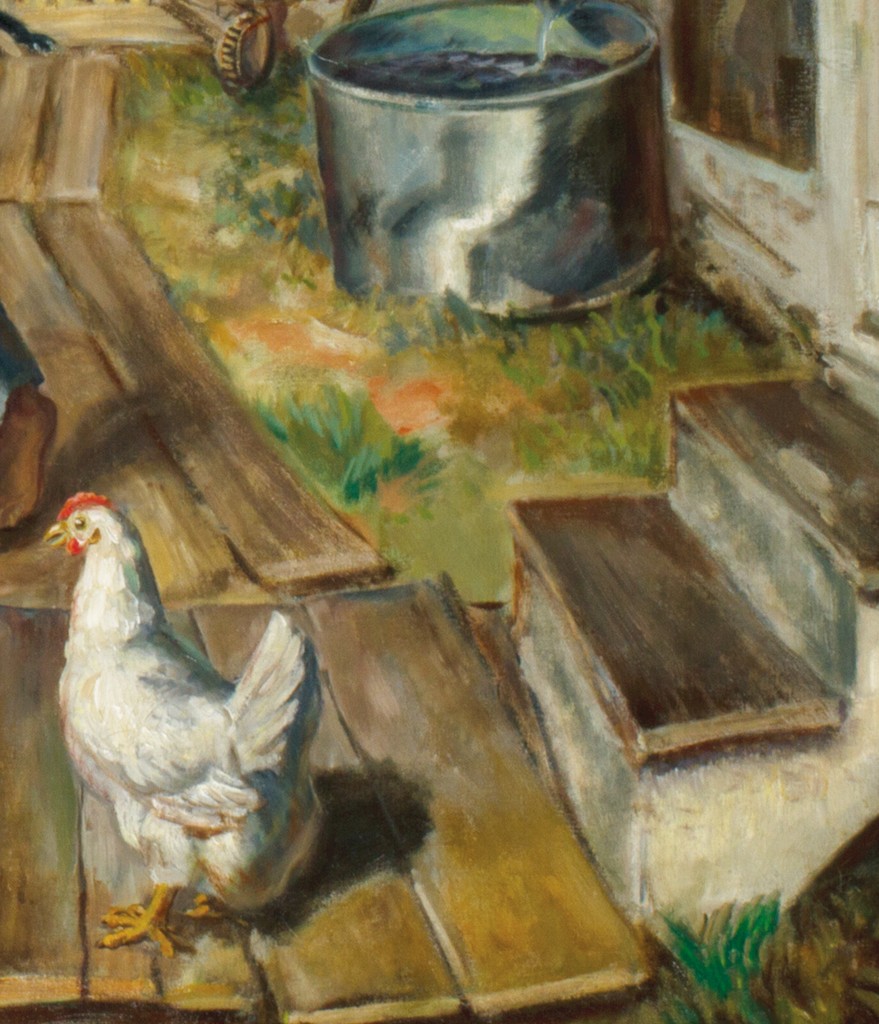
The setting helps give those actions direction. The open cellar defines a destination; the house and fence establish a narrow working space; the barn and distant outbuilding frame the approaching weather. Ordinary farm structures become part of the picture’s dramatic organization. Their positions help the viewer understand where safety might lie and how the figures can reach it.
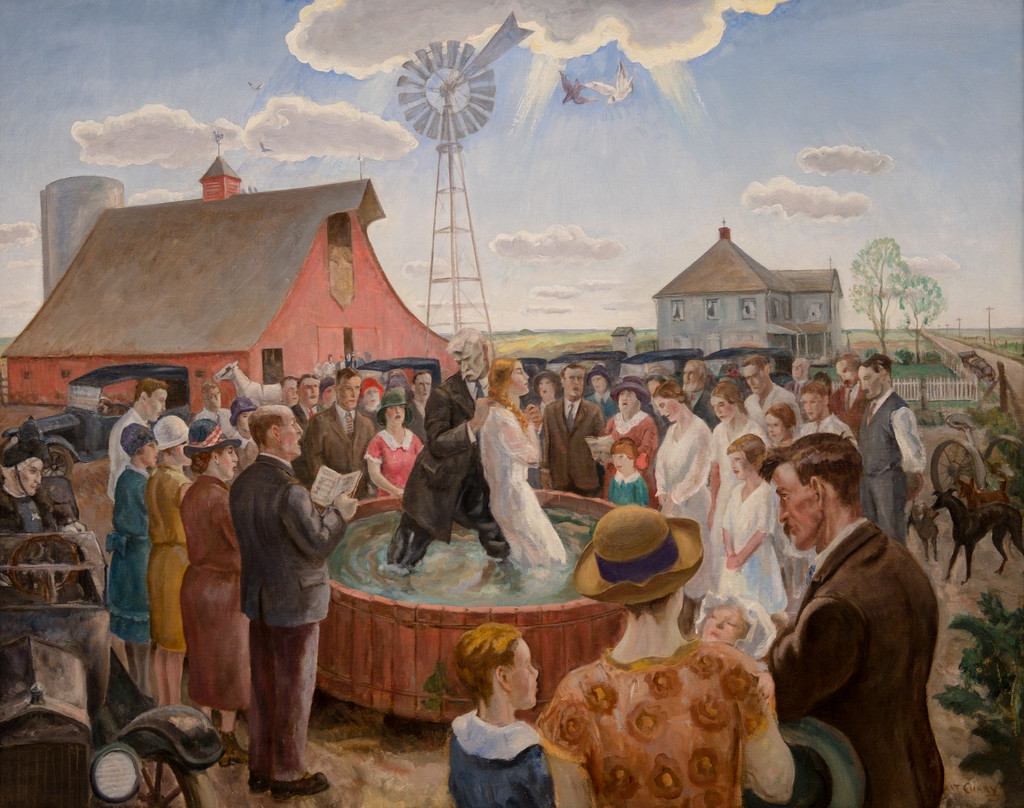
Baptism in Kansas gathers attention differently. People surround a water tank in which the ceremony takes place. Faces and bodies turn inward, creating a ring of spectators around the central act. Cars, a barn and the windmill place the gathering within a functioning farm landscape. The Whitney dates the painting to 1928 and connects it with a baptism Curry remembered from 1915. [2]
Here the crowd’s stillness and attentive gestures matter as much as movement. The rounded tank offers a strong organizing form, while the figures’ varied heights and clothing prevent the gathering from becoming a uniform band. Curry’s narrative clarity depends on those small differences within the larger arrangement.
Annotated Details from Composition and weight in two paintings
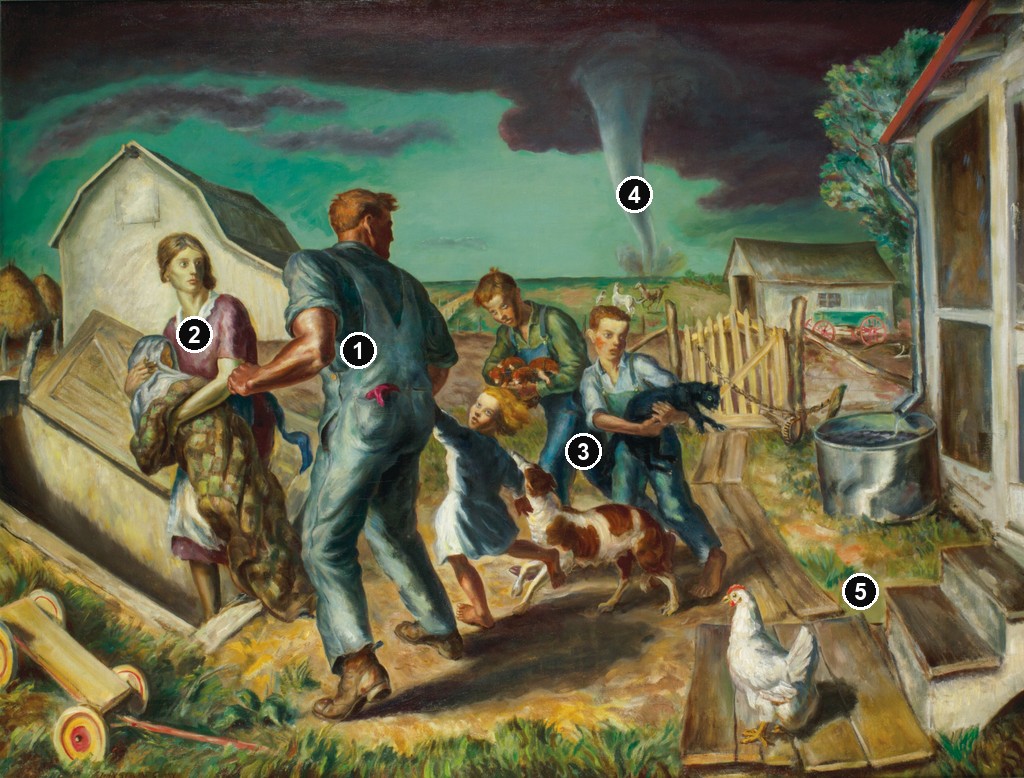
The numbered points identify visible features discussed in this article. Return from each detail to the whole composition. The captions keep each work’s identity, date and medium separate.
Tornado Over Kansas - 1929 oil
John Steuart Curry, The Tornado (Tornado Over Kansas), 1929, oil on canvas. Muskegon Museum of Art. Image source. Public domain. Editorial numbers added to the overview; detail crops retain the source image’s appearance.
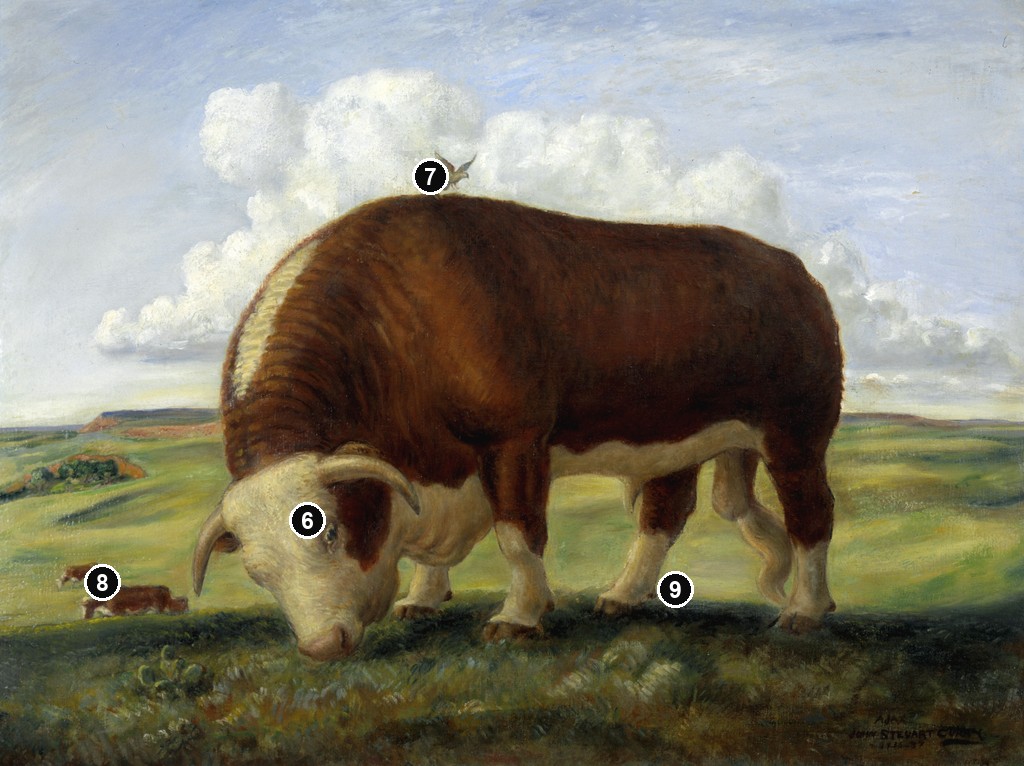
Ajax - 1936-37 oil
John Steuart Curry, Ajax, 1936–37, oil on canvas. Smithsonian American Art Museum, 2001.95. Image source. CC0 / public domain. Editorial numbers added to the overview; detail crops retain the source image’s appearance.
Details from COMPOSITION AND WEIGHT IN TWO PAINTINGS
These details support comparisons of visible composition and bodily weight. The article’s material findings come from its separately cited conservation research.
Tornado Over Kansas - 1929 oil
The father turns across the movement
The father’s turned head and outstretched arm interrupt the family’s leftward route. His large back forms a hinge between the nearer household and the approaching storm.
Mother, infant and quilt
The mother carries the infant close to her body, with patterned fabric gathered around them. The small face and supporting arms give the larger emergency a domestic scale.
Children carrying animals
The children respond through different actions: carrying small animals, turning towards an adult and moving past the dog. Their bodies make the route to shelter crowded and uneven.
The funnel beyond the fence
The funnel descends from the dark cloud into the open country beyond the household. The interval of land between it and the family makes the danger both distant and imminent.
Water basin and porch objects
The basin, boards and chicken belong to the farm’s ordinary surroundings. Seen beside the hurried figures, these small things help make the emergency an interruption of everyday life.
Ajax - 1936-37 oil
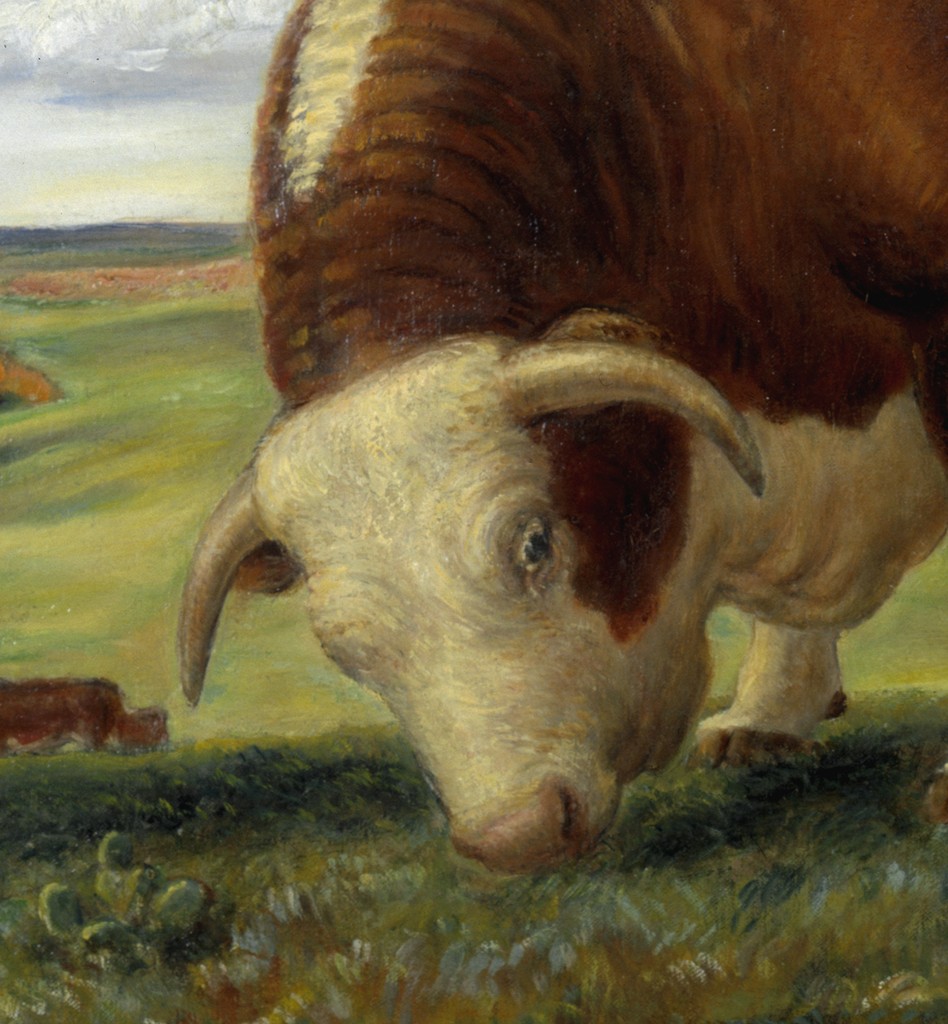
The lowered head and curved horns
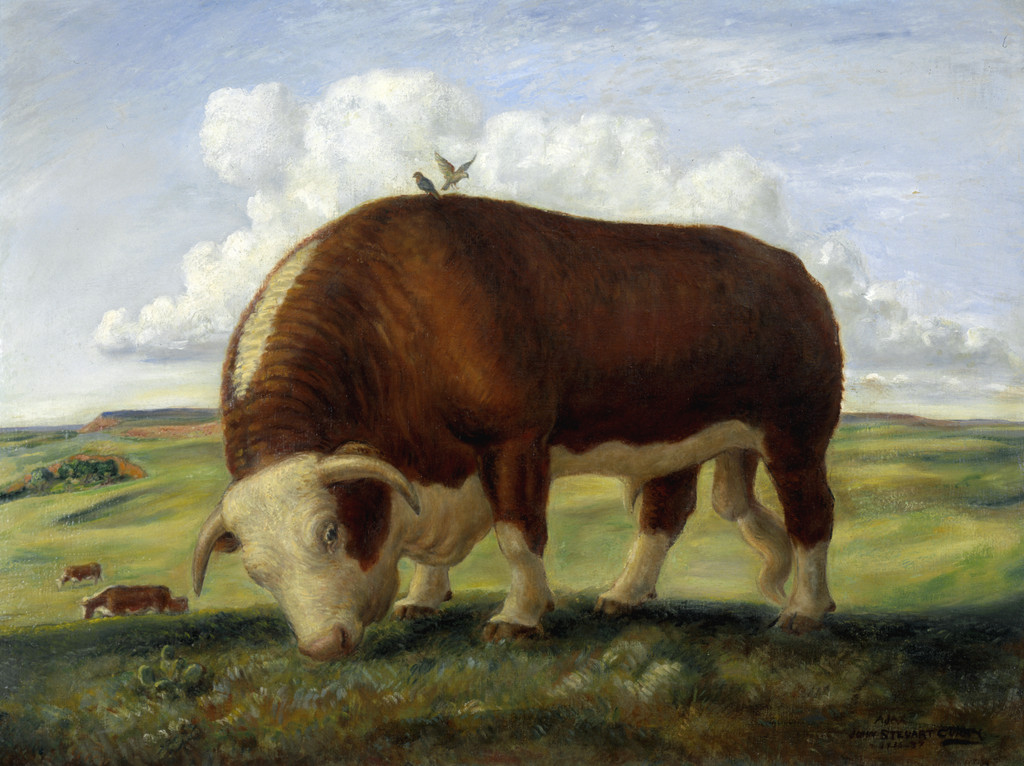
The pale face and sweeping horns turn down towards the pasture. The lowered head gives the bull a grazing action while preserving the animal’s great physical weight.
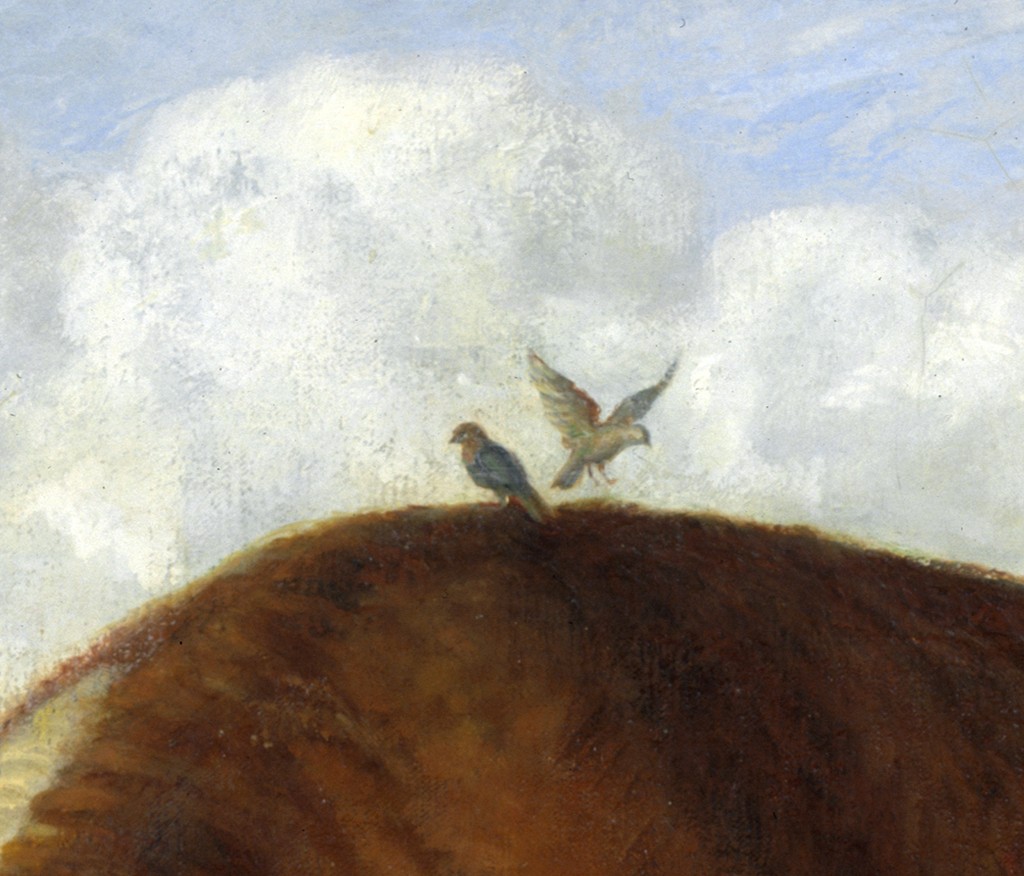
Small birds above the back
Two small birds interrupt the bull’s broad upper contour. Their delicate shapes provide a compact comparison with the heavy body beneath them.
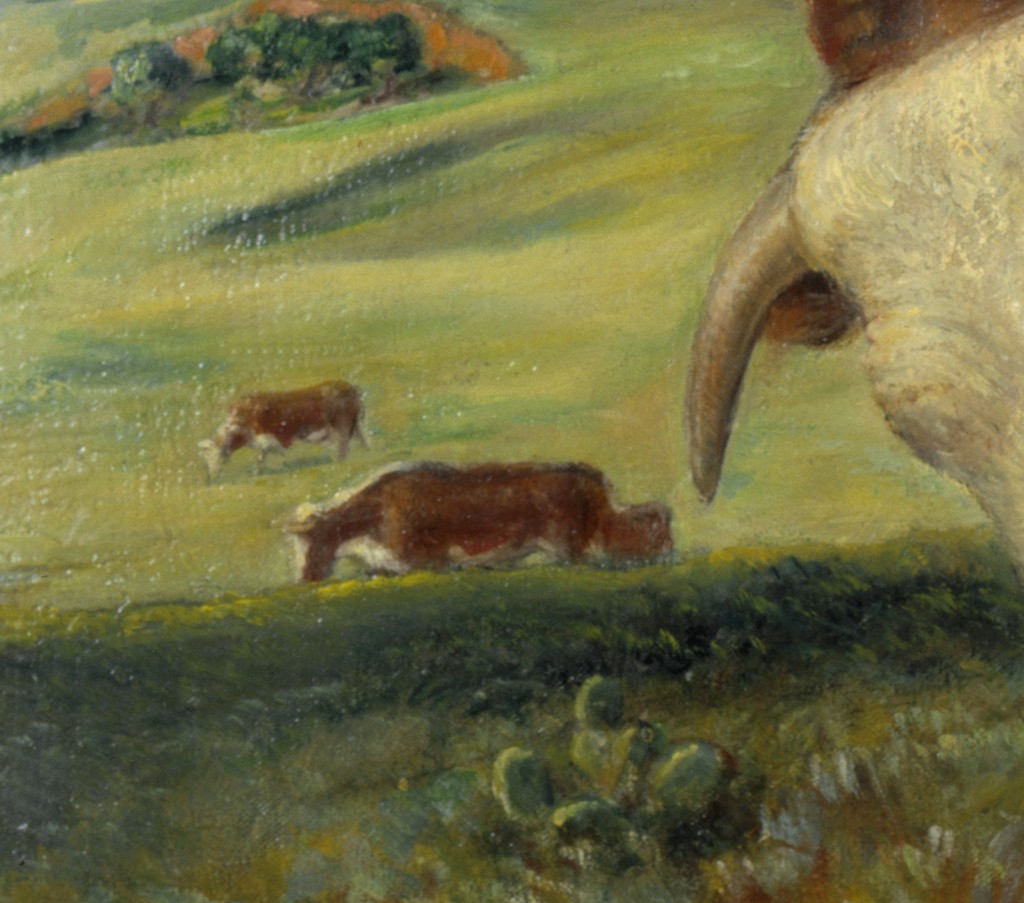
Distant cattle in the pasture
The much smaller cattle at the left establish another scale within the landscape. Their distance makes the foreground bull appear still more substantial.
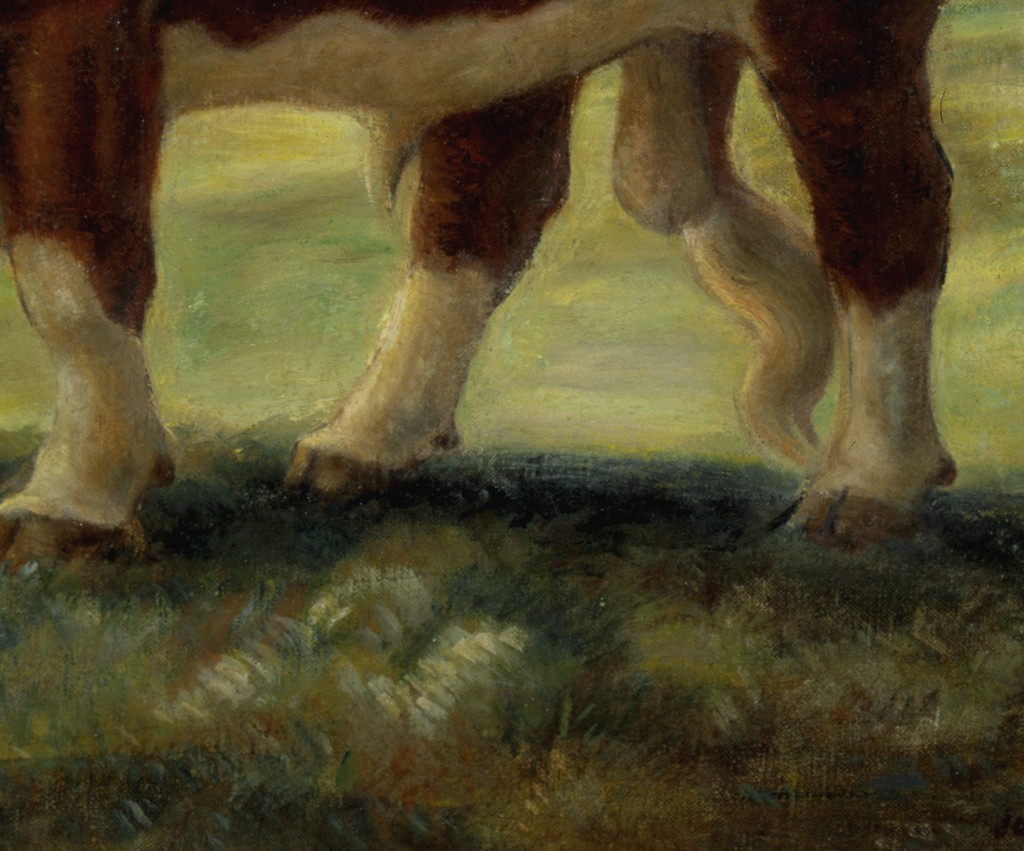
Legs, pale underside and shadow
The pale underside and lower legs separate the animal from the dark patch of ground. This meeting of body and shadow helps anchor the large figure in the pasture.
Weight, scale and the monumental figure
In Ajax , the bull occupies most of the foreground. His broad body rises against the sky, while the smaller cattle behind him establish the depth of the pasture. The low viewpoint and the difference in scale give an ordinary farm animal an imposing presence. The Smithsonian dates the oil painting to 1936–37. [3]
The bull’s lowered head brings weight toward the ground. The legs anchor his body, and the strong horizontal mass of his back contrasts with the shifting contours of the clouds. Birds on his back add a much smaller measure of scale. The effect combines solidity with living detail: the animal is a substantial shape and an attentive creature within its surroundings.
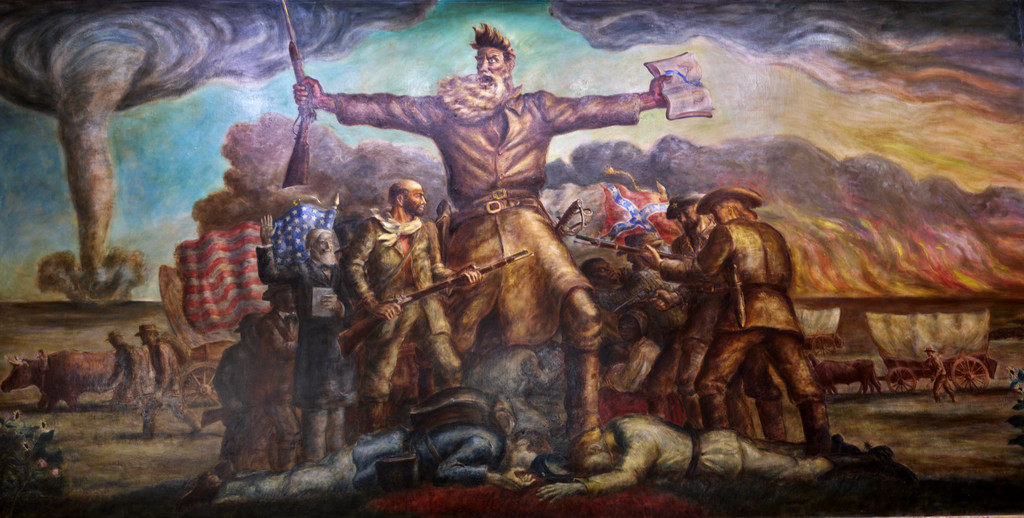
The monumental body also serves historical subjects. In Tragic Prelude , John Brown’s outstretched arms dominate the central composition. The Kansas Historical Society relates the surrounding imagery to the violence preceding the Civil War. Brown’s enlarged presence brings those historical conflicts into the register of a single emphatic body. [4]
The comparison with Ajax makes scale especially revealing. A bull’s bulk can establish agricultural abundance and physical power; a historical figure’s breadth can gather competing events around a central symbol. The meaning depends on the subject, but both compositions direct attention through the relationship between a dominant body and the smaller forms around it.
John Steuart Curry, Ajax, 1936–37, oil on canvas. Smithsonian American Art Museum, 2001.95.
Image source
.
CC0 / public domain
. Proportionally resized; original appearance retained.
Weather as a compositional force
Curry’s skies often carry changes in scale, direction and light. In Tornado Over Kansas , the funnel draws the eye toward the distance while the dark cloud mass extends across the upper picture. Below it, the figures occupy a brighter, more sharply articulated space. The contrast makes the household’s immediate activity seem exposed to something much larger. [1]
The sky in Ajax works differently. Pale clouds rise behind the bull and help separate his dark red body from the distance. Their soft contours contrast with the animal’s substantial outline. Weather participates in the composition even when it brings no immediate threat: it can supply an interval of light, a change of texture or a setting against which a body becomes legible. [3]
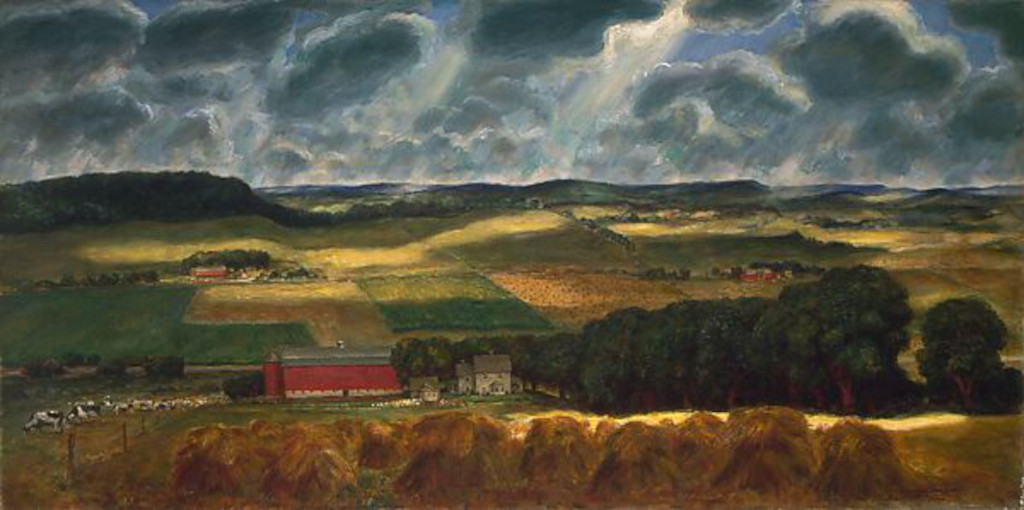
Wisconsin Landscape offers a broader arrangement. The Met describes an idealized composite rather than one specific farm. Its expansive view connects cultivated land, buildings and cattle within changing light. That composite character makes the painting useful for considering how Curry could organize a landscape from several kinds of observation and remembered experience. [5]
These differences help explain why weather deserves close attention beyond the presence of a storm. Look for the proportion of sky to land, the direction of cloud forms and the light separating foreground from distance. Those relationships can establish danger, abundance or breadth before the viewer has identified every object within the scene.
Memory, drawing and studio construction
The Kansas subject in The Tornado was painted in Westport, Connecticut, in 1929. Baptism in Kansas returns to an event remembered from years earlier. Both works therefore involve an interval between experience and the making of the picture. Their recognizable rural settings were developed through studio decisions about figures, buildings and the distribution of attention. [1] [2]
Worcester Art Museum’s account of Curry’s sketchbooks supplies another part of that process. It describes notes, references, casual marks and finished drawings, with subjects ranging from livestock and weather to circus performers and mural designs. These records preserve several kinds of looking and invention together. A drawing might hold a movement for later use or investigate a form more patiently. [6]
The drawings and prints page follows those activities more fully. For the paintings, their significance lies in the passage from individual observations to a constructed whole. A convincing action can be prepared and revised; a familiar place can be rearranged so that the principal event remains easy to understand.
John Steuart Curry, Baptism in Kansas, 1928, oil on canvas, Whitney Museum of American Art. Photograph by Mollerus, 2018; the painting is seen at an angle.
Image source
.
CC BY 2.0 photograph; underlying painting public domain
. Proportionally resized; original appearance retained.
Oil, tempera and experiments with layers
Conservators Lance Mayer and Gay Myers connect Curry’s changing technique with his concern about paintings that darkened, cracked or allowed underlayers to become more apparent. Their examination of Kansas Pastures , dated 1930, found a well-preserved oil painting. Their research also reports problems Curry noted in other early works. Those different outcomes helped frame his continuing search for dependable materials. [7]
The chronology complicates a familiar account of influence. Max Doerner’s materials book appeared in English in 1934, but Mayer and Myers identify a dated notebook reference to Curry using tempera underpainting on circus subjects in 1932. They also trace recipes obtained through intermediaries and other sources. His experiments developed through an exchange of information, rather than beginning with one newly available book. [7]
The Whitney’s The Flying Codonas , dated 1932, is catalogued as tempera and oil on composition board. The museum label establishes a combination of media and a particular support. It does not by itself specify every ingredient or the order in which Curry applied them. That more detailed history requires additional documentary or physical evidence. [8]
For The Line Storm , Mayer and Myers discuss a sequence involving egg-tempera underpainting, an intervening shellac coating and oil overpainting. Their account of the related period shows further variations between pictures. The notebook descriptions, as reported by the conservators, are valuable precisely because they preserve those differences. [7]
The terms describe different roles within a painting. Underpainting establishes an earlier image or arrangement beneath later work. A glaze is a comparatively transparent paint layer through which earlier layers remain visible. Opaque passages can cover what lies below more completely. A final varnish is a surface coating with a different role from paint that builds the image. Curry’s use of resin-containing materials within some paint sequences makes those distinctions particularly relevant. The appearance of depth or brightness can depend on interactions between layers, while the same layered structure can create challenges as the materials dry and age. [7]
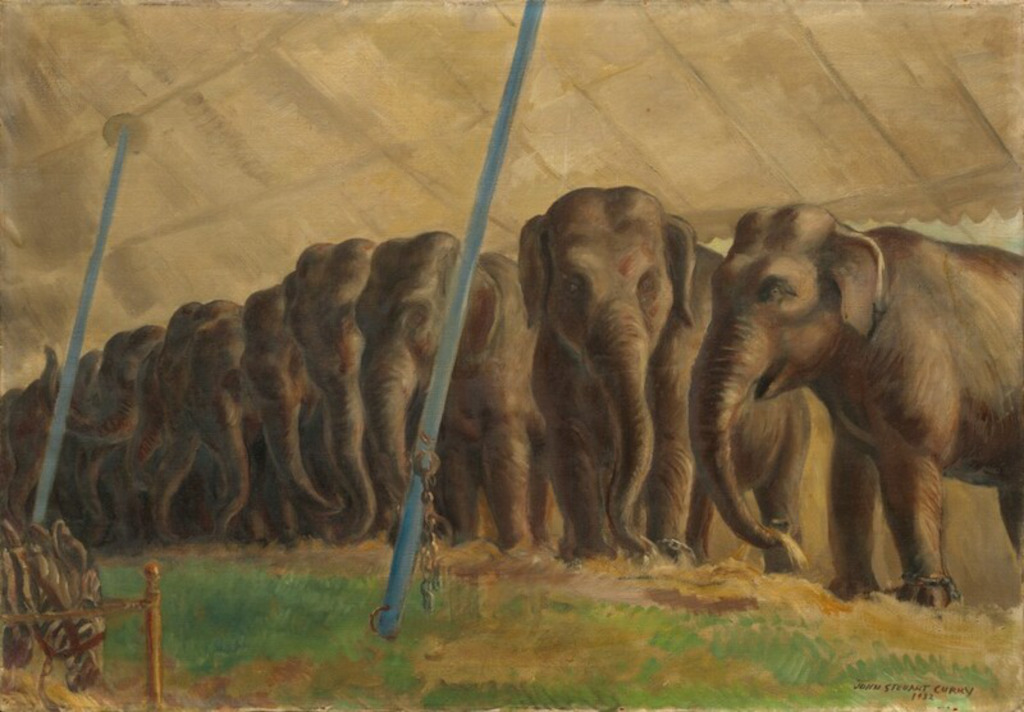
A painting labelled oil can also involve several kinds of brushwork. The National Gallery’s technical summary of Circus Elephants describes thin paint worked wet into wet, followed by thicker details made with a nearly dry brush. It also notes that the first paint layer anticipated the tent poles. The evidence suggests a planned arrangement realized through varied handling. [9]
Watch: John Steuart Curry
Choose a film to explore the artist’s work, its interpretation and its wider setting.
Look at This: John Steuart Curry at MOWA
An exhibition interview with Graeme Reid considers Curry’s work and life in Wisconsin.
Watch on YouTubeGrounds, scratching and the painted surface
A ground is the prepared layer beneath the image, separating the paint from its support and affecting the surface on which the artist works. Mayer and Myers document considerable variation in Curry’s grounds. Their account includes chalk-containing preparations and later commercial products, with recipes adjusted between works. The preparation beneath a painting formed part of his experiments alongside the paint above it. [7]
Their research also traces exchanges with Grant Wood and advice from the paint manufacturer Benjamin Moore. Those contacts show a practical network concerned with absorption, consistency and working properties. They help explain how painters associated with similar subjects could exchange technical information without producing identical surfaces or following one common procedure. [7]
The surface can contribute directly to the subject’s energy. The Art Institute of Chicago describes short, broken brushwork and scratched marks suggesting bristles in Hogs Killing a Snake . The museum connects those marks with the animals’ converging movement. Its account provides an example of physical handling reinforcing the composition’s agitation. [10]
The comparison with Ajax is instructive. One animal subject concentrates on a massive body standing within open pasture; another organizes several animals around a struggle. Reading the paintings through their particular forms and recorded handling explains more than assigning every picture the same degree of roughness, finish or intensity.
Varnish, dealers and changing expectations
The final appearance of a painting can involve decisions made after the main paint layers have dried. Mayer and Myers report correspondence in which Curry discussed delayed varnishing with dealers. They also describe easel paintings remaining unvarnished in his studio and later in his widow’s possession. Surfaces varied between matte and glossy, sometimes within a single work. [7]
This evidence makes the individual object’s history essential. An unvarnished surface does not automatically establish that Curry intended every easel painting to remain that way. Nor does a glossy passage alone identify a particular final coating. The painting’s materials, drying, exhibition and subsequent treatment can all affect the encounter with its surface.
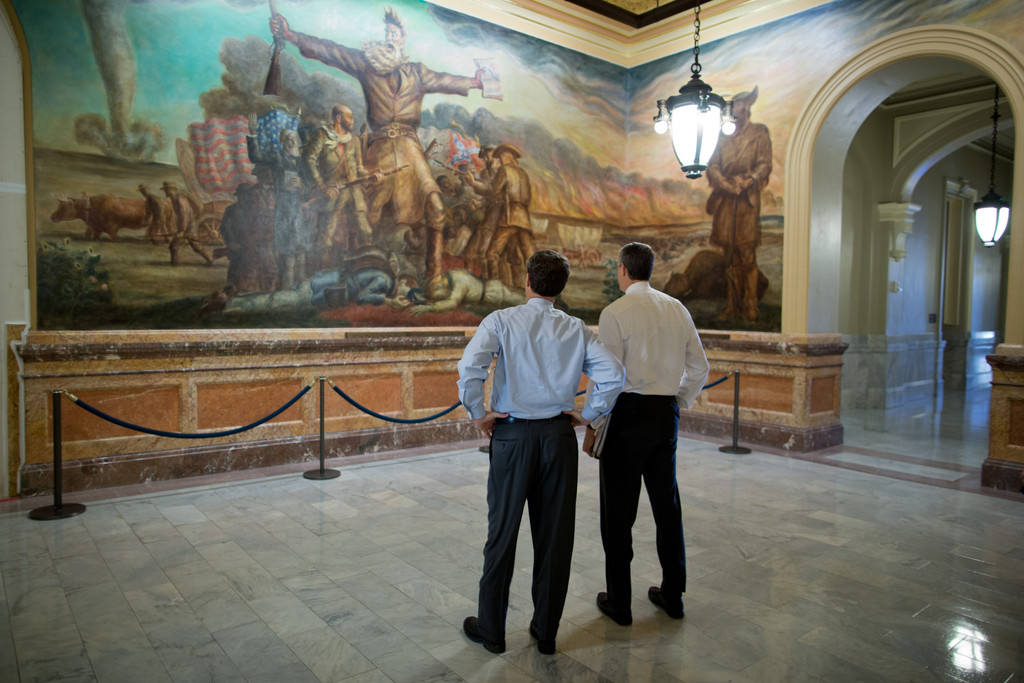
Murals raised different viewing problems. Mayer and Myers describe Curry’s attempts to moderate the sheen of the Kansas paintings, his dissatisfaction with some results and his consultation with other painters and manufacturers. Coatings were part of an effort to manage the appearance of large compositions within architectural spaces. The evidence belongs to those specific projects and should be kept attached to them. [7]
Lighting adds another variable. A wall painting seen from below under room lights offers a different experience from an evenly lit reproduction. Reflections can obscure a dark area or make a surface seem brighter. Describing the visible effect is useful, provided it remains separate from identifying the historical material that caused it.
Sam Brownback and Arne Duncan viewing Tragic Prelude at the Kansas State Capitol, 18 September 2012. Photograph by Chuck Kennedy. This installation view includes people and architectural surroundings.
Image source
.
CC BY 2.0
. Proportionally resized; original appearance retained.
What conservation can establish
Conservation brings the documentary record into contact with surviving objects. Examination can investigate supports, layer relationships, damage and later interventions. Written notes supply a different kind of evidence about intended materials or working decisions. Mayer and Myers repeatedly compare those sources, retaining uncertainty where a proposed explanation goes beyond what they could establish. [7]
Their treatment of The Line Storm discusses cracking in relation to adhesion over the shellac layer and to differences in drying between paint layers. These are proposed contributors to a particular condition. The authors also found contrasting behaviour in other works, including paint unusually sensitive to solvents. Such observations connect Curry’s experiments with the paintings’ later histories, while leaving room for several interacting causes. A crack pattern alone cannot reconstruct every decision that produced it. [7]
The Wisconsin Biochemistry Building murals provide a particularly useful comparison within one architectural setting. A university account of their 2011 conservation distinguishes heavier canvas in the stairwell foyer from thinner muslin in the Seminar Room. It reports very thin, direct painting in the latter. Such differences make it difficult to infer one technique simply from the general category of mural. [11]
That account also describes repairs, cleaning and a new protective coating, informed by records of a 1985 treatment. What a visitor sees can therefore include an artist’s original materials, their ageing and carefully documented later care. A modern varnish layer is part of that treatment history, not evidence that Curry used the same product. [11]
The National Gallery offers a more specific example of qualified evidence: fluorescence in a white area of Circus Elephants suggests zinc white. The wording expresses a possibility rather than a confirmed pigment identification. Keeping that qualification preserves the usefulness of the observation without claiming a certainty the technical account does not provide. [9]
Across these examples, Curry’s style becomes visible through relationships between subject, arrangement and material. Begin with where a body stands and how the eye moves through the scene. Then consider the documented handling and the history of that particular object. Those two kinds of attention give his dramatic images both their visual force and their material complexity.
Artworks and versions directory
Browse 84 selected object, version, edition and reproduction records. Several concern related images or different impressions; this is not a complete lifetime catalogue or a count of unique compositions. Search also finds prints, photographs and reproductions; the medium filter groups paintings and drawings.
Frequently Asked Questions
No. Museum records identify works in oil, tempera and combinations of media. The Flying Codonas , for example, is tempera and oil on composition board. [8]
The chronology is more complicated. Mayer and Myers identify a dated 1932 notebook reference to tempera underpainting and discuss other routes through which technical information reached him. [7]
No single method should be assumed. Conservation reporting on the Wisconsin Biochemistry Building distinguishes different canvas types and handling within that mural group. [11]
A reproduction can help explain colour and composition, but precise material identification needs further evidence. The National Gallery’s qualified zinc-white suggestion illustrates why technical findings retain their stated level of certainty. [9]
Discussion
Look again at the images and ideas explored in John Steuart Curry: Style and Technique. These editorial prompts invite your observations.
Reader Insights
Compare the foreground bodies in Ajax and Tornado Over Kansas . How does Curry give each a sense of weight while suggesting different kinds of action?
In Baptism in Kansas , which shapes and gestures direct attention toward the ceremony? How does the farm setting contribute to that arrangement?
How might reflections, room lighting or the loss of a picture’s original scale change your response to one of Curry’s murals?
Join the Conversation
Share a detail, comparison or question about John Steuart Curry: Style and Technique below.
References
- Muskegon Museum of Art , Tornado Over Kansas , object essay and painting history. View source
- Whitney Museum of American Art , Baptism in Kansas , 1928, oil on canvas, 31.159. View source
- Smithsonian American Art Museum , Ajax , 1936–37, oil on canvas, 2001.95. View source
- Kansas Historical Society , Kansas State Capitol online tour: Tragic Prelude , mural location and imagery. View source
- The Metropolitan Museum of Art , Wisconsin Landscape , 1938–39, oil on canvas, 42.154. View source
- Worcester Art Museum , Collective Images: The Sketchbooks of John Steuart Curry , 2002 exhibition essay. View source
- Lance Mayer and Gay Myers , “Old Master Recipes in the 1920s, 1930s, and 1940s: Curry, Marsh, Doerner, and Maroger”, Journal of the American Institute for Conservation 41, no. 1 (2002): 21–42; Curry section 2.1–2.5, including the authors’ discussion of notebook and correspondence evidence. View source
- Whitney Museum of American Art , The Flying Codonas , 1932, tempera and oil on composition board, 33.10. View source
- Robert Torchia , Circus Elephants , National Gallery of Art, online collection essay and technical summary, 17 August 2018. View source
- Art Institute of Chicago , Hogs Killing a Snake , about 1930, oil on canvas, 1947.392. View source
- Dennis Chaptman , “Treasured campus murals conserved for future generations”, University of Wisconsin–Madison, 25 October 2011. View source
- Splash image source.
John Steuart Curry, The Tornado (Tornado Over Kansas), 1929, oil on canvas. Muskegon Museum of Art. Public domain . Proportionally resized; original appearance retained.
View source
More CURRY Paintings
Our Good Earth
1942 painting and its related prints and wartime imagery.
Wisconsin Landscape
1938–39 panorama of working farmland, held by The Met.


Circus Elephants
1932 painting of elephants, handlers and the work behind the circus.