


 by
Tom Gurney
Tom Gurney BSc (Hons) is an art history expert with over 20 years experience
Email:
tomgurney1@gmail.com
/ Phone:
+44 7429 011000
Tragic Prelude by John Steuart Curry: Introduction
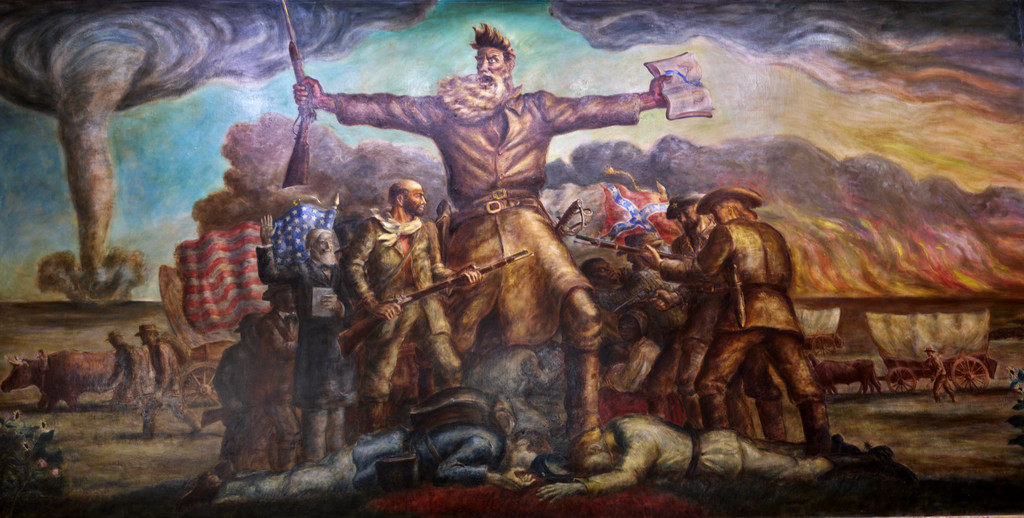
John Brown stands with his arms stretched across a landscape of armed men, covered wagons, fire and approaching storm. His body dominates John Steuart Curry’s Tragic Prelude , but the painting’s subject extends beyond one abolitionist. It connects the violence surrounding slavery in Kansas with the national catastrophe of the Civil War, making weather, human action and historical memory occupy the same space.
The mural belongs to Curry’s unfinished programme for the Kansas State Capitol in Topeka. The commission began in 1937; the principal corridor paintings were completed in 1940, while the wider undertaking ended in 1942. Brown’s familiar image occupies the north wall of the east corridor, with earlier historical figures continuing onto the adjoining east wall. Understanding both the architecture and the abandoned programme changes the meaning of this celebrated scene. [1] [2]
At a Glance
- Artist John Steuart Curry, 1897–1946.
- Title Tragic Prelude .
- Location Kansas State Capitol, Topeka, Kansas.
- Position North and east walls of the second-floor east corridor.
- Commission Began in 1937; principal corridor panels completed in 1940; wider project ceased in summer 1942.
- Central figure John Brown, the abolitionist.
- Related works Spencer Museum’s 1937 oil sketch and circa 1938–39 drawing; the Metropolitan Museum of Art’s 1939 John Brown oil study.
- Signature Curry left the Capitol murals unsigned because he regarded the larger programme as incomplete.
This work across John Steuart Curry’s career
Circus Elephants
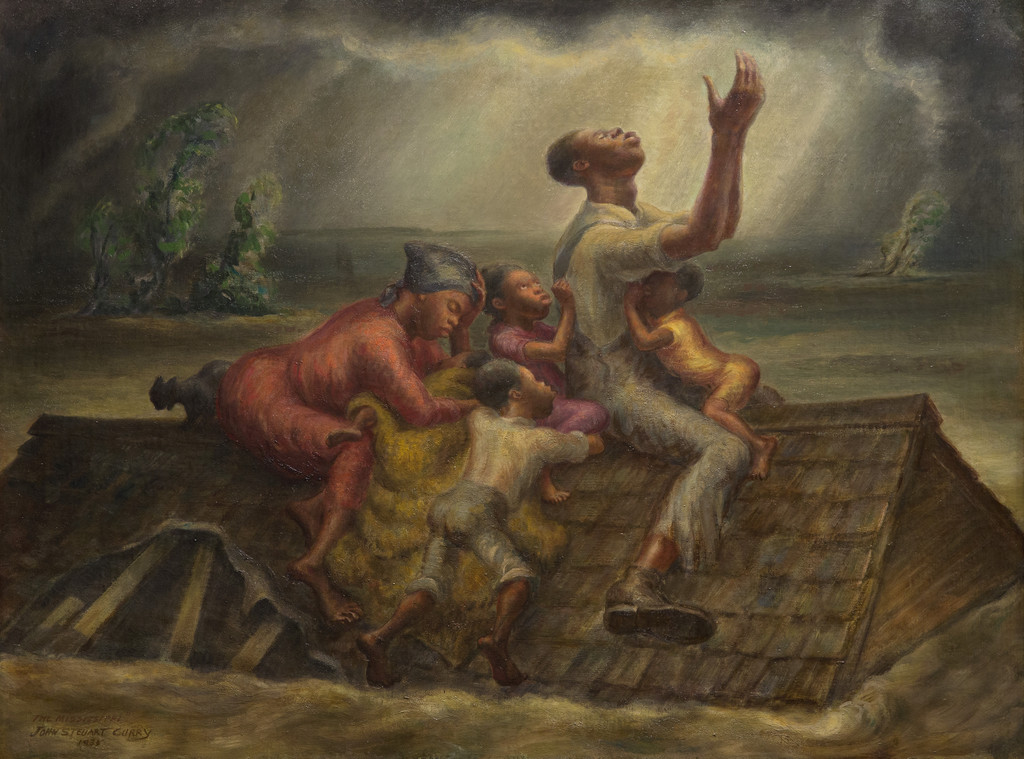
1932 paintingThe Mississippi
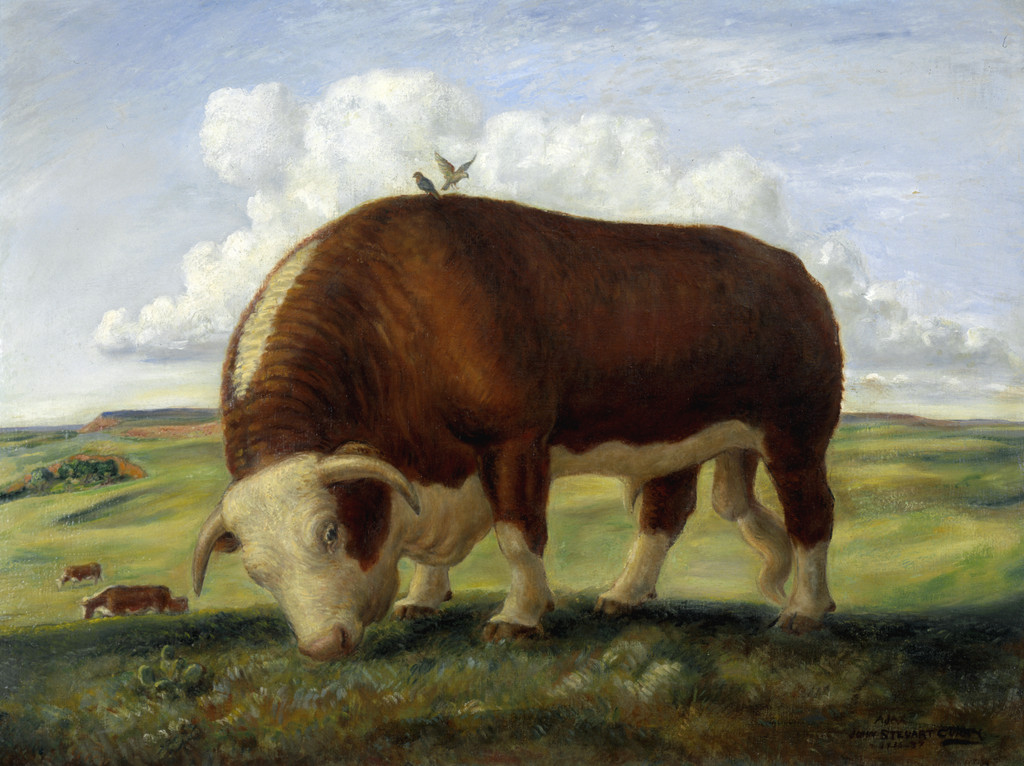
1935 paintingAjax
1936–37 oil paintingTragic Prelude (current article)
1938–40; project 1937–42Wisconsin Landscape
1938–39Our Good Earth
1942 oil paintingNotes and sources
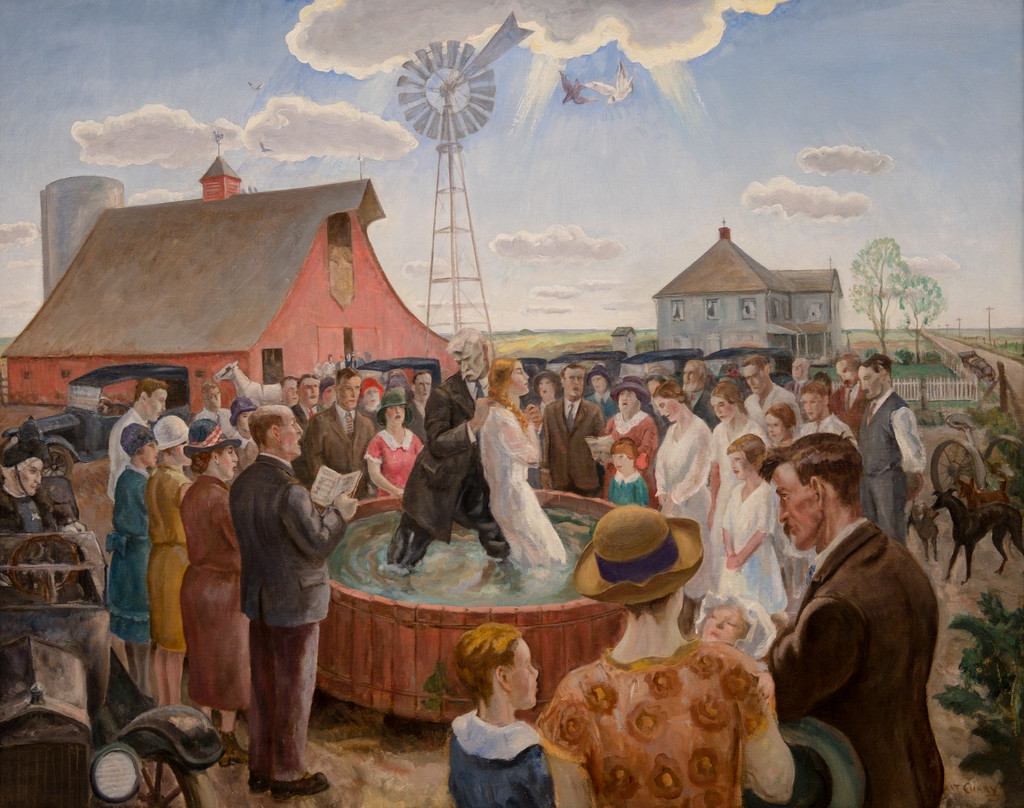
Baptism in Kansas. A remembered Kansas ceremony is staged within a working farmyard. [3]
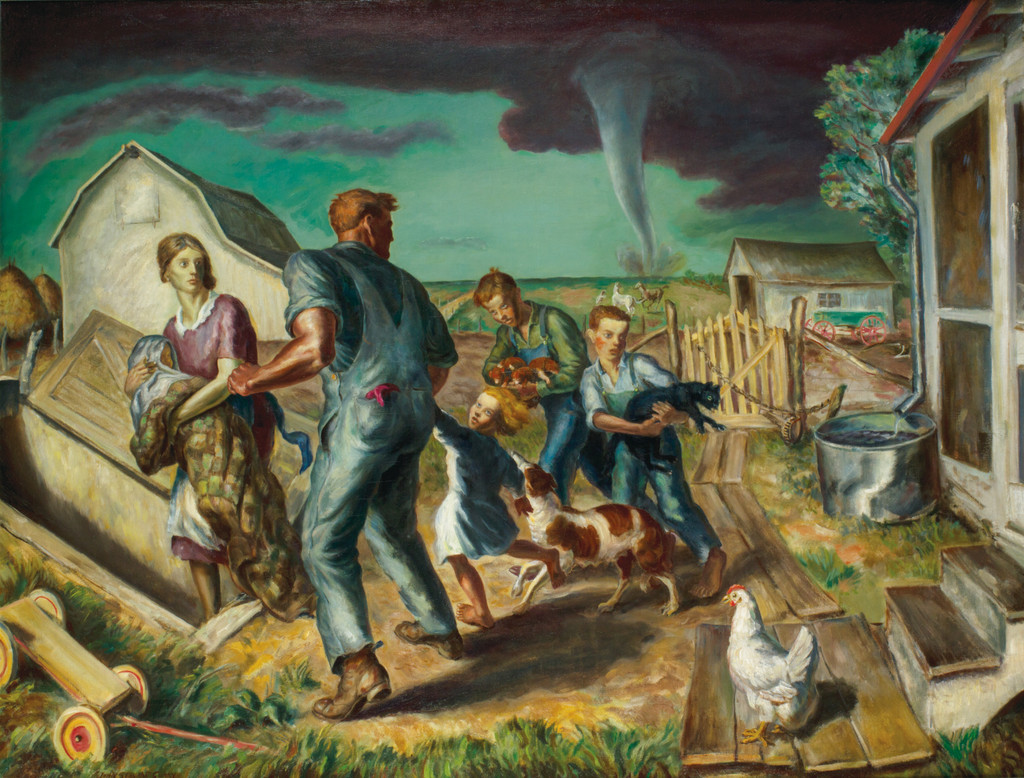
Tornado Over Kansas. A Kansas storm and a family seeking shelter, painted in Curry’s Westport studio. [4]
Circus Elephants. Elephants and handlers occupy the working space beneath a circus tent. [5]
The Mississippi. A family occupies a roof amid floodwater; the painting is tempera on canvas mounted on panel. [6]
Ajax. The monumental bull in the Smithsonian oil differs from the earlier lithograph. [7]
Tragic Prelude (current article). John Brown stands at the centre of a Kansas State Capitol mural continuing across adjoining walls. [8]
Wisconsin Landscape. An extensive farm panorama, distinct from the separately catalogued preparatory study. [9]
Our Good Earth. The Chazen painting is distinct from the watercolour study, lithographs and wartime posters. [10]
Contents
- John Brown at the centre of the wall
- Arms, book and rifle
- The Kansas history behind the figure
- Opposing figures, flags and the human cost
- Tornado, fire and the wider landscape
- A mural that turns onto another wall
- Studies for a public composition
- The 1939 John Brown study
- The commission’s changing ambitions
- Annotated details
John Brown at the centre of the wall
Brown’s scale establishes the composition before any individual symbol is identified. His head rises above the surrounding men and his arms extend across the sky. The figures beside him belong to a crowded struggle; he occupies a different order of size. Curry makes a historical person into the structure around which the whole picture is arranged.
His stance is expansive but unsettled. The legs spread, the coat opens around his body, and the belt gives a firm horizontal accent beneath the long diagonal of the torso. Above it, the open mouth, lifted hair and streaming beard concentrate movement around the head. He appears to address something beyond the immediate group rather than exchange words with one clearly identified companion.
The light sky behind Brown helps separate this silhouette from the darker clouds. Arms, shoulders and head become readable across the broad surface, while smaller incidents remain available to a closer viewer. The picture therefore works at more than one distance. A first glance establishes Brown’s enormous presence; a longer look reveals the divided society and damaged bodies around him.
The disparity in scale is part of the painting’s argument. Brown is physically too large for the ordinary people and wagons below, yet he remains caught within their world. His outstretched arms span the opposing groups without bringing their weapons down. The pose can suggest command, warning or an impossible attempt to contain the conflict. Those possibilities emerge from the arrangement rather than from a single fixed expression of approval.
The direction of attention can change as the eye moves through the image. Following the arms outward leads to the book and rifle; following the body downward leads to the men and the dead. The upper part offers the commanding silhouette of a public figure, while the lower part returns attention to vulnerability. Curry makes both readings available within one continuous body, so that the apparent authority of the pose never entirely separates from what happens at its feet.
Annotated Details from Tragic Prelude
The numbered points identify visible features discussed in this article. Return from each detail to the whole composition. John Steuart Curry, Tragic Prelude, Kansas State Capitol. North-wall composition photographed by Carol M. Highsmith, 2021, Library of Congress. The mural continues onto an adjoining wall. Image source. No known restrictions on publication; underlying mural public domain. Editorial numbers added to the overview; detail crops retain the source image’s appearance.
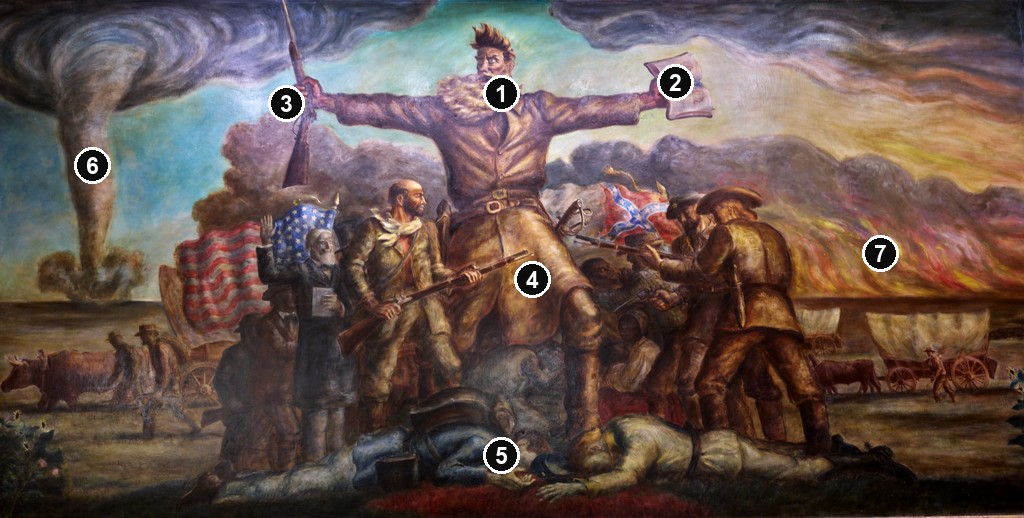
Details from TRAGIC PRELUDE
Compare the cropped details with the complete images above. Notice how their colours, shapes and positions contribute to the larger compositions.
Brown’s head and expansive upper body
The open mouth, lifted hair and broad shoulders make Brown’s body an emphatic centre. His scale sets him apart from the smaller armed figures gathered below.
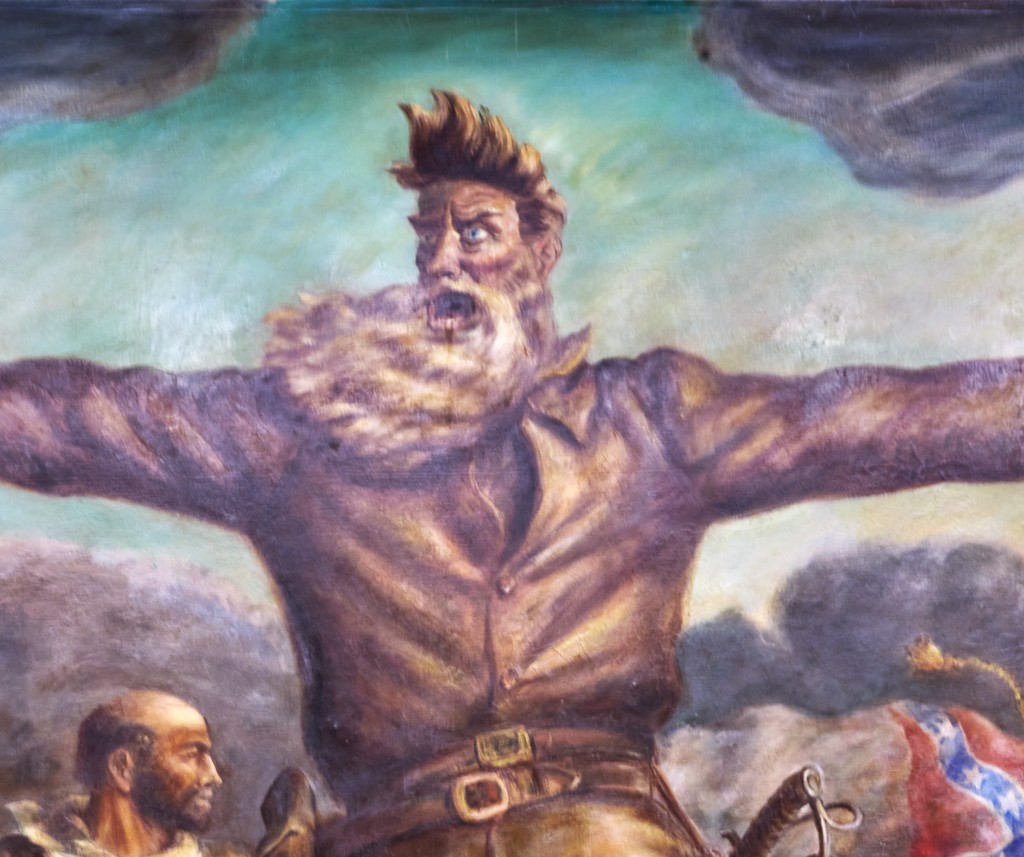
The open book
The open pages occupy the end of one extended arm, held against a comparatively light part of the sky. Their broad shape helps balance the upright firearm on the other side.
The upright firearm
The long firearm reaches towards the upper edge of the mural. Its steep line meets the nearly horizontal direction of Brown’s arm, extending the central figure’s reach.
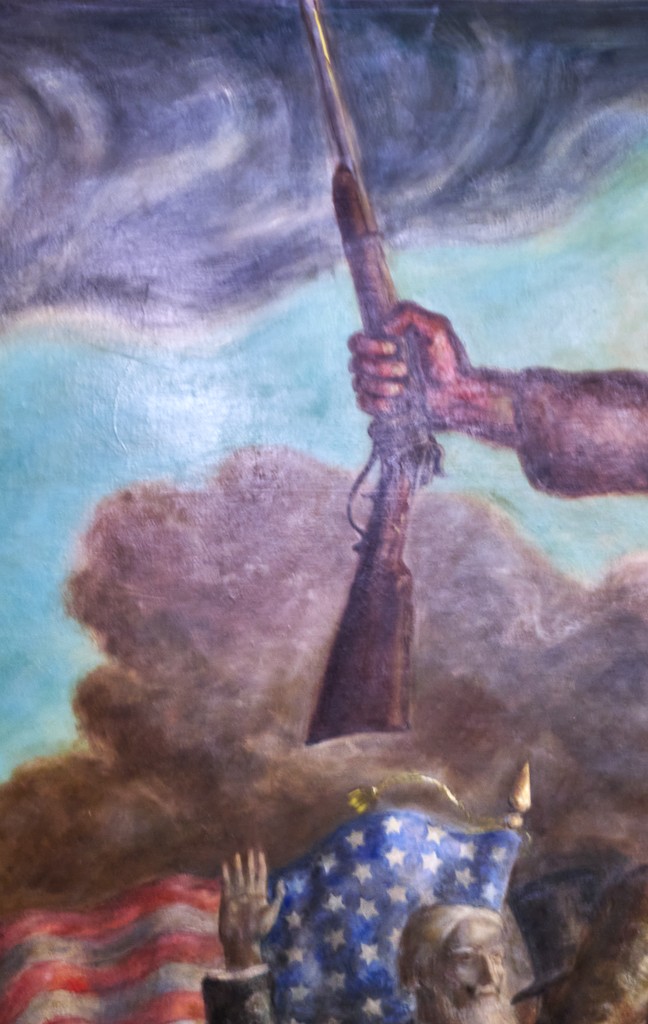
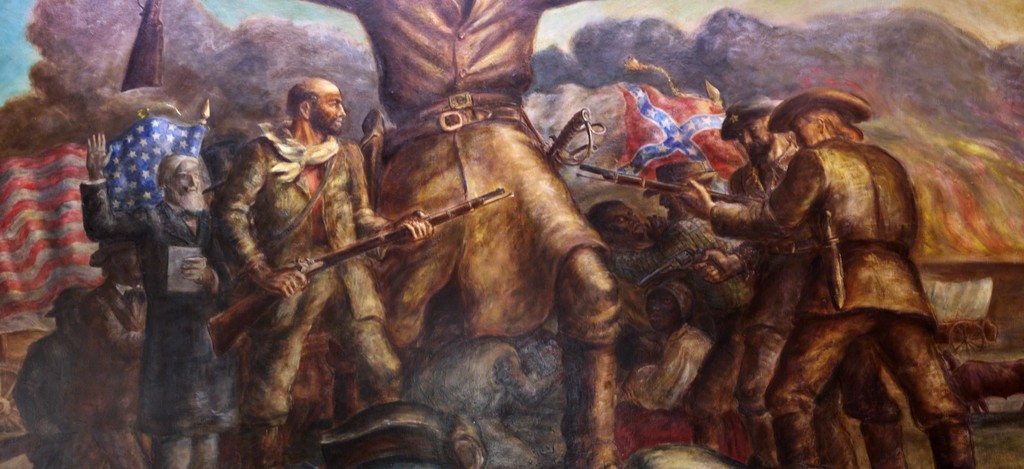
Opposing flags and armed groups
The United States flag and Confederate battle flag identify opposed groups around Brown. Weapons and overlapping bodies compress the conflict beneath his outstretched arms.
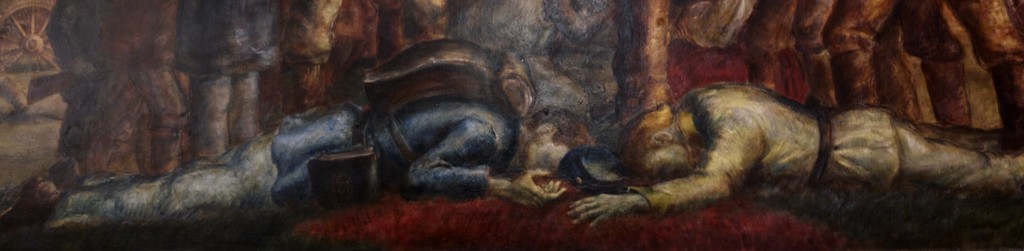
Fallen bodies across the foreground
The low, horizontal bodies interrupt the upright figures and weapons above. Their position close to the bottom edge gives the scene’s violence an immediate human cost.
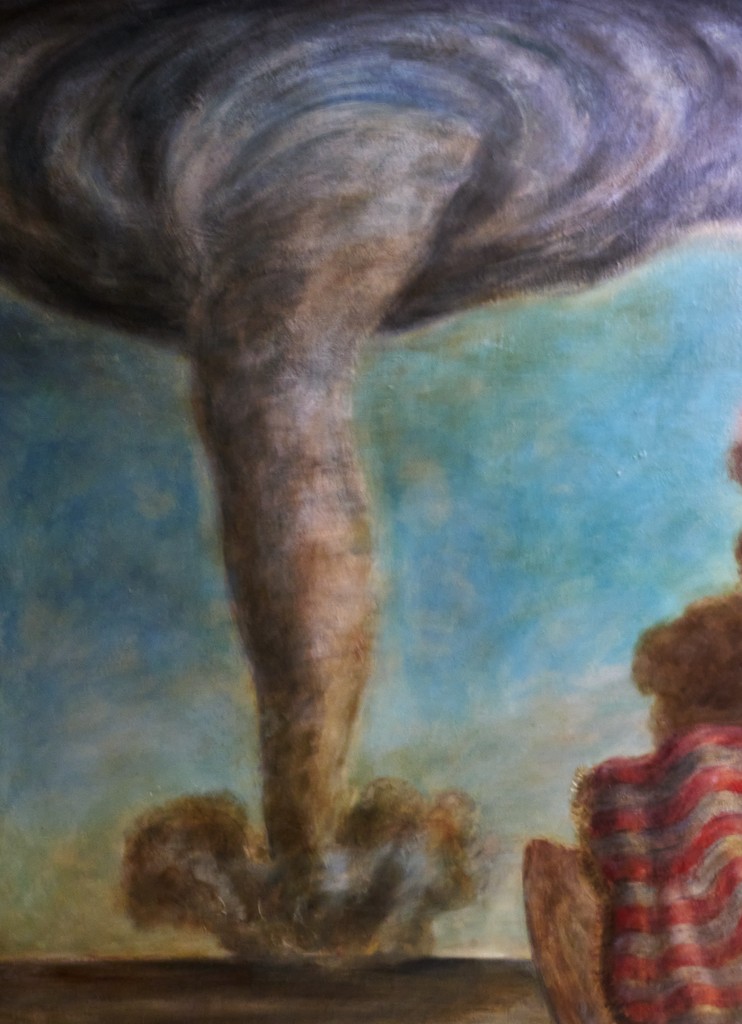
The tornado at the left
The funnel twists down from the dark cloud beside the central confrontation. Its narrowing shape adds a moving natural force to a scene already filled with human conflict.
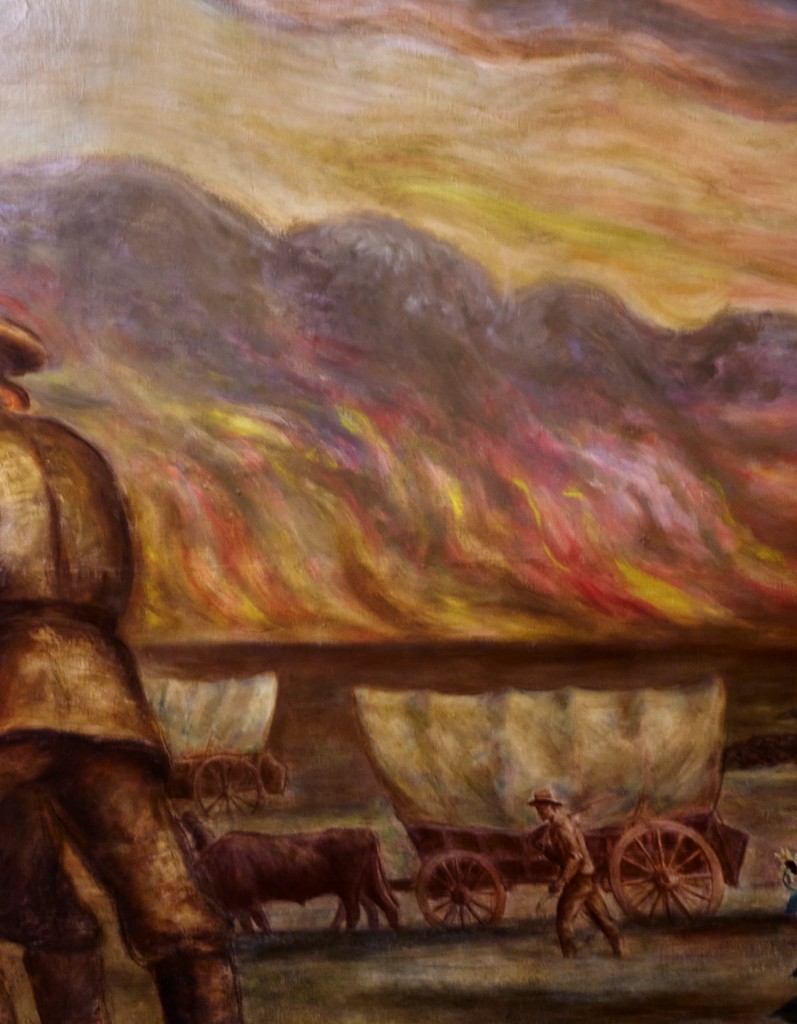
Fire and covered wagons
A band of fire and smoke rises above the covered wagons at the right. Small travelling figures and vehicles extend the mural’s story beyond the central armed encounter.
Arms, book and rifle
Brown holds an open Bible in his left hand, at the viewer’s right, and an upright rifle in his right. The two objects occupy opposite ends of his reach. Their separation gives them unusual clarity: one belongs to religious conviction and the other to armed force, while Brown’s body joins them across the centre.
The rifle’s vertical line leads upward beyond his hand toward the cloud. The book presents its pages outward, allowing its lighter surface to stand against the sky. Neither object is being used in an ordinary action. Brown is not aiming at a particular opponent or reading privately. The display turns both into public declarations.
Curator Kate Meyer’s account for the Spencer Museum describes the pose as cruciform and identifies the weapon with the rifles known as “Beecher’s Bibles.” The comparison helps explain the religious charge of the image without making Brown a straightforward representation of Christ. He stands among combatants with a weapon in hand; the bodily resemblance creates an association rather than resolving the moral questions around him. [11]
The open arms also establish a difficult relationship between conviction and responsibility. They can be read as a gesture of proclamation, but they leave the body exposed. Beneath them, smaller figures continue to confront each other. The image gives religious purpose an immense visual presence while surrounding it with the consequences of violence.
The Kansas history behind the figure
Brown’s antislavery activity in Kansas preceded the Civil War. He arrived in the territory in 1855, where conflict over slavery had already drawn settlers and armed supporters into confrontation. In May 1856, following the attack on Lawrence, Brown and his followers killed five proslavery men in the Pottawatomie massacre. His opposition to slavery and his use of lethal violence both belong to the history Curry compresses into the mural. [12]
Brown later attempted to seize the federal arsenal at Harpers Ferry in October 1859. The raid failed; he was captured, tried and executed on 2 December. The National Park Service’s account also identifies Black participants, including Dangerfield Newby and Shields Green. Their presence matters when looking at a work whose scale makes the white abolitionist appear to contain the entire struggle against slavery. [13]
Tragic Prelude does not illustrate one of those episodes as a self-contained event. Brown had died before the Civil War began in 1861, yet he stands among figures associated with that later conflict. The picture brings different moments together to make an argument about their relationship. Its historical sequence is symbolic, not a record of who could have stood together on a particular day.
That distinction also limits what the central figure can explain. The struggle against slavery included enslaved people’s resistance, escape, organizing and participation in armed action. Brown’s exaggerated size makes his role unforgettable, but it cannot serve as a complete history of emancipation. Looking at the mural critically means recognizing the strength of its chosen image and the much wider history outside it.
The dates of the painting introduce a further distance. Curry was looking back at the nineteenth century from the late 1930s, constructing a remembered past for a twentieth-century audience. The mural is evidence of how that past could be represented in his own period, as well as an interpretation of the events themselves. Its compressed chronology and enormous central figure announce that act of selection rather than conceal it behind the appearance of an eyewitness scene.
Opposing figures, flags and the human cost
Below Brown’s arms, armed men face inward from opposite sides. The United States flag and the Confederate battle flag identify the national division within the larger scene. The men’s lower positions and the directions of their weapons draw attention toward the area around Brown’s legs, where the confrontation becomes most compressed.
The composition is balanced without being calm. A standing man at the left turns toward the centre; another at the right presents a broad back and shoulder. Between these larger figures, faces, hands and gun barrels overlap. The space is tight enough to make individual movement difficult to disentangle. Curry uses that crowding to give the conflict pressure.
At the bottom, two fallen men extend across the foreground. Their horizontal bodies interrupt the upward energy of Brown’s stance. One wears blue, while the other’s lighter clothing catches the eye beside the dark earth and blood-red ground. Hats and weapons join the figures at the lower edge, bringing the effects of combat into the viewer’s immediate field.
An artist’s description reproduced by the Spencer Museum through M. Sue Kendall’s study identifies the opposing forces and interprets the dead figures as symbols of the war’s losses. It also connects the storm and fire with the coming destruction. This account supports a reading of the picture as historical allegory rather than a literal battlefield scene. [14]
The matching presence of death on both sides establishes a shared human cost. It does not erase the difference between defending slavery and resisting it. That distinction is essential to the scene’s subject: the mural’s visual arrangement brings opposing bodies into relation, while the institution of slavery remains the cause around which the historical conflict developed.
Tornado, fire and the wider landscape
The tornado at the left and the prairie fire at the right give the sky and ground their own forms of violence. The funnel narrows as it reaches downward, while the flames travel across a much broader horizontal band. Their shapes differ, but both make the landscape appear unstable around the human confrontation.
The Kansas Historical Society interprets these features as signs of the approaching Civil War. The weather is therefore more than a regional identifier. It supplies a second language for the same historical subject: gathering force in the sky, spreading destruction on the ground, and people placed between them. [8]
The analogy gives historical conflict an elemental scale, but it also has a limit. A tornado cannot make a political decision; the men carrying weapons can. The mural places both kinds of force within the same landscape, inviting the viewer to feel their combined pressure. It should not lead to treating slavery or war as unavoidable weather. The human figures, their competing emblems and the consequences visible in the foreground keep questions of action and responsibility within the picture.
Covered wagons pass behind the central group. Their small wheels, pale covers and accompanying animals establish a scale far removed from Brown’s gigantic body. They suggest continued movement through a landscape already threatened by disaster. The mural can hold migration and conflict together because it does not ask all its figures to occupy one naturalistic moment.
The wagons also make the space beyond the armed men feel inhabited. This is not an empty backdrop provided for a heroic portrait. People travel, animals pull loads, and a route continues across the picture. The distant activity makes the confrontation part of a larger account of land and settlement, even where the painting leaves individual travellers unnamed.
Weather had already carried narrative force in Curry’s 1929 Tornado Over Kansas . There a family responds to a threatening funnel by moving toward shelter. The comparison reveals a change of scale and purpose: an immediate household emergency becomes, in Tragic Prelude , an image through which national violence can be imagined. The two works share an interest in human vulnerability, but the mural gives the storm a specifically historical function. [4]
A mural that turns onto another wall
The famous Brown composition is only one part of Tragic Prelude . The work continues onto the east wall, where Coronado, the Franciscan friar Juan de Padilla and a frontiersman place European exploration and the frontier before the territorial struggle. The change of wall matters because it makes the history unfold through an actual interior rather than within one easily reproduced rectangle. [8]
In photographs restricted to the north wall, Brown can appear to be the beginning and end of the work. In the Capitol, the adjoining figures extend the chronology. The frontiersman and the slain buffalo connect the larger narrative with hunting and occupation of the plains. Looking toward the corner restores relationships that a detached reproduction can conceal.
Chuck Kennedy’s 2012 photograph provides a useful view of that setting. Governor Sam Brownback and Education Secretary Arne Duncan stand beneath the mural; the corner, hanging lamp, marble facing and archway remain visible. The photograph shows the difference between a painted image reproduced on its own and a work encountered among the fittings and circulation spaces of a public building. [15]
The lamp partly intervenes in the view, and the adjoining wall recedes at an angle. These are ordinary conditions of encountering the painting. They make clear that the viewer moves, adjusts position and looks across architecture. No single frontal photograph can reproduce every relationship in the wrapped composition at once.
Carol M. Highsmith’s photograph of 5 April 2021, preserved by the Library of Congress, offers a much closer view of the north-wall composition. It makes the relationships among Brown, the armed groups and the landscape easier to follow. Seen beside the wider interior photograph, it also clarifies the limits of a detached view: greater access to the painted details comes with less information about the corner and the surrounding room. The two photographs answer different questions about the same work. [16]
The earlier figures also change the questions the mural raises. The Spencer Museum’s Displacement interpretation explicitly describes colonial exploration and conquest as violent. That perspective draws attention to the people whose land is being traversed and claimed. A history that opens with European arrivals cannot be treated as the beginning of the land’s human history. [14]
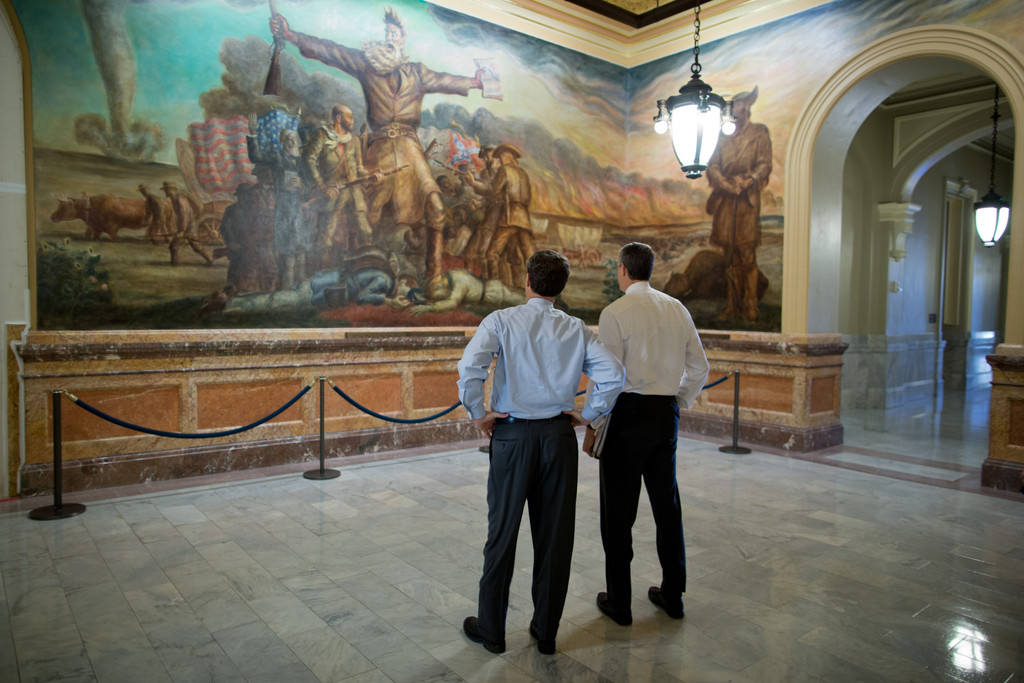
Sam Brownback and Arne Duncan viewing Tragic Prelude at the Kansas State Capitol, 18 September 2012. Photograph by Chuck Kennedy. This installation view includes people and architectural surroundings.
Image source
.
CC BY 2.0
. Proportionally resized; original appearance retained.
Watch: John Steuart Curry
Choose a film to explore the artist’s work, its interpretation and its wider setting.
Look at This: John Steuart Curry at MOWA
An exhibition interview with Graeme Reid considers Curry’s work and life in Wisconsin.
Watch on YouTubeStudies for a public composition
Curry developed the Capitol programme through preparatory works in different media and formats. The Spencer Museum holds an oil-on-canvas sketch for Tragic Prelude I (John Brown) dated 1937. At 67.3 by 122 centimetres, it is a horizontal painting, separate from the larger vertical study now at the Met. Its identity establishes an early stage of work on the subject without making every surviving Brown image interchangeable. [14]
The Spencer also owns sketch for Tragic Prelude I and II , catalogued to about 1938–39. This is a chalk-and-ink drawing on paper, measuring 35.1 by 48 centimetres, given by Jay and Susan Gates. The change of medium matters: a paper study has its own material identity, even when it belongs to the same developing mural project. [11]
The Kansas Historical Society’s account of the commission describes small crayon studies for the State Capitol as well. Together, the surviving records show that the mural was worked out through more than one preparatory object. The finished wall should be understood as the result of sustained decisions about figures, sequence and setting rather than as a single image enlarged without revision. [17]
Scale gives those decisions practical consequences. A figure that occupies part of a sheet must carry across a corridor when translated into the building. The long reach of Brown’s arms, the contrast behind his head and the clear opposition of the groups all contribute to that distant readability. The wall’s broad arrangement remains strong even when a viewer cannot immediately distinguish every smaller face or object.
The 1939 John Brown study
The Metropolitan Museum of Art’s John Brown is a substantial oil painting in its own right. Dated 1939, it measures 175.3 by 114.3 centimetres and entered the museum through the Arthur Hoppock Hearn Fund in 1950, accession 50.94.1. The museum identifies it as a study for the Kansas State Capitol mural. Its acquisition date belongs to the painting’s collection history, not to the completion of Curry’s work in Topeka. [18]
The narrow format produces a different encounter with Brown. His torso fills most of the canvas, while the arms extend out toward the edges. The expression, hair and beard occupy a much larger proportion of the field than they do in the broad mural photograph. The viewer confronts the face and clothing before exploring the reduced landscape behind them.
That concentration makes several devices especially apparent. The hair rises in a sharp crest; the beard sweeps across the coat; and the open mouth forms a dark centre within the illuminated face. The clothing is articulated through folds, buttons and the weight of the belt. These details make the figure feel physically substantial even while the head and surrounding atmosphere push toward exaggeration.
A smaller Black figure appears beside the lower part of Brown’s body. The Met identifies an enslaved man at his side, emphasizing the painting’s antislavery subject. The relationship of scale also invites scrutiny: the person whose freedom is at stake is given much less pictorial space than the abolitionist who dominates the image. [18]
The study and mural therefore reward comparison without being collapsed into one object. The canvas intensifies the encounter with Brown’s person; the wall places him within a broader arrangement of armed men, deaths and migration. A detail of one cannot automatically stand as evidence for everything visible in the other. [19]
The commission’s changing ambitions
The Capitol commission followed a campaign by Kansas newspaper editors to bring Curry’s work to his home state. The Kansas Historical Society names Jack Harris of the Hutchinson News , Paul Jones of the Lyons Daily News and William Allen White of the Emporia Gazette among its supporters. The invitation represented public confidence in an artist whose Kansas subjects had also provoked criticism. [17]
The planned programme was larger than the Brown scene. Tragic Prelude formed an opening historical chapter; proposed rotunda paintings would address homesteading, agriculture and the difficulties of managing the land; Kansas Pastoral would present contemporary rural life. The intended sequence linked conflict, settlement and the cultivated landscape across different parts of the building. [1]
That structure helps explain why the storm and fire belong beside the agricultural imagery elsewhere. Curry’s Kansas was capable of both abundance and destruction. A public building could present those conditions as connected parts of a history rather than select only the most reassuring image of the state.
The setting sharpened the stakes. A painting in a state capitol participates in an official account of community and government. Visitors do not need to agree on its meaning for it to become associated with the place. Curry’s treatment made disagreement particularly likely because the dominant figure embodied conviction, violence and a contested historical reputation at the same time.
The contrast with an ordinary commemorative portrait is substantial. Brown is not presented against a neutral background with the attributes of an office. The landscape around him is active, and the people beside him do not settle into an orderly company. Even the objects in his hands point toward different kinds of authority. The result allows admiration for the force of the figure to coexist with unease about the world the painting places around him.
Completed paintings and an unfinished programme
The main corridor panels were finished in 1940. Curry’s next work depended on making space for the rotunda scenes, which required removing marble panels. Opposition to that alteration became the practical point at which the wider scheme was stopped; the legislature intervened in 1941, and Curry ceased work on the project in summer 1942. These dates describe different stages, not competing completion years for a single portable painting. [1] [2]
The unpainted rotunda matters to the interpretation of the existing walls. The Kansas Historical Society’s unfinished-murals account identifies eight proposed scenes that were never executed. Curry left the paintings unsigned because the programme remained incomplete. The missing signature was connected to the relationship among the parts of the commission, not to a failure to finish painting John Brown’s face or figure. [20]
This distinction also prevents a misleading story about rejection. The completed corridor murals were already in the Capitol during Curry’s lifetime. The dispute curtailed the additional work he intended to do. Their subsequent familiarity should not obscure the fact that he regarded the surviving sections as fragments of a larger conception.
The loss is architectural as well as numerical. Without the connecting scenes, a visitor encounters a sequence with a substantial gap. Brown’s violent opening and the rural abundance elsewhere remain, but the planned middle account of making and maintaining farms does not. The unfinished programme affects how the existing images can be read together.
Criticism, later recognition and competing memories
The Kansas Historical Society records objections to the mural’s colour and menacing effect. Those responses are understandable in relation to its visible choices: a vast, agitated Brown; weapons converging below; exposed dead bodies; and a landscape threatened by fire and tornado. The painting offers a powerful image of Kansas, but not an uncomplicated celebration. [8]
The institutional reception changed over time. According to the Society’s account of the Capitol studies, Kansas Senate Resolution 1809 recognized the legislature’s poor treatment of Curry in 1992. That later recognition did not complete the missing rotunda cycle. It did establish a different official attitude toward the artist and the dispute surrounding his commission. [17]
Other artists’ treatments of Brown help expose the choices within Curry’s version. In its discussion of Jacob Lawrence’s The Legend of John Brown , the Spencer Museum considers a sequence of twenty-two prints, including episodes of Kansas violence and escape from slavery. A series can distribute attention across events in a way that differs from Curry’s enormous central figure. [21]
Neither format supplies an unmediated view of the past. Curry compresses history into a public allegory, while Lawrence’s sequence constructs a story through successive scenes. Comparing them opens questions about who acts, whose suffering is visible and how religious conviction is represented. It also keeps Brown’s image from becoming a substitute for the many people and conflicts that made the history.
Tragic Prelude remains forceful because its composition makes those tensions difficult to ignore. Brown commands the wall, but the bodies below him and the threatened landscape complicate his command. The surrounding building adds another layer: the painting is both an image of historical conflict and the survivor of a conflict over how Kansas should represent itself.
Artworks and versions directory
Browse 84 selected object, version, edition and reproduction records. Several concern related images or different impressions; this is not a complete lifetime catalogue or a count of unique compositions. Search also finds prints, photographs and reproductions; the medium filter groups paintings and drawings.
Frequently Asked Questions
It is in the Kansas State Capitol in Topeka, on the north and east walls of the second-floor east corridor. The familiar John Brown composition occupies the north wall.
He holds an open Bible in his left hand and a rifle in his right. Religious conviction and armed action are brought together through his outstretched pose.
He regarded the larger Capitol programme as unfinished after the proposed rotunda scenes were prevented. The completed corridor paintings remained unsigned.
No. The Met owns a separate 1939 oil-on-canvas study, accession 50.94.1. The Capitol mural and the Spencer Museum’s preparatory works are different objects.
Discussion
Look again at the images and ideas explored in Tragic Prelude by John Steuart Curry. These editorial prompts invite your observations.
Reader Insights
How does Brown’s exaggerated size change your understanding of the people around him?
What changes when the mural is seen within the Capitol rather than as a detached photograph?
How might a sequence of smaller historical scenes tell this story differently from a single monumental figure?
Join the Conversation
Share a detail, comparison or question about Tragic Prelude by John Steuart Curry below.
References
- Kansas Historical Society , Kansas State Capitol: Curry murals; commission and planned sequence. View source
- Kansas Historical Society , Curry murals: online tour introduction; summer 1942 cessation. View source
- Whitney Museum of American Art, John Steuart Curry | Baptism in Kansas | Whitney Museum of American Art. View source
- Muskegon Museum of Art , Tornado Over Kansas, 1929, 1935.4. View source
- National Gallery of Art, Circus Elephants: collection object record. View source
- Saint Louis Art Museum, The Mississippi,1935,7:1937: collection record and provenance. View source
- Smithsonian American Art Museum, Ajax. View source
- Kansas Historical Society , Tragic Prelude: online tour and symbolic interpretation. View source
- Metropolitan Museum of Art, Wisconsin Landscape. View source
- Chazen Museum of Art, Our Good Earth | 1873 |Chazen Museum of Art. View source
- Spencer Museum of Art , sketch for Tragic Prelude I and II, circa 1938–39, 1986.0095; Kate Meyer exhibition label, 2006. View source
- Kansas Historical Society , John Brown: Kansas activity and historical chronology. View source
- National Park Service , John Brown’s Raid: Harpers Ferry, October–December 1859. View source
- Spencer Museum of Art , sketch for Tragic Prelude I (John Brown), 1937, 1957.0059; Displacement interpretation and Curry description reproduced through M. Sue Kendall. View source
- Chuck Kennedy , Brownback and Duncan viewing the Capitol mural, 18 September 2012; photograph via Wikimedia Commons. View source
- Library of Congress , Carol M. Highsmith’s Tragic Prelude photograph, 5 April 2021, LC-DIG-highsm-67050. View source
- Kansas Historical Society , Curry’s Studies for Kansas State Capitol: newspaper campaign, preparatory work and 1992 recognition. View source
- Metropolitan Museum of Art , John Brown, 1939, oil on canvas, 50.94.1. View source
- John Steuart Curry , John Brown, 1939, Met study; research reproduction and object description via Wikimedia Commons. View source
- Kansas Historical Society , Curry murals unfinished: proposed rotunda scenes and unsigned works. View source
- Claire Cox , The Legend of John Brown in Kansas, Spencer Museum of Art, 19 December 2024. View source
- Splash image source.
John Steuart Curry, Tragic Prelude, Kansas State Capitol. North-wall composition photographed by Carol M. Highsmith, 2021, Library of Congress. The mural continues onto an adjoining wall. No known restrictions on publication; underlying mural public domain . Proportionally resized; original appearance retained.
View source
More CURRY Paintings
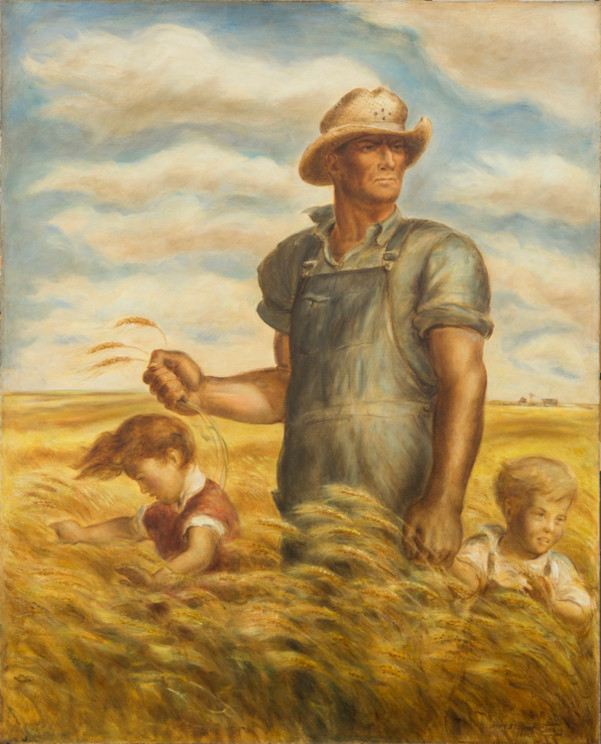
Our Good Earth
1942 painting and its related prints and wartime imagery.
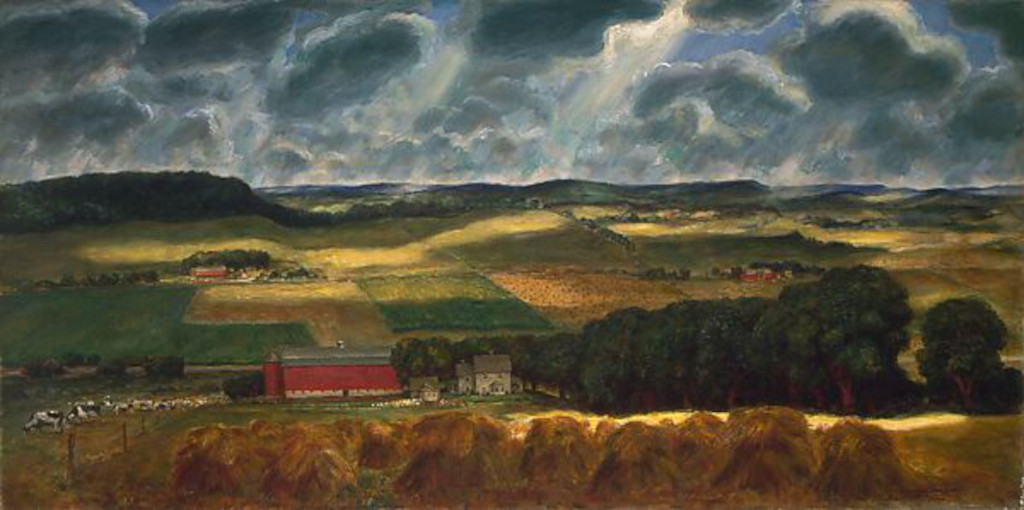
Wisconsin Landscape
1938–39 panorama of working farmland, held by The Met.


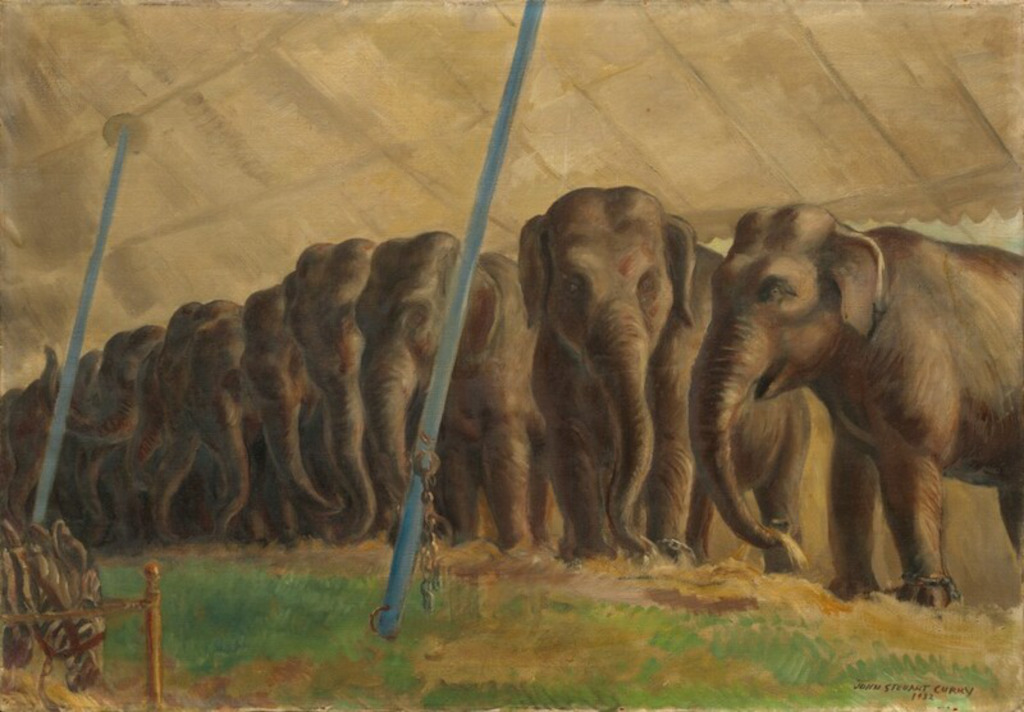
Circus Elephants
1932 painting of elephants, handlers and the work behind the circus.