


 by
Tom Gurney
Tom Gurney BSc (Hons) is an art history expert with over 20 years experience
Email:
tomgurney1@gmail.com
/ Phone:
+44 7429 011000
The Mississippi by John Steuart Curry: Introduction
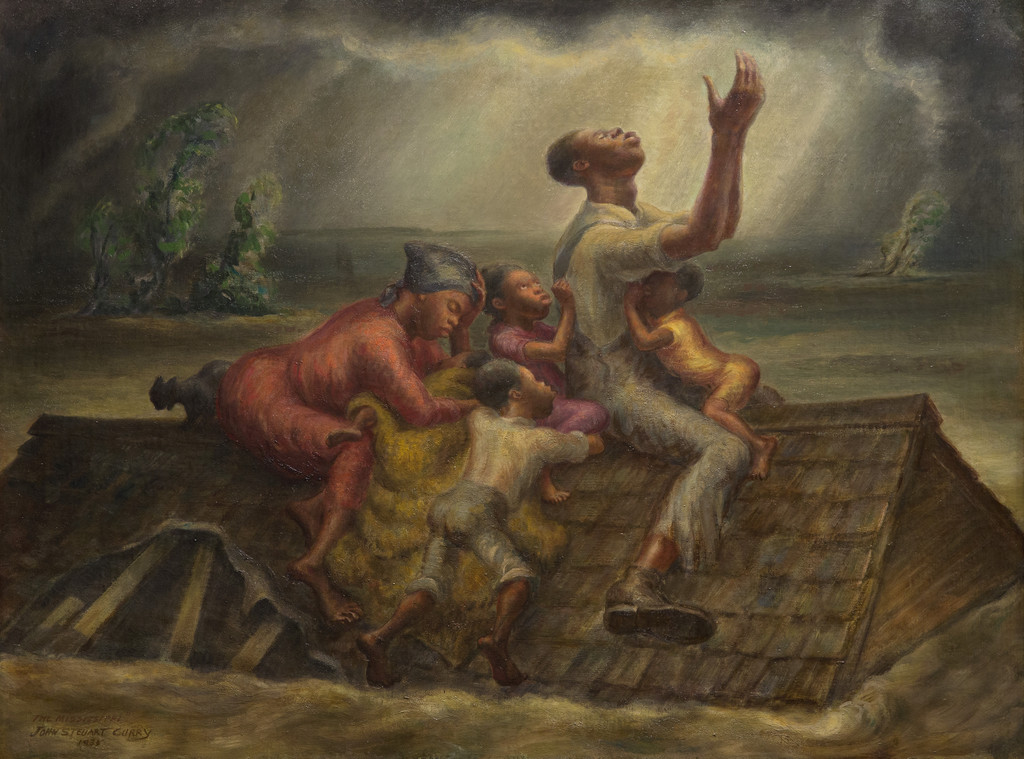
A family gathers on the roof of a house surrounded by muddy floodwater. The father raises his hands towards an opening in the clouds, while the children hold close and the mother rests her head against one hand. In John Steuart Curry's The Mississippi , a familiar domestic structure has become a precarious refuge. The river occupies the space where ordinary life should continue.
The Saint Louis Art Museum dates the painting to 1935 and identifies its medium as tempera on canvas mounted on panel. [1] Its concentration on one endangered household gives a large disaster a human scale. Faces, hands, bare feet and the small cat make the consequences of the flood immediate.
At a Glance
- Artist John Steuart Curry, 1897–1946.
- Title The Mississippi .
- Date 1935.
- Medium Tempera on canvas mounted on panel.
- Dimensions 36 × 48 inches, or 91.4 × 121.9 centimetres.
- Collection Saint Louis Art Museum.
- Credit Museum Purchase.
- Object number 7:1937.
- Related work Mississippi Noah , a separate lithograph.
This work across John Steuart Curry’s career
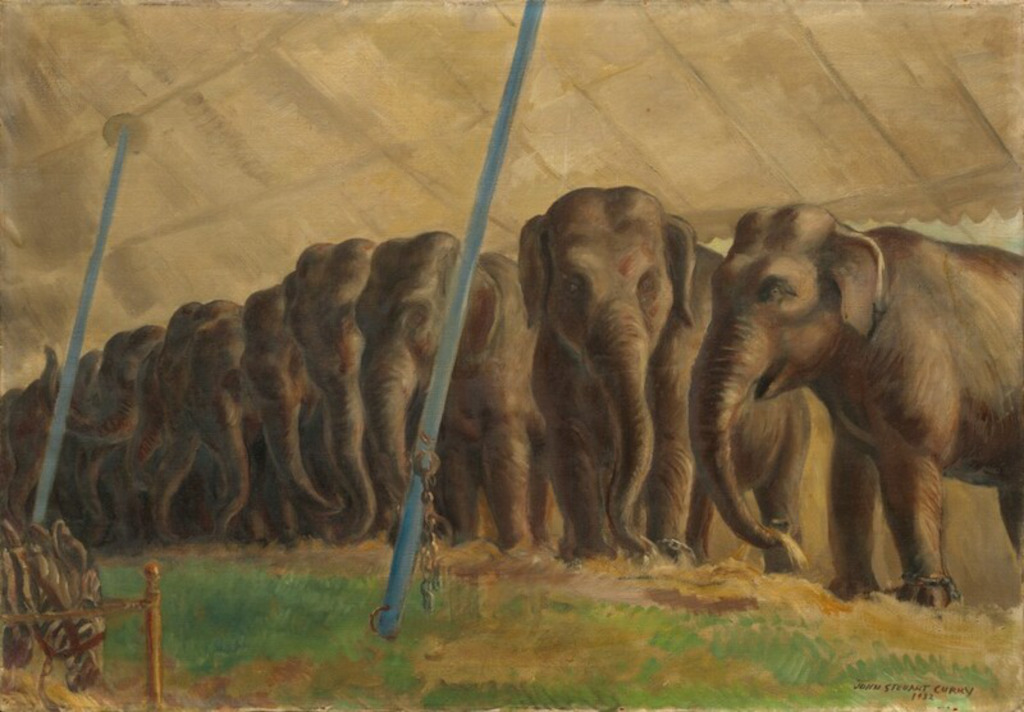
Circus Elephants
1932 paintingThe Mississippi (current article)
1935 paintingAjax
1936–37 oil paintingTragic Prelude
1938–40; project 1937–42Wisconsin Landscape
1938–39Our Good Earth
1942 oil paintingNotes and sources
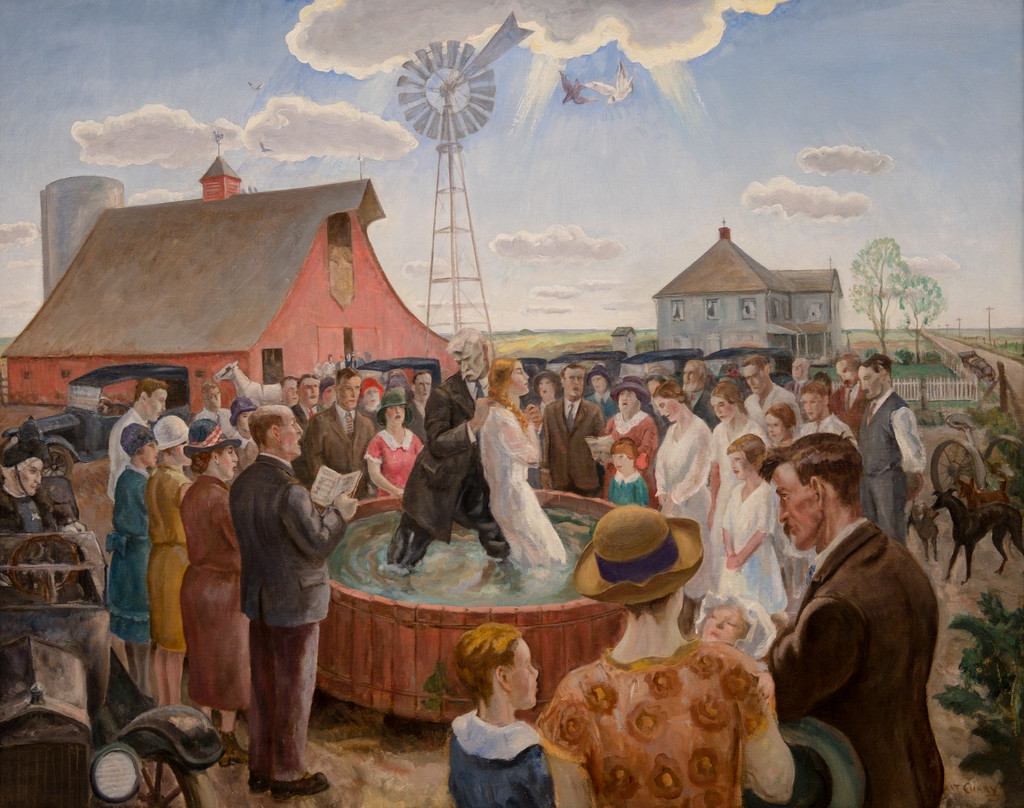
Baptism in Kansas. A remembered Kansas ceremony is staged within a working farmyard. [2]
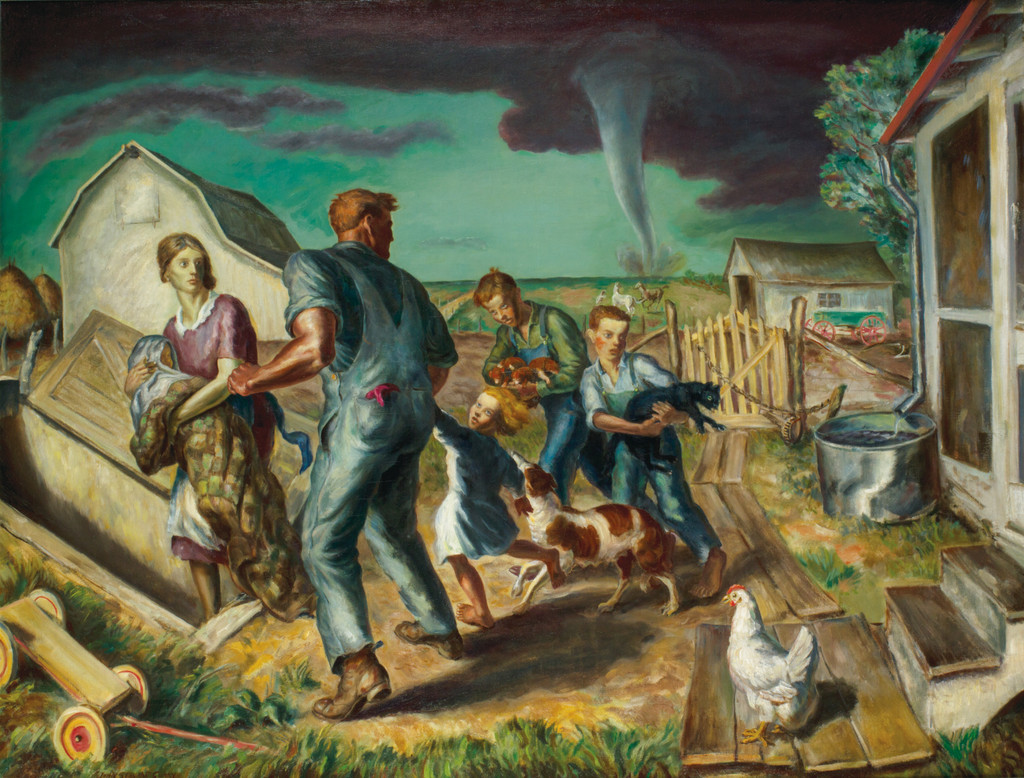
Tornado Over Kansas. A Kansas storm and a family seeking shelter, painted in Curry’s Westport studio. [3]
Circus Elephants. Elephants and handlers occupy the working space beneath a circus tent. [4]
The Mississippi (current article). A family occupies a roof amid floodwater; the painting is tempera on canvas mounted on panel. [1]
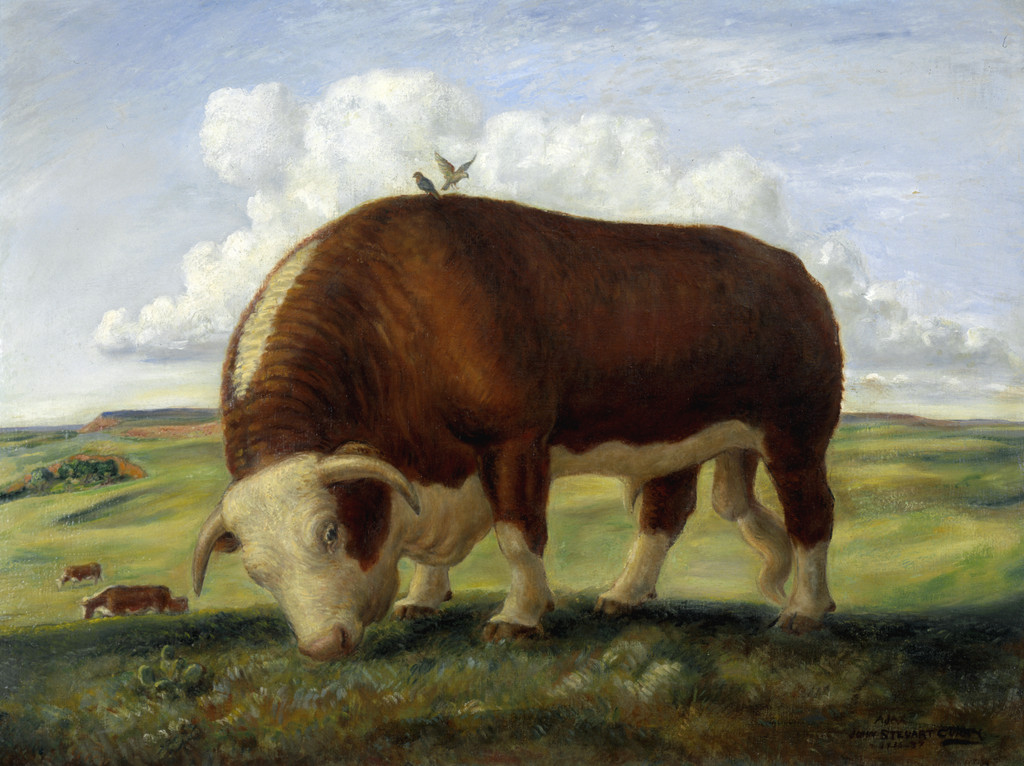
Ajax. The monumental bull in the Smithsonian oil differs from the earlier lithograph. [5]
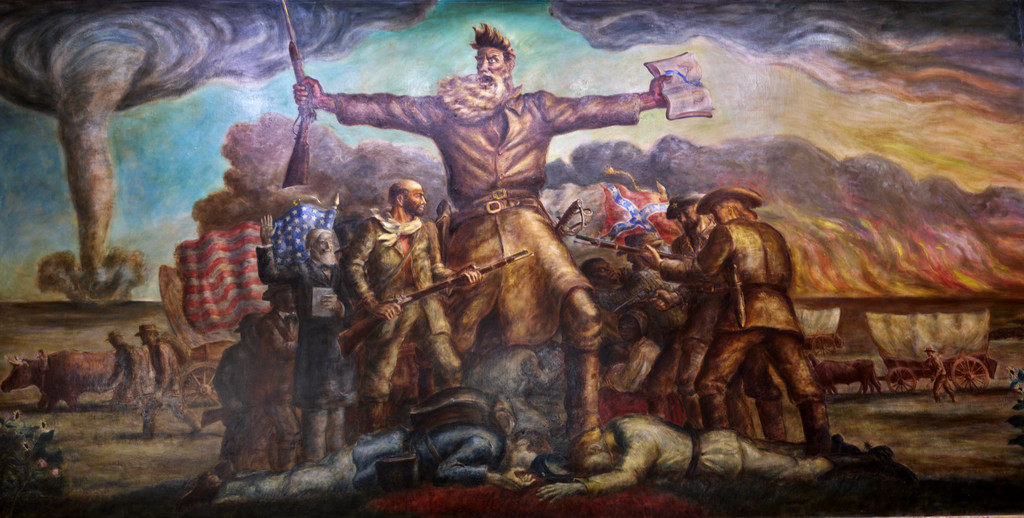
Tragic Prelude. John Brown stands at the centre of a Kansas State Capitol mural continuing across adjoining walls. [6]
Wisconsin Landscape. An extensive farm panorama, distinct from the separately catalogued preparatory study. [7]
Our Good Earth. The Chazen painting is distinct from the watercolour study, lithographs and wartime posters. [8]
Contents
- A family on a roof in floodwater
- The father's raised hands
- Mother, children and the endangered household
- Storm, light and the uncertain distance
- Flood subjects and Mississippi Noah
- The painting and its museum context
- Annotated details
A family on a roof in floodwater
The roof cuts diagonally across the foreground, bringing the family close to the viewer. Its slope remains clearly visible beneath their bodies, with rows of shingles descending towards the water. This is a recognizable part of a house, but its practical meaning has changed. An element intended to shelter the rooms below now supplies the household's last visible place to sit.
Curry keeps the surrounding water in view on several sides. It presses against the roof's lower edges and extends towards the distant trees. There is little space for an alternative route to safety. The composition holds the family together while making their isolation apparent: the roof supports them, yet it cannot restore the stable ground on which a home ordinarily depends.
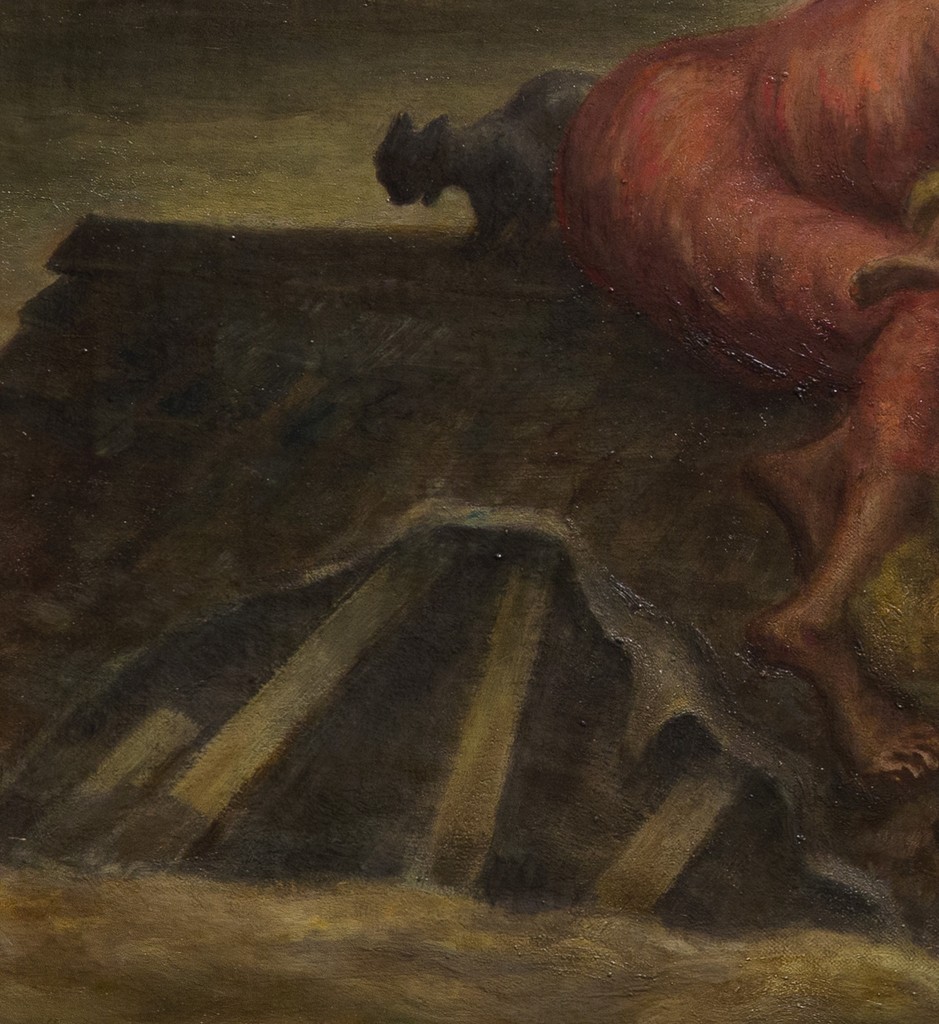
The small black cat crouches behind the mother on the left. Its dark silhouette is easy to overlook beside the larger human figures. Once noticed, it adds another vulnerable life to the group and reinforces the domestic character of the scene. The family has brought part of its household onto the roof, with very little room available for anything beyond survival.
An opening at the lower left exposes slanting timbers, while a dark shoe lies on the shingles near the father's feet. These details interrupt any impression of a smooth, secure platform. They also draw attention downwards, towards the material refuge beneath the family, before the eye follows the father's body upwards again.
Annotated Details from The Mississippi
The numbered points identify visible features discussed in this article. Return from each detail to the whole composition. John Steuart Curry, The Mississippi, 1935, tempera on canvas mounted on panel. Saint Louis Art Museum, 7:1937. Image source. Public domain. Editorial numbers added to the overview; detail crops retain the source image’s appearance.
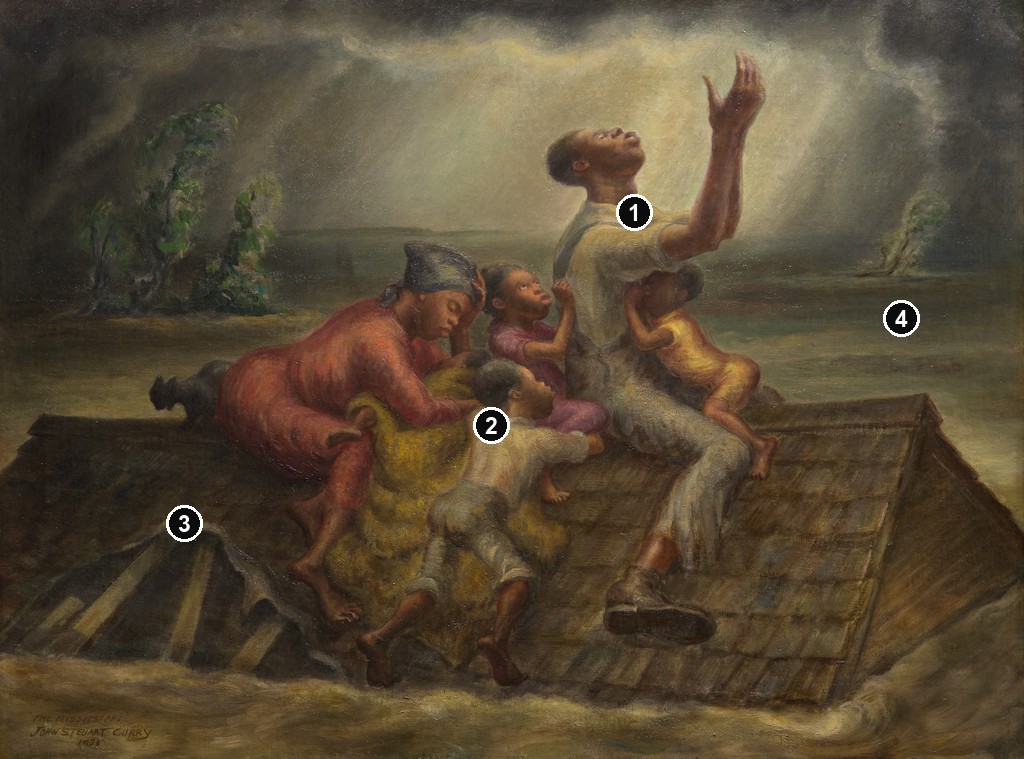
Details from THE MISSISSIPPI
Compare the cropped details with the complete images above. Notice how their colours, shapes and positions contribute to the larger compositions.
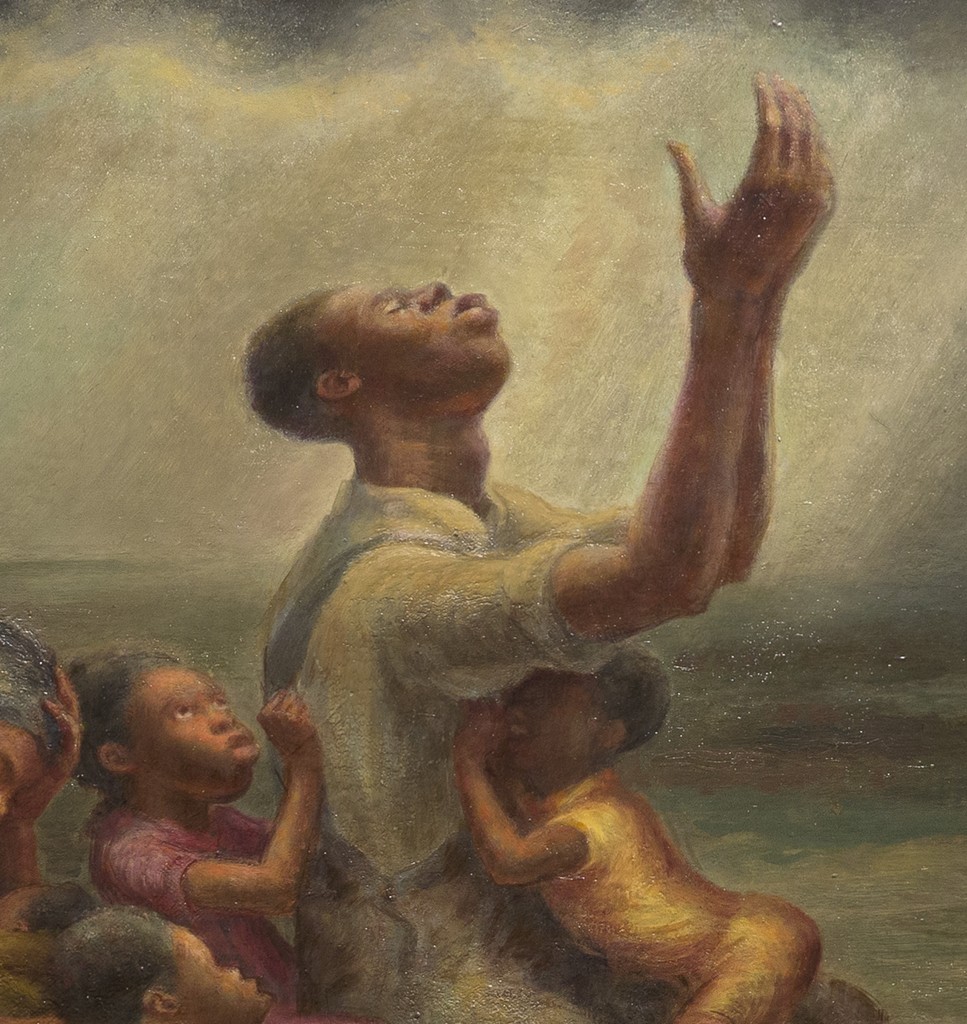
The father’s hands rise towards the light
The lifted hands and tilted face turn attention upwards towards the opening in the clouds. This gesture gives the family’s exposed position a direction beyond the surrounding water.
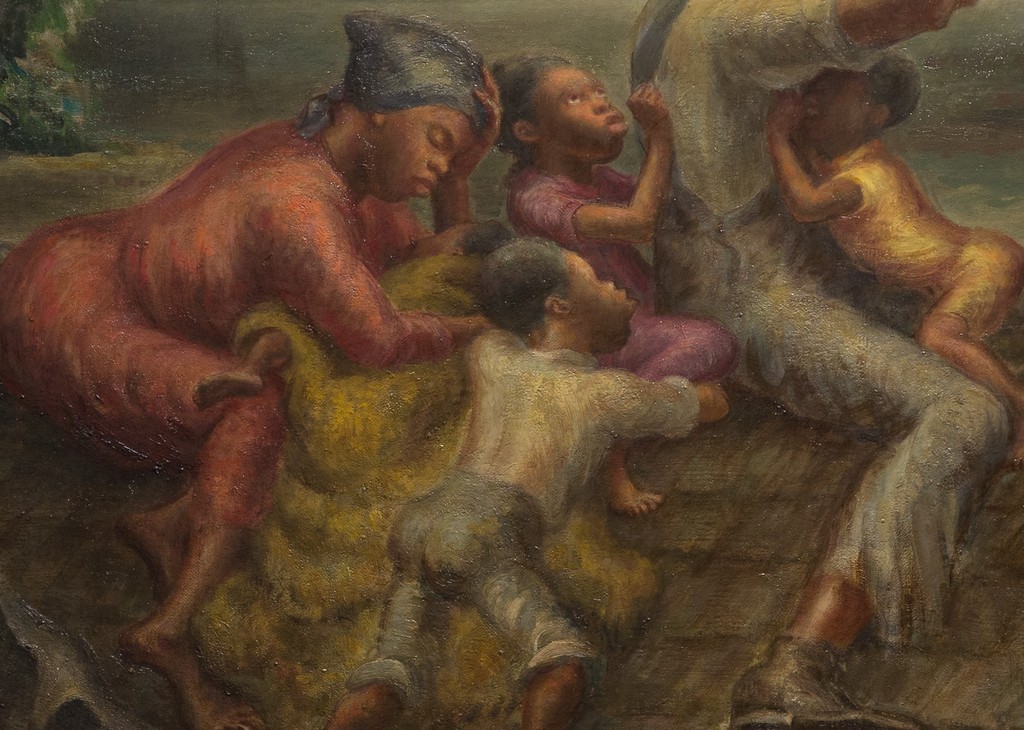
The mother and children cluster together
The mother bends her head while the children draw close to the adults. Their overlapping bodies concentrate the household into a small area on the sloping roof.
A cat beside the broken roof opening
The small black cat and the opening in the roof keep domestic details within the disaster. The house’s structure has become a precarious surface on which the household waits.
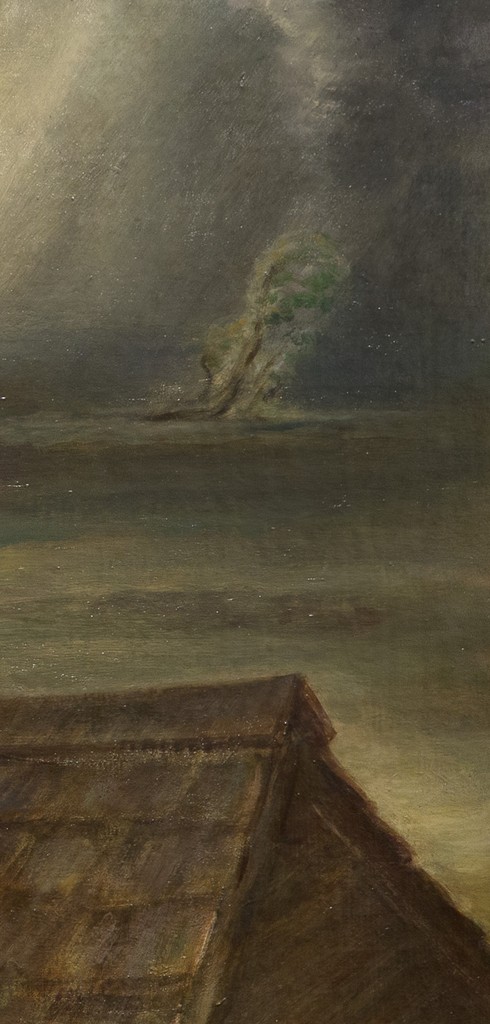
Water and wind-bent trees
The broad water separates the roof from a distant tree, while the dark clouds press down above it. These surrounding spaces make the family’s refuge appear isolated.
The father's raised hands
The father forms the tallest part of the group. His seated body rises through the centre-right of the picture, and his arms extend above the surrounding heads. The gesture creates a strong vertical movement within a scene dominated by the roof's diagonal and the river's broad horizontal reach.
His open hands stand out against a lighter area of sky. The Saint Louis Art Museum interprets them as an appeal for divine aid and reads the break in the clouds as a suggestion of hope. It also connects the subject with the devastating Mississippi flood of 1927. [1]
The gesture remains powerful because the rest of the body still belongs to the immediate crisis. The father sits on the roof, with children pressing against him. His upward appeal does not remove him from their shared danger. Instead, it brings two directions together: attention towards the sky and bodily contact with the family below.
Curry makes those relationships legible without filling the scene with separate actions. The father's head tilts back, the arms rise, and the nearest children turn towards him. Their small hands and his large hands operate at different scales. Together they make touch and gesture central to the picture's emotional force.
Mother, children and the endangered household
The mother's red clothing gives the left side of the family a concentrated warmth. Her bent posture contrasts with the father's upward reach. She leans into the group, with her head supported by one hand and her other arm extending towards the children. The pose can suggest weariness or distress, while also helping gather the figures into one closely connected shape.
Three children occupy the spaces between and beside the adults. One leans across the foreground, another looks upwards from the middle of the group, and the smallest clings to the father's side. Their different positions keep the family from becoming a rigid arrangement. Each body finds a limited place on the roof and a point of contact with another person.
The household is represented as a Black family, placed prominently within the picture rather than reduced to distant figures in a panoramic flood scene. Their vulnerability is clear, but so are the actions that hold them together: clinging, supporting, watching and appealing. A reading concerned only with the spectacle of disaster would miss these relationships.
The close viewpoint also prevents the viewer from surveying the flood entirely from a detached position. We encounter particular bodies before we can take in the wider landscape. The river's reach becomes understandable through its effect on this small occupied roof, where an ordinary family's domestic space has narrowed to a few precarious surfaces.
Storm, light and the uncertain distance
Dark clouds gather at the upper corners, with a brighter opening behind the father. Bent trees on either side suggest the force of the weather. Their separation leaves the central family exposed, with little surrounding structure to provide shelter or a clear destination.
The palette links the muddy water, weathered roof and troubled sky through browns and greys. Against them, the mother's red dress and the children's warmer colours help keep the group distinct. The picture's light is therefore both a compositional device and a possible source of meaning. It directs attention to the raised hands while the dark water keeps the danger visible.
Nothing in the depicted scene completes a rescue. There is no clearly approaching boat or firm landing place that resolves the family's situation. Hope, as the museum reads it, remains a possibility within the image. The painting asks the viewer to stay with that suspended moment, when the family has found temporary support but its future remains open.
Watch: John Steuart Curry
Choose a film to explore the artist’s work, its interpretation and its wider setting.
Look at This: John Steuart Curry at MOWA
An exhibition interview with Graeme Reid considers Curry’s work and life in Wisconsin.
Watch on YouTubeFlood subjects and Mississippi Noah
Curry also treated this rooftop subject in lithography. The Whitney Museum of American Art owns Mississippi Noah , dated 1934, accession 34.42. Its record identifies an edition of 35, an image measuring 25.1 by 35.1 centimetres and a larger sheet measuring 34.4 by 47.5 centimetres. Those measurements and the lithographic medium belong to the print. [9]
Jeffrey Richmond-Moll identifies a 1932 Mississippi Noah at the Figge Art Museum as an antecedent to the painting. [10] The differing institutional dates should be retained with their records, rather than making every impression conform to one year. The Saint Louis painting remains a separate 1935 work, with its own materials and collection history.
The print's title invites comparison with the biblical flood and Noah's household. That association adds a religious dimension to a subject rooted in a modern disaster. The roof can suggest a provisional vessel carrying a family through dangerous water, while the father's appeal gives the scene an explicitly devotional direction. These associations help explain the title's resonance without establishing that the painting illustrates a particular passage of scripture.
The relationship also shows why a print should not be treated simply as a later photograph of a painting. Here, the published scholarship places a lithographic treatment before the finished Saint Louis work. Curry returned to the subject across different objects, allowing the rooftop family to circulate through both painting and print.
Painted eight years after the 1927 disaster, the 1935 work returns to the flood as a subject of sustained reflection. Its date alone does not establish when Curry first conceived the composition or whether he met people who might have inspired the depicted family.
The painting and its museum context
The Saint Louis Art Museum purchased The Mississippi from Walker Art Galleries in 1937. Its collection record cites a January 1937 invoice and museum minutes. [1] This provenance distinguishes the painting's early museum history from the separate ownership of individual lithographs.
The painting later featured in Muskegon's John Steuart Curry: Weathering the Storm , scheduled for 23 May–2 September 2024. The museum's journal names The Mississippi among the works and Saint Louis among the lenders; the exhibition was organized with art historian Patricia Junker. [11]
Seen beside Tornado Over Kansas , the painting offers another view of a family confronting destructive weather. The Kansas family moves towards a cellar; the rooftop family already occupies a fragile refuge. In each, Curry makes the relationship between people, animals and domestic space central to the drama. The Mississippi sustains that drama through the contrast between the father's upward gesture and the unstable water beneath the household.
Artworks and versions directory
Browse 84 selected object, version, edition and reproduction records. Several concern related images or different impressions; this is not a complete lifetime catalogue or a count of unique compositions. Search also finds prints, photographs and reproductions; the medium filter groups paintings and drawings.
Frequently Asked Questions
The Saint Louis Art Museum dates the painting to 1935.
The museum identifies tempera on canvas mounted on panel, rather than oil on canvas.
The museum connects the subject with the Mississippi flood of 1927. Its record does not identify the depicted family by name.
No. Mississippi Noah is a related lithograph. The Whitney's impression has accession 34.42; the Saint Louis painting is 7:1937.
Discussion
Look again at the images and ideas explored in The Mississippi by John Steuart Curry. These editorial prompts invite your observations.
Reader Insights
How does the father's upward gesture change your reading of the family's physical situation?
Which small domestic detail makes the disaster most immediate to you?
Does the opening in the clouds offer reassurance, or make the family's uncertainty more apparent?
Join the Conversation
Share a detail, comparison or question about The Mississippi by John Steuart Curry below.
References
- Saint Louis Art Museum , The Mississippi, 1935, tempera on canvas mounted on panel, 7:1937: object record, interpretation and provenance. View source
- Whitney Museum of American Art, John Steuart Curry | Baptism in Kansas | Whitney Museum of American Art. View source
- Muskegon Museum of Art, Tornado Over Kansas - Muskegon Museum of Art. View source
- National Gallery of Art, Circus Elephants: collection object record. View source
- Smithsonian American Art Museum, Ajax. View source
- Kansas Historical Society, Kansas State Capitol - Online tour - Tragic Prelude - Kansas Historical Society. View source
- Metropolitan Museum of Art, Wisconsin Landscape. View source
- Chazen Museum of Art, Our Good Earth | 1873 |Chazen Museum of Art. View source
- Whitney Museum of American Art , Mississippi Noah, 1934, lithograph, 34.42. View source
- Jeffrey Richmond-Moll , Holy Rollers: Religion and Modern Mobility in the Art of John Steuart Curry, Panorama 9, no. 2, Fall 2023, note 5. View source
- Muskegon Museum of Art , Summer 2024 Journal, physical page 4: John Steuart Curry: Weathering the Storm. View source
- Splash image source.
John Steuart Curry, The Mississippi, 1935, tempera on canvas mounted on panel. Saint Louis Art Museum, 7:1937. Public domain . Proportionally resized; original appearance retained.
View source
More CURRY Paintings
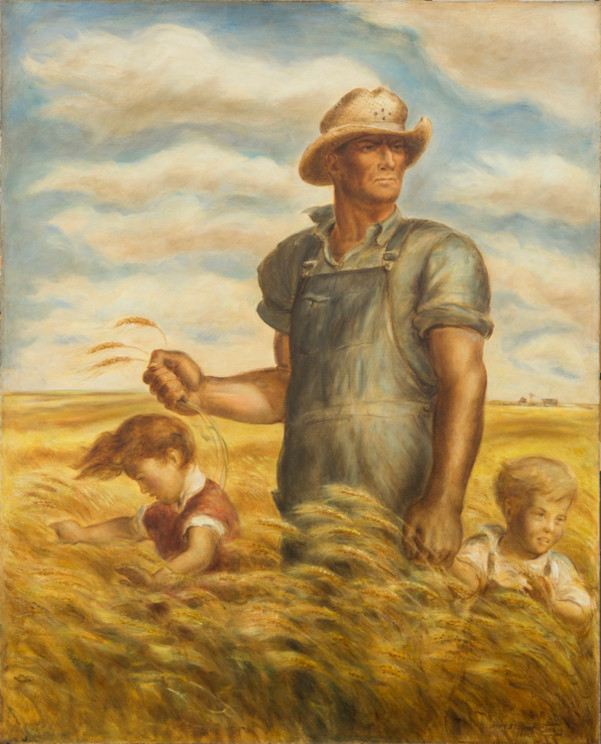
Our Good Earth
1942 painting and its related prints and wartime imagery.
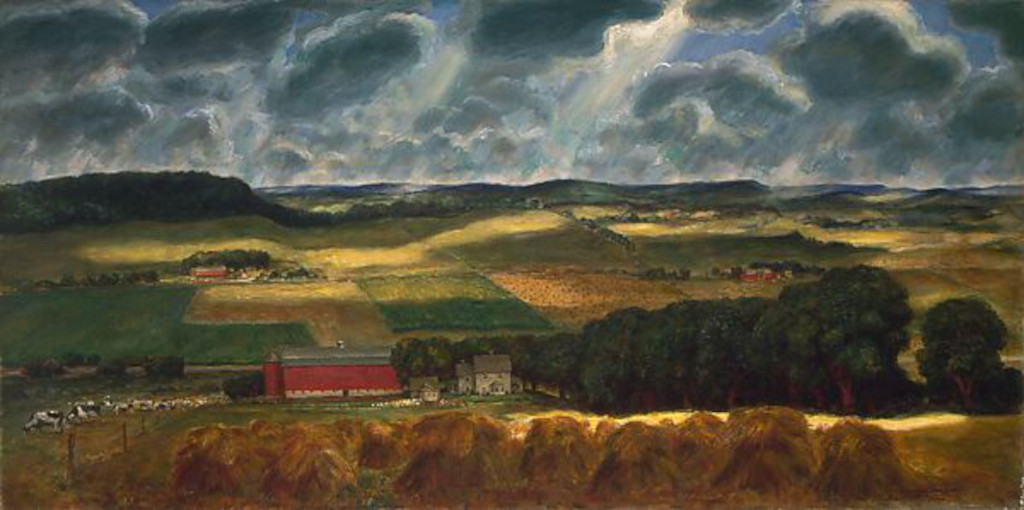
Wisconsin Landscape
1938–39 panorama of working farmland, held by The Met.


Circus Elephants
1932 painting of elephants, handlers and the work behind the circus.